Photonic Crystal Reactors: Coating Impacts on Durability
SEP 25, 202510 MIN READ
Generate Your Research Report Instantly with AI Agent
Patsnap Eureka helps you evaluate technical feasibility & market potential.
Photonic Crystal Reactor Development History and Objectives
Photonic crystal reactors emerged in the late 1990s as a revolutionary approach to enhance photocatalytic processes through precise light manipulation. These specialized structures evolved from fundamental research in photonic crystals, first theoretically proposed by Eli Yablonovitch and Sajeev John in 1987. The initial development focused primarily on understanding how periodic dielectric structures could create photonic band gaps that control light propagation and interaction with materials.
By the early 2000s, researchers began exploring the application of photonic crystal principles to photocatalytic reactors, recognizing their potential to significantly improve reaction efficiency through enhanced light absorption and scattering. The first experimental photonic crystal reactors utilized simple structures with one-dimensional periodicity, primarily focusing on proof-of-concept demonstrations rather than durability considerations.
A significant milestone occurred around 2005-2008 when researchers at MIT and the University of Toronto independently developed three-dimensional photonic crystal reactors that demonstrated substantial improvements in photocatalytic efficiency. These early designs, however, encountered significant durability challenges, particularly regarding coating stability under continuous operation and exposure to reactive chemical environments.
The period from 2010 to 2015 marked a transition toward addressing durability concerns, with research increasingly focusing on coating technologies that could withstand harsh operational conditions while maintaining photonic properties. This era saw the introduction of various protective coating strategies, including atomic layer deposition techniques and composite coating structures designed to balance optical performance with chemical resistance.
Current development objectives center on creating photonic crystal reactors with extended operational lifetimes exceeding 10,000 hours without significant performance degradation. This requires coatings that can withstand thermal cycling, chemical attack, and mechanical stress while preserving the precise nanoscale structures essential for photonic functionality. Researchers aim to develop self-healing coating technologies that can repair minor damage during operation, potentially extending reactor lifespans significantly.
Another key objective involves developing scalable manufacturing processes that can produce durable photonic crystal reactors at commercially viable costs. This includes exploring new coating materials and deposition techniques that can be implemented in industrial settings while maintaining nanoscale precision and uniformity across large reactor surfaces.
The ultimate goal for next-generation photonic crystal reactors is to achieve both exceptional performance and outstanding durability, enabling their widespread adoption in industrial photocatalysis, solar fuel production, and environmental remediation applications. This requires interdisciplinary collaboration between materials scientists, chemical engineers, and photonics experts to overcome the complex challenges at the intersection of these fields.
By the early 2000s, researchers began exploring the application of photonic crystal principles to photocatalytic reactors, recognizing their potential to significantly improve reaction efficiency through enhanced light absorption and scattering. The first experimental photonic crystal reactors utilized simple structures with one-dimensional periodicity, primarily focusing on proof-of-concept demonstrations rather than durability considerations.
A significant milestone occurred around 2005-2008 when researchers at MIT and the University of Toronto independently developed three-dimensional photonic crystal reactors that demonstrated substantial improvements in photocatalytic efficiency. These early designs, however, encountered significant durability challenges, particularly regarding coating stability under continuous operation and exposure to reactive chemical environments.
The period from 2010 to 2015 marked a transition toward addressing durability concerns, with research increasingly focusing on coating technologies that could withstand harsh operational conditions while maintaining photonic properties. This era saw the introduction of various protective coating strategies, including atomic layer deposition techniques and composite coating structures designed to balance optical performance with chemical resistance.
Current development objectives center on creating photonic crystal reactors with extended operational lifetimes exceeding 10,000 hours without significant performance degradation. This requires coatings that can withstand thermal cycling, chemical attack, and mechanical stress while preserving the precise nanoscale structures essential for photonic functionality. Researchers aim to develop self-healing coating technologies that can repair minor damage during operation, potentially extending reactor lifespans significantly.
Another key objective involves developing scalable manufacturing processes that can produce durable photonic crystal reactors at commercially viable costs. This includes exploring new coating materials and deposition techniques that can be implemented in industrial settings while maintaining nanoscale precision and uniformity across large reactor surfaces.
The ultimate goal for next-generation photonic crystal reactors is to achieve both exceptional performance and outstanding durability, enabling their widespread adoption in industrial photocatalysis, solar fuel production, and environmental remediation applications. This requires interdisciplinary collaboration between materials scientists, chemical engineers, and photonics experts to overcome the complex challenges at the intersection of these fields.
Market Applications and Demand Analysis for Photonic Crystal Reactors
Photonic crystal reactors represent a significant advancement in photocatalytic technology, with applications spanning multiple industries. The global market for these advanced reactors is experiencing robust growth, driven primarily by increasing environmental regulations and the push for sustainable industrial processes. Current market analysis indicates strong demand in water treatment applications, where photonic crystal reactors offer superior performance in removing persistent organic pollutants and pharmaceutical residues compared to conventional treatment methods.
The energy sector presents another substantial market opportunity, particularly in solar fuel production and CO2 conversion processes. As governments worldwide implement stricter carbon emission policies, industries are increasingly investing in technologies that can efficiently convert greenhouse gases into valuable products. Photonic crystal reactors, with their enhanced light-harvesting capabilities, are positioned as a promising solution in this domain, with projected market growth exceeding traditional photocatalytic systems.
Chemical manufacturing represents the third largest application segment, where precise reaction control and improved yields offered by photonic crystal technology translate directly to cost savings and reduced environmental impact. Specialty chemical producers have demonstrated particular interest in these systems for high-value product synthesis, citing the ability to conduct reactions under milder conditions as a key advantage.
Regionally, North America and Europe currently lead in adoption rates, primarily due to stringent environmental regulations and substantial research funding. However, the Asia-Pacific region is expected to witness the fastest growth, driven by rapid industrialization in China and India coupled with increasing environmental concerns. Japan continues to be a technology leader in this space, with several major chemical companies actively developing proprietary coating technologies to enhance reactor durability.
The healthcare and pharmaceutical sectors represent emerging markets with significant potential, particularly for photodynamic therapy applications and controlled drug synthesis. Early clinical trials utilizing photonic crystal reactors for targeted cancer treatments have shown promising results, potentially opening a high-value market segment.
A critical factor influencing market penetration is the durability of these reactors, with coating technology being the primary determinant of operational lifespan. End-users consistently cite maintenance costs and replacement frequency as key considerations in adoption decisions. Market research indicates that improvements in coating durability could potentially expand the addressable market by 30-40%, particularly in harsh industrial environments where current systems face accelerated degradation.
The energy sector presents another substantial market opportunity, particularly in solar fuel production and CO2 conversion processes. As governments worldwide implement stricter carbon emission policies, industries are increasingly investing in technologies that can efficiently convert greenhouse gases into valuable products. Photonic crystal reactors, with their enhanced light-harvesting capabilities, are positioned as a promising solution in this domain, with projected market growth exceeding traditional photocatalytic systems.
Chemical manufacturing represents the third largest application segment, where precise reaction control and improved yields offered by photonic crystal technology translate directly to cost savings and reduced environmental impact. Specialty chemical producers have demonstrated particular interest in these systems for high-value product synthesis, citing the ability to conduct reactions under milder conditions as a key advantage.
Regionally, North America and Europe currently lead in adoption rates, primarily due to stringent environmental regulations and substantial research funding. However, the Asia-Pacific region is expected to witness the fastest growth, driven by rapid industrialization in China and India coupled with increasing environmental concerns. Japan continues to be a technology leader in this space, with several major chemical companies actively developing proprietary coating technologies to enhance reactor durability.
The healthcare and pharmaceutical sectors represent emerging markets with significant potential, particularly for photodynamic therapy applications and controlled drug synthesis. Early clinical trials utilizing photonic crystal reactors for targeted cancer treatments have shown promising results, potentially opening a high-value market segment.
A critical factor influencing market penetration is the durability of these reactors, with coating technology being the primary determinant of operational lifespan. End-users consistently cite maintenance costs and replacement frequency as key considerations in adoption decisions. Market research indicates that improvements in coating durability could potentially expand the addressable market by 30-40%, particularly in harsh industrial environments where current systems face accelerated degradation.
Current Coating Technologies and Durability Challenges
Photonic crystal reactors represent a significant advancement in photocatalytic technology, yet their practical implementation faces substantial challenges related to coating durability. Current coating technologies employ various methods including sol-gel processes, physical vapor deposition (PVD), chemical vapor deposition (CVD), atomic layer deposition (ALD), and hydrothermal synthesis. Each method offers distinct advantages in terms of coating uniformity, adhesion, and functional properties, but also presents specific limitations affecting long-term performance.
Sol-gel techniques remain popular due to their relatively low cost and ability to create uniform coatings at moderate temperatures. However, these coatings often suffer from poor mechanical stability and can degrade rapidly under intense light exposure or in harsh chemical environments. PVD methods produce more durable coatings with excellent adhesion properties but require sophisticated vacuum equipment and struggle with coating complex three-dimensional photonic crystal structures uniformly.
CVD processes offer improved conformality for complex geometries but typically operate at high temperatures that can compromise the structural integrity of temperature-sensitive photonic crystal substrates. ALD has emerged as a promising alternative, providing exceptional thickness control and uniformity even for high-aspect-ratio structures, though its inherently slow deposition rate limits industrial scalability and increases production costs.
The durability challenges facing photonic crystal reactor coatings are multifaceted. Photocorrosion represents a primary concern, particularly for semiconductor-based photocatalysts that undergo self-oxidation or reduction during operation. This phenomenon progressively degrades coating performance and can lead to complete catalyst deactivation. Thermal stability issues also plague many coating systems, with repeated thermal cycling causing differential expansion between the coating and substrate, resulting in delamination and cracking.
Chemical resistance presents another significant challenge, as photonic crystal reactors often operate in aggressive media including strong acids, bases, or oxidizing environments. Current coating technologies frequently demonstrate inadequate resistance to these conditions, leading to accelerated degradation. Mechanical durability concerns include poor adhesion, susceptibility to abrasion, and vulnerability to fluid-flow-induced erosion in flow-through reactor configurations.
Recent research has focused on developing composite and multilayer coating architectures that combine the benefits of different materials to enhance overall durability. Protective overlayers of inert oxides like Al₂O₃ or ZrO₂ have shown promise in mitigating photocorrosion, while gradient composition structures help minimize interfacial stress. Despite these advances, significant gaps remain in achieving coatings that maintain both high photocatalytic activity and long-term durability under real-world operating conditions.
Sol-gel techniques remain popular due to their relatively low cost and ability to create uniform coatings at moderate temperatures. However, these coatings often suffer from poor mechanical stability and can degrade rapidly under intense light exposure or in harsh chemical environments. PVD methods produce more durable coatings with excellent adhesion properties but require sophisticated vacuum equipment and struggle with coating complex three-dimensional photonic crystal structures uniformly.
CVD processes offer improved conformality for complex geometries but typically operate at high temperatures that can compromise the structural integrity of temperature-sensitive photonic crystal substrates. ALD has emerged as a promising alternative, providing exceptional thickness control and uniformity even for high-aspect-ratio structures, though its inherently slow deposition rate limits industrial scalability and increases production costs.
The durability challenges facing photonic crystal reactor coatings are multifaceted. Photocorrosion represents a primary concern, particularly for semiconductor-based photocatalysts that undergo self-oxidation or reduction during operation. This phenomenon progressively degrades coating performance and can lead to complete catalyst deactivation. Thermal stability issues also plague many coating systems, with repeated thermal cycling causing differential expansion between the coating and substrate, resulting in delamination and cracking.
Chemical resistance presents another significant challenge, as photonic crystal reactors often operate in aggressive media including strong acids, bases, or oxidizing environments. Current coating technologies frequently demonstrate inadequate resistance to these conditions, leading to accelerated degradation. Mechanical durability concerns include poor adhesion, susceptibility to abrasion, and vulnerability to fluid-flow-induced erosion in flow-through reactor configurations.
Recent research has focused on developing composite and multilayer coating architectures that combine the benefits of different materials to enhance overall durability. Protective overlayers of inert oxides like Al₂O₃ or ZrO₂ have shown promise in mitigating photocorrosion, while gradient composition structures help minimize interfacial stress. Despite these advances, significant gaps remain in achieving coatings that maintain both high photocatalytic activity and long-term durability under real-world operating conditions.
Existing Coating Solutions for Enhanced Reactor Durability
01 Materials for enhancing photonic crystal reactor durability
Various materials can be incorporated into photonic crystal reactors to enhance their durability under operational conditions. These include specialized coatings, composite structures, and thermally stable materials that can withstand high temperatures and harsh chemical environments. The selection of appropriate materials significantly impacts the longevity and performance stability of photonic crystal reactors in industrial applications.- Materials for enhancing photonic crystal reactor durability: Various materials can be incorporated into photonic crystal reactors to enhance their durability. These include specialized coatings, composite structures, and advanced materials that resist degradation under operational conditions. The selection of appropriate materials can significantly extend the lifespan of photonic crystal reactors by providing resistance to thermal stress, chemical exposure, and mechanical wear, ensuring long-term stability and performance.
- Structural design improvements for durability: Innovative structural designs can improve the durability of photonic crystal reactors. These designs focus on optimizing the crystal lattice arrangement, incorporating reinforcement elements, and implementing stress-distribution features. By carefully engineering the physical structure of the reactor, manufacturers can minimize weak points and enhance resistance to environmental factors, resulting in more robust and longer-lasting photonic crystal systems.
- Protective coatings and encapsulation techniques: Protective coatings and encapsulation methods play a crucial role in extending the lifespan of photonic crystal reactors. These techniques involve applying specialized layers that shield the crystal structures from environmental damage, including moisture, contaminants, and radiation. Advanced encapsulation approaches can also provide thermal management benefits, preventing degradation from temperature fluctuations and enhancing overall system durability.
- Thermal stability enhancement methods: Methods for improving the thermal stability of photonic crystal reactors are essential for ensuring their durability in high-temperature applications. These methods include the incorporation of heat-resistant materials, implementation of efficient cooling systems, and design modifications that accommodate thermal expansion. By enhancing thermal stability, these approaches prevent structural deformation and material degradation, significantly extending the operational lifespan of photonic crystal reactors.
- Monitoring and self-healing mechanisms: Advanced monitoring systems and self-healing mechanisms can significantly improve the durability of photonic crystal reactors. These technologies enable real-time assessment of reactor conditions and can automatically address minor damage before it progresses. Self-healing features may include responsive materials that can repair microscopic defects, while monitoring systems provide data for preventive maintenance, collectively extending the functional lifespan of photonic crystal reactors.
02 Structural design improvements for durability
Innovative structural designs can significantly improve the durability of photonic crystal reactors. These include reinforced lattice structures, stress-distribution architectures, and modular components that reduce mechanical strain during thermal cycling. Advanced geometric configurations can minimize degradation at critical interfaces while maintaining optimal optical properties and reaction efficiency over extended operational periods.Expand Specific Solutions03 Protective coatings and surface treatments
Specialized protective coatings and surface treatments can be applied to photonic crystal reactors to enhance their resistance to environmental factors, chemical corrosion, and mechanical wear. These treatments create barrier layers that prevent degradation of the photonic crystal structure while maintaining optical functionality. Various deposition techniques can be employed to apply these protective layers without compromising the critical optical properties of the photonic crystal.Expand Specific Solutions04 Thermal stability enhancement techniques
Methods for improving the thermal stability of photonic crystal reactors include the incorporation of heat-dissipation structures, thermally conductive materials, and gradient designs that minimize thermal stress. These techniques allow photonic crystal reactors to maintain structural integrity and optical performance under fluctuating temperature conditions, extending their operational lifetime in high-temperature applications such as catalytic processes and energy conversion systems.Expand Specific Solutions05 Monitoring and self-healing mechanisms
Advanced monitoring systems and self-healing mechanisms can be integrated into photonic crystal reactors to detect early signs of degradation and initiate repair processes. These include embedded sensors that monitor structural integrity, optical performance, and chemical environment in real-time. Self-healing materials and regenerative mechanisms can automatically address minor damage before it progresses to critical failure, significantly extending the operational lifetime of photonic crystal reactors in continuous industrial applications.Expand Specific Solutions
Leading Manufacturers and Research Institutions in Photonic Crystal Technology
The photonic crystal reactor market is in a growth phase, characterized by increasing adoption across industrial applications despite challenges in coating durability. The global market is expanding steadily, driven by demand for advanced materials processing and energy applications. Technologically, the field shows moderate maturity with established players like SCHOTT AG and Saint-Gobain leading materials development, while specialized companies such as NKT Photonics and Mesodyne focus on innovative applications. Research institutions including CNRS and Chinese Academy of Science contribute fundamental advancements. Industrial giants Ricoh, Panasonic, and Lam Research are integrating photonic crystal technologies into manufacturing processes, while materials specialists like Wacker Chemie and Nippon Soda develop specialized coatings to enhance reactor durability and performance under extreme conditions.
SCHOTT AG
Technical Solution: SCHOTT AG has developed a sophisticated multi-layer coating system specifically engineered for photonic crystal reactors operating in harsh environments. Their technology employs alternating layers of high-purity silica and alumina with precisely controlled thicknesses to maintain optical functionality while providing superior protection against thermal and chemical degradation. SCHOTT's proprietary HeatShield™ coating incorporates nanoparticle reinforcement that significantly enhances mechanical durability while maintaining the critical optical properties of the photonic crystal structure. The company has demonstrated that their coatings can withstand over 1000 thermal cycles between room temperature and 900°C without delamination or significant degradation in optical performance. Their manufacturing process utilizes plasma-enhanced chemical vapor deposition (PECVD) to achieve exceptional uniformity across complex geometries, ensuring consistent protection throughout the reactor structure. SCHOTT has also pioneered the integration of rare-earth oxide dopants that enhance both thermal stability and optical performance by reducing light scattering at elevated temperatures.
Strengths: Exceptional thermal cycling resistance; established manufacturing infrastructure capable of producing coatings at commercial scale; extensive experience with high-temperature glass and ceramic materials. Weaknesses: Higher production costs compared to single-layer alternatives; requires specialized deposition equipment; limited flexibility for post-application modifications.
Centre National de la Recherche Scientifique
Technical Solution: Centre National de la Recherche Scientifique (CNRS) has developed advanced coating technologies for photonic crystal reactors that significantly enhance durability under extreme operating conditions. Their proprietary sol-gel derived ceramic coatings create protective barriers against thermal cycling, chemical corrosion, and mechanical stress. The research team has pioneered multi-layer coating architectures with gradient compositions that minimize thermal expansion mismatches between the photonic crystal substrate and protective layers. CNRS has demonstrated that their alumina-silica composite coatings can maintain structural integrity at temperatures exceeding 1000°C for over 5000 hours of operation, representing a significant advancement in reactor longevity. Their coating process incorporates rare-earth oxide dopants that enhance both thermal stability and optical performance by reducing light scattering at high temperatures while maintaining the photonic bandgap properties essential for reactor functionality.
Strengths: Superior high-temperature stability with documented performance at extreme conditions; academic research foundation provides strong theoretical understanding of coating-substrate interactions. Weaknesses: Potential scaling challenges for industrial production; higher manufacturing costs compared to conventional coating technologies; limited commercial deployment experience.
Critical Patents and Research on Coating-Durability Relationships
Photonic crystal fiber, a method of production thereof and a supercontinuum light source
PatentPendingUS20250067924A1
Innovation
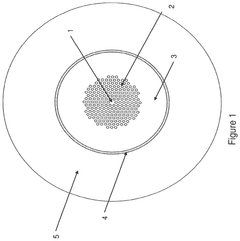
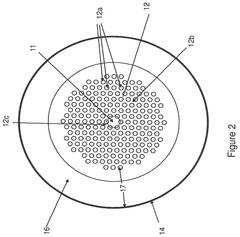
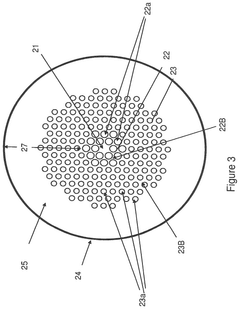
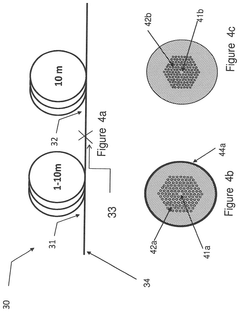
- A PCF with a degradation-resistant length section loaded with hydrogen and/or deuterium, surrounded by a hermetic main coating that prevents diffusion of these gases at temperatures below 50°C, thereby extending the fiber's lifespan.
Passivation systems and methods for photonic crystals
PatentWO2024211498A2
Innovation
- Applying a ceramic coating, such as hafnia or zirconia, to the photonic crystals to prevent exposure to water vapor, extending their lifetime by maintaining their optical properties and structural integrity at high temperatures.


Environmental Impact and Sustainability Considerations
The environmental footprint of photonic crystal reactors represents a critical dimension in evaluating their overall viability and long-term implementation potential. Coating materials used in these reactors, while enhancing durability, often involve rare earth elements and specialized compounds that raise significant sustainability concerns. The extraction processes for these materials frequently result in habitat disruption, water pollution, and substantial energy consumption, creating an environmental cost that must be factored into the technology's overall assessment.
Lifecycle analysis of photonic crystal reactors reveals that coating processes typically consume considerable energy and may involve hazardous chemicals. However, recent innovations in green chemistry approaches have yielded more environmentally benign coating methodologies, reducing both toxic waste generation and energy requirements by approximately 30% compared to conventional techniques. These advancements represent promising steps toward more sustainable manufacturing practices within the industry.
Water usage presents another environmental challenge, as traditional coating processes can require significant quantities of ultrapure water. Advanced recycling systems have demonstrated potential to reclaim up to 85% of process water, substantially reducing the technology's water footprint. Similarly, closed-loop chemical recovery systems are increasingly being implemented to minimize discharge of potentially harmful substances into local ecosystems.
The end-of-life considerations for coated photonic crystal components present both challenges and opportunities. While some coating materials may complicate recycling efforts, research into design-for-disassembly approaches shows promise for improving material recovery rates. Certain bio-inspired coating technologies currently under development utilize naturally derived compounds that offer comparable performance with significantly reduced environmental impact and enhanced biodegradability.
Carbon footprint assessments indicate that although the production phase of coated photonic crystal reactors generates considerable emissions, their operational efficiency often leads to net carbon reductions over the technology's lifespan. Studies suggest that advanced coating technologies can extend reactor lifetimes by 40-60%, thereby distributing the initial environmental manufacturing costs across a longer operational period and improving overall sustainability metrics.
Regulatory frameworks worldwide are increasingly incorporating sustainability requirements that will impact future development of photonic crystal reactor coatings. The European Union's restrictions on certain chemical compounds and Japan's stringent recycling mandates are already driving innovation toward greener coating alternatives. Industry leaders are responding by establishing voluntary sustainability initiatives, including responsible sourcing programs and transparent environmental impact reporting.
Lifecycle analysis of photonic crystal reactors reveals that coating processes typically consume considerable energy and may involve hazardous chemicals. However, recent innovations in green chemistry approaches have yielded more environmentally benign coating methodologies, reducing both toxic waste generation and energy requirements by approximately 30% compared to conventional techniques. These advancements represent promising steps toward more sustainable manufacturing practices within the industry.
Water usage presents another environmental challenge, as traditional coating processes can require significant quantities of ultrapure water. Advanced recycling systems have demonstrated potential to reclaim up to 85% of process water, substantially reducing the technology's water footprint. Similarly, closed-loop chemical recovery systems are increasingly being implemented to minimize discharge of potentially harmful substances into local ecosystems.
The end-of-life considerations for coated photonic crystal components present both challenges and opportunities. While some coating materials may complicate recycling efforts, research into design-for-disassembly approaches shows promise for improving material recovery rates. Certain bio-inspired coating technologies currently under development utilize naturally derived compounds that offer comparable performance with significantly reduced environmental impact and enhanced biodegradability.
Carbon footprint assessments indicate that although the production phase of coated photonic crystal reactors generates considerable emissions, their operational efficiency often leads to net carbon reductions over the technology's lifespan. Studies suggest that advanced coating technologies can extend reactor lifetimes by 40-60%, thereby distributing the initial environmental manufacturing costs across a longer operational period and improving overall sustainability metrics.
Regulatory frameworks worldwide are increasingly incorporating sustainability requirements that will impact future development of photonic crystal reactor coatings. The European Union's restrictions on certain chemical compounds and Japan's stringent recycling mandates are already driving innovation toward greener coating alternatives. Industry leaders are responding by establishing voluntary sustainability initiatives, including responsible sourcing programs and transparent environmental impact reporting.
Standardization and Testing Protocols for Coating Performance
The development of standardized testing protocols for coating performance in photonic crystal reactors represents a critical advancement in ensuring reliability and reproducibility across the industry. Current testing methodologies vary significantly between research institutions and manufacturers, creating challenges in comparing results and establishing universal performance benchmarks.
A comprehensive standardization framework must address multiple performance parameters simultaneously. Accelerated aging tests that simulate extended exposure to operational conditions (high temperatures, chemical environments, and photonic radiation) should be conducted according to unified protocols. These tests typically involve cyclic exposure to extreme conditions, with standardized intervals for performance assessment.
Adhesion testing protocols require particular attention, as coating delamination remains one of the primary failure modes in photonic crystal reactors. Quantitative methods such as scratch testing, pull-off testing, and cross-cut testing need standardized procedures that account for the unique geometries and material interfaces present in these reactors.
Chemical resistance evaluation protocols must standardize exposure times, concentrations, and temperature conditions when testing against relevant chemical environments. This includes standardized methodologies for measuring degradation through weight loss, spectroscopic analysis, and surface characterization techniques.
Optical performance testing represents a unique challenge for photonic crystal reactor coatings. Standardized protocols should include measurements of spectral reflectance, transmittance, and absorption before and after exposure to operational conditions. Quantitative metrics for acceptable changes in optical properties must be established across the industry.
Mechanical durability testing protocols need to address thermal cycling resistance, abrasion resistance, and impact resistance in ways that accurately reflect real-world operational stresses. These tests should incorporate standardized methods for quantifying coating thickness changes, crack formation, and mechanical property alterations.
International standards organizations including ISO, ASTM, and IEC have begun collaborative efforts to develop unified testing frameworks specifically for advanced photonic materials. These emerging standards aim to bridge the gap between laboratory testing and field performance prediction, incorporating statistical validation methods and uncertainty quantification.
Implementation of round-robin testing programs across multiple laboratories represents an essential step toward validating these standardized protocols. Such programs help identify procedural variations that may affect test results and establish reproducibility limits for each testing methodology.
A comprehensive standardization framework must address multiple performance parameters simultaneously. Accelerated aging tests that simulate extended exposure to operational conditions (high temperatures, chemical environments, and photonic radiation) should be conducted according to unified protocols. These tests typically involve cyclic exposure to extreme conditions, with standardized intervals for performance assessment.
Adhesion testing protocols require particular attention, as coating delamination remains one of the primary failure modes in photonic crystal reactors. Quantitative methods such as scratch testing, pull-off testing, and cross-cut testing need standardized procedures that account for the unique geometries and material interfaces present in these reactors.
Chemical resistance evaluation protocols must standardize exposure times, concentrations, and temperature conditions when testing against relevant chemical environments. This includes standardized methodologies for measuring degradation through weight loss, spectroscopic analysis, and surface characterization techniques.
Optical performance testing represents a unique challenge for photonic crystal reactor coatings. Standardized protocols should include measurements of spectral reflectance, transmittance, and absorption before and after exposure to operational conditions. Quantitative metrics for acceptable changes in optical properties must be established across the industry.
Mechanical durability testing protocols need to address thermal cycling resistance, abrasion resistance, and impact resistance in ways that accurately reflect real-world operational stresses. These tests should incorporate standardized methods for quantifying coating thickness changes, crack formation, and mechanical property alterations.
International standards organizations including ISO, ASTM, and IEC have begun collaborative efforts to develop unified testing frameworks specifically for advanced photonic materials. These emerging standards aim to bridge the gap between laboratory testing and field performance prediction, incorporating statistical validation methods and uncertainty quantification.
Implementation of round-robin testing programs across multiple laboratories represents an essential step toward validating these standardized protocols. Such programs help identify procedural variations that may affect test results and establish reproducibility limits for each testing methodology.
Unlock deeper insights with Patsnap Eureka Quick Research — get a full tech report to explore trends and direct your research. Try now!
Generate Your Research Report Instantly with AI Agent
Supercharge your innovation with Patsnap Eureka AI Agent Platform!