

Post-Quantum Cryptography in National Defense Systems: Deployment Guide
JUN 2, 20269 MIN READ
Generate Your Research Report Instantly with AI Agent
Patsnap Eureka helps you evaluate technical feasibility & market potential.
Post-Quantum Cryptography Defense Background and Objectives
The emergence of quantum computing represents a paradigm shift that fundamentally threatens the cryptographic foundations upon which modern national defense systems rely. Traditional public-key cryptographic algorithms, including RSA, Elliptic Curve Cryptography (ECC), and Diffie-Hellman key exchange, derive their security from mathematical problems that are computationally intractable for classical computers. However, quantum computers leveraging Shor's algorithm can efficiently solve these problems, rendering current cryptographic protections obsolete.
National defense systems encompass a vast ecosystem of interconnected components requiring robust cryptographic protection. These include secure communications networks, satellite systems, command and control infrastructure, intelligence gathering platforms, weapons systems, and classified data repositories. The cryptographic vulnerabilities extend across multiple layers, from tactical field communications to strategic nuclear command systems, creating unprecedented security risks.
The timeline for quantum threat realization has accelerated significantly over the past decade. While early estimates suggested quantum computers capable of breaking current encryption might emerge in 30-50 years, recent advances by organizations such as IBM, Google, and various national research institutions have compressed these projections. Current assessments indicate that cryptographically relevant quantum computers could become operational within 10-15 years, necessitating immediate preparation and migration strategies.
Post-quantum cryptography represents the primary defensive response to this quantum threat. Unlike quantum key distribution, which requires specialized hardware and infrastructure, post-quantum cryptographic algorithms can operate on existing classical computing systems while providing security against both classical and quantum attacks. These algorithms are based on mathematical problems believed to be resistant to quantum computational advantages, including lattice-based problems, hash-based signatures, code-based cryptography, and multivariate polynomial equations.
The strategic objectives for post-quantum cryptography deployment in national defense systems encompass multiple critical dimensions. Primary goals include maintaining operational security continuity during the transition period, ensuring interoperability across allied defense systems, and establishing cryptographic agility to adapt to evolving threat landscapes. Additionally, the deployment must address long-term data protection requirements, considering that adversaries may be collecting encrypted data today for future decryption once quantum capabilities mature.
The urgency of this transition cannot be overstated, as the "Y2Q" moment—when quantum computers can break current encryption—approaches rapidly, demanding comprehensive preparation and systematic implementation across all defense infrastructure.
National defense systems encompass a vast ecosystem of interconnected components requiring robust cryptographic protection. These include secure communications networks, satellite systems, command and control infrastructure, intelligence gathering platforms, weapons systems, and classified data repositories. The cryptographic vulnerabilities extend across multiple layers, from tactical field communications to strategic nuclear command systems, creating unprecedented security risks.
The timeline for quantum threat realization has accelerated significantly over the past decade. While early estimates suggested quantum computers capable of breaking current encryption might emerge in 30-50 years, recent advances by organizations such as IBM, Google, and various national research institutions have compressed these projections. Current assessments indicate that cryptographically relevant quantum computers could become operational within 10-15 years, necessitating immediate preparation and migration strategies.
Post-quantum cryptography represents the primary defensive response to this quantum threat. Unlike quantum key distribution, which requires specialized hardware and infrastructure, post-quantum cryptographic algorithms can operate on existing classical computing systems while providing security against both classical and quantum attacks. These algorithms are based on mathematical problems believed to be resistant to quantum computational advantages, including lattice-based problems, hash-based signatures, code-based cryptography, and multivariate polynomial equations.
The strategic objectives for post-quantum cryptography deployment in national defense systems encompass multiple critical dimensions. Primary goals include maintaining operational security continuity during the transition period, ensuring interoperability across allied defense systems, and establishing cryptographic agility to adapt to evolving threat landscapes. Additionally, the deployment must address long-term data protection requirements, considering that adversaries may be collecting encrypted data today for future decryption once quantum capabilities mature.
The urgency of this transition cannot be overstated, as the "Y2Q" moment—when quantum computers can break current encryption—approaches rapidly, demanding comprehensive preparation and systematic implementation across all defense infrastructure.
Market Demand for Quantum-Resistant Defense Solutions
The global defense sector is experiencing unprecedented urgency in transitioning to quantum-resistant cryptographic solutions, driven by the accelerating development of quantum computing capabilities that threaten current encryption standards. National defense organizations worldwide recognize that quantum computers capable of breaking RSA, ECC, and other widely-used cryptographic algorithms could emerge within the next decade, creating a critical vulnerability window for military communications, intelligence systems, and classified data protection.
Government defense agencies are actively seeking comprehensive post-quantum cryptography solutions that can seamlessly integrate with existing military infrastructure while maintaining operational security standards. The demand encompasses multiple defense domains including secure communications networks, satellite systems, command and control infrastructure, weapons systems, and intelligence platforms. Military organizations require solutions that not only provide quantum resistance but also demonstrate backward compatibility with legacy systems during the transition period.
The market demand is characterized by stringent requirements for cryptographic agility, enabling defense systems to rapidly update or replace cryptographic algorithms as new quantum-resistant standards emerge. Defense contractors and system integrators are increasingly prioritizing vendors who can deliver hybrid cryptographic approaches, combining classical and post-quantum algorithms to ensure continuous protection throughout the migration process.
Budget allocations for quantum-resistant defense solutions are expanding significantly across major military powers, with procurement cycles accelerating beyond traditional timelines due to the perceived quantum threat urgency. Defense organizations are particularly focused on solutions that address the "harvest now, decrypt later" attack scenario, where adversaries collect encrypted data today with the intention of decrypting it once quantum computers become available.
The demand extends beyond pure cryptographic implementation to include comprehensive deployment frameworks, risk assessment methodologies, and training programs for military personnel. Defense agencies require vendors to provide detailed migration roadmaps, performance impact assessments, and long-term support strategies that align with national security objectives and international standardization efforts.
Government defense agencies are actively seeking comprehensive post-quantum cryptography solutions that can seamlessly integrate with existing military infrastructure while maintaining operational security standards. The demand encompasses multiple defense domains including secure communications networks, satellite systems, command and control infrastructure, weapons systems, and intelligence platforms. Military organizations require solutions that not only provide quantum resistance but also demonstrate backward compatibility with legacy systems during the transition period.
The market demand is characterized by stringent requirements for cryptographic agility, enabling defense systems to rapidly update or replace cryptographic algorithms as new quantum-resistant standards emerge. Defense contractors and system integrators are increasingly prioritizing vendors who can deliver hybrid cryptographic approaches, combining classical and post-quantum algorithms to ensure continuous protection throughout the migration process.
Budget allocations for quantum-resistant defense solutions are expanding significantly across major military powers, with procurement cycles accelerating beyond traditional timelines due to the perceived quantum threat urgency. Defense organizations are particularly focused on solutions that address the "harvest now, decrypt later" attack scenario, where adversaries collect encrypted data today with the intention of decrypting it once quantum computers become available.
The demand extends beyond pure cryptographic implementation to include comprehensive deployment frameworks, risk assessment methodologies, and training programs for military personnel. Defense agencies require vendors to provide detailed migration roadmaps, performance impact assessments, and long-term support strategies that align with national security objectives and international standardization efforts.
Current State and Challenges of PQC in Defense Systems
The global defense sector currently finds itself at a critical juncture regarding post-quantum cryptography implementation. While NIST has standardized several PQC algorithms including CRYSTALS-Kyber for key encapsulation and CRYSTALS-Dilithium for digital signatures, defense systems worldwide remain predominantly reliant on RSA and ECC-based cryptographic infrastructures. This technological gap represents a significant vulnerability window as quantum computing capabilities continue advancing.
Major defense contractors and government agencies have initiated pilot programs to evaluate PQC integration. The United States Department of Defense has established quantum-resistant cryptography working groups, while NATO allies are coordinating standardization efforts through the Communications and Information Agency. However, deployment progress varies significantly across different military branches and allied nations, creating potential interoperability challenges.
Current PQC implementations in defense systems face substantial technical obstacles. Algorithm performance remains a primary concern, as post-quantum schemes typically require larger key sizes and increased computational overhead compared to classical cryptography. CRYSTALS-Kyber, for instance, utilizes key sizes ranging from 800 to 1,568 bytes, significantly larger than traditional 256-bit ECC keys. This expansion directly impacts bandwidth-constrained military communication systems and embedded hardware platforms.
Legacy system integration presents another formidable challenge. Defense networks often incorporate decades-old hardware and software components that cannot accommodate PQC algorithms without extensive modifications. Critical systems such as satellite communications, tactical radios, and command control infrastructure require careful migration strategies to maintain operational continuity while implementing quantum-resistant protections.
Standardization inconsistencies compound deployment difficulties. While NIST has finalized initial PQC standards, ongoing evaluation of additional algorithms creates uncertainty for long-term procurement decisions. Defense organizations must balance immediate security needs against potential future standard revisions, particularly given the extended lifecycle of military systems.
Interoperability concerns extend beyond technical specifications to encompass international cooperation requirements. Defense systems must maintain secure communications with allied forces, necessitating coordinated PQC adoption timelines and compatible algorithm selections. The absence of unified international standards complicates joint operations and intelligence sharing protocols.
Resource allocation represents a significant institutional challenge. PQC deployment requires substantial investments in research, testing, and system upgrades across multiple defense domains simultaneously. Budget constraints and competing modernization priorities often limit the scope and pace of quantum-resistant cryptography implementation initiatives.
Major defense contractors and government agencies have initiated pilot programs to evaluate PQC integration. The United States Department of Defense has established quantum-resistant cryptography working groups, while NATO allies are coordinating standardization efforts through the Communications and Information Agency. However, deployment progress varies significantly across different military branches and allied nations, creating potential interoperability challenges.
Current PQC implementations in defense systems face substantial technical obstacles. Algorithm performance remains a primary concern, as post-quantum schemes typically require larger key sizes and increased computational overhead compared to classical cryptography. CRYSTALS-Kyber, for instance, utilizes key sizes ranging from 800 to 1,568 bytes, significantly larger than traditional 256-bit ECC keys. This expansion directly impacts bandwidth-constrained military communication systems and embedded hardware platforms.
Legacy system integration presents another formidable challenge. Defense networks often incorporate decades-old hardware and software components that cannot accommodate PQC algorithms without extensive modifications. Critical systems such as satellite communications, tactical radios, and command control infrastructure require careful migration strategies to maintain operational continuity while implementing quantum-resistant protections.
Standardization inconsistencies compound deployment difficulties. While NIST has finalized initial PQC standards, ongoing evaluation of additional algorithms creates uncertainty for long-term procurement decisions. Defense organizations must balance immediate security needs against potential future standard revisions, particularly given the extended lifecycle of military systems.
Interoperability concerns extend beyond technical specifications to encompass international cooperation requirements. Defense systems must maintain secure communications with allied forces, necessitating coordinated PQC adoption timelines and compatible algorithm selections. The absence of unified international standards complicates joint operations and intelligence sharing protocols.
Resource allocation represents a significant institutional challenge. PQC deployment requires substantial investments in research, testing, and system upgrades across multiple defense domains simultaneously. Budget constraints and competing modernization priorities often limit the scope and pace of quantum-resistant cryptography implementation initiatives.
Existing PQC Deployment Solutions for Defense
01 Lattice-based cryptographic algorithms
Implementation of cryptographic systems based on lattice problems such as Learning With Errors (LWE) and Ring-LWE. These algorithms provide security against quantum computer attacks by relying on the difficulty of solving lattice problems, which are believed to be hard even for quantum computers. The systems include key generation, encryption, decryption, and digital signature schemes using lattice structures.- Lattice-based cryptographic algorithms: Implementation of cryptographic systems based on lattice problems such as Learning With Errors (LWE) and Ring-LWE. These algorithms provide security against quantum computer attacks by relying on the difficulty of solving lattice problems, which are believed to be resistant to both classical and quantum cryptanalysis. The systems include key generation, encryption, decryption, and digital signature schemes using lattice structures.
- Hash-based digital signatures: Development of signature schemes that rely on the security of cryptographic hash functions rather than number-theoretic problems. These systems use one-time signature schemes and Merkle tree structures to create quantum-resistant digital signatures. The approach provides long-term security guarantees based on the assumption that hash functions remain secure against quantum attacks.
- Code-based cryptographic systems: Cryptographic protocols based on error-correcting codes and the difficulty of decoding random linear codes. These systems utilize the hardness of problems in coding theory to provide quantum-resistant encryption and key exchange mechanisms. The implementations focus on optimizing key sizes and computational efficiency while maintaining security against quantum adversaries.
- Multivariate cryptographic schemes: Cryptographic systems based on the difficulty of solving systems of multivariate polynomial equations over finite fields. These schemes provide quantum-resistant public key cryptography through the computational hardness of the multivariate quadratic problem. The implementations include both encryption schemes and digital signature algorithms designed to resist quantum computer attacks.
- Hybrid cryptographic implementations: Integration of multiple post-quantum cryptographic approaches or combination of classical and quantum-resistant algorithms to provide enhanced security and backward compatibility. These systems implement protocol negotiation mechanisms and algorithm agility to support smooth transition from classical to post-quantum cryptography while maintaining interoperability with existing infrastructure.
02 Code-based cryptographic systems
Cryptographic methods utilizing error-correcting codes to create secure communication systems resistant to quantum attacks. These systems leverage the hardness of decoding random linear codes and syndrome decoding problems. The implementations include public key encryption schemes and digital signatures based on algebraic coding theory principles.Expand Specific Solutions03 Hash-based signature schemes
Digital signature systems that derive their security from the properties of cryptographic hash functions rather than number-theoretic problems. These schemes use one-time signatures and Merkle tree structures to create signatures that remain secure against quantum computer attacks. The methods provide long-term security guarantees based on hash function collision resistance.Expand Specific Solutions04 Multivariate cryptographic protocols
Cryptographic systems based on the difficulty of solving systems of multivariate polynomial equations over finite fields. These protocols implement public key cryptography where the security relies on the NP-hard problem of solving multivariate quadratic equations. The systems include encryption schemes and digital signatures using polynomial mathematics.Expand Specific Solutions05 Isogeny-based cryptographic methods
Cryptographic approaches utilizing the mathematical properties of elliptic curve isogenies to create quantum-resistant security systems. These methods exploit the difficulty of finding isogenies between supersingular elliptic curves. The implementations provide key exchange protocols and encryption schemes based on walks in isogeny graphs of elliptic curves.Expand Specific Solutions
Key Players in Defense PQC Implementation
The post-quantum cryptography (PQC) deployment in national defense systems represents an emerging yet rapidly maturing market driven by the imminent threat of quantum computing to current cryptographic standards. The industry is in its early adoption phase, with market size projected to reach billions as governments mandate quantum-resistant security. Technology maturity varies significantly across players: established tech giants like Intel, Huawei, and Siemens leverage existing infrastructure capabilities, while specialized firms such as Qusecure and Arqit focus on dedicated quantum security solutions. Academic institutions including Zhejiang University and Huazhong University of Science & Technology contribute foundational research, while companies like Origin Quantum and Norma advance practical implementations. The competitive landscape shows a convergence of semiconductor manufacturers, cybersecurity specialists, and research institutions racing to establish quantum-safe standards before cryptographically relevant quantum computers emerge.
Qusecure, Inc.
Technical Solution: Qusecure specializes in quantum-safe security solutions specifically tailored for defense and government applications. Their post-quantum cryptography platform provides end-to-end encryption using NIST-approved algorithms including CRYSTALS-Kyber, CRYSTALS-Dilithium, and FALCON. The company's deployment methodology focuses on risk assessment frameworks and phased implementation strategies that minimize operational disruption during the transition period. Their solution architecture includes quantum key distribution integration, secure boot processes, and real-time threat monitoring capabilities designed to meet stringent defense security requirements and compliance standards for classified information systems.
Strengths: Specialized focus on quantum-safe security with deep expertise in defense requirements. Weaknesses: Limited market presence compared to larger technology providers and potential scalability challenges for large-scale deployments.
Intel Corp.
Technical Solution: Intel has developed comprehensive post-quantum cryptography solutions for national defense systems, including hardware-accelerated implementations of NIST-standardized algorithms like CRYSTALS-Kyber and CRYSTALS-Dilithium. Their approach focuses on integrating PQC algorithms into existing security infrastructures through their Trust Domain Extensions (TDX) and Software Guard Extensions (SGX) technologies. Intel's deployment strategy emphasizes backward compatibility and seamless migration paths, offering cryptographic agility frameworks that allow defense systems to transition gradually from classical to quantum-resistant algorithms without compromising operational continuity.
Strengths: Extensive hardware acceleration capabilities and established defense contractor relationships. Weaknesses: Higher implementation complexity and potential performance overhead in legacy systems.
Core PQC Algorithms and Defense Integration Technologies
Systems and methods for post-quantum cryptography optimization
PatentActiveUS11750378B1
Innovation
- The implementation of post-quantum cryptography (PQC) systems that use techniques like hash-based, lattice-based, isogeny-based, code-based, and zero-knowledge proof cryptography to generate and apply encryption attributes based on data attributes, risk profiles, and cryptographic performance information, ensuring data security against quantum attacks.


System and Methods for Secure Communication Using Post-Quantum Cryptography
PatentActiveUS20230361994A1
Innovation
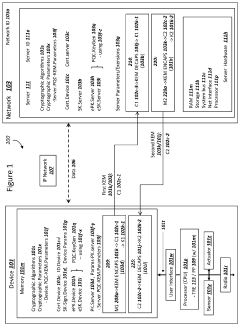
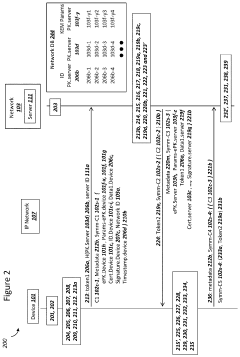
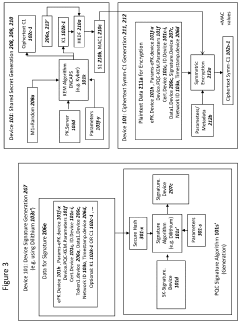
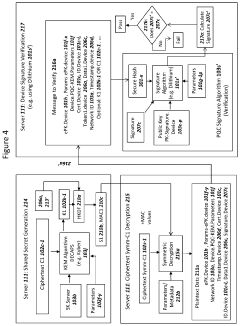
- Implementing a system where a device and server use multiple post-quantum cryptography key encapsulation mechanisms (KEM) algorithms, including lattice-based, code-based, and Supersingular Isogeny Key Encapsulation (SIKE), to derive multiple independent shared secrets, ensuring security even if one algorithm is compromised, and using static and ephemeral keys to resist quantum computer attacks and 'Man in the Middle' threats.
National Security Policy Framework for PQC Adoption
The establishment of a comprehensive national security policy framework for Post-Quantum Cryptography adoption represents a critical strategic imperative for modern defense organizations. This framework must address the fundamental shift from classical cryptographic systems to quantum-resistant alternatives while maintaining operational continuity and security effectiveness across all defense domains.
At the foundational level, the policy framework should establish clear governance structures that define roles, responsibilities, and decision-making authorities for PQC implementation. This includes designating lead agencies for cryptographic standards adoption, creating inter-agency coordination mechanisms, and establishing oversight bodies to monitor compliance and effectiveness. The framework must also define risk tolerance levels and establish criteria for prioritizing system migrations based on threat assessments and operational criticality.
The policy structure should incorporate mandatory compliance timelines aligned with quantum threat projections and technological readiness assessments. These timelines must balance urgency with practical implementation constraints, allowing sufficient time for thorough testing and validation while ensuring protection against emerging quantum computing capabilities. Phased implementation schedules should prioritize the most vulnerable and critical systems first.
Risk management protocols constitute another essential component, requiring comprehensive threat modeling that considers both current and projected quantum computing capabilities. The framework should establish continuous monitoring mechanisms to track quantum computing developments and adjust security postures accordingly. This includes defining trigger points for accelerated implementation based on breakthrough indicators in quantum technology advancement.
Interoperability requirements must be explicitly addressed to ensure seamless integration between legacy systems and new PQC implementations during transition periods. The policy should mandate standardized approaches to hybrid cryptographic systems and establish protocols for secure key exchange between different cryptographic generations.
Finally, the framework should incorporate regular review and update mechanisms to adapt to evolving quantum threats and technological developments. This includes establishing feedback loops from operational deployments, integrating lessons learned from pilot programs, and maintaining alignment with international standards and allied nation approaches to ensure coalition interoperability in joint operations.
At the foundational level, the policy framework should establish clear governance structures that define roles, responsibilities, and decision-making authorities for PQC implementation. This includes designating lead agencies for cryptographic standards adoption, creating inter-agency coordination mechanisms, and establishing oversight bodies to monitor compliance and effectiveness. The framework must also define risk tolerance levels and establish criteria for prioritizing system migrations based on threat assessments and operational criticality.
The policy structure should incorporate mandatory compliance timelines aligned with quantum threat projections and technological readiness assessments. These timelines must balance urgency with practical implementation constraints, allowing sufficient time for thorough testing and validation while ensuring protection against emerging quantum computing capabilities. Phased implementation schedules should prioritize the most vulnerable and critical systems first.
Risk management protocols constitute another essential component, requiring comprehensive threat modeling that considers both current and projected quantum computing capabilities. The framework should establish continuous monitoring mechanisms to track quantum computing developments and adjust security postures accordingly. This includes defining trigger points for accelerated implementation based on breakthrough indicators in quantum technology advancement.
Interoperability requirements must be explicitly addressed to ensure seamless integration between legacy systems and new PQC implementations during transition periods. The policy should mandate standardized approaches to hybrid cryptographic systems and establish protocols for secure key exchange between different cryptographic generations.
Finally, the framework should incorporate regular review and update mechanisms to adapt to evolving quantum threats and technological developments. This includes establishing feedback loops from operational deployments, integrating lessons learned from pilot programs, and maintaining alignment with international standards and allied nation approaches to ensure coalition interoperability in joint operations.
Risk Assessment and Migration Strategy for Defense PQC
The transition from classical cryptographic systems to post-quantum cryptography in defense environments presents multifaceted risks that require comprehensive assessment and strategic mitigation approaches. Defense organizations face the dual challenge of maintaining operational security while implementing quantum-resistant algorithms across diverse mission-critical systems.
Cryptographic vulnerability assessment forms the foundation of effective PQC migration strategy. Legacy encryption systems remain susceptible to quantum attacks, creating windows of exposure during transition periods. Defense networks must evaluate the quantum threat timeline against their current cryptographic inventory, prioritizing systems based on data sensitivity and operational criticality. This assessment should encompass communication protocols, data storage encryption, authentication mechanisms, and embedded system security across all defense domains.
Operational continuity risks emerge as primary concerns during PQC deployment. Defense systems require uninterrupted functionality, making gradual migration strategies essential. Hybrid cryptographic approaches enable parallel operation of classical and quantum-resistant algorithms, providing fallback mechanisms while ensuring compatibility with allied systems. However, this dual-system approach introduces complexity in key management and increases computational overhead, potentially affecting system performance in resource-constrained environments.
Interoperability challenges significantly impact defense coalition operations and information sharing protocols. PQC migration must maintain seamless communication capabilities with allied forces while ensuring backward compatibility with existing infrastructure. Standardization alignment becomes crucial, requiring coordination with international defense partners and adherence to emerging NIST post-quantum standards. Defense organizations must establish clear timelines for algorithm adoption while maintaining flexibility for standard evolution.
Strategic migration planning should adopt a phased approach, beginning with high-value assets and critical communication channels. Risk-based prioritization enables efficient resource allocation, focusing initial deployment on systems handling classified information or supporting critical operations. Implementation strategies must include comprehensive testing protocols, personnel training programs, and contingency planning for potential algorithm vulnerabilities or performance issues.
Performance impact assessment remains vital for defense system optimization. Post-quantum algorithms typically require increased computational resources and larger key sizes, potentially affecting real-time operations and bandwidth-constrained environments. Defense planners must evaluate processing overhead, memory requirements, and communication latency implications across various operational scenarios, ensuring mission effectiveness remains uncompromised during and after migration completion.
Cryptographic vulnerability assessment forms the foundation of effective PQC migration strategy. Legacy encryption systems remain susceptible to quantum attacks, creating windows of exposure during transition periods. Defense networks must evaluate the quantum threat timeline against their current cryptographic inventory, prioritizing systems based on data sensitivity and operational criticality. This assessment should encompass communication protocols, data storage encryption, authentication mechanisms, and embedded system security across all defense domains.
Operational continuity risks emerge as primary concerns during PQC deployment. Defense systems require uninterrupted functionality, making gradual migration strategies essential. Hybrid cryptographic approaches enable parallel operation of classical and quantum-resistant algorithms, providing fallback mechanisms while ensuring compatibility with allied systems. However, this dual-system approach introduces complexity in key management and increases computational overhead, potentially affecting system performance in resource-constrained environments.
Interoperability challenges significantly impact defense coalition operations and information sharing protocols. PQC migration must maintain seamless communication capabilities with allied forces while ensuring backward compatibility with existing infrastructure. Standardization alignment becomes crucial, requiring coordination with international defense partners and adherence to emerging NIST post-quantum standards. Defense organizations must establish clear timelines for algorithm adoption while maintaining flexibility for standard evolution.
Strategic migration planning should adopt a phased approach, beginning with high-value assets and critical communication channels. Risk-based prioritization enables efficient resource allocation, focusing initial deployment on systems handling classified information or supporting critical operations. Implementation strategies must include comprehensive testing protocols, personnel training programs, and contingency planning for potential algorithm vulnerabilities or performance issues.
Performance impact assessment remains vital for defense system optimization. Post-quantum algorithms typically require increased computational resources and larger key sizes, potentially affecting real-time operations and bandwidth-constrained environments. Defense planners must evaluate processing overhead, memory requirements, and communication latency implications across various operational scenarios, ensuring mission effectiveness remains uncompromised during and after migration completion.
Unlock deeper insights with Patsnap Eureka Quick Research — get a full tech report to explore trends and direct your research. Try now!
Generate Your Research Report Instantly with AI Agent
Supercharge your innovation with Patsnap Eureka AI Agent Platform!