

Proton Membrane vs Lithium Battery Efficiency: Analysis
MAR 10, 20269 MIN READ
Generate Your Research Report Instantly with AI Agent
PatSnap Eureka helps you evaluate technical feasibility & market potential.
Proton Membrane vs Lithium Battery Tech Background and Goals
The evolution of energy storage technologies has been fundamentally shaped by the pursuit of higher efficiency, greater energy density, and improved sustainability. Proton exchange membrane fuel cells emerged in the 1960s as a promising alternative energy conversion technology, initially developed for NASA's space missions. These systems utilize proton-conducting membranes to facilitate electrochemical reactions between hydrogen and oxygen, producing electricity with water as the primary byproduct.
Lithium-ion battery technology, first commercialized by Sony in 1991, revolutionized portable electronics and later expanded into electric vehicles and grid storage applications. The technology relies on lithium ion intercalation between cathode and anode materials, offering high energy density and relatively long cycle life compared to earlier battery chemistries.
The comparative efficiency analysis between these technologies has gained critical importance as global energy systems transition toward decarbonization. Proton membrane fuel cells demonstrate theoretical efficiencies of 40-60% in converting chemical energy to electrical energy, with the potential for combined heat and power applications reaching 80-90% total efficiency. However, the overall system efficiency must account for hydrogen production, storage, and distribution losses.
Lithium batteries exhibit round-trip efficiencies typically ranging from 85-95%, making them highly effective for applications requiring frequent charge-discharge cycles. The direct electrical storage mechanism eliminates intermediate conversion steps, contributing to superior efficiency in many use cases.
Current technological objectives focus on addressing fundamental limitations in both systems. For proton membrane technology, primary goals include reducing platinum catalyst loading, improving membrane durability under varying operating conditions, and developing cost-effective hydrogen infrastructure. The target is achieving system costs below $40/kW while maintaining performance standards.
Lithium battery development aims to increase energy density beyond 300 Wh/kg, extend cycle life to over 10,000 cycles, and reduce manufacturing costs through advanced materials and production processes. Safety improvements and thermal management optimization remain critical objectives, particularly for large-scale applications.
The efficiency comparison extends beyond pure energy conversion metrics to encompass lifecycle considerations, including material extraction, manufacturing energy requirements, and end-of-life recycling potential. Both technologies face challenges in achieving optimal efficiency across diverse operating conditions and application scenarios.
Strategic research directions emphasize hybrid system architectures that leverage the complementary strengths of both technologies, potentially achieving superior overall efficiency through intelligent energy management and optimized operational profiles.
Lithium-ion battery technology, first commercialized by Sony in 1991, revolutionized portable electronics and later expanded into electric vehicles and grid storage applications. The technology relies on lithium ion intercalation between cathode and anode materials, offering high energy density and relatively long cycle life compared to earlier battery chemistries.
The comparative efficiency analysis between these technologies has gained critical importance as global energy systems transition toward decarbonization. Proton membrane fuel cells demonstrate theoretical efficiencies of 40-60% in converting chemical energy to electrical energy, with the potential for combined heat and power applications reaching 80-90% total efficiency. However, the overall system efficiency must account for hydrogen production, storage, and distribution losses.
Lithium batteries exhibit round-trip efficiencies typically ranging from 85-95%, making them highly effective for applications requiring frequent charge-discharge cycles. The direct electrical storage mechanism eliminates intermediate conversion steps, contributing to superior efficiency in many use cases.
Current technological objectives focus on addressing fundamental limitations in both systems. For proton membrane technology, primary goals include reducing platinum catalyst loading, improving membrane durability under varying operating conditions, and developing cost-effective hydrogen infrastructure. The target is achieving system costs below $40/kW while maintaining performance standards.
Lithium battery development aims to increase energy density beyond 300 Wh/kg, extend cycle life to over 10,000 cycles, and reduce manufacturing costs through advanced materials and production processes. Safety improvements and thermal management optimization remain critical objectives, particularly for large-scale applications.
The efficiency comparison extends beyond pure energy conversion metrics to encompass lifecycle considerations, including material extraction, manufacturing energy requirements, and end-of-life recycling potential. Both technologies face challenges in achieving optimal efficiency across diverse operating conditions and application scenarios.
Strategic research directions emphasize hybrid system architectures that leverage the complementary strengths of both technologies, potentially achieving superior overall efficiency through intelligent energy management and optimized operational profiles.
Market Demand Analysis for Advanced Energy Storage Solutions
The global energy storage market is experiencing unprecedented growth driven by the accelerating transition toward renewable energy systems and the electrification of transportation. Traditional lithium-ion battery technology faces increasing scrutiny regarding resource scarcity, environmental impact, and performance limitations, creating substantial market opportunities for alternative energy storage solutions including proton exchange membrane technologies.
Electric vehicle manufacturers represent the largest demand segment for advanced energy storage solutions, with automotive companies actively seeking battery technologies that offer superior energy density, faster charging capabilities, and enhanced safety profiles. The commercial energy storage sector, including grid-scale applications and industrial backup systems, demonstrates growing interest in technologies that can provide longer cycle life and reduced maintenance requirements compared to conventional lithium-based systems.
Renewable energy integration applications constitute another critical market segment driving demand for innovative storage technologies. Solar and wind power installations require energy storage solutions capable of handling frequent charge-discharge cycles while maintaining efficiency over extended operational periods. Proton membrane technologies show particular promise in this sector due to their potential for rapid response times and minimal degradation over repeated cycling.
The consumer electronics market continues to demand lighter, more compact energy storage solutions with improved safety characteristics. Recent incidents involving lithium battery thermal runaway have intensified market interest in alternative technologies that eliminate fire and explosion risks while maintaining comparable or superior performance metrics.
Emerging applications in aerospace, marine, and remote power systems are creating niche but high-value market segments for advanced energy storage technologies. These applications often require specialized performance characteristics such as operation in extreme temperatures, resistance to vibration, or extended shelf life, areas where proton membrane technologies may offer distinct advantages over traditional lithium systems.
Market demand is increasingly influenced by regulatory frameworks promoting sustainable technologies and circular economy principles. Government incentives for clean energy storage solutions and stricter environmental regulations on battery disposal are reshaping procurement decisions across multiple industries, favoring technologies with lower environmental impact throughout their lifecycle.
Electric vehicle manufacturers represent the largest demand segment for advanced energy storage solutions, with automotive companies actively seeking battery technologies that offer superior energy density, faster charging capabilities, and enhanced safety profiles. The commercial energy storage sector, including grid-scale applications and industrial backup systems, demonstrates growing interest in technologies that can provide longer cycle life and reduced maintenance requirements compared to conventional lithium-based systems.
Renewable energy integration applications constitute another critical market segment driving demand for innovative storage technologies. Solar and wind power installations require energy storage solutions capable of handling frequent charge-discharge cycles while maintaining efficiency over extended operational periods. Proton membrane technologies show particular promise in this sector due to their potential for rapid response times and minimal degradation over repeated cycling.
The consumer electronics market continues to demand lighter, more compact energy storage solutions with improved safety characteristics. Recent incidents involving lithium battery thermal runaway have intensified market interest in alternative technologies that eliminate fire and explosion risks while maintaining comparable or superior performance metrics.
Emerging applications in aerospace, marine, and remote power systems are creating niche but high-value market segments for advanced energy storage technologies. These applications often require specialized performance characteristics such as operation in extreme temperatures, resistance to vibration, or extended shelf life, areas where proton membrane technologies may offer distinct advantages over traditional lithium systems.
Market demand is increasingly influenced by regulatory frameworks promoting sustainable technologies and circular economy principles. Government incentives for clean energy storage solutions and stricter environmental regulations on battery disposal are reshaping procurement decisions across multiple industries, favoring technologies with lower environmental impact throughout their lifecycle.
Current State and Challenges in Proton vs Lithium Technologies
Proton exchange membrane fuel cells (PEMFCs) currently demonstrate significant technological maturity in automotive applications, with major manufacturers like Toyota, Hyundai, and Honda deploying commercial fuel cell vehicles. These systems achieve energy conversion efficiencies of 50-60% under optimal conditions, substantially higher than internal combustion engines. However, system-level efficiency drops to 30-40% when accounting for hydrogen production, storage, and distribution losses. The technology excels in rapid refueling capabilities and extended driving ranges, making it particularly suitable for heavy-duty transportation and long-haul applications.
Lithium-ion battery technology has reached unprecedented levels of commercialization across multiple sectors, from consumer electronics to electric vehicles and grid storage. Current lithium-ion systems achieve round-trip efficiencies of 85-95%, with Tesla's latest 4680 cells and CATL's Qilin batteries pushing energy densities beyond 300 Wh/kg. The technology benefits from established manufacturing infrastructure and rapidly declining costs, dropping over 85% in the past decade. Advanced battery management systems now enable precise state-of-charge monitoring and thermal regulation, extending operational lifespans to over 3000 charge cycles.
Despite these advances, both technologies face substantial technical barriers that limit widespread adoption. PEMFC systems struggle with platinum catalyst costs, representing 30-40% of total stack expenses, while catalyst degradation under start-stop cycling reduces durability. Hydrogen storage remains problematic, requiring either high-pressure vessels (700 bar) or cryogenic systems, both adding complexity and safety concerns. Water management within the membrane presents ongoing challenges, particularly in sub-zero conditions where ice formation can damage cell structures.
Lithium battery technology confronts resource scarcity issues, with lithium, cobalt, and nickel supply chains concentrated in geopolitically sensitive regions. Thermal runaway risks persist despite safety improvements, requiring sophisticated cooling systems and fire suppression measures. Fast charging capabilities remain limited by heat generation and lithium plating phenomena, while capacity degradation accelerates under extreme temperature conditions. Recycling infrastructure for end-of-life batteries remains underdeveloped, creating potential environmental concerns.
The geographical distribution of technological expertise reveals distinct regional specializations. Japan and South Korea lead in PEMFC development, leveraging decades of materials science research and automotive engineering capabilities. China dominates lithium battery manufacturing with over 70% global production capacity, while European initiatives focus on sustainable battery chemistries and recycling technologies. North American efforts concentrate on solid-state battery development and hydrogen infrastructure deployment, creating a complex global competitive landscape that influences technology advancement trajectories.
Lithium-ion battery technology has reached unprecedented levels of commercialization across multiple sectors, from consumer electronics to electric vehicles and grid storage. Current lithium-ion systems achieve round-trip efficiencies of 85-95%, with Tesla's latest 4680 cells and CATL's Qilin batteries pushing energy densities beyond 300 Wh/kg. The technology benefits from established manufacturing infrastructure and rapidly declining costs, dropping over 85% in the past decade. Advanced battery management systems now enable precise state-of-charge monitoring and thermal regulation, extending operational lifespans to over 3000 charge cycles.
Despite these advances, both technologies face substantial technical barriers that limit widespread adoption. PEMFC systems struggle with platinum catalyst costs, representing 30-40% of total stack expenses, while catalyst degradation under start-stop cycling reduces durability. Hydrogen storage remains problematic, requiring either high-pressure vessels (700 bar) or cryogenic systems, both adding complexity and safety concerns. Water management within the membrane presents ongoing challenges, particularly in sub-zero conditions where ice formation can damage cell structures.
Lithium battery technology confronts resource scarcity issues, with lithium, cobalt, and nickel supply chains concentrated in geopolitically sensitive regions. Thermal runaway risks persist despite safety improvements, requiring sophisticated cooling systems and fire suppression measures. Fast charging capabilities remain limited by heat generation and lithium plating phenomena, while capacity degradation accelerates under extreme temperature conditions. Recycling infrastructure for end-of-life batteries remains underdeveloped, creating potential environmental concerns.
The geographical distribution of technological expertise reveals distinct regional specializations. Japan and South Korea lead in PEMFC development, leveraging decades of materials science research and automotive engineering capabilities. China dominates lithium battery manufacturing with over 70% global production capacity, while European initiatives focus on sustainable battery chemistries and recycling technologies. North American efforts concentrate on solid-state battery development and hydrogen infrastructure deployment, creating a complex global competitive landscape that influences technology advancement trajectories.
Current Efficiency Solutions in Energy Storage Systems
01 Proton exchange membrane materials and compositions for lithium batteries
Development of specialized proton exchange membrane materials that can improve lithium battery performance. These membranes are designed with specific polymer compositions and structures to enhance proton conductivity while maintaining chemical stability in battery environments. The materials may include modified polymers, composite structures, or novel organic-inorganic hybrid materials that facilitate efficient ion transport.- Proton exchange membrane materials and compositions for lithium batteries: Development of specialized proton exchange membrane materials that can improve lithium battery performance. These membranes are designed with specific polymer compositions and structures to enhance proton conductivity while maintaining chemical stability in battery environments. The materials may include modified polymers, composite structures, or novel organic-inorganic hybrid materials that facilitate efficient proton transport.
- Membrane structure optimization for enhanced ion transport: Optimization of membrane microstructure and morphology to improve ion transport efficiency in lithium batteries. This includes controlling pore size distribution, membrane thickness, and surface properties to reduce internal resistance and enhance battery performance. The structural modifications aim to create efficient pathways for ion movement while maintaining mechanical strength and durability.
- Electrolyte and membrane interface engineering: Technologies focused on improving the interface between proton membranes and electrolytes in lithium battery systems. This involves developing compatible electrolyte formulations and membrane surface treatments that reduce interfacial resistance and improve charge transfer kinetics. The approaches may include surface modification techniques, interfacial layer design, and electrolyte additive optimization.
- Membrane durability and stability enhancement: Methods to improve the long-term stability and durability of proton membranes in lithium battery applications. This includes developing membranes with enhanced chemical resistance, thermal stability, and mechanical properties to withstand battery operating conditions. Techniques may involve crosslinking strategies, reinforcement materials, or protective coatings that extend membrane lifetime and maintain consistent performance.
- Integrated membrane-electrode assembly design: Comprehensive design approaches for integrating proton membranes with electrode structures to maximize lithium battery efficiency. This encompasses the development of membrane-electrode assemblies with optimized contact, reduced interfacial losses, and improved overall cell performance. The designs consider factors such as electrode-membrane compatibility, current distribution, and manufacturing scalability.
02 Membrane structure optimization for enhanced ion conductivity
Techniques for optimizing the physical and chemical structure of membranes to improve ion transport efficiency in lithium batteries. This includes controlling membrane thickness, porosity, pore size distribution, and surface morphology. Structural modifications can reduce internal resistance and enhance the overall electrochemical performance of the battery system.Expand Specific Solutions03 Electrolyte and membrane interface engineering
Methods for improving the interface between proton-conducting membranes and battery electrolytes to enhance efficiency. This involves surface treatment techniques, interfacial layer design, and compatibility optimization between membrane materials and electrolyte solutions. Proper interface engineering can minimize resistance losses and improve charge transfer kinetics.Expand Specific Solutions04 Composite membrane systems with functional additives
Integration of functional additives and nanoparticles into membrane matrices to enhance proton conductivity and battery efficiency. These composite systems may incorporate conductive fillers, ceramic particles, or other functional materials that improve mechanical strength, thermal stability, and electrochemical properties. The additives work synergistically with the base membrane material to optimize performance.Expand Specific Solutions05 Manufacturing processes for high-performance battery membranes
Advanced manufacturing and processing techniques for producing proton-conducting membranes with improved efficiency characteristics. This includes casting methods, phase inversion processes, electrospinning, and other fabrication approaches that control membrane microstructure and properties. Optimized manufacturing processes ensure consistent quality and enhanced electrochemical performance in lithium battery applications.Expand Specific Solutions
Key Players in Proton Membrane and Lithium Battery Industries
The proton membrane versus lithium battery efficiency analysis represents a competitive landscape characterized by mature lithium-ion technology dominance and emerging proton exchange membrane innovations. The market is currently in a transitional phase, with lithium battery technology reaching commercial maturity through established players like Contemporary Amperex Technology, Samsung SDI, LG Energy Solution, BYD, and Panasonic, who collectively command significant market share in the multi-billion dollar energy storage sector. Meanwhile, proton membrane technology remains in early development stages, primarily driven by research institutions like CEA and Japan Atomic Energy Agency alongside materials specialists such as W.L. Gore & Associates and Asahi Kasei. The technological maturity gap is evident, with lithium systems offering proven scalability and manufacturing infrastructure, while proton membrane solutions promise higher theoretical efficiency but face commercialization challenges requiring substantial R&D investment and breakthrough innovations.
Contemporary Amperex Technology Co., Ltd.
Technical Solution: CATL has developed advanced lithium battery technologies including LFP (Lithium Iron Phosphate) and NCM (Nickel Cobalt Manganese) chemistries with energy densities reaching 160-200 Wh/kg for LFP and 250-280 Wh/kg for NCM batteries. Their Qilin battery technology achieves ultra-fast charging capabilities with 10-80% charging in 10 minutes while maintaining over 1000 charge cycles. The company focuses on improving thermal management systems and developing solid-state electrolytes to enhance safety and performance compared to traditional liquid electrolyte systems.
Strengths: Market leadership in battery manufacturing scale, advanced thermal management, fast charging capabilities. Weaknesses: Still relies on liquid electrolytes, limited energy density compared to emerging solid-state technologies.
Samsung SDI Co., Ltd.
Technical Solution: Samsung SDI develops solid-state battery technology using sulfide-based electrolytes achieving 900+ Wh/L volumetric energy density and targeting commercialization by 2027. Their conventional lithium batteries utilize high-nickel NCM chemistry with over 90% nickel content reaching 280 Wh/kg energy density. The company's PRiMX technology integrates advanced separator materials and electrolyte additives to enhance safety and extend cycle life beyond 1000 cycles. Samsung SDI also develops flexible and curved battery formats for diverse applications including wearables and automotive integration.
Strengths: Leading solid-state battery development, high energy density NCM technology, diverse form factor capabilities. Weaknesses: Solid-state technology still in development phase, high manufacturing complexity and costs.
Core Innovations in Proton Membrane Efficiency Technologies
Cathode for proton batteries and method of manufacture
PatentWO2024119235A1
Innovation
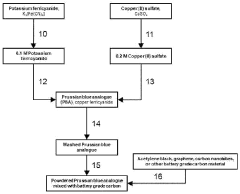
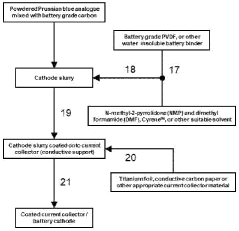
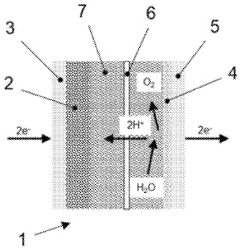
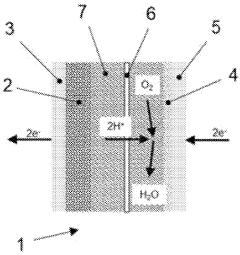
- A cathode for proton batteries comprising a Prussian blue analogue (PBA) coated on a current collector, combined with battery-grade carbon nanoparticles and a non-water-soluble binder, utilizing a copper hexacyanoferrate or manganese hexacyanoferrate structure for enhanced proton intercalation and storage capabilities, along with a suitable current collector and electrolyte system.
Redox flow secondary battery and electrolyte membrane for redox flow secondary batteries
PatentActiveEP3091599A1
Innovation
- A fluorine-based polyelectrolyte polymer with a specific structure is used as the ion-exchange resin in the electrolyte membrane, which regulates fluorine ion elution and incorporates additives like Ce, Co, or Mn to enhance ion permselectivity and oxidative deterioration resistance, resulting in a membrane with low electric resistance and high current efficiency.


Environmental Impact Assessment of Energy Storage Technologies
The environmental implications of proton exchange membrane fuel cells (PEMFCs) and lithium-ion batteries present distinct sustainability profiles that significantly influence their adoption in energy storage applications. Both technologies demonstrate varying environmental footprints across their entire lifecycle, from raw material extraction through manufacturing, operation, and end-of-life disposal.
Proton membrane fuel cells exhibit relatively minimal direct environmental impact during operation, producing only water vapor and heat as byproducts when utilizing hydrogen fuel. However, the environmental burden largely depends on hydrogen production methods. Green hydrogen generated through renewable energy-powered electrolysis offers exceptional environmental benefits, while hydrogen derived from fossil fuel reforming carries substantial carbon emissions. The membrane materials, particularly perfluorinated polymers, present challenges in terms of manufacturing energy intensity and potential environmental persistence.
Lithium-ion batteries face significant environmental concerns related to raw material extraction, particularly lithium, cobalt, and nickel mining operations. These processes often involve substantial water consumption, habitat disruption, and potential soil contamination. Cobalt mining, predominantly concentrated in the Democratic Republic of Congo, raises additional concerns regarding environmental degradation and social responsibility. The manufacturing phase requires energy-intensive processes, contributing to the overall carbon footprint.
Operational environmental performance favors both technologies when integrated with renewable energy systems. PEMFCs demonstrate superior efficiency in long-duration storage applications, while lithium batteries excel in short-term cycling scenarios. The absence of toxic emissions during normal operation positions both technologies favorably compared to conventional fossil fuel alternatives.
End-of-life management presents critical environmental considerations for both technologies. Lithium batteries offer established recycling pathways for recovering valuable materials, though current recycling rates remain suboptimal. PEMFC components, particularly platinum catalysts, possess high recycling value, while membrane materials require specialized disposal methods. The development of circular economy approaches for both technologies represents a crucial factor in minimizing long-term environmental impact and resource depletion concerns.
Proton membrane fuel cells exhibit relatively minimal direct environmental impact during operation, producing only water vapor and heat as byproducts when utilizing hydrogen fuel. However, the environmental burden largely depends on hydrogen production methods. Green hydrogen generated through renewable energy-powered electrolysis offers exceptional environmental benefits, while hydrogen derived from fossil fuel reforming carries substantial carbon emissions. The membrane materials, particularly perfluorinated polymers, present challenges in terms of manufacturing energy intensity and potential environmental persistence.
Lithium-ion batteries face significant environmental concerns related to raw material extraction, particularly lithium, cobalt, and nickel mining operations. These processes often involve substantial water consumption, habitat disruption, and potential soil contamination. Cobalt mining, predominantly concentrated in the Democratic Republic of Congo, raises additional concerns regarding environmental degradation and social responsibility. The manufacturing phase requires energy-intensive processes, contributing to the overall carbon footprint.
Operational environmental performance favors both technologies when integrated with renewable energy systems. PEMFCs demonstrate superior efficiency in long-duration storage applications, while lithium batteries excel in short-term cycling scenarios. The absence of toxic emissions during normal operation positions both technologies favorably compared to conventional fossil fuel alternatives.
End-of-life management presents critical environmental considerations for both technologies. Lithium batteries offer established recycling pathways for recovering valuable materials, though current recycling rates remain suboptimal. PEMFC components, particularly platinum catalysts, possess high recycling value, while membrane materials require specialized disposal methods. The development of circular economy approaches for both technologies represents a crucial factor in minimizing long-term environmental impact and resource depletion concerns.
Cost-Benefit Analysis Framework for Energy Storage Selection
The cost-benefit analysis framework for energy storage selection between proton exchange membrane fuel cells and lithium-ion batteries requires a comprehensive evaluation methodology that encompasses multiple financial and operational dimensions. This framework serves as a critical decision-making tool for organizations seeking to optimize their energy storage investments while balancing performance requirements with economic constraints.
Initial capital expenditure represents the primary cost consideration, where lithium-ion battery systems typically demonstrate lower upfront costs ranging from $200-400 per kWh, while proton membrane fuel cell systems require substantially higher initial investments of $1,000-3,000 per kW due to complex manufacturing processes and precious metal catalysts. However, this analysis must extend beyond simple acquisition costs to encompass total cost of ownership over the system's operational lifetime.
Operational expenditure analysis reveals distinct patterns between these technologies. Lithium-ion systems incur minimal maintenance costs but face significant replacement expenses every 8-15 years depending on usage patterns and depth of discharge cycles. Proton membrane systems require regular maintenance including membrane replacement and hydrogen supply infrastructure, yet potentially offer extended operational lifespans of 20-30 years with proper maintenance protocols.
Energy efficiency metrics directly impact long-term operational costs, with lithium-ion batteries achieving round-trip efficiencies of 85-95%, while proton membrane fuel cells typically operate at 40-60% efficiency when considering the complete hydrogen production, storage, and conversion cycle. This efficiency differential translates into substantial operational cost variations over extended deployment periods.
The framework must incorporate scalability factors, as proton membrane systems demonstrate superior performance in large-scale applications where hydrogen can be produced during off-peak periods, while lithium-ion systems excel in distributed applications requiring rapid response times. Risk assessment components should evaluate supply chain stability, technology maturity, and regulatory compliance costs.
Financial modeling within this framework should employ net present value calculations incorporating discount rates, inflation factors, and technology learning curves that may reduce future costs. The analysis must also consider intangible benefits such as environmental impact, grid stability contributions, and potential revenue streams from ancillary services, creating a holistic evaluation methodology for informed energy storage selection decisions.
Initial capital expenditure represents the primary cost consideration, where lithium-ion battery systems typically demonstrate lower upfront costs ranging from $200-400 per kWh, while proton membrane fuel cell systems require substantially higher initial investments of $1,000-3,000 per kW due to complex manufacturing processes and precious metal catalysts. However, this analysis must extend beyond simple acquisition costs to encompass total cost of ownership over the system's operational lifetime.
Operational expenditure analysis reveals distinct patterns between these technologies. Lithium-ion systems incur minimal maintenance costs but face significant replacement expenses every 8-15 years depending on usage patterns and depth of discharge cycles. Proton membrane systems require regular maintenance including membrane replacement and hydrogen supply infrastructure, yet potentially offer extended operational lifespans of 20-30 years with proper maintenance protocols.
Energy efficiency metrics directly impact long-term operational costs, with lithium-ion batteries achieving round-trip efficiencies of 85-95%, while proton membrane fuel cells typically operate at 40-60% efficiency when considering the complete hydrogen production, storage, and conversion cycle. This efficiency differential translates into substantial operational cost variations over extended deployment periods.
The framework must incorporate scalability factors, as proton membrane systems demonstrate superior performance in large-scale applications where hydrogen can be produced during off-peak periods, while lithium-ion systems excel in distributed applications requiring rapid response times. Risk assessment components should evaluate supply chain stability, technology maturity, and regulatory compliance costs.
Financial modeling within this framework should employ net present value calculations incorporating discount rates, inflation factors, and technology learning curves that may reduce future costs. The analysis must also consider intangible benefits such as environmental impact, grid stability contributions, and potential revenue streams from ancillary services, creating a holistic evaluation methodology for informed energy storage selection decisions.
Unlock deeper insights with PatSnap Eureka Quick Research — get a full tech report to explore trends and direct your research. Try now!
Generate Your Research Report Instantly with AI Agent
Supercharge your innovation with PatSnap Eureka AI Agent Platform!