Artificial Intelligence in Process Innovation and Adaptability
FEB 28, 20269 MIN READ
Generate Your Research Report Instantly with AI Agent
PatSnap Eureka helps you evaluate technical feasibility & market potential.
AI Process Innovation Background and Objectives
The integration of artificial intelligence into process innovation represents a paradigm shift in how organizations approach operational efficiency, adaptability, and competitive advantage. Traditional process improvement methodologies, while effective in stable environments, often struggle to keep pace with rapidly changing market conditions and evolving customer demands. The emergence of AI technologies has created unprecedented opportunities to revolutionize process design, execution, and optimization across industries.
Process innovation has evolved from static, rule-based systems to dynamic, learning-enabled frameworks that can adapt in real-time. The historical progression shows a clear trajectory from manual process optimization in the 1980s, through business process reengineering in the 1990s, to lean and Six Sigma methodologies in the 2000s, culminating in today's AI-driven intelligent process automation. This evolution reflects an increasing emphasis on data-driven decision making and autonomous system capabilities.
The current technological landscape presents unique challenges that traditional approaches cannot adequately address. Organizations face increasing complexity in their operational environments, with multiple variables affecting process outcomes simultaneously. Customer expectations for personalization and rapid response times have intensified, while regulatory requirements continue to evolve. These factors create a compelling need for processes that can learn, adapt, and optimize themselves without constant human intervention.
AI technologies offer transformative potential through machine learning algorithms that can identify patterns in process data, predict bottlenecks before they occur, and automatically adjust parameters to maintain optimal performance. Natural language processing enables better human-machine interaction in process management, while computer vision can monitor physical processes and detect anomalies in real-time. These capabilities represent a fundamental shift from reactive to proactive process management.
The primary objective of integrating AI into process innovation is to create self-optimizing systems that can maintain peak performance while adapting to changing conditions. This includes developing processes that can learn from historical data, predict future scenarios, and make autonomous adjustments to maintain efficiency and quality standards. The goal extends beyond simple automation to encompass intelligent decision-making capabilities that can handle complex, multi-variable optimization problems.
Secondary objectives focus on enhancing organizational agility and resilience. AI-enabled processes should demonstrate superior adaptability to market fluctuations, supply chain disruptions, and changing regulatory requirements. The technology should also enable more sophisticated performance monitoring and predictive maintenance capabilities, reducing downtime and improving overall system reliability.
Process innovation has evolved from static, rule-based systems to dynamic, learning-enabled frameworks that can adapt in real-time. The historical progression shows a clear trajectory from manual process optimization in the 1980s, through business process reengineering in the 1990s, to lean and Six Sigma methodologies in the 2000s, culminating in today's AI-driven intelligent process automation. This evolution reflects an increasing emphasis on data-driven decision making and autonomous system capabilities.
The current technological landscape presents unique challenges that traditional approaches cannot adequately address. Organizations face increasing complexity in their operational environments, with multiple variables affecting process outcomes simultaneously. Customer expectations for personalization and rapid response times have intensified, while regulatory requirements continue to evolve. These factors create a compelling need for processes that can learn, adapt, and optimize themselves without constant human intervention.
AI technologies offer transformative potential through machine learning algorithms that can identify patterns in process data, predict bottlenecks before they occur, and automatically adjust parameters to maintain optimal performance. Natural language processing enables better human-machine interaction in process management, while computer vision can monitor physical processes and detect anomalies in real-time. These capabilities represent a fundamental shift from reactive to proactive process management.
The primary objective of integrating AI into process innovation is to create self-optimizing systems that can maintain peak performance while adapting to changing conditions. This includes developing processes that can learn from historical data, predict future scenarios, and make autonomous adjustments to maintain efficiency and quality standards. The goal extends beyond simple automation to encompass intelligent decision-making capabilities that can handle complex, multi-variable optimization problems.
Secondary objectives focus on enhancing organizational agility and resilience. AI-enabled processes should demonstrate superior adaptability to market fluctuations, supply chain disruptions, and changing regulatory requirements. The technology should also enable more sophisticated performance monitoring and predictive maintenance capabilities, reducing downtime and improving overall system reliability.
Market Demand for AI-Driven Process Optimization
The global market for AI-driven process optimization is experiencing unprecedented growth, driven by enterprises' urgent need to enhance operational efficiency and maintain competitive advantages in increasingly complex business environments. Manufacturing industries represent the largest segment of demand, where companies seek to minimize production costs, reduce waste, and improve quality control through intelligent automation systems. The automotive, pharmaceutical, and electronics sectors are particularly aggressive in adopting AI solutions to optimize their production lines and supply chain operations.
Financial services institutions are rapidly embracing AI-powered process optimization to streamline operations, enhance risk management, and improve customer experience. Banks and insurance companies are implementing intelligent systems to automate document processing, fraud detection, and regulatory compliance procedures. The demand in this sector is intensified by the need to process vast amounts of transactional data while maintaining accuracy and security standards.
Healthcare organizations are increasingly recognizing the potential of AI-driven optimization to improve patient outcomes while reducing operational costs. Hospitals and healthcare systems are seeking solutions to optimize patient flow, resource allocation, and treatment protocols. The COVID-19 pandemic has accelerated this demand as healthcare providers face pressure to maximize efficiency while managing limited resources and ensuring patient safety.
Supply chain and logistics companies are driving significant demand for AI optimization solutions to address complex challenges in inventory management, route optimization, and demand forecasting. E-commerce growth and global supply chain disruptions have created urgent needs for intelligent systems that can adapt to rapidly changing market conditions and consumer behaviors.
The energy sector presents substantial opportunities for AI-driven process optimization, particularly in renewable energy management, grid optimization, and predictive maintenance. Utility companies are investing heavily in smart grid technologies and energy management systems that can optimize power distribution and reduce operational costs while supporting sustainability goals.
Small and medium enterprises are emerging as a growing market segment, seeking affordable and scalable AI solutions to compete with larger organizations. Cloud-based AI platforms and software-as-a-service models are making advanced optimization technologies accessible to companies with limited technical resources and budgets.
Financial services institutions are rapidly embracing AI-powered process optimization to streamline operations, enhance risk management, and improve customer experience. Banks and insurance companies are implementing intelligent systems to automate document processing, fraud detection, and regulatory compliance procedures. The demand in this sector is intensified by the need to process vast amounts of transactional data while maintaining accuracy and security standards.
Healthcare organizations are increasingly recognizing the potential of AI-driven optimization to improve patient outcomes while reducing operational costs. Hospitals and healthcare systems are seeking solutions to optimize patient flow, resource allocation, and treatment protocols. The COVID-19 pandemic has accelerated this demand as healthcare providers face pressure to maximize efficiency while managing limited resources and ensuring patient safety.
Supply chain and logistics companies are driving significant demand for AI optimization solutions to address complex challenges in inventory management, route optimization, and demand forecasting. E-commerce growth and global supply chain disruptions have created urgent needs for intelligent systems that can adapt to rapidly changing market conditions and consumer behaviors.
The energy sector presents substantial opportunities for AI-driven process optimization, particularly in renewable energy management, grid optimization, and predictive maintenance. Utility companies are investing heavily in smart grid technologies and energy management systems that can optimize power distribution and reduce operational costs while supporting sustainability goals.
Small and medium enterprises are emerging as a growing market segment, seeking affordable and scalable AI solutions to compete with larger organizations. Cloud-based AI platforms and software-as-a-service models are making advanced optimization technologies accessible to companies with limited technical resources and budgets.
Current AI Process Innovation Status and Challenges
The current landscape of AI-driven process innovation presents a complex ecosystem characterized by rapid technological advancement alongside significant implementation challenges. Organizations across industries are increasingly recognizing AI's transformative potential for optimizing operational processes, yet the practical deployment of these technologies reveals substantial gaps between theoretical capabilities and real-world applications.
Manufacturing sectors have emerged as early adopters, leveraging machine learning algorithms for predictive maintenance, quality control, and supply chain optimization. However, the integration of AI systems into existing industrial processes faces considerable obstacles, including data quality issues, legacy system compatibility, and the need for substantial infrastructure investments. Many organizations struggle with fragmented data sources and inconsistent data formats, which impede the development of robust AI models.
The healthcare industry demonstrates both promising applications and persistent challenges in AI process innovation. While diagnostic imaging and drug discovery have shown remarkable progress, the adaptation of AI systems to diverse clinical workflows remains problematic. Regulatory compliance, patient privacy concerns, and the need for clinical validation create additional layers of complexity that slow innovation cycles.
Financial services have made significant strides in implementing AI for fraud detection, risk assessment, and algorithmic trading. Nevertheless, the sector grapples with explainability requirements, regulatory scrutiny, and the challenge of maintaining human oversight in automated decision-making processes. The adaptability of AI systems to evolving market conditions and regulatory frameworks continues to pose significant technical challenges.
A critical challenge across all sectors is the lack of standardized frameworks for measuring AI system adaptability. Current approaches often rely on domain-specific metrics that fail to capture the dynamic nature of real-world environments. This limitation hampers the development of truly adaptive AI systems capable of responding effectively to changing operational conditions.
The skills gap represents another fundamental challenge, as organizations struggle to find personnel capable of bridging the divide between AI technology and process engineering. This shortage of interdisciplinary expertise slows the pace of innovation and limits the effectiveness of AI implementations.
Despite these challenges, emerging trends indicate growing momentum toward more sophisticated AI process innovation, with increased focus on explainable AI, federated learning approaches, and hybrid human-AI collaboration models that promise to address current limitations while enhancing system adaptability.
Manufacturing sectors have emerged as early adopters, leveraging machine learning algorithms for predictive maintenance, quality control, and supply chain optimization. However, the integration of AI systems into existing industrial processes faces considerable obstacles, including data quality issues, legacy system compatibility, and the need for substantial infrastructure investments. Many organizations struggle with fragmented data sources and inconsistent data formats, which impede the development of robust AI models.
The healthcare industry demonstrates both promising applications and persistent challenges in AI process innovation. While diagnostic imaging and drug discovery have shown remarkable progress, the adaptation of AI systems to diverse clinical workflows remains problematic. Regulatory compliance, patient privacy concerns, and the need for clinical validation create additional layers of complexity that slow innovation cycles.
Financial services have made significant strides in implementing AI for fraud detection, risk assessment, and algorithmic trading. Nevertheless, the sector grapples with explainability requirements, regulatory scrutiny, and the challenge of maintaining human oversight in automated decision-making processes. The adaptability of AI systems to evolving market conditions and regulatory frameworks continues to pose significant technical challenges.
A critical challenge across all sectors is the lack of standardized frameworks for measuring AI system adaptability. Current approaches often rely on domain-specific metrics that fail to capture the dynamic nature of real-world environments. This limitation hampers the development of truly adaptive AI systems capable of responding effectively to changing operational conditions.
The skills gap represents another fundamental challenge, as organizations struggle to find personnel capable of bridging the divide between AI technology and process engineering. This shortage of interdisciplinary expertise slows the pace of innovation and limits the effectiveness of AI implementations.
Despite these challenges, emerging trends indicate growing momentum toward more sophisticated AI process innovation, with increased focus on explainable AI, federated learning approaches, and hybrid human-AI collaboration models that promise to address current limitations while enhancing system adaptability.
Existing AI Process Adaptability Solutions
01 AI-driven adaptive process optimization systems
Systems and methods that utilize artificial intelligence to dynamically optimize business and manufacturing processes through real-time monitoring and adjustment. These solutions employ machine learning algorithms to analyze process parameters, identify inefficiencies, and automatically adapt workflows to improve performance. The technology enables continuous process improvement by learning from historical data and current conditions to make intelligent decisions about process modifications.- AI-driven adaptive process optimization systems: Systems and methods that utilize artificial intelligence to dynamically optimize business and manufacturing processes through real-time monitoring and adjustment. These solutions employ machine learning algorithms to analyze process parameters, identify inefficiencies, and automatically adapt workflows to improve performance. The technology enables continuous process improvement by learning from historical data and current conditions to make intelligent decisions about process modifications.
- Machine learning for process innovation and transformation: Application of machine learning techniques to drive innovation in existing processes and enable digital transformation. These approaches use neural networks and deep learning models to discover new process patterns, predict outcomes, and suggest innovative improvements. The technology facilitates the identification of breakthrough opportunities by analyzing large datasets and recognizing complex relationships that human analysts might miss.
- Adaptive AI systems for dynamic workflow management: Intelligent systems that automatically adjust workflows and operational procedures based on changing conditions and requirements. These solutions incorporate reinforcement learning and adaptive algorithms to modify process steps in response to environmental factors, resource availability, and performance metrics. The technology ensures optimal process execution across varying scenarios without manual intervention.
- AI-enabled process flexibility and scalability frameworks: Frameworks that leverage artificial intelligence to create flexible and scalable process architectures capable of adapting to different operational scales and requirements. These systems use intelligent agents and distributed AI models to manage process complexity and enable seamless scaling. The technology supports rapid process reconfiguration and deployment across multiple contexts while maintaining efficiency and quality standards.
- Cognitive automation for process innovation: Advanced automation solutions that combine cognitive computing with process management to enable intelligent process innovation. These systems utilize natural language processing, computer vision, and reasoning capabilities to understand process contexts and generate innovative solutions. The technology empowers organizations to automate complex decision-making and creative problem-solving within their operational processes.
02 Machine learning for process innovation and transformation
Application of machine learning techniques to drive innovation in traditional processes by identifying patterns, predicting outcomes, and suggesting novel approaches. These methods enable organizations to transform legacy processes through data-driven insights and automated decision-making. The technology facilitates the discovery of new process methodologies and supports the implementation of innovative workflows that adapt to changing business requirements.Expand Specific Solutions03 Adaptive AI systems for dynamic workflow management
Intelligent systems that automatically adjust workflows and processes based on changing conditions, user behavior, and environmental factors. These solutions incorporate feedback loops and reinforcement learning to continuously refine process execution. The technology enables self-optimizing systems that can handle variability and uncertainty while maintaining operational efficiency and quality standards.Expand Specific Solutions04 AI-powered process automation and cognitive adaptation
Advanced automation frameworks that combine artificial intelligence with cognitive computing to create self-adapting process execution engines. These systems can understand context, learn from exceptions, and modify their behavior without human intervention. The technology supports intelligent process automation that goes beyond rule-based systems to handle complex, unstructured scenarios and evolving business needs.Expand Specific Solutions05 Intelligent process monitoring and predictive adaptation
Solutions that leverage artificial intelligence for continuous process monitoring and predictive analytics to anticipate required adaptations before issues arise. These systems use neural networks and deep learning to forecast process deviations and proactively adjust parameters. The technology enables preventive process optimization and supports resilient operations through early detection of potential problems and automatic corrective actions.Expand Specific Solutions
Key Players in AI Process Innovation Industry
The artificial intelligence landscape in process innovation and adaptability is experiencing rapid evolution, characterized by significant market expansion and diverse technological maturity levels across industry players. The sector encompasses established technology giants like IBM, Intel, and Siemens AG who leverage decades of industrial automation expertise, alongside specialized AI companies such as Phaidra and MakinaRocks that focus specifically on process optimization solutions. Traditional industrial leaders including ABB, Samsung Electronics, and Huawei Technologies are integrating AI capabilities into existing manufacturing and infrastructure systems, while financial institutions like Bank of America and ICBC explore AI-driven process improvements. The technology maturity varies considerably, with hardware manufacturers like Taiwan Semiconductor and telecommunications providers such as China Mobile offering foundational infrastructure, while emerging players like Bioeutectics demonstrate innovative applications in specialized industrial processes, indicating a dynamic competitive environment with substantial growth potential.
International Business Machines Corp.
Technical Solution: IBM has developed Watson AI platform for process optimization and industrial automation, leveraging machine learning algorithms to analyze manufacturing data and predict equipment failures. Their AI solutions include process mining capabilities that can identify bottlenecks and inefficiencies in real-time, while their cognitive computing systems adapt to changing operational conditions through continuous learning mechanisms. The platform integrates natural language processing and computer vision to enhance human-machine collaboration in industrial settings.
Strengths: Comprehensive AI ecosystem with strong enterprise integration capabilities and proven track record in industrial applications. Weaknesses: High implementation costs and complexity may limit adoption for smaller organizations.
Intel Corp.
Technical Solution: Intel provides AI-optimized processors and edge computing solutions specifically designed for process innovation applications. Their OpenVINO toolkit enables deployment of AI models across various industrial environments, while their neuromorphic computing research focuses on adaptive learning systems that can evolve with changing process requirements. Intel's AI accelerators support real-time decision making in manufacturing processes, enabling predictive maintenance and quality control through deep learning algorithms integrated directly into production lines.
Strengths: Hardware-software co-optimization provides superior performance and energy efficiency for AI workloads. Weaknesses: Primarily hardware-focused approach may require additional software partnerships for complete solutions.
Core AI Algorithms for Process Innovation
Ai automation for computer-based processes based on tacit expert knowledge
PatentInactiveEP4354373A1
Innovation
- A computer-implemented method using a machine learning system that captures and processes expert user data to determine sequences of actions for tasks, allowing the system to automate and orchestrate computer-based processes, even when faced with different requirements and changes, by integrating existing data and using clustering algorithms like K-Nearest Neighbour or K-Means for data analysis.


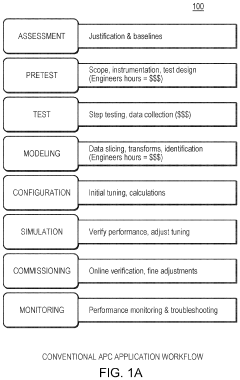
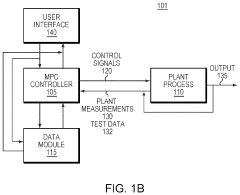
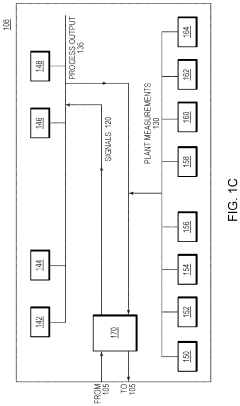
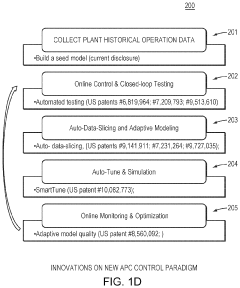
System And Methods For Automated Model Development From Plant Historical Data For Advanced Process Control
PatentActiveUS20210116891A1
Innovation
- A computer-implemented method and system utilizing artificial intelligence (AI) and machine learning (ML) techniques to build a 'seed-model' from historical plant data, automating the identification of process variables, data cleansing, and model configuration, allowing for the creation of a working dataset and subsequent MPC model, thereby reducing the need for traditional pre-testing and minimizing production disruptions.
AI Ethics and Governance in Process Innovation
The integration of artificial intelligence in process innovation necessitates robust ethical frameworks and governance structures to ensure responsible deployment and sustainable outcomes. As AI systems increasingly drive autonomous decision-making in industrial processes, organizations must establish comprehensive ethical guidelines that address transparency, accountability, and fairness in algorithmic operations.
Current governance challenges center on the lack of standardized ethical protocols for AI-driven process innovation. Many organizations operate without clear guidelines for AI decision-making transparency, creating potential risks in critical industrial applications. The absence of unified regulatory frameworks across different jurisdictions further complicates the implementation of consistent ethical standards in global operations.
Transparency emerges as a fundamental pillar of AI ethics in process innovation. Organizations must ensure that AI-driven process modifications are explainable and auditable, particularly when these systems adapt autonomously to changing conditions. This requirement extends beyond technical documentation to include clear communication of AI decision rationale to stakeholders and regulatory bodies.
Accountability frameworks must clearly delineate responsibility chains when AI systems make process adjustments that impact safety, quality, or environmental outcomes. Establishing human oversight mechanisms becomes crucial, especially in scenarios where AI systems operate with high degrees of autonomy. These frameworks should define escalation procedures and intervention protocols for situations where AI decisions may conflict with organizational values or regulatory requirements.
Data governance represents another critical dimension, encompassing privacy protection, data quality assurance, and bias mitigation in training datasets. Organizations must implement rigorous data management practices to prevent discriminatory outcomes and ensure that AI systems make fair and unbiased process optimization decisions across different operational contexts.
The development of industry-specific ethical standards for AI in process innovation requires collaborative efforts between technology providers, end-users, and regulatory bodies. These standards should address sector-specific risks while maintaining flexibility to accommodate rapid technological advancement and diverse operational requirements across different industrial domains.
Current governance challenges center on the lack of standardized ethical protocols for AI-driven process innovation. Many organizations operate without clear guidelines for AI decision-making transparency, creating potential risks in critical industrial applications. The absence of unified regulatory frameworks across different jurisdictions further complicates the implementation of consistent ethical standards in global operations.
Transparency emerges as a fundamental pillar of AI ethics in process innovation. Organizations must ensure that AI-driven process modifications are explainable and auditable, particularly when these systems adapt autonomously to changing conditions. This requirement extends beyond technical documentation to include clear communication of AI decision rationale to stakeholders and regulatory bodies.
Accountability frameworks must clearly delineate responsibility chains when AI systems make process adjustments that impact safety, quality, or environmental outcomes. Establishing human oversight mechanisms becomes crucial, especially in scenarios where AI systems operate with high degrees of autonomy. These frameworks should define escalation procedures and intervention protocols for situations where AI decisions may conflict with organizational values or regulatory requirements.
Data governance represents another critical dimension, encompassing privacy protection, data quality assurance, and bias mitigation in training datasets. Organizations must implement rigorous data management practices to prevent discriminatory outcomes and ensure that AI systems make fair and unbiased process optimization decisions across different operational contexts.
The development of industry-specific ethical standards for AI in process innovation requires collaborative efforts between technology providers, end-users, and regulatory bodies. These standards should address sector-specific risks while maintaining flexibility to accommodate rapid technological advancement and diverse operational requirements across different industrial domains.
Human-AI Collaboration in Adaptive Processes
The integration of human intelligence with artificial intelligence systems represents a paradigm shift in how adaptive processes are designed, implemented, and optimized across various industries. This collaborative approach leverages the complementary strengths of human cognitive abilities and AI computational power to create more resilient and responsive process frameworks.
Human-AI collaboration in adaptive processes fundamentally relies on the principle of augmented intelligence, where AI systems enhance human decision-making capabilities rather than replacing them entirely. Humans contribute contextual understanding, creative problem-solving, ethical judgment, and domain expertise, while AI provides rapid data processing, pattern recognition, predictive analytics, and continuous monitoring capabilities. This symbiotic relationship enables organizations to respond more effectively to dynamic operational environments.
The collaborative framework typically operates through several interaction modalities. Real-time advisory systems provide human operators with AI-generated insights and recommendations during critical decision points. Interactive dashboards allow process managers to visualize complex data patterns and receive intelligent alerts about potential process deviations or optimization opportunities. Machine learning algorithms continuously learn from human feedback and decisions, improving their predictive accuracy and recommendation quality over time.
Successful implementation of human-AI collaboration requires careful consideration of interface design and workflow integration. The AI systems must present information in intuitive formats that support human cognitive processes rather than overwhelming operators with excessive data. Trust-building mechanisms, including explainable AI features and transparency in algorithmic decision-making, are essential for effective collaboration.
The adaptive nature of these collaborative systems manifests through continuous learning loops where human expertise guides AI model refinement, while AI insights inform human strategic thinking. This creates self-improving processes that become more efficient and responsive to changing conditions. Organizations implementing such systems report enhanced process flexibility, reduced response times to market changes, and improved innovation outcomes through the combination of human creativity and AI-powered analysis.
Human-AI collaboration in adaptive processes fundamentally relies on the principle of augmented intelligence, where AI systems enhance human decision-making capabilities rather than replacing them entirely. Humans contribute contextual understanding, creative problem-solving, ethical judgment, and domain expertise, while AI provides rapid data processing, pattern recognition, predictive analytics, and continuous monitoring capabilities. This symbiotic relationship enables organizations to respond more effectively to dynamic operational environments.
The collaborative framework typically operates through several interaction modalities. Real-time advisory systems provide human operators with AI-generated insights and recommendations during critical decision points. Interactive dashboards allow process managers to visualize complex data patterns and receive intelligent alerts about potential process deviations or optimization opportunities. Machine learning algorithms continuously learn from human feedback and decisions, improving their predictive accuracy and recommendation quality over time.
Successful implementation of human-AI collaboration requires careful consideration of interface design and workflow integration. The AI systems must present information in intuitive formats that support human cognitive processes rather than overwhelming operators with excessive data. Trust-building mechanisms, including explainable AI features and transparency in algorithmic decision-making, are essential for effective collaboration.
The adaptive nature of these collaborative systems manifests through continuous learning loops where human expertise guides AI model refinement, while AI insights inform human strategic thinking. This creates self-improving processes that become more efficient and responsive to changing conditions. Organizations implementing such systems report enhanced process flexibility, reduced response times to market changes, and improved innovation outcomes through the combination of human creativity and AI-powered analysis.
Unlock deeper insights with PatSnap Eureka Quick Research — get a full tech report to explore trends and direct your research. Try now!
Generate Your Research Report Instantly with AI Agent
Supercharge your innovation with PatSnap Eureka AI Agent Platform!