Catalyst Poisoning And Regeneration Methods: Organics, Sulfur, And Cleaning Routines
AUG 27, 20257 MIN READ
Generate Your Research Report Instantly with AI Agent
Patsnap Eureka helps you evaluate technical feasibility & market potential.
Catalyst Poisoning Mechanisms and Research Objectives
Catalyst poisoning represents a significant challenge in industrial catalytic processes, affecting efficiency, selectivity, and overall economic viability. The phenomenon occurs when certain substances interact with active sites on catalyst surfaces, blocking access to reactants or altering the electronic properties of the catalyst. This technical research focuses specifically on poisoning caused by organic compounds and sulfur species, which are among the most prevalent and problematic contaminants in various catalytic applications.
Historically, catalyst poisoning has been observed since the early development of catalytic processes in the petroleum and chemical industries. The evolution of understanding has progressed from empirical observations to molecular-level characterization of poisoning mechanisms. Recent advancements in analytical techniques, including in-situ spectroscopy and computational modeling, have significantly enhanced our ability to study poisoning phenomena at the atomic scale.
Organic poisons typically include nitrogen-containing compounds, aromatic hydrocarbons, and oxygenated species that strongly adsorb on catalyst surfaces. These compounds can form stable complexes with active metal sites or support materials, leading to temporary or permanent deactivation. Sulfur poisoning, particularly prevalent in hydroprocessing and automotive catalysts, occurs through strong chemisorption of sulfur atoms on metal surfaces, forming metal-sulfur bonds that fundamentally alter catalytic properties.
The primary objective of this research is to develop a comprehensive understanding of the mechanisms by which organic and sulfur compounds poison catalysts across different industrial applications. This includes identifying the molecular interactions between poison species and catalyst surfaces, quantifying adsorption energies and kinetics, and determining the structural changes induced in catalyst materials upon poisoning.
Additionally, this research aims to establish systematic approaches for catalyst regeneration, focusing on cleaning routines that can effectively remove poison species while preserving catalyst structure and activity. The development of regeneration protocols requires balancing technical effectiveness with economic considerations, as regeneration processes must be cost-effective compared to catalyst replacement.
The technological trajectory suggests increasing emphasis on poison-resistant catalyst designs and in-situ regeneration methods. Emerging trends include the development of self-healing catalysts, poison-trapping materials, and continuous regeneration systems that minimize downtime in industrial operations. These innovations align with broader industry goals of improving process sustainability and reducing material waste through extended catalyst lifetimes.
Historically, catalyst poisoning has been observed since the early development of catalytic processes in the petroleum and chemical industries. The evolution of understanding has progressed from empirical observations to molecular-level characterization of poisoning mechanisms. Recent advancements in analytical techniques, including in-situ spectroscopy and computational modeling, have significantly enhanced our ability to study poisoning phenomena at the atomic scale.
Organic poisons typically include nitrogen-containing compounds, aromatic hydrocarbons, and oxygenated species that strongly adsorb on catalyst surfaces. These compounds can form stable complexes with active metal sites or support materials, leading to temporary or permanent deactivation. Sulfur poisoning, particularly prevalent in hydroprocessing and automotive catalysts, occurs through strong chemisorption of sulfur atoms on metal surfaces, forming metal-sulfur bonds that fundamentally alter catalytic properties.
The primary objective of this research is to develop a comprehensive understanding of the mechanisms by which organic and sulfur compounds poison catalysts across different industrial applications. This includes identifying the molecular interactions between poison species and catalyst surfaces, quantifying adsorption energies and kinetics, and determining the structural changes induced in catalyst materials upon poisoning.
Additionally, this research aims to establish systematic approaches for catalyst regeneration, focusing on cleaning routines that can effectively remove poison species while preserving catalyst structure and activity. The development of regeneration protocols requires balancing technical effectiveness with economic considerations, as regeneration processes must be cost-effective compared to catalyst replacement.
The technological trajectory suggests increasing emphasis on poison-resistant catalyst designs and in-situ regeneration methods. Emerging trends include the development of self-healing catalysts, poison-trapping materials, and continuous regeneration systems that minimize downtime in industrial operations. These innovations align with broader industry goals of improving process sustainability and reducing material waste through extended catalyst lifetimes.
Market Analysis of Catalyst Regeneration Technologies
The global catalyst regeneration market is experiencing robust growth, valued at approximately $4.5 billion in 2022 and projected to reach $7.2 billion by 2028, representing a compound annual growth rate of 8.1%. This growth is primarily driven by stringent environmental regulations, increasing focus on sustainable manufacturing processes, and the rising costs of fresh catalysts.
Petroleum refining remains the largest application segment, accounting for nearly 45% of the total market share. This dominance is attributed to the extensive use of catalysts in hydroprocessing, fluid catalytic cracking, and reforming processes, all of which suffer from various poisoning mechanisms including organic fouling and sulfur contamination. Chemical manufacturing follows as the second-largest segment at 28%, with environmental applications growing at the fastest rate of 9.7% annually.
Regionally, North America and Europe collectively hold approximately 55% of the market share, primarily due to their established industrial infrastructure and stringent environmental regulations. However, Asia-Pacific is emerging as the fastest-growing region with a 10.2% growth rate, driven by rapid industrialization in China and India, coupled with increasing environmental awareness and regulatory frameworks.
Thermal regeneration technologies currently dominate the market with a 62% share, owing to their effectiveness in removing organic contaminants through controlled oxidation processes. Chemical regeneration methods account for 25% of the market, particularly effective for sulfur poisoning remediation. Emerging technologies such as supercritical fluid regeneration and advanced plasma techniques are gaining traction, expected to grow at 12.3% annually, though they currently represent only 8% of the market.
The market exhibits moderate fragmentation with the top five players controlling approximately 40% of the global market. These include Porocel Corporation, Catalyst Recovery Solutions, Eurecat, Al Bilad Catalyst Company, and Nippon Ketjen. A notable trend is the increasing vertical integration, where catalyst manufacturers are expanding into regeneration services to provide comprehensive lifecycle management solutions to their customers.
Customer demand is increasingly shifting toward on-site regeneration services, which reduce operational downtime and transportation costs. This segment is growing at 11.5% annually, outpacing the overall market growth. Additionally, there is rising demand for regeneration technologies specifically designed for novel catalyst formulations used in renewable energy applications, creating a niche but rapidly expanding market segment estimated at $320 million in 2022.
Petroleum refining remains the largest application segment, accounting for nearly 45% of the total market share. This dominance is attributed to the extensive use of catalysts in hydroprocessing, fluid catalytic cracking, and reforming processes, all of which suffer from various poisoning mechanisms including organic fouling and sulfur contamination. Chemical manufacturing follows as the second-largest segment at 28%, with environmental applications growing at the fastest rate of 9.7% annually.
Regionally, North America and Europe collectively hold approximately 55% of the market share, primarily due to their established industrial infrastructure and stringent environmental regulations. However, Asia-Pacific is emerging as the fastest-growing region with a 10.2% growth rate, driven by rapid industrialization in China and India, coupled with increasing environmental awareness and regulatory frameworks.
Thermal regeneration technologies currently dominate the market with a 62% share, owing to their effectiveness in removing organic contaminants through controlled oxidation processes. Chemical regeneration methods account for 25% of the market, particularly effective for sulfur poisoning remediation. Emerging technologies such as supercritical fluid regeneration and advanced plasma techniques are gaining traction, expected to grow at 12.3% annually, though they currently represent only 8% of the market.
The market exhibits moderate fragmentation with the top five players controlling approximately 40% of the global market. These include Porocel Corporation, Catalyst Recovery Solutions, Eurecat, Al Bilad Catalyst Company, and Nippon Ketjen. A notable trend is the increasing vertical integration, where catalyst manufacturers are expanding into regeneration services to provide comprehensive lifecycle management solutions to their customers.
Customer demand is increasingly shifting toward on-site regeneration services, which reduce operational downtime and transportation costs. This segment is growing at 11.5% annually, outpacing the overall market growth. Additionally, there is rising demand for regeneration technologies specifically designed for novel catalyst formulations used in renewable energy applications, creating a niche but rapidly expanding market segment estimated at $320 million in 2022.
Established Techniques for Catalyst Regeneration
01 Mechanisms of catalyst poisoning
Catalyst poisoning occurs when substances bind to active sites, reducing catalytic activity. Common poisons include sulfur compounds, heavy metals, and carbon deposits. Poisoning can be reversible or irreversible depending on the strength of binding between the poison and catalyst surface. Understanding these mechanisms is crucial for developing effective regeneration strategies and designing poison-resistant catalysts.- Mechanisms of catalyst poisoning: Catalyst poisoning occurs when substances bind to active sites, reducing catalytic activity. Common poisons include sulfur compounds, heavy metals, and carbon deposits. Poisoning can be reversible or irreversible depending on the strength of binding between the poison and catalyst surface. Understanding these mechanisms is crucial for developing effective regeneration strategies and designing poison-resistant catalysts.
- Thermal regeneration techniques: Thermal regeneration involves heating poisoned catalysts to high temperatures to remove contaminants. This process can include oxidation of carbon deposits, desorption of adsorbed poisons, or decomposition of deactivating compounds. Controlled temperature profiles are essential to prevent catalyst sintering or structural damage while effectively removing poisons. Various heating methods including direct heating, steam treatment, and controlled combustion can be employed depending on the catalyst type and poison characteristics.
- Chemical washing and solvent-based regeneration: Chemical regeneration methods use solvents, acids, bases, or chelating agents to dissolve and remove catalyst poisons. These techniques are particularly effective for metal-poisoned catalysts where the contaminants can be solubilized and washed away. Sequential washing with different reagents may be employed to target specific poisons. The process typically involves soaking the catalyst in the regeneration solution, followed by rinsing and drying steps to restore catalytic activity.
- In-situ regeneration systems: In-situ regeneration allows for catalyst restoration without removing it from the reactor, minimizing downtime and handling. These systems incorporate specialized equipment for introducing regeneration agents (gases, liquids, or plasma) directly to the catalyst bed during operation or during short maintenance periods. Continuous or cyclic regeneration processes can be implemented to maintain catalyst activity over extended periods. Advanced monitoring systems help optimize the timing and conditions of regeneration cycles.
- Novel catalyst designs for poison resistance: Innovative catalyst formulations are being developed to inherently resist poisoning effects. These include core-shell structures that shield active sites, sacrificial components that preferentially bind poisons, and multi-functional catalysts with self-regenerating properties. Surface modifications can alter adsorption characteristics to minimize poison binding. Additionally, catalyst supports with controlled porosity can be designed to exclude potential poisons based on molecular size, extending catalyst lifetime and reducing regeneration frequency.
02 Thermal regeneration techniques
Thermal regeneration involves heating poisoned catalysts to high temperatures to remove contaminants. This process can include oxidation of carbon deposits, desorption of adsorbed poisons, or decomposition of poison compounds. Temperature control is critical to prevent catalyst sintering or structural damage. Thermal regeneration can be performed in-situ or ex-situ depending on the catalyst system and process requirements.Expand Specific Solutions03 Chemical regeneration methods
Chemical regeneration uses specific reagents to react with and remove catalyst poisons. This may involve acid washing to dissolve metal deposits, solvent extraction to remove organic contaminants, or chemical treatments that convert poisons into less harmful compounds. The selection of chemicals depends on the nature of the poison and the catalyst material to ensure effective regeneration without damaging the catalyst structure.Expand Specific Solutions04 Innovative regeneration equipment and systems
Advanced equipment and systems have been developed specifically for catalyst regeneration. These include fluidized bed regenerators, continuous regeneration units, and specialized reactors with controlled atmospheres. Such systems often incorporate precise temperature control, gas flow management, and monitoring capabilities to optimize the regeneration process and extend catalyst lifetime while minimizing energy consumption and environmental impact.Expand Specific Solutions05 Poison-resistant catalyst formulations
Novel catalyst formulations have been developed with enhanced resistance to poisoning. These include catalysts with modified surface properties, protective coatings, or additives that preferentially bind to poisons. Some formulations incorporate sacrificial components that selectively attract poisons away from active sites. These approaches aim to extend catalyst lifetime and reduce the frequency of regeneration cycles, improving process economics and sustainability.Expand Specific Solutions
Leading Companies and Research Institutions in Catalysis
The catalyst poisoning and regeneration field is currently in a mature development phase, with a growing market driven by increasing environmental regulations and efficiency demands. The global market size for catalyst technologies is estimated at $35-40 billion, expanding at 4-5% annually. Leading players include major petrochemical corporations like China Petroleum & Chemical Corp. (Sinopec) and its research institutes, which have developed advanced regeneration techniques for sulfur-poisoned catalysts. International companies such as Covestro, Toyota, and IFP Energies Nouvelles demonstrate technological maturity through innovations in organics removal and cleaning routines. Academic institutions like MIT and Bar-Ilan University contribute fundamental research, while specialized entities like Tanaka Kikinzoku focus on precious metal catalyst recovery, indicating a well-established technical ecosystem with ongoing innovation potential.
China Petroleum & Chemical Corp.
Technical Solution: China Petroleum & Chemical Corp. (Sinopec) has developed comprehensive catalyst regeneration technologies focusing on organics and sulfur poisoning. Their approach includes a multi-stage thermal regeneration process that systematically removes carbon deposits at controlled temperatures (400-550°C) while maintaining catalyst structural integrity. For sulfur poisoning, they employ proprietary chemical washing techniques using alkaline solutions followed by controlled oxidation to convert sulfur compounds to removable forms. Their research has demonstrated that optimized regeneration can restore up to 95% of original catalyst activity in petroleum refining applications. Sinopec has also pioneered in-situ regeneration methods that reduce downtime by allowing partial regeneration during operation. Their latest innovation involves using supercritical CO2 as an environmentally friendly solvent for removing organic poisons from catalyst surfaces without thermal damage.
Strengths: Extensive industrial implementation experience across various refining processes; integrated approach combining mechanical, thermal and chemical treatments; proprietary technologies for handling complex poison mixtures. Weaknesses: Some regeneration processes require significant energy input; certain heavy metal poisons remain difficult to remove completely; regeneration efficiency decreases after multiple cycles.
Toyota Motor Corp.
Technical Solution: Toyota Motor Corp. has developed advanced catalyst regeneration technologies specifically for automotive catalytic converters affected by sulfur poisoning and organic contamination. Their approach includes an intelligent on-board diagnostic system that monitors catalyst efficiency in real-time and triggers regeneration cycles when performance degrades below threshold levels. For sulfur poisoning, Toyota employs a high-temperature desulfation process (650-750°C) with controlled rich/lean exhaust gas cycling to remove sulfur oxides. Their proprietary "Intelligent Catalyst Cleaning" system optimizes fuel injection patterns to create specific exhaust compositions that facilitate poison removal while minimizing thermal stress on the catalyst structure. Toyota has also pioneered nano-engineered catalyst materials with improved resistance to poisoning through strategic placement of protective components that preferentially adsorb poisons before they reach active sites. Research shows their regeneration methods can extend catalyst lifetime by up to 40% compared to conventional systems.
Strengths: Seamless integration with vehicle control systems; adaptive regeneration strategies based on driving conditions; minimal driver intervention required; comprehensive approach addressing multiple poison types. Weaknesses: High-temperature regeneration impacts fuel economy; complete regeneration may not be possible for aged catalysts; some regeneration processes require specific driving conditions to complete effectively.
Key Patents in Organic and Sulfur Poisoning Remediation
Method for regenerating a ruthenium- or ruthenium compound-containing catalyst which is contaminated with sulfur in the form of sulfur compounds
PatentActiveEP2257372A2
Innovation
- Treatment with a gas stream containing hydrogen chloride under non-oxidative conditions at elevated temperatures to reduce sulfur content and restore catalyst activity, allowing the catalyst to maintain performance similar to non-poisoned counterparts.
Methods for regenerating sulfur-contaminated aromatization catalysts
PatentWO2018118607A1
Innovation
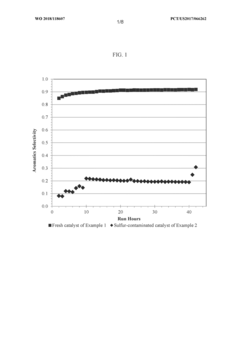
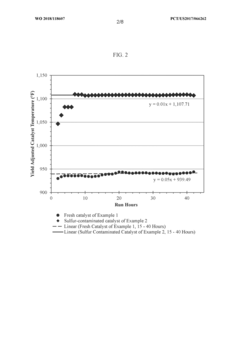
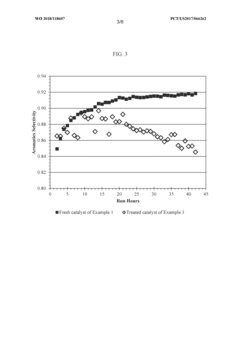
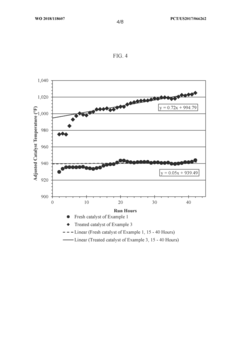
- A method involving washing sulfur-contaminated catalysts with an aqueous solution, optionally containing an alkali metal, followed by contacting with a halogen solution comprising chlorine or fluorine to produce a halogenated catalyst, which can include additional steps like carbon burn, drying, and calcination to enhance regeneration.
Environmental Impact of Catalyst Cleaning Processes
Catalyst cleaning processes, while essential for maintaining industrial efficiency, pose significant environmental challenges that require careful consideration. The chemicals used in these processes, particularly for removing organic and sulfur-based poisons, often contain hazardous substances such as strong acids, bases, and organic solvents that can harm ecosystems if improperly managed.
Water consumption represents a major environmental concern in catalyst regeneration. Traditional wet cleaning methods may require substantial volumes of water, contributing to resource depletion in water-stressed regions. Additionally, the wastewater generated typically contains dissolved heavy metals, sulfur compounds, and organic contaminants that require extensive treatment before discharge to prevent aquatic ecosystem damage.
Air emissions during thermal regeneration processes present another environmental challenge. When catalysts are regenerated at high temperatures, volatile organic compounds (VOCs), sulfur oxides (SOx), and nitrogen oxides (NOx) may be released. These emissions contribute to air pollution, smog formation, and potential acid rain if not properly controlled through appropriate abatement technologies.
Energy consumption constitutes a significant environmental footprint of catalyst cleaning operations. Thermal regeneration methods in particular require substantial energy inputs to reach and maintain the high temperatures necessary for contaminant removal. This energy demand translates to increased greenhouse gas emissions when fossil fuels serve as the energy source.
Waste management issues arise from spent cleaning solutions and residues that may contain concentrated levels of contaminants removed from catalysts. These materials often qualify as hazardous waste, necessitating specialized disposal protocols to prevent soil and groundwater contamination. The transportation and disposal of these wastes create additional environmental risks and carbon footprint concerns.
Regulatory frameworks worldwide have evolved to address these environmental impacts. Stringent regulations in many jurisdictions now mandate specific treatment standards for wastewater discharge, air emissions controls, and hazardous waste management practices related to catalyst cleaning operations. Companies must navigate complex compliance requirements that vary by region and industry sector.
Sustainable alternatives are emerging in response to these environmental challenges. Green chemistry approaches utilizing biodegradable solvents, supercritical CO2 extraction methods, and enzyme-based cleaning technologies show promise for reducing environmental impacts. Additionally, closed-loop systems that recycle cleaning agents and recover valuable metals from spent catalysts are gaining traction as environmentally preferable options that also offer economic benefits.
Water consumption represents a major environmental concern in catalyst regeneration. Traditional wet cleaning methods may require substantial volumes of water, contributing to resource depletion in water-stressed regions. Additionally, the wastewater generated typically contains dissolved heavy metals, sulfur compounds, and organic contaminants that require extensive treatment before discharge to prevent aquatic ecosystem damage.
Air emissions during thermal regeneration processes present another environmental challenge. When catalysts are regenerated at high temperatures, volatile organic compounds (VOCs), sulfur oxides (SOx), and nitrogen oxides (NOx) may be released. These emissions contribute to air pollution, smog formation, and potential acid rain if not properly controlled through appropriate abatement technologies.
Energy consumption constitutes a significant environmental footprint of catalyst cleaning operations. Thermal regeneration methods in particular require substantial energy inputs to reach and maintain the high temperatures necessary for contaminant removal. This energy demand translates to increased greenhouse gas emissions when fossil fuels serve as the energy source.
Waste management issues arise from spent cleaning solutions and residues that may contain concentrated levels of contaminants removed from catalysts. These materials often qualify as hazardous waste, necessitating specialized disposal protocols to prevent soil and groundwater contamination. The transportation and disposal of these wastes create additional environmental risks and carbon footprint concerns.
Regulatory frameworks worldwide have evolved to address these environmental impacts. Stringent regulations in many jurisdictions now mandate specific treatment standards for wastewater discharge, air emissions controls, and hazardous waste management practices related to catalyst cleaning operations. Companies must navigate complex compliance requirements that vary by region and industry sector.
Sustainable alternatives are emerging in response to these environmental challenges. Green chemistry approaches utilizing biodegradable solvents, supercritical CO2 extraction methods, and enzyme-based cleaning technologies show promise for reducing environmental impacts. Additionally, closed-loop systems that recycle cleaning agents and recover valuable metals from spent catalysts are gaining traction as environmentally preferable options that also offer economic benefits.
Economic Feasibility of Regeneration vs. Replacement
The economic analysis of catalyst regeneration versus replacement presents a critical decision point for industrial operations. When evaluating the financial implications of these alternatives, several factors must be considered to determine the most cost-effective approach. Current market data indicates that regeneration typically costs between 30-60% of new catalyst replacement, creating a significant potential for operational savings.
Capital expenditure analysis reveals that while replacement requires substantial upfront investment, regeneration distributes costs over multiple cycles, improving cash flow management. For a typical industrial catalyst system, replacement might cost $500,000-2,000,000, whereas regeneration services range from $150,000-800,000 depending on catalyst type and contamination severity.
Operational downtime represents another crucial economic factor. Replacement often necessitates 7-14 days of system shutdown, while advanced on-site regeneration techniques can reduce this to 3-5 days. This differential translates to substantial production value retention, particularly in high-throughput operations where daily output losses can exceed $100,000.
Lifecycle analysis demonstrates that properly regenerated catalysts typically achieve 80-95% of original activity levels. While this represents some performance degradation compared to new catalysts, the cost-benefit ratio frequently favors regeneration for the first 2-4 cycles, depending on the specific application and poisoning mechanism.
Environmental compliance costs increasingly influence economic decisions. Catalyst disposal fees range from $5,000-50,000 per ton depending on composition and regional regulations. Regeneration reduces waste generation by 70-90%, significantly decreasing these expenses while also mitigating potential environmental liabilities.
Return on investment calculations indicate that for sulfur-poisoned catalysts, regeneration typically delivers ROI of 200-400% compared to replacement. For organically fouled systems, this advantage decreases to 150-300%, reflecting the more complex regeneration processes required. The economic advantage diminishes with each regeneration cycle, eventually reaching a crossover point where replacement becomes more economical.
Predictive maintenance modeling suggests implementing a hybrid approach often maximizes economic value. This strategy involves scheduled regenerations until efficiency drops below a predetermined threshold (typically 75-80% of original activity), followed by replacement. Such optimization can reduce lifetime catalyst system costs by 25-40% compared to either strategy used exclusively.
Capital expenditure analysis reveals that while replacement requires substantial upfront investment, regeneration distributes costs over multiple cycles, improving cash flow management. For a typical industrial catalyst system, replacement might cost $500,000-2,000,000, whereas regeneration services range from $150,000-800,000 depending on catalyst type and contamination severity.
Operational downtime represents another crucial economic factor. Replacement often necessitates 7-14 days of system shutdown, while advanced on-site regeneration techniques can reduce this to 3-5 days. This differential translates to substantial production value retention, particularly in high-throughput operations where daily output losses can exceed $100,000.
Lifecycle analysis demonstrates that properly regenerated catalysts typically achieve 80-95% of original activity levels. While this represents some performance degradation compared to new catalysts, the cost-benefit ratio frequently favors regeneration for the first 2-4 cycles, depending on the specific application and poisoning mechanism.
Environmental compliance costs increasingly influence economic decisions. Catalyst disposal fees range from $5,000-50,000 per ton depending on composition and regional regulations. Regeneration reduces waste generation by 70-90%, significantly decreasing these expenses while also mitigating potential environmental liabilities.
Return on investment calculations indicate that for sulfur-poisoned catalysts, regeneration typically delivers ROI of 200-400% compared to replacement. For organically fouled systems, this advantage decreases to 150-300%, reflecting the more complex regeneration processes required. The economic advantage diminishes with each regeneration cycle, eventually reaching a crossover point where replacement becomes more economical.
Predictive maintenance modeling suggests implementing a hybrid approach often maximizes economic value. This strategy involves scheduled regenerations until efficiency drops below a predetermined threshold (typically 75-80% of original activity), followed by replacement. Such optimization can reduce lifetime catalyst system costs by 25-40% compared to either strategy used exclusively.
Unlock deeper insights with Patsnap Eureka Quick Research — get a full tech report to explore trends and direct your research. Try now!
Generate Your Research Report Instantly with AI Agent
Supercharge your innovation with Patsnap Eureka AI Agent Platform!