

Silicon Oxide Anodes vs MnO2: Performance Under Pulsed Currents
MAY 26, 20269 MIN READ
Generate Your Research Report Instantly with AI Agent
PatSnap Eureka helps you evaluate technical feasibility & market potential.
Silicon Oxide and MnO2 Anode Technology Background and Goals
Silicon oxide (SiOx) and manganese dioxide (MnO2) anodes represent two distinct technological pathways in advanced battery systems, each emerging from different evolutionary trajectories in electrochemical energy storage. Silicon oxide anodes evolved from the pursuit of high-capacity alternatives to traditional graphite anodes, leveraging silicon's theoretical capacity of 4200 mAh/g while addressing the severe volume expansion challenges through oxide formation and nanostructuring approaches.
The development of SiOx anodes traces back to early 2000s research efforts aimed at commercializing silicon-based materials for lithium-ion batteries. The incorporation of oxygen into silicon structures creates a buffer matrix that accommodates volume changes during lithiation/delithiation cycles, though at the cost of reduced theoretical capacity compared to pure silicon. This technology has progressed through multiple generations, from simple silicon-silica composites to sophisticated engineered nanostructures with controlled stoichiometry.
MnO2 anodes, conversely, emerged from the extensive research into transition metal oxides as conversion-type electrode materials. Manganese dioxide offers advantages including natural abundance, environmental compatibility, and multiple oxidation states that enable diverse electrochemical mechanisms. The technology development focused on optimizing crystal structures, from alpha and beta phases to engineered nanostructured morphologies that enhance ionic and electronic conductivity.
The convergence of interest in pulsed current applications stems from the growing demand for batteries capable of handling dynamic power profiles in applications such as electric vehicles, grid storage, and portable electronics. Pulsed current conditions impose unique stresses on electrode materials, including rapid ion transport requirements, thermal management challenges, and mechanical stress from rapid volume changes.
Current technological objectives center on achieving superior rate capability, cycle stability, and energy density under pulsed current conditions. For SiOx anodes, goals include maintaining structural integrity during rapid charge/discharge cycles while maximizing capacity utilization. For MnO2 systems, objectives focus on optimizing conversion reaction kinetics and minimizing polarization losses during high-rate pulsed operations.
The comparative evaluation of these technologies under pulsed current conditions represents a critical research frontier, as traditional steady-state performance metrics may not accurately predict behavior under dynamic loading conditions that increasingly characterize real-world applications.
The development of SiOx anodes traces back to early 2000s research efforts aimed at commercializing silicon-based materials for lithium-ion batteries. The incorporation of oxygen into silicon structures creates a buffer matrix that accommodates volume changes during lithiation/delithiation cycles, though at the cost of reduced theoretical capacity compared to pure silicon. This technology has progressed through multiple generations, from simple silicon-silica composites to sophisticated engineered nanostructures with controlled stoichiometry.
MnO2 anodes, conversely, emerged from the extensive research into transition metal oxides as conversion-type electrode materials. Manganese dioxide offers advantages including natural abundance, environmental compatibility, and multiple oxidation states that enable diverse electrochemical mechanisms. The technology development focused on optimizing crystal structures, from alpha and beta phases to engineered nanostructured morphologies that enhance ionic and electronic conductivity.
The convergence of interest in pulsed current applications stems from the growing demand for batteries capable of handling dynamic power profiles in applications such as electric vehicles, grid storage, and portable electronics. Pulsed current conditions impose unique stresses on electrode materials, including rapid ion transport requirements, thermal management challenges, and mechanical stress from rapid volume changes.
Current technological objectives center on achieving superior rate capability, cycle stability, and energy density under pulsed current conditions. For SiOx anodes, goals include maintaining structural integrity during rapid charge/discharge cycles while maximizing capacity utilization. For MnO2 systems, objectives focus on optimizing conversion reaction kinetics and minimizing polarization losses during high-rate pulsed operations.
The comparative evaluation of these technologies under pulsed current conditions represents a critical research frontier, as traditional steady-state performance metrics may not accurately predict behavior under dynamic loading conditions that increasingly characterize real-world applications.
Market Demand for Pulsed Current Battery Applications
The market demand for pulsed current battery applications is experiencing unprecedented growth across multiple sectors, driven by the increasing adoption of advanced electronic systems that require rapid energy delivery and high-power density solutions. This demand surge is fundamentally reshaping battery technology requirements, particularly emphasizing the need for electrode materials that can withstand intermittent high-current loads without significant performance degradation.
Electric vehicle markets represent the largest driver of pulsed current battery demand, where regenerative braking systems and acceleration events create substantial current spikes. Modern EVs require battery systems capable of handling discharge rates exceeding ten times their nominal capacity during peak performance scenarios. The automotive sector's transition toward electrification has created an urgent need for electrode materials that maintain structural integrity under these demanding conditions.
Consumer electronics markets are simultaneously driving demand through the proliferation of high-performance devices requiring burst power capabilities. Smartphones, tablets, and wearable devices increasingly incorporate features like fast charging, high-resolution displays, and intensive computational tasks that generate pulsed current profiles. The gaming industry particularly demands batteries capable of sustaining high current draws during intensive processing periods while maintaining thermal stability.
Industrial applications present another significant market segment, encompassing power tools, robotics, and automated manufacturing systems. These applications often require batteries to deliver substantial power bursts for motor startup, heavy-duty operations, and precision control systems. The industrial Internet of Things expansion further amplifies this demand as connected devices require reliable power systems capable of handling communication bursts and sensor activation cycles.
Grid-scale energy storage systems represent an emerging high-value market segment where pulsed current performance directly impacts system economics. These installations must respond rapidly to grid frequency fluctuations and demand spikes, requiring electrode materials that can handle frequent charge-discharge cycles without capacity fade. The integration of renewable energy sources creates additional demand for batteries capable of managing intermittent power flows and grid stabilization requirements.
Military and aerospace applications constitute specialized but lucrative market segments demanding extreme reliability under pulsed current conditions. These applications often involve critical systems where battery failure is not acceptable, driving premium pricing for advanced electrode materials that demonstrate superior performance under stress testing protocols.
The convergence of these market drivers creates substantial opportunities for electrode materials that excel under pulsed current conditions, with silicon oxide and manganese dioxide representing key technological approaches to address these demanding applications.
Electric vehicle markets represent the largest driver of pulsed current battery demand, where regenerative braking systems and acceleration events create substantial current spikes. Modern EVs require battery systems capable of handling discharge rates exceeding ten times their nominal capacity during peak performance scenarios. The automotive sector's transition toward electrification has created an urgent need for electrode materials that maintain structural integrity under these demanding conditions.
Consumer electronics markets are simultaneously driving demand through the proliferation of high-performance devices requiring burst power capabilities. Smartphones, tablets, and wearable devices increasingly incorporate features like fast charging, high-resolution displays, and intensive computational tasks that generate pulsed current profiles. The gaming industry particularly demands batteries capable of sustaining high current draws during intensive processing periods while maintaining thermal stability.
Industrial applications present another significant market segment, encompassing power tools, robotics, and automated manufacturing systems. These applications often require batteries to deliver substantial power bursts for motor startup, heavy-duty operations, and precision control systems. The industrial Internet of Things expansion further amplifies this demand as connected devices require reliable power systems capable of handling communication bursts and sensor activation cycles.
Grid-scale energy storage systems represent an emerging high-value market segment where pulsed current performance directly impacts system economics. These installations must respond rapidly to grid frequency fluctuations and demand spikes, requiring electrode materials that can handle frequent charge-discharge cycles without capacity fade. The integration of renewable energy sources creates additional demand for batteries capable of managing intermittent power flows and grid stabilization requirements.
Military and aerospace applications constitute specialized but lucrative market segments demanding extreme reliability under pulsed current conditions. These applications often involve critical systems where battery failure is not acceptable, driving premium pricing for advanced electrode materials that demonstrate superior performance under stress testing protocols.
The convergence of these market drivers creates substantial opportunities for electrode materials that excel under pulsed current conditions, with silicon oxide and manganese dioxide representing key technological approaches to address these demanding applications.
Current State and Challenges of Anode Materials Under Pulsed Conditions
Silicon oxide (SiOx) anodes represent one of the most promising alternatives to conventional graphite anodes in lithium-ion batteries, offering theoretical capacities exceeding 1000 mAh/g compared to graphite's 372 mAh/g. However, under pulsed current conditions, SiOx anodes face significant volumetric expansion challenges, with volume changes reaching up to 300% during lithiation cycles. This expansion becomes particularly problematic during high-rate pulsed operations, leading to mechanical stress, particle cracking, and subsequent capacity degradation.
Manganese dioxide (MnO2) cathodes, while traditionally used as positive electrode materials, have gained attention for their stability under varying current profiles. Current research indicates that MnO2 exhibits better structural integrity during pulsed operations compared to SiOx, maintaining approximately 85% capacity retention after 500 pulse cycles at 5C rates. However, MnO2 suffers from limited theoretical capacity (308 mAh/g) and faces dissolution issues in conventional electrolytes during extended pulsed operations.
The primary technical challenge for both materials under pulsed conditions lies in managing the rapid ion transport kinetics and associated thermal effects. SiOx anodes demonstrate superior energy density but struggle with mechanical degradation, while MnO2 offers enhanced cycle stability at the cost of reduced capacity. Current solid electrolyte interphase (SEI) formation mechanisms prove inadequate for both materials under high-frequency pulsed conditions, leading to continuous electrolyte consumption and impedance growth.
Existing research reveals that pulse duration and frequency significantly impact performance degradation patterns. Short pulses (< 1 second) with high current densities (> 3C) cause irreversible structural changes in SiOx, while MnO2 shows gradual performance decline under similar conditions. Temperature management emerges as a critical factor, with both materials requiring advanced thermal regulation systems to maintain performance under pulsed operations.
The geographical distribution of research efforts shows concentrated development in East Asia, particularly South Korea and Japan, where major battery manufacturers are investing heavily in pulse-compatible anode technologies. European research focuses primarily on fundamental understanding of degradation mechanisms, while North American efforts emphasize system-level integration challenges for pulsed applications in electric vehicles and grid storage systems.
Manganese dioxide (MnO2) cathodes, while traditionally used as positive electrode materials, have gained attention for their stability under varying current profiles. Current research indicates that MnO2 exhibits better structural integrity during pulsed operations compared to SiOx, maintaining approximately 85% capacity retention after 500 pulse cycles at 5C rates. However, MnO2 suffers from limited theoretical capacity (308 mAh/g) and faces dissolution issues in conventional electrolytes during extended pulsed operations.
The primary technical challenge for both materials under pulsed conditions lies in managing the rapid ion transport kinetics and associated thermal effects. SiOx anodes demonstrate superior energy density but struggle with mechanical degradation, while MnO2 offers enhanced cycle stability at the cost of reduced capacity. Current solid electrolyte interphase (SEI) formation mechanisms prove inadequate for both materials under high-frequency pulsed conditions, leading to continuous electrolyte consumption and impedance growth.
Existing research reveals that pulse duration and frequency significantly impact performance degradation patterns. Short pulses (< 1 second) with high current densities (> 3C) cause irreversible structural changes in SiOx, while MnO2 shows gradual performance decline under similar conditions. Temperature management emerges as a critical factor, with both materials requiring advanced thermal regulation systems to maintain performance under pulsed operations.
The geographical distribution of research efforts shows concentrated development in East Asia, particularly South Korea and Japan, where major battery manufacturers are investing heavily in pulse-compatible anode technologies. European research focuses primarily on fundamental understanding of degradation mechanisms, while North American efforts emphasize system-level integration challenges for pulsed applications in electric vehicles and grid storage systems.
Existing Solutions for Pulsed Current Performance Enhancement
01 Silicon oxide anode material composition and structure optimization
Silicon oxide anodes can be optimized through various compositional and structural modifications to enhance their electrochemical performance under pulsed current conditions. The material structure, particle size, and surface modifications play crucial roles in determining the anode's ability to handle rapid charge-discharge cycles and maintain stability during pulsed operations.- Silicon oxide anode material composition and structure optimization: Silicon oxide anodes can be optimized through various compositional modifications and structural enhancements to improve their electrochemical performance. The material composition includes different ratios of silicon to oxygen, incorporation of carbon materials, and nanostructured designs. These modifications help address volume expansion issues and enhance conductivity, leading to better cycling stability and capacity retention under various operating conditions including pulsed current applications.
- MnO2 cathode performance enhancement techniques: Manganese dioxide cathodes demonstrate improved performance through structural modifications, doping strategies, and composite formation. Various crystalline phases and morphologies of the material can be engineered to optimize ion transport and electron conductivity. Surface treatments and the incorporation of conductive additives further enhance the electrochemical properties, particularly important for applications involving variable current profiles.
- Pulsed current charging and discharging protocols: Pulsed current techniques involve specific charging and discharging patterns that can significantly impact battery performance and longevity. These protocols include controlled current pulses with defined rest periods, which can help mitigate polarization effects and improve ion diffusion within electrode materials. The optimization of pulse parameters such as amplitude, duration, and frequency is crucial for maximizing the benefits of this charging methodology.
- Electrode interface and electrolyte compatibility: The interface between silicon oxide anodes, electrolytes, and other battery components plays a critical role in overall performance. Electrolyte formulations must be compatible with both anode and cathode materials to ensure stable operation. Interface engineering through surface coatings, electrolyte additives, and separator modifications can improve ionic conductivity and reduce unwanted side reactions that may be exacerbated under pulsed current conditions.
- Battery system integration and performance monitoring: Integration of silicon oxide anodes and manganese dioxide cathodes in complete battery systems requires careful consideration of cell design, thermal management, and performance monitoring systems. Advanced battery management systems can optimize pulsed current profiles based on real-time performance data. System-level considerations include capacity balancing, safety protocols, and long-term degradation monitoring to ensure reliable operation throughout the battery lifecycle.
02 MnO2 cathode performance enhancement under pulsed current applications
Manganese dioxide cathodes demonstrate specific performance characteristics when subjected to pulsed current conditions. The material's crystal structure, morphology, and electrochemical properties can be tailored to optimize power delivery and cycling stability during intermittent high-current operations typical in pulsed applications.Expand Specific Solutions03 Electrode interface engineering and electrolyte compatibility
The interface between silicon oxide anodes and electrolytes requires careful engineering to maintain performance under pulsed current conditions. Surface treatments, coating technologies, and electrolyte formulations are critical for managing the rapid ion transport and minimizing degradation during high-rate pulsed operations.Expand Specific Solutions04 Battery system design for pulsed current applications
Complete battery systems incorporating both silicon oxide anodes and manganese dioxide cathodes require specialized design considerations for pulsed current applications. This includes thermal management, current distribution, and system-level optimization to handle the unique demands of intermittent high-power operations while maintaining overall performance and safety.Expand Specific Solutions05 Manufacturing processes and quality control for pulsed current batteries
Specialized manufacturing techniques and quality control measures are essential for producing silicon oxide and manganese dioxide electrodes capable of reliable performance under pulsed current conditions. This encompasses electrode preparation methods, assembly processes, and testing protocols specifically designed to validate performance under intermittent high-current scenarios.Expand Specific Solutions
Key Players in Advanced Anode Materials Industry
The silicon oxide anodes versus MnO2 performance under pulsed currents represents an emerging competitive landscape within the advanced battery materials sector. The industry is currently in a transitional phase, moving from traditional graphite anodes toward next-generation silicon-based solutions, with market size expanding rapidly due to electric vehicle adoption and energy storage demands. Technology maturity varies significantly across players, with established companies like Enevate Corp. and Nexeon Ltd. leading silicon anode commercialization, while material specialists such as BTR New Material Group and OSAKA Titanium Technologies focus on manufacturing scalability. Academic institutions including Cornell University, Huazhong University of Science & Technology, and Chongqing University are driving fundamental research breakthroughs. The competitive dynamics show a clear division between pure-play battery material innovators like Echion Technologies, traditional electronics companies such as Sharp Laboratories and Philips expanding into energy storage, and emerging Chinese manufacturers like Shenzhen Dynanonic positioning for market share in this rapidly evolving technological landscape.
BTR New Material Group Co., Ltd.
Technical Solution: BTR New Material Group has developed silicon oxide composite anode materials specifically engineered for high-rate and pulsed current applications. Their silicon oxide/carbon composite anodes demonstrate initial capacity of 1,400 mAh/g with excellent rate capability, maintaining 70% capacity at 5C discharge rates. Under pulsed current testing, their materials show superior performance compared to MnO2 systems, with faster lithium-ion diffusion kinetics and reduced polarization. The company's manufacturing process enables large-scale production of silicon oxide anodes with consistent quality and performance characteristics.
Advantages: Large-scale manufacturing capability, proven silicon oxide expertise, cost-effective production processes. Disadvantages: Capacity fade over extended cycling, ongoing optimization needed for pulse applications.
Duracell U.S. Operations, Inc.
Technical Solution: Duracell has extensive research in both silicon oxide anodes and MnO2 cathode systems for primary and secondary battery applications. Their comparative studies show that silicon oxide anodes provide 3-4 times higher specific capacity (1,200-1,500 mAh/g) compared to MnO2 systems (200-300 mAh/g) under pulsed current conditions. The company's research indicates that silicon oxide anodes maintain better voltage stability and lower internal resistance during high-rate pulsed discharge, making them superior for applications requiring burst power delivery.
Advantages: Extensive testing data, proven manufacturing scale, comprehensive understanding of both technologies. Disadvantages: Focus primarily on consumer applications, limited high-power industrial solutions.
Core Innovations in Silicon Oxide vs MnO2 Anode Design
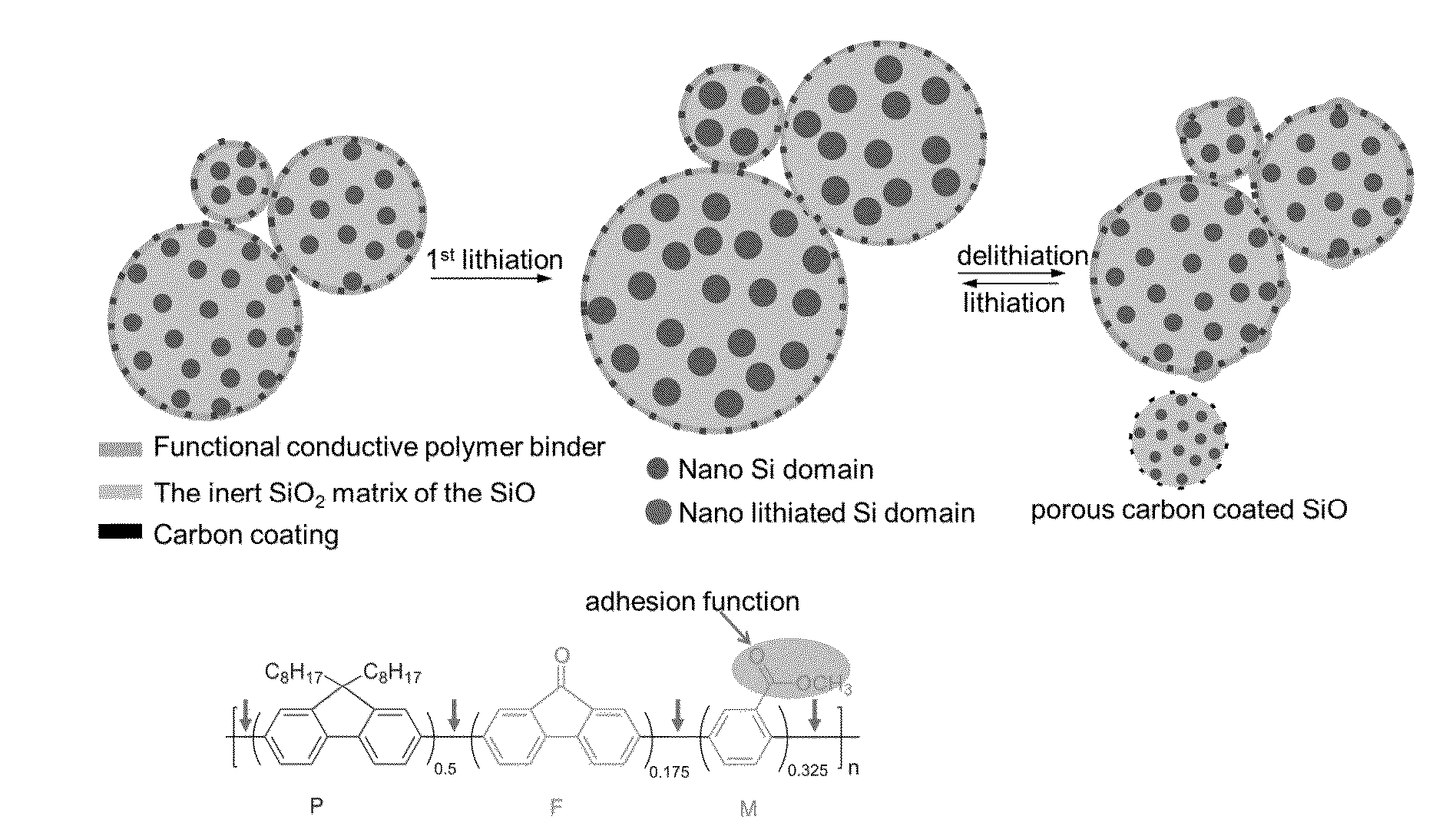
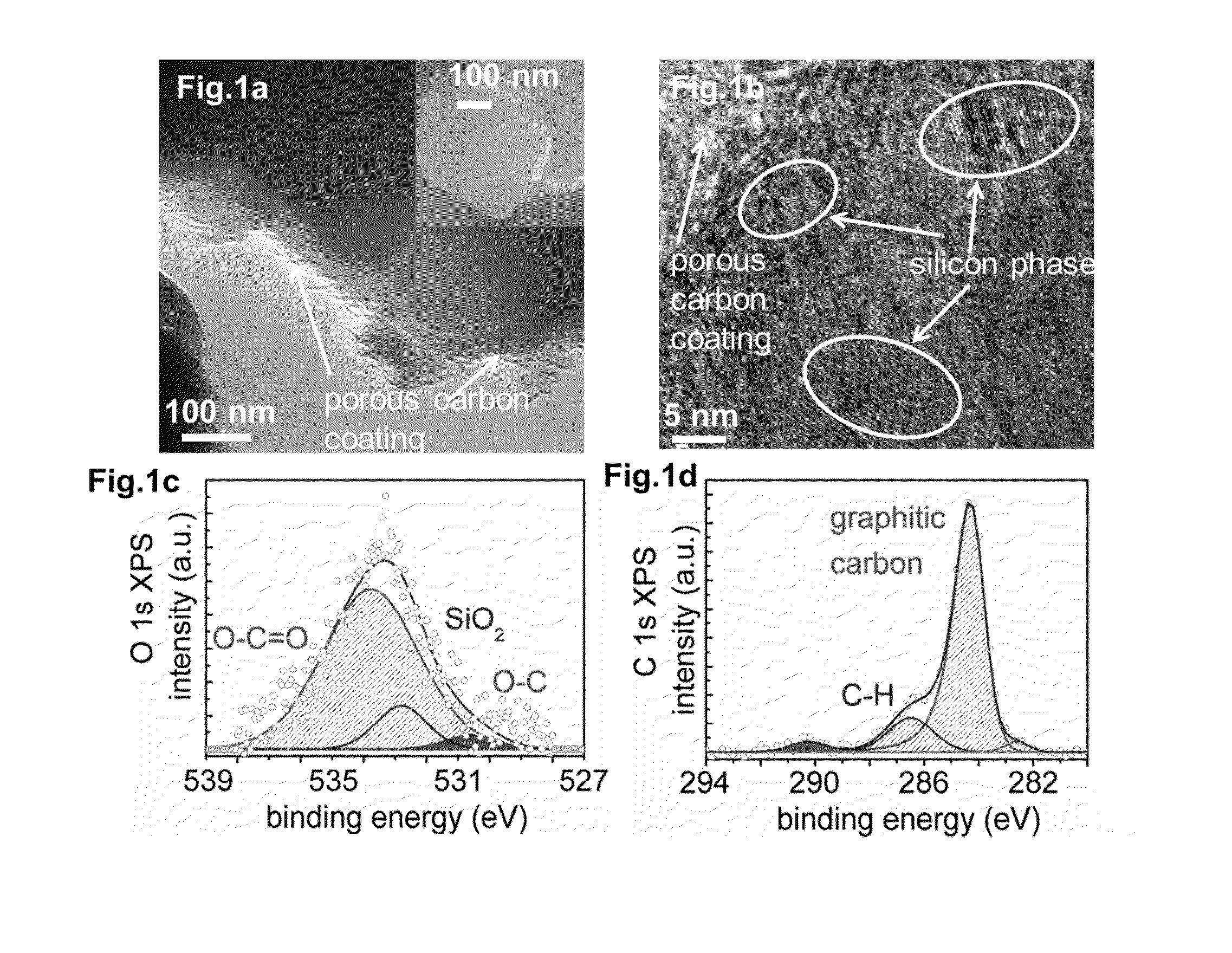
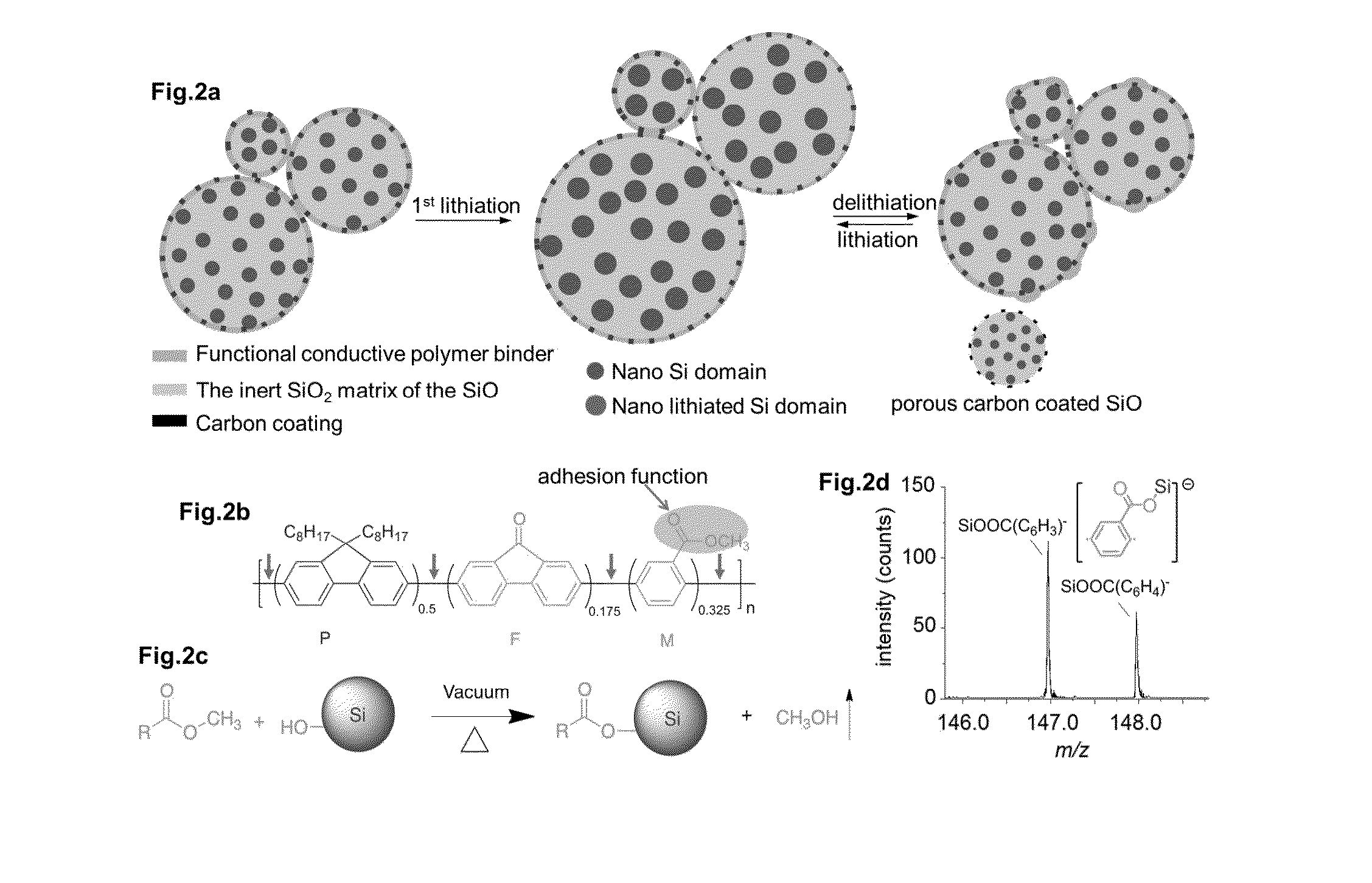
Porous Silicon Oxide (SiO) Anode Enabled by a Conductive Polymer Binder and Performance Enhancement by Stabilized Lithium Metal Power (SLMP)
PatentActiveUS20160164073A1
Innovation
- The use of silicon monoxide (SiO) with a conductive polymer binder, such as Poly (9,9-dioctylfluorene-co-fluorenone-co-methylbenzoic ester) (PFM), which provides strong adhesion and electronic conduction, combined with Stabilized Lithium Metal Powder (SLMP) prelithiation, to enhance the cycling stability and energy density of SiO electrodes, allowing for higher active material loading and improved mechanical integrity.

Manganese oxide containing material for electrodes and electrochemical devices using the electrodes
PatentInactiveUS20210013504A1
Innovation
- A composite material comprising manganese oxide and ion-active carbon, with alloying elements like silicon, germanium, and graphite, is used as an electrode, offering a low surface area and micro-scale structure that facilitates rapid charging and discharging while reducing electrolyte consumption and solid electrolyte interphase buildup.


Environmental Impact Assessment of Anode Material Production
The production of silicon oxide and manganese dioxide anode materials presents distinct environmental challenges that require comprehensive assessment across their respective manufacturing lifecycles. Silicon oxide anodes, primarily derived from silicon processing, involve energy-intensive purification and oxidation processes that generate significant carbon emissions. The manufacturing typically requires high-temperature furnace operations exceeding 1000°C, contributing to substantial energy consumption and associated greenhouse gas emissions.
Manganese dioxide production follows different pathways, with electrolytic and chemical precipitation methods being predominant. The electrolytic process consumes considerable electrical energy, while chemical routes often involve sulfuric acid treatment and generate acidic wastewater streams. Mining operations for manganese ore extraction create additional environmental burdens, including habitat disruption and potential heavy metal contamination of surrounding ecosystems.
Water consumption patterns differ significantly between these materials. Silicon oxide manufacturing requires extensive water usage for cooling and cleaning processes, generating silicon-containing wastewater that demands specialized treatment. Conversely, MnO2 production creates manganese-rich effluents with varying pH levels, necessitating neutralization and metal recovery systems to prevent environmental contamination.
Carbon footprint analysis reveals that silicon oxide anodes typically exhibit higher embodied energy due to the silicon purification requirements. The Siemens process, commonly used for silicon production, operates at temperatures around 1100°C and requires substantial electricity input. MnO2 manufacturing demonstrates lower energy intensity per unit mass but involves chemical processing steps that generate secondary waste streams requiring treatment.
Waste generation characteristics also vary considerably. Silicon oxide production generates silicon dust and off-gases containing volatile organic compounds, while MnO2 manufacturing produces manganese-containing sludges and spent electrolytes. The recyclability potential differs as well, with silicon-based materials offering better recovery prospects through established semiconductor industry recycling infrastructure compared to manganese compounds, which face more complex separation challenges in end-of-life processing scenarios.
Manganese dioxide production follows different pathways, with electrolytic and chemical precipitation methods being predominant. The electrolytic process consumes considerable electrical energy, while chemical routes often involve sulfuric acid treatment and generate acidic wastewater streams. Mining operations for manganese ore extraction create additional environmental burdens, including habitat disruption and potential heavy metal contamination of surrounding ecosystems.
Water consumption patterns differ significantly between these materials. Silicon oxide manufacturing requires extensive water usage for cooling and cleaning processes, generating silicon-containing wastewater that demands specialized treatment. Conversely, MnO2 production creates manganese-rich effluents with varying pH levels, necessitating neutralization and metal recovery systems to prevent environmental contamination.
Carbon footprint analysis reveals that silicon oxide anodes typically exhibit higher embodied energy due to the silicon purification requirements. The Siemens process, commonly used for silicon production, operates at temperatures around 1100°C and requires substantial electricity input. MnO2 manufacturing demonstrates lower energy intensity per unit mass but involves chemical processing steps that generate secondary waste streams requiring treatment.
Waste generation characteristics also vary considerably. Silicon oxide production generates silicon dust and off-gases containing volatile organic compounds, while MnO2 manufacturing produces manganese-containing sludges and spent electrolytes. The recyclability potential differs as well, with silicon-based materials offering better recovery prospects through established semiconductor industry recycling infrastructure compared to manganese compounds, which face more complex separation challenges in end-of-life processing scenarios.
Safety Standards for High-Performance Battery Anodes
The development of safety standards for high-performance battery anodes, particularly silicon oxide and manganese dioxide materials, has become increasingly critical as these technologies advance toward commercial deployment. Current regulatory frameworks primarily focus on traditional lithium-ion battery systems, creating significant gaps in addressing the unique safety challenges posed by next-generation anode materials operating under dynamic current conditions.
Silicon oxide anodes present distinct safety considerations due to their substantial volume expansion during lithium insertion, which can reach up to 300% compared to graphite anodes. This expansion creates mechanical stress that may lead to particle fracturing, electrolyte decomposition, and potential thermal runaway scenarios. Under pulsed current conditions, these effects are amplified as rapid charge-discharge cycles exacerbate structural degradation and heat generation. Existing safety standards inadequately address these volumetric changes and their cascading effects on cell integrity.
Manganese dioxide cathodes paired with advanced anodes introduce additional safety complexities, particularly regarding manganese dissolution and migration under high-rate pulsed operations. The dissolution of manganese ions can deposit on anode surfaces, creating localized hot spots and compromising the solid electrolyte interphase stability. Current safety protocols lack specific testing methodologies for evaluating manganese migration rates under pulsed current profiles.
The absence of standardized testing protocols for pulsed current applications represents a critical regulatory gap. Traditional constant current testing methods fail to capture the thermal and mechanical stresses experienced during real-world pulsed operations, such as those encountered in electric vehicle regenerative braking or grid storage applications. New safety standards must incorporate dynamic testing scenarios that simulate these operational conditions.
Thermal management requirements for high-performance anodes operating under pulsed currents demand updated safety specifications. The rapid heat generation and dissipation cycles create temperature gradients that existing thermal abuse testing cannot adequately evaluate. Safety standards must establish maximum temperature rise rates, thermal gradient limits, and cooling requirements specific to pulsed operation modes.
Gas generation monitoring protocols require enhancement to address the unique outgassing characteristics of silicon oxide anodes under pulsed conditions. The formation and evolution of gases during rapid cycling can create pressure buildup that exceeds current venting system designs, necessitating revised pressure relief specifications and gas composition analysis requirements for safety certification.
Silicon oxide anodes present distinct safety considerations due to their substantial volume expansion during lithium insertion, which can reach up to 300% compared to graphite anodes. This expansion creates mechanical stress that may lead to particle fracturing, electrolyte decomposition, and potential thermal runaway scenarios. Under pulsed current conditions, these effects are amplified as rapid charge-discharge cycles exacerbate structural degradation and heat generation. Existing safety standards inadequately address these volumetric changes and their cascading effects on cell integrity.
Manganese dioxide cathodes paired with advanced anodes introduce additional safety complexities, particularly regarding manganese dissolution and migration under high-rate pulsed operations. The dissolution of manganese ions can deposit on anode surfaces, creating localized hot spots and compromising the solid electrolyte interphase stability. Current safety protocols lack specific testing methodologies for evaluating manganese migration rates under pulsed current profiles.
The absence of standardized testing protocols for pulsed current applications represents a critical regulatory gap. Traditional constant current testing methods fail to capture the thermal and mechanical stresses experienced during real-world pulsed operations, such as those encountered in electric vehicle regenerative braking or grid storage applications. New safety standards must incorporate dynamic testing scenarios that simulate these operational conditions.
Thermal management requirements for high-performance anodes operating under pulsed currents demand updated safety specifications. The rapid heat generation and dissipation cycles create temperature gradients that existing thermal abuse testing cannot adequately evaluate. Safety standards must establish maximum temperature rise rates, thermal gradient limits, and cooling requirements specific to pulsed operation modes.
Gas generation monitoring protocols require enhancement to address the unique outgassing characteristics of silicon oxide anodes under pulsed conditions. The formation and evolution of gases during rapid cycling can create pressure buildup that exceeds current venting system designs, necessitating revised pressure relief specifications and gas composition analysis requirements for safety certification.
Unlock deeper insights with PatSnap Eureka Quick Research — get a full tech report to explore trends and direct your research. Try now!
Generate Your Research Report Instantly with AI Agent
Supercharge your innovation with PatSnap Eureka AI Agent Platform!