

Validate Tandem OLED outcoupling gain using angular EL integration
MAY 9, 202610 MIN READ
Generate Your Research Report Instantly with AI Agent
PatSnap Eureka helps you evaluate technical feasibility & market potential.
Tandem OLED Technology Background and Validation Goals
Tandem OLED technology represents a significant advancement in organic light-emitting diode architecture, where two or more emissive units are stacked vertically and connected through charge generation layers (CGLs). This configuration enables higher luminance output, improved power efficiency, and extended operational lifetime compared to conventional single-unit OLEDs. The technology has evolved from early research concepts in the 2000s to become a cornerstone of premium display applications, particularly in smartphones and high-end televisions.
The fundamental principle behind tandem OLEDs lies in the multiplication of photon generation through multiple emissive zones while maintaining similar driving voltages. Each emissive unit contributes to the overall light output, theoretically doubling or tripling the luminance efficiency depending on the number of stacked units. However, the practical implementation faces challenges related to optical interference, charge balance, and light extraction efficiency that require sophisticated engineering solutions.
Outcoupling efficiency represents one of the most critical performance metrics for tandem OLED devices, as it directly determines how effectively the internally generated photons can be extracted from the device structure. Traditional OLEDs suffer from significant light trapping due to total internal reflection at various interfaces, with typical outcoupling efficiencies ranging from 20-30%. In tandem structures, this challenge becomes more complex due to multiple emissive zones and additional layer interfaces that can further impede light extraction.
Angular electroluminescence integration has emerged as a precise validation methodology for quantifying outcoupling gains in tandem OLED structures. This approach involves measuring the electroluminescent intensity across a comprehensive range of viewing angles, typically from 0° to 80° or beyond, and integrating these measurements to calculate the total photon flux extracted from the device. The technique provides more accurate efficiency assessments compared to conventional forward-direction measurements alone.
The validation goals for tandem OLED outcoupling gain through angular EL integration encompass several key objectives. Primary among these is the accurate quantification of light extraction efficiency improvements achieved through tandem architecture compared to single-unit references. This involves establishing baseline measurements for conventional OLEDs and systematically comparing them with tandem variants under identical measurement conditions.
Secondary validation goals include characterizing the angular distribution patterns of emitted light, which can reveal insights into the optical behavior of different emissive units within the tandem stack. Understanding these patterns is crucial for optimizing device architecture and predicting performance in real-world applications where viewing angle characteristics significantly impact user experience.
The validation process also aims to establish correlations between theoretical predictions and experimental observations, enabling more accurate modeling of tandem OLED optical behavior. This correlation is essential for accelerating future device development and reducing the reliance on extensive experimental iterations during the design optimization phase.
The fundamental principle behind tandem OLEDs lies in the multiplication of photon generation through multiple emissive zones while maintaining similar driving voltages. Each emissive unit contributes to the overall light output, theoretically doubling or tripling the luminance efficiency depending on the number of stacked units. However, the practical implementation faces challenges related to optical interference, charge balance, and light extraction efficiency that require sophisticated engineering solutions.
Outcoupling efficiency represents one of the most critical performance metrics for tandem OLED devices, as it directly determines how effectively the internally generated photons can be extracted from the device structure. Traditional OLEDs suffer from significant light trapping due to total internal reflection at various interfaces, with typical outcoupling efficiencies ranging from 20-30%. In tandem structures, this challenge becomes more complex due to multiple emissive zones and additional layer interfaces that can further impede light extraction.
Angular electroluminescence integration has emerged as a precise validation methodology for quantifying outcoupling gains in tandem OLED structures. This approach involves measuring the electroluminescent intensity across a comprehensive range of viewing angles, typically from 0° to 80° or beyond, and integrating these measurements to calculate the total photon flux extracted from the device. The technique provides more accurate efficiency assessments compared to conventional forward-direction measurements alone.
The validation goals for tandem OLED outcoupling gain through angular EL integration encompass several key objectives. Primary among these is the accurate quantification of light extraction efficiency improvements achieved through tandem architecture compared to single-unit references. This involves establishing baseline measurements for conventional OLEDs and systematically comparing them with tandem variants under identical measurement conditions.
Secondary validation goals include characterizing the angular distribution patterns of emitted light, which can reveal insights into the optical behavior of different emissive units within the tandem stack. Understanding these patterns is crucial for optimizing device architecture and predicting performance in real-world applications where viewing angle characteristics significantly impact user experience.
The validation process also aims to establish correlations between theoretical predictions and experimental observations, enabling more accurate modeling of tandem OLED optical behavior. This correlation is essential for accelerating future device development and reducing the reliance on extensive experimental iterations during the design optimization phase.
Market Demand for High-Efficiency OLED Display Solutions
The global display industry is experiencing unprecedented demand for high-efficiency OLED solutions, driven by the convergence of consumer electronics evolution, sustainability requirements, and technological advancement needs. Premium smartphone manufacturers are increasingly adopting OLED displays as standard features, while the automotive sector demands energy-efficient displays for electric vehicles to maximize battery life. The proliferation of wearable devices, from smartwatches to AR glasses, requires displays that deliver exceptional visual quality while minimizing power consumption.
Market dynamics reveal that display efficiency directly correlates with device battery life, thermal management, and overall user experience. Tandem OLED architectures represent a critical technological pathway to address these market demands by potentially doubling luminous efficiency compared to conventional single-stack OLEDs. This efficiency improvement translates to reduced power consumption, extended device operation time, and enhanced display brightness capabilities that meet outdoor visibility requirements.
The premium display segment demonstrates strong willingness to adopt advanced OLED technologies, particularly in flagship smartphones, high-end tablets, and professional monitors where performance justifies premium pricing. Enterprise applications, including medical displays, industrial control panels, and automotive dashboard systems, prioritize efficiency and reliability over cost considerations, creating substantial market opportunities for validated high-efficiency OLED solutions.
Television manufacturers are increasingly focusing on large-area OLED displays where power efficiency becomes critical for consumer acceptance and regulatory compliance. The growing emphasis on energy efficiency ratings and environmental certifications in major markets drives demand for displays that demonstrate measurable efficiency improvements through rigorous validation methodologies.
Emerging applications in augmented reality, virtual reality, and mixed reality devices present particularly demanding efficiency requirements due to battery constraints and thermal limitations in compact form factors. These applications require displays that maintain high brightness and color accuracy while operating within strict power budgets, making validated tandem OLED efficiency gains essential for market viability.
The market increasingly values quantifiable performance metrics backed by standardized measurement techniques, as manufacturers seek to differentiate their products through verified efficiency claims rather than theoretical specifications.
Market dynamics reveal that display efficiency directly correlates with device battery life, thermal management, and overall user experience. Tandem OLED architectures represent a critical technological pathway to address these market demands by potentially doubling luminous efficiency compared to conventional single-stack OLEDs. This efficiency improvement translates to reduced power consumption, extended device operation time, and enhanced display brightness capabilities that meet outdoor visibility requirements.
The premium display segment demonstrates strong willingness to adopt advanced OLED technologies, particularly in flagship smartphones, high-end tablets, and professional monitors where performance justifies premium pricing. Enterprise applications, including medical displays, industrial control panels, and automotive dashboard systems, prioritize efficiency and reliability over cost considerations, creating substantial market opportunities for validated high-efficiency OLED solutions.
Television manufacturers are increasingly focusing on large-area OLED displays where power efficiency becomes critical for consumer acceptance and regulatory compliance. The growing emphasis on energy efficiency ratings and environmental certifications in major markets drives demand for displays that demonstrate measurable efficiency improvements through rigorous validation methodologies.
Emerging applications in augmented reality, virtual reality, and mixed reality devices present particularly demanding efficiency requirements due to battery constraints and thermal limitations in compact form factors. These applications require displays that maintain high brightness and color accuracy while operating within strict power budgets, making validated tandem OLED efficiency gains essential for market viability.
The market increasingly values quantifiable performance metrics backed by standardized measurement techniques, as manufacturers seek to differentiate their products through verified efficiency claims rather than theoretical specifications.
Current Challenges in OLED Outcoupling Efficiency Measurement
OLED outcoupling efficiency measurement faces significant technical challenges that directly impact the accurate validation of tandem OLED performance gains. Traditional measurement approaches often rely on simplified assumptions about light distribution patterns, leading to substantial discrepancies between theoretical predictions and actual device performance. The complexity of measuring true outcoupling efficiency stems from the intricate optical phenomena occurring within multilayer OLED structures, where light propagation involves multiple interfaces, waveguiding effects, and angular-dependent emission characteristics.
Current measurement methodologies predominantly utilize integrating sphere systems for total luminous flux collection, but these approaches fail to capture the complete angular distribution of emitted light. The spherical geometry assumption inherent in many measurement setups introduces systematic errors, particularly when dealing with tandem OLED architectures that exhibit complex emission profiles. These devices often demonstrate non-Lambertian emission patterns due to microcavity effects and interference phenomena between multiple emissive layers, making conventional measurement techniques inadequate for precise efficiency quantification.
Angular electroluminescence measurement presents unique instrumentation challenges, requiring sophisticated goniometric setups capable of capturing emission data across the entire hemisphere above the device surface. The precision requirements for angular resolution, typically demanding sub-degree accuracy, necessitate advanced positioning systems and highly sensitive photodetectors. Environmental factors such as temperature stability, vibration isolation, and stray light elimination become critical parameters that significantly influence measurement reliability and repeatability.
Data processing and integration algorithms represent another substantial challenge in current OLED outcoupling efficiency measurement protocols. Converting angular emission data into meaningful outcoupling efficiency metrics requires complex mathematical frameworks that account for refractive index variations, substrate effects, and encapsulation influences. The computational intensity of these calculations, particularly when processing high-resolution angular datasets, often leads to simplified approximations that compromise measurement accuracy.
Standardization gaps across the industry further complicate comparative analysis of OLED outcoupling performance. Different research institutions and manufacturers employ varying measurement protocols, angular sampling strategies, and data interpretation methods, resulting in inconsistent efficiency values for similar device architectures. The absence of universally accepted measurement standards particularly affects tandem OLED validation, where small efficiency improvements must be distinguished from measurement uncertainties.
Temporal stability during measurement cycles poses additional complications, as OLED devices exhibit aging effects and thermal drift that can influence emission characteristics throughout extended angular scanning procedures. The time required for comprehensive angular measurements often exceeds device stability windows, introducing systematic errors that mask true outcoupling performance. These temporal effects become particularly pronounced in tandem structures where multiple emissive layers may exhibit different degradation rates, complicating the interpretation of efficiency measurements over time.
Current measurement methodologies predominantly utilize integrating sphere systems for total luminous flux collection, but these approaches fail to capture the complete angular distribution of emitted light. The spherical geometry assumption inherent in many measurement setups introduces systematic errors, particularly when dealing with tandem OLED architectures that exhibit complex emission profiles. These devices often demonstrate non-Lambertian emission patterns due to microcavity effects and interference phenomena between multiple emissive layers, making conventional measurement techniques inadequate for precise efficiency quantification.
Angular electroluminescence measurement presents unique instrumentation challenges, requiring sophisticated goniometric setups capable of capturing emission data across the entire hemisphere above the device surface. The precision requirements for angular resolution, typically demanding sub-degree accuracy, necessitate advanced positioning systems and highly sensitive photodetectors. Environmental factors such as temperature stability, vibration isolation, and stray light elimination become critical parameters that significantly influence measurement reliability and repeatability.
Data processing and integration algorithms represent another substantial challenge in current OLED outcoupling efficiency measurement protocols. Converting angular emission data into meaningful outcoupling efficiency metrics requires complex mathematical frameworks that account for refractive index variations, substrate effects, and encapsulation influences. The computational intensity of these calculations, particularly when processing high-resolution angular datasets, often leads to simplified approximations that compromise measurement accuracy.
Standardization gaps across the industry further complicate comparative analysis of OLED outcoupling performance. Different research institutions and manufacturers employ varying measurement protocols, angular sampling strategies, and data interpretation methods, resulting in inconsistent efficiency values for similar device architectures. The absence of universally accepted measurement standards particularly affects tandem OLED validation, where small efficiency improvements must be distinguished from measurement uncertainties.
Temporal stability during measurement cycles poses additional complications, as OLED devices exhibit aging effects and thermal drift that can influence emission characteristics throughout extended angular scanning procedures. The time required for comprehensive angular measurements often exceeds device stability windows, introducing systematic errors that mask true outcoupling performance. These temporal effects become particularly pronounced in tandem structures where multiple emissive layers may exhibit different degradation rates, complicating the interpretation of efficiency measurements over time.
Existing Angular EL Integration Solutions for OLED Validation
01 Optical coupling structures for enhanced light extraction
Various optical coupling structures can be integrated into tandem OLED devices to improve light outcoupling efficiency. These structures include microlens arrays, light extraction layers, and surface texturing techniques that help redirect internally trapped light toward the viewing direction. The implementation of such structures can significantly increase the overall luminous efficiency of tandem OLED displays by reducing total internal reflection losses.- Light extraction enhancement structures: Various optical structures can be incorporated into tandem OLED devices to improve light outcoupling efficiency. These structures include microlens arrays, light extraction layers, and surface texturing that help redirect trapped light modes toward useful viewing angles. The enhancement structures can be positioned at different interfaces within the device stack to maximize photon extraction from multiple emissive layers.
- Intermediate connector layers optimization: The design and material selection of charge generation layers between emissive units significantly impacts outcoupling performance in tandem structures. Proper engineering of these intermediate layers ensures efficient charge injection while minimizing optical losses. The refractive index matching and thickness optimization of connector layers can enhance overall light extraction efficiency.
- Substrate and encapsulation modifications: Modifications to the substrate and encapsulation layers can significantly improve light outcoupling in tandem OLED devices. These approaches include using high refractive index substrates, incorporating scattering particles, and optimizing the substrate-device interface. Advanced encapsulation techniques that maintain optical properties while providing protection can further enhance light extraction efficiency.
- Optical cavity design and management: Careful design of optical cavities within tandem OLED structures can optimize light outcoupling by controlling interference effects and mode coupling. This involves precise control of layer thicknesses, refractive indices, and the positioning of emissive zones within the optical stack. Proper cavity design can enhance extraction efficiency while maintaining color stability and viewing angle characteristics.
- External outcoupling enhancement techniques: External optical elements and surface treatments can be applied to tandem OLED devices to improve light extraction beyond internal modifications. These techniques include anti-reflection coatings, external scattering films, and specialized optical films that can be laminated or attached to the device surface. Such approaches provide additional pathways for trapped light to escape the device structure.
02 Intermediate connector layers optimization
The design and optimization of intermediate connector layers between multiple OLED units in tandem structures plays a crucial role in outcoupling performance. These layers facilitate charge injection and transport while maintaining optical transparency. Proper selection of materials and thickness optimization of these intermediate layers can enhance both electrical performance and light extraction efficiency in tandem configurations.Expand Specific Solutions03 Substrate and electrode modifications for improved outcoupling
Modifications to substrate materials and electrode configurations can significantly impact light outcoupling in tandem OLED devices. This includes the use of high refractive index substrates, transparent conductive materials with optimized optical properties, and electrode patterning techniques. These approaches help minimize optical losses and improve the overall light extraction efficiency from the device stack.Expand Specific Solutions04 Wavelength-specific outcoupling enhancement techniques
Specialized techniques for enhancing outcoupling of specific wavelengths or color components in tandem OLED structures involve the use of wavelength-selective optical elements, color conversion layers, and spectral management approaches. These methods can optimize the color gamut and efficiency for different emission wavelengths while maintaining the advantages of tandem architecture.Expand Specific Solutions05 Advanced device architectures for outcoupling optimization
Novel device architectures and structural designs specifically developed for tandem OLED outcoupling enhancement include inverted structures, multi-stack configurations, and hybrid organic-inorganic approaches. These advanced architectures aim to maximize light extraction while maintaining the electrical and operational benefits of tandem OLED technology, often incorporating multiple optimization strategies simultaneously.Expand Specific Solutions
Key Players in Tandem OLED and Measurement Equipment Industry
The tandem OLED outcoupling validation technology represents a rapidly evolving segment within the mature OLED display industry, which has reached substantial market scale exceeding $30 billion globally. The competitive landscape is characterized by advanced-stage development with established players like Samsung Display, BOE Technology, and LG Display (through Global OLED Technology) leading manufacturing capabilities, while companies such as Novaled, Merck Patent, and Applied Materials provide critical materials and equipment solutions. Technology maturity varies significantly across participants, with Asian manufacturers like Japan Display, Innolux, and Tianma demonstrating strong production expertise, while research institutions including University of Michigan and National Taiwan University contribute fundamental research. The angular electroluminescence integration approach for validating outcoupling efficiency represents a sophisticated measurement technique that requires both advanced optical characterization capabilities and deep understanding of OLED physics, positioning this as a specialized but crucial technology area for next-generation high-efficiency OLED development.
BOE Technology Group Co., Ltd.
Technical Solution: BOE has developed comprehensive tandem OLED technologies focusing on outcoupling optimization through advanced optical simulation and experimental validation. Their technical approach combines theoretical modeling with practical angular EL measurement systems to quantify light extraction improvements. The company implements specialized outcoupling structures including textured substrates, scattering layers, and optimized electrode configurations in their tandem OLED designs. BOE's validation methodology involves systematic angular EL integration measurements using calibrated goniophotometer systems to assess luminous efficacy enhancements. Their research encompasses both bottom-emission and top-emission tandem OLED configurations, with particular emphasis on maximizing photon extraction efficiency through careful optical design and material selection.
Strengths: Strong manufacturing capabilities and growing expertise in OLED technology development with cost-effective solutions. Weaknesses: Relatively newer player compared to established competitors, requiring continued investment in advanced R&D.
Samsung Display Co., Ltd.
Technical Solution: Samsung Display has developed advanced tandem OLED structures with sophisticated outcoupling enhancement technologies. Their approach involves implementing microlens arrays and light extraction layers to improve photon extraction efficiency. The company utilizes comprehensive angular electroluminescence (EL) measurement systems to validate outcoupling gains across different viewing angles. Their tandem OLED architecture incorporates charge generation layers between multiple emissive units, enabling higher brightness and efficiency. Samsung's validation methodology includes detailed angular EL integration protocols that measure luminous intensity distribution patterns and calculate total luminous flux improvements. The company has demonstrated significant outcoupling efficiency enhancements through their proprietary light management technologies integrated into tandem OLED structures.
Strengths: Leading market position with extensive R&D resources and proven tandem OLED manufacturing capabilities. Weaknesses: High development costs and complex manufacturing processes that may limit scalability.
Core Patents in Tandem OLED Outcoupling Enhancement
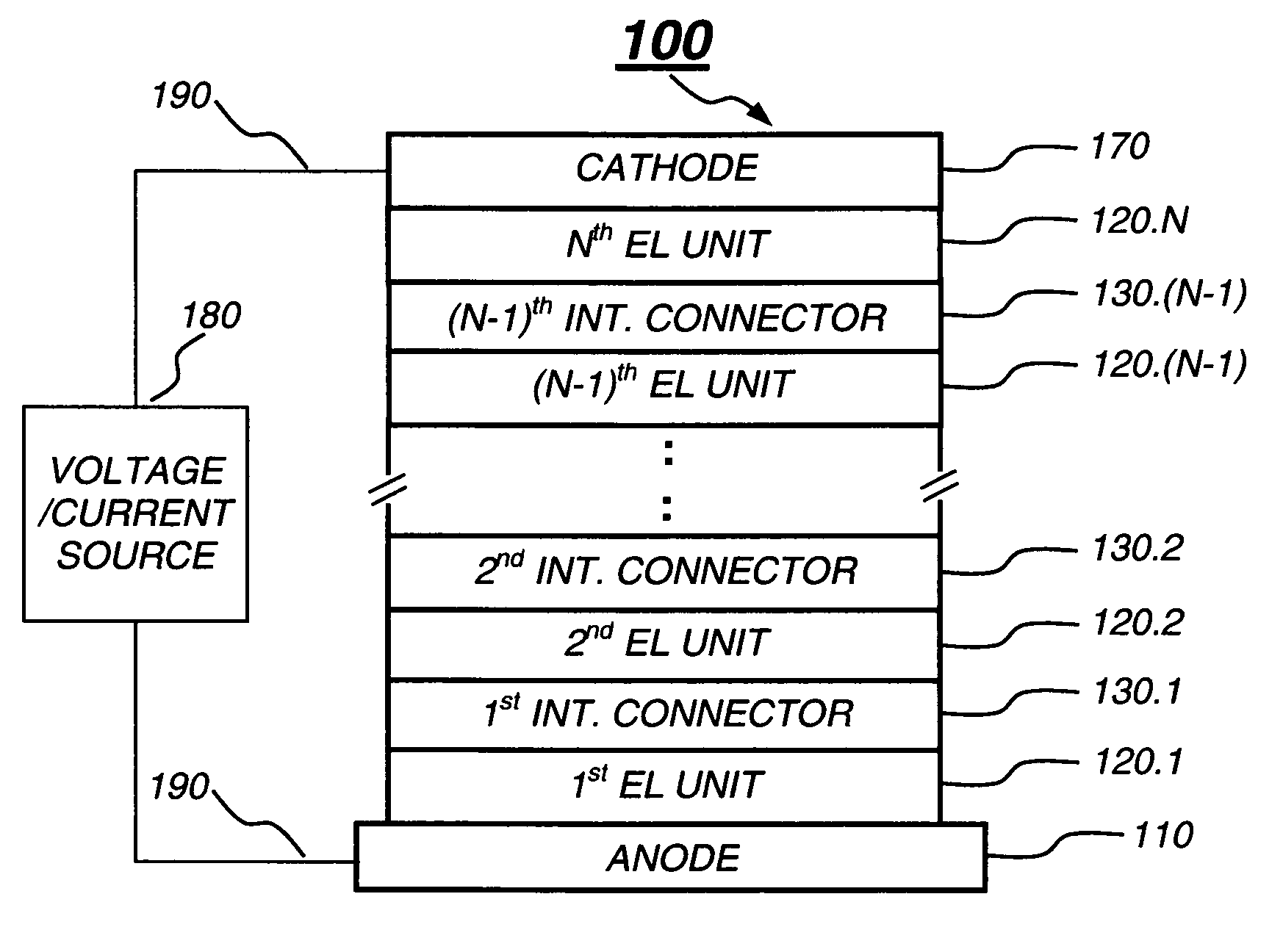
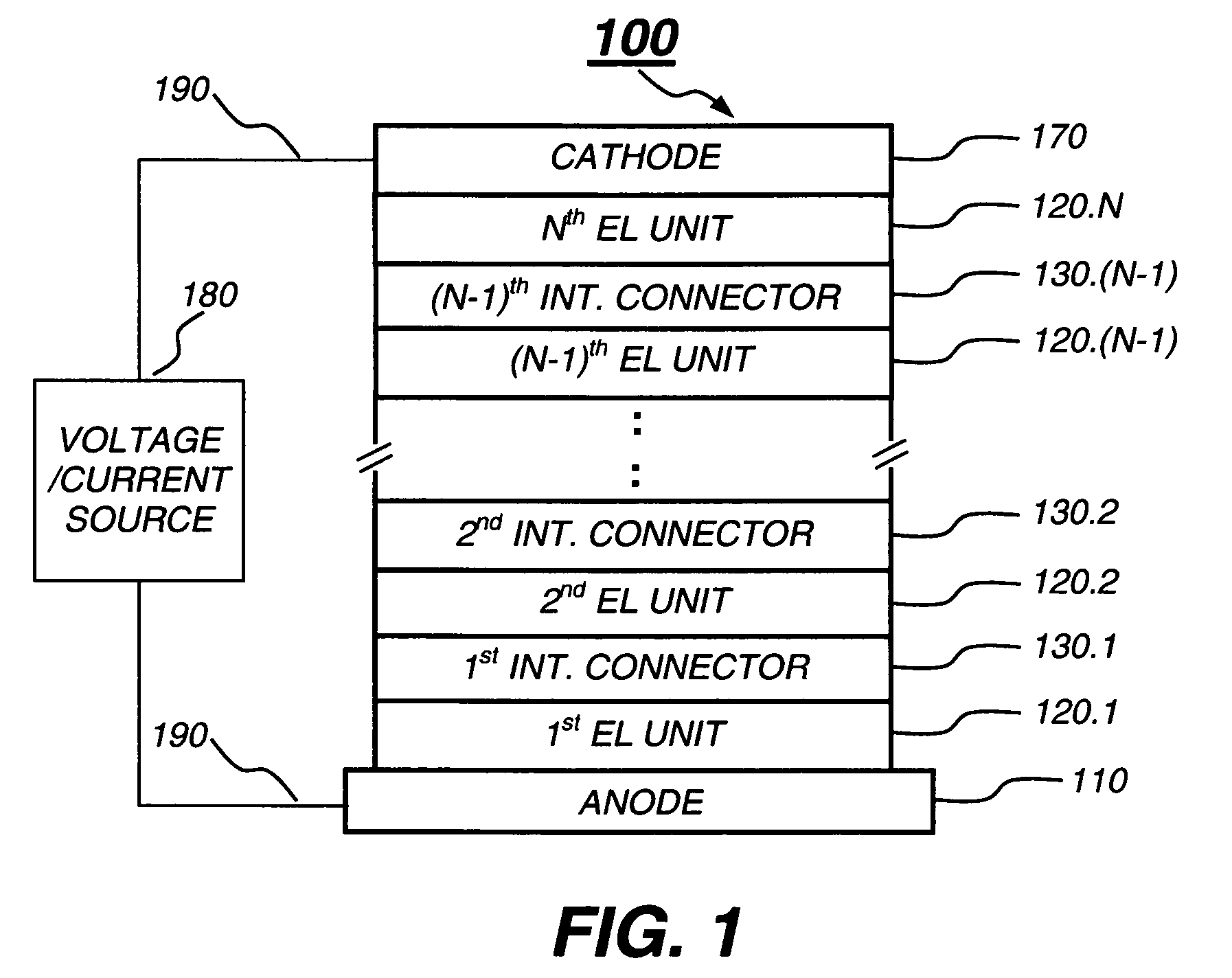
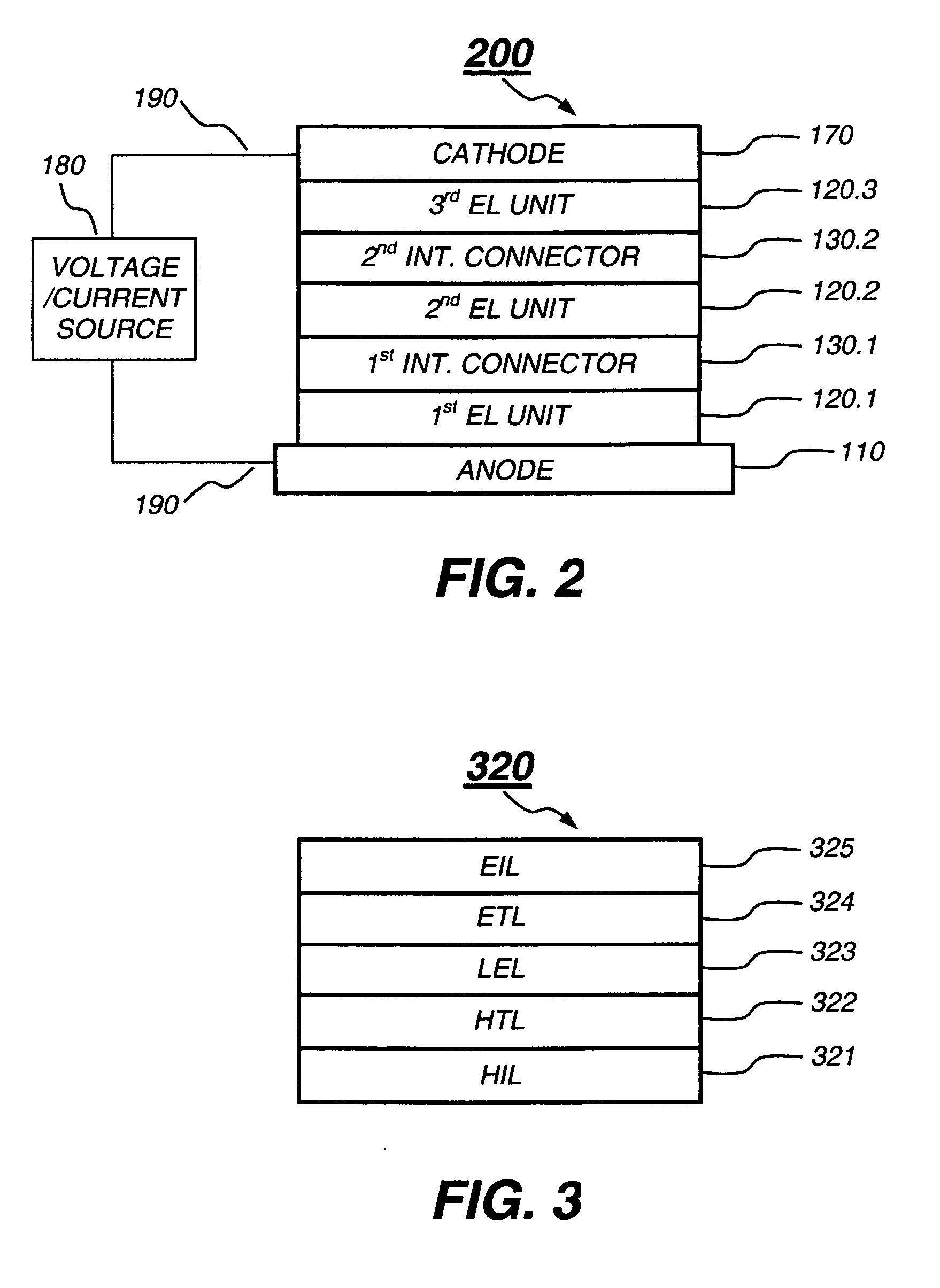
Tandem OLED device with intermediate connector
PatentActiveUS20090191428A1
Innovation
- A tandem OLED device structure incorporating at least two electroluminescent units with an intermediate connector featuring an n-doped organic layer and an electron-accepting layer, where the electron-accepting layer is closer to the cathode, and the n-doped organic layer includes alkali metal and an organic alkali metal complex, enhancing carrier injection and optical transparency.


Tandem OLEDs having low drive voltage
PatentInactiveUS7075231B1
Innovation
- A tandem OLED structure is designed with multiple electroluminescent units and thin intermediate connectors, optimizing layer thickness to ensure a voltage drop of less than 4.0 V×N, allowing for low drive voltage operation compatible with TFT drive circuitry, using a five-layer EL unit structure with thin light-emitting layers and metal compound or high work function metal intermediate connectors.

Standardization Requirements for OLED Performance Testing
The standardization of OLED performance testing methodologies has become increasingly critical as the industry seeks to establish reliable benchmarks for tandem OLED outcoupling efficiency validation. Current testing protocols lack comprehensive frameworks for angular electroluminescence integration measurements, creating significant gaps in performance assessment capabilities across different manufacturers and research institutions.
International standardization bodies including the International Electrotechnical Commission and the Society for Information Display have initiated preliminary discussions regarding unified testing standards for advanced OLED architectures. However, existing standards primarily address conventional single-layer OLED structures and fail to adequately address the complexities inherent in tandem configurations where multiple emissive layers contribute to overall light extraction efficiency.
The development of standardized angular EL integration protocols requires establishing precise measurement geometries, calibrated detection systems, and normalized data processing algorithms. Key parameters that must be standardized include angular resolution requirements, spectral measurement ranges, temporal stability criteria, and environmental testing conditions. These specifications are essential for ensuring reproducible and comparable results across different testing facilities and equipment configurations.
Measurement uncertainty quantification represents another critical aspect of standardization requirements. The integration of angular-dependent electroluminescence data involves complex mathematical operations that can amplify measurement errors if not properly controlled. Standardized uncertainty budgets must account for detector calibration accuracy, angular positioning precision, spectral response variations, and statistical sampling limitations inherent in the integration process.
Traceability to international measurement standards poses additional challenges for OLED performance testing standardization. Unlike conventional photometric measurements, angular EL integration requires specialized reference materials and calibration procedures that are not yet widely available through national metrology institutes. The development of certified reference OLEDs with known outcoupling characteristics would significantly enhance measurement reliability and inter-laboratory comparability.
Data reporting formats and calculation methodologies also require standardization to facilitate meaningful performance comparisons. Standardized metrics for outcoupling gain quantification, including appropriate normalization procedures and statistical analysis requirements, must be established to enable effective benchmarking of tandem OLED technologies across different device architectures and material systems.
International standardization bodies including the International Electrotechnical Commission and the Society for Information Display have initiated preliminary discussions regarding unified testing standards for advanced OLED architectures. However, existing standards primarily address conventional single-layer OLED structures and fail to adequately address the complexities inherent in tandem configurations where multiple emissive layers contribute to overall light extraction efficiency.
The development of standardized angular EL integration protocols requires establishing precise measurement geometries, calibrated detection systems, and normalized data processing algorithms. Key parameters that must be standardized include angular resolution requirements, spectral measurement ranges, temporal stability criteria, and environmental testing conditions. These specifications are essential for ensuring reproducible and comparable results across different testing facilities and equipment configurations.
Measurement uncertainty quantification represents another critical aspect of standardization requirements. The integration of angular-dependent electroluminescence data involves complex mathematical operations that can amplify measurement errors if not properly controlled. Standardized uncertainty budgets must account for detector calibration accuracy, angular positioning precision, spectral response variations, and statistical sampling limitations inherent in the integration process.
Traceability to international measurement standards poses additional challenges for OLED performance testing standardization. Unlike conventional photometric measurements, angular EL integration requires specialized reference materials and calibration procedures that are not yet widely available through national metrology institutes. The development of certified reference OLEDs with known outcoupling characteristics would significantly enhance measurement reliability and inter-laboratory comparability.
Data reporting formats and calculation methodologies also require standardization to facilitate meaningful performance comparisons. Standardized metrics for outcoupling gain quantification, including appropriate normalization procedures and statistical analysis requirements, must be established to enable effective benchmarking of tandem OLED technologies across different device architectures and material systems.
Environmental Impact Assessment of Advanced OLED Technologies
The environmental implications of advanced OLED technologies, particularly tandem OLED structures with enhanced outcoupling mechanisms, present a complex landscape of both challenges and opportunities for sustainable display manufacturing. As the industry moves toward more sophisticated architectures that maximize light extraction efficiency through angular electroluminescence optimization, the environmental footprint of these technologies requires comprehensive evaluation across their entire lifecycle.
Manufacturing processes for tandem OLED devices with advanced outcoupling structures typically involve additional material layers and more complex fabrication procedures compared to conventional single-stack OLEDs. These enhanced architectures often incorporate specialized optical films, nanostructured substrates, or microlens arrays to improve light extraction efficiency. The production of these components introduces additional chemical precursors, solvents, and energy-intensive processing steps that can increase the overall environmental burden during manufacturing.
Material consumption patterns in advanced OLED technologies reflect both positive and negative environmental trends. While tandem structures require more organic materials and metal electrodes per device, the improved efficiency achieved through optimized outcoupling can reduce the operational energy consumption significantly. This efficiency gain becomes particularly relevant when considering the total environmental impact over the device's operational lifetime, as reduced power consumption translates to lower carbon emissions from electricity generation.
Waste generation and material recovery present unique challenges for advanced OLED technologies. The complex multi-layer structures and specialized outcoupling enhancement materials can complicate recycling processes. However, the longer operational lifespans typically associated with more efficient tandem devices may offset some of these concerns by reducing the frequency of device replacement and associated waste generation.
Energy consumption analysis reveals that while manufacturing energy requirements increase for advanced OLED structures, the operational energy savings can be substantial. Devices with optimized angular electroluminescence characteristics and enhanced outcoupling efficiency can achieve 30-50% improvements in power efficiency compared to conventional architectures. This improvement directly translates to reduced environmental impact during the use phase, which typically represents the largest portion of a display device's total environmental footprint.
The carbon footprint assessment of these technologies must consider both direct and indirect emissions throughout the supply chain. Advanced outcoupling technologies may require rare earth materials or specialized manufacturing equipment that contribute to upstream emissions. However, the extended device lifetimes and improved energy efficiency can result in net positive environmental benefits when evaluated over complete product lifecycles.
Manufacturing processes for tandem OLED devices with advanced outcoupling structures typically involve additional material layers and more complex fabrication procedures compared to conventional single-stack OLEDs. These enhanced architectures often incorporate specialized optical films, nanostructured substrates, or microlens arrays to improve light extraction efficiency. The production of these components introduces additional chemical precursors, solvents, and energy-intensive processing steps that can increase the overall environmental burden during manufacturing.
Material consumption patterns in advanced OLED technologies reflect both positive and negative environmental trends. While tandem structures require more organic materials and metal electrodes per device, the improved efficiency achieved through optimized outcoupling can reduce the operational energy consumption significantly. This efficiency gain becomes particularly relevant when considering the total environmental impact over the device's operational lifetime, as reduced power consumption translates to lower carbon emissions from electricity generation.
Waste generation and material recovery present unique challenges for advanced OLED technologies. The complex multi-layer structures and specialized outcoupling enhancement materials can complicate recycling processes. However, the longer operational lifespans typically associated with more efficient tandem devices may offset some of these concerns by reducing the frequency of device replacement and associated waste generation.
Energy consumption analysis reveals that while manufacturing energy requirements increase for advanced OLED structures, the operational energy savings can be substantial. Devices with optimized angular electroluminescence characteristics and enhanced outcoupling efficiency can achieve 30-50% improvements in power efficiency compared to conventional architectures. This improvement directly translates to reduced environmental impact during the use phase, which typically represents the largest portion of a display device's total environmental footprint.
The carbon footprint assessment of these technologies must consider both direct and indirect emissions throughout the supply chain. Advanced outcoupling technologies may require rare earth materials or specialized manufacturing equipment that contribute to upstream emissions. However, the extended device lifetimes and improved energy efficiency can result in net positive environmental benefits when evaluated over complete product lifecycles.
Unlock deeper insights with PatSnap Eureka Quick Research — get a full tech report to explore trends and direct your research. Try now!
Generate Your Research Report Instantly with AI Agent
Supercharge your innovation with PatSnap Eureka AI Agent Platform!