
Waveguide Gratings for Aerospace: Navigational Precision
APR 14, 20269 MIN READ
Generate Your Research Report Instantly with AI Agent
Patsnap Eureka helps you evaluate technical feasibility & market potential.
Waveguide Grating Technology Background and Aerospace Navigation Goals
Waveguide grating technology represents a sophisticated optical engineering discipline that has evolved significantly since the mid-20th century. Initially developed for telecommunications applications, this technology leverages the principles of diffraction and interference to manipulate electromagnetic waves within confined optical pathways. The fundamental concept involves creating periodic structures within or on waveguides that can selectively filter, reflect, or redirect specific wavelengths of light with exceptional precision.
The aerospace industry's adoption of waveguide gratings emerged from the critical need for enhanced navigational accuracy in increasingly complex flight environments. Traditional navigation systems, while reliable, face limitations in precision and susceptibility to external interference. The integration of photonic technologies, particularly waveguide gratings, offers unprecedented opportunities to achieve sub-meter accuracy in positioning systems, essential for autonomous flight operations and precision landing procedures.
Historical development of this technology traces back to fiber Bragg gratings in the 1970s, which demonstrated the potential for wavelength-selective optical components. The aerospace sector recognized the transformative potential of these devices for creating robust, lightweight, and highly accurate sensing systems. The evolution progressed through planar waveguide implementations in the 1990s, leading to today's sophisticated integrated photonic platforms capable of supporting complex navigational algorithms.
Current aerospace navigation goals center on achieving centimeter-level positioning accuracy while maintaining system reliability in harsh environmental conditions. The technology aims to address challenges including GPS signal degradation, electromagnetic interference, and the need for backup navigation systems in critical flight phases. Waveguide gratings enable the development of inertial navigation systems with enhanced stability and reduced drift characteristics.
The strategic importance of this technology extends beyond conventional navigation applications. Future aerospace missions demand autonomous operation capabilities, requiring navigation systems that can function independently of ground-based infrastructure. Waveguide grating-based sensors offer the potential for self-calibrating systems that maintain accuracy over extended operational periods, crucial for deep space missions and unmanned aerial vehicle operations in contested environments.
The aerospace industry's adoption of waveguide gratings emerged from the critical need for enhanced navigational accuracy in increasingly complex flight environments. Traditional navigation systems, while reliable, face limitations in precision and susceptibility to external interference. The integration of photonic technologies, particularly waveguide gratings, offers unprecedented opportunities to achieve sub-meter accuracy in positioning systems, essential for autonomous flight operations and precision landing procedures.
Historical development of this technology traces back to fiber Bragg gratings in the 1970s, which demonstrated the potential for wavelength-selective optical components. The aerospace sector recognized the transformative potential of these devices for creating robust, lightweight, and highly accurate sensing systems. The evolution progressed through planar waveguide implementations in the 1990s, leading to today's sophisticated integrated photonic platforms capable of supporting complex navigational algorithms.
Current aerospace navigation goals center on achieving centimeter-level positioning accuracy while maintaining system reliability in harsh environmental conditions. The technology aims to address challenges including GPS signal degradation, electromagnetic interference, and the need for backup navigation systems in critical flight phases. Waveguide gratings enable the development of inertial navigation systems with enhanced stability and reduced drift characteristics.
The strategic importance of this technology extends beyond conventional navigation applications. Future aerospace missions demand autonomous operation capabilities, requiring navigation systems that can function independently of ground-based infrastructure. Waveguide grating-based sensors offer the potential for self-calibrating systems that maintain accuracy over extended operational periods, crucial for deep space missions and unmanned aerial vehicle operations in contested environments.
Market Demand for High-Precision Aerospace Navigation Systems
The aerospace industry is experiencing unprecedented growth in demand for high-precision navigation systems, driven by the increasing complexity of modern aircraft operations and the stringent safety requirements of both commercial and military aviation sectors. This surge in demand stems from the critical need for enhanced navigational accuracy in congested airspace, autonomous flight operations, and precision landing systems under adverse weather conditions.
Commercial aviation represents the largest market segment, with airlines seeking advanced navigation solutions to optimize flight paths, reduce fuel consumption, and ensure passenger safety. The integration of waveguide grating technology into inertial navigation systems offers significant advantages over traditional gyroscopic systems, including improved resistance to electromagnetic interference and enhanced long-term stability. Major aircraft manufacturers are increasingly specifying high-precision navigation requirements for next-generation aircraft platforms.
Military and defense applications constitute another substantial market driver, where mission-critical operations demand navigation systems with exceptional accuracy and reliability. Modern military aircraft require navigation precision for tactical operations, weapon delivery systems, and stealth mission profiles. The defense sector's emphasis on GPS-denied environments has intensified the need for autonomous navigation solutions that can maintain accuracy without external reference signals.
The emerging unmanned aerial vehicle market presents significant growth opportunities for waveguide grating-based navigation systems. As UAV operations expand into commercial applications such as cargo delivery, surveillance, and emergency response, regulatory authorities are mandating sophisticated navigation capabilities to ensure safe integration into civilian airspace. These platforms require lightweight, compact navigation systems that maintain high precision over extended operational periods.
Space exploration missions represent a specialized but high-value market segment where navigation precision is paramount. Spacecraft and satellite platforms operating in deep space environments require navigation systems capable of maintaining accuracy over vast distances and extended mission durations. Waveguide grating technology offers unique advantages in these applications due to its inherent stability and resistance to radiation-induced drift.
The market demand is further amplified by regulatory developments mandating enhanced navigation performance standards. Aviation authorities worldwide are implementing stricter requirements for Required Navigation Performance capabilities, driving retrofit demand in existing aircraft fleets. This regulatory push creates sustained market opportunities beyond new aircraft production, encompassing the substantial installed base of commercial and military aircraft requiring navigation system upgrades.
Commercial aviation represents the largest market segment, with airlines seeking advanced navigation solutions to optimize flight paths, reduce fuel consumption, and ensure passenger safety. The integration of waveguide grating technology into inertial navigation systems offers significant advantages over traditional gyroscopic systems, including improved resistance to electromagnetic interference and enhanced long-term stability. Major aircraft manufacturers are increasingly specifying high-precision navigation requirements for next-generation aircraft platforms.
Military and defense applications constitute another substantial market driver, where mission-critical operations demand navigation systems with exceptional accuracy and reliability. Modern military aircraft require navigation precision for tactical operations, weapon delivery systems, and stealth mission profiles. The defense sector's emphasis on GPS-denied environments has intensified the need for autonomous navigation solutions that can maintain accuracy without external reference signals.
The emerging unmanned aerial vehicle market presents significant growth opportunities for waveguide grating-based navigation systems. As UAV operations expand into commercial applications such as cargo delivery, surveillance, and emergency response, regulatory authorities are mandating sophisticated navigation capabilities to ensure safe integration into civilian airspace. These platforms require lightweight, compact navigation systems that maintain high precision over extended operational periods.
Space exploration missions represent a specialized but high-value market segment where navigation precision is paramount. Spacecraft and satellite platforms operating in deep space environments require navigation systems capable of maintaining accuracy over vast distances and extended mission durations. Waveguide grating technology offers unique advantages in these applications due to its inherent stability and resistance to radiation-induced drift.
The market demand is further amplified by regulatory developments mandating enhanced navigation performance standards. Aviation authorities worldwide are implementing stricter requirements for Required Navigation Performance capabilities, driving retrofit demand in existing aircraft fleets. This regulatory push creates sustained market opportunities beyond new aircraft production, encompassing the substantial installed base of commercial and military aircraft requiring navigation system upgrades.
Current State and Challenges of Waveguide Gratings in Aerospace
Waveguide gratings in aerospace applications have achieved significant technological maturity over the past two decades, with current implementations primarily focusing on fiber optic gyroscopes (FOGs) and integrated photonic navigation systems. Leading aerospace manufacturers have successfully deployed these systems in commercial and military aircraft, achieving angular velocity measurement accuracies of 0.001 degrees per hour in high-end inertial navigation units. The technology has demonstrated exceptional reliability in harsh environmental conditions, operating effectively across temperature ranges from -55°C to +85°C while maintaining phase stability critical for precision navigation.
Contemporary waveguide grating systems face substantial challenges in miniaturization and power consumption optimization. Current devices typically require complex temperature compensation mechanisms and sophisticated signal processing algorithms to maintain accuracy, resulting in increased system complexity and weight penalties. The integration of multiple grating elements within compact form factors introduces crosstalk issues and manufacturing tolerances that directly impact navigational precision, particularly in space-based applications where size and weight constraints are paramount.
Manufacturing consistency represents a critical bottleneck in current waveguide grating production for aerospace applications. Achieving the nanometer-scale precision required for optimal grating performance across large production volumes remains technically challenging and economically demanding. Variations in refractive index profiles and grating periodicity can introduce systematic errors that accumulate over extended operational periods, compromising long-term navigational accuracy in mission-critical scenarios.
The current technological landscape is geographically concentrated, with primary development centers located in North America, Europe, and select regions in Asia. United States-based companies dominate the high-precision aerospace segment, while European manufacturers focus on commercial aviation applications. Asian manufacturers are rapidly advancing in cost-effective solutions, though they currently lag in ultra-high precision requirements demanded by military and space applications.
Emerging challenges include the integration of waveguide gratings with next-generation quantum navigation systems and the development of radiation-hardened variants for deep space missions. Current solutions struggle with long-term stability in high-radiation environments, limiting their applicability in extended space exploration missions. Additionally, the increasing demand for autonomous vehicle navigation systems requires waveguide gratings to operate reliably in GPS-denied environments while maintaining centimeter-level positioning accuracy.
Contemporary waveguide grating systems face substantial challenges in miniaturization and power consumption optimization. Current devices typically require complex temperature compensation mechanisms and sophisticated signal processing algorithms to maintain accuracy, resulting in increased system complexity and weight penalties. The integration of multiple grating elements within compact form factors introduces crosstalk issues and manufacturing tolerances that directly impact navigational precision, particularly in space-based applications where size and weight constraints are paramount.
Manufacturing consistency represents a critical bottleneck in current waveguide grating production for aerospace applications. Achieving the nanometer-scale precision required for optimal grating performance across large production volumes remains technically challenging and economically demanding. Variations in refractive index profiles and grating periodicity can introduce systematic errors that accumulate over extended operational periods, compromising long-term navigational accuracy in mission-critical scenarios.
The current technological landscape is geographically concentrated, with primary development centers located in North America, Europe, and select regions in Asia. United States-based companies dominate the high-precision aerospace segment, while European manufacturers focus on commercial aviation applications. Asian manufacturers are rapidly advancing in cost-effective solutions, though they currently lag in ultra-high precision requirements demanded by military and space applications.
Emerging challenges include the integration of waveguide gratings with next-generation quantum navigation systems and the development of radiation-hardened variants for deep space missions. Current solutions struggle with long-term stability in high-radiation environments, limiting their applicability in extended space exploration missions. Additionally, the increasing demand for autonomous vehicle navigation systems requires waveguide gratings to operate reliably in GPS-denied environments while maintaining centimeter-level positioning accuracy.
Existing Waveguide Grating Solutions for Navigation Precision
01 Waveguide grating structures for optical navigation systems
Waveguide gratings can be designed with specific structural parameters to enhance navigational precision in optical systems. These structures utilize diffraction patterns and light propagation characteristics to improve signal accuracy and positioning capabilities. The grating configurations can be optimized for wavelength selectivity and angular precision, enabling more accurate navigation measurements in various applications including aerospace and maritime systems.- Waveguide grating structures for optical navigation systems: Waveguide gratings can be designed with specific structural parameters to enhance navigational precision in optical systems. These structures utilize diffraction patterns and light propagation characteristics to improve signal accuracy and reduce positioning errors. The grating configurations can be optimized for specific wavelengths and incident angles to maximize navigation performance in various environmental conditions.
- Input and output coupling gratings for waveguide-based displays: Coupling gratings serve as critical components for directing light into and out of waveguide systems used in augmented reality and heads-up display applications. These gratings enable precise control of light propagation angles and field of view, which directly impacts the accuracy of visual navigation information presented to users. Advanced coupling designs can minimize optical aberrations and improve image quality for navigation interfaces.
- Holographic and diffractive optical elements for position sensing: Holographic gratings and diffractive optical elements can be integrated into navigation systems to provide high-resolution position sensing capabilities. These elements utilize interference patterns and wavelength-selective properties to achieve precise angular measurements and spatial localization. The technology enables compact sensor designs with improved accuracy for inertial navigation and orientation tracking applications.
- Multi-layer waveguide architectures for enhanced signal processing: Multi-layer waveguide configurations incorporating multiple grating layers can improve navigational precision through advanced signal processing and multiplexing capabilities. These architectures allow for simultaneous processing of multiple optical channels and wavelengths, enabling more robust error correction and redundancy in navigation systems. The layered approach also facilitates integration of additional sensing modalities for improved overall system accuracy.
- Adaptive and tunable grating systems for dynamic navigation: Tunable waveguide gratings enable dynamic adjustment of optical properties to maintain navigational precision under varying operational conditions. These adaptive systems can compensate for environmental factors such as temperature fluctuations, mechanical stress, and wavelength drift. The tunability allows for real-time calibration and optimization of navigation parameters, ensuring consistent performance across different scenarios and improving long-term stability.
02 Input and output coupling optimization in waveguide gratings
The efficiency of waveguide gratings in navigation systems can be enhanced through optimized input and output coupling mechanisms. These techniques focus on maximizing light transmission and minimizing losses at coupling interfaces, which directly impacts the precision of navigational measurements. Advanced coupling designs enable better signal-to-noise ratios and improved detection sensitivity for navigation applications.Expand Specific Solutions03 Multi-layer waveguide grating configurations for enhanced precision
Multi-layer waveguide grating architectures provide improved navigational precision through enhanced optical path control and signal processing capabilities. These configurations utilize multiple grating layers with different refractive indices and periodicities to achieve superior wavelength discrimination and angular resolution. The layered approach enables more sophisticated signal manipulation for high-precision navigation requirements.Expand Specific Solutions04 Integrated photonic circuits with waveguide gratings for navigation
Integration of waveguide gratings within photonic circuits enables compact and precise navigation systems. These integrated solutions combine multiple optical functions on a single platform, reducing size and improving reliability while maintaining high navigational accuracy. The integration approach facilitates advanced signal processing and real-time navigation data analysis with reduced power consumption and enhanced stability.Expand Specific Solutions05 Adaptive and tunable waveguide grating systems
Adaptive waveguide grating technologies enable dynamic adjustment of optical properties to maintain navigational precision under varying environmental conditions. These systems incorporate tuning mechanisms that can modify grating parameters in response to temperature changes, mechanical stress, or operational requirements. The adaptability ensures consistent navigation performance across different operational scenarios and extends the operational range of navigation systems.Expand Specific Solutions
Key Players in Aerospace Waveguide and Navigation Industry
The waveguide gratings market for aerospace navigational precision represents an emerging sector within the broader photonics industry, currently in its growth phase with significant technological advancement potential. The market encompasses diverse players ranging from established semiconductor giants like Intel Corp. and Applied Materials to specialized optoelectronics firms such as DigiLens and Luna Innovations. Technology maturity varies considerably across the competitive landscape, with companies like Northrop Grumman and Airbus Defence & Space demonstrating advanced aerospace integration capabilities, while emerging players like Greatar Tech and Shanghai Mingkun Semiconductor focus on next-generation waveguide manufacturing. Research institutions including University of Southampton and CEA contribute fundamental innovations, indicating strong academic-industry collaboration. The sector shows promising growth trajectory driven by increasing demand for precision navigation systems in aerospace applications.
Intel Corp.
Technical Solution: Intel develops silicon photonics-based waveguide grating solutions for next-generation aerospace navigation systems, leveraging their semiconductor manufacturing capabilities to produce integrated optical circuits with embedded Bragg gratings for inertial measurement units. Their technology combines CMOS-compatible silicon waveguides with precision-lithographed grating structures that enable chip-scale optical gyroscopes with performance comparable to traditional fiber optic systems while reducing size, weight, and power consumption by up to 50%. The platform supports wavelength-division multiplexing for multi-axis sensing and incorporates on-chip signal processing capabilities that enhance navigation system integration and reduce overall system complexity for aerospace applications.
Strengths: Advanced semiconductor manufacturing capabilities enabling cost-effective mass production and miniaturization. Weaknesses: Limited aerospace qualification experience and challenges in meeting stringent reliability requirements for safety-critical applications.
Northrop Grumman Systems Corp.
Technical Solution: Northrop Grumman develops advanced waveguide grating systems for aerospace navigation applications, incorporating precision-engineered diffractive optical elements that provide high-resolution angular measurements for inertial navigation systems. Their technology utilizes fiber optic gyroscopes with integrated waveguide gratings to achieve sub-degree accuracy in attitude determination and navigation reference systems for military and commercial aircraft. The company's solutions feature temperature-compensated grating structures that maintain navigational precision across extreme aerospace operating conditions, from -55°C to +85°C, while providing vibration resistance up to 20G acceleration loads typical in aerospace environments.
Strengths: Proven aerospace heritage with military-grade reliability and extensive flight testing validation. Weaknesses: High cost structure and complex integration requirements for commercial applications.
Core Innovations in Aerospace Waveguide Grating Patents
Waveguide Grating Device
PatentActiveUS20240019640A1
Innovation
- An optical waveguide with two TIR surfaces containing a grating that diffracts input light over a wide angular range, with each diffraction providing a unique TIR angular range, allowing for expanded angular bandwidth by configuring the grating to have specific diffraction efficiency versus angle characteristics and using multiplexed gratings with spatially varying thickness and k-vector directions.


Arrayed waveguide gratings with improved transmission efficiency
PatentInactiveUS6956993B2
Innovation
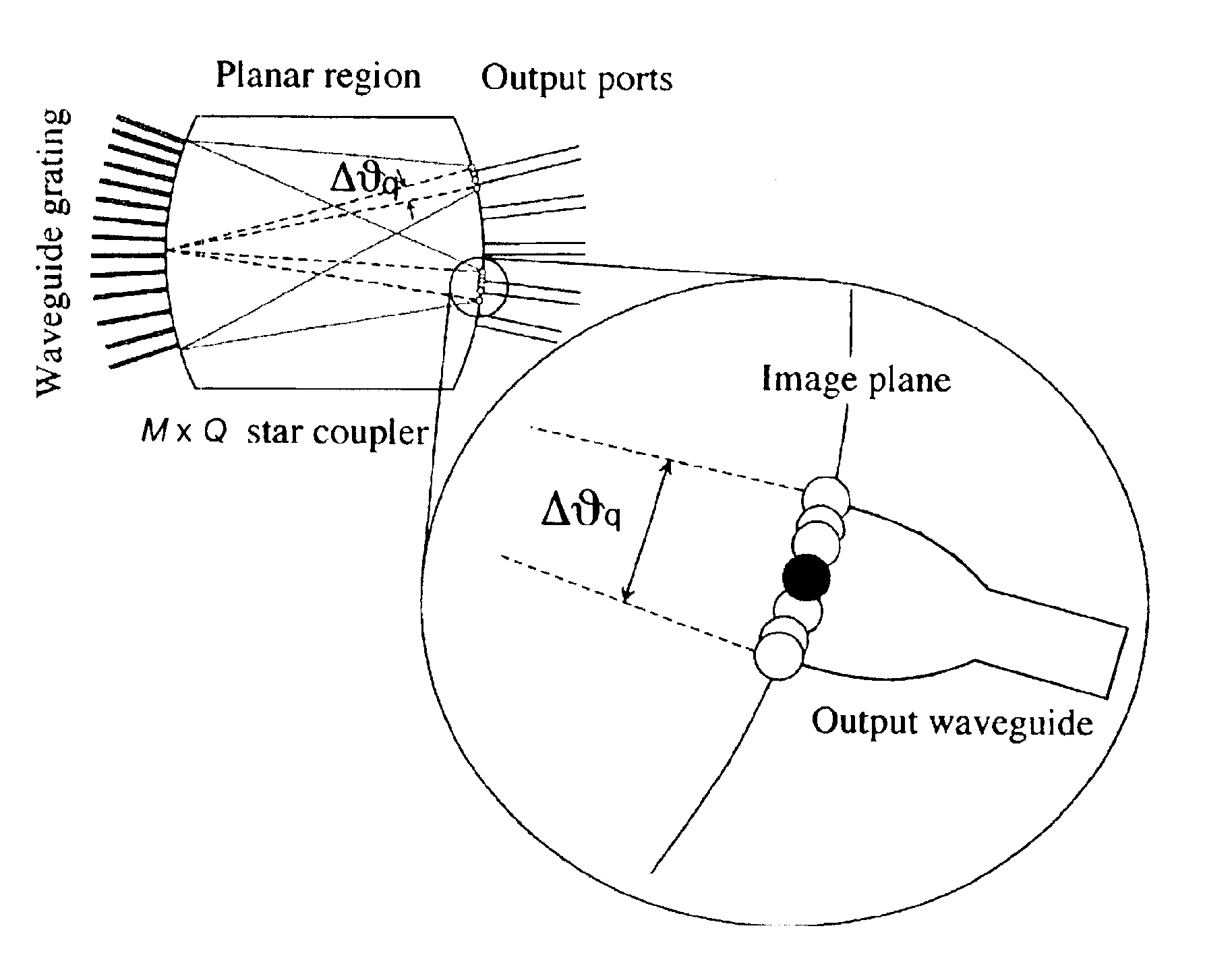
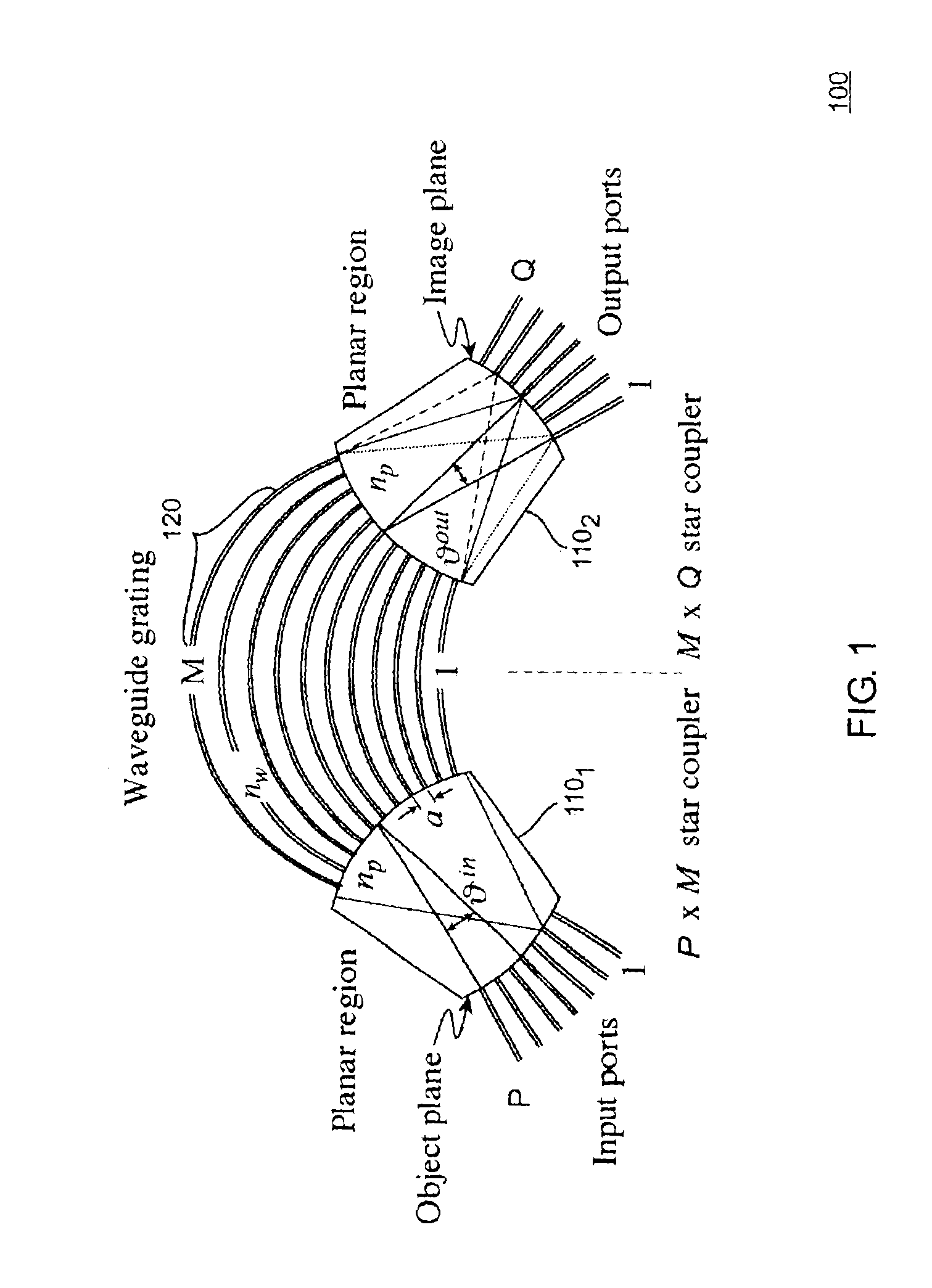
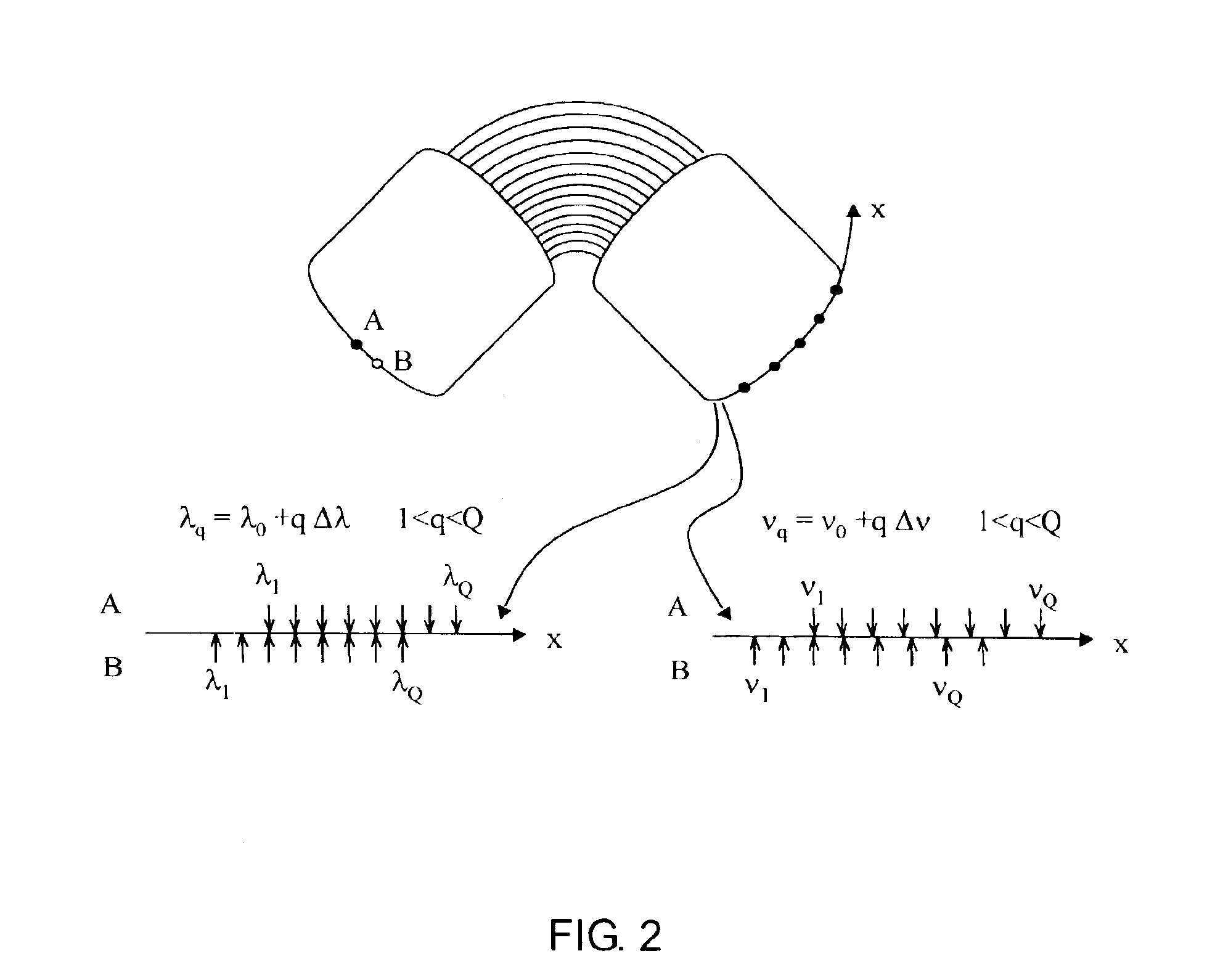
- The method involves optimizing the positioning of input and output ports in arrayed waveguide gratings by determining the initial positions based on wavelength dispersion images and iteratively adjusting them to minimize the maximum angular spread of image combs, allowing for improved alignment and increased transmission efficiency by operating within a single diffraction order and repositioning output ports to maximize signal transmission coefficients.

Aerospace Certification Standards for Navigation Components
Aerospace certification standards for navigation components represent a critical framework governing the deployment of waveguide gratings in aviation and space applications. These standards ensure that navigational systems incorporating advanced photonic technologies meet stringent safety, reliability, and performance requirements essential for aerospace operations.
The Federal Aviation Administration (FAA) DO-178C standard serves as the primary certification framework for airborne software, while DO-254 addresses hardware design assurance. For waveguide grating-based navigation systems, these standards mandate comprehensive verification and validation processes, including environmental testing under extreme temperature variations, vibration resistance, and electromagnetic interference immunity. The Radio Technical Commission for Aeronautics (RTCA) guidelines specifically address the integration of optical components in avionics systems.
European Aviation Safety Agency (EASA) certification requirements parallel FAA standards but emphasize additional environmental compliance measures. The CS-25 certification specification for large aircraft mandates that navigation components demonstrate fault tolerance and fail-safe operation modes. Waveguide gratings must undergo rigorous testing protocols including thermal cycling between -55°C to +125°C, shock resistance up to 40G acceleration, and long-term stability assessments exceeding 20,000 operational hours.
Military and space applications follow MIL-STD-810 environmental testing standards and NASA's technical standards for space-qualified components. These specifications require radiation hardness testing, outgassing compliance per ASTM E595, and demonstration of functionality in vacuum conditions. The qualification process typically spans 18-24 months and involves multiple test phases including component-level validation, system integration testing, and flight certification trials.
Quality assurance protocols mandate traceability throughout the manufacturing process, with AS9100 aerospace quality management systems ensuring consistent production standards. Documentation requirements include detailed design verification reports, failure mode and effects analysis, and comprehensive test data packages that demonstrate compliance with all applicable certification criteria for successful aerospace deployment.
The Federal Aviation Administration (FAA) DO-178C standard serves as the primary certification framework for airborne software, while DO-254 addresses hardware design assurance. For waveguide grating-based navigation systems, these standards mandate comprehensive verification and validation processes, including environmental testing under extreme temperature variations, vibration resistance, and electromagnetic interference immunity. The Radio Technical Commission for Aeronautics (RTCA) guidelines specifically address the integration of optical components in avionics systems.
European Aviation Safety Agency (EASA) certification requirements parallel FAA standards but emphasize additional environmental compliance measures. The CS-25 certification specification for large aircraft mandates that navigation components demonstrate fault tolerance and fail-safe operation modes. Waveguide gratings must undergo rigorous testing protocols including thermal cycling between -55°C to +125°C, shock resistance up to 40G acceleration, and long-term stability assessments exceeding 20,000 operational hours.
Military and space applications follow MIL-STD-810 environmental testing standards and NASA's technical standards for space-qualified components. These specifications require radiation hardness testing, outgassing compliance per ASTM E595, and demonstration of functionality in vacuum conditions. The qualification process typically spans 18-24 months and involves multiple test phases including component-level validation, system integration testing, and flight certification trials.
Quality assurance protocols mandate traceability throughout the manufacturing process, with AS9100 aerospace quality management systems ensuring consistent production standards. Documentation requirements include detailed design verification reports, failure mode and effects analysis, and comprehensive test data packages that demonstrate compliance with all applicable certification criteria for successful aerospace deployment.
Environmental Resilience Requirements for Space Applications
Space-based waveguide gratings face unprecedented environmental challenges that demand exceptional resilience characteristics. The harsh conditions of outer space, including extreme temperature variations ranging from -270°C to +120°C, create thermal stress cycles that can compromise grating structural integrity and optical performance. These temperature fluctuations necessitate materials with ultra-low thermal expansion coefficients and robust thermal management systems to maintain navigational precision across operational temperature ranges.
Radiation exposure presents another critical resilience requirement, as cosmic rays and solar particle events can induce material degradation, particularly in polymer-based grating substrates. High-energy particles cause atomic displacement and molecular chain scission, leading to refractive index variations and optical loss increases. Space-qualified waveguide gratings must demonstrate radiation hardness levels exceeding 1 MRad total ionizing dose while maintaining optical performance within specified tolerances.
Vacuum conditions in space eliminate convective cooling mechanisms, requiring passive thermal management strategies and materials with enhanced thermal conductivity. The absence of atmospheric pressure also affects outgassing characteristics, where volatile compounds from grating materials can contaminate optical surfaces or create unwanted interference patterns. Stringent outgassing requirements typically mandate total mass loss below 1% and collected volatile condensable materials under 0.1%.
Mechanical resilience encompasses vibration tolerance during launch phases, where acceleration forces can reach 10-15 g, and micrometeorite impact resistance throughout operational lifetime. Launch-induced mechanical stress can cause delamination in multi-layer grating structures or introduce micro-cracks that propagate under thermal cycling. Advanced packaging techniques, including hermetic sealing and shock-absorbing mounting systems, become essential for preserving grating alignment and optical characteristics.
Long-term stability requirements extend beyond immediate environmental survival to encompass mission durations spanning decades. Waveguide gratings must maintain navigational accuracy specifications throughout extended operational periods without maintenance opportunities, demanding materials with proven space heritage and accelerated aging test validation protocols.
Radiation exposure presents another critical resilience requirement, as cosmic rays and solar particle events can induce material degradation, particularly in polymer-based grating substrates. High-energy particles cause atomic displacement and molecular chain scission, leading to refractive index variations and optical loss increases. Space-qualified waveguide gratings must demonstrate radiation hardness levels exceeding 1 MRad total ionizing dose while maintaining optical performance within specified tolerances.
Vacuum conditions in space eliminate convective cooling mechanisms, requiring passive thermal management strategies and materials with enhanced thermal conductivity. The absence of atmospheric pressure also affects outgassing characteristics, where volatile compounds from grating materials can contaminate optical surfaces or create unwanted interference patterns. Stringent outgassing requirements typically mandate total mass loss below 1% and collected volatile condensable materials under 0.1%.
Mechanical resilience encompasses vibration tolerance during launch phases, where acceleration forces can reach 10-15 g, and micrometeorite impact resistance throughout operational lifetime. Launch-induced mechanical stress can cause delamination in multi-layer grating structures or introduce micro-cracks that propagate under thermal cycling. Advanced packaging techniques, including hermetic sealing and shock-absorbing mounting systems, become essential for preserving grating alignment and optical characteristics.
Long-term stability requirements extend beyond immediate environmental survival to encompass mission durations spanning decades. Waveguide gratings must maintain navigational accuracy specifications throughout extended operational periods without maintenance opportunities, demanding materials with proven space heritage and accelerated aging test validation protocols.
Unlock deeper insights with Patsnap Eureka Quick Research — get a full tech report to explore trends and direct your research. Try now!
Generate Your Research Report Instantly with AI Agent
Supercharge your innovation with Patsnap Eureka AI Agent Platform!