

What Makes Gallium Oxide Semiconductors Unique
OCT 27, 20259 MIN READ
Generate Your Research Report Instantly with AI Agent
PatSnap Eureka helps you evaluate technical feasibility & market potential.
Gallium Oxide Semiconductor Evolution and Objectives
Gallium oxide (Ga2O3) has emerged as a revolutionary material in the semiconductor industry over the past two decades, representing a significant advancement in wide-bandgap semiconductor technology. The evolution of this material began in the early 2000s when researchers first recognized its potential for high-power electronic applications, but significant momentum only developed after 2010 when improved crystal growth techniques enabled the production of higher quality substrates.
The fundamental property that distinguishes gallium oxide from conventional semiconductors is its ultra-wide bandgap of approximately 4.8-4.9 eV, which exceeds that of silicon carbide (3.3 eV) and gallium nitride (3.4 eV). This characteristic has positioned Ga2O3 as a promising candidate for next-generation power electronics, where higher breakdown voltages and operating temperatures are increasingly demanded.
The technical evolution of Ga2O3 has progressed through several distinct phases. Initially, research focused on basic material properties and preliminary device demonstrations. This was followed by advancements in substrate growth techniques, particularly the development of edge-defined film-fed growth (EFG) and floating zone methods that enabled the production of larger, higher quality single crystals. The most recent phase has centered on device optimization and addressing reliability challenges.
Current technical objectives in the Ga2O3 semiconductor field are multifaceted. Primary goals include improving material quality by reducing defect densities and enhancing crystal growth techniques to produce larger wafers cost-effectively. Researchers are also focused on developing effective doping strategies, particularly p-type doping which remains a significant challenge due to the material's inherent properties.
Device-level objectives include increasing the breakdown voltage capabilities beyond 10 kV, improving thermal management strategies to mitigate Ga2O3's relatively low thermal conductivity, and enhancing long-term device reliability under high-field and high-temperature operating conditions. Additionally, there is growing interest in exploring novel device architectures that can fully leverage Ga2O3's unique properties.
The trajectory of Ga2O3 technology is moving toward commercial viability, with increasing focus on manufacturing scalability and cost reduction. The ultimate objective is to position gallium oxide as a mainstream semiconductor material for specific high-performance applications where its unique properties offer decisive advantages over existing technologies.
Research trends indicate growing international collaboration in this field, with significant contributions from research groups in Japan, the United States, China, and Germany. The evolution of patent filings shows an acceleration in intellectual property development, suggesting increasing commercial interest and technological maturity in this promising semiconductor material.
The fundamental property that distinguishes gallium oxide from conventional semiconductors is its ultra-wide bandgap of approximately 4.8-4.9 eV, which exceeds that of silicon carbide (3.3 eV) and gallium nitride (3.4 eV). This characteristic has positioned Ga2O3 as a promising candidate for next-generation power electronics, where higher breakdown voltages and operating temperatures are increasingly demanded.
The technical evolution of Ga2O3 has progressed through several distinct phases. Initially, research focused on basic material properties and preliminary device demonstrations. This was followed by advancements in substrate growth techniques, particularly the development of edge-defined film-fed growth (EFG) and floating zone methods that enabled the production of larger, higher quality single crystals. The most recent phase has centered on device optimization and addressing reliability challenges.
Current technical objectives in the Ga2O3 semiconductor field are multifaceted. Primary goals include improving material quality by reducing defect densities and enhancing crystal growth techniques to produce larger wafers cost-effectively. Researchers are also focused on developing effective doping strategies, particularly p-type doping which remains a significant challenge due to the material's inherent properties.
Device-level objectives include increasing the breakdown voltage capabilities beyond 10 kV, improving thermal management strategies to mitigate Ga2O3's relatively low thermal conductivity, and enhancing long-term device reliability under high-field and high-temperature operating conditions. Additionally, there is growing interest in exploring novel device architectures that can fully leverage Ga2O3's unique properties.
The trajectory of Ga2O3 technology is moving toward commercial viability, with increasing focus on manufacturing scalability and cost reduction. The ultimate objective is to position gallium oxide as a mainstream semiconductor material for specific high-performance applications where its unique properties offer decisive advantages over existing technologies.
Research trends indicate growing international collaboration in this field, with significant contributions from research groups in Japan, the United States, China, and Germany. The evolution of patent filings shows an acceleration in intellectual property development, suggesting increasing commercial interest and technological maturity in this promising semiconductor material.
Market Applications and Demand Analysis for Ga2O3 Technology
The global market for gallium oxide (Ga2O3) semiconductors is experiencing significant growth driven by increasing demand for high-power electronic devices across multiple industries. Current market projections indicate that the wide bandgap semiconductor market, which includes Ga2O3, is expected to reach $5.9 billion by 2027, with Ga2O3 representing an emerging segment with substantial growth potential. This expansion is primarily fueled by the superior properties of Ga2O3 in high-voltage and high-frequency applications.
Power electronics represents the largest market opportunity for Ga2O3 technology, particularly in electric vehicles, renewable energy systems, and industrial motor drives. The automotive sector's transition toward electrification has created substantial demand for more efficient power conversion systems where Ga2O3's high breakdown field strength offers significant advantages over silicon carbide and gallium nitride alternatives. Market analysis suggests that power device manufacturers could achieve up to 30% efficiency improvements by adopting Ga2O3-based solutions.
The telecommunications industry presents another substantial market for Ga2O3 semiconductors, particularly in 5G and future 6G infrastructure. The material's ability to operate efficiently at high frequencies makes it ideal for RF power amplifiers and base station components. Market research indicates that the RF semiconductor segment specifically addressable by Ga2O3 technology could reach $1.2 billion by 2026, representing a compound annual growth rate of approximately 22%.
Emerging applications in ultraviolet (UV) photodetectors and sensors are creating additional market opportunities. The solar-blind detection capabilities of Ga2O3 are particularly valuable in flame detection, missile warning systems, and environmental monitoring. This specialized segment is projected to grow at 18% annually through 2028, driven by increasing security and environmental monitoring requirements across government and industrial sectors.
Regional analysis reveals that North America and Asia-Pacific currently dominate the Ga2O3 market landscape. Japan leads in research and development activities, while the United States maintains strong positions in both fundamental research and commercialization efforts. China has significantly increased investments in wide bandgap semiconductor technologies, including Ga2O3, as part of its strategic focus on next-generation electronics.
Market adoption faces several challenges, including high production costs, limited wafer availability, and competition from more established wide bandgap semiconductors. Current Ga2O3 wafer prices remain 3-5 times higher than silicon carbide alternatives, though economies of scale are expected to reduce this differential as production volumes increase. Industry surveys indicate that 65% of potential adopters cite cost as the primary barrier to implementation, followed by concerns about long-term reliability and ecosystem maturity.
Power electronics represents the largest market opportunity for Ga2O3 technology, particularly in electric vehicles, renewable energy systems, and industrial motor drives. The automotive sector's transition toward electrification has created substantial demand for more efficient power conversion systems where Ga2O3's high breakdown field strength offers significant advantages over silicon carbide and gallium nitride alternatives. Market analysis suggests that power device manufacturers could achieve up to 30% efficiency improvements by adopting Ga2O3-based solutions.
The telecommunications industry presents another substantial market for Ga2O3 semiconductors, particularly in 5G and future 6G infrastructure. The material's ability to operate efficiently at high frequencies makes it ideal for RF power amplifiers and base station components. Market research indicates that the RF semiconductor segment specifically addressable by Ga2O3 technology could reach $1.2 billion by 2026, representing a compound annual growth rate of approximately 22%.
Emerging applications in ultraviolet (UV) photodetectors and sensors are creating additional market opportunities. The solar-blind detection capabilities of Ga2O3 are particularly valuable in flame detection, missile warning systems, and environmental monitoring. This specialized segment is projected to grow at 18% annually through 2028, driven by increasing security and environmental monitoring requirements across government and industrial sectors.
Regional analysis reveals that North America and Asia-Pacific currently dominate the Ga2O3 market landscape. Japan leads in research and development activities, while the United States maintains strong positions in both fundamental research and commercialization efforts. China has significantly increased investments in wide bandgap semiconductor technologies, including Ga2O3, as part of its strategic focus on next-generation electronics.
Market adoption faces several challenges, including high production costs, limited wafer availability, and competition from more established wide bandgap semiconductors. Current Ga2O3 wafer prices remain 3-5 times higher than silicon carbide alternatives, though economies of scale are expected to reduce this differential as production volumes increase. Industry surveys indicate that 65% of potential adopters cite cost as the primary barrier to implementation, followed by concerns about long-term reliability and ecosystem maturity.
Current State and Technical Barriers in Ga2O3 Development
Gallium oxide (Ga2O3) has emerged as a promising ultra-wide bandgap semiconductor material, with significant research momentum globally. Currently, the development of Ga2O3 technology has reached several important milestones, though numerous technical challenges remain before widespread commercial adoption can be achieved.
The most mature form of Ga2O3 is the β-polymorph, which has demonstrated superior material properties including a bandgap of approximately 4.8-4.9 eV, significantly wider than traditional semiconductors like silicon (1.1 eV) and gallium nitride (3.4 eV). This enables theoretical breakdown fields exceeding 8 MV/cm, positioning Ga2O3 as an excellent candidate for high-power electronic applications.
Substrate growth technology has advanced considerably, with methods such as edge-defined film-fed growth (EFG) and Czochralski techniques now capable of producing single-crystal β-Ga2O3 wafers up to 4 inches in diameter with reasonable quality. However, scaling to larger diameters while maintaining crystal quality remains challenging, limiting mass production capabilities.
Epitaxial growth techniques including molecular beam epitaxy (MBE), metal-organic chemical vapor deposition (MOCVD), and halide vapor phase epitaxy (HVPE) have been developed for Ga2O3, though each presents unique challenges. MOCVD processes struggle with oxygen precursor management and carbon contamination, while MBE faces growth rate limitations. HVPE offers higher growth rates but with less precise control over layer thickness and doping profiles.
A significant technical barrier in Ga2O3 development is the achievement of p-type doping. The material exhibits a strong self-compensation effect and deep acceptor levels, making p-type conductivity extremely difficult to achieve. This limitation has restricted device architectures primarily to unipolar designs, preventing the realization of complementary devices and limiting application versatility.
Thermal management represents another critical challenge. Ga2O3 has inherently low thermal conductivity (approximately 10-30 W/m·K, depending on crystal orientation), significantly lower than competing materials like SiC (~490 W/m·K). This poor thermal performance creates heat dissipation issues in high-power applications, potentially negating some of the material's electrical advantages.
Device reliability and stability issues persist, particularly regarding surface passivation and contact formation. The development of stable ohmic contacts with low resistance remains challenging, especially for high-temperature operation. Additionally, interface quality between Ga2O3 and dielectric materials needs improvement to reduce interface trap densities and enhance device performance.
Standardization across the industry is lacking, with various research groups and companies employing different growth conditions, characterization methods, and device fabrication processes. This fragmentation has slowed the establishment of reliable benchmarks and hampered collaborative progress in addressing fundamental challenges.
The most mature form of Ga2O3 is the β-polymorph, which has demonstrated superior material properties including a bandgap of approximately 4.8-4.9 eV, significantly wider than traditional semiconductors like silicon (1.1 eV) and gallium nitride (3.4 eV). This enables theoretical breakdown fields exceeding 8 MV/cm, positioning Ga2O3 as an excellent candidate for high-power electronic applications.
Substrate growth technology has advanced considerably, with methods such as edge-defined film-fed growth (EFG) and Czochralski techniques now capable of producing single-crystal β-Ga2O3 wafers up to 4 inches in diameter with reasonable quality. However, scaling to larger diameters while maintaining crystal quality remains challenging, limiting mass production capabilities.
Epitaxial growth techniques including molecular beam epitaxy (MBE), metal-organic chemical vapor deposition (MOCVD), and halide vapor phase epitaxy (HVPE) have been developed for Ga2O3, though each presents unique challenges. MOCVD processes struggle with oxygen precursor management and carbon contamination, while MBE faces growth rate limitations. HVPE offers higher growth rates but with less precise control over layer thickness and doping profiles.
A significant technical barrier in Ga2O3 development is the achievement of p-type doping. The material exhibits a strong self-compensation effect and deep acceptor levels, making p-type conductivity extremely difficult to achieve. This limitation has restricted device architectures primarily to unipolar designs, preventing the realization of complementary devices and limiting application versatility.
Thermal management represents another critical challenge. Ga2O3 has inherently low thermal conductivity (approximately 10-30 W/m·K, depending on crystal orientation), significantly lower than competing materials like SiC (~490 W/m·K). This poor thermal performance creates heat dissipation issues in high-power applications, potentially negating some of the material's electrical advantages.
Device reliability and stability issues persist, particularly regarding surface passivation and contact formation. The development of stable ohmic contacts with low resistance remains challenging, especially for high-temperature operation. Additionally, interface quality between Ga2O3 and dielectric materials needs improvement to reduce interface trap densities and enhance device performance.
Standardization across the industry is lacking, with various research groups and companies employing different growth conditions, characterization methods, and device fabrication processes. This fragmentation has slowed the establishment of reliable benchmarks and hampered collaborative progress in addressing fundamental challenges.
Current Fabrication Methods and Device Architectures
01 Gallium oxide semiconductor materials and properties
Gallium oxide (Ga2O3) is emerging as a promising wide bandgap semiconductor material with excellent electrical properties. It has a wide bandgap of approximately 4.8-4.9 eV, which makes it suitable for high-power and high-frequency electronic applications. The material exhibits high breakdown field strength and good thermal stability, making it advantageous for power devices. Various crystal structures of gallium oxide exist, with β-Ga2O3 being the most stable and commonly used form in semiconductor applications.- Gallium oxide semiconductor materials and properties: Gallium oxide (Ga2O3) is emerging as a promising wide bandgap semiconductor material with excellent electrical properties. It has a bandgap of approximately 4.8-4.9 eV, making it suitable for high-power and high-frequency electronic applications. The material exhibits high breakdown field strength, good thermal stability, and can be grown in various crystalline forms, with β-Ga2O3 being the most commonly used polymorph for semiconductor applications.
- Device fabrication and structure: Various techniques are employed for fabricating gallium oxide semiconductor devices, including metal-organic chemical vapor deposition (MOCVD), molecular beam epitaxy (MBE), and pulsed laser deposition (PLD). These methods enable the growth of high-quality gallium oxide thin films on different substrates. Device structures include field-effect transistors (FETs), Schottky barrier diodes, and metal-oxide-semiconductor (MOS) structures, with specific attention to electrode materials, gate insulators, and interface quality to optimize device performance.
- Doping and conductivity control: Controlling the electrical properties of gallium oxide semiconductors through doping is essential for device applications. Various dopants such as silicon, tin, and nitrogen are used to achieve n-type conductivity, while achieving stable p-type doping remains challenging. Doping concentration and distribution significantly affect carrier mobility, resistivity, and overall device performance. Advanced doping techniques and post-growth treatments are employed to optimize the electrical characteristics of gallium oxide-based devices.
- Power electronics and high-voltage applications: Gallium oxide semiconductors show exceptional potential for power electronics due to their wide bandgap and high breakdown field strength. These properties enable the development of high-voltage, high-power devices with improved efficiency and reduced size compared to conventional semiconductor materials. Applications include power switching devices, high-voltage rectifiers, and power management systems for electric vehicles, renewable energy systems, and industrial equipment, where gallium oxide-based devices can operate at higher temperatures and voltages.
- Novel heterostructures and integration technologies: Advanced research focuses on developing novel gallium oxide-based heterostructures and integration technologies to enhance device performance. This includes combining gallium oxide with other semiconductor materials to create heterojunctions with unique properties, developing vertical device architectures for improved current handling, and exploring integration with existing semiconductor technologies. These approaches aim to overcome current limitations and expand the application range of gallium oxide semiconductors in next-generation electronics.
02 Fabrication methods for gallium oxide semiconductor devices
Various fabrication techniques are employed to produce high-quality gallium oxide semiconductor devices. These include molecular beam epitaxy (MBE), metal-organic chemical vapor deposition (MOCVD), pulsed laser deposition (PLD), and mist chemical vapor deposition. The growth conditions, such as temperature, pressure, and precursor ratios, significantly affect the crystal quality and electrical properties of the resulting gallium oxide films. Post-growth treatments like annealing can further improve the material quality and device performance.Expand Specific Solutions03 Gallium oxide-based power electronic devices
Gallium oxide semiconductors are particularly promising for power electronic applications due to their wide bandgap and high breakdown field. Various device structures have been developed, including metal-oxide-semiconductor field-effect transistors (MOSFETs), Schottky barrier diodes (SBDs), and high-electron-mobility transistors (HEMTs). These devices demonstrate excellent performance characteristics such as high breakdown voltage, low on-resistance, and good switching capabilities, making them suitable for high-power and high-frequency applications in electric vehicles, renewable energy systems, and industrial equipment.Expand Specific Solutions04 Doping and defect engineering in gallium oxide semiconductors
Controlling the electrical properties of gallium oxide through doping and defect engineering is crucial for device performance. Common dopants include silicon (Si) and tin (Sn) for n-type conductivity, while achieving stable p-type doping remains challenging. Native defects such as oxygen vacancies significantly influence the electrical and optical properties of gallium oxide. Various techniques are employed to control defect formation and distribution, including growth condition optimization, post-growth annealing, and ion implantation, to achieve desired carrier concentrations and mobility.Expand Specific Solutions05 Novel gallium oxide heterostructures and composite materials
Advanced gallium oxide-based heterostructures and composite materials are being developed to enhance device performance and enable new functionalities. These include heterojunctions with other wide bandgap semiconductors like AlGaO, InGaO, and GaN, as well as integration with 2D materials. Such heterostructures can improve carrier transport properties, reduce interface states, and enable band engineering for specific applications. Additionally, gallium oxide composites with various metal oxides are being explored for applications in sensors, optoelectronics, and energy conversion devices.Expand Specific Solutions
Leading Research Institutions and Companies in Ga2O3 Field
Gallium oxide semiconductor technology is currently in the early growth stage, characterized by increasing research interest but limited commercial deployment. The market is projected to expand significantly due to gallium oxide's unique properties, including an ultra-wide bandgap (4.8-5.3 eV) and exceptional breakdown field strength, making it superior for high-power, high-frequency applications. Key players are emerging across research institutions and industry, with FLOSFIA pioneering commercial applications through mist CVD technology, while NGK Insulators, Sumitomo Electric, and Kyocera are developing manufacturing capabilities. Academic research is advancing through collaborations between universities like Nanjing University and Fudan University, alongside corporate R&D from Semiconductor Energy Laboratory and DENSO, focusing on improving material quality, device fabrication, and reliability for power electronics applications.
FLOSFIA, Inc.
Technical Solution: FLOSFIA has pioneered corundum-structured α-Ga2O3 power devices using their proprietary Mist Chemical Vapor Deposition (Mist-CVD) technology. Their approach focuses on developing α-phase gallium oxide rather than the more common β-phase, achieving a wider bandgap of approximately 5.3 eV compared to β-Ga2O3's 4.8-4.9 eV. This enables higher breakdown voltage capabilities essential for power electronics. FLOSFIA's technology allows for low-temperature deposition (as low as 300°C) on various substrates including sapphire, which significantly reduces manufacturing costs. Their Schottky barrier diodes have demonstrated breakdown voltages exceeding 1kV with forward current densities of 1000A/cm² and ultra-low reverse leakage currents, positioning them as a viable alternative to SiC and GaN in medium-to-high voltage applications (600V-2kV range).
Strengths: Lower manufacturing costs through mist-CVD process; ability to grow α-Ga2O3 at relatively low temperatures; compatibility with various substrates including sapphire; excellent thermal stability. Weaknesses: Challenges in achieving large-area uniform films; relatively early stage of commercialization compared to SiC and GaN technologies; limited availability of production-scale manufacturing infrastructure.
NGK Insulators, Ltd.
Technical Solution: NGK Insulators has developed specialized techniques for growing high-purity β-Ga2O3 single crystals using the edge-defined film-fed growth (EFG) method and floating zone (FZ) crystal growth. Their approach focuses on precise control of point defects and impurities to achieve semi-insulating Ga2O3 substrates with resistivities exceeding 10¹² Ω·cm, critical for high-frequency device applications. NGK's technology enables the production of large-diameter wafers (up to 4 inches) with controlled crystal orientation, primarily focusing on (010) and (001) planes that offer optimal properties for device fabrication. The company has pioneered doping techniques using elements like Fe, Mg, and N to control carrier concentration and achieve desired electrical properties. Their substrates feature extremely low etch pit densities (<10³ cm⁻²) and excellent crystallinity with X-ray rocking curve FWHM values below 50 arcsec. NGK has also developed specialized wafer processing techniques including mechanical polishing and chemical mechanical polishing (CMP) to achieve atomically smooth surfaces with roughness below 0.2 nm, essential for high-quality epitaxial growth and device fabrication.
Strengths: Expertise in producing high-resistivity semi-insulating substrates; capability for large-diameter wafer production; excellent crystal quality with low defect density; specialized surface preparation techniques. Weaknesses: High manufacturing costs compared to conventional semiconductor substrates; limited throughput in crystal growth processes; challenges in achieving uniform electrical properties across full wafer diameter; thermal management issues in device applications.
Key Patents and Scientific Breakthroughs in Ga2O3 Technology
Lateral gallium oxide transistor and method of manufacturing the same
PatentPendingUS20240321971A1
Innovation
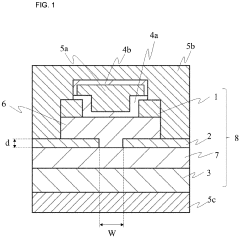
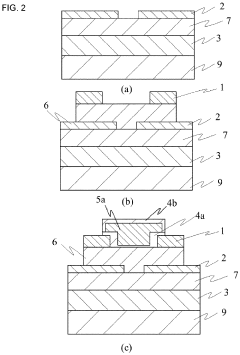
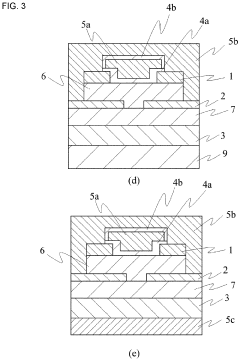
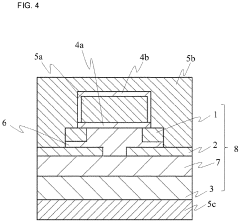
- A lateral gallium oxide transistor is designed with a gallium oxide substrate, an n-type gallium oxide epitaxial layer, and a p-type nickel oxide layer forming a pn heterojunction, along with a recessed gate trench and specific electrode structures to facilitate efficient operation, utilizing a nickel oxide-gallium oxide combination that enables accumulation mode operation.


Semiconductor device
PatentPendingEP4333075A1
Innovation
- A semiconductor device is designed with a crystalline oxide semiconductor layer comprising a channel layer and a drift layer, featuring a current blocking layer with different compositions of crystalline oxides, including metals from Groups 6 to 10 and 13 of the periodic table, to enhance withstand voltage performance, utilizing a corundum structure and specific dopants for improved conductivity and insulation.
Material Properties Comparison with Conventional Semiconductors
Gallium oxide (Ga2O3) semiconductors exhibit remarkable material properties that distinguish them from conventional semiconductors like silicon (Si), gallium arsenide (GaAs), silicon carbide (SiC), and gallium nitride (GaN). The most striking difference lies in Ga2O3's ultra-wide bandgap of approximately 4.8-5.0 eV, which significantly exceeds that of Si (1.1 eV), GaAs (1.4 eV), SiC (3.3 eV), and GaN (3.4 eV). This exceptionally wide bandgap enables Ga2O3 devices to withstand much higher electric fields before breakdown occurs.
The theoretical breakdown field strength of Ga2O3 reaches an impressive 8 MV/cm, substantially surpassing Si (0.3 MV/cm), GaAs (0.4 MV/cm), SiC (2.5 MV/cm), and GaN (3.3 MV/cm). This property makes Ga2O3 particularly valuable for high-power electronic applications where device miniaturization and efficiency are paramount.
Thermal conductivity represents one area where Ga2O3 faces challenges compared to other wide-bandgap semiconductors. With a thermal conductivity of approximately 10-27 W/m·K (depending on crystal orientation), Ga2O3 falls short of SiC (490 W/m·K) and GaN (130 W/m·K), though it remains comparable to GaAs (55 W/m·K) and exceeds Si (150 W/m·K) in certain aspects of thermal management.
Another distinctive characteristic of Ga2O3 is its transparency in the visible spectrum due to its wide bandgap, making it suitable for optoelectronic applications. This transparency, combined with its electrical properties, enables unique applications in transparent electronics and UV photodetectors that conventional semiconductors cannot address effectively.
Ga2O3 also demonstrates superior electron mobility compared to other ultra-wide bandgap materials, with values ranging from 150-300 cm²/V·s. While this falls below Si (1400 cm²/V·s) and GaAs (8500 cm²/V·s), it remains competitive with SiC (900 cm²/V·s) and GaN (1200 cm²/V·s) when considering the overall performance metrics for power applications.
The Baliga's Figure of Merit (BFOM), which evaluates semiconductor performance for power applications, reveals Ga2O3's exceptional potential. Its BFOM exceeds that of Si by approximately 3,000 times, GaAs by 800 times, SiC by 10 times, and GaN by 4 times, highlighting its tremendous advantage for high-power, high-frequency applications.
Additionally, Ga2O3 offers manufacturing advantages through the availability of melt-growth techniques like Czochralski and floating zone methods, which can produce large, high-quality single crystals at potentially lower costs than epitaxial growth methods required for SiC and GaN. This manufacturing scalability represents a significant commercial advantage for Ga2O3 in the semiconductor market.
The theoretical breakdown field strength of Ga2O3 reaches an impressive 8 MV/cm, substantially surpassing Si (0.3 MV/cm), GaAs (0.4 MV/cm), SiC (2.5 MV/cm), and GaN (3.3 MV/cm). This property makes Ga2O3 particularly valuable for high-power electronic applications where device miniaturization and efficiency are paramount.
Thermal conductivity represents one area where Ga2O3 faces challenges compared to other wide-bandgap semiconductors. With a thermal conductivity of approximately 10-27 W/m·K (depending on crystal orientation), Ga2O3 falls short of SiC (490 W/m·K) and GaN (130 W/m·K), though it remains comparable to GaAs (55 W/m·K) and exceeds Si (150 W/m·K) in certain aspects of thermal management.
Another distinctive characteristic of Ga2O3 is its transparency in the visible spectrum due to its wide bandgap, making it suitable for optoelectronic applications. This transparency, combined with its electrical properties, enables unique applications in transparent electronics and UV photodetectors that conventional semiconductors cannot address effectively.
Ga2O3 also demonstrates superior electron mobility compared to other ultra-wide bandgap materials, with values ranging from 150-300 cm²/V·s. While this falls below Si (1400 cm²/V·s) and GaAs (8500 cm²/V·s), it remains competitive with SiC (900 cm²/V·s) and GaN (1200 cm²/V·s) when considering the overall performance metrics for power applications.
The Baliga's Figure of Merit (BFOM), which evaluates semiconductor performance for power applications, reveals Ga2O3's exceptional potential. Its BFOM exceeds that of Si by approximately 3,000 times, GaAs by 800 times, SiC by 10 times, and GaN by 4 times, highlighting its tremendous advantage for high-power, high-frequency applications.
Additionally, Ga2O3 offers manufacturing advantages through the availability of melt-growth techniques like Czochralski and floating zone methods, which can produce large, high-quality single crystals at potentially lower costs than epitaxial growth methods required for SiC and GaN. This manufacturing scalability represents a significant commercial advantage for Ga2O3 in the semiconductor market.
Environmental Impact and Sustainability Considerations
Gallium oxide (Ga2O3) semiconductors present a compelling case for sustainable electronics development, offering significant environmental advantages compared to conventional semiconductor materials. The production of Ga2O3 benefits from gallium's increasing availability as a byproduct of aluminum and zinc manufacturing, creating an opportunity to utilize what would otherwise be industrial waste. This recycling pathway substantially reduces the environmental footprint associated with raw material extraction, particularly when compared to traditional semiconductor materials that often require dedicated mining operations.
Energy efficiency represents one of the most significant environmental benefits of Ga2O3 semiconductors. Devices manufactured with this material can operate at higher voltages and temperatures while maintaining efficiency, potentially reducing cooling requirements and overall energy consumption in electronic systems. This characteristic becomes particularly valuable in power electronics applications, where even marginal efficiency improvements translate to substantial energy savings at scale.
The manufacturing process for Ga2O3 semiconductors also demonstrates promising sustainability metrics. The material can be grown using techniques that consume less energy than those required for silicon carbide or gallium nitride production. Additionally, the crystal growth processes typically employ fewer toxic chemicals and generate reduced hazardous waste compared to conventional semiconductor fabrication, contributing to a cleaner manufacturing ecosystem.
From a lifecycle perspective, Ga2O3-based devices offer extended operational lifespans due to their inherent thermal stability and resistance to degradation under extreme conditions. This longevity reduces electronic waste generation and the associated environmental impacts of premature device replacement. The material's stability also suggests potential advantages in recyclability at end-of-life, though specialized recycling infrastructure would need development to fully realize this benefit.
Water conservation represents another environmental advantage, as Ga2O3 manufacturing processes typically require less water than traditional silicon semiconductor production. This characteristic becomes increasingly important as semiconductor manufacturing expands in regions facing water scarcity challenges.
Despite these advantages, challenges remain in fully assessing the environmental impact of widespread Ga2O3 adoption. Limited data exists on large-scale production environmental metrics, and the complete lifecycle analysis requires further research. Additionally, as with any emerging technology, the environmental benefits must be weighed against potential unknown risks that may emerge with widespread implementation.
The transition toward Ga2O3 semiconductors aligns with broader industry sustainability goals and regulatory trends emphasizing reduced energy consumption and minimized environmental impact. As manufacturing scales and techniques mature, the environmental advantages of this unique semiconductor material are likely to become increasingly significant factors in technology adoption decisions.
Energy efficiency represents one of the most significant environmental benefits of Ga2O3 semiconductors. Devices manufactured with this material can operate at higher voltages and temperatures while maintaining efficiency, potentially reducing cooling requirements and overall energy consumption in electronic systems. This characteristic becomes particularly valuable in power electronics applications, where even marginal efficiency improvements translate to substantial energy savings at scale.
The manufacturing process for Ga2O3 semiconductors also demonstrates promising sustainability metrics. The material can be grown using techniques that consume less energy than those required for silicon carbide or gallium nitride production. Additionally, the crystal growth processes typically employ fewer toxic chemicals and generate reduced hazardous waste compared to conventional semiconductor fabrication, contributing to a cleaner manufacturing ecosystem.
From a lifecycle perspective, Ga2O3-based devices offer extended operational lifespans due to their inherent thermal stability and resistance to degradation under extreme conditions. This longevity reduces electronic waste generation and the associated environmental impacts of premature device replacement. The material's stability also suggests potential advantages in recyclability at end-of-life, though specialized recycling infrastructure would need development to fully realize this benefit.
Water conservation represents another environmental advantage, as Ga2O3 manufacturing processes typically require less water than traditional silicon semiconductor production. This characteristic becomes increasingly important as semiconductor manufacturing expands in regions facing water scarcity challenges.
Despite these advantages, challenges remain in fully assessing the environmental impact of widespread Ga2O3 adoption. Limited data exists on large-scale production environmental metrics, and the complete lifecycle analysis requires further research. Additionally, as with any emerging technology, the environmental benefits must be weighed against potential unknown risks that may emerge with widespread implementation.
The transition toward Ga2O3 semiconductors aligns with broader industry sustainability goals and regulatory trends emphasizing reduced energy consumption and minimized environmental impact. As manufacturing scales and techniques mature, the environmental advantages of this unique semiconductor material are likely to become increasingly significant factors in technology adoption decisions.
Unlock deeper insights with PatSnap Eureka Quick Research — get a full tech report to explore trends and direct your research. Try now!
Generate Your Research Report Instantly with AI Agent
Supercharge your innovation with PatSnap Eureka AI Agent Platform!