


Introduction: The Battle of TV Technologies
Choosing between QLED vs. OLED TVs can feel like a daunting decision, especially with both technologies dominating the premium TV market. These two options promise stunning visuals, but they differ significantly in brightness, contrast, and durability, which can make or break your viewing experience.
In this guide, we’ll explain the differences between QLED vs. OLED, exploring their strengths, weaknesses, and ideal use cases. Whether you prioritize deep blacks for movie nights or vibrant brightness for daytime viewing, we’ve got everything you need to make an informed decision.
What Is QLED?
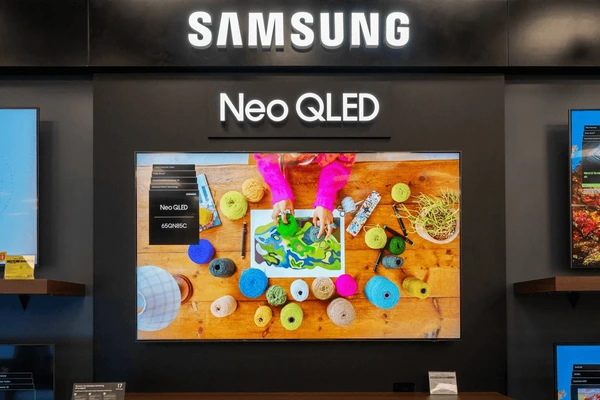
QLED stands for Quantum Dot Light Emitting Diode. It is a display technology that utilizes quantum dots to produce light, resulting in improved color accuracy, brightness, and energy efficiency compared to traditional display technologies like OLEDs. Quantum dots are tiny semiconductor particles that can emit light when an electric current is passed through them, and they have the ability to produce a wide range of colors, which contributes to the high color purity and wide color gamut of QLED displays.
What Is OLED?
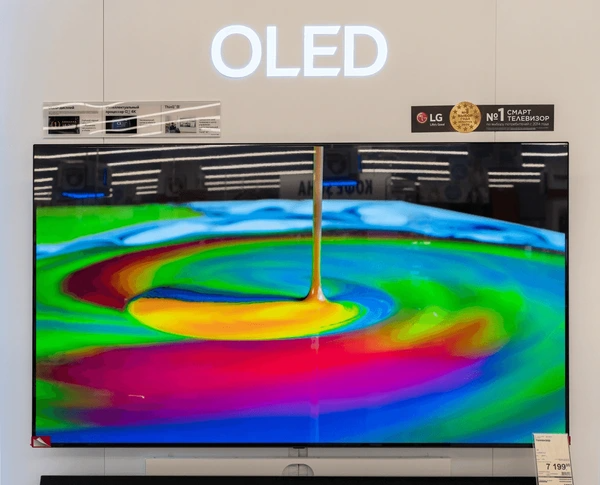
OLED stands for Organic Light-Emitting Diode. It is a type of solid-state device that uses a stack of organic thin films between an anode and a cathode to produce light when an electric current is applied. In OLEDs, holes and electrons are injected from the anode and cathode, respectively, forming excitons in the organic layer(s). These excitons can relax to ground states, resulting in electroluminescence.
QLED vs. OLED: Key Differences
Working Principle
- OLED: Uses an organic material that emits light when an electric current passes through it. Each pixel is made up of three sub-pixels, one for each primary color (red, green, and blue), which can be turned on and off independently to produce different colors and intensities.
- QLED: Utilizes quantum dots, which are tiny crystals that can be tuned to emit specific colors of light when excited by an electric current. The quantum dots are typically placed between layers of other materials that help with charge transport and light emission.
Color Accuracy and Gamut
- QLED: Offers higher color purity and a wider color gamut compared to OLEDs. This means QLEDs can display a broader range of colors, particularly in the red and green spectrum, which is beneficial for applications like graphic design and gaming.
- OLED: Also provides excellent color accuracy and a wide color gamut, but may not quite match the performance of QLEDs in this regard.
Brightness and Efficiency
- QLED: Generally has higher peak brightness levels compared to OLEDs, which can be beneficial for very bright environments. However, QLEDs may not be as efficient in terms of power consumption as OLEDs at lower brightness levels.
- OLED: Typically has better power efficiency and can produce true blacks by turning off pixels, which can lead to better contrast ratios.
Viewing Angle and Stability
- QLED: Maintains color accuracy and contrast across a wide range of viewing angles, and the quantum dots provide excellent stability and resistance to degradation over time.
- OLED: Also offers good viewing angles, but some users may notice a slight decrease in color accuracy at very wide angles. OLEDs can be more susceptible to degradation over time compared to QLEDs.
Applications and Flexibility
- QLED: Well-suited for large-scale, cost-effective manufacturing and can be used in flexible displays due to the stability of quantum dots.
- OLED: Can also be used in flexible displays, but the organic materials may be more prone to damage compared to quantum dots.
Lifespan and Durability
- QLED: Generally has a longer lifespan and is more durable due to the stability of quantum dots. This can lead to a longer operational life and reduced risk of image retention.
- OLED: May experience issues like image retention or burn-in over time, although modern technologies are working to mitigate these effects.
Cost Comparison: QLED vs. OLED
- OLED: Generally more expensive to produce, which translates to higher prices for consumers. High-end OLED TVs can be quite pricey, but they also offer premium features and performance.
- QLED: Often priced lower than OLEDs, making it a more affordable option for consumers. QLED TVs are popular in the mid-range to high-end market, offering excellent performance at a lower cost than OLEDs.
Which One Is Best for You?
When deciding between QLED and OLED displays, there are several factors to consider:
Budget
- If budget is a concern, QLED displays may be a more affordable option. However, if you are willing to invest in a premium product, OLED displays may offer better image quality and features.
Image Quality
- If you prioritize image quality, OLED displays may offer better contrast, color accuracy, and viewing angles. However, QLED displays can also offer excellent image quality, especially in terms of brightness and color gamut.
Power Consumption
- QLED displays are generally more power-efficient than OLED displays, especially at high brightness levels. If energy efficiency is a concern, QLED may be a better option.
Size and Resolution
- Both QLED and OLED displays come in various sizes and resolutions. When choosing a display, consider the size and resolution that best suits your needs.
Brand and Features
- Different brands may offer different features and performance levels for their QLED and OLED displays. Research and compare different models to find the best option for your needs.

FAQs:
What sizes are available for QLED and OLED TVs?
QLED TVs are available in a wider range of sizes, from compact to massive, while OLED TVs are mostly available in 48 to 83 inches.
What lasts longer, QLED or OLED?
QLED TVs are typically more durable because they don’t suffer from burn-in or image retention, unlike OLED panels.
Does OLED have burn-in issues?
Yes, OLED TVs can experience burn-in if static images are displayed for prolonged periods, but this is rare with regular use.
Is QLED better for gaming?
QLED TVs often have higher brightness levels and are great for well-lit rooms, but OLED TVs provide better response times and deeper blacks, ideal for dark gaming scenes.
Which technology offers better picture quality?
OLED generally wins with its perfect blacks and infinite contrast, but QLED shines in brightness and vibrant colors.
To get detailed scientific explanations of Qled vs. OLED, try Patsnap Eureka.

Learn more
Multiplexor: Efficient Data Selector for Electronics
Understanding STP Cable: Shielded Twisted Pair Explained
Understanding Twisted Pair Cable: Basics, Benefits, and Uses
JFET 101: A Beginner’s Guide to Junction Field-Effect Transistors