


What Is OSPF?
Open Shortest Path First (OSPF) is a powerful link-state routing protocol used in IP networks to manage and distribute routing information within a single autonomous system (AS). It enables routers to exchange data about network topology and compute the most efficient paths using the Shortest Path First (SPF) algorithm. Known for its scalability and fast convergence, OSPF is widely deployed in enterprise and service provider networks, making it a cornerstone of modern IP routing. This article delves into how OSPF works, its benefits, and its role in optimizing network performance.
How Does OSPF Work?
Routers establish neighbor relationships to share network information effectively. They exchange link-state advertisements (LSAs), which include details about their interfaces and metrics. Using this shared data, each router builds an identical link-state database (LSDB) to represent the entire network topology. To determine the best routes, routers apply the Dijkstra algorithm, calculating a shortest path tree with themselves as the root. This process ensures efficient and accurate routing to all destinations within the network.

Key Features of OSPF Protocol
1. Hierarchical Network Design
- Divides the network into areas for improved scalability.
- Reduces the impact of routing updates on the entire network.
2. Fast Convergence
- Quickly adapts to topology changes.
- Ensures efficient data flow and minimal downtime.
3. Support for CIDR and VLSM
- Enables efficient IP address allocation.
- Facilitates flexible subnetting to optimize network resources.
4. Loop Prevention
- Utilizes link-state databases to eliminate routing loops.
- Ensures accurate and reliable routing decisions throughout the network.
Advantages of OSPF in Networking
- Efficient Routing and Convergence: Using the Shortest Path First (SPF) algorithm, this protocol calculates the most efficient routes within a network. This ensures optimal path selection and fast adaptation to network changes, enhancing overall performance and reliability.
- Scalability with Hierarchical Design: The protocol supports hierarchical network design, dividing large networks into manageable areas. This reduces the amount of routing information exchanged and improves scalability, making it ideal for handling complex, expansive networks efficiently.
- Load Balancing and Redundancy: Support for Equal Cost Multipath (ECMP) routing enables traffic distribution across multiple equal-cost paths. This feature enhances network performance and reliability by balancing loads and providing redundancy.
- Fast Convergence with BFD: Integration with Bidirectional Forwarding Detection (BFD) enables rapid failure detection and fast convergence times. This minimizes packet loss during network disruptions and ensures smooth communication.
- Extensibility and Interoperability: As an open standard, this protocol operates across various network devices and platforms. Its vendor-neutral design ensures compatibility and extensibility, making it a flexible choice for diverse network environments.
- Security Features: robust security mechanisms, including authentication and packet filtering, protect the routing infrastructure from unauthorized access and attacks. These features ensure a secure and resilient network environment.
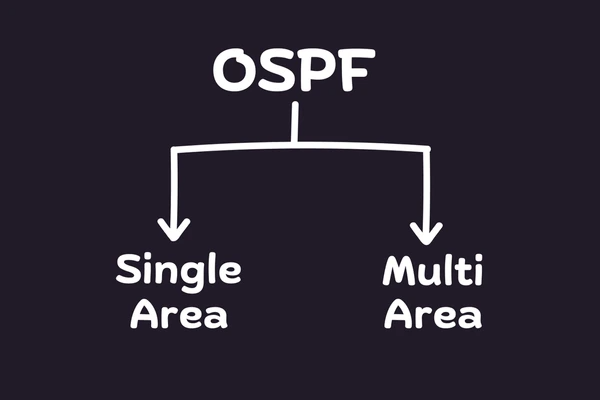
OSPF vs. Other Routing Protocols
Comparison with Other Routing Protocols
- RIP: This distance-vector protocol offers limited scalability and slower convergence, making it less suitable for large or dynamic networks. It is simpler to configure but lacks the efficiency needed for more complex environments.
- EIGRP: A Cisco proprietary protocol, EIGRP combines features of distance-vector and link-state routing. It delivers faster convergence and better performance in some scenarios, especially in Cisco-dominated networks. However, its proprietary nature limits interoperability with non-Cisco devices.
- BGP: Designed for inter-domain routing, BGP excels in managing traffic between autonomous systems. While it complements protocols used within a domain, it is more complex and tailored for large-scale internet routing rather than internal network operations.
Applications of OSPF in Real-World Scenarios
- Service Provider Networks
Internet Service Providers (ISPs) rely on advanced routing protocols to efficiently manage traffic within their networks. These protocols ensure optimal path selection and provide effective load balancing, enhancing overall performance. - Enterprise Networks
Large organizations, such as universities, hospitals, and corporations, use these protocols to manage internal routing. They support reliable connectivity and streamline operations across campus networks. - Wireless and Mobile Networks
Dynamic routing protocols are essential in wireless and mobile communication systems. They adapt to frequent topology changes, ensuring seamless connectivity in ad-hoc and rapidly changing environments. - Software-Defined Networking (SDN)
In SDN architectures, these protocols play a role in the control plane to make routing decisions. They enable centralized network management and enhance programmability, simplifying complex network operations.
Application Cases
| Product/Project | Technical Outcomes | Application Scenarios |
|---|---|---|
| Split Architecture Network Telefonaktiebolaget LM Ericsson | Provides optimal routing and scalability in split architecture networks by propagating limited intra-area link cost data between areas. | Large-scale networks divided into areas with centralized control planes and distributed data planes. |
| S-OSPF | Provides traffic engineering solution for OSPF-based best-effort networks by formulating an optimization problem to minimize maximum link utilization. | Service provider networks aiming to optimize resource utilization and reduce congestion hotspots. |
Configuring OSPF: Basic Steps
- Enable Protocol on Interfaces
Activate the routing protocol on router interfaces and assign them to designated areas. - Set Router ID
Configure a unique 32-bit router identifier to distinguish it within the network. - Adjust Protocol Parameters
Customize settings such as hello and dead intervals, area types, and other parameters to optimize operation. - Establish Neighbor Relationships
Use the Hello protocol to establish adjacencies between routers. - Synchronize Network Information
Share and update link-state databases through Database Description packets to maintain consistent topology views. - Calculate Routes
Run the Shortest Path First (SPF) algorithm to determine the most efficient paths to destinations.
Optimization and Best Practices
- Adopt Hierarchical Design
Use a backbone area (Area 0) with additional non-backbone areas to improve scalability and efficiency. - Tune Timers and Metrics
Adjust protocol timers and metrics to achieve faster convergence and better network performance. - Integrate Advanced Features
Leverage Bidirectional Forwarding Detection (BFD) for rapid failure detection, ensuring minimal downtime. - Utilize Extensions
Implement advanced features like Graceful Restart and Traffic Engineering to enhance functionality. - Enhance Security
Apply authentication and access control mechanisms to protect against unauthorized access and attacks. - Monitor and Troubleshoot
Regularly monitor performance and resolve issues using network analysis tools for consistent reliability.
To get detailed scientific explanations of OSPF, try Patsnap Eureka.
