
Method for estimating uplink channel quality in time division duplex system, base station and terminal
A channel quality estimation and time-division duplex system technology, applied in transmission systems, digital transmission systems, wireless communications, etc., can solve the problems of CQIDL estimation accuracy reduction, occupying too many wireless resources, and mutual interference between terminals to achieve cost reduction, Effect of reduced power consumption, simplified process
Patent Information
- Authority / Receiving Office
- CN · China
- Patent Type
- Patents(China)
- Current Assignee / Owner
- Publication Date
- 2011-10-05
Smart Images
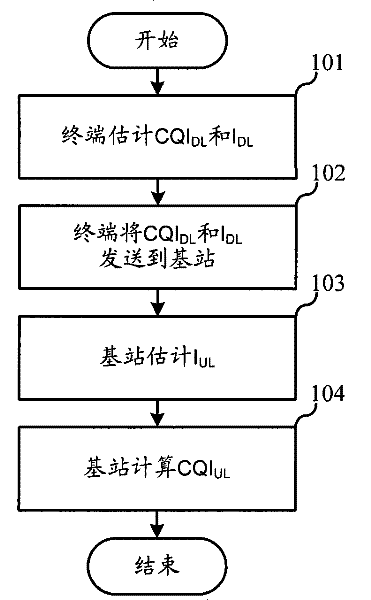
Figure 1 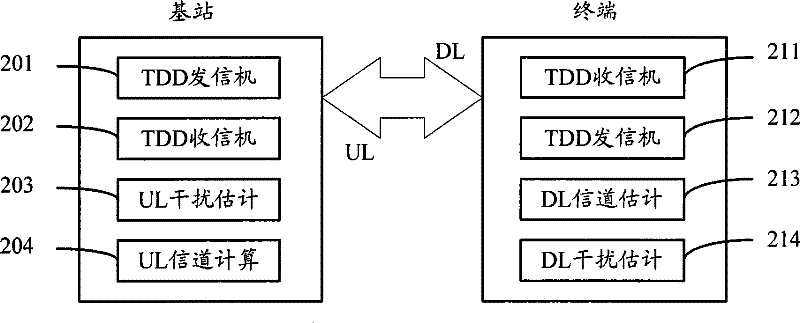
Figure 2 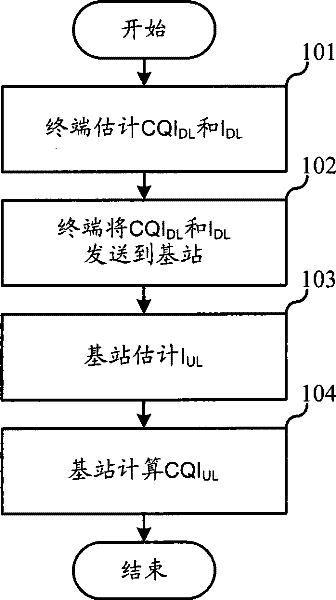
Figure 3
Abstract
Description
technical field
[0001] The present invention relates to the field of wireless communication, in particular to an uplink channel quality estimation technique in a Time Division Duplex (TDD for short) system. Background technique
[0002] Time Division Duplex, referred to as TDD, is a communication method of a mobile communication system. In this method, the sending and receiving information between the base station and the mobile station is in the form of a burst pulse sequence, which is alternately transmitted on the same carrier frequency, that is, sending and receiving The two parties take turns sending and receiving, or "ping-pong method". In this way, a duplex channel can be implemented on one carrier frequency, thereby improving spectrum utilization.
[0003] In a two-way mobile communication system, in order to make full use of the channel capacity, the transmitting end needs to determine the coding and modulation format to be used for the current transmission accordi...
Examples
Embodiment Construction
[0026] In the following description, many technical details are proposed in order to enable readers to better understand the application. However, those skilled in the art can understand that without these technical details and various changes and modifications based on the following implementation modes, the technical solution claimed in each claim of the present application can be realized.
[0027] In order to make the purpose, technical solution and advantages of the present invention clearer, the following will further describe the implementation of the present invention in detail in conjunction with the accompanying drawings.
[0028] In step 101, the terminal estimates the downlink channel quality indicator CQI DL and interference estimation I DL . In an example, the terminal processes the signal received from the downlink (for example, estimates according to the pilot frequency), and obtains the downlink channel estimate C DL and I DL , by the formula CQI DL =C D...