
A kind of synthetic method of silodosin
A technology of silodosin and a synthesis method is applied in the field of preparation of silodosin, a drug for synthesizing prostatic hyperplasia. Industrial production, controllable optical purity
Patent Information
- Authority / Receiving Office
- CN · China
- Patent Type
- Patents(China)
- Current Assignee / Owner
- Publication Date
- 2016-06-22
Smart Images
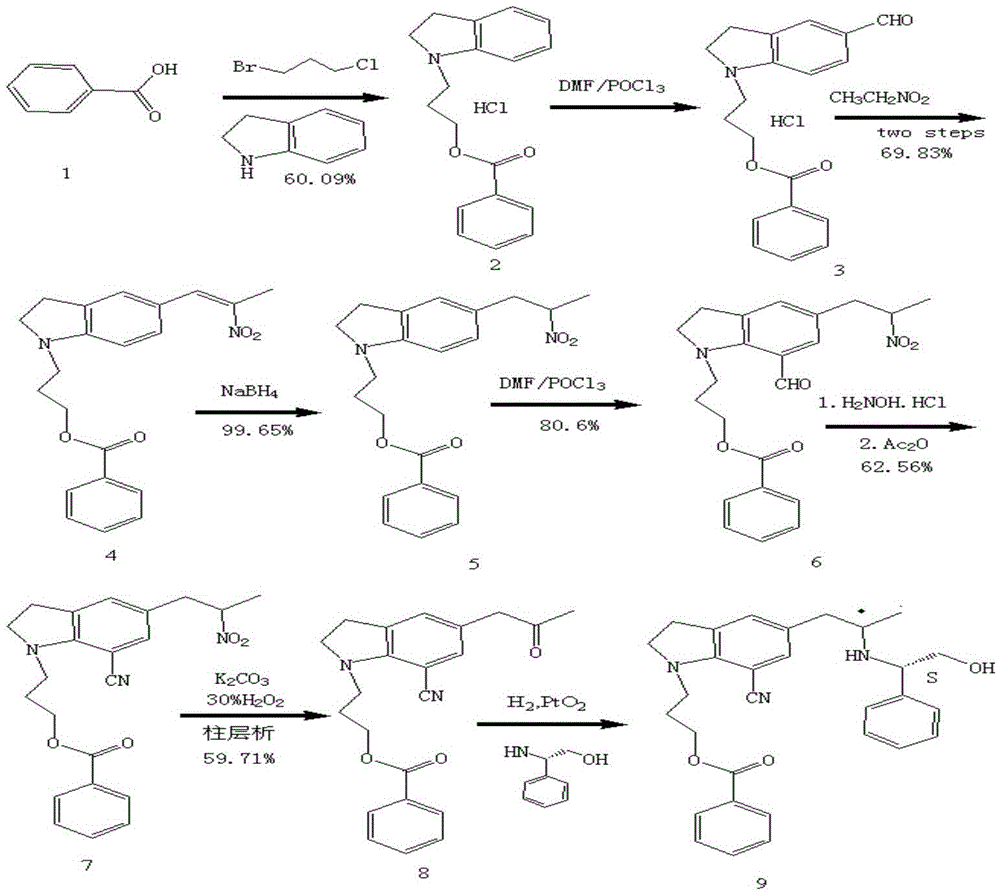
Figure 1 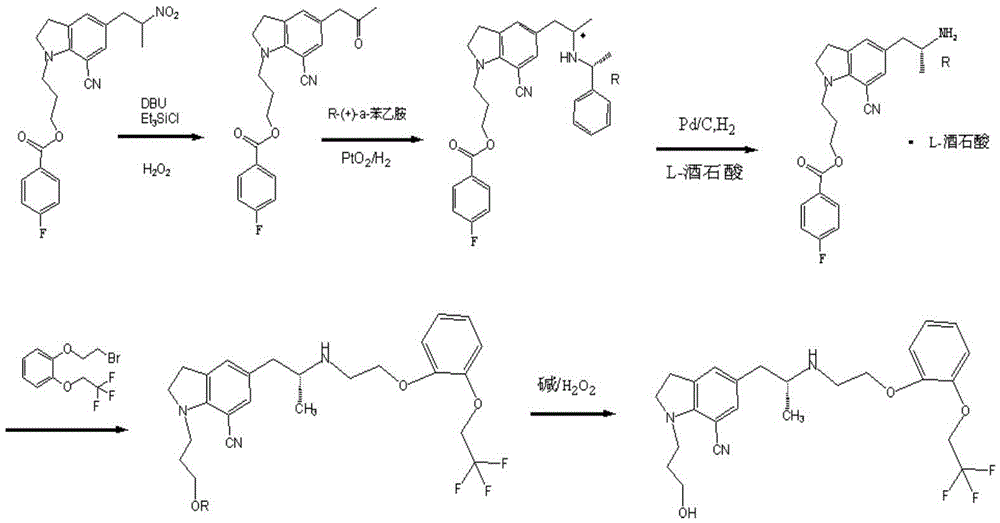
Figure 2 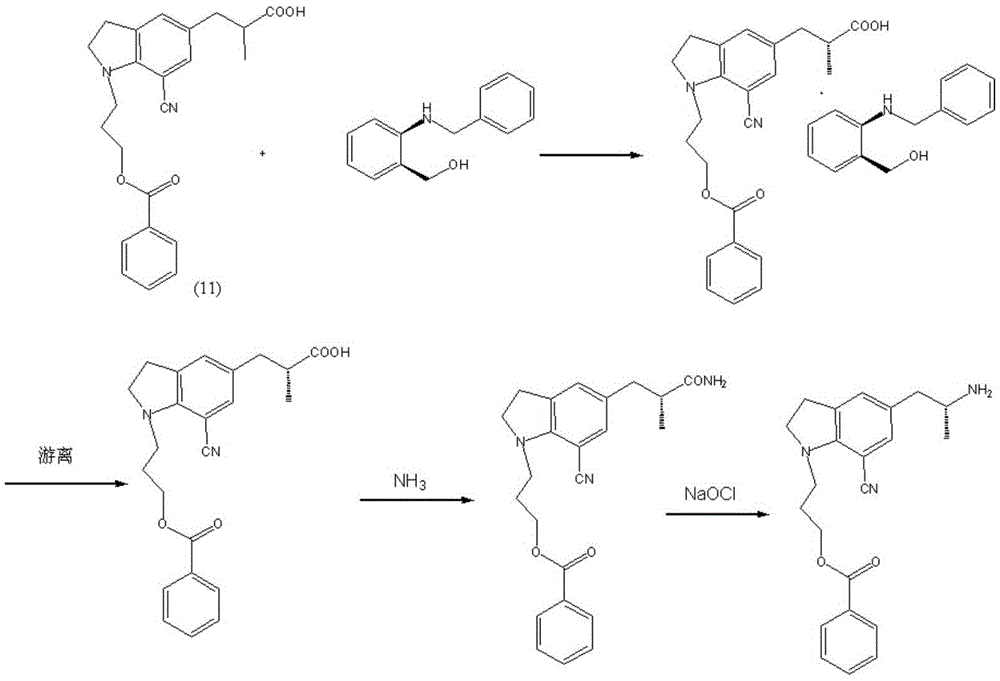
Figure 3
Abstract
Description
technical field
[0001] The invention relates to the field of medicinal chemistry, in particular to a preparation method for synthesizing silodosin, a drug for treating benign prostatic hyperplasia. Background technique
[0002] Silodosin (Silodosin) is a selective α1A-adrenergic blocker. Preclinical studies have shown that its selective effect on the urethra is 12 and 7.5 higher than that of Prazosin (Prazosin) and Tamsulosin (Tamsulosin). times. Silodosin can significantly inhibit norepinephrine-induced human prostate contraction; it has a dose-dependent inhibitory effect on bladder hyperactivity in rat benign prostatic hypertrophy model, and can increase the pressure threshold of bladder contraction. These data suggest that, in addition to improving bladder function, silodosin is also effective in relieving symptoms associated with benign prostatic hypertrophy.
[0003] Benign prostatic hyperplasia (BPH) is a common disease in elderly men, characterized by non-malignant ...
Examples
Embodiment 1
[0043] Example 1, a synthetic method of silodosin, the steps are as follows: 7-cyanoindoline is used as the starting material, and a benzoyloxypropyl group is introduced into the 1 position of indoline to synthesize 1-(benzoyloxypropyl)-7-cyanoindoline compound (I), and then with 2R-2-[(phenylmethyl)amino]-propionyl chloride compound (II) by Friedel-Crafts Synthesis of key chiral intermediate 5-[(2R)-2-(benzylamino)-1-propanone]-1-[3-(benzoyloxy)propyl]-7-cyano through acylation reaction The indoline compound (III) was reduced by triethylsilane to obtain 5-[(2R)-2-(benzylamino)propyl]-1-[3-(benzoyloxy)propyl]- 7-cyanoindoline compound (IV), and then through catalytic hydrogenation to obtain (R)-1-[1-(3-benzoyloxypropyl)-5-(2-aminopropyl)7- A cyano]indoline compound (V) undergoes a condensation reaction with a 2-(2,2,2,-trifluoroethoxy) phenoxyethyl methanesulfonate compound (VI) under basic conditions to obtain 1 -(3-(4-fluorobenzoyl)hydroxypropyl)-5-((2R)-2-(2-(2-(2,2,2-tri...
Embodiment 2
[0044] Example 2, in the method described in Example 1: 7-cyanoindoline is used as raw material and 3-chloropropyl benzoate to react to obtain the compound of formula (I), and the specific steps are as follows: 1.0 parts by weight 3-chloropropyl benzoate and 1.6 parts by weight of 7-cyanoindoline were reacted in 5-10 times the amount of polar solvent at 80-100°C for 10-15 hours, and finally hydrochloric acid was added to form a salt to obtain Compound (I) hydrochloride; the polar solvent is selected from DMF or DMSO, and an acid reducing agent is added to DMF or DMSO.
Embodiment 3
[0045] Embodiment 3, in the method described in embodiment 2: the acid reducing agent that adds in the DMF or DMSO is the triethylamine or pyridine of 0.84 weight part.