
An automatic unfolding tooling mold for vacuum-assisted shelter forming process
A molding process and automatic unfolding technology, which is applied in the field of automatic unfolding tooling and moulds, can solve the problems of low mass production efficiency, numerous processes, and too primitive combination methods, and achieve high mass production efficiency, simple and convenient operation, and shortened reinforcement time. Effect
Patent Information
- Authority / Receiving Office
- CN · China
- Patent Type
- Patents(China)
- Current Assignee / Owner
- Publication Date
- 2020-08-25
Smart Images
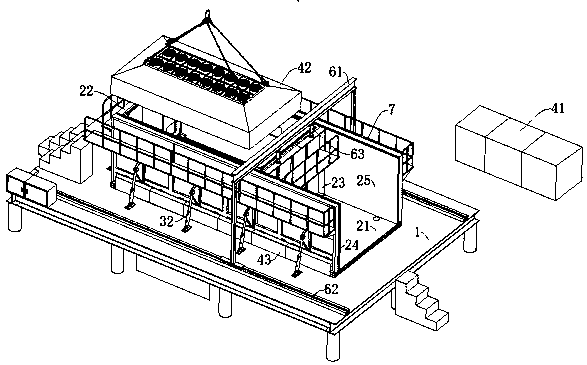
Figure 1 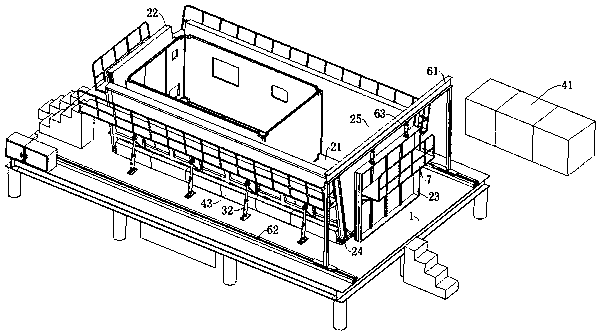
Figure 2 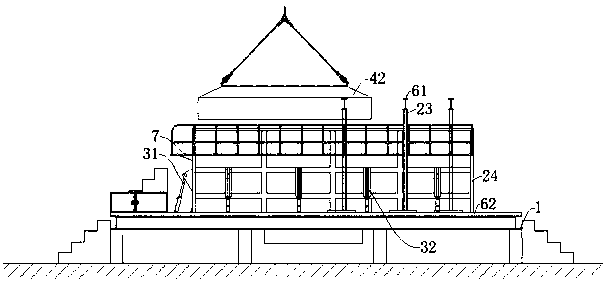
Figure 3
Abstract
Description
technical field
[0001] The invention relates to the technical field of composite material shelter forming, in particular to an automatic unfolding tooling mold for a vacuum-assisted shelter forming process. Background technique
[0002] At present, most of the existing composite material shelters use the shelter wall panels to form a single body, and then use methods such as wrapping corners, rivets, and structural adhesives to combine the various wall panels into a closed cabin. For example, CN 204172227 U and CN 205553270 U respectively disclose a utility model patent for a combined steel mold of a vacuum-assisted forming process and a multi-functional combined standardized shelter integrally formed to make a tooling mold. The common points of these two patents are The mold clamping and fixing methods are the same, and the templates are fixed by pins and bolts. The difference lies in the demoulding method: the former uses a hydraulic ejector device to lift up the surroundi...
Examples
Embodiment Construction
[0033] The following will clearly and completely describe the technical solutions in the embodiments of the present invention with reference to the accompanying drawings in the embodiments of the present invention. Obviously, the described embodiments are only part of the embodiments of the present invention, not all of them. Based on the embodiments of the present invention, all other embodiments obtained by persons of ordinary skill in the art without creative efforts fall within the protection scope of the present invention.
[0034] It should be noted that all directional indications (such as up, down, left, right, front, back...) in the embodiments of the present invention are only used to explain the relationship between the components in a certain posture (as shown in the figure). Relative positional relationship, movement conditions, etc., if the specific posture changes, the directional indication will also change accordingly.
[0035] In addition, in the present inve...