
Nitric oxide releasing prodrugs of diaryl-2-(5h)-furanones as cyclooxygenase-2 inhibitors
a technology of diaryl and furanone, which is applied in the direction of biocide, plant growth regulator, animal husbandry, etc., can solve the problems of increasing the risk of thrombotic cardiovascular events in patients with chronic inflammatory conditions, and limiting the therapeutic potential of diaryl and its prodrugs, so as to reduce the risk of thrombotic cardiovascular events
Patent Information
- Authority / Receiving Office
- US · United States
- Patent Type
- Patents(United States)
- Current Assignee / Owner
- Publication Date
- 2007-04-03
- Estimated Expiration
- Not applicable · inactive patent
Smart Images
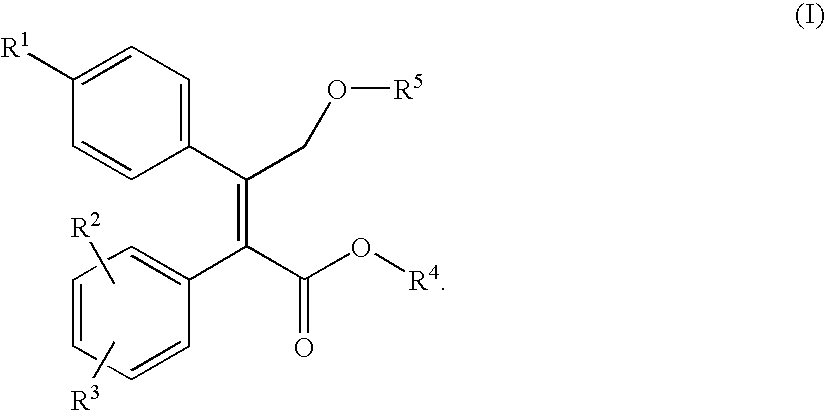
Figure 1 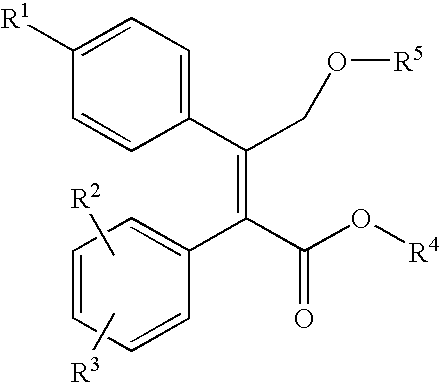
Figure 2 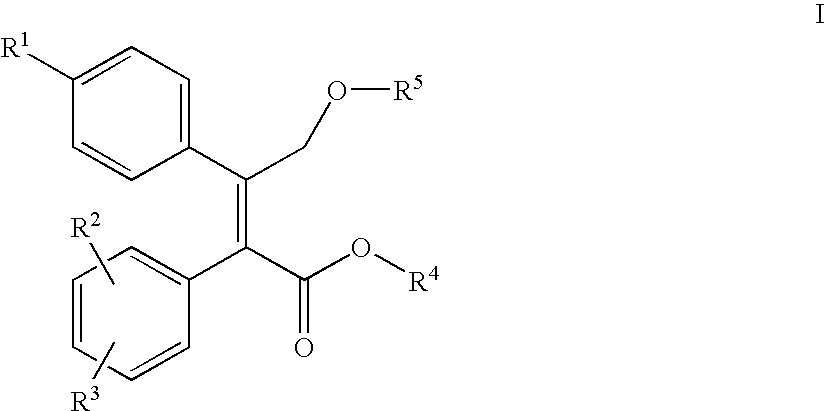
Figure 3
Abstract
Description
CROSS REFERENCE TO RELATED APPLICATIONS
[0001] This application is a U.S. National Phase application under 35 U.S.C. § 371 of PCT Application No. PCT / CA03 / 01115, filed Jul. 24, 2003, which claims priority under 35 U.S.C. 119 to U.S. No. 60 / 435,341, filed Dec. 20, 2002 and 60 / 398,683, filed Jul. 26, 2002.BACKGROUND OF THE INVENTION
[0002] Selective inhibitors of cyclooxygenase-2 are a sub-class of the class of drugs known as non-steroidal antiinflammatory drugs (NSAIDs). The NSADs are active in reducing the prostaglandin-induced pain and swelling associated with the inflammation process but are also active in affecting other prostaglandin-regulated processes not associated with the inflammation process. Thus, use of high doses of most common NSAIDs can produce severe side effects, including life threatening ulcers, that limit their therapeutic potential. An alternative to NSAIDs is the use of corticosteroids, which have even more drastic side effects, especially when long term therapy is...
Examples
example 1
methyl (2Z)-3-[4-(methylsulfonyl)phenyl]-4-(nitrooxy)-2-phenylbut-2-enoate
[0344]
Step 1: methyl (2E)-3-[4-(methylsulfonyl)phenyl]-2-phenylbut-2-enoate
[0345]
[0346]At −78° C., 15 mL of isopropylmagnesium bromide (30 mmol, 2M) was added dropwise to a solution of 15 mmol of phenyl-acetic acid in 4 mL of TBF. The mixture was then warmed to 40° C. and stirred for 30 min and then re-cooled to −78° C. A solution of 15 mmol of 1-(4-methanesulfonyl-phenyl)-ethanone in a minimum amount of THF was added to the reaction mixture. The resulting mixture was warmed again to 40° C. for 30 min, and then the reaction was quenched by the addition of 35 mL of 1 M HCl. The organic layer was separated and washed with brine. The aqueous layer was extracted with EtOAc and the organic layer was dried over Na2SO4 and filtered. The filtrate was treated with CH2N2 / Et2O until TLC analysis revealed the absence of the carboxylic acid. The solvent was evaporated and the residue was dissolved in 100 mL of 1,2-dichloro...
example 2
(2Z)-4-methoxy-2-[4-(methylsulfonyl)phenyl]-4-oxo-3-phenylbut-2-enyl 3-({[tert-butyl(dimethyl)silyl]oxy}methyl)benzoate
[0349]
Step 1: (2Z)-4-methoxy-2-[4-(methylsulfonyl)phenyl]-4-oxo-3-phenylbut-2-enyl 3-({[tert-butyl(dimethyl)silyl]oxy}methyl)benzoate
[0350]
[0351]The allylic bromide intermediate from procedure Example 1, step 2 above (410 mg) was dissolved in DMF (10 mL) and treated with Cs2CO3 (575 mg) and 3-({[tert-butyl(dimethyl)silyl]oxy}methyl)benzoic acid (530 mg). The reaction mixture was allowed to stir at room temperature for 2 h. At this time, the reaction mixture was poured into a separatory funnel containing water-ethyl acetate, the layers were separated and the aqueous layer was extracted with ethyl acetate. The combined organic layers were washed with saturated aqueous Na2CO3, water, brine, dried over anhydrous MgSO4 and concentrated. The resulting material was purified by flash chromatography eluting with 20% EtOAc / hexane to yield 260 mg of the title compound as a col...
example 3
methyl (2Z)-3-[4-(methylsulfonyl)phenyl]-4-({[4-(nitrooxy)butoxy]carbonyl}oxy)-2-phenylbut-2-enoate
[0354]
Step 1: (2Z)-2-[4-(methylsulfonyl)phenyl]-3-phenylbut-2-ene-1,4-diol
[0355]
[0356]To a solution of 110 g of 4-(4-methanesulfonyl-phenyl)-3-phenyl-5H-furan-2-one in 1.5 L of dichloromethane stirred at −78° C., 150 mL of DIBAL was added dropwise. The resulting mixture was warmed to room temperature and stirred overnight. The reaction mixture was then cooled to −78° C., and 1.2 L of 1 M aqueous NaOH was added dropwise. After the addition, the resulting mixture was warmed to room temperature and the organic phase was separated. The aqueous phase was extracted with dichloromethane. The organic phases were combined and dried over Na2SO4. 110 g of the titled compound was obtained after evaporation. 1H NMR (acetone-d6, 500 M Hz): δ 7.69 (d, 2 H), 7.36 (d, 2 H), 7.16–7.05 (m, 5 H), 4,66 (d, 2 H), 4.63 (d, 2 H), 4.19 (t, 1 H, OH), 4.17 (t, 1 H. OH), 3.04 (s, 3 H).
Step 2: (2Z)-4-{[tert-butyl...