
Hybrid polymer light-emitting devices
a light-emitting device and hybrid technology, applied in solid-state devices, layered products, electrical devices, etc., can solve the problems of short response time, low work function cathode and/or thin interfacial layer, and inability to meet the requirements of polymer layers, etc., to achieve short response time, excellent current-rectification diode properties, and long operating life
Patent Information
- Authority / Receiving Office
- US · United States
- Patent Type
- Patents(United States)
- Current Assignee / Owner
- Publication Date
- 2010-06-29
- Estimated Expiration
- Not applicable · inactive patent
Smart Images
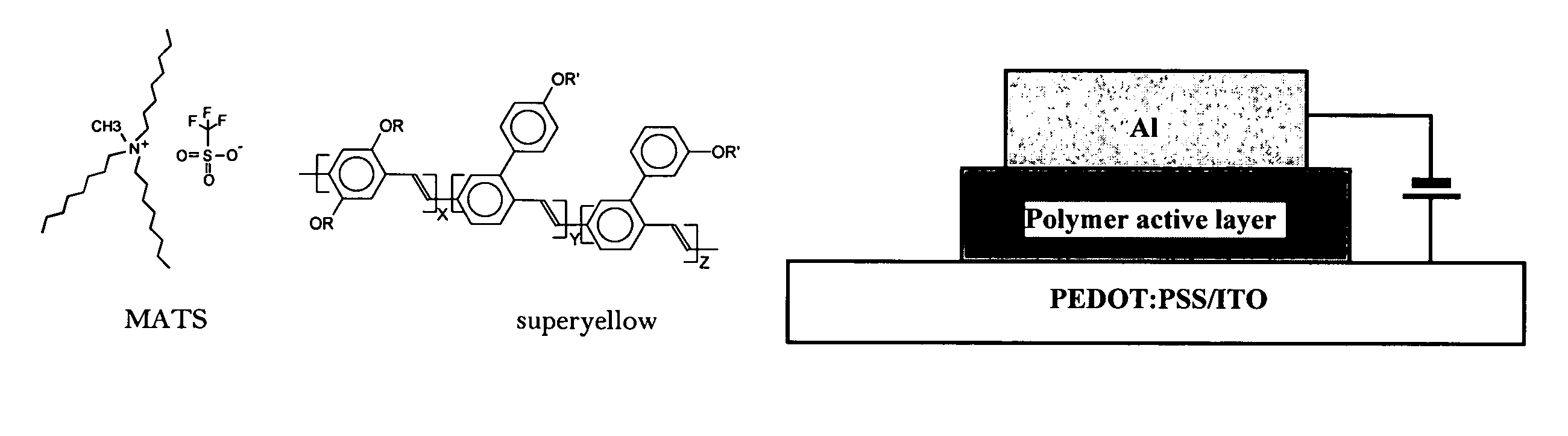
Figure 1 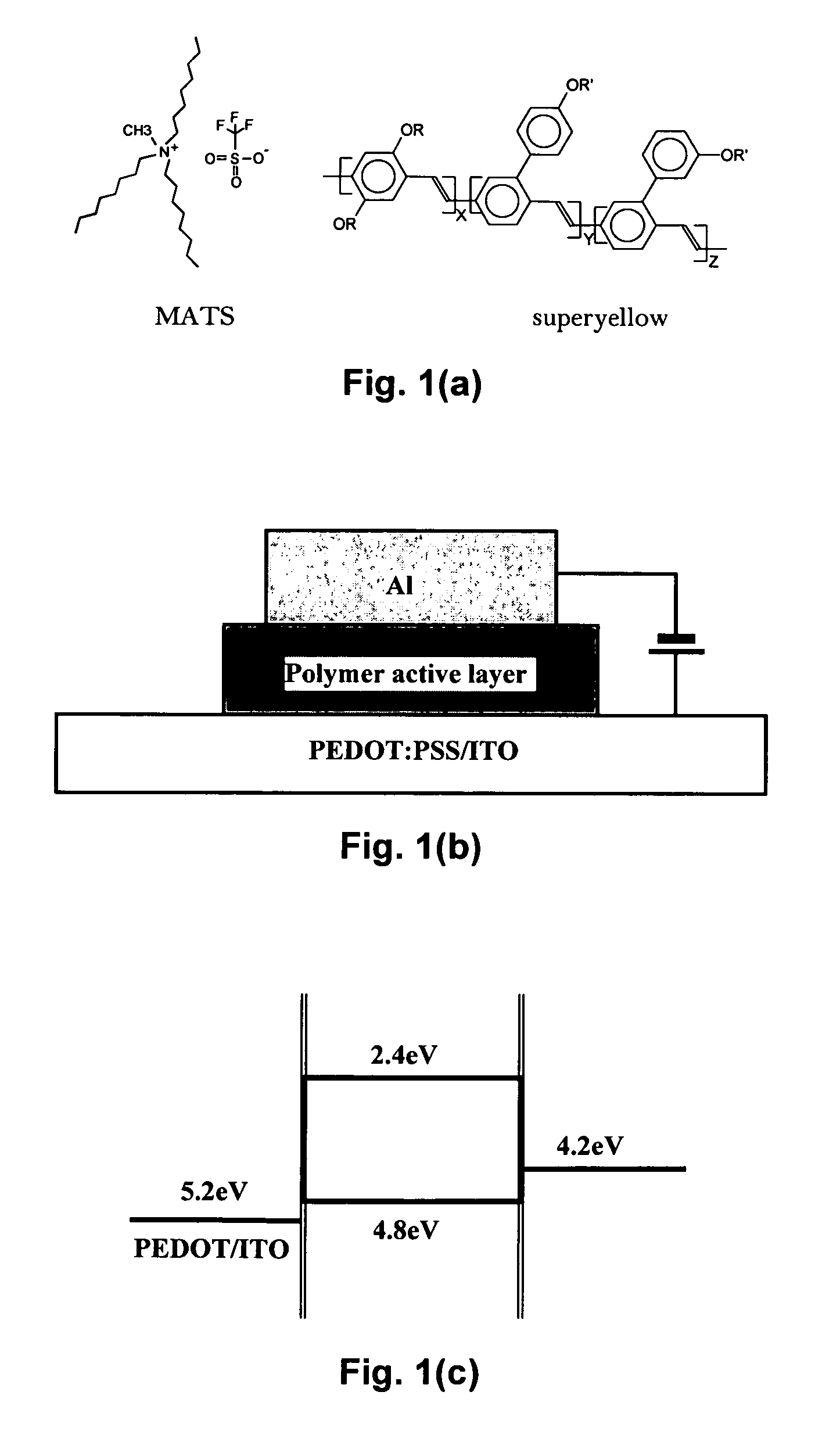
Figure 2 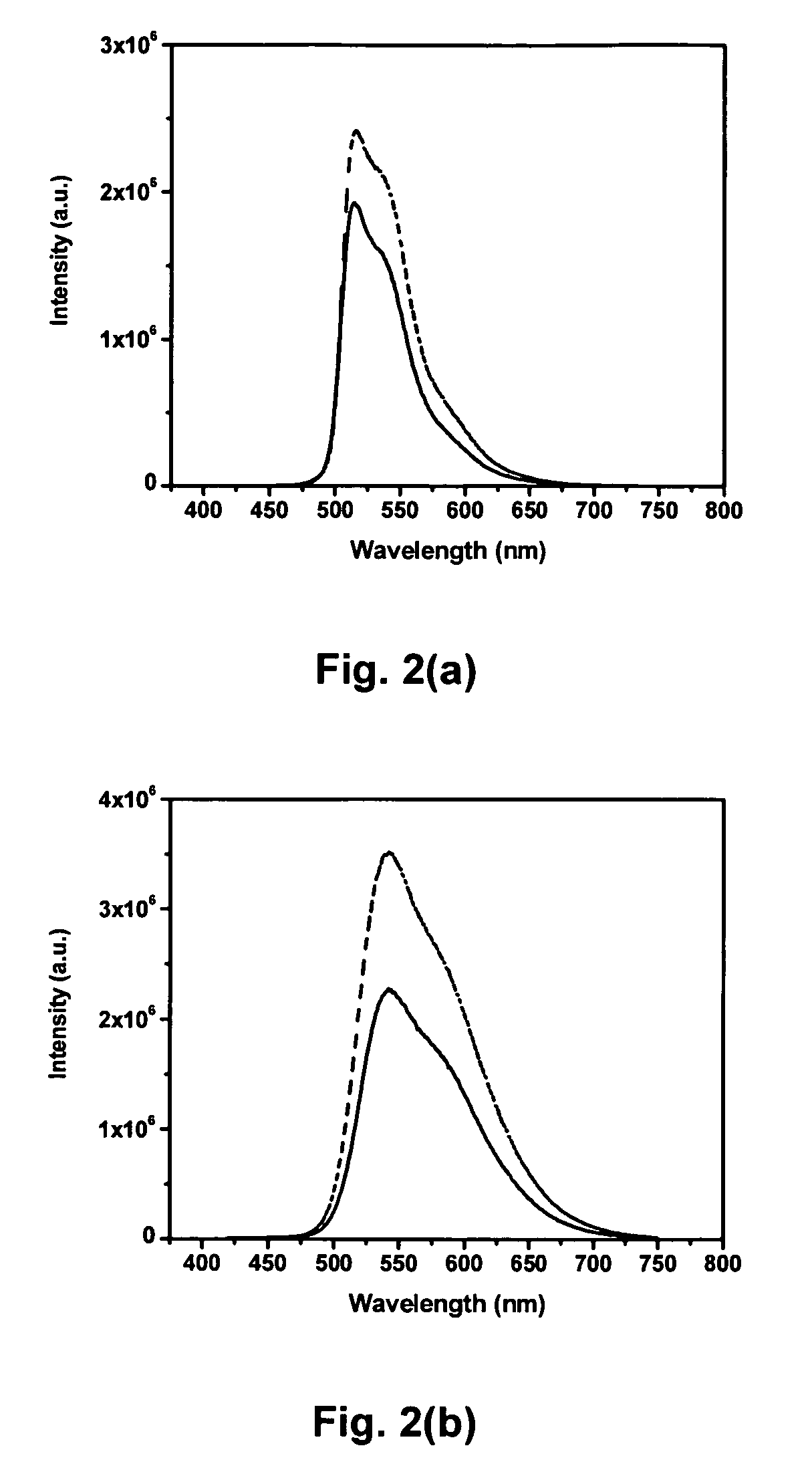
Figure 3
Abstract
Description
RELATED APPLICATIONS
[0001] This application claims the benefit of U.S. Provisional Application No. 60 / 850227 filed on Oct. 5, 2006, which is incorporated herein by reference in its entirety.FIELD OF THE INVENTION
[0002] The invention relates to polymer light-emitting devices.BACKGROUND OF THE INVENTION
[0003] Polymer light-emitting devices have been divided into two general types: polymer light-emitting diodes (PLEDs) and polymer light-emitting electrochemical cells (PLECs) [1, 2, 3, 4, 5]. The advantages for PLEDs include fast response and relatively long operating lifetime (with proper packaging). However, low work function cathodes and / or thin interfacial layers (e.g. LiF) between the metal and the emitting polymer layer are required. In contrast, PLECs have relatively low turn-on voltages (approximately equal to the band gap of the luminescent semiconducting polymer), and low work function metals are not required.
[0004] One of the serious disadvantages of PLECs, however, is the slow r...
Examples
Embodiment Construction
[0037]In the devices described here, we utilized the simplest sandwich structure for the device configuration with poly(3,4-ethylenedioxythiophene)-poly(styrene sulfonate) (PEDOT-PSS) coated indium-tin-oxide (ITO) glass as the anode and aluminum as the cathode. A soluble phenyl-substituted poly(para-phenylene vinylene) (PPV) copolymer (“superyellow” from Merck KGaA, Frankfurter Str. 250, 64293 Darmstadt, Germany) was selected as our host light-emitting polymer and an organic ionic liquid, methyltrioctylammonium trifluoromethanesulfonate (MATS) was used to introduce a dilute concentration of mobile ions into the emitting polymer layer. The molecular structures of MATS and superyellow are shown in FIG. 1(a).
[0038]In other embodiments, light emitting polymers other than phenyl-substituted poly(para-phenylene vinylene) (PPV) copolymer, and its derivatives substituted at various positions on the phenylene moiety, can be used including, but not limited to poly(2-methoxy-5-(2-ethylhexyloxy...