
Anonymous tracking using a set of wireless devices
a wireless device and anonymous tracking technology, applied in the field of anonymous tracking using a set of wireless devices, can solve the problems of long time, difficult to count the number of all tags in the system in a short period of time, and efforts that have not been fully endorsed by the industry, so as to improve the operating range of an ezb estimator, reduce the total estimation time, and improve the effect of accuracy
Patent Information
- Authority / Receiving Office
- US · United States
- Patent Type
- Patents(United States)
- Current Assignee / Owner
- Publication Date
- 2012-10-30
- Estimated Expiration
- Not applicable · inactive patent
Smart Images
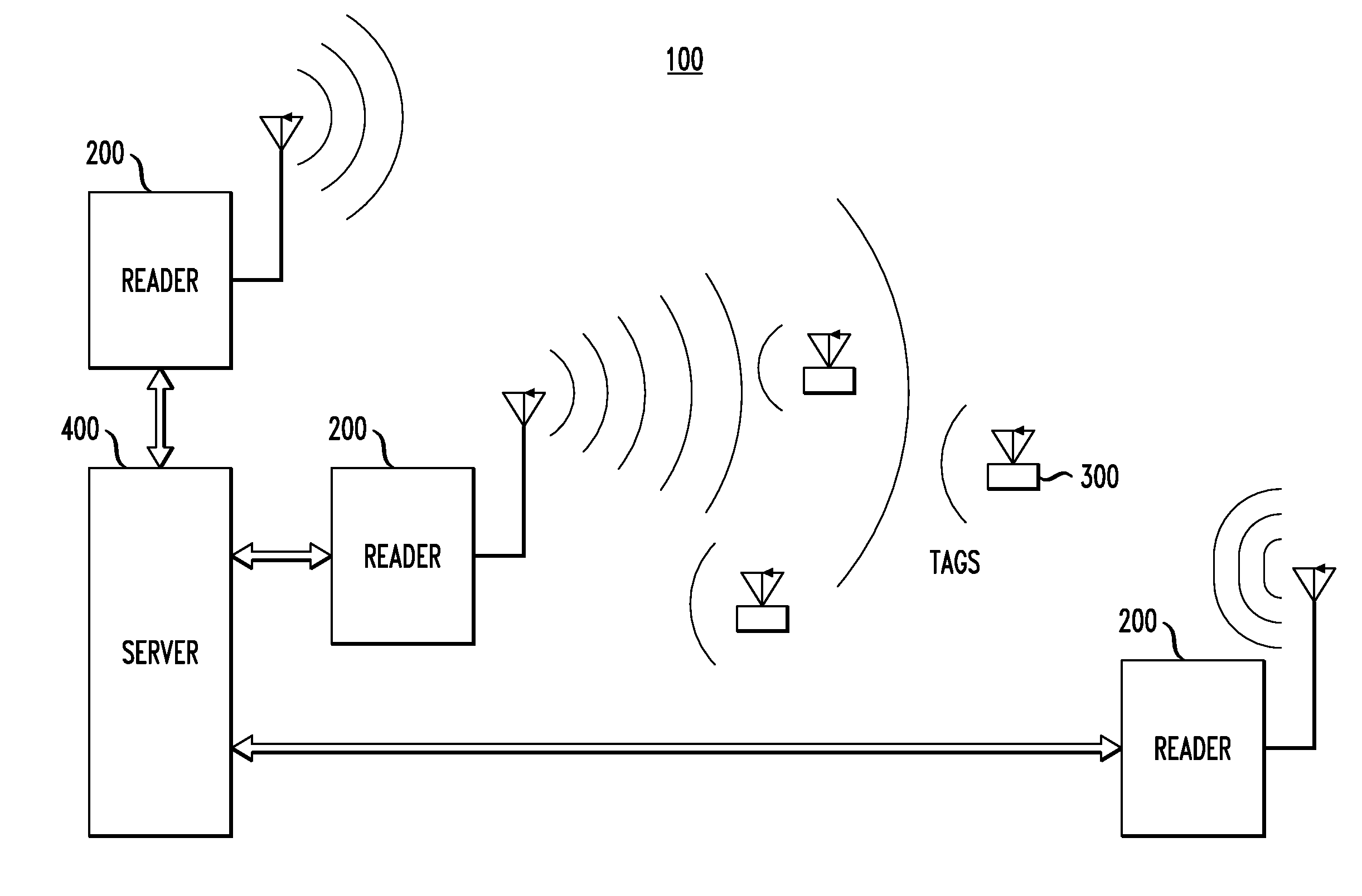
Figure 1 
Figure 2 
Figure 3
Abstract
Description
CROSS-REFERENCE TO RELATED APPLICATION
[0001] This application claims the benefit of the filing date of U.S. provisional application No. 60 / 847,598, filed on Sep. 27, 2006, the teachings of which are incorporated herein by reference.BACKGROUND OF THE INVENTION
[0002] 1. Field of the Invention
[0003] The present invention relates to wireless devices, such as radio-frequency identification (RFID) tags, and, in particular, to methods of quickly estimating the cardinality of a dynamically-changing set of wireless devices, i.e., the number of devices in the set, without explicitly identifying the individual devices of the set.
[0004] 2. Description of the Related Art
[0005] Radio-Frequency Identification (RFID) tags are being increasingly used in many applications for identification and tracking purposes. While these devices offer many advantages to consumers, business, and government, privacy advocates have expressed genuine fears that RFID tags can be used for tracking purposes beyond their inte...
Examples
Embodiment Construction
[0024]An RFID-tag and system model, in one embodiment of the invention, will now be introduced. Considering a large field of RFID tags and a set of readers, the set of readers could imply multiple readers reading the field at the same time, or alternatively, a single reader sequentially querying the field at different points in space and / or time, or a combination of both. Such a system adopts a “listen-before-talk” model for the RFID tags, wherein the tags “listen” to the reader's request before they “talk” back. In this scenario, even though tags may have their own unique identifiers, it is not of interest to identify tags uniquely.
[0025]The range of a reader is defined by the set of RFID tags that are capable of transmitting back to the reader. This is because the reader's transmission radius is assumed to be far greater than a tag's transmission radius, and yet, the reader's usefulness is determined only by the number of tags that it can read.
[0026]In a basic ALOHA scheme, as ful...