
Compact high pressure rubber hose
a high-pressure rubber hose, compact technology, applied in the direction of flexible pipes, mechanical equipment, pipes, etc., can solve the problems of kinking or fatigue, exposure to a variety of environmental factors, mechanical stresses which cannot always be predicted,
Patent Information
- Authority / Receiving Office
- US · United States
- Patent Type
- Patents(United States)
- Current Assignee / Owner
- Publication Date
- 2013-09-24
Smart Images
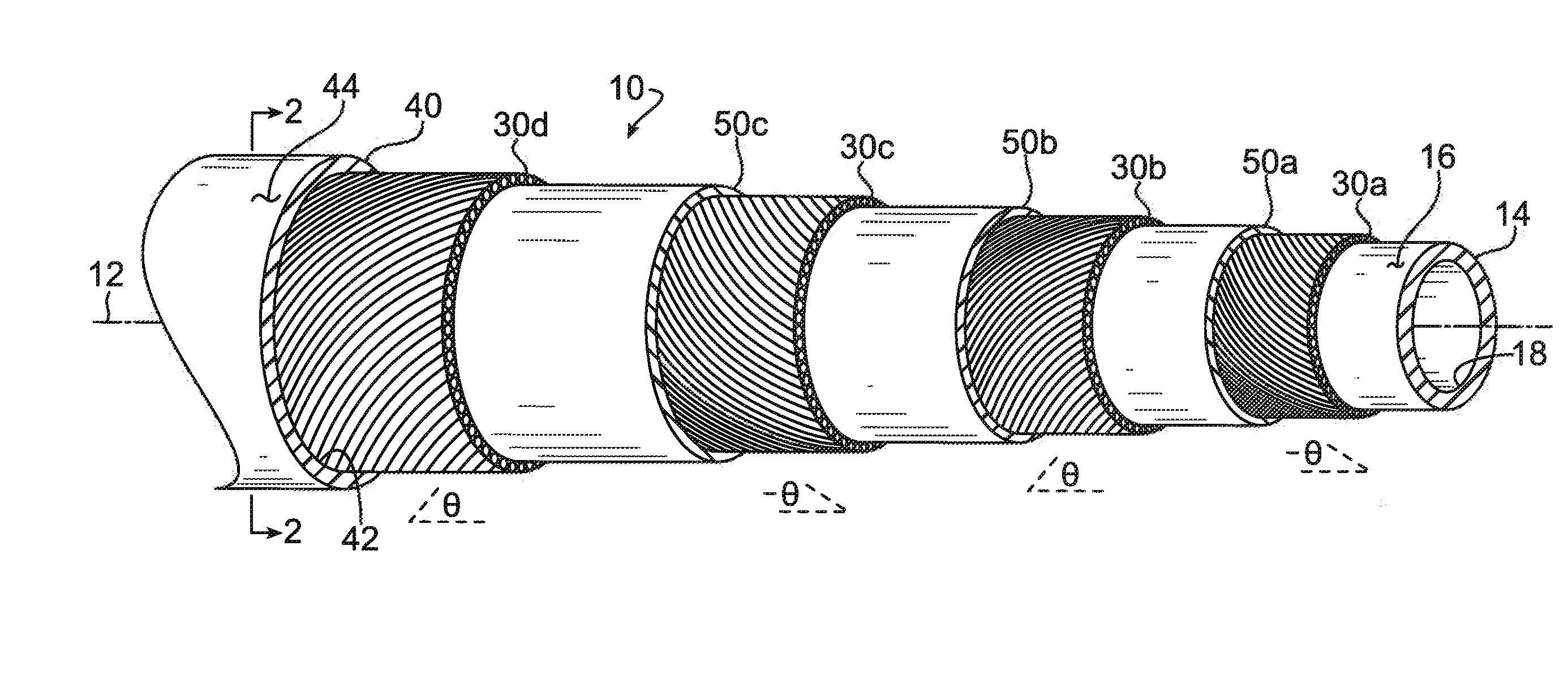
Figure 1 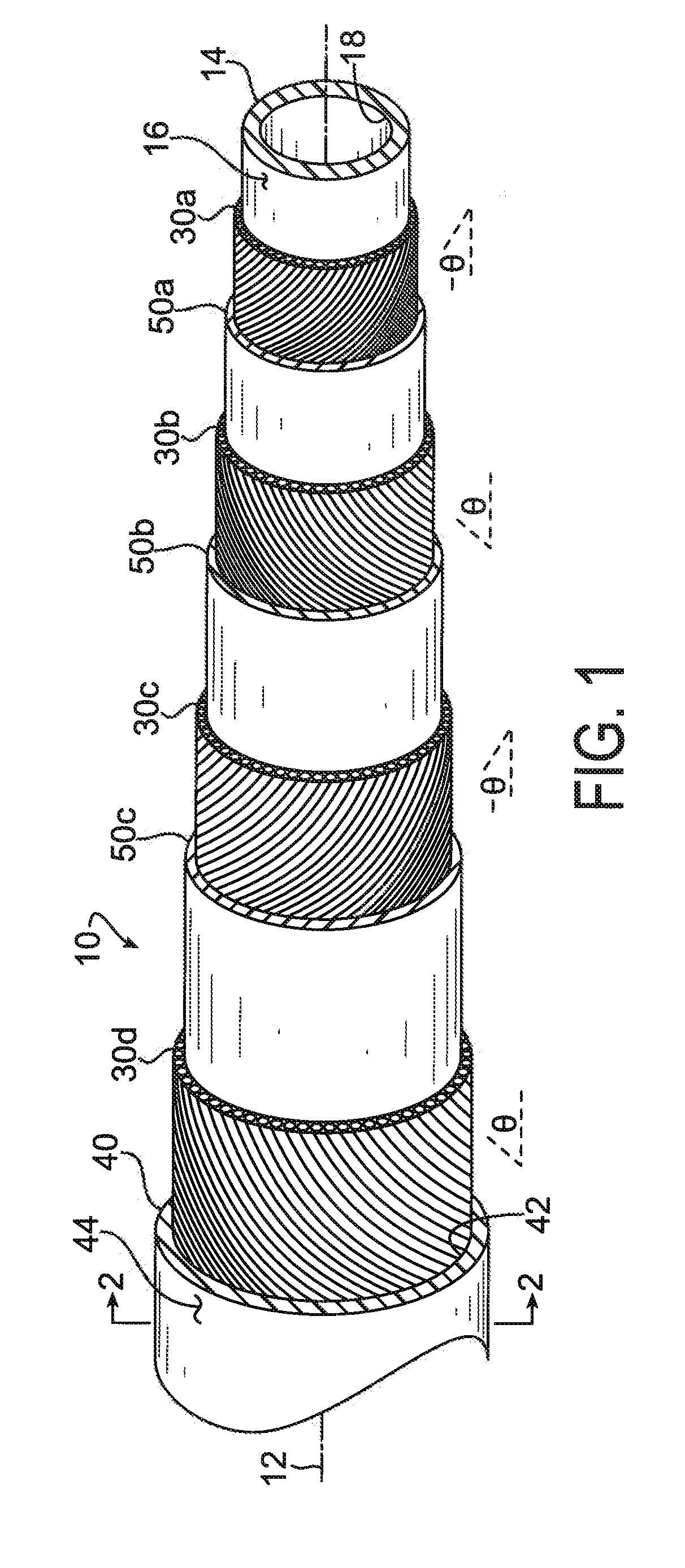
Figure 2 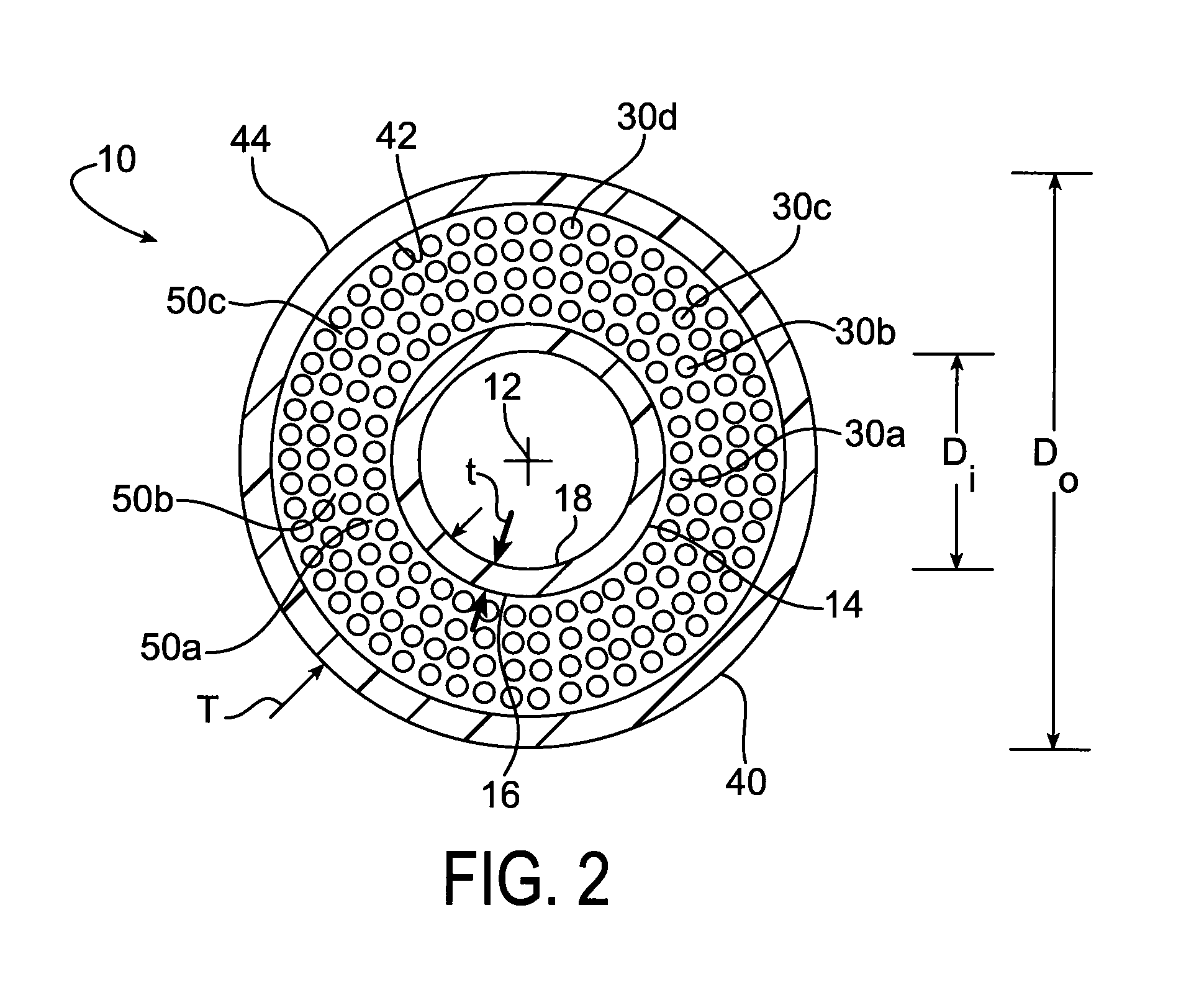
Figure 3
Abstract
Description
CROSS REFERENCE TO RELATES CASES
[0001] The present application claims the benefit of the filing date of U.S. Provisional Application Ser. No. 60 / 164,002; filed Mar. 27, 2009, the disclosure of which is expressly incorporated herein by reference.BACKGROUND OF THE INVENTION
[0002] The present invention relates broadly to flexible rubber hoses for low, medium, or, particularly, high pressure applications, and more particularly to a construction therefor which is of a compact design.
[0003] Flexible rubber hose is used in a variety of hydraulic and other fluid transfer applications for conveying fluid pressures which for “high” pressure applications typically range from about 4000 psi (28 MPa) to 8000 psi (55 MPa) or more. In basic construction, hoses of the type herein involved typically are formed as having a tubular, innermost inner tube or core surrounded by one or more outer layers of a braided or spiral-wound reinforcement material which may be a metal or metal-alloy wire or a natural ...
Examples
Embodiment Construction
[0017]Certain terminology may be employed in the following description for convenience rather than for any limiting purpose. For example, the terms “forward” and “rearward,”“front” and “rear,”“right” and “left,”“upper” and “lower,” and “top” and “bottom” designate directions in the drawings to which reference is made, with the terms “inward,”“inner,”“interior,” or “inboard” and “outward,”“outer,”“exterior,” or “outboard” referring, respectively, to directions toward and away from the center of the referenced element, the terms “radial” or “horizontal” and “axial” or “vertical” referring, respectively, to directions or planes which are perpendicular, in the case of radial or horizontal, or parallel, in the case of axial or vertical, to the longitudinal central axis of the referenced element, and the terms “downstream” and “upstream” referring, respectively, to directions in and opposite that of fluid flow. Terminology of similar import other than the words specifically mentioned abov...