

Assessing Scalability Challenges for Silicon Oxide Anode Designs
MAY 26, 20269 MIN READ
Generate Your Research Report Instantly with AI Agent
PatSnap Eureka helps you evaluate technical feasibility & market potential.
Silicon Oxide Anode Development Background and Scalability Goals
Silicon oxide (SiOx) anodes have emerged as a promising alternative to conventional graphite anodes in lithium-ion batteries, driven by the increasing demand for higher energy density storage solutions. The development of SiOx anodes traces back to early research on silicon-based materials in the 1970s, when scientists first recognized silicon's theoretical capacity of 4,200 mAh/g, nearly ten times higher than graphite's 372 mAh/g. However, pure silicon's severe volume expansion during lithiation led researchers to explore silicon oxide compositions as a more stable alternative.
The evolution of SiOx anode technology gained momentum in the 2000s as battery manufacturers sought to address the limitations of graphite anodes in meeting the energy requirements of emerging applications. Silicon oxide materials, typically represented as SiOx where x ranges from 0.5 to 2.0, offered a compromise between high capacity and structural stability. These materials demonstrated theoretical capacities ranging from 1,200 to 2,000 mAh/g while exhibiting reduced volume expansion compared to pure silicon.
Current scalability goals for SiOx anode designs center on achieving commercial viability through cost-effective manufacturing processes and consistent performance at industrial scales. The primary objective involves developing synthesis methods that can produce SiOx materials with controlled stoichiometry and particle morphology while maintaining economic feasibility. Manufacturing targets include achieving production costs below $15 per kilogram of active material and establishing continuous production capabilities exceeding 1,000 tons annually.
Performance scalability goals encompass maintaining first-cycle efficiency above 85% and cycle life exceeding 1,000 cycles at commercial cell levels. These targets require addressing fundamental challenges related to solid electrolyte interphase formation, particle size distribution control, and binder optimization. Additionally, scalability objectives include developing standardized quality control protocols that ensure batch-to-batch consistency across different production facilities.
The integration of SiOx anodes into existing battery manufacturing infrastructure represents another critical scalability goal. This involves adapting current electrode coating processes, optimizing slurry formulations for large-scale production, and establishing supply chain networks for raw materials. Success in achieving these scalability goals will determine the commercial adoption timeline for SiOx anode technology in next-generation lithium-ion batteries.
The evolution of SiOx anode technology gained momentum in the 2000s as battery manufacturers sought to address the limitations of graphite anodes in meeting the energy requirements of emerging applications. Silicon oxide materials, typically represented as SiOx where x ranges from 0.5 to 2.0, offered a compromise between high capacity and structural stability. These materials demonstrated theoretical capacities ranging from 1,200 to 2,000 mAh/g while exhibiting reduced volume expansion compared to pure silicon.
Current scalability goals for SiOx anode designs center on achieving commercial viability through cost-effective manufacturing processes and consistent performance at industrial scales. The primary objective involves developing synthesis methods that can produce SiOx materials with controlled stoichiometry and particle morphology while maintaining economic feasibility. Manufacturing targets include achieving production costs below $15 per kilogram of active material and establishing continuous production capabilities exceeding 1,000 tons annually.
Performance scalability goals encompass maintaining first-cycle efficiency above 85% and cycle life exceeding 1,000 cycles at commercial cell levels. These targets require addressing fundamental challenges related to solid electrolyte interphase formation, particle size distribution control, and binder optimization. Additionally, scalability objectives include developing standardized quality control protocols that ensure batch-to-batch consistency across different production facilities.
The integration of SiOx anodes into existing battery manufacturing infrastructure represents another critical scalability goal. This involves adapting current electrode coating processes, optimizing slurry formulations for large-scale production, and establishing supply chain networks for raw materials. Success in achieving these scalability goals will determine the commercial adoption timeline for SiOx anode technology in next-generation lithium-ion batteries.
Market Demand for High-Capacity Battery Anodes
The global battery market is experiencing unprecedented growth driven by the rapid expansion of electric vehicles, energy storage systems, and portable electronics. This surge in demand has created an urgent need for next-generation battery technologies that can deliver significantly higher energy densities while maintaining safety and cost-effectiveness. Traditional graphite anodes, with their theoretical capacity limited to 372 mAh/g, are increasingly inadequate for meeting the performance requirements of modern applications.
Silicon oxide anodes represent a transformative solution to this capacity bottleneck, offering theoretical capacities exceeding 1500 mAh/g. The electric vehicle sector, which accounts for the largest portion of high-capacity battery demand, requires energy densities that can enable longer driving ranges while reducing battery pack size and weight. Current lithium-ion batteries struggle to meet the industry target of 500 Wh/kg at the pack level, creating substantial market opportunities for silicon oxide anode technologies.
Energy storage systems for renewable energy integration present another significant demand driver. Grid-scale storage applications require batteries with high energy density to minimize installation footprint and reduce capital costs per kilowatt-hour stored. The intermittent nature of solar and wind power generation necessitates large-capacity storage solutions that can efficiently store and discharge energy over extended periods.
Consumer electronics continue to demand thinner, lighter devices with longer battery life. Smartphones, laptops, and wearable devices require batteries that can deliver more energy within increasingly constrained form factors. Silicon oxide anodes enable manufacturers to achieve these design goals while improving user experience through extended operational time between charges.
The aerospace and defense sectors represent emerging high-value markets for advanced battery technologies. These applications demand exceptional energy density combined with reliability under extreme conditions. Silicon oxide anodes offer the potential to significantly reduce weight in aircraft and satellite applications while providing the high capacity required for mission-critical operations.
Market dynamics indicate strong preference for battery technologies that can achieve energy densities above 300 Wh/kg at the cell level. This performance threshold represents a critical inflection point where electric vehicles achieve cost and performance parity with internal combustion engines. Silicon oxide anodes are positioned as a key enabling technology for reaching this milestone, driving substantial investment and development efforts across the battery value chain.
Silicon oxide anodes represent a transformative solution to this capacity bottleneck, offering theoretical capacities exceeding 1500 mAh/g. The electric vehicle sector, which accounts for the largest portion of high-capacity battery demand, requires energy densities that can enable longer driving ranges while reducing battery pack size and weight. Current lithium-ion batteries struggle to meet the industry target of 500 Wh/kg at the pack level, creating substantial market opportunities for silicon oxide anode technologies.
Energy storage systems for renewable energy integration present another significant demand driver. Grid-scale storage applications require batteries with high energy density to minimize installation footprint and reduce capital costs per kilowatt-hour stored. The intermittent nature of solar and wind power generation necessitates large-capacity storage solutions that can efficiently store and discharge energy over extended periods.
Consumer electronics continue to demand thinner, lighter devices with longer battery life. Smartphones, laptops, and wearable devices require batteries that can deliver more energy within increasingly constrained form factors. Silicon oxide anodes enable manufacturers to achieve these design goals while improving user experience through extended operational time between charges.
The aerospace and defense sectors represent emerging high-value markets for advanced battery technologies. These applications demand exceptional energy density combined with reliability under extreme conditions. Silicon oxide anodes offer the potential to significantly reduce weight in aircraft and satellite applications while providing the high capacity required for mission-critical operations.
Market dynamics indicate strong preference for battery technologies that can achieve energy densities above 300 Wh/kg at the cell level. This performance threshold represents a critical inflection point where electric vehicles achieve cost and performance parity with internal combustion engines. Silicon oxide anodes are positioned as a key enabling technology for reaching this milestone, driving substantial investment and development efforts across the battery value chain.
Current Silicon Oxide Anode Challenges and Manufacturing Barriers
Silicon oxide anodes face significant volume expansion challenges during lithiation and delithiation cycles, with expansion rates reaching 160-300% compared to graphite's modest 10%. This dramatic dimensional change creates mechanical stress that leads to particle cracking, active material pulverization, and subsequent capacity fade. The repeated expansion-contraction cycles cause progressive deterioration of the electrode structure, making long-term cycling stability a critical concern for commercial viability.
The solid electrolyte interphase formation on silicon oxide surfaces presents complex electrochemical challenges. Unlike conventional graphite anodes, silicon oxide generates unstable SEI layers that continuously reform during cycling, consuming electrolyte and lithium inventory. This dynamic SEI behavior results in increased impedance growth and reduced coulombic efficiency, particularly during initial formation cycles where irreversible capacity losses can exceed 20-30%.
Manufacturing scalability encounters substantial barriers in achieving uniform particle size distribution and consistent silicon-to-oxygen ratios across large production batches. Current synthesis methods, including chemical vapor deposition and sol-gel processes, struggle to maintain quality control at industrial scales. The high-temperature processing requirements and precise atmospheric control needed for silicon oxide production significantly increase manufacturing complexity and costs.
Electrode processing presents unique formulation challenges due to silicon oxide's poor intrinsic conductivity and adhesion properties. Traditional slurry coating processes must accommodate specialized binder systems and conductive additives, often requiring 15-25% binder content compared to 5-10% for graphite electrodes. The increased inactive material content reduces energy density benefits and complicates large-scale electrode manufacturing.
Quality control and characterization methods for silicon oxide materials remain inadequately standardized across the industry. Variations in surface oxidation states, crystallinity, and morphology significantly impact electrochemical performance, yet current analytical techniques struggle to provide rapid, cost-effective quality assessment suitable for high-volume production environments.
Thermal management during cell operation poses additional challenges as silicon oxide anodes exhibit different heat generation patterns compared to conventional materials. The increased resistance and side reactions contribute to elevated operating temperatures, requiring enhanced thermal management systems that add complexity and cost to battery pack designs.
The solid electrolyte interphase formation on silicon oxide surfaces presents complex electrochemical challenges. Unlike conventional graphite anodes, silicon oxide generates unstable SEI layers that continuously reform during cycling, consuming electrolyte and lithium inventory. This dynamic SEI behavior results in increased impedance growth and reduced coulombic efficiency, particularly during initial formation cycles where irreversible capacity losses can exceed 20-30%.
Manufacturing scalability encounters substantial barriers in achieving uniform particle size distribution and consistent silicon-to-oxygen ratios across large production batches. Current synthesis methods, including chemical vapor deposition and sol-gel processes, struggle to maintain quality control at industrial scales. The high-temperature processing requirements and precise atmospheric control needed for silicon oxide production significantly increase manufacturing complexity and costs.
Electrode processing presents unique formulation challenges due to silicon oxide's poor intrinsic conductivity and adhesion properties. Traditional slurry coating processes must accommodate specialized binder systems and conductive additives, often requiring 15-25% binder content compared to 5-10% for graphite electrodes. The increased inactive material content reduces energy density benefits and complicates large-scale electrode manufacturing.
Quality control and characterization methods for silicon oxide materials remain inadequately standardized across the industry. Variations in surface oxidation states, crystallinity, and morphology significantly impact electrochemical performance, yet current analytical techniques struggle to provide rapid, cost-effective quality assessment suitable for high-volume production environments.
Thermal management during cell operation poses additional challenges as silicon oxide anodes exhibit different heat generation patterns compared to conventional materials. The increased resistance and side reactions contribute to elevated operating temperatures, requiring enhanced thermal management systems that add complexity and cost to battery pack designs.
Existing Silicon Oxide Anode Manufacturing Solutions
01 Silicon oxide nanostructure synthesis and preparation methods
Various synthesis methods have been developed to create silicon oxide nanostructures for anode applications, including chemical vapor deposition, sol-gel processes, and thermal oxidation techniques. These methods focus on controlling particle size, morphology, and surface properties to optimize electrochemical performance. The preparation techniques aim to achieve uniform distribution and proper crystalline structure for enhanced battery performance.- Silicon oxide nanostructure synthesis and preparation methods: Various synthesis techniques have been developed to create silicon oxide nanostructures for anode applications. These methods focus on controlling particle size, morphology, and surface properties to optimize electrochemical performance. The preparation processes include sol-gel methods, chemical vapor deposition, and thermal oxidation techniques that enable precise control over the material characteristics for enhanced battery performance.
- Composite material integration for enhanced conductivity: Silicon oxide anodes are combined with conductive materials such as carbon, graphene, or metal nanoparticles to improve electrical conductivity and cycling stability. These composite structures help address the inherent low conductivity of silicon oxide while maintaining structural integrity during charge-discharge cycles. The integration approaches include coating, mixing, and layered architectures.
- Manufacturing scalability and industrial production processes: Large-scale production methods have been developed to manufacture silicon oxide anodes economically for commercial battery applications. These processes focus on cost-effective synthesis routes, continuous production techniques, and quality control measures suitable for industrial implementation. The scalability considerations include raw material availability, process optimization, and equipment design for mass production.
- Structural optimization and volume expansion control: Engineering approaches have been developed to manage the volume expansion issues inherent in silicon oxide anodes during lithiation and delithiation processes. These solutions include porous structures, hollow architectures, and flexible binder systems that accommodate dimensional changes while maintaining electrical contact and structural stability throughout battery cycling.
- Surface modification and interface engineering: Surface treatment techniques and interface engineering strategies have been implemented to improve the electrochemical properties and cycling performance of silicon oxide anodes. These modifications include surface coatings, functionalization processes, and electrolyte interface optimization that enhance charge transfer kinetics and reduce side reactions during battery operation.
02 Composite material integration and structural design
Silicon oxide anodes are integrated with various composite materials such as carbon matrices, conductive polymers, and metal frameworks to improve structural stability and electrical conductivity. These composite designs help address volume expansion issues during charge-discharge cycles while maintaining high capacity. The structural engineering approaches focus on creating hierarchical architectures that can accommodate mechanical stress.Expand Specific Solutions03 Manufacturing scalability and production processes
Large-scale manufacturing processes have been developed to produce silicon oxide anodes commercially, including continuous production methods, roll-to-roll processing, and automated coating techniques. These scalable approaches address cost-effectiveness, quality control, and mass production requirements. The manufacturing strategies focus on maintaining consistent performance while reducing production costs for industrial applications.Expand Specific Solutions04 Surface modification and coating technologies
Surface treatment methods are employed to enhance the electrochemical stability and cycling performance of silicon oxide anodes. These modifications include protective coatings, surface functionalization, and interface engineering to prevent electrolyte decomposition and improve charge transfer kinetics. The coating technologies aim to create stable solid electrolyte interfaces that maintain performance over extended cycling.Expand Specific Solutions05 Performance optimization and capacity enhancement
Various strategies have been developed to optimize the electrochemical performance of silicon oxide anodes, including doping techniques, particle size control, and electrolyte compatibility improvements. These approaches focus on maximizing energy density while maintaining cycle life and rate capability. The optimization methods address key challenges such as capacity retention, voltage stability, and temperature performance for practical battery applications.Expand Specific Solutions
Key Players in Silicon Oxide Anode Industry
The silicon oxide anode technology sector is experiencing rapid growth as the industry transitions from early development to commercial deployment phases. The market demonstrates significant expansion potential, driven by increasing demand for high-energy-density batteries in electric vehicles and energy storage applications. Technology maturity varies considerably across market participants, with established players like Tesla, SK On, and Ningde Amperex Technology (CATL) leading commercial implementation, while specialized companies such as Sicona Battery Technologies, NanoGraf Corp., Enevate Corp., and Nexeon Ltd. focus on advanced silicon-based anode innovations. Material suppliers including BTR New Material Group and Shin-Etsu Chemical provide foundational components, supported by extensive research from institutions like KAIST, Rensselaer Polytechnic Institute, and Max Planck Society. The competitive landscape reflects a maturing ecosystem where scalability challenges are being addressed through diverse technological approaches and strategic partnerships between battery manufacturers, material developers, and automotive companies.
Tesla, Inc.
Technical Solution: Tesla has developed silicon nanowire anode technology integrated into their 4680 battery cells, focusing on addressing the volume expansion challenges through advanced electrode engineering and electrolyte optimization. Their approach involves using silicon-dominant anodes with specialized binder systems and conductive additives to maintain structural integrity during cycling. The company has implemented manufacturing processes that can handle the mechanical stress from silicon expansion while maintaining high energy density targets of over 300 Wh/kg at the cell level.
Strengths: Vertical integration capabilities and large-scale manufacturing experience enable rapid commercialization. Weaknesses: Limited public disclosure of specific technical solutions and reliance on proprietary processes may limit scalability partnerships.
Sicona Battery Technologies Pty Ltd.
Technical Solution: Sicona has developed proprietary silicon composite anode materials using their patented porous silicon technology that addresses the fundamental scalability challenges of silicon oxide anodes. Their approach involves creating engineered porous silicon particles that can accommodate volume expansion while maintaining electrical connectivity. The company has demonstrated pilot-scale production capabilities and has established partnerships for commercial-scale manufacturing. Their technology focuses on reducing the irreversible capacity loss typically associated with silicon oxide anodes through surface modification and electrolyte engineering.
Strengths: Specialized focus on silicon anode technology with proven intellectual property portfolio and pilot-scale validation. Weaknesses: Limited manufacturing scale compared to established battery material suppliers and dependence on partnership agreements for large-scale production.
Core Patents in Scalable Silicon Oxide Processing
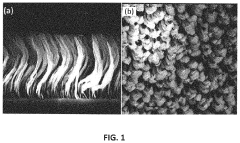
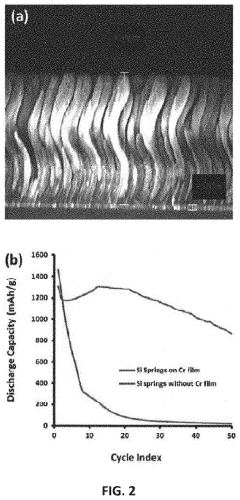
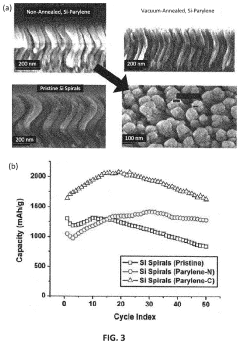
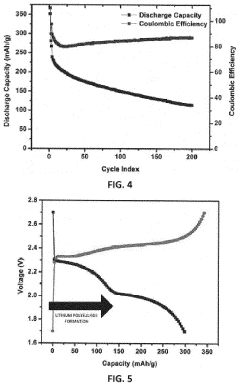
Scalable silicon anodes and the role of parylene films in improving electrode performance characteristics in energy storage systems
PatentActiveUS20210367281A1
Innovation
- The use of a parylene coating on electrodes, specifically nanostructured silicon and carbon-sulfur materials, to form a conformal barrier that prevents electrolyte reaction, provides structural rigidity, and contains lithium polysulfides, thereby reducing capacity loss and enhancing cycle life.
Silicon-based anode material and preparation method thereof
PatentPendingUS20230420660A1
Innovation
- A silicon-based anode material with a nano silicon core and a lithium-containing silicon oxide core coated with a polymer layer featuring —Si—O—Si— bonds, which inhibits gas production and enhances processing performance by forming a stable aqueous slurry and improving initial Coulombic efficiency.


Environmental Impact of Silicon Oxide Manufacturing
The manufacturing of silicon oxide for battery anodes presents significant environmental challenges that must be carefully evaluated as the technology scales toward commercial deployment. The production process typically involves high-temperature synthesis methods, including thermal oxidation of silicon nanoparticles or chemical vapor deposition techniques, which consume substantial amounts of energy and generate considerable carbon emissions. These energy-intensive processes often require temperatures exceeding 1000°C, contributing to the overall carbon footprint of silicon oxide anode production.
Water consumption represents another critical environmental concern in silicon oxide manufacturing. The purification and washing stages of silicon oxide nanoparticles require extensive use of deionized water and various chemical solvents. Additionally, the wet chemical synthesis routes commonly employed for producing silicon oxide materials generate significant volumes of wastewater containing residual chemicals and byproducts that require proper treatment before disposal.
Chemical waste generation poses substantial environmental risks throughout the silicon oxide production chain. The synthesis processes often utilize hazardous precursors such as silane gases, organic solvents, and various reducing agents. Incomplete reactions and purification steps result in chemical waste streams that contain toxic compounds, requiring specialized disposal methods and contributing to environmental pollution if not properly managed.
The mining and processing of raw silicon materials create upstream environmental impacts that extend beyond the immediate manufacturing facility. Silicon extraction involves energy-intensive purification processes that generate silicon tetrachloride and other chlorinated compounds as byproducts. These materials pose environmental hazards and require careful handling and disposal protocols.
Lifecycle assessment studies indicate that silicon oxide anode manufacturing generates approximately 15-25% higher carbon emissions compared to conventional graphite anode production. However, emerging green manufacturing approaches, including renewable energy integration and closed-loop water recycling systems, show promise for reducing environmental impacts. Advanced synthesis methods utilizing lower-temperature plasma-enhanced processes and bio-based reducing agents are being developed to minimize energy consumption and chemical waste generation, potentially improving the environmental profile of silicon oxide anode manufacturing as the technology matures.
Water consumption represents another critical environmental concern in silicon oxide manufacturing. The purification and washing stages of silicon oxide nanoparticles require extensive use of deionized water and various chemical solvents. Additionally, the wet chemical synthesis routes commonly employed for producing silicon oxide materials generate significant volumes of wastewater containing residual chemicals and byproducts that require proper treatment before disposal.
Chemical waste generation poses substantial environmental risks throughout the silicon oxide production chain. The synthesis processes often utilize hazardous precursors such as silane gases, organic solvents, and various reducing agents. Incomplete reactions and purification steps result in chemical waste streams that contain toxic compounds, requiring specialized disposal methods and contributing to environmental pollution if not properly managed.
The mining and processing of raw silicon materials create upstream environmental impacts that extend beyond the immediate manufacturing facility. Silicon extraction involves energy-intensive purification processes that generate silicon tetrachloride and other chlorinated compounds as byproducts. These materials pose environmental hazards and require careful handling and disposal protocols.
Lifecycle assessment studies indicate that silicon oxide anode manufacturing generates approximately 15-25% higher carbon emissions compared to conventional graphite anode production. However, emerging green manufacturing approaches, including renewable energy integration and closed-loop water recycling systems, show promise for reducing environmental impacts. Advanced synthesis methods utilizing lower-temperature plasma-enhanced processes and bio-based reducing agents are being developed to minimize energy consumption and chemical waste generation, potentially improving the environmental profile of silicon oxide anode manufacturing as the technology matures.
Cost-Effectiveness Analysis for Commercial Viability
The commercial viability of silicon oxide anode designs hinges critically on achieving cost parity with existing graphite-based solutions while delivering superior performance metrics. Current manufacturing costs for silicon oxide anodes remain approximately 3-5 times higher than conventional graphite anodes, primarily due to complex synthesis processes, specialized equipment requirements, and lower production volumes. The cost structure is dominated by raw material expenses, accounting for 40-50% of total production costs, followed by energy-intensive processing steps that contribute an additional 25-30%.
Manufacturing scalability presents significant economic challenges that directly impact unit costs. The transition from laboratory-scale synthesis to industrial production requires substantial capital investments in specialized equipment, including high-temperature furnaces, controlled atmosphere systems, and precision coating machinery. These infrastructure requirements create high barriers to entry and necessitate production volumes exceeding 1,000 tons annually to achieve meaningful economies of scale.
Raw material sourcing represents another critical cost factor, particularly for high-purity silicon precursors and specialized carbon coating materials. Supply chain optimization and vertical integration strategies could potentially reduce material costs by 15-20%, though this requires significant upfront investment and long-term supplier partnerships. Alternative synthesis routes using lower-cost silicon sources, such as metallurgical-grade silicon, are being explored but currently compromise performance characteristics.
The economic value proposition becomes more favorable when considering the total cost of ownership perspective. Silicon oxide anodes enable higher energy density batteries, potentially reducing the number of cells required for equivalent energy storage capacity. This system-level cost reduction, combined with extended cycle life and improved fast-charging capabilities, can offset higher material costs in premium applications such as electric vehicles and grid storage systems.
Market adoption timing significantly influences cost-effectiveness projections. Early commercialization in high-value applications, where performance premiums justify higher costs, provides a pathway for technology maturation and cost reduction. As production scales increase and manufacturing processes optimize, cost projections indicate potential achievement of cost parity with graphite anodes within 5-7 years, assuming sustained investment and technological advancement.
Manufacturing scalability presents significant economic challenges that directly impact unit costs. The transition from laboratory-scale synthesis to industrial production requires substantial capital investments in specialized equipment, including high-temperature furnaces, controlled atmosphere systems, and precision coating machinery. These infrastructure requirements create high barriers to entry and necessitate production volumes exceeding 1,000 tons annually to achieve meaningful economies of scale.
Raw material sourcing represents another critical cost factor, particularly for high-purity silicon precursors and specialized carbon coating materials. Supply chain optimization and vertical integration strategies could potentially reduce material costs by 15-20%, though this requires significant upfront investment and long-term supplier partnerships. Alternative synthesis routes using lower-cost silicon sources, such as metallurgical-grade silicon, are being explored but currently compromise performance characteristics.
The economic value proposition becomes more favorable when considering the total cost of ownership perspective. Silicon oxide anodes enable higher energy density batteries, potentially reducing the number of cells required for equivalent energy storage capacity. This system-level cost reduction, combined with extended cycle life and improved fast-charging capabilities, can offset higher material costs in premium applications such as electric vehicles and grid storage systems.
Market adoption timing significantly influences cost-effectiveness projections. Early commercialization in high-value applications, where performance premiums justify higher costs, provides a pathway for technology maturation and cost reduction. As production scales increase and manufacturing processes optimize, cost projections indicate potential achievement of cost parity with graphite anodes within 5-7 years, assuming sustained investment and technological advancement.
Unlock deeper insights with PatSnap Eureka Quick Research — get a full tech report to explore trends and direct your research. Try now!
Generate Your Research Report Instantly with AI Agent
Supercharge your innovation with PatSnap Eureka AI Agent Platform!