
Avoiding Alignment Disruptions in Long-Life Zero-Backlash Coupling Uses
JUN 1, 20269 MIN READ
Generate Your Research Report Instantly with AI Agent
Patsnap Eureka helps you evaluate technical feasibility & market potential.
Zero-Backlash Coupling Technology Background and Objectives
Zero-backlash couplings represent a critical mechanical transmission technology that has evolved significantly since the mid-20th century to address the fundamental challenge of eliminating rotational play in precision motion systems. The technology emerged from the aerospace and defense industries' demanding requirements for accurate positioning systems, where even minimal angular displacement errors could compromise mission-critical operations. Early developments focused on overcoming the inherent limitations of traditional rigid and flexible couplings, which introduced backlash through manufacturing tolerances and wear over operational lifecycles.
The historical progression of zero-backlash coupling technology began with simple split-collar designs in the 1950s, advancing through bellows-type configurations in the 1960s, and evolving into sophisticated multi-element systems incorporating advanced materials and precision manufacturing techniques. This evolution was driven by the increasing demands of computer numerical control machines, robotics, and high-precision instrumentation that required sub-arcminute positioning accuracy maintained over extended operational periods.
Contemporary zero-backlash couplings face the persistent challenge of maintaining their precision characteristics throughout extended service lives, particularly in applications involving continuous operation, varying loads, and environmental stresses. The primary technical objective centers on preventing alignment disruptions that can gradually degrade the coupling's zero-backlash performance, leading to positioning errors, increased maintenance requirements, and potential system failures.
Current technological goals focus on developing coupling designs that can maintain their initial precision specifications for operational lifespans exceeding 100 million cycles while withstanding misalignment conditions, thermal variations, and dynamic loading scenarios. Key performance targets include maintaining angular positioning accuracy within ±30 arcseconds, accommodating radial and angular misalignments without performance degradation, and ensuring consistent torque transmission characteristics throughout the operational envelope.
The strategic importance of addressing alignment disruption challenges extends beyond immediate performance considerations to encompass lifecycle cost optimization, system reliability enhancement, and enabling next-generation precision applications in emerging fields such as additive manufacturing, autonomous systems, and advanced semiconductor processing equipment where positioning tolerances continue to tighten while operational duration requirements increase.
The historical progression of zero-backlash coupling technology began with simple split-collar designs in the 1950s, advancing through bellows-type configurations in the 1960s, and evolving into sophisticated multi-element systems incorporating advanced materials and precision manufacturing techniques. This evolution was driven by the increasing demands of computer numerical control machines, robotics, and high-precision instrumentation that required sub-arcminute positioning accuracy maintained over extended operational periods.
Contemporary zero-backlash couplings face the persistent challenge of maintaining their precision characteristics throughout extended service lives, particularly in applications involving continuous operation, varying loads, and environmental stresses. The primary technical objective centers on preventing alignment disruptions that can gradually degrade the coupling's zero-backlash performance, leading to positioning errors, increased maintenance requirements, and potential system failures.
Current technological goals focus on developing coupling designs that can maintain their initial precision specifications for operational lifespans exceeding 100 million cycles while withstanding misalignment conditions, thermal variations, and dynamic loading scenarios. Key performance targets include maintaining angular positioning accuracy within ±30 arcseconds, accommodating radial and angular misalignments without performance degradation, and ensuring consistent torque transmission characteristics throughout the operational envelope.
The strategic importance of addressing alignment disruption challenges extends beyond immediate performance considerations to encompass lifecycle cost optimization, system reliability enhancement, and enabling next-generation precision applications in emerging fields such as additive manufacturing, autonomous systems, and advanced semiconductor processing equipment where positioning tolerances continue to tighten while operational duration requirements increase.
Market Demand for Long-Life Precision Coupling Solutions
The global precision coupling market is experiencing unprecedented growth driven by increasing demands for high-accuracy mechanical systems across multiple industrial sectors. Manufacturing industries, particularly those involved in precision machining, semiconductor fabrication, and automated assembly lines, require coupling solutions that maintain exceptional alignment stability over extended operational periods. The proliferation of Industry 4.0 initiatives has intensified the need for zero-backlash couplings that can sustain precision performance throughout their operational lifecycle without compromising system accuracy.
Aerospace and defense applications represent a significant market segment demanding long-life precision coupling solutions. Aircraft engine systems, satellite positioning mechanisms, and missile guidance systems require couplings that maintain alignment integrity under extreme operational conditions while delivering consistent performance over decades of service. The stringent reliability requirements in these applications drive substantial investment in advanced coupling technologies that can prevent alignment disruptions throughout their extended service life.
The robotics and automation sector constitutes another major demand driver for precision coupling solutions. Industrial robots performing repetitive high-precision tasks require couplings that maintain positional accuracy over millions of operational cycles. Collaborative robots and precision pick-and-place systems particularly benefit from zero-backlash couplings that prevent cumulative positioning errors caused by alignment drift over time.
Medical device manufacturing and laboratory automation equipment represent emerging high-growth market segments. Precision diagnostic equipment, surgical robots, and automated laboratory systems demand coupling solutions that maintain micron-level accuracy throughout their operational lifetime. The increasing adoption of automated medical testing systems and precision surgical equipment creates substantial market opportunities for advanced coupling technologies.
Renewable energy applications, particularly wind turbine systems and solar tracking mechanisms, require robust coupling solutions capable of maintaining alignment precision despite continuous exposure to environmental stresses. These applications demand couplings that can operate reliably for decades while maintaining system efficiency and preventing costly maintenance interventions.
The semiconductor manufacturing industry drives significant demand for ultra-precision coupling solutions in wafer handling systems, lithography equipment, and inspection tools. These applications require couplings that maintain nanometer-level positioning accuracy over extended periods while operating in controlled environments with stringent contamination requirements.
Market growth is further accelerated by increasing emphasis on predictive maintenance strategies and total cost of ownership optimization. Organizations are increasingly recognizing that investing in high-quality, long-life coupling solutions reduces overall system maintenance costs and improves operational reliability compared to frequent replacement of lower-grade components.
Aerospace and defense applications represent a significant market segment demanding long-life precision coupling solutions. Aircraft engine systems, satellite positioning mechanisms, and missile guidance systems require couplings that maintain alignment integrity under extreme operational conditions while delivering consistent performance over decades of service. The stringent reliability requirements in these applications drive substantial investment in advanced coupling technologies that can prevent alignment disruptions throughout their extended service life.
The robotics and automation sector constitutes another major demand driver for precision coupling solutions. Industrial robots performing repetitive high-precision tasks require couplings that maintain positional accuracy over millions of operational cycles. Collaborative robots and precision pick-and-place systems particularly benefit from zero-backlash couplings that prevent cumulative positioning errors caused by alignment drift over time.
Medical device manufacturing and laboratory automation equipment represent emerging high-growth market segments. Precision diagnostic equipment, surgical robots, and automated laboratory systems demand coupling solutions that maintain micron-level accuracy throughout their operational lifetime. The increasing adoption of automated medical testing systems and precision surgical equipment creates substantial market opportunities for advanced coupling technologies.
Renewable energy applications, particularly wind turbine systems and solar tracking mechanisms, require robust coupling solutions capable of maintaining alignment precision despite continuous exposure to environmental stresses. These applications demand couplings that can operate reliably for decades while maintaining system efficiency and preventing costly maintenance interventions.
The semiconductor manufacturing industry drives significant demand for ultra-precision coupling solutions in wafer handling systems, lithography equipment, and inspection tools. These applications require couplings that maintain nanometer-level positioning accuracy over extended periods while operating in controlled environments with stringent contamination requirements.
Market growth is further accelerated by increasing emphasis on predictive maintenance strategies and total cost of ownership optimization. Organizations are increasingly recognizing that investing in high-quality, long-life coupling solutions reduces overall system maintenance costs and improves operational reliability compared to frequent replacement of lower-grade components.
Current Alignment Challenges in Zero-Backlash Coupling Systems
Zero-backlash coupling systems face significant alignment challenges that directly impact their operational longevity and precision performance. Angular misalignment represents one of the most critical issues, occurring when the input and output shafts are not perfectly parallel or collinear. This misalignment creates uneven stress distribution across coupling elements, leading to accelerated wear patterns and potential premature failure of critical components.
Radial offset misalignment poses another substantial challenge, where shaft centerlines are parallel but not coincident. This condition generates cyclic loading patterns that create fatigue stress concentrations in coupling materials. The resulting mechanical stress can compromise the zero-backlash characteristics by causing elastic deformation or permanent set in precision-machined components, ultimately degrading positional accuracy over extended operational periods.
Axial misalignment complications arise from thermal expansion, mounting tolerances, and operational loads that cause shaft displacement along the rotational axis. These displacements create additional forces that must be accommodated by the coupling design while maintaining zero-backlash performance. The challenge intensifies in applications with significant temperature variations, where differential thermal expansion between connected equipment creates dynamic alignment conditions.
Installation precision requirements present ongoing challenges for maintaining proper alignment throughout the coupling's service life. Manufacturing tolerances in mounting surfaces, shaft runout variations, and assembly procedures can introduce initial misalignments that compound over time. These factors become particularly problematic in high-precision applications where even microscopic alignment deviations can affect system performance.
Dynamic loading conditions further complicate alignment maintenance, as operational forces, vibrations, and shock loads can gradually shift component positions. The coupling must accommodate these dynamic effects while preserving its zero-backlash characteristics and preventing the development of play or looseness that would compromise precision positioning capabilities.
Environmental factors including temperature cycling, contamination, and corrosive conditions can affect alignment stability by altering material properties, causing dimensional changes, or degrading component interfaces. These environmental influences create long-term alignment drift that must be considered in coupling design and application planning to ensure sustained performance throughout the intended service life.
Radial offset misalignment poses another substantial challenge, where shaft centerlines are parallel but not coincident. This condition generates cyclic loading patterns that create fatigue stress concentrations in coupling materials. The resulting mechanical stress can compromise the zero-backlash characteristics by causing elastic deformation or permanent set in precision-machined components, ultimately degrading positional accuracy over extended operational periods.
Axial misalignment complications arise from thermal expansion, mounting tolerances, and operational loads that cause shaft displacement along the rotational axis. These displacements create additional forces that must be accommodated by the coupling design while maintaining zero-backlash performance. The challenge intensifies in applications with significant temperature variations, where differential thermal expansion between connected equipment creates dynamic alignment conditions.
Installation precision requirements present ongoing challenges for maintaining proper alignment throughout the coupling's service life. Manufacturing tolerances in mounting surfaces, shaft runout variations, and assembly procedures can introduce initial misalignments that compound over time. These factors become particularly problematic in high-precision applications where even microscopic alignment deviations can affect system performance.
Dynamic loading conditions further complicate alignment maintenance, as operational forces, vibrations, and shock loads can gradually shift component positions. The coupling must accommodate these dynamic effects while preserving its zero-backlash characteristics and preventing the development of play or looseness that would compromise precision positioning capabilities.
Environmental factors including temperature cycling, contamination, and corrosive conditions can affect alignment stability by altering material properties, causing dimensional changes, or degrading component interfaces. These environmental influences create long-term alignment drift that must be considered in coupling design and application planning to ensure sustained performance throughout the intended service life.
Existing Solutions for Maintaining Coupling Alignment
01 Flexible coupling designs for backlash elimination
Flexible coupling mechanisms utilize elastic elements, bellows, or flexible materials to eliminate backlash while maintaining torque transmission. These designs compensate for misalignment through deformation of flexible components, providing zero-backlash operation by maintaining constant contact between coupling elements. The flexible nature allows for angular, parallel, and axial misalignment compensation while preventing the formation of gaps that cause backlash.- Flexible coupling designs for backlash elimination: Flexible coupling mechanisms utilize elastic elements, bellows, or flexible materials to eliminate backlash while maintaining torque transmission. These designs accommodate misalignment through deformation of flexible components rather than mechanical clearances, providing zero-backlash operation through continuous contact between coupling elements.
- Preloaded mechanical coupling systems: Preloaded coupling mechanisms employ spring-loaded or tensioned components to maintain constant contact between coupling elements, eliminating backlash through continuous mechanical preload. These systems use various preloading techniques including spring mechanisms, adjustable tension systems, and biased engagement methods to ensure zero clearance operation.
- Precision alignment and adjustment mechanisms: Advanced alignment systems incorporate adjustable components and precision positioning mechanisms to minimize coupling misalignment and associated backlash. These mechanisms feature fine-tuning capabilities, self-centering designs, and multi-axis adjustment systems that maintain proper coupling alignment during operation and reduce backlash-induced disruptions.
- Split coupling and multi-element designs: Multi-element coupling configurations utilize split or segmented designs with multiple engagement points to distribute loads and eliminate backlash. These systems employ overlapping elements, multiple contact surfaces, and redundant engagement mechanisms that provide continuous power transmission while compensating for wear and maintaining zero-backlash operation.
- Active backlash compensation and monitoring systems: Electronic and servo-controlled systems actively monitor and compensate for backlash in real-time through feedback mechanisms and automated adjustment. These systems incorporate sensors, actuators, and control algorithms to detect alignment disruptions and automatically adjust coupling parameters to maintain zero-backlash conditions during operation.
02 Preloaded coupling systems
Preloaded coupling mechanisms employ spring-loaded or tensioned elements to maintain constant engagement between coupling components. These systems use compression springs, tension springs, or other preloading mechanisms to eliminate clearances and ensure continuous contact. The preload force is carefully calibrated to prevent backlash while allowing for proper operation and misalignment accommodation.Expand Specific Solutions03 Multi-element coupling configurations
Multi-element coupling designs incorporate multiple interconnected components such as multiple discs, pins, or intermediate elements to distribute loads and eliminate backlash. These configurations often feature redundant load paths and multiple contact points that ensure continuous engagement. The multi-element approach provides enhanced misalignment capability while maintaining zero-backlash characteristics through distributed contact mechanisms.Expand Specific Solutions04 Precision machined coupling interfaces
Precision manufacturing techniques create coupling interfaces with extremely tight tolerances to minimize or eliminate backlash. These designs feature carefully machined surfaces, precise fits, and controlled clearances that prevent gap formation. Advanced manufacturing processes ensure consistent dimensional accuracy and surface quality to maintain zero-backlash operation throughout the coupling's service life.Expand Specific Solutions05 Adjustable coupling mechanisms
Adjustable coupling systems provide means for fine-tuning and eliminating backlash through mechanical adjustment features. These designs incorporate adjustment screws, threaded components, or variable positioning elements that allow for backlash compensation during installation or maintenance. The adjustability enables optimization of coupling performance and accommodation of wear or manufacturing variations while maintaining zero-backlash operation.Expand Specific Solutions
Key Players in Precision Coupling and Motion Control Industry
The zero-backlash coupling technology market is in a mature growth phase, driven by increasing demand for precision motion control across aerospace, robotics, and industrial automation sectors. The market demonstrates significant scale with established players like FANUC Corp., ABB Ltd., and NTN Corp. leading in industrial applications, while specialized manufacturers such as Gates Corp. and Motus Labs LLC focus on niche coupling solutions. Technology maturity varies across segments, with companies like Rethink Robotics and NASA pushing advanced applications in collaborative robotics and space systems, while traditional manufacturers like Kobe Steel and TE Connectivity provide foundational mechanical and electrical integration components. The competitive landscape shows consolidation around precision engineering capabilities, with European firms like OSRAM GmbH and Rosenberger Hochfrequenztechnik contributing specialized optical and high-frequency applications that require zero-backlash performance for long-term reliability.
FANUC Corp.
Technical Solution: FANUC develops advanced zero-backlash coupling systems utilizing proprietary harmonic drive technology with integrated strain wave gearing mechanisms. Their coupling solutions incorporate precision-machined flexspline components that maintain consistent torque transmission while eliminating backlash through controlled elastic deformation. The system features dual-stage torque sensing with real-time feedback control to compensate for thermal expansion and mechanical wear over extended operational periods. FANUC's couplings integrate smart monitoring capabilities that track alignment parameters and predict maintenance requirements, ensuring long-term reliability in industrial automation applications where precision positioning is critical.
Strengths: Industry-leading precision and reliability in robotic applications, extensive field-proven technology. Weaknesses: Higher cost compared to conventional couplings, complex maintenance requirements.
NTN Corp. (Osaka)
Technical Solution: NTN develops precision bearing-integrated zero-backlash couplings using advanced ceramic ball bearing technology with preloaded angular contact configurations. Their coupling design incorporates duplex bearing arrangements with controlled preload mechanisms that eliminate axial and radial play while maintaining smooth rotational characteristics. The system features proprietary lubrication systems with synthetic lubricants designed for extended service life and thermal stability. NTN's couplings include integrated condition monitoring sensors that track bearing temperature, vibration levels, and lubrication condition to prevent alignment disruptions caused by bearing degradation over the coupling's operational lifetime.
Strengths: Superior bearing technology expertise, excellent load capacity and durability, proven reliability. Weaknesses: Limited flexibility in custom applications, higher initial investment costs.
Core Innovations in Anti-Disruption Coupling Design
Zero-Backlash Bushing
PatentInactiveUS20140301802A1
Innovation
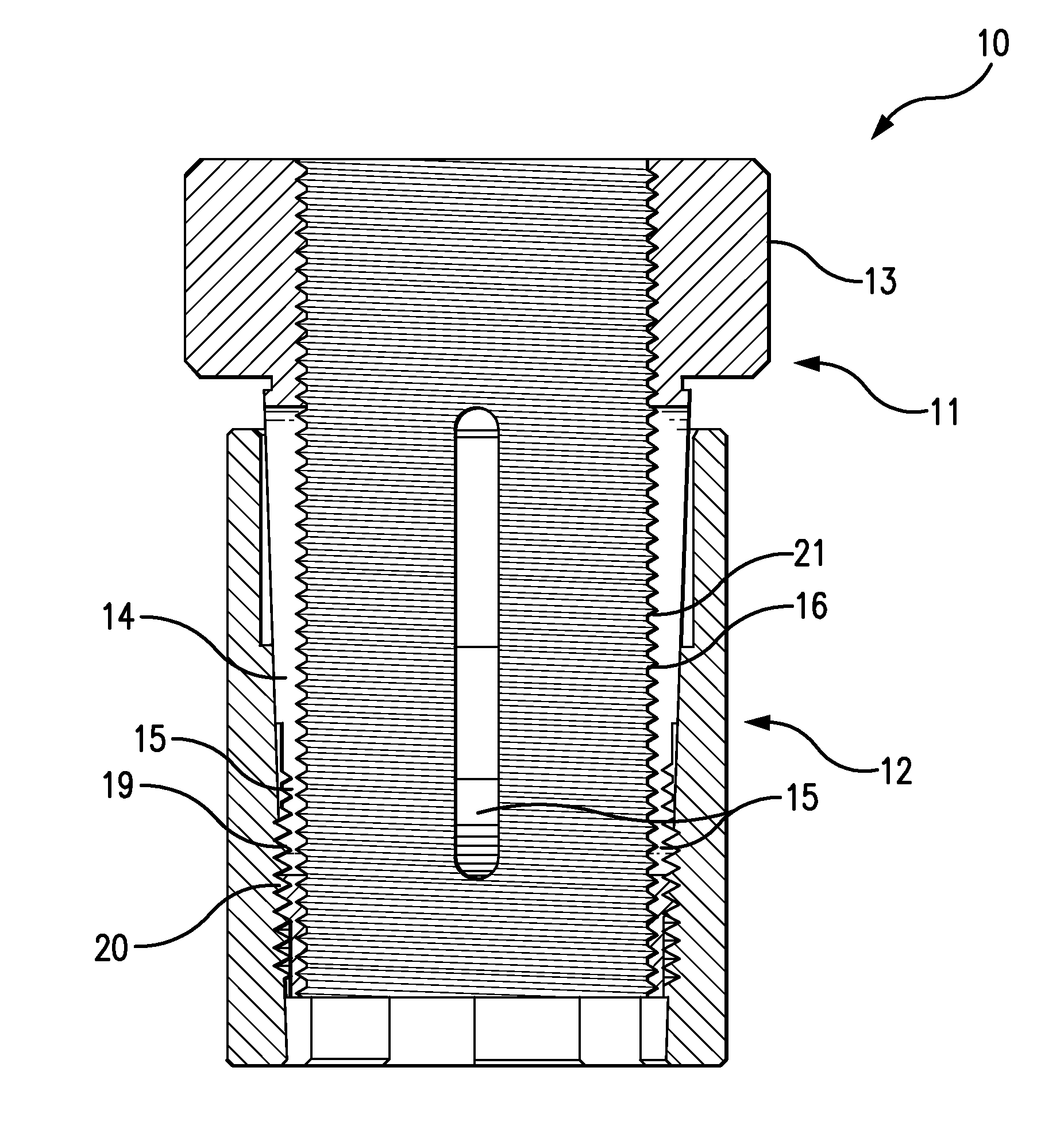
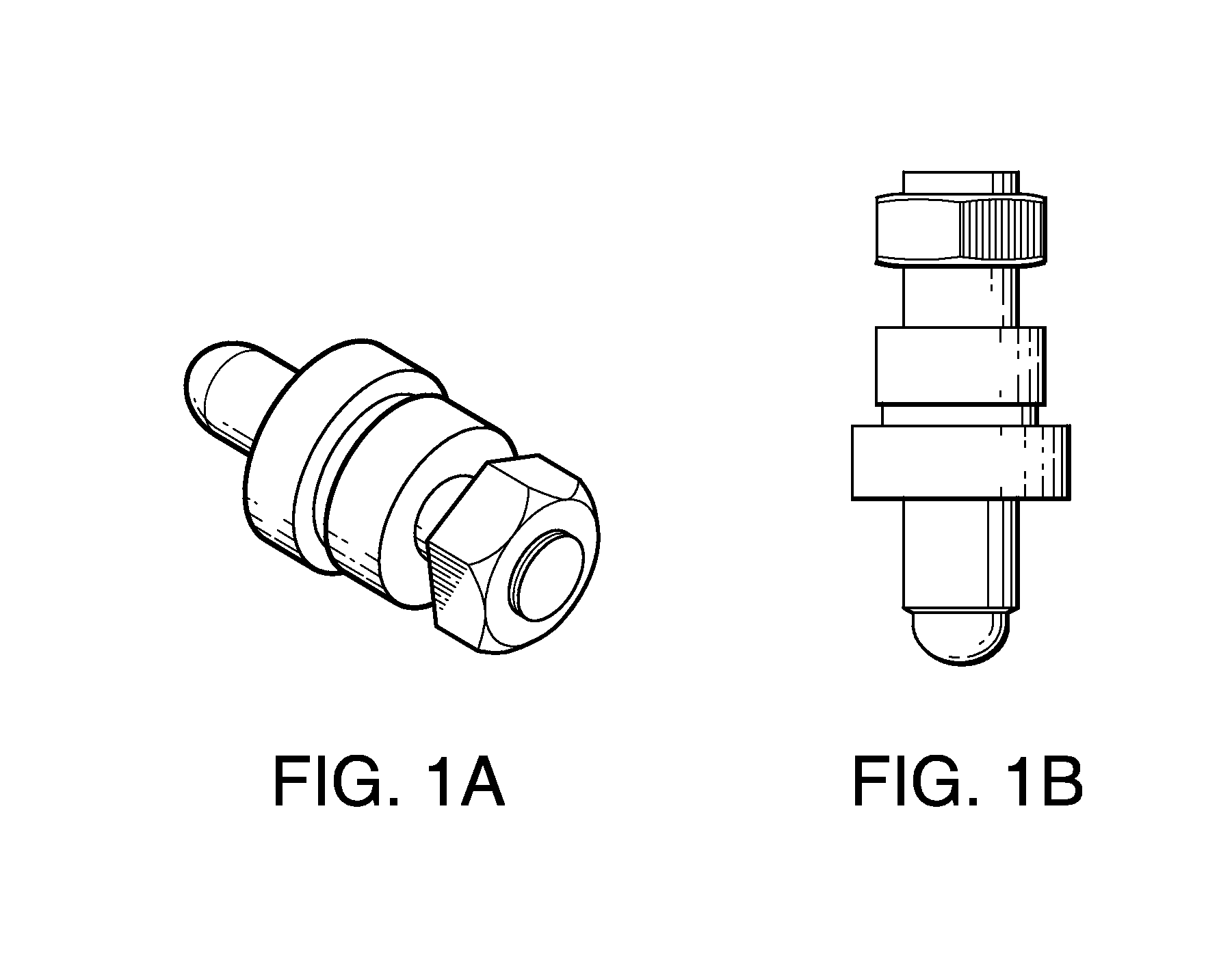
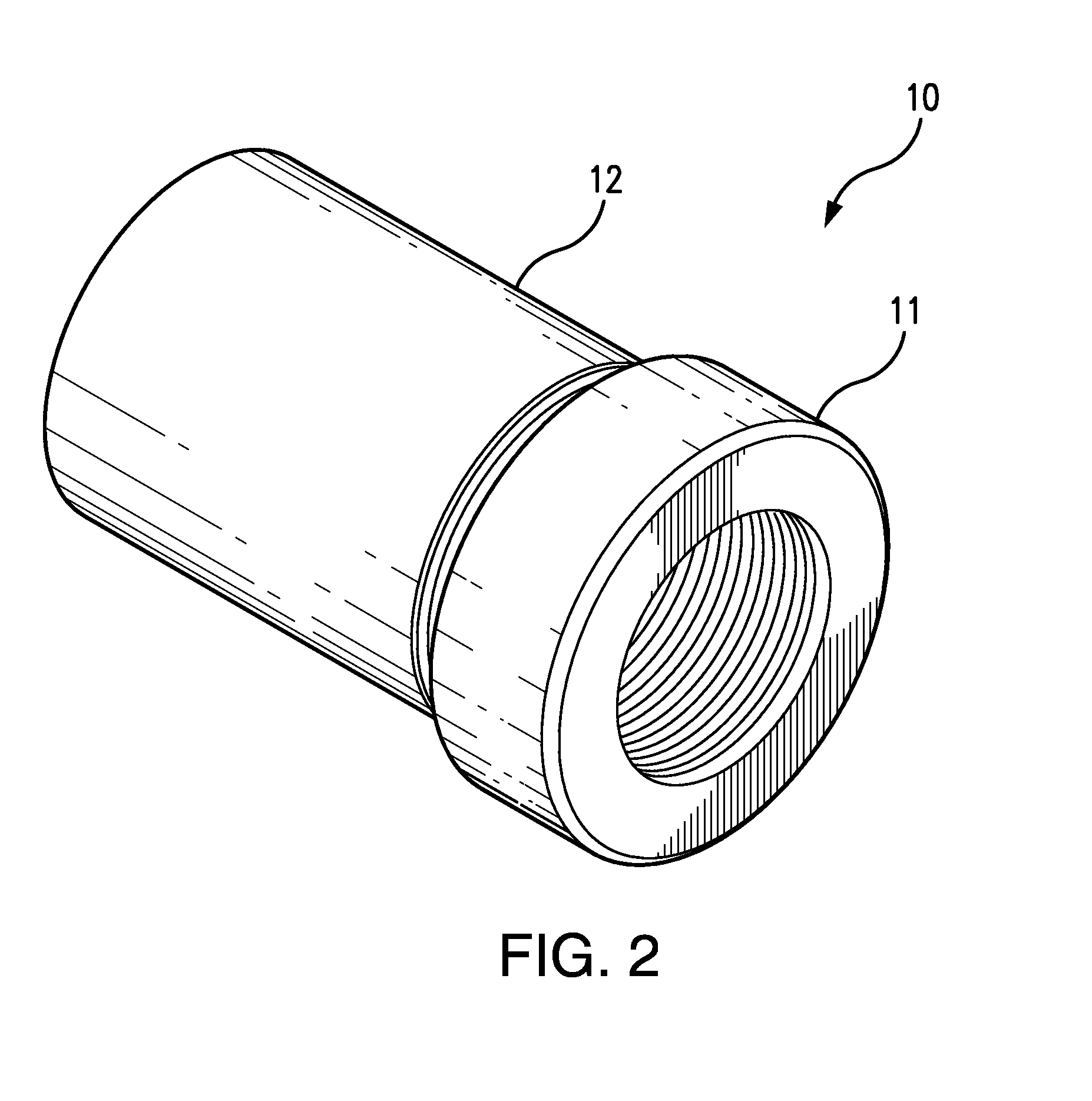
- Dual-component composite design with tapered resilient slotted bushing core and cylindrical annular sleeve creates circumferential pressure instead of traditional axial pressure from locking nuts.
- Circumferential compression mechanism generates tight radial engagement between threads while maintaining radial gaps that can be filled with grease for long-term lubrication.
- Slotted bushing core design enables grease migration within the bushing and facilitates controlled constriction for optimal thread engagement.

Coupling structure of servo motor with detector
PatentWO1984000586A1
Innovation
- The use of an Oldham coupling with cross-arranged teeth and slits allows for the absorption of axial misalignment and ensures a backlash-free connection by engaging the output shaft of the servo motor with the input shaft of the detector, utilizing elastic teeth that fit tightly into corresponding grooves.


Material Science Impact on Coupling Longevity
Material selection fundamentally determines the operational lifespan and performance stability of zero-backlash couplings in precision applications. Advanced metallurgical compositions, particularly high-strength steel alloys and specialized titanium variants, demonstrate superior resistance to fatigue-induced deformation that commonly leads to alignment disruptions. These materials exhibit enhanced elastic modulus properties, maintaining dimensional stability under cyclic loading conditions that would otherwise compromise coupling integrity over extended operational periods.
Surface treatment technologies significantly amplify material performance characteristics in coupling applications. Nitriding processes create hardened surface layers that resist wear-induced geometry changes, while advanced coating systems such as diamond-like carbon films provide exceptional tribological properties. These treatments effectively minimize material degradation at contact interfaces, preventing the gradual accumulation of microscopic deformations that eventually manifest as alignment errors in precision systems.
Thermal stability represents a critical material science consideration for long-life coupling applications. Materials with low thermal expansion coefficients, including specific ceramic composites and thermally stable alloys, maintain consistent dimensional characteristics across operational temperature ranges. This thermal stability prevents thermally-induced stress concentrations that can accelerate material fatigue and compromise the zero-backlash characteristics essential for precision positioning systems.
Microstructural engineering through controlled heat treatment processes optimizes grain boundary characteristics and residual stress distributions within coupling materials. Fine-grained microstructures exhibit superior fatigue resistance compared to conventional materials, while controlled residual compressive stresses enhance crack propagation resistance. These microstructural optimizations directly correlate with extended service life and maintained alignment precision throughout operational cycles.
Composite material integration offers promising pathways for enhanced coupling longevity through tailored mechanical properties. Fiber-reinforced metal matrix composites provide directional strength characteristics that can be optimized for specific loading conditions, while hybrid material systems combine the benefits of multiple constituent materials to achieve superior overall performance in demanding applications requiring sustained precision alignment.
Surface treatment technologies significantly amplify material performance characteristics in coupling applications. Nitriding processes create hardened surface layers that resist wear-induced geometry changes, while advanced coating systems such as diamond-like carbon films provide exceptional tribological properties. These treatments effectively minimize material degradation at contact interfaces, preventing the gradual accumulation of microscopic deformations that eventually manifest as alignment errors in precision systems.
Thermal stability represents a critical material science consideration for long-life coupling applications. Materials with low thermal expansion coefficients, including specific ceramic composites and thermally stable alloys, maintain consistent dimensional characteristics across operational temperature ranges. This thermal stability prevents thermally-induced stress concentrations that can accelerate material fatigue and compromise the zero-backlash characteristics essential for precision positioning systems.
Microstructural engineering through controlled heat treatment processes optimizes grain boundary characteristics and residual stress distributions within coupling materials. Fine-grained microstructures exhibit superior fatigue resistance compared to conventional materials, while controlled residual compressive stresses enhance crack propagation resistance. These microstructural optimizations directly correlate with extended service life and maintained alignment precision throughout operational cycles.
Composite material integration offers promising pathways for enhanced coupling longevity through tailored mechanical properties. Fiber-reinforced metal matrix composites provide directional strength characteristics that can be optimized for specific loading conditions, while hybrid material systems combine the benefits of multiple constituent materials to achieve superior overall performance in demanding applications requiring sustained precision alignment.
Predictive Maintenance for Coupling Alignment Systems
Predictive maintenance represents a paradigm shift from traditional reactive and scheduled maintenance approaches to data-driven, condition-based strategies for coupling alignment systems. This methodology leverages advanced sensor technologies, machine learning algorithms, and real-time monitoring capabilities to anticipate alignment disruptions before they manifest as operational failures. The integration of predictive maintenance frameworks specifically addresses the critical challenge of maintaining precise alignment in zero-backlash couplings throughout their extended operational lifecycles.
Modern predictive maintenance systems for coupling alignment employ multi-sensor arrays that continuously monitor key parameters including vibration signatures, temperature variations, torque fluctuations, and angular displacement measurements. These sensors utilize accelerometers, strain gauges, optical encoders, and thermal imaging devices to capture comprehensive operational data. Advanced signal processing techniques filter and analyze this data stream to identify subtle patterns indicative of emerging alignment issues, often detecting deviations weeks or months before traditional inspection methods would reveal problems.
Machine learning algorithms form the analytical backbone of predictive maintenance systems, utilizing historical performance data to establish baseline operational signatures for specific coupling configurations. These algorithms employ techniques such as anomaly detection, trend analysis, and pattern recognition to identify deviations from normal operating conditions. Neural networks and support vector machines are particularly effective in processing complex multi-dimensional datasets, enabling the system to correlate seemingly unrelated parameters that collectively indicate alignment degradation.
Implementation of predictive maintenance requires sophisticated data acquisition infrastructure, including wireless sensor networks, edge computing capabilities, and cloud-based analytics platforms. Real-time data transmission enables immediate response to critical alignment events, while long-term data storage facilitates trend analysis and predictive model refinement. Integration with existing enterprise maintenance management systems ensures seamless workflow incorporation and automated work order generation based on predictive insights.
The economic benefits of predictive maintenance for coupling alignment systems include significant reductions in unplanned downtime, extended component lifecycles, and optimized maintenance resource allocation. Studies indicate that predictive maintenance can reduce maintenance costs by 25-30% while improving equipment availability by 10-15%. For zero-backlash couplings in critical applications, these improvements translate to substantial operational savings and enhanced system reliability throughout the coupling's extended service life.
Modern predictive maintenance systems for coupling alignment employ multi-sensor arrays that continuously monitor key parameters including vibration signatures, temperature variations, torque fluctuations, and angular displacement measurements. These sensors utilize accelerometers, strain gauges, optical encoders, and thermal imaging devices to capture comprehensive operational data. Advanced signal processing techniques filter and analyze this data stream to identify subtle patterns indicative of emerging alignment issues, often detecting deviations weeks or months before traditional inspection methods would reveal problems.
Machine learning algorithms form the analytical backbone of predictive maintenance systems, utilizing historical performance data to establish baseline operational signatures for specific coupling configurations. These algorithms employ techniques such as anomaly detection, trend analysis, and pattern recognition to identify deviations from normal operating conditions. Neural networks and support vector machines are particularly effective in processing complex multi-dimensional datasets, enabling the system to correlate seemingly unrelated parameters that collectively indicate alignment degradation.
Implementation of predictive maintenance requires sophisticated data acquisition infrastructure, including wireless sensor networks, edge computing capabilities, and cloud-based analytics platforms. Real-time data transmission enables immediate response to critical alignment events, while long-term data storage facilitates trend analysis and predictive model refinement. Integration with existing enterprise maintenance management systems ensures seamless workflow incorporation and automated work order generation based on predictive insights.
The economic benefits of predictive maintenance for coupling alignment systems include significant reductions in unplanned downtime, extended component lifecycles, and optimized maintenance resource allocation. Studies indicate that predictive maintenance can reduce maintenance costs by 25-30% while improving equipment availability by 10-15%. For zero-backlash couplings in critical applications, these improvements translate to substantial operational savings and enhanced system reliability throughout the coupling's extended service life.
Unlock deeper insights with Patsnap Eureka Quick Research — get a full tech report to explore trends and direct your research. Try now!
Generate Your Research Report Instantly with AI Agent
Supercharge your innovation with Patsnap Eureka AI Agent Platform!