
Optimizing Mechanical Interfaces with Zero-Backlash Coupling Solutions
JUN 1, 20269 MIN READ
Generate Your Research Report Instantly with AI Agent
Patsnap Eureka helps you evaluate technical feasibility & market potential.
Zero-Backlash Coupling Technology Background and Objectives
Zero-backlash coupling technology represents a critical advancement in precision mechanical systems, addressing the fundamental challenge of eliminating rotational play between connected components. This technology has evolved from traditional mechanical coupling solutions that inherently contained angular clearances, which compromised system accuracy and responsiveness in high-precision applications.
The historical development of zero-backlash couplings emerged from the increasing demands of automation, robotics, and precision manufacturing industries during the late 20th century. Early mechanical couplings, while functional for basic power transmission, introduced angular errors that accumulated throughout mechanical systems, resulting in positioning inaccuracies and reduced system performance. The evolution toward zero-backlash solutions was driven by the need for improved precision in CNC machining, robotic positioning, and servo-controlled systems.
Modern zero-backlash coupling technology encompasses various mechanical approaches, including spring-loaded designs, split-hub configurations, and elastomeric coupling systems. These solutions utilize different mechanisms to eliminate rotational clearance while maintaining torque transmission capabilities. The technology has progressed from simple mechanical preloading systems to sophisticated designs incorporating advanced materials and manufacturing techniques.
The primary technical objectives of zero-backlash coupling solutions focus on achieving precise angular positioning without rotational play while maintaining reliable torque transmission. Key performance targets include minimizing angular backlash to less than one arcminute, ensuring consistent torque transmission across varying load conditions, and maintaining long-term reliability under cyclic loading. Additionally, these systems must accommodate minor shaft misalignments while preserving zero-backlash characteristics.
Contemporary development trends emphasize the integration of smart materials, improved manufacturing precision, and enhanced durability. The technology aims to address challenges in high-speed applications, temperature stability, and maintenance-free operation. Future objectives include developing self-adjusting mechanisms that compensate for wear-induced backlash and incorporating condition monitoring capabilities for predictive maintenance applications.
The strategic importance of zero-backlash coupling technology extends beyond mechanical performance improvements, encompassing broader system-level benefits including enhanced product quality, reduced cycle times, and improved overall equipment effectiveness in precision manufacturing environments.
The historical development of zero-backlash couplings emerged from the increasing demands of automation, robotics, and precision manufacturing industries during the late 20th century. Early mechanical couplings, while functional for basic power transmission, introduced angular errors that accumulated throughout mechanical systems, resulting in positioning inaccuracies and reduced system performance. The evolution toward zero-backlash solutions was driven by the need for improved precision in CNC machining, robotic positioning, and servo-controlled systems.
Modern zero-backlash coupling technology encompasses various mechanical approaches, including spring-loaded designs, split-hub configurations, and elastomeric coupling systems. These solutions utilize different mechanisms to eliminate rotational clearance while maintaining torque transmission capabilities. The technology has progressed from simple mechanical preloading systems to sophisticated designs incorporating advanced materials and manufacturing techniques.
The primary technical objectives of zero-backlash coupling solutions focus on achieving precise angular positioning without rotational play while maintaining reliable torque transmission. Key performance targets include minimizing angular backlash to less than one arcminute, ensuring consistent torque transmission across varying load conditions, and maintaining long-term reliability under cyclic loading. Additionally, these systems must accommodate minor shaft misalignments while preserving zero-backlash characteristics.
Contemporary development trends emphasize the integration of smart materials, improved manufacturing precision, and enhanced durability. The technology aims to address challenges in high-speed applications, temperature stability, and maintenance-free operation. Future objectives include developing self-adjusting mechanisms that compensate for wear-induced backlash and incorporating condition monitoring capabilities for predictive maintenance applications.
The strategic importance of zero-backlash coupling technology extends beyond mechanical performance improvements, encompassing broader system-level benefits including enhanced product quality, reduced cycle times, and improved overall equipment effectiveness in precision manufacturing environments.
Market Demand for Precision Mechanical Interface Solutions
The global precision mechanical interface market is experiencing unprecedented growth driven by the increasing demand for high-accuracy positioning systems across multiple industrial sectors. Manufacturing industries, particularly those involved in semiconductor fabrication, aerospace component production, and precision machining, require mechanical coupling solutions that eliminate backlash to achieve sub-micron positioning accuracy. The proliferation of automated manufacturing systems and Industry 4.0 initiatives has intensified the need for zero-backlash coupling technologies that can maintain consistent performance over extended operational cycles.
Robotics and automation sectors represent the largest consumer segment for precision mechanical interfaces. Industrial robots performing assembly operations, pick-and-place tasks, and precision welding require coupling systems that eliminate mechanical play to ensure repeatable positioning accuracy. The growing adoption of collaborative robots in manufacturing environments has further expanded market demand, as these systems must operate with enhanced precision to safely interact with human workers while maintaining productivity standards.
The aerospace and defense industries constitute another significant market driver, where zero-backlash coupling solutions are essential for satellite positioning systems, radar tracking mechanisms, and flight control actuators. These applications demand mechanical interfaces that can withstand extreme environmental conditions while maintaining precise angular positioning without degradation over time. The increasing deployment of satellite constellations and unmanned aerial systems has created substantial demand for lightweight, high-precision coupling technologies.
Medical device manufacturing represents an emerging high-growth segment, particularly in surgical robotics and diagnostic imaging equipment. Precision mechanical interfaces enable accurate positioning of surgical instruments and imaging components, where even minimal backlash can compromise patient safety and diagnostic accuracy. The expanding market for minimally invasive surgical procedures has accelerated demand for ultra-precise mechanical coupling solutions.
The semiconductor equipment sector drives significant demand for zero-backlash coupling technologies in wafer handling systems, lithography equipment, and inspection tools. As semiconductor device geometries continue to shrink, manufacturing equipment requires increasingly precise positioning capabilities that can only be achieved through advanced mechanical interface solutions. The global expansion of semiconductor manufacturing capacity has created sustained market growth opportunities.
Market demand is also influenced by the growing emphasis on predictive maintenance and system reliability. Zero-backlash coupling solutions offer enhanced durability and consistent performance characteristics that reduce unplanned downtime and maintenance costs. This reliability factor has become increasingly important as manufacturers seek to optimize overall equipment effectiveness and reduce total cost of ownership across their production systems.
Robotics and automation sectors represent the largest consumer segment for precision mechanical interfaces. Industrial robots performing assembly operations, pick-and-place tasks, and precision welding require coupling systems that eliminate mechanical play to ensure repeatable positioning accuracy. The growing adoption of collaborative robots in manufacturing environments has further expanded market demand, as these systems must operate with enhanced precision to safely interact with human workers while maintaining productivity standards.
The aerospace and defense industries constitute another significant market driver, where zero-backlash coupling solutions are essential for satellite positioning systems, radar tracking mechanisms, and flight control actuators. These applications demand mechanical interfaces that can withstand extreme environmental conditions while maintaining precise angular positioning without degradation over time. The increasing deployment of satellite constellations and unmanned aerial systems has created substantial demand for lightweight, high-precision coupling technologies.
Medical device manufacturing represents an emerging high-growth segment, particularly in surgical robotics and diagnostic imaging equipment. Precision mechanical interfaces enable accurate positioning of surgical instruments and imaging components, where even minimal backlash can compromise patient safety and diagnostic accuracy. The expanding market for minimally invasive surgical procedures has accelerated demand for ultra-precise mechanical coupling solutions.
The semiconductor equipment sector drives significant demand for zero-backlash coupling technologies in wafer handling systems, lithography equipment, and inspection tools. As semiconductor device geometries continue to shrink, manufacturing equipment requires increasingly precise positioning capabilities that can only be achieved through advanced mechanical interface solutions. The global expansion of semiconductor manufacturing capacity has created sustained market growth opportunities.
Market demand is also influenced by the growing emphasis on predictive maintenance and system reliability. Zero-backlash coupling solutions offer enhanced durability and consistent performance characteristics that reduce unplanned downtime and maintenance costs. This reliability factor has become increasingly important as manufacturers seek to optimize overall equipment effectiveness and reduce total cost of ownership across their production systems.
Current State and Challenges in Backlash Elimination Technology
The global mechanical coupling industry has witnessed significant advancement in backlash elimination technologies over the past decade, driven by increasing demands for precision in robotics, aerospace, and manufacturing automation. Current zero-backlash coupling solutions primarily rely on three fundamental approaches: preloaded mechanical systems, flexible coupling designs, and active compensation mechanisms. These technologies have achieved remarkable precision levels, with leading solutions delivering backlash values below 0.1 arcminutes in high-end applications.
Preloaded ball screw assemblies and harmonic drive systems represent the most mature technologies in this domain. Major manufacturers have successfully implemented these solutions across various industrial sectors, achieving repeatability tolerances within micrometers. However, these conventional approaches face inherent limitations in dynamic response characteristics and long-term reliability under varying load conditions.
The primary technical challenge lies in maintaining zero-backlash performance across diverse operating environments while preserving system responsiveness. Temperature variations, wear patterns, and dynamic loading create complex interactions that compromise coupling precision over time. Current solutions often require frequent recalibration and maintenance, limiting their effectiveness in autonomous systems and remote applications.
Manufacturing complexity presents another significant obstacle. Achieving the tight tolerances required for zero-backlash performance demands sophisticated production processes and quality control systems. This complexity translates into elevated costs, restricting widespread adoption across price-sensitive market segments. Additionally, the integration of these precision components into existing mechanical systems often requires substantial design modifications.
Emerging challenges include the growing demand for miniaturization in medical devices and consumer electronics, where traditional zero-backlash solutions prove inadequate due to size and weight constraints. The industry also faces pressure to develop environmentally sustainable solutions that maintain performance standards while reducing material consumption and manufacturing energy requirements.
Recent developments in smart materials and adaptive control systems offer promising pathways for addressing these challenges. However, the transition from laboratory prototypes to commercially viable products remains constrained by reliability concerns and cost considerations. The current technological landscape indicates a critical need for innovative approaches that can deliver consistent zero-backlash performance while addressing scalability and sustainability requirements.
Preloaded ball screw assemblies and harmonic drive systems represent the most mature technologies in this domain. Major manufacturers have successfully implemented these solutions across various industrial sectors, achieving repeatability tolerances within micrometers. However, these conventional approaches face inherent limitations in dynamic response characteristics and long-term reliability under varying load conditions.
The primary technical challenge lies in maintaining zero-backlash performance across diverse operating environments while preserving system responsiveness. Temperature variations, wear patterns, and dynamic loading create complex interactions that compromise coupling precision over time. Current solutions often require frequent recalibration and maintenance, limiting their effectiveness in autonomous systems and remote applications.
Manufacturing complexity presents another significant obstacle. Achieving the tight tolerances required for zero-backlash performance demands sophisticated production processes and quality control systems. This complexity translates into elevated costs, restricting widespread adoption across price-sensitive market segments. Additionally, the integration of these precision components into existing mechanical systems often requires substantial design modifications.
Emerging challenges include the growing demand for miniaturization in medical devices and consumer electronics, where traditional zero-backlash solutions prove inadequate due to size and weight constraints. The industry also faces pressure to develop environmentally sustainable solutions that maintain performance standards while reducing material consumption and manufacturing energy requirements.
Recent developments in smart materials and adaptive control systems offer promising pathways for addressing these challenges. However, the transition from laboratory prototypes to commercially viable products remains constrained by reliability concerns and cost considerations. The current technological landscape indicates a critical need for innovative approaches that can deliver consistent zero-backlash performance while addressing scalability and sustainability requirements.
Existing Zero-Backlash Coupling Design Solutions
01 Flexible coupling elements for backlash elimination
Flexible coupling elements such as elastomeric materials, springs, or flexible membranes are incorporated into coupling designs to eliminate backlash by maintaining constant contact between mating surfaces. These elements provide preload forces that take up clearances and compensate for manufacturing tolerances while allowing for slight misalignments between connected shafts.- Flexible coupling elements for backlash elimination: Flexible coupling elements such as elastomeric inserts, flexible discs, or spring-loaded components are used to eliminate backlash in mechanical couplings. These elements provide continuous contact between mating surfaces while accommodating misalignment and absorbing vibrations. The flexible nature of these components ensures that there is always tension or compression in the system, preventing the formation of gaps that would otherwise cause backlash.
- Preloaded mechanical systems: Preloading mechanisms apply constant force or torque to coupling components to maintain continuous engagement and eliminate clearances. This approach uses springs, adjustable tensioning devices, or hydraulic systems to create a bias force that keeps all components in contact. The preload force is carefully calibrated to eliminate backlash while not creating excessive friction or wear in the system.
- Split coupling designs with adjustment mechanisms: Split or segmented coupling designs incorporate adjustment mechanisms that allow for precise control of clearances between components. These designs typically feature multiple segments or halves that can be adjusted relative to each other to eliminate gaps. Adjustment mechanisms may include threaded fasteners, cam systems, or wedge arrangements that enable fine-tuning of the coupling engagement.
- Gear-based anti-backlash mechanisms: Specialized gear arrangements and tooth profiles are designed to minimize or eliminate backlash in rotary couplings. These mechanisms may include dual-gear systems where one gear is spring-loaded against the other, modified tooth geometries that ensure continuous contact, or planetary gear arrangements with preloaded components. The gear systems are engineered to maintain engagement throughout the operating range while compensating for manufacturing tolerances.
- Magnetic and electromagnetic coupling systems: Magnetic or electromagnetic systems create contactless coupling arrangements that inherently eliminate mechanical backlash. These systems use permanent magnets or electromagnets to create attractive or repulsive forces that maintain precise positioning without physical contact between components. The magnetic forces provide continuous engagement while allowing for smooth operation and reduced wear compared to mechanical contact systems.
02 Split coupling with preload mechanisms
Split coupling designs utilize two or more coupling halves with built-in preload mechanisms such as springs, screws, or wedge systems to eliminate backlash. The preload system maintains tension between the coupling components, ensuring zero clearance in the power transmission path while allowing for easy assembly and maintenance.Expand Specific Solutions03 Gear-based anti-backlash coupling systems
Anti-backlash coupling systems employ gear mechanisms with spring-loaded or adjustable components to eliminate play between meshing teeth. These systems often feature dual gear arrangements where one gear is spring-loaded against the other to maintain constant mesh engagement, effectively removing backlash from the transmission system.Expand Specific Solutions04 Adjustable backlash compensation mechanisms
Adjustable mechanisms allow for fine-tuning and compensation of backlash through mechanical adjustments such as threaded components, cam systems, or sliding elements. These designs enable users to set and maintain zero backlash conditions throughout the coupling's operational life, accommodating wear and thermal expansion effects.Expand Specific Solutions05 Multi-element coupling with backlash control
Multi-element coupling designs incorporate multiple components such as pins, rollers, or balls with controlled clearances and preload systems to achieve zero backlash operation. These designs distribute loads across multiple contact points while maintaining precise angular positioning through carefully engineered clearance control and preload application.Expand Specific Solutions
Key Players in Precision Coupling and Motion Control Industry
The zero-backlash coupling solutions market represents a mature yet evolving technological landscape driven by precision engineering demands across automotive, aerospace, and industrial automation sectors. The industry is experiencing steady growth with an estimated market size exceeding $2 billion globally, fueled by increasing automation and electric vehicle adoption. Technology maturity varies significantly among key players, with established industrial giants like Robert Bosch GmbH, Hilti AG, and Renishaw Plc leading advanced mechanical interface innovations through substantial R&D investments. Automotive leaders including Ford Global Technologies LLC, GM Global Technology Operations LLC, and Valeo Siemens demonstrate strong coupling integration capabilities in drivetrain applications. Specialized manufacturers such as Voith Turbo Safeset AB and Eisele Pneumatics focus on niche high-precision solutions, while academic institutions like Beihang University and Northwestern Polytechnical University contribute fundamental research advancements, creating a competitive ecosystem balancing established expertise with emerging technological breakthroughs.
Robert Bosch GmbH
Technical Solution: Bosch has developed advanced zero-backlash coupling solutions utilizing precision-engineered flexible coupling systems with integrated torque compensation mechanisms. Their technology incorporates multi-stage torsional stiffness control through specialized elastomeric elements and metallic bellows configurations. The coupling design features adaptive preload adjustment systems that maintain zero backlash across varying operational conditions and temperature ranges. Bosch's solution integrates smart sensing capabilities for real-time backlash monitoring and automatic compensation, ensuring consistent performance in high-precision applications such as automotive steering systems and industrial automation equipment.
Strengths: Proven automotive industry expertise, integrated smart monitoring systems, robust temperature compensation. Weaknesses: Higher cost complexity, requires specialized maintenance protocols.
Renishaw Plc
Technical Solution: Renishaw specializes in ultra-precision zero-backlash coupling solutions for metrology and manufacturing applications. Their technology employs advanced kinematic coupling principles combined with precision-machined components featuring sub-micron tolerances. The coupling system utilizes a unique three-point contact mechanism with spring-loaded ball and groove interfaces that eliminate backlash while maintaining exceptional repeatability. Renishaw's solutions incorporate temperature-stable materials and thermal compensation algorithms to ensure consistent performance across environmental variations. Their couplings are specifically designed for high-accuracy positioning systems, coordinate measuring machines, and precision manufacturing equipment where nanometer-level accuracy is required.
Strengths: Exceptional precision and repeatability, proven metrology expertise, temperature stability. Weaknesses: Limited to specialized applications, high precision requirements increase cost.
Core Patents in Zero-Backlash Mechanical Interface Technology
Zero clearance coupling
PatentInactiveCA1086970A
Innovation
- A zero backlash spline coupling design incorporating a frusto-conical surface with a keeper and collar system, featuring a specific included angle and missing spline teeth for zero backlash and backup torque transmission, allowing for easy disassembly and reduced manufacturing costs.


Zero-Backlash Bushing
PatentInactiveUS20140301802A1
Innovation
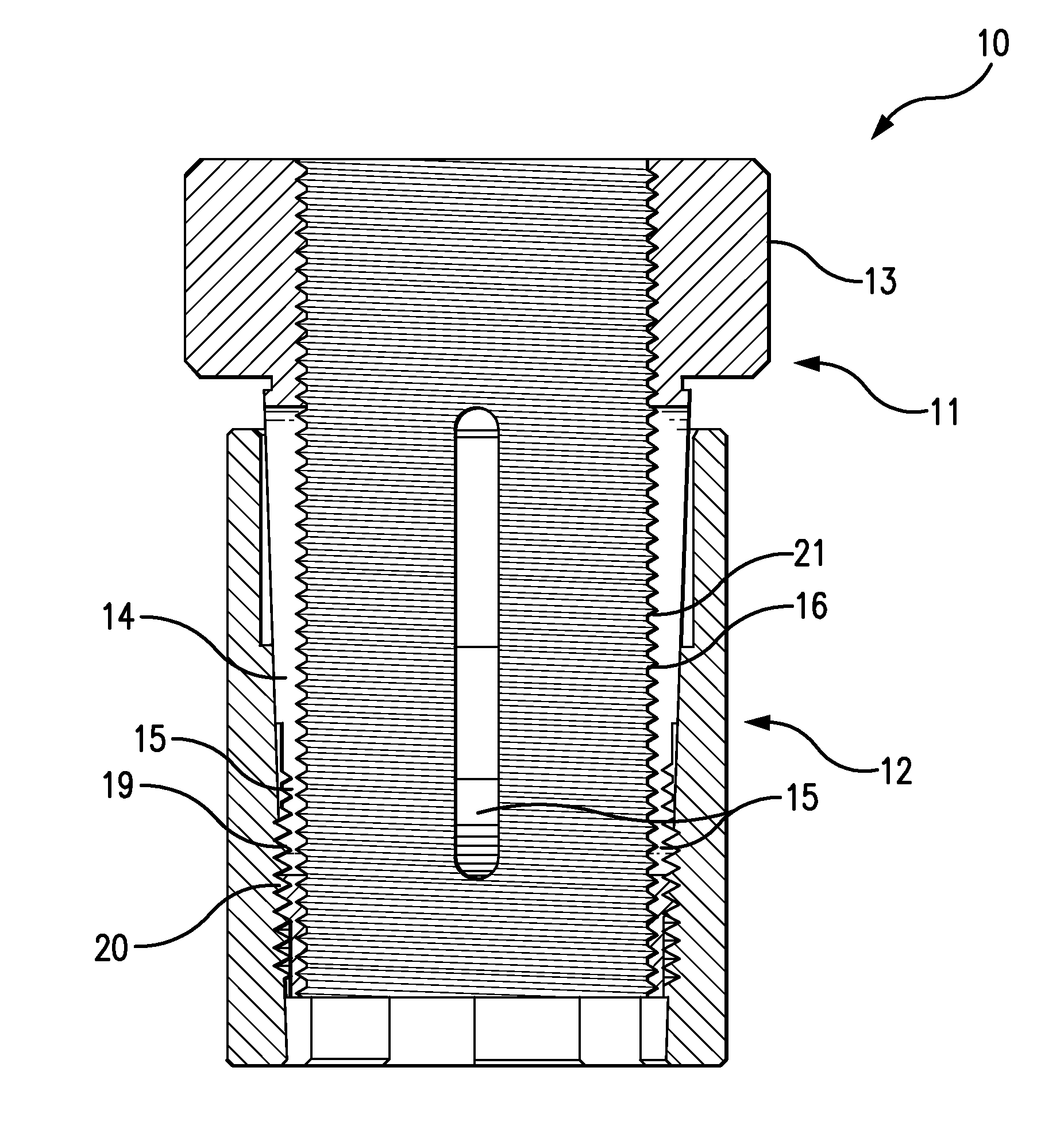
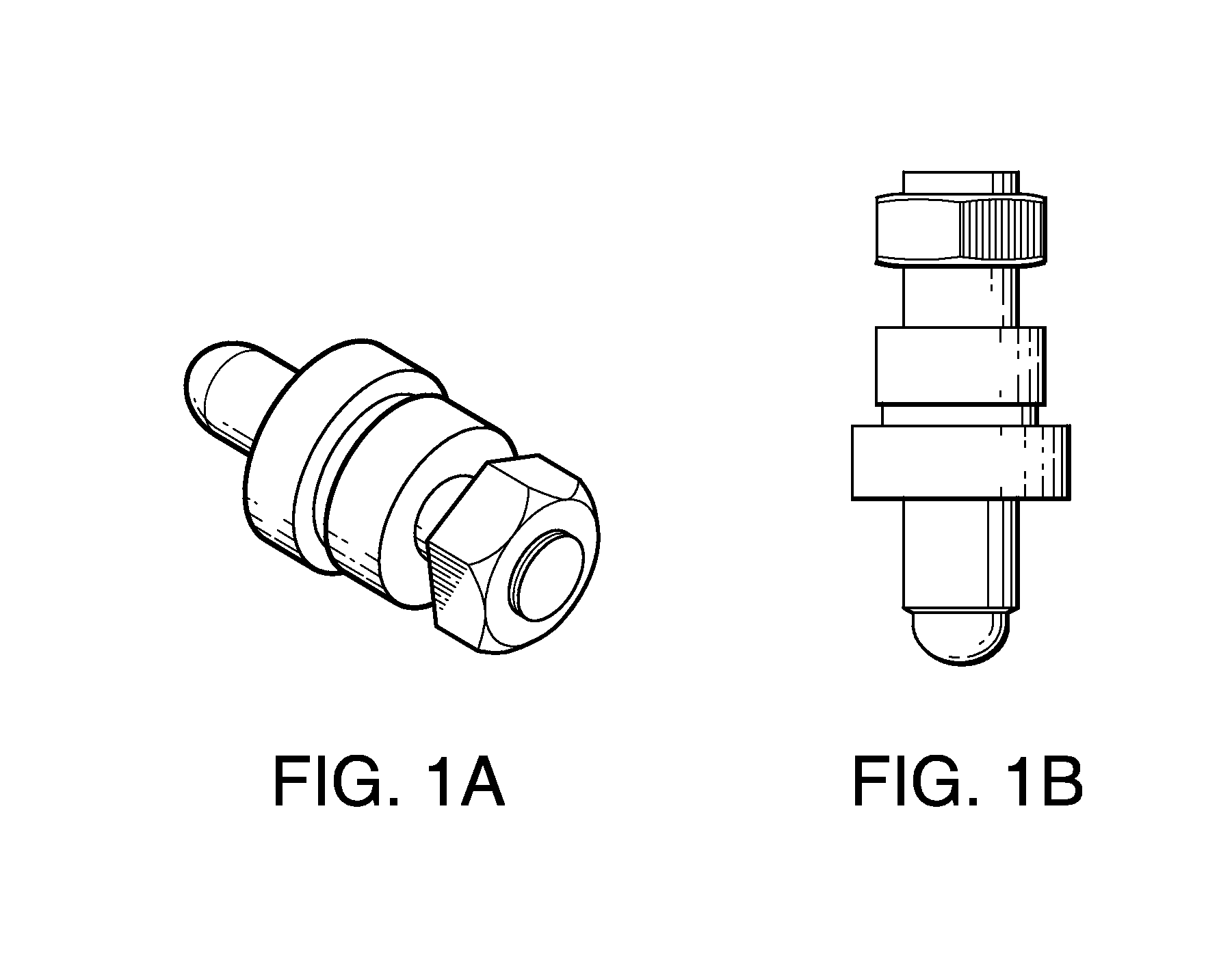
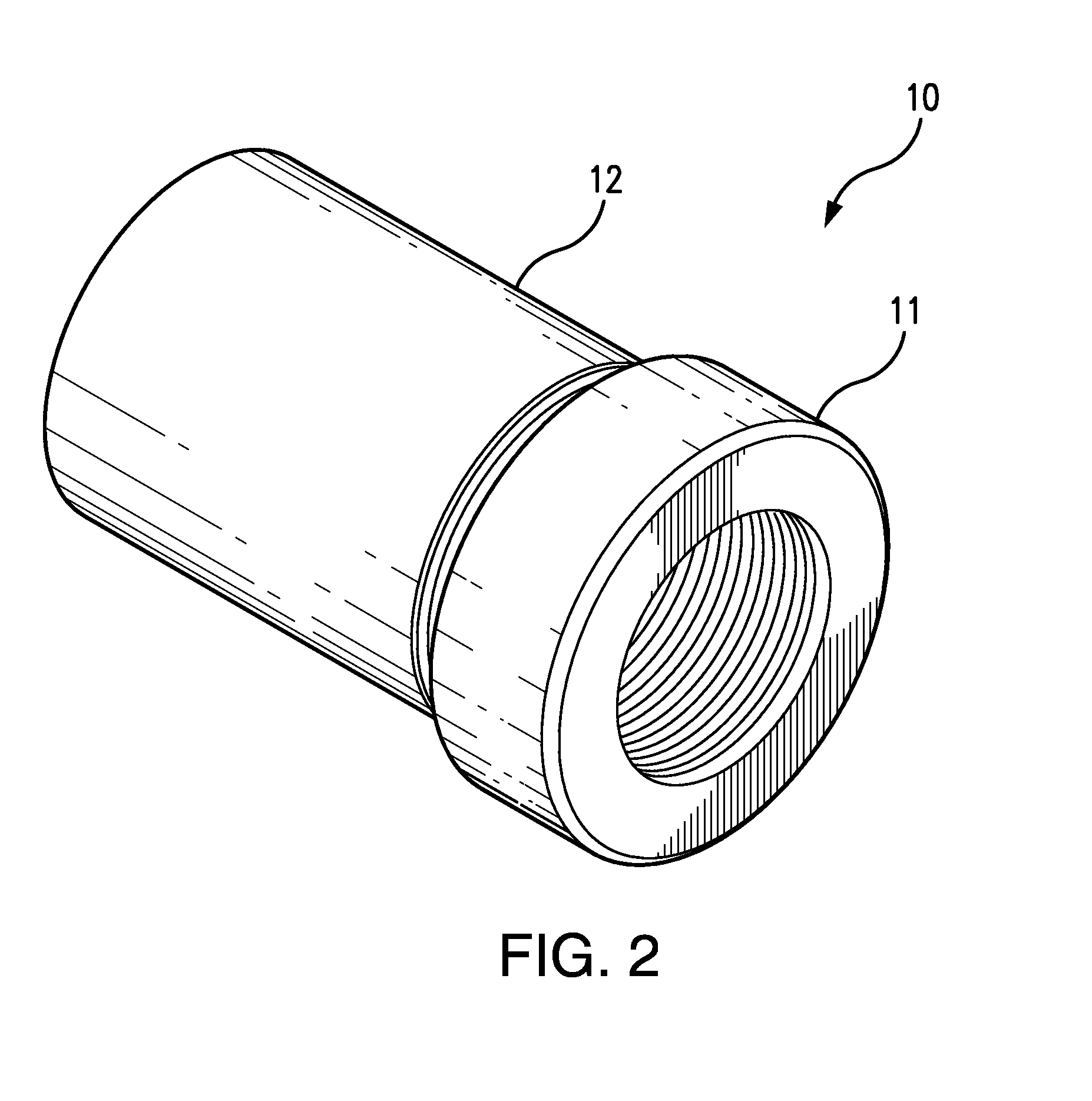
- Dual-component composite design with tapered resilient slotted bushing core and cylindrical annular sleeve that applies circumferential pressure instead of axial pressure for zero-backlash engagement.
- Truncated V-threads in the central section of bushing core paired with external sharp V-threads of screw create isolated radial gaps that serve as grease circulation channels while preventing lateral grease migration.
- Slotted bushing core design enables controlled radial constriction and internal grease migration while maintaining tight thread engagement through circumferential compression.

Manufacturing Standards for Precision Mechanical Couplings
The manufacturing of precision mechanical couplings requires adherence to stringent standards that ensure dimensional accuracy, material consistency, and performance reliability. International standards such as ISO 14579 for keyless bushings and DIN 808 for flexible couplings provide fundamental guidelines for manufacturing tolerances, surface finishes, and material specifications. These standards establish critical parameters including bore concentricity within ±0.005mm, surface roughness requirements of Ra 0.8μm or better, and specific heat treatment protocols to achieve optimal hardness distributions.
Quality control protocols for zero-backlash couplings demand advanced metrology techniques including coordinate measuring machines (CMM) with sub-micron accuracy capabilities. Manufacturing processes must incorporate statistical process control (SPC) methodologies to monitor critical dimensions such as hub bore concentricity, keyway positioning accuracy, and flexural element thickness variations. Typical acceptance criteria require backlash measurements below 0.002 inches under specified torque loads, with repeatability standards of ±0.0005 inches across production batches.
Material certification standards play a crucial role in ensuring coupling performance consistency. Steel components must meet AISI 4140 or equivalent specifications with certified tensile strength ranges of 850-1000 MPa and hardness values between 28-35 HRC. Non-metallic flexible elements require compliance with specific durometer ratings and fatigue resistance standards, typically validated through 10^7 cycle testing protocols at rated torque levels.
Traceability requirements mandate comprehensive documentation throughout the manufacturing process, including material certificates, heat treatment records, and dimensional inspection reports. Each coupling assembly must include serialized identification enabling full backward traceability to raw material lots and processing parameters. This documentation framework supports quality assurance protocols and enables rapid root cause analysis in case of field performance issues.
Manufacturing facilities producing precision couplings typically require ISO 9001 certification with additional aerospace or automotive industry-specific qualifications such as AS9100 or TS16949. These certifications ensure implementation of robust quality management systems, calibrated measurement equipment, and trained personnel capable of maintaining the exacting standards required for zero-backlash coupling production.
Quality control protocols for zero-backlash couplings demand advanced metrology techniques including coordinate measuring machines (CMM) with sub-micron accuracy capabilities. Manufacturing processes must incorporate statistical process control (SPC) methodologies to monitor critical dimensions such as hub bore concentricity, keyway positioning accuracy, and flexural element thickness variations. Typical acceptance criteria require backlash measurements below 0.002 inches under specified torque loads, with repeatability standards of ±0.0005 inches across production batches.
Material certification standards play a crucial role in ensuring coupling performance consistency. Steel components must meet AISI 4140 or equivalent specifications with certified tensile strength ranges of 850-1000 MPa and hardness values between 28-35 HRC. Non-metallic flexible elements require compliance with specific durometer ratings and fatigue resistance standards, typically validated through 10^7 cycle testing protocols at rated torque levels.
Traceability requirements mandate comprehensive documentation throughout the manufacturing process, including material certificates, heat treatment records, and dimensional inspection reports. Each coupling assembly must include serialized identification enabling full backward traceability to raw material lots and processing parameters. This documentation framework supports quality assurance protocols and enables rapid root cause analysis in case of field performance issues.
Manufacturing facilities producing precision couplings typically require ISO 9001 certification with additional aerospace or automotive industry-specific qualifications such as AS9100 or TS16949. These certifications ensure implementation of robust quality management systems, calibrated measurement equipment, and trained personnel capable of maintaining the exacting standards required for zero-backlash coupling production.
Cost-Performance Optimization in Zero-Backlash Systems
The economic viability of zero-backlash coupling systems hinges on achieving an optimal balance between manufacturing costs and performance benefits. Traditional approaches often prioritize either maximum precision or minimum cost, resulting in suboptimal solutions that fail to address the diverse requirements of modern industrial applications. A comprehensive cost-performance optimization framework must consider multiple variables including material selection, manufacturing complexity, maintenance requirements, and operational lifespan.
Material costs represent a significant portion of zero-backlash coupling expenses, with high-performance alloys and specialized composites commanding premium prices. However, strategic material selection can yield substantial long-term savings through reduced maintenance intervals and extended service life. Advanced steel alloys with enhanced fatigue resistance may justify higher initial costs through improved durability, while engineered polymers offer cost-effective solutions for moderate-load applications without compromising backlash elimination.
Manufacturing process optimization presents substantial opportunities for cost reduction without performance degradation. Precision machining operations, while essential for achieving zero-backlash characteristics, can be streamlined through advanced tooling strategies and optimized cutting parameters. Investment in automated manufacturing systems may increase initial capital requirements but delivers consistent quality and reduced per-unit costs for high-volume production scenarios.
Performance metrics must be carefully weighted against cost implications to establish meaningful optimization criteria. Critical parameters include torque transmission capacity, angular accuracy, dynamic response characteristics, and operational temperature range. Applications requiring extreme precision may justify premium solutions, while standard industrial applications can achieve acceptable performance through cost-optimized designs that maintain zero-backlash functionality.
Lifecycle cost analysis reveals that initial purchase price represents only a fraction of total ownership costs. Maintenance requirements, replacement frequency, and system downtime significantly impact overall economic performance. Zero-backlash systems with higher initial costs often demonstrate superior long-term value through reduced maintenance needs and extended operational life, particularly in high-duty cycle applications where reliability is paramount.
Material costs represent a significant portion of zero-backlash coupling expenses, with high-performance alloys and specialized composites commanding premium prices. However, strategic material selection can yield substantial long-term savings through reduced maintenance intervals and extended service life. Advanced steel alloys with enhanced fatigue resistance may justify higher initial costs through improved durability, while engineered polymers offer cost-effective solutions for moderate-load applications without compromising backlash elimination.
Manufacturing process optimization presents substantial opportunities for cost reduction without performance degradation. Precision machining operations, while essential for achieving zero-backlash characteristics, can be streamlined through advanced tooling strategies and optimized cutting parameters. Investment in automated manufacturing systems may increase initial capital requirements but delivers consistent quality and reduced per-unit costs for high-volume production scenarios.
Performance metrics must be carefully weighted against cost implications to establish meaningful optimization criteria. Critical parameters include torque transmission capacity, angular accuracy, dynamic response characteristics, and operational temperature range. Applications requiring extreme precision may justify premium solutions, while standard industrial applications can achieve acceptable performance through cost-optimized designs that maintain zero-backlash functionality.
Lifecycle cost analysis reveals that initial purchase price represents only a fraction of total ownership costs. Maintenance requirements, replacement frequency, and system downtime significantly impact overall economic performance. Zero-backlash systems with higher initial costs often demonstrate superior long-term value through reduced maintenance needs and extended operational life, particularly in high-duty cycle applications where reliability is paramount.
Unlock deeper insights with Patsnap Eureka Quick Research — get a full tech report to explore trends and direct your research. Try now!
Generate Your Research Report Instantly with AI Agent
Supercharge your innovation with Patsnap Eureka AI Agent Platform!