

Battery Pack Frames for Robotics: Best Practices in Precision Design
JUN 1, 202610 MIN READ
Generate Your Research Report Instantly with AI Agent
Patsnap Eureka helps you evaluate technical feasibility & market potential.
Robotics Battery Frame Design Background and Objectives
The evolution of robotics has fundamentally transformed industrial automation, service applications, and emerging sectors such as autonomous vehicles and space exploration. As robotic systems become increasingly sophisticated and autonomous, the demand for reliable, efficient, and precisely engineered power solutions has intensified dramatically. Battery pack frames represent a critical intersection between mechanical engineering excellence and electrical system optimization, serving as the foundational infrastructure that determines overall system performance, safety, and operational longevity.
Modern robotic applications span diverse operational environments, from manufacturing floors with stringent precision requirements to outdoor autonomous systems facing extreme environmental conditions. Each application domain presents unique challenges for battery pack integration, including weight distribution optimization, thermal management, vibration resistance, and electromagnetic interference mitigation. The complexity of these requirements has elevated battery frame design from a simple housing solution to a sophisticated engineering discipline requiring multidisciplinary expertise.
The historical development of robotics battery systems reveals a clear trajectory toward miniaturization, increased energy density, and enhanced safety protocols. Early robotic systems relied on bulky lead-acid batteries with rudimentary mounting solutions, often resulting in suboptimal weight distribution and limited operational flexibility. The transition to lithium-ion technologies introduced new design paradigms, demanding precise thermal management and advanced protection mechanisms that traditional frame designs could not adequately address.
Contemporary precision design methodologies in robotics battery frames encompass advanced materials science, computational fluid dynamics for thermal optimization, finite element analysis for structural integrity, and sophisticated manufacturing techniques including additive manufacturing and precision machining. These approaches enable engineers to achieve previously unattainable levels of integration density while maintaining rigorous safety standards and operational reliability.
The primary objective of this technical investigation centers on establishing comprehensive best practices for precision design in robotics battery pack frames. This encompasses developing standardized design methodologies that balance structural integrity with weight optimization, establishing thermal management protocols that ensure consistent performance across varying operational conditions, and creating modular design frameworks that accommodate diverse battery chemistries and form factors. Additionally, the research aims to identify emerging materials and manufacturing technologies that can further enhance frame performance while reducing production costs and environmental impact.
Modern robotic applications span diverse operational environments, from manufacturing floors with stringent precision requirements to outdoor autonomous systems facing extreme environmental conditions. Each application domain presents unique challenges for battery pack integration, including weight distribution optimization, thermal management, vibration resistance, and electromagnetic interference mitigation. The complexity of these requirements has elevated battery frame design from a simple housing solution to a sophisticated engineering discipline requiring multidisciplinary expertise.
The historical development of robotics battery systems reveals a clear trajectory toward miniaturization, increased energy density, and enhanced safety protocols. Early robotic systems relied on bulky lead-acid batteries with rudimentary mounting solutions, often resulting in suboptimal weight distribution and limited operational flexibility. The transition to lithium-ion technologies introduced new design paradigms, demanding precise thermal management and advanced protection mechanisms that traditional frame designs could not adequately address.
Contemporary precision design methodologies in robotics battery frames encompass advanced materials science, computational fluid dynamics for thermal optimization, finite element analysis for structural integrity, and sophisticated manufacturing techniques including additive manufacturing and precision machining. These approaches enable engineers to achieve previously unattainable levels of integration density while maintaining rigorous safety standards and operational reliability.
The primary objective of this technical investigation centers on establishing comprehensive best practices for precision design in robotics battery pack frames. This encompasses developing standardized design methodologies that balance structural integrity with weight optimization, establishing thermal management protocols that ensure consistent performance across varying operational conditions, and creating modular design frameworks that accommodate diverse battery chemistries and form factors. Additionally, the research aims to identify emerging materials and manufacturing technologies that can further enhance frame performance while reducing production costs and environmental impact.
Market Demand for Precision Robotic Battery Solutions
The global robotics market is experiencing unprecedented growth, driving substantial demand for precision battery solutions that can meet the stringent requirements of modern robotic applications. Industrial automation, service robotics, and autonomous systems are expanding rapidly across manufacturing, healthcare, logistics, and consumer sectors, creating a robust market foundation for specialized battery pack frames designed with precision engineering principles.
Manufacturing and industrial automation represent the largest segment of demand for precision robotic battery solutions. Factory automation systems, collaborative robots, and autonomous guided vehicles require battery packs that can withstand continuous operation cycles, vibration, and temperature variations while maintaining consistent power delivery. The precision design of battery frames becomes critical in these environments where even minor power fluctuations can disrupt production lines and result in significant economic losses.
The healthcare robotics sector demonstrates particularly strong demand for precision battery solutions due to strict safety and reliability requirements. Surgical robots, rehabilitation devices, and hospital service robots operate in environments where battery failure is not acceptable. These applications demand battery pack frames with exceptional structural integrity, electromagnetic compatibility, and fail-safe mechanisms, driving the need for advanced precision design methodologies.
Autonomous vehicle and drone markets are emerging as significant drivers of demand for lightweight yet robust battery pack frames. These applications require optimal power-to-weight ratios while maintaining structural durability under dynamic loading conditions. The precision design of battery frames directly impacts vehicle range, payload capacity, and operational safety, making it a critical competitive factor.
Service robotics, including cleaning robots, security systems, and personal assistance devices, represents a rapidly growing consumer market segment. These applications demand cost-effective yet reliable battery solutions that can operate consistently across varied environmental conditions. The precision design requirements focus on balancing performance, durability, and manufacturing efficiency to meet competitive pricing pressures.
The increasing adoption of artificial intelligence and machine learning in robotics is creating demand for more sophisticated power management systems. Modern robotic applications require battery pack frames that can accommodate advanced battery management systems, thermal regulation components, and communication interfaces while maintaining compact form factors and precise mechanical tolerances.
Geographic demand patterns show strong growth in Asia-Pacific regions, particularly in countries with advanced manufacturing sectors, while North American and European markets focus on high-value applications requiring premium precision battery solutions. This geographic distribution influences design requirements, with different regions prioritizing various aspects of precision engineering based on local application needs and regulatory environments.
Manufacturing and industrial automation represent the largest segment of demand for precision robotic battery solutions. Factory automation systems, collaborative robots, and autonomous guided vehicles require battery packs that can withstand continuous operation cycles, vibration, and temperature variations while maintaining consistent power delivery. The precision design of battery frames becomes critical in these environments where even minor power fluctuations can disrupt production lines and result in significant economic losses.
The healthcare robotics sector demonstrates particularly strong demand for precision battery solutions due to strict safety and reliability requirements. Surgical robots, rehabilitation devices, and hospital service robots operate in environments where battery failure is not acceptable. These applications demand battery pack frames with exceptional structural integrity, electromagnetic compatibility, and fail-safe mechanisms, driving the need for advanced precision design methodologies.
Autonomous vehicle and drone markets are emerging as significant drivers of demand for lightweight yet robust battery pack frames. These applications require optimal power-to-weight ratios while maintaining structural durability under dynamic loading conditions. The precision design of battery frames directly impacts vehicle range, payload capacity, and operational safety, making it a critical competitive factor.
Service robotics, including cleaning robots, security systems, and personal assistance devices, represents a rapidly growing consumer market segment. These applications demand cost-effective yet reliable battery solutions that can operate consistently across varied environmental conditions. The precision design requirements focus on balancing performance, durability, and manufacturing efficiency to meet competitive pricing pressures.
The increasing adoption of artificial intelligence and machine learning in robotics is creating demand for more sophisticated power management systems. Modern robotic applications require battery pack frames that can accommodate advanced battery management systems, thermal regulation components, and communication interfaces while maintaining compact form factors and precise mechanical tolerances.
Geographic demand patterns show strong growth in Asia-Pacific regions, particularly in countries with advanced manufacturing sectors, while North American and European markets focus on high-value applications requiring premium precision battery solutions. This geographic distribution influences design requirements, with different regions prioritizing various aspects of precision engineering based on local application needs and regulatory environments.
Current State and Challenges in Battery Frame Engineering
Battery pack frame engineering for robotics applications currently faces significant technological and manufacturing challenges that impact both performance and commercial viability. The precision requirements for robotic systems demand frame tolerances within ±0.1mm, yet conventional manufacturing processes struggle to consistently achieve such specifications while maintaining cost-effectiveness. Current aluminum extrusion and sheet metal fabrication techniques often result in dimensional variations that compromise battery cell alignment and thermal management efficiency.
Thermal management represents one of the most critical challenges in contemporary battery frame design. Existing solutions primarily rely on passive cooling through aluminum heat sinks and thermal interface materials, but these approaches prove inadequate for high-power robotic applications. The thermal conductivity mismatch between frame materials and battery cells creates hotspots that can reduce battery life by up to 30% and pose safety risks. Current thermal simulation models lack the sophistication to accurately predict heat distribution in complex robotic operating environments.
Structural integrity constraints further complicate frame engineering efforts. Robotic applications subject battery packs to dynamic loads, vibrations, and impact forces that exceed automotive standards. Traditional frame designs based on rectangular geometries cannot effectively distribute these multi-directional stresses, leading to premature fatigue failures and compromised protection for sensitive battery cells. The challenge intensifies when considering weight optimization requirements, as reducing material thickness to save weight directly conflicts with structural strength needs.
Manufacturing scalability presents another significant obstacle in current battery frame engineering. While prototype frames can achieve required precision through CNC machining, scaling to production volumes necessitates alternative manufacturing methods that often sacrifice dimensional accuracy. The transition from prototype to production frequently results in design compromises that affect thermal performance and structural reliability. Current quality control systems lack real-time monitoring capabilities to detect dimensional deviations during high-volume manufacturing processes.
Integration complexity with robotic systems creates additional engineering challenges that current frame designs inadequately address. Modern robotic platforms require sophisticated sensor integration, cable management, and modular connectivity that traditional battery frames cannot accommodate without extensive customization. The lack of standardized interfaces between battery frames and robotic chassis components results in lengthy development cycles and increased costs for system integrators.
Material selection limitations constrain current engineering approaches, as available materials cannot simultaneously optimize for thermal conductivity, structural strength, electromagnetic shielding, and weight requirements. Carbon fiber composites offer weight advantages but present thermal management challenges, while aluminum alloys provide good thermal properties but add significant weight penalties that impact robotic performance and energy efficiency.
Thermal management represents one of the most critical challenges in contemporary battery frame design. Existing solutions primarily rely on passive cooling through aluminum heat sinks and thermal interface materials, but these approaches prove inadequate for high-power robotic applications. The thermal conductivity mismatch between frame materials and battery cells creates hotspots that can reduce battery life by up to 30% and pose safety risks. Current thermal simulation models lack the sophistication to accurately predict heat distribution in complex robotic operating environments.
Structural integrity constraints further complicate frame engineering efforts. Robotic applications subject battery packs to dynamic loads, vibrations, and impact forces that exceed automotive standards. Traditional frame designs based on rectangular geometries cannot effectively distribute these multi-directional stresses, leading to premature fatigue failures and compromised protection for sensitive battery cells. The challenge intensifies when considering weight optimization requirements, as reducing material thickness to save weight directly conflicts with structural strength needs.
Manufacturing scalability presents another significant obstacle in current battery frame engineering. While prototype frames can achieve required precision through CNC machining, scaling to production volumes necessitates alternative manufacturing methods that often sacrifice dimensional accuracy. The transition from prototype to production frequently results in design compromises that affect thermal performance and structural reliability. Current quality control systems lack real-time monitoring capabilities to detect dimensional deviations during high-volume manufacturing processes.
Integration complexity with robotic systems creates additional engineering challenges that current frame designs inadequately address. Modern robotic platforms require sophisticated sensor integration, cable management, and modular connectivity that traditional battery frames cannot accommodate without extensive customization. The lack of standardized interfaces between battery frames and robotic chassis components results in lengthy development cycles and increased costs for system integrators.
Material selection limitations constrain current engineering approaches, as available materials cannot simultaneously optimize for thermal conductivity, structural strength, electromagnetic shielding, and weight requirements. Carbon fiber composites offer weight advantages but present thermal management challenges, while aluminum alloys provide good thermal properties but add significant weight penalties that impact robotic performance and energy efficiency.
Existing Precision Design Solutions for Battery Frames
01 Battery pack frame structural design and assembly methods
Advanced structural designs for battery pack frames focus on optimizing the assembly process and overall framework integrity. These designs incorporate specific geometric configurations, connection mechanisms, and modular approaches that enhance the precision of frame construction. The structural innovations include reinforcement patterns, joint configurations, and assembly sequences that ensure accurate positioning and alignment of battery components within the frame system.- Battery pack frame structural design and assembly methods: Advanced structural designs for battery pack frames focus on optimizing the assembly process and overall framework integrity. These designs incorporate specific geometric configurations, connection mechanisms, and modular approaches that enhance the precision of frame construction. The structural innovations include reinforcement patterns, joint configurations, and assembly sequences that ensure accurate positioning and alignment of battery components within the frame system.
- Precision manufacturing techniques for battery frame components: Manufacturing processes specifically developed for achieving high precision in battery pack frame production involve advanced machining, forming, and quality control methods. These techniques ensure dimensional accuracy, surface finish quality, and consistent tolerances across frame components. The manufacturing approaches include specialized tooling, measurement systems, and process controls that maintain strict geometric specifications throughout production.
- Thermal management integration in precision frame systems: Integration of thermal management features within precision battery pack frames involves incorporating cooling channels, heat dissipation elements, and temperature control mechanisms directly into the frame structure. These systems maintain optimal operating temperatures while preserving the dimensional accuracy and structural integrity of the frame. The thermal integration approaches balance heat management requirements with precision manufacturing constraints.
- Measurement and quality control systems for frame precision: Sophisticated measurement and quality control systems ensure that battery pack frames meet stringent precision requirements throughout manufacturing and assembly processes. These systems employ advanced metrology techniques, automated inspection methods, and real-time monitoring to verify dimensional accuracy and geometric tolerances. The quality control approaches include coordinate measurement, optical inspection, and statistical process control methods.
- Material selection and treatment for precision frame applications: Specialized materials and treatment processes are employed to achieve the required precision and performance characteristics in battery pack frames. These materials exhibit specific properties such as dimensional stability, thermal expansion control, and mechanical strength that support precision applications. The material treatments include surface modifications, stress relief processes, and coating applications that enhance dimensional accuracy and long-term stability.
02 Precision manufacturing techniques for battery frame components
Manufacturing processes specifically developed for achieving high precision in battery pack frame production involve advanced machining, forming, and quality control methods. These techniques ensure dimensional accuracy, surface finish quality, and consistent tolerances across frame components. The manufacturing approaches include specialized tooling, measurement systems, and process controls that maintain strict geometric specifications throughout production.Expand Specific Solutions03 Frame alignment and positioning systems
Sophisticated alignment and positioning mechanisms are integrated into battery pack frames to ensure precise placement of cells and modules. These systems utilize reference points, guide structures, and adjustment mechanisms that facilitate accurate assembly and maintain positional stability during operation. The alignment technologies incorporate both passive and active positioning elements to achieve required precision levels.Expand Specific Solutions04 Dimensional control and tolerance management
Comprehensive approaches to dimensional control in battery pack frames involve systematic tolerance management, measurement protocols, and quality assurance procedures. These methods ensure that frame dimensions remain within specified limits throughout the manufacturing and assembly process. The control systems include monitoring techniques, correction mechanisms, and validation procedures that maintain precision standards.Expand Specific Solutions05 Integration of precision fastening and connection systems
Specialized fastening and connection technologies designed for battery pack frames provide secure and precise joining of frame components. These systems incorporate advanced fastener designs, connection interfaces, and assembly methods that ensure reliable mechanical connections while maintaining dimensional accuracy. The fastening solutions address both structural integrity and precision requirements in battery pack applications.Expand Specific Solutions
Key Players in Robotics Battery Frame Manufacturing
The battery pack frame design for robotics represents a rapidly evolving market segment within the broader energy storage and automation industries. The competitive landscape is characterized by a mature technology foundation driven by established automotive and battery manufacturers, yet remains in early-to-mid development stages specifically for robotic applications. Major automotive players like Toyota Motor Corp., Honda Motor Co., Nissan Motor Co., and BMW Brilliance Automotive Ltd. bring extensive experience from electric vehicle battery integration, while specialized battery manufacturers including LG Energy Solution Ltd., Samsung SDI Co., BYD Co., and SK On Co. contribute advanced cell technologies and pack engineering expertise. The market shows significant growth potential as robotics adoption accelerates across industrial and service sectors. Technology maturity varies considerably, with companies like EVE Energy Co., Hubei Yiwei Power Co., and Vehicle Energy Japan Inc. developing specialized solutions, while automation specialists such as Chongqing Dexin Robot Testing Center Co. and Shanghai Deetrue Technology focus on precision manufacturing and testing capabilities essential for robotic battery frame applications.
LG Energy Solution Ltd.
Technical Solution: LG Energy Solution develops modular battery pack frame systems utilizing advanced aluminum alloy construction with integrated thermal management channels. Their precision-engineered frames feature standardized mounting interfaces compatible with various robotic platforms, incorporating vibration dampening materials and IP67-rated sealing. The company's frame design emphasizes weight optimization through topology optimization algorithms, achieving up to 30% weight reduction while maintaining structural integrity. Their modular approach allows for scalable battery configurations from 24V to 800V systems, with integrated safety features including impact-resistant zones and thermal runaway containment structures.
Strengths: Industry-leading thermal management integration, proven automotive-grade reliability, extensive manufacturing scale. Weaknesses: Higher cost compared to standard solutions, limited customization for specialized robotic applications.
Samsung SDI Co., Ltd.
Technical Solution: Samsung SDI employs precision-cast aluminum frames with integrated cooling plates and modular cell mounting systems for robotic applications. Their design incorporates advanced finite element analysis for optimal stress distribution and features quick-disconnect electrical connections with automated assembly compatibility. The frame structure utilizes honeycomb reinforcement patterns to maximize strength-to-weight ratios while providing excellent electromagnetic shielding. Samsung's approach includes integrated Battery Management System mounting points and standardized communication interfaces for seamless robot integration, with frames designed to accommodate various cell chemistries and form factors.
Strengths: Advanced materials engineering, excellent electromagnetic compatibility, robust quality control systems. Weaknesses: Limited flexibility for non-standard configurations, higher initial tooling costs for custom applications.
Core Innovations in Robotic Battery Frame Design
Battery pack and frame for battery pack
PatentWO2020135154A1
Innovation
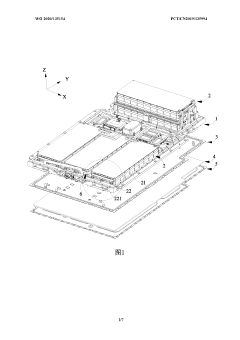
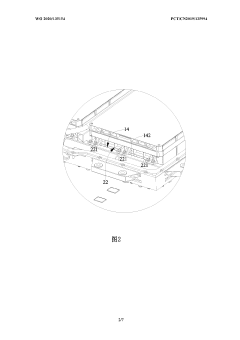
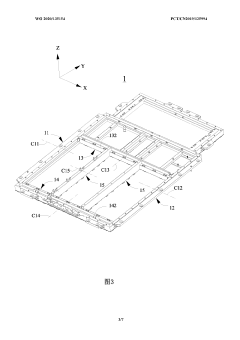
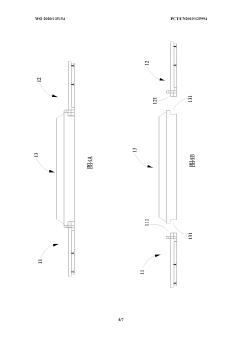
- The frame design includes the first beam, the second beam, the third beam and the fourth beam. The battery module is supported by the step overlap method, which reduces the support strength requirements for the heat exchange plate and improves the stiffness and strength of the battery pack. Design simplicity.
Extruded frame for battery pack case
PatentActiveKR1020240073311A
Innovation
- An extruded frame with a reinforcement frame having a hollow portion that incorporates a high-rigidity roll forming beam, inserted and fixed within the reinforcement frame, enhancing side impact rigidity without increasing the frame's width.


Safety Standards and Regulations for Robotic Battery Systems
The regulatory landscape for robotic battery systems encompasses multiple international and regional standards that directly impact the design and implementation of battery pack frames. The International Electrotechnical Commission (IEC) 62133 series provides fundamental safety requirements for portable sealed secondary cells and batteries, while IEC 61508 addresses functional safety of electrical systems in robotics applications. These standards establish baseline requirements for thermal management, electrical isolation, and mechanical protection that battery pack frames must accommodate.
Regional regulations vary significantly across major markets, with the European Union's Machinery Directive 2006/42/EC and Battery Regulation (EU) 2023/1542 setting comprehensive requirements for robotic systems. The United States follows OSHA guidelines alongside UL 2089 standards for health and wellness devices, while Japan implements JIS C 8715 standards for lithium-ion battery safety. These regulatory frameworks mandate specific design considerations for battery enclosures, including flame retardancy ratings, ingress protection levels, and electromagnetic compatibility requirements.
Industry-specific standards further refine safety requirements based on application contexts. ISO 10218 for industrial robots establishes safety protocols that extend to power system design, requiring fail-safe mechanisms and emergency shutdown capabilities. For service robots, ISO 13482 emphasizes human-robot interaction safety, mandating additional protection against battery-related hazards such as thermal runaway and electrical shock. Medical robotics applications must comply with IEC 60601-1 standards, imposing stricter requirements for patient safety and system reliability.
Certification processes typically involve third-party testing laboratories that evaluate battery pack frame designs against applicable standards. Key assessment criteria include mechanical stress testing, thermal cycling validation, and electrical safety verification. Documentation requirements encompass design specifications, risk assessments, and quality management system compliance. Manufacturers must maintain traceability throughout the supply chain and implement post-market surveillance programs to monitor safety performance.
Emerging regulatory trends reflect advancing battery technologies and evolving robotic applications. Updated standards increasingly address lithium-ion battery specific hazards, wireless charging safety, and autonomous operation scenarios. Regulatory bodies are developing harmonized international standards to facilitate global market access while maintaining safety integrity. These evolving requirements necessitate proactive design approaches that anticipate future regulatory developments and incorporate adaptive safety features into battery pack frame architectures.
Regional regulations vary significantly across major markets, with the European Union's Machinery Directive 2006/42/EC and Battery Regulation (EU) 2023/1542 setting comprehensive requirements for robotic systems. The United States follows OSHA guidelines alongside UL 2089 standards for health and wellness devices, while Japan implements JIS C 8715 standards for lithium-ion battery safety. These regulatory frameworks mandate specific design considerations for battery enclosures, including flame retardancy ratings, ingress protection levels, and electromagnetic compatibility requirements.
Industry-specific standards further refine safety requirements based on application contexts. ISO 10218 for industrial robots establishes safety protocols that extend to power system design, requiring fail-safe mechanisms and emergency shutdown capabilities. For service robots, ISO 13482 emphasizes human-robot interaction safety, mandating additional protection against battery-related hazards such as thermal runaway and electrical shock. Medical robotics applications must comply with IEC 60601-1 standards, imposing stricter requirements for patient safety and system reliability.
Certification processes typically involve third-party testing laboratories that evaluate battery pack frame designs against applicable standards. Key assessment criteria include mechanical stress testing, thermal cycling validation, and electrical safety verification. Documentation requirements encompass design specifications, risk assessments, and quality management system compliance. Manufacturers must maintain traceability throughout the supply chain and implement post-market surveillance programs to monitor safety performance.
Emerging regulatory trends reflect advancing battery technologies and evolving robotic applications. Updated standards increasingly address lithium-ion battery specific hazards, wireless charging safety, and autonomous operation scenarios. Regulatory bodies are developing harmonized international standards to facilitate global market access while maintaining safety integrity. These evolving requirements necessitate proactive design approaches that anticipate future regulatory developments and incorporate adaptive safety features into battery pack frame architectures.
Thermal Management Considerations in Battery Frame Design
Thermal management represents one of the most critical design considerations in battery pack frames for robotic applications, directly impacting system performance, safety, and operational longevity. The compact nature of robotic systems creates unique challenges where heat dissipation must be optimized within severely constrained spatial envelopes while maintaining structural integrity and precision alignment of battery cells.
Effective thermal design begins with understanding heat generation patterns within lithium-ion battery packs during various operational modes. High-discharge scenarios common in robotic applications can generate significant thermal loads, with temperature gradients potentially exceeding 15°C across individual cells if not properly managed. The frame design must incorporate thermal pathways that facilitate uniform heat distribution while preventing localized hot spots that could trigger thermal runaway conditions.
Material selection for battery frames plays a pivotal role in thermal management strategy. Aluminum alloys offer excellent thermal conductivity ranging from 150-200 W/mK, enabling efficient heat transfer from battery cells to frame structures. Advanced composite materials with embedded thermal interface materials provide directional heat conduction capabilities, allowing designers to channel heat toward designated cooling zones while maintaining lightweight characteristics essential for robotic mobility.
Integration of active cooling elements within frame architecture requires careful consideration of space allocation and thermal interface design. Micro-channel cooling systems can be embedded directly into frame structures, providing localized temperature control with minimal impact on overall system weight. Heat pipe integration offers passive thermal management solutions particularly suitable for mobile robotic platforms where power consumption for active cooling must be minimized.
Thermal expansion management becomes increasingly critical in precision robotic applications where dimensional stability directly affects operational accuracy. Frame designs must accommodate differential thermal expansion between battery cells, frame materials, and mounting interfaces. Strategic placement of expansion joints and flexible mounting systems prevents thermal stress accumulation that could compromise structural integrity or introduce mechanical tolerances affecting robotic precision.
Advanced thermal modeling and simulation tools enable optimization of frame geometries for enhanced heat dissipation performance. Computational fluid dynamics analysis helps identify optimal ventilation pathways and cooling air flow patterns within frame structures, ensuring adequate thermal performance across diverse operational environments and duty cycles encountered in robotic applications.
Effective thermal design begins with understanding heat generation patterns within lithium-ion battery packs during various operational modes. High-discharge scenarios common in robotic applications can generate significant thermal loads, with temperature gradients potentially exceeding 15°C across individual cells if not properly managed. The frame design must incorporate thermal pathways that facilitate uniform heat distribution while preventing localized hot spots that could trigger thermal runaway conditions.
Material selection for battery frames plays a pivotal role in thermal management strategy. Aluminum alloys offer excellent thermal conductivity ranging from 150-200 W/mK, enabling efficient heat transfer from battery cells to frame structures. Advanced composite materials with embedded thermal interface materials provide directional heat conduction capabilities, allowing designers to channel heat toward designated cooling zones while maintaining lightweight characteristics essential for robotic mobility.
Integration of active cooling elements within frame architecture requires careful consideration of space allocation and thermal interface design. Micro-channel cooling systems can be embedded directly into frame structures, providing localized temperature control with minimal impact on overall system weight. Heat pipe integration offers passive thermal management solutions particularly suitable for mobile robotic platforms where power consumption for active cooling must be minimized.
Thermal expansion management becomes increasingly critical in precision robotic applications where dimensional stability directly affects operational accuracy. Frame designs must accommodate differential thermal expansion between battery cells, frame materials, and mounting interfaces. Strategic placement of expansion joints and flexible mounting systems prevents thermal stress accumulation that could compromise structural integrity or introduce mechanical tolerances affecting robotic precision.
Advanced thermal modeling and simulation tools enable optimization of frame geometries for enhanced heat dissipation performance. Computational fluid dynamics analysis helps identify optimal ventilation pathways and cooling air flow patterns within frame structures, ensuring adequate thermal performance across diverse operational environments and duty cycles encountered in robotic applications.
Unlock deeper insights with Patsnap Eureka Quick Research — get a full tech report to explore trends and direct your research. Try now!
Generate Your Research Report Instantly with AI Agent
Supercharge your innovation with Patsnap Eureka AI Agent Platform!