

Thermal Runaway Studies in Battery Pack Frames: Prevention Techniques
JUN 1, 20269 MIN READ
Generate Your Research Report Instantly with AI Agent
Patsnap Eureka helps you evaluate technical feasibility & market potential.
Battery Thermal Runaway Background and Prevention Goals
Battery thermal runaway represents one of the most critical safety challenges in modern energy storage systems, particularly in lithium-ion battery technologies. This phenomenon occurs when a battery cell experiences an uncontrolled increase in temperature, leading to a cascade of exothermic reactions that can propagate throughout an entire battery pack. The process typically initiates when internal cell temperatures exceed critical thresholds, often around 130-150°C, triggering electrolyte decomposition and separator breakdown.
The evolution of battery thermal runaway understanding has progressed significantly since the early commercialization of lithium-ion batteries in the 1990s. Initial research focused primarily on individual cell behavior, but as battery applications expanded into electric vehicles, grid storage, and aerospace systems, the focus shifted toward understanding thermal propagation mechanisms within multi-cell configurations and battery pack architectures.
Contemporary thermal runaway studies encompass multiple triggering mechanisms including mechanical abuse, electrical overcharge, external heating, and internal short circuits. Each pathway presents unique challenges for prevention and mitigation strategies. Mechanical abuse scenarios, such as crush or penetration events, can cause immediate internal short circuits, while electrical abuse conditions may develop gradually through overcharging or deep discharge cycles.
The primary technical objectives in thermal runaway prevention center on three fundamental approaches: early detection and intervention, thermal propagation mitigation, and system-level safety integration. Early detection systems aim to identify precursor conditions before thermal runaway initiation, utilizing parameters such as temperature gradients, voltage anomalies, and gas emission signatures. Advanced monitoring algorithms now incorporate machine learning techniques to predict thermal events based on subtle pattern recognition in operational data.
Thermal propagation mitigation focuses on containing thermal runaway effects within individual cells or cell groups, preventing cascade failures across entire battery packs. This involves sophisticated thermal management architectures, including phase change materials, thermal barriers, and active cooling systems designed to absorb and dissipate excess heat energy during thermal events.
System-level safety integration represents the most comprehensive approach, incorporating thermal runaway considerations into overall battery pack design philosophy. This includes structural frame modifications, ventilation system optimization, and emergency response protocols that can safely manage thermal runaway events when they occur, minimizing risks to surrounding systems and personnel while maintaining operational integrity of unaffected battery sections.
The evolution of battery thermal runaway understanding has progressed significantly since the early commercialization of lithium-ion batteries in the 1990s. Initial research focused primarily on individual cell behavior, but as battery applications expanded into electric vehicles, grid storage, and aerospace systems, the focus shifted toward understanding thermal propagation mechanisms within multi-cell configurations and battery pack architectures.
Contemporary thermal runaway studies encompass multiple triggering mechanisms including mechanical abuse, electrical overcharge, external heating, and internal short circuits. Each pathway presents unique challenges for prevention and mitigation strategies. Mechanical abuse scenarios, such as crush or penetration events, can cause immediate internal short circuits, while electrical abuse conditions may develop gradually through overcharging or deep discharge cycles.
The primary technical objectives in thermal runaway prevention center on three fundamental approaches: early detection and intervention, thermal propagation mitigation, and system-level safety integration. Early detection systems aim to identify precursor conditions before thermal runaway initiation, utilizing parameters such as temperature gradients, voltage anomalies, and gas emission signatures. Advanced monitoring algorithms now incorporate machine learning techniques to predict thermal events based on subtle pattern recognition in operational data.
Thermal propagation mitigation focuses on containing thermal runaway effects within individual cells or cell groups, preventing cascade failures across entire battery packs. This involves sophisticated thermal management architectures, including phase change materials, thermal barriers, and active cooling systems designed to absorb and dissipate excess heat energy during thermal events.
System-level safety integration represents the most comprehensive approach, incorporating thermal runaway considerations into overall battery pack design philosophy. This includes structural frame modifications, ventilation system optimization, and emergency response protocols that can safely manage thermal runaway events when they occur, minimizing risks to surrounding systems and personnel while maintaining operational integrity of unaffected battery sections.
Market Demand for Safe Battery Pack Systems
The global battery pack market is experiencing unprecedented growth driven by the rapid expansion of electric vehicles, energy storage systems, and portable electronics. This surge in demand has intensified focus on battery safety, particularly thermal runaway prevention, as a critical market differentiator. Consumer awareness of battery-related safety incidents has elevated thermal management from a technical consideration to a primary purchasing criterion.
Electric vehicle manufacturers face increasing regulatory pressure and consumer scrutiny regarding battery safety. Major automotive recalls due to thermal runaway incidents have demonstrated the substantial financial and reputational risks associated with inadequate thermal management systems. This has created a robust market demand for advanced battery pack frame designs that incorporate sophisticated thermal runaway prevention mechanisms.
The energy storage sector presents another significant market opportunity, where large-scale battery installations require comprehensive thermal management solutions. Grid-scale energy storage projects demand battery systems with proven thermal stability and fail-safe mechanisms, driving investment in advanced frame technologies that can contain and mitigate thermal events.
Consumer electronics manufacturers are also prioritizing thermal safety as device power densities continue to increase. Smartphones, laptops, and wearable devices require compact battery pack frames that can effectively manage heat dissipation while maintaining safety standards. The market increasingly values solutions that balance performance, safety, and form factor constraints.
Insurance companies and regulatory bodies are establishing stricter safety standards, creating mandatory market requirements for thermal runaway prevention technologies. These evolving standards are driving demand for battery pack frames with integrated thermal barriers, heat dissipation systems, and emergency containment features.
The market shows strong preference for modular thermal management solutions that can be adapted across different battery chemistries and applications. Manufacturers seek versatile frame designs that accommodate various cell formats while providing consistent thermal protection. This demand for flexibility is spurring innovation in adaptive thermal management systems and standardized safety interfaces.
Investment in thermal runaway prevention technologies reflects the market's recognition that safety features directly impact product viability and market acceptance. Companies demonstrating superior thermal management capabilities gain competitive advantages in securing contracts and regulatory approvals across multiple industry sectors.
Electric vehicle manufacturers face increasing regulatory pressure and consumer scrutiny regarding battery safety. Major automotive recalls due to thermal runaway incidents have demonstrated the substantial financial and reputational risks associated with inadequate thermal management systems. This has created a robust market demand for advanced battery pack frame designs that incorporate sophisticated thermal runaway prevention mechanisms.
The energy storage sector presents another significant market opportunity, where large-scale battery installations require comprehensive thermal management solutions. Grid-scale energy storage projects demand battery systems with proven thermal stability and fail-safe mechanisms, driving investment in advanced frame technologies that can contain and mitigate thermal events.
Consumer electronics manufacturers are also prioritizing thermal safety as device power densities continue to increase. Smartphones, laptops, and wearable devices require compact battery pack frames that can effectively manage heat dissipation while maintaining safety standards. The market increasingly values solutions that balance performance, safety, and form factor constraints.
Insurance companies and regulatory bodies are establishing stricter safety standards, creating mandatory market requirements for thermal runaway prevention technologies. These evolving standards are driving demand for battery pack frames with integrated thermal barriers, heat dissipation systems, and emergency containment features.
The market shows strong preference for modular thermal management solutions that can be adapted across different battery chemistries and applications. Manufacturers seek versatile frame designs that accommodate various cell formats while providing consistent thermal protection. This demand for flexibility is spurring innovation in adaptive thermal management systems and standardized safety interfaces.
Investment in thermal runaway prevention technologies reflects the market's recognition that safety features directly impact product viability and market acceptance. Companies demonstrating superior thermal management capabilities gain competitive advantages in securing contracts and regulatory approvals across multiple industry sectors.
Current Thermal Runaway Challenges in Battery Frames
Battery pack thermal runaway represents one of the most critical safety challenges facing the energy storage industry today. The phenomenon occurs when a single cell experiences uncontrolled temperature rise, triggering a cascade of exothermic reactions that can propagate throughout the entire battery system. Current battery frame designs struggle to effectively contain and mitigate these thermal events, leading to catastrophic failures that pose significant risks to both equipment and human safety.
The primary challenge lies in the rapid heat generation and propagation characteristics of lithium-ion batteries during thermal runaway events. When a cell reaches temperatures exceeding 130-150°C, internal chemical reactions become self-sustaining, generating temperatures that can exceed 800°C within minutes. Traditional battery frame materials, typically composed of aluminum or steel alloys, lack sufficient thermal management capabilities to prevent heat transfer between adjacent cells, resulting in thermal propagation rates that can affect entire battery modules within 5-10 minutes.
Structural integrity presents another significant challenge as battery frames must withstand extreme thermal stresses while maintaining mechanical stability. During thermal runaway events, rapid thermal expansion and the release of toxic gases create internal pressures that can compromise frame structural integrity. Current designs often fail to balance the competing requirements of thermal isolation, mechanical strength, and weight optimization, leading to inadequate protection against cell-to-cell thermal propagation.
Detection and early warning systems integrated within battery frames face substantial technical hurdles. Existing temperature monitoring solutions suffer from slow response times and limited spatial resolution, often failing to detect thermal runaway initiation until propagation has already begun. The harsh electromagnetic environment within battery packs interferes with sensor accuracy, while the need for cost-effective solutions limits the deployment of advanced monitoring technologies.
Thermal management integration within battery frame architectures remains inadequately addressed by current solutions. Passive cooling systems demonstrate insufficient heat dissipation capacity during thermal runaway events, while active cooling systems face challenges in rapid response deployment and system complexity. The integration of phase change materials and advanced thermal interface materials within frame structures shows promise but encounters manufacturing scalability and long-term reliability concerns.
Gas venting and containment represent critical safety challenges that current battery frame designs inadequately address. Thermal runaway events generate toxic and flammable gases including hydrogen fluoride, carbon monoxide, and various organic compounds. Existing frame designs lack effective gas management systems, creating risks of secondary combustion events and toxic exposure. The development of integrated venting systems that can safely direct and neutralize these gases while maintaining structural integrity remains a significant technical challenge requiring innovative engineering solutions.
The primary challenge lies in the rapid heat generation and propagation characteristics of lithium-ion batteries during thermal runaway events. When a cell reaches temperatures exceeding 130-150°C, internal chemical reactions become self-sustaining, generating temperatures that can exceed 800°C within minutes. Traditional battery frame materials, typically composed of aluminum or steel alloys, lack sufficient thermal management capabilities to prevent heat transfer between adjacent cells, resulting in thermal propagation rates that can affect entire battery modules within 5-10 minutes.
Structural integrity presents another significant challenge as battery frames must withstand extreme thermal stresses while maintaining mechanical stability. During thermal runaway events, rapid thermal expansion and the release of toxic gases create internal pressures that can compromise frame structural integrity. Current designs often fail to balance the competing requirements of thermal isolation, mechanical strength, and weight optimization, leading to inadequate protection against cell-to-cell thermal propagation.
Detection and early warning systems integrated within battery frames face substantial technical hurdles. Existing temperature monitoring solutions suffer from slow response times and limited spatial resolution, often failing to detect thermal runaway initiation until propagation has already begun. The harsh electromagnetic environment within battery packs interferes with sensor accuracy, while the need for cost-effective solutions limits the deployment of advanced monitoring technologies.
Thermal management integration within battery frame architectures remains inadequately addressed by current solutions. Passive cooling systems demonstrate insufficient heat dissipation capacity during thermal runaway events, while active cooling systems face challenges in rapid response deployment and system complexity. The integration of phase change materials and advanced thermal interface materials within frame structures shows promise but encounters manufacturing scalability and long-term reliability concerns.
Gas venting and containment represent critical safety challenges that current battery frame designs inadequately address. Thermal runaway events generate toxic and flammable gases including hydrogen fluoride, carbon monoxide, and various organic compounds. Existing frame designs lack effective gas management systems, creating risks of secondary combustion events and toxic exposure. The development of integrated venting systems that can safely direct and neutralize these gases while maintaining structural integrity remains a significant technical challenge requiring innovative engineering solutions.
Existing Thermal Runaway Prevention Methods
01 Thermal management systems for battery pack frames
Battery pack frames incorporate advanced thermal management systems to prevent thermal runaway events. These systems include heat dissipation structures, thermal barriers, and cooling channels integrated into the frame design. The thermal management approach focuses on maintaining optimal operating temperatures and preventing heat accumulation that could lead to thermal runaway conditions.- Thermal management systems for battery pack frames: Battery pack frames incorporate advanced thermal management systems including heat dissipation structures, thermal interface materials, and cooling channels to prevent thermal runaway. These systems actively monitor and control temperature distribution across the battery pack, utilizing conductive materials and heat sinks to maintain optimal operating temperatures and prevent localized overheating that could trigger thermal runaway events.
- Fire suppression and containment mechanisms: Battery pack frames are designed with integrated fire suppression systems and containment barriers to mitigate thermal runaway propagation. These mechanisms include flame-retardant materials, automatic fire suppression agents, and compartmentalization structures that isolate affected cells to prevent cascade failures and contain thermal events within specific zones of the battery pack.
- Structural reinforcement and safety barriers: Frame designs incorporate reinforced structural elements and safety barriers that maintain integrity during thermal runaway events. These include impact-resistant housings, pressure relief mechanisms, and structural supports that prevent deformation and maintain protective enclosure even under extreme thermal conditions, ensuring containment of hazardous materials and gases.
- Monitoring and early detection systems: Advanced monitoring systems integrated into battery pack frames provide real-time detection of thermal runaway precursors through temperature sensors, gas detection, and electrical parameter monitoring. These systems enable early warning capabilities and automatic shutdown procedures to prevent thermal runaway initiation and minimize damage through predictive safety measures.
- Ventilation and gas management systems: Battery pack frames feature specialized ventilation systems and gas management mechanisms to handle toxic gases and pressure buildup during thermal runaway events. These systems include controlled venting pathways, gas filtration components, and pressure equalization features that safely direct hazardous emissions away from critical areas while maintaining structural integrity.
02 Fire suppression and containment mechanisms
Battery pack frames are designed with fire suppression systems and containment mechanisms to control thermal runaway propagation. These include fire-resistant materials, suppression agents, and compartmentalization features that isolate affected cells. The containment approach prevents the spread of thermal events to adjacent battery modules within the pack structure.Expand Specific Solutions03 Structural reinforcement and safety barriers
Frame designs incorporate structural reinforcement elements and safety barriers to withstand thermal runaway events. These features include reinforced housing materials, pressure relief mechanisms, and protective barriers that maintain structural integrity during thermal events. The reinforcement systems are designed to prevent catastrophic failure and maintain containment.Expand Specific Solutions04 Monitoring and detection systems integration
Battery pack frames integrate comprehensive monitoring and detection systems to identify early signs of thermal runaway. These systems include temperature sensors, gas detection capabilities, and real-time monitoring networks embedded within the frame structure. The detection approach enables early intervention and preventive measures before thermal events escalate.Expand Specific Solutions05 Ventilation and gas management systems
Frame designs incorporate ventilation systems and gas management features to handle gases released during thermal runaway events. These include venting mechanisms, gas filtration systems, and controlled release pathways that safely direct hazardous gases away from critical components. The ventilation approach prevents gas accumulation and reduces explosion risks.Expand Specific Solutions
Key Players in Battery Safety and Thermal Solutions
The thermal runaway prevention technology in battery pack frames represents a rapidly evolving sector within the broader battery safety market, currently in its growth phase as electric vehicle adoption accelerates globally. The market is experiencing significant expansion driven by stringent safety regulations and increasing demand for reliable energy storage solutions. Technology maturity varies considerably across market participants, with established players like LG Energy Solution, Samsung SDI, and Panasonic Energy demonstrating advanced thermal management capabilities through years of R&D investment. Tesla and Cummins are integrating sophisticated prevention techniques into their vehicle platforms, while emerging companies such as REPT Battero and Jiangsu Zenergy are developing innovative approaches to thermal runaway mitigation. The competitive landscape shows a mix of mature battery manufacturers with proven thermal safety solutions and newer entrants focusing on next-generation prevention technologies, indicating a dynamic market with ongoing technological advancement.
LG Energy Solution Ltd.
Technical Solution: LG Energy Solution focuses on cell-level thermal runaway prevention integrated with pack frame design through their advanced thermal propagation control technology. Their approach incorporates thermally insulating materials within the battery pack frame structure, including ceramic-based thermal barriers and phase-change materials that absorb excess heat during thermal events. The company develops modular pack frame designs with compartmentalization strategies that physically separate cell groups to prevent thermal cascade effects. LG's thermal runaway studies emphasize the use of flame-retardant structural components in pack frames, combined with pressure relief systems that are integrated into the frame architecture. Their prevention techniques include advanced cell chemistry modifications that increase thermal stability thresholds and sophisticated thermal modeling for optimized pack frame ventilation design.
Strengths: Strong expertise in cell chemistry and thermal materials, established automotive partnerships for validation. Weaknesses: Limited vertical integration compared to some competitors, dependency on automotive OEM requirements.
SK On Co., Ltd.
Technical Solution: SK On develops thermal runaway prevention through their SafetyPlus technology platform, which integrates advanced thermal management systems directly into battery pack frame designs. Their approach includes the implementation of thermal runaway propagation barriers using specialized insulation materials and heat-absorbing compounds within the pack structure. The company focuses on predictive thermal modeling and real-time monitoring systems that work in conjunction with mechanically robust pack frames designed to contain thermal events. SK On's prevention techniques involve the use of fire-resistant composite materials in pack frame construction, combined with optimized cell spacing and thermal pathway management. Their research emphasizes the development of smart pack frames with integrated sensors and automated response systems that can detect and respond to thermal anomalies before they escalate to full thermal runaway conditions.
Strengths: Advanced materials science capabilities, strong focus on safety-first design philosophy. Weaknesses: Relatively newer market presence compared to established competitors, limited global manufacturing scale.
Core Innovations in Battery Frame Thermal Protection
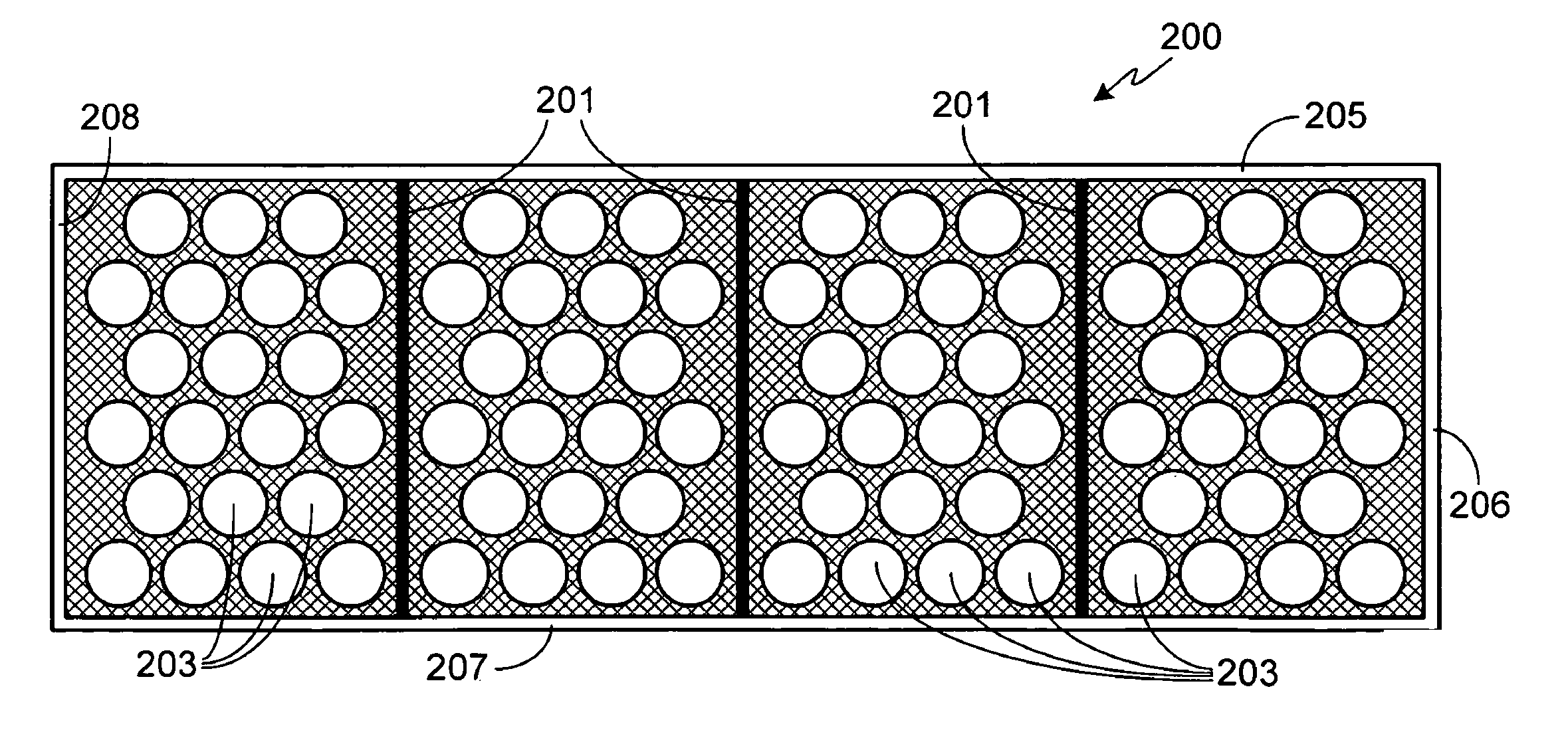
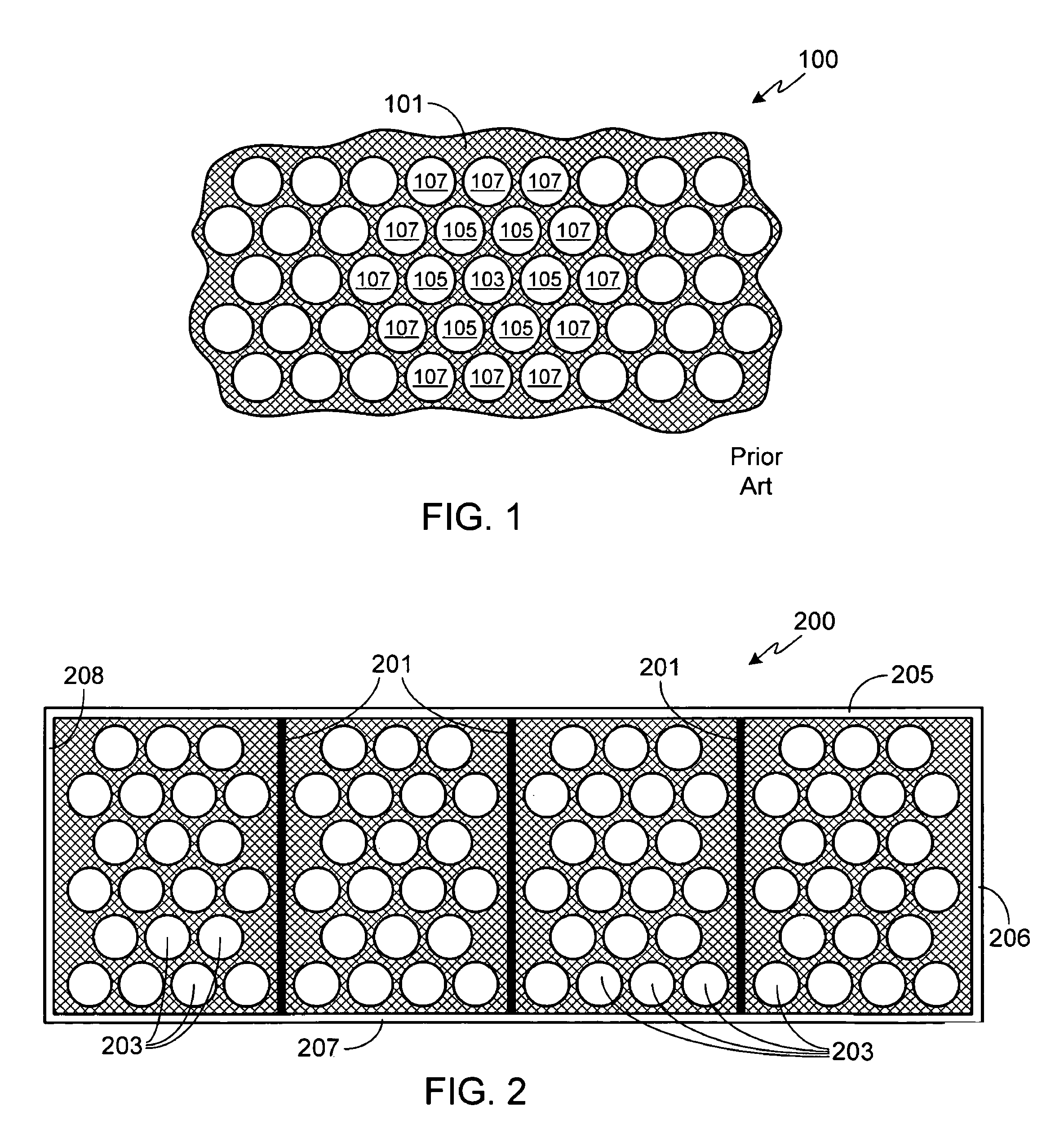
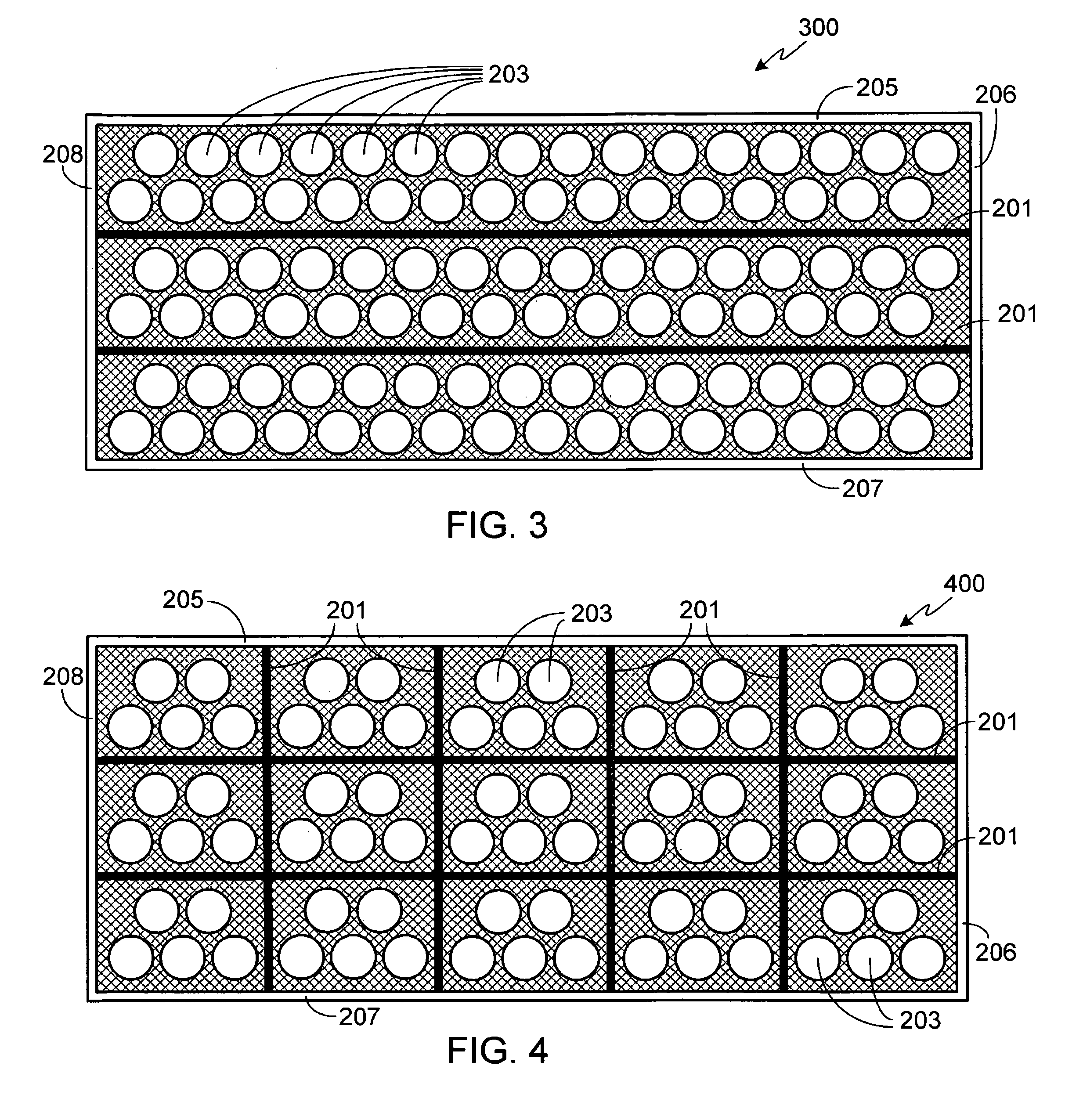
Thermal barrier structure for containing thermal runaway propagation within a battery pack
PatentActiveUS8541126B2
Innovation
- Implementing thermal barrier elements with high melting temperatures and low thermal conductivity to divide battery packs into groups, preventing the propagation of thermal runaway events between cell groups, and integrating heat transfer channels coupled to passive or active cooling systems to manage thermal energy.

Active thermal runaway mitigation system for use within a battery pack
PatentActiveUS9093726B2
Innovation
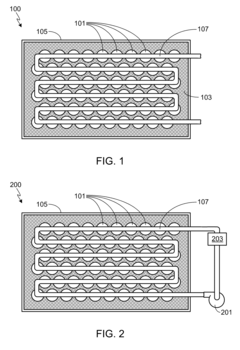
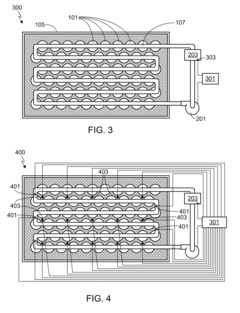
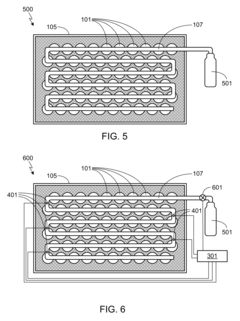
- An active thermal runaway mitigation system is implemented, featuring a battery pack enclosure with fluid-containing conduits that breach at a preset temperature to discharge cooling fluids or gases onto overheated cells, using sensors and a system controller to manage fluid pump operation and prevent propagation of thermal runaway to adjacent cells.
Safety Standards and Regulations for Battery Systems
Battery thermal runaway prevention has become a critical focus for regulatory bodies worldwide, driving the establishment of comprehensive safety standards and regulations. The International Electrotechnical Commission (IEC) has developed IEC 62619 and IEC 62133 series standards, which specifically address safety requirements for lithium-ion batteries in industrial applications and portable devices respectively. These standards mandate rigorous thermal abuse testing protocols, including overcharge, over-discharge, and thermal shock assessments to evaluate battery pack frame performance under extreme conditions.
The United Nations Economic Commission for Europe (UNECE) has implemented UN 38.3 transportation regulations, requiring extensive thermal runaway testing for battery systems during shipping and handling. These regulations specify temperature cycling tests ranging from -40°C to 75°C, along with altitude simulation and vibration resistance requirements that directly impact battery pack frame design specifications.
Regional regulatory frameworks have evolved to address specific thermal management challenges. The European Union's Battery Regulation 2023/1542 introduces stringent thermal safety requirements for industrial battery packs, mandating thermal propagation prevention measures and emergency response protocols. Similarly, the United States Department of Transportation (DOT) has established specific guidelines under 49 CFR Part 173 for lithium battery transportation, emphasizing thermal containment within battery pack structures.
Emerging regulatory trends focus on predictive thermal management systems and real-time monitoring capabilities. The Society of Automotive Engineers (SAE) has developed SAE J2464 and SAE J2929 standards specifically addressing thermal runaway detection and mitigation in automotive battery applications. These standards require integration of temperature sensors, thermal barriers, and automated shutdown mechanisms within battery pack frames.
Compliance verification processes have become increasingly sophisticated, requiring third-party certification through accredited testing laboratories. Organizations such as Underwriters Laboratories (UL) and TÜV Rheinland have established specialized testing protocols that simulate real-world thermal runaway scenarios, ensuring battery pack frames meet prescribed safety thresholds before market deployment.
The United Nations Economic Commission for Europe (UNECE) has implemented UN 38.3 transportation regulations, requiring extensive thermal runaway testing for battery systems during shipping and handling. These regulations specify temperature cycling tests ranging from -40°C to 75°C, along with altitude simulation and vibration resistance requirements that directly impact battery pack frame design specifications.
Regional regulatory frameworks have evolved to address specific thermal management challenges. The European Union's Battery Regulation 2023/1542 introduces stringent thermal safety requirements for industrial battery packs, mandating thermal propagation prevention measures and emergency response protocols. Similarly, the United States Department of Transportation (DOT) has established specific guidelines under 49 CFR Part 173 for lithium battery transportation, emphasizing thermal containment within battery pack structures.
Emerging regulatory trends focus on predictive thermal management systems and real-time monitoring capabilities. The Society of Automotive Engineers (SAE) has developed SAE J2464 and SAE J2929 standards specifically addressing thermal runaway detection and mitigation in automotive battery applications. These standards require integration of temperature sensors, thermal barriers, and automated shutdown mechanisms within battery pack frames.
Compliance verification processes have become increasingly sophisticated, requiring third-party certification through accredited testing laboratories. Organizations such as Underwriters Laboratories (UL) and TÜV Rheinland have established specialized testing protocols that simulate real-world thermal runaway scenarios, ensuring battery pack frames meet prescribed safety thresholds before market deployment.
Environmental Impact of Battery Thermal Events
Battery thermal events, particularly thermal runaway incidents, pose significant environmental challenges that extend far beyond immediate safety concerns. When lithium-ion batteries experience thermal runaway within pack frames, the environmental consequences can be severe and long-lasting, affecting air quality, soil composition, and water systems in surrounding areas.
The atmospheric impact of battery thermal events represents one of the most immediate environmental concerns. During thermal runaway, batteries release toxic gases including hydrogen fluoride, carbon monoxide, and various organic compounds into the atmosphere. These emissions contribute to local air pollution and can create hazardous conditions for both human health and ecosystem stability. The release of particulate matter during combustion events further exacerbates air quality degradation, with potential impacts extending several kilometers from the incident site.
Soil contamination emerges as a critical long-term environmental consequence of battery thermal events. Heavy metals such as lithium, cobalt, nickel, and manganese can leach into surrounding soil systems, creating persistent contamination that affects plant growth and soil microorganism populations. The alkaline nature of many battery electrolytes can alter soil pH levels, disrupting natural nutrient cycles and potentially rendering agricultural land unusable for extended periods.
Water system contamination represents another significant environmental impact pathway. Runoff from thermal events can carry toxic compounds into groundwater supplies, streams, and rivers. Fluoride compounds released during thermal runaway are particularly concerning due to their persistence in aquatic environments and potential for bioaccumulation in food chains. The contamination of water sources can affect both human communities and wildlife populations dependent on these resources.
The carbon footprint associated with battery thermal events extends beyond the immediate incident. Emergency response activities, cleanup operations, and the premature replacement of damaged battery systems contribute to increased greenhouse gas emissions. Additionally, the loss of energy storage capacity during thermal events can necessitate reliance on less sustainable backup power sources, further amplifying environmental impacts.
Ecosystem disruption occurs through multiple pathways during and after thermal events. Wildlife populations may experience habitat degradation due to soil and water contamination, while vegetation can suffer from exposure to toxic compounds released during battery combustion. The recovery of affected ecosystems often requires years or decades, depending on the severity of contamination and the effectiveness of remediation efforts.
The atmospheric impact of battery thermal events represents one of the most immediate environmental concerns. During thermal runaway, batteries release toxic gases including hydrogen fluoride, carbon monoxide, and various organic compounds into the atmosphere. These emissions contribute to local air pollution and can create hazardous conditions for both human health and ecosystem stability. The release of particulate matter during combustion events further exacerbates air quality degradation, with potential impacts extending several kilometers from the incident site.
Soil contamination emerges as a critical long-term environmental consequence of battery thermal events. Heavy metals such as lithium, cobalt, nickel, and manganese can leach into surrounding soil systems, creating persistent contamination that affects plant growth and soil microorganism populations. The alkaline nature of many battery electrolytes can alter soil pH levels, disrupting natural nutrient cycles and potentially rendering agricultural land unusable for extended periods.
Water system contamination represents another significant environmental impact pathway. Runoff from thermal events can carry toxic compounds into groundwater supplies, streams, and rivers. Fluoride compounds released during thermal runaway are particularly concerning due to their persistence in aquatic environments and potential for bioaccumulation in food chains. The contamination of water sources can affect both human communities and wildlife populations dependent on these resources.
The carbon footprint associated with battery thermal events extends beyond the immediate incident. Emergency response activities, cleanup operations, and the premature replacement of damaged battery systems contribute to increased greenhouse gas emissions. Additionally, the loss of energy storage capacity during thermal events can necessitate reliance on less sustainable backup power sources, further amplifying environmental impacts.
Ecosystem disruption occurs through multiple pathways during and after thermal events. Wildlife populations may experience habitat degradation due to soil and water contamination, while vegetation can suffer from exposure to toxic compounds released during battery combustion. The recovery of affected ecosystems often requires years or decades, depending on the severity of contamination and the effectiveness of remediation efforts.
Unlock deeper insights with Patsnap Eureka Quick Research — get a full tech report to explore trends and direct your research. Try now!
Generate Your Research Report Instantly with AI Agent
Supercharge your innovation with Patsnap Eureka AI Agent Platform!