Ceramic vs. Steel Thrust Bearings: Longevity and Performance
MAR 16, 20269 MIN READ
Generate Your Research Report Instantly with AI Agent
PatSnap Eureka helps you evaluate technical feasibility & market potential.
Ceramic vs Steel Thrust Bearing Technology Background and Goals
Thrust bearings represent a critical component class in mechanical systems, designed to handle axial loads and prevent relative motion between rotating and stationary parts. The evolution of thrust bearing technology has been driven by increasing demands for higher performance, extended operational life, and enhanced reliability across diverse industrial applications. Traditional steel-based thrust bearings have dominated the market for decades, leveraging well-established manufacturing processes and proven metallurgical properties.
The emergence of advanced ceramic materials in bearing applications marks a significant technological shift in the industry. Silicon nitride, silicon carbide, and other engineered ceramics have demonstrated exceptional properties including superior hardness, corrosion resistance, and thermal stability. This material evolution has opened new possibilities for thrust bearing design, particularly in demanding environments where conventional steel bearings face limitations.
Historical development of thrust bearing technology began with simple bronze and steel configurations in the early industrial era. The introduction of ball and roller thrust bearings in the mid-20th century represented a major advancement, followed by improvements in steel metallurgy and heat treatment processes. The late 20th century witnessed the first commercial applications of ceramic bearing elements, initially in specialized aerospace and high-speed machinery applications.
Current technological objectives focus on achieving extended bearing life cycles while maintaining or improving load-carrying capacity and operational efficiency. The primary goal involves optimizing the balance between material properties, manufacturing precision, and cost-effectiveness. Steel thrust bearings continue to target improvements in fatigue resistance and surface treatments, while ceramic alternatives pursue enhanced fracture toughness and thermal shock resistance.
Performance benchmarking between ceramic and steel thrust bearings encompasses multiple critical parameters including dynamic load ratings, speed capabilities, temperature tolerance, and maintenance requirements. The industry seeks to establish clear application guidelines that leverage the unique advantages of each material system while addressing their respective limitations.
The strategic importance of this technology comparison extends beyond immediate performance metrics to encompass total cost of ownership, environmental impact, and supply chain considerations. Modern industrial applications demand bearing solutions that can operate reliably in increasingly challenging conditions while supporting sustainability objectives and operational efficiency targets.
The emergence of advanced ceramic materials in bearing applications marks a significant technological shift in the industry. Silicon nitride, silicon carbide, and other engineered ceramics have demonstrated exceptional properties including superior hardness, corrosion resistance, and thermal stability. This material evolution has opened new possibilities for thrust bearing design, particularly in demanding environments where conventional steel bearings face limitations.
Historical development of thrust bearing technology began with simple bronze and steel configurations in the early industrial era. The introduction of ball and roller thrust bearings in the mid-20th century represented a major advancement, followed by improvements in steel metallurgy and heat treatment processes. The late 20th century witnessed the first commercial applications of ceramic bearing elements, initially in specialized aerospace and high-speed machinery applications.
Current technological objectives focus on achieving extended bearing life cycles while maintaining or improving load-carrying capacity and operational efficiency. The primary goal involves optimizing the balance between material properties, manufacturing precision, and cost-effectiveness. Steel thrust bearings continue to target improvements in fatigue resistance and surface treatments, while ceramic alternatives pursue enhanced fracture toughness and thermal shock resistance.
Performance benchmarking between ceramic and steel thrust bearings encompasses multiple critical parameters including dynamic load ratings, speed capabilities, temperature tolerance, and maintenance requirements. The industry seeks to establish clear application guidelines that leverage the unique advantages of each material system while addressing their respective limitations.
The strategic importance of this technology comparison extends beyond immediate performance metrics to encompass total cost of ownership, environmental impact, and supply chain considerations. Modern industrial applications demand bearing solutions that can operate reliably in increasingly challenging conditions while supporting sustainability objectives and operational efficiency targets.
Market Demand Analysis for Advanced Thrust Bearing Solutions
The global thrust bearing market is experiencing significant growth driven by expanding industrial automation, renewable energy infrastructure development, and increasing demand for high-performance machinery across multiple sectors. Advanced thrust bearing solutions, particularly those incorporating ceramic materials, are gaining substantial traction as industries prioritize equipment reliability, operational efficiency, and extended service life.
Aerospace and defense sectors represent primary demand drivers for advanced thrust bearing technologies. Modern aircraft engines, satellite systems, and military equipment require bearings capable of withstanding extreme temperatures, high rotational speeds, and corrosive environments. The superior thermal stability and reduced weight characteristics of ceramic thrust bearings make them increasingly attractive for these applications, where performance reliability directly impacts safety and mission success.
Industrial manufacturing sectors, including automotive, heavy machinery, and precision equipment manufacturing, are demonstrating growing interest in advanced thrust bearing solutions. The push toward Industry 4.0 and smart manufacturing has intensified requirements for components that can operate continuously with minimal maintenance interventions. Ceramic thrust bearings offer compelling advantages in reducing unplanned downtime and maintenance costs, making them economically attractive despite higher initial investment requirements.
The renewable energy sector, particularly wind power generation, presents substantial market opportunities for advanced thrust bearing technologies. Wind turbine applications demand bearings capable of handling variable loads, harsh environmental conditions, and extended operational periods with minimal maintenance access. The longevity advantages of ceramic materials align well with the economic models of renewable energy projects, where operational reliability over decades is crucial for investment returns.
Marine and offshore applications constitute another significant demand segment, where corrosion resistance and reliability in harsh environments are paramount. Advanced ceramic thrust bearings demonstrate superior performance in saltwater environments and high-humidity conditions compared to traditional steel alternatives, driving adoption in marine propulsion systems, offshore drilling equipment, and subsea machinery.
The medical device and precision instrumentation markets are increasingly adopting advanced thrust bearing solutions for applications requiring exceptional precision, cleanliness, and reliability. Ceramic bearings offer advantages in magnetic resonance imaging equipment, surgical instruments, and laboratory automation systems where contamination risks and precision requirements exceed the capabilities of conventional steel bearings.
Market demand is further supported by growing environmental regulations and sustainability initiatives across industries. The extended service life and reduced maintenance requirements of advanced thrust bearing solutions contribute to lower environmental impact through reduced material consumption and waste generation over equipment lifecycles.
Aerospace and defense sectors represent primary demand drivers for advanced thrust bearing technologies. Modern aircraft engines, satellite systems, and military equipment require bearings capable of withstanding extreme temperatures, high rotational speeds, and corrosive environments. The superior thermal stability and reduced weight characteristics of ceramic thrust bearings make them increasingly attractive for these applications, where performance reliability directly impacts safety and mission success.
Industrial manufacturing sectors, including automotive, heavy machinery, and precision equipment manufacturing, are demonstrating growing interest in advanced thrust bearing solutions. The push toward Industry 4.0 and smart manufacturing has intensified requirements for components that can operate continuously with minimal maintenance interventions. Ceramic thrust bearings offer compelling advantages in reducing unplanned downtime and maintenance costs, making them economically attractive despite higher initial investment requirements.
The renewable energy sector, particularly wind power generation, presents substantial market opportunities for advanced thrust bearing technologies. Wind turbine applications demand bearings capable of handling variable loads, harsh environmental conditions, and extended operational periods with minimal maintenance access. The longevity advantages of ceramic materials align well with the economic models of renewable energy projects, where operational reliability over decades is crucial for investment returns.
Marine and offshore applications constitute another significant demand segment, where corrosion resistance and reliability in harsh environments are paramount. Advanced ceramic thrust bearings demonstrate superior performance in saltwater environments and high-humidity conditions compared to traditional steel alternatives, driving adoption in marine propulsion systems, offshore drilling equipment, and subsea machinery.
The medical device and precision instrumentation markets are increasingly adopting advanced thrust bearing solutions for applications requiring exceptional precision, cleanliness, and reliability. Ceramic bearings offer advantages in magnetic resonance imaging equipment, surgical instruments, and laboratory automation systems where contamination risks and precision requirements exceed the capabilities of conventional steel bearings.
Market demand is further supported by growing environmental regulations and sustainability initiatives across industries. The extended service life and reduced maintenance requirements of advanced thrust bearing solutions contribute to lower environmental impact through reduced material consumption and waste generation over equipment lifecycles.
Current Status and Challenges in Thrust Bearing Materials
The thrust bearing industry currently faces a complex landscape where traditional steel-based solutions compete with emerging ceramic technologies. Steel thrust bearings, predominantly manufactured using high-grade tool steels and bearing steels such as AISI 52100, have dominated the market for decades due to their established manufacturing processes and cost-effectiveness. However, these conventional materials encounter significant limitations in high-temperature, high-speed, and corrosive environments where performance degradation becomes pronounced.
Ceramic thrust bearings, particularly those utilizing silicon nitride (Si3N4) and silicon carbide (SiC), represent an advanced alternative that addresses many limitations of steel bearings. Current ceramic bearing technology demonstrates superior performance characteristics including reduced friction coefficients, enhanced corrosion resistance, and exceptional thermal stability. Leading manufacturers have successfully implemented full ceramic and hybrid ceramic-steel configurations, with hybrid designs gaining particular traction due to their balanced performance-cost ratio.
Manufacturing challenges remain a critical constraint in ceramic bearing adoption. The production of high-quality ceramic bearing components requires sophisticated processing techniques including hot isostatic pressing and precision grinding with diamond tools. These manufacturing complexities result in significantly higher production costs compared to steel bearings, limiting widespread adoption despite superior performance characteristics. Quality control and consistency in ceramic material properties continue to pose challenges for mass production scalability.
Performance optimization represents another significant challenge area. While ceramic materials offer theoretical advantages, achieving optimal bearing geometry and surface finish requires specialized expertise and equipment. The brittle nature of ceramic materials demands careful consideration of stress concentration factors and loading conditions, necessitating advanced design methodologies that differ substantially from traditional steel bearing design approaches.
Market penetration barriers include conservative industry attitudes toward material substitution, particularly in critical applications where proven reliability is paramount. The aerospace, automotive, and industrial machinery sectors exhibit varying degrees of acceptance, with aerospace applications leading adoption due to performance requirements that justify higher costs. Cost-performance trade-offs remain the primary decision factor, as ceramic bearings typically cost 3-5 times more than equivalent steel bearings while offering specific performance advantages rather than universal superiority.
Supply chain maturity presents additional challenges, as ceramic bearing manufacturing requires specialized raw materials and processing capabilities that are less widely available compared to steel bearing production infrastructure. This limitation affects both production capacity and geographic distribution of ceramic bearing suppliers, potentially impacting delivery times and technical support availability for end users.
Ceramic thrust bearings, particularly those utilizing silicon nitride (Si3N4) and silicon carbide (SiC), represent an advanced alternative that addresses many limitations of steel bearings. Current ceramic bearing technology demonstrates superior performance characteristics including reduced friction coefficients, enhanced corrosion resistance, and exceptional thermal stability. Leading manufacturers have successfully implemented full ceramic and hybrid ceramic-steel configurations, with hybrid designs gaining particular traction due to their balanced performance-cost ratio.
Manufacturing challenges remain a critical constraint in ceramic bearing adoption. The production of high-quality ceramic bearing components requires sophisticated processing techniques including hot isostatic pressing and precision grinding with diamond tools. These manufacturing complexities result in significantly higher production costs compared to steel bearings, limiting widespread adoption despite superior performance characteristics. Quality control and consistency in ceramic material properties continue to pose challenges for mass production scalability.
Performance optimization represents another significant challenge area. While ceramic materials offer theoretical advantages, achieving optimal bearing geometry and surface finish requires specialized expertise and equipment. The brittle nature of ceramic materials demands careful consideration of stress concentration factors and loading conditions, necessitating advanced design methodologies that differ substantially from traditional steel bearing design approaches.
Market penetration barriers include conservative industry attitudes toward material substitution, particularly in critical applications where proven reliability is paramount. The aerospace, automotive, and industrial machinery sectors exhibit varying degrees of acceptance, with aerospace applications leading adoption due to performance requirements that justify higher costs. Cost-performance trade-offs remain the primary decision factor, as ceramic bearings typically cost 3-5 times more than equivalent steel bearings while offering specific performance advantages rather than universal superiority.
Supply chain maturity presents additional challenges, as ceramic bearing manufacturing requires specialized raw materials and processing capabilities that are less widely available compared to steel bearing production infrastructure. This limitation affects both production capacity and geographic distribution of ceramic bearing suppliers, potentially impacting delivery times and technical support availability for end users.
Current Technical Solutions for Thrust Bearing Performance
01 Advanced bearing materials and coatings
The use of specialized materials and surface coatings can significantly enhance thrust bearing longevity and performance. These materials include advanced alloys, composite materials, and protective coatings that provide improved wear resistance, reduced friction, and better corrosion protection. Surface treatments and specialized coatings help maintain bearing integrity under high-load conditions and extend operational life by minimizing material degradation.- Advanced bearing materials and coatings: The use of specialized materials and surface coatings can significantly enhance thrust bearing longevity and performance. Advanced materials such as ceramics, composite materials, and specially treated metals provide improved wear resistance and reduced friction. Surface treatments and coatings can create protective layers that minimize degradation and extend operational life under high-load conditions.
- Lubrication systems and methods: Effective lubrication is critical for thrust bearing performance and longevity. Innovations in lubrication systems include self-lubricating bearing designs, improved oil delivery mechanisms, and the use of advanced lubricants with enhanced properties. These systems ensure consistent lubrication under varying operating conditions, reducing wear and preventing premature failure.
- Structural design optimization: Optimized structural designs of thrust bearings can improve load distribution and reduce stress concentrations, thereby enhancing performance and extending service life. Design innovations include modified bearing geometries, improved load-bearing surfaces, and configurations that better accommodate thermal expansion and operational stresses.
- Thermal management solutions: Managing heat generation and dissipation is essential for maintaining thrust bearing performance and preventing thermal degradation. Solutions include integrated cooling channels, heat-resistant materials, and designs that facilitate efficient heat transfer away from critical bearing surfaces. Proper thermal management prevents overheating and maintains dimensional stability.
- Load capacity enhancement techniques: Increasing the load-carrying capacity of thrust bearings extends their operational range and improves reliability under demanding conditions. Techniques include the use of multiple bearing elements, optimized contact geometries, and materials with superior strength-to-weight ratios. These enhancements allow bearings to handle higher axial loads while maintaining performance characteristics.
02 Lubrication systems and methods
Effective lubrication is critical for thrust bearing performance and longevity. Various lubrication systems and methods have been developed to ensure consistent lubricant delivery, reduce friction, and prevent wear. These include self-lubricating bearing designs, improved oil distribution systems, and specialized lubricant formulations that maintain their properties under extreme temperatures and pressures. Proper lubrication management helps prevent premature bearing failure and maintains optimal performance throughout the bearing's service life.Expand Specific Solutions03 Structural design optimization
Optimized structural designs of thrust bearings contribute to enhanced performance and extended service life. Design improvements include optimized geometry, load distribution mechanisms, and configurations that reduce stress concentrations. These structural enhancements allow bearings to handle higher loads, operate at increased speeds, and maintain stability under varying operational conditions. Design optimization also addresses thermal management and dimensional stability to ensure consistent performance.Expand Specific Solutions04 Load capacity and stress distribution improvements
Enhancing load capacity and improving stress distribution are key factors in thrust bearing longevity. Innovations in this area include multi-pad designs, tilting pad configurations, and advanced bearing geometries that distribute loads more evenly across bearing surfaces. These improvements reduce localized stress concentrations, minimize deformation, and prevent premature failure. Enhanced load-bearing capabilities allow thrust bearings to operate reliably in demanding applications with heavy axial loads.Expand Specific Solutions05 Monitoring and maintenance technologies
Advanced monitoring and maintenance technologies play a crucial role in maximizing thrust bearing longevity and performance. These include condition monitoring systems, predictive maintenance techniques, and diagnostic tools that detect early signs of wear or failure. Real-time monitoring of parameters such as temperature, vibration, and lubrication conditions enables timely interventions and prevents catastrophic failures. Maintenance strategies based on actual bearing condition rather than fixed schedules optimize operational efficiency and extend bearing service life.Expand Specific Solutions
Major Players in Ceramic and Steel Thrust Bearing Industry
The ceramic versus steel thrust bearings market represents a mature industrial sector experiencing technological evolution driven by performance demands across aerospace, automotive, and industrial applications. The industry is in a consolidation phase with established players like NTN Corp., NSK Ltd., Schaeffler Technologies, and JTEKT Corp. dominating the steel bearing segment, while companies such as Saint-Gobain Ceramics & Plastics and IBIDEN Co. lead ceramic innovations. Market size exceeds several billion dollars globally, with ceramic bearings capturing growing share due to superior longevity and performance characteristics. Technology maturity varies significantly - steel bearings represent well-established technology with incremental improvements, while ceramic bearings showcase advancing materials science with companies like Oiles Corp. and specialized manufacturers developing hybrid solutions. The competitive landscape reflects a transition period where traditional bearing manufacturers are investing in ceramic technologies to meet evolving performance requirements in high-temperature, corrosive, and precision applications.
NTN Corp. (Osaka)
Technical Solution: NTN Corporation manufactures advanced ceramic thrust bearings using silicon nitride ceramic rolling elements combined with precision steel raceways, achieving operational speeds up to 2.6 million DN. Their ceramic bearings exhibit superior performance in high-temperature applications, maintaining dimensional stability at temperatures up to 180°C while conventional steel bearings are limited to 120°C continuous operation. NTN's ceramic thrust bearings demonstrate 50% reduction in bearing-generated heat compared to steel equivalents, attributed to lower friction coefficients and reduced sliding contact. The ceramic material provides excellent corrosion resistance in aggressive environments, extending service life by 4-6 times in applications involving chemical exposure or moisture contamination. Their bearings incorporate optimized lubrication systems specifically designed for ceramic-steel interfaces.
Advantages: Excellent high-temperature performance, superior corrosion resistance, reduced heat generation, extended service intervals. Disadvantages: Higher initial investment, brittleness under shock conditions, limited repair options requiring complete replacement.
Svenska Kullagerfabriken AB
Technical Solution: SKF has developed advanced ceramic thrust bearing solutions utilizing silicon nitride (Si3N4) ceramic balls and rings combined with specialized steel races. Their ceramic bearings demonstrate superior performance in high-speed applications, operating at speeds up to 3 million DN values compared to 2 million DN for steel bearings. The ceramic material exhibits 40% lower density than steel, reducing centrifugal forces and enabling higher rotational speeds. SKF's hybrid ceramic thrust bearings incorporate optimized cage designs and advanced lubrication systems, extending operational life by 3-5 times in contaminated environments. Their ceramic bearings maintain dimensional stability across temperature ranges from -40°C to 200°C, while steel variants typically operate within -20°C to 120°C ranges.
Advantages: Exceptional high-speed capability, superior corrosion resistance, extended service life in harsh environments, reduced maintenance requirements. Disadvantages: Higher initial cost (3-4x steel bearings), brittleness under shock loads, limited availability in specialized configurations.
Core Technologies in Ceramic vs Steel Bearing Design
Rolling bearing of ceramic and steel engaging parts
PatentInactiveUS20120037278A1
Innovation
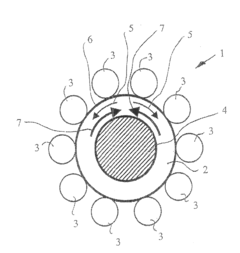
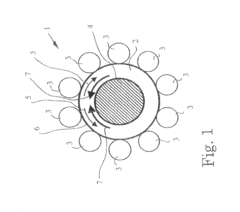
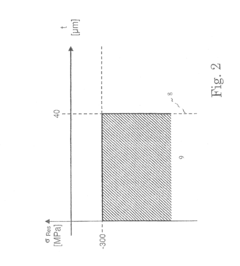
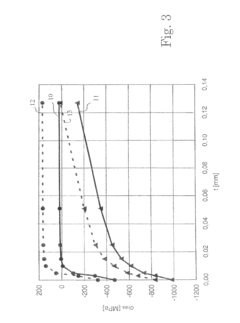
- Introducing residual compressive stresses in the surface layer of the steel components through thermochemical processes like shot peening or gas nitriding, combined with double hardening, to enhance their resistance to surface pressures and notch effects, thereby improving the durability of the rolling contact with ceramic components.
Roller bearing
PatentInactiveEP1774188A1
Innovation
- Generating residual compressive stresses on the surface of the steel rolling partner using thermochemical or mechanical processes, such as shot peening, to reduce sensitivity to surface pressures and notch effects, combined with a surface hardness of at least 850 HV0.3, thereby enhancing the resilience of the steel component in contact with ceramic rolling partners.
Manufacturing Standards and Quality Control Requirements
Manufacturing standards for ceramic and steel thrust bearings differ significantly due to their distinct material properties and processing requirements. Steel thrust bearings typically adhere to established international standards such as ISO 492, ABEC, and DIN 620, which define dimensional tolerances, surface roughness, and geometric accuracy. These standards have been refined over decades of industrial application and provide comprehensive guidelines for bearing grade classifications ranging from P0 to P2 precision levels.
Ceramic thrust bearings, particularly those utilizing silicon nitride or silicon carbide balls, require specialized manufacturing protocols that extend beyond conventional steel bearing standards. The ceramic ball manufacturing process demands precise control of sintering temperatures, typically ranging from 1400°C to 1800°C, and requires specialized equipment for grinding and polishing to achieve surface finishes below 0.02 μm Ra. Quality control for ceramic components involves additional testing procedures including thermal shock resistance, fracture toughness measurement, and statistical strength analysis using Weibull distribution methods.
Dimensional accuracy requirements for both bearing types maintain similar tolerances, with precision grades demanding roundness deviations within 0.13 μm for Grade 5 balls. However, ceramic bearings require additional specifications for material density uniformity, typically exceeding 99% theoretical density, and porosity control to prevent premature failure under high-stress conditions.
Quality control protocols for hybrid ceramic-steel bearings incorporate both metallic and ceramic testing methodologies. This includes vibration analysis using accelerometers to detect ceramic ball defects, which produce different frequency signatures compared to steel components. Surface integrity verification through scanning electron microscopy becomes critical for ceramic components, as microscopic surface cracks can propagate rapidly under cyclic loading conditions.
Temperature cycling tests represent a crucial quality control requirement unique to ceramic bearings, as thermal expansion mismatches between ceramic balls and steel races can induce stress concentrations. Standard protocols require testing across temperature ranges from -40°C to 200°C with controlled heating and cooling rates to simulate operational conditions.
Contamination control during manufacturing requires enhanced clean room environments for ceramic bearing assembly, as ceramic materials exhibit higher sensitivity to foreign particle damage compared to steel components. This necessitates Class 1000 or better clean room conditions and specialized handling procedures to prevent surface contamination that could compromise bearing performance and longevity.
Ceramic thrust bearings, particularly those utilizing silicon nitride or silicon carbide balls, require specialized manufacturing protocols that extend beyond conventional steel bearing standards. The ceramic ball manufacturing process demands precise control of sintering temperatures, typically ranging from 1400°C to 1800°C, and requires specialized equipment for grinding and polishing to achieve surface finishes below 0.02 μm Ra. Quality control for ceramic components involves additional testing procedures including thermal shock resistance, fracture toughness measurement, and statistical strength analysis using Weibull distribution methods.
Dimensional accuracy requirements for both bearing types maintain similar tolerances, with precision grades demanding roundness deviations within 0.13 μm for Grade 5 balls. However, ceramic bearings require additional specifications for material density uniformity, typically exceeding 99% theoretical density, and porosity control to prevent premature failure under high-stress conditions.
Quality control protocols for hybrid ceramic-steel bearings incorporate both metallic and ceramic testing methodologies. This includes vibration analysis using accelerometers to detect ceramic ball defects, which produce different frequency signatures compared to steel components. Surface integrity verification through scanning electron microscopy becomes critical for ceramic components, as microscopic surface cracks can propagate rapidly under cyclic loading conditions.
Temperature cycling tests represent a crucial quality control requirement unique to ceramic bearings, as thermal expansion mismatches between ceramic balls and steel races can induce stress concentrations. Standard protocols require testing across temperature ranges from -40°C to 200°C with controlled heating and cooling rates to simulate operational conditions.
Contamination control during manufacturing requires enhanced clean room environments for ceramic bearing assembly, as ceramic materials exhibit higher sensitivity to foreign particle damage compared to steel components. This necessitates Class 1000 or better clean room conditions and specialized handling procedures to prevent surface contamination that could compromise bearing performance and longevity.
Cost-Performance Trade-offs in Bearing Material Selection
The selection of bearing materials involves a complex balance between initial investment costs and long-term operational benefits. Steel thrust bearings typically present lower upfront costs, with standard steel grades being readily available and cost-effective to manufacture. However, the total cost of ownership must consider maintenance intervals, replacement frequency, and operational downtime costs that can significantly impact the economic equation over the bearing's service life.
Ceramic thrust bearings command a premium price, often 3-5 times higher than comparable steel bearings, primarily due to advanced manufacturing processes and specialized materials like silicon nitride or silicon carbide. This initial cost barrier can be substantial for budget-constrained applications, yet the investment may prove economically justified through extended service intervals and reduced maintenance requirements.
Performance characteristics directly influence the cost-benefit analysis. Ceramic bearings demonstrate superior performance in high-temperature environments, corrosive conditions, and applications requiring minimal lubrication. Their lower friction coefficients translate to reduced energy consumption, while their resistance to wear extends operational life significantly. These performance advantages can offset higher initial costs through improved efficiency and reduced replacement frequency.
Steel bearings remain cost-effective for standard operating conditions where extreme performance characteristics are not required. Their established supply chains, proven reliability, and lower replacement costs make them suitable for applications with regular maintenance schedules and moderate operating conditions. The availability of various steel grades allows for performance optimization within budget constraints.
The decision framework should incorporate application-specific factors including operating environment severity, maintenance accessibility, downtime costs, and expected service life. High-value applications with difficult maintenance access often justify ceramic bearing investments, while standard industrial applications may achieve optimal cost-performance balance with quality steel bearings.
Long-term economic analysis reveals that ceramic bearings often provide superior value in demanding applications despite higher initial costs, while steel bearings maintain advantages in cost-sensitive, standard-duty applications where frequent maintenance is acceptable.
Ceramic thrust bearings command a premium price, often 3-5 times higher than comparable steel bearings, primarily due to advanced manufacturing processes and specialized materials like silicon nitride or silicon carbide. This initial cost barrier can be substantial for budget-constrained applications, yet the investment may prove economically justified through extended service intervals and reduced maintenance requirements.
Performance characteristics directly influence the cost-benefit analysis. Ceramic bearings demonstrate superior performance in high-temperature environments, corrosive conditions, and applications requiring minimal lubrication. Their lower friction coefficients translate to reduced energy consumption, while their resistance to wear extends operational life significantly. These performance advantages can offset higher initial costs through improved efficiency and reduced replacement frequency.
Steel bearings remain cost-effective for standard operating conditions where extreme performance characteristics are not required. Their established supply chains, proven reliability, and lower replacement costs make them suitable for applications with regular maintenance schedules and moderate operating conditions. The availability of various steel grades allows for performance optimization within budget constraints.
The decision framework should incorporate application-specific factors including operating environment severity, maintenance accessibility, downtime costs, and expected service life. High-value applications with difficult maintenance access often justify ceramic bearing investments, while standard industrial applications may achieve optimal cost-performance balance with quality steel bearings.
Long-term economic analysis reveals that ceramic bearings often provide superior value in demanding applications despite higher initial costs, while steel bearings maintain advantages in cost-sensitive, standard-duty applications where frequent maintenance is acceptable.
Unlock deeper insights with PatSnap Eureka Quick Research — get a full tech report to explore trends and direct your research. Try now!
Generate Your Research Report Instantly with AI Agent
Supercharge your innovation with PatSnap Eureka AI Agent Platform!