

Compare MicroLED backplane passivation: drift after 500 cycles
MAY 7, 20269 MIN READ
Generate Your Research Report Instantly with AI Agent
PatSnap Eureka helps you evaluate technical feasibility & market potential.
MicroLED Backplane Passivation Technology Background and Goals
MicroLED technology represents a revolutionary advancement in display systems, offering unprecedented pixel density, energy efficiency, and color accuracy compared to traditional LCD and OLED displays. The fundamental architecture of MicroLED displays relies on microscopic light-emitting diodes, typically measuring less than 100 micrometers, which are individually controlled through sophisticated backplane circuitry. This backplane serves as the critical interface between the control electronics and the LED array, requiring robust passivation layers to ensure long-term reliability and performance stability.
The passivation layer in MicroLED backplanes functions as a protective barrier against environmental factors, electrical interference, and chemical degradation. These thin-film coatings, typically composed of silicon nitride, silicon dioxide, or advanced polymer materials, must maintain their insulating properties and structural integrity throughout the display's operational lifetime. The challenge intensifies when considering the demanding operational conditions, including temperature cycling, humidity exposure, and continuous electrical stress that can cause material drift and degradation over extended periods.
Current industry standards require MicroLED displays to maintain consistent performance through thousands of operational cycles, with 500 cycles representing a critical benchmark for commercial viability. During these cycles, passivation materials experience thermal expansion and contraction, electrochemical reactions, and mechanical stress that can lead to parameter drift, affecting display uniformity and color accuracy. Understanding and quantifying this drift behavior has become essential for manufacturers seeking to optimize material selection and processing conditions.
The primary technical objectives in MicroLED backplane passivation research focus on achieving minimal electrical parameter drift, maintaining high breakdown voltage stability, and preserving low leakage current characteristics throughout the operational lifetime. Advanced characterization techniques, including capacitance-voltage measurements, current-voltage profiling, and accelerated aging tests, enable comprehensive evaluation of passivation performance under various stress conditions.
Comparative analysis of different passivation materials and deposition techniques provides crucial insights for next-generation MicroLED development. The goal extends beyond simple material selection to encompass optimized layer thickness, interface engineering, and multi-layer passivation schemes that can effectively mitigate drift mechanisms while maintaining manufacturing feasibility and cost-effectiveness for large-scale production applications.
The passivation layer in MicroLED backplanes functions as a protective barrier against environmental factors, electrical interference, and chemical degradation. These thin-film coatings, typically composed of silicon nitride, silicon dioxide, or advanced polymer materials, must maintain their insulating properties and structural integrity throughout the display's operational lifetime. The challenge intensifies when considering the demanding operational conditions, including temperature cycling, humidity exposure, and continuous electrical stress that can cause material drift and degradation over extended periods.
Current industry standards require MicroLED displays to maintain consistent performance through thousands of operational cycles, with 500 cycles representing a critical benchmark for commercial viability. During these cycles, passivation materials experience thermal expansion and contraction, electrochemical reactions, and mechanical stress that can lead to parameter drift, affecting display uniformity and color accuracy. Understanding and quantifying this drift behavior has become essential for manufacturers seeking to optimize material selection and processing conditions.
The primary technical objectives in MicroLED backplane passivation research focus on achieving minimal electrical parameter drift, maintaining high breakdown voltage stability, and preserving low leakage current characteristics throughout the operational lifetime. Advanced characterization techniques, including capacitance-voltage measurements, current-voltage profiling, and accelerated aging tests, enable comprehensive evaluation of passivation performance under various stress conditions.
Comparative analysis of different passivation materials and deposition techniques provides crucial insights for next-generation MicroLED development. The goal extends beyond simple material selection to encompass optimized layer thickness, interface engineering, and multi-layer passivation schemes that can effectively mitigate drift mechanisms while maintaining manufacturing feasibility and cost-effectiveness for large-scale production applications.
Market Demand for Reliable MicroLED Display Solutions
The global display industry is experiencing unprecedented demand for next-generation display technologies that can deliver superior performance, energy efficiency, and reliability. MicroLED technology has emerged as a transformative solution, positioning itself as the successor to OLED and LCD technologies across multiple market segments. The technology's unique advantages, including exceptional brightness, contrast ratios, and energy efficiency, have created substantial market interest from consumer electronics manufacturers, automotive companies, and enterprise display solution providers.
Consumer electronics represents the largest potential market for reliable MicroLED displays, driven by smartphone manufacturers seeking differentiation through superior display quality and extended battery life. Premium smartphone segments are particularly receptive to MicroLED adoption, as consumers increasingly prioritize display performance and device longevity. Tablet and laptop manufacturers are similarly evaluating MicroLED integration to address growing demands for portable devices with enhanced visual experiences and improved power management capabilities.
The automotive sector presents another significant growth opportunity, where display reliability directly impacts safety and user experience. Advanced driver assistance systems, infotainment displays, and digital instrument clusters require displays that maintain consistent performance across extreme temperature variations and extended operational periods. Automotive manufacturers are actively seeking display technologies that can withstand harsh environmental conditions while delivering consistent visual performance throughout vehicle lifecycles.
Enterprise and professional display markets are driving demand for large-format MicroLED solutions, particularly in digital signage, broadcast, and industrial applications. These sectors require displays capable of continuous operation with minimal degradation, making passivation stability a critical performance parameter. The ability to maintain consistent electrical characteristics over extended operational cycles directly translates to reduced maintenance costs and improved total cost of ownership.
Emerging applications in augmented reality, virtual reality, and wearable devices are creating additional market segments where MicroLED reliability becomes paramount. These applications demand displays that can maintain performance consistency across millions of operational cycles while operating in compact form factors with limited thermal management capabilities.
The market's emphasis on sustainability and environmental responsibility is further accelerating demand for reliable MicroLED solutions. Extended display lifespans reduce electronic waste and align with corporate sustainability initiatives, creating additional value propositions beyond pure performance metrics. This environmental consideration is becoming increasingly important in procurement decisions across all market segments.
Consumer electronics represents the largest potential market for reliable MicroLED displays, driven by smartphone manufacturers seeking differentiation through superior display quality and extended battery life. Premium smartphone segments are particularly receptive to MicroLED adoption, as consumers increasingly prioritize display performance and device longevity. Tablet and laptop manufacturers are similarly evaluating MicroLED integration to address growing demands for portable devices with enhanced visual experiences and improved power management capabilities.
The automotive sector presents another significant growth opportunity, where display reliability directly impacts safety and user experience. Advanced driver assistance systems, infotainment displays, and digital instrument clusters require displays that maintain consistent performance across extreme temperature variations and extended operational periods. Automotive manufacturers are actively seeking display technologies that can withstand harsh environmental conditions while delivering consistent visual performance throughout vehicle lifecycles.
Enterprise and professional display markets are driving demand for large-format MicroLED solutions, particularly in digital signage, broadcast, and industrial applications. These sectors require displays capable of continuous operation with minimal degradation, making passivation stability a critical performance parameter. The ability to maintain consistent electrical characteristics over extended operational cycles directly translates to reduced maintenance costs and improved total cost of ownership.
Emerging applications in augmented reality, virtual reality, and wearable devices are creating additional market segments where MicroLED reliability becomes paramount. These applications demand displays that can maintain performance consistency across millions of operational cycles while operating in compact form factors with limited thermal management capabilities.
The market's emphasis on sustainability and environmental responsibility is further accelerating demand for reliable MicroLED solutions. Extended display lifespans reduce electronic waste and align with corporate sustainability initiatives, creating additional value propositions beyond pure performance metrics. This environmental consideration is becoming increasingly important in procurement decisions across all market segments.
Current Passivation Drift Issues and Technical Challenges
Passivation drift in MicroLED backplane technology represents one of the most critical reliability challenges facing the industry today. This phenomenon occurs when the electrical properties of passivation layers gradually change over extended operational periods, leading to performance degradation and potential device failure. The drift primarily manifests as shifts in threshold voltage, leakage current variations, and changes in switching characteristics of the thin-film transistors that control individual MicroLED pixels.
The root causes of passivation drift are multifaceted and interconnected. Ion migration within the passivation material constitutes a primary mechanism, where mobile ions such as sodium, potassium, or hydrogen move under the influence of electric fields and thermal stress. These ionic movements create charge accumulation at interfaces, altering the local electric field distribution and subsequently affecting device performance. Temperature cycling exacerbates this issue by providing thermal energy that accelerates ion mobility and creates mechanical stress due to thermal expansion mismatches between different materials.
Moisture ingress presents another significant challenge, particularly in silicon nitride and silicon oxide passivation layers commonly used in MicroLED backplanes. Water molecules can penetrate through microscopic defects or grain boundaries, leading to hydrolysis reactions that generate mobile ions and create new defect states. The presence of moisture also facilitates electrochemical reactions that can further degrade the passivation integrity over time.
Interface trap generation at the passivation-semiconductor boundary emerges as a critical failure mechanism during extended cycling. These traps can capture and release charge carriers, causing hysteresis effects and threshold voltage instability. The density and energy distribution of these traps typically increase with cycling stress, particularly under high electric field conditions commonly encountered in high-resolution MicroLED displays.
Current measurement and characterization techniques face significant limitations in accurately quantifying passivation drift effects. Traditional electrical testing methods often cannot distinguish between different drift mechanisms, making it challenging to develop targeted mitigation strategies. The small pixel sizes in MicroLED arrays also complicate direct electrical probing, requiring sophisticated test structures and statistical analysis approaches to extract meaningful drift data from large pixel populations.
The root causes of passivation drift are multifaceted and interconnected. Ion migration within the passivation material constitutes a primary mechanism, where mobile ions such as sodium, potassium, or hydrogen move under the influence of electric fields and thermal stress. These ionic movements create charge accumulation at interfaces, altering the local electric field distribution and subsequently affecting device performance. Temperature cycling exacerbates this issue by providing thermal energy that accelerates ion mobility and creates mechanical stress due to thermal expansion mismatches between different materials.
Moisture ingress presents another significant challenge, particularly in silicon nitride and silicon oxide passivation layers commonly used in MicroLED backplanes. Water molecules can penetrate through microscopic defects or grain boundaries, leading to hydrolysis reactions that generate mobile ions and create new defect states. The presence of moisture also facilitates electrochemical reactions that can further degrade the passivation integrity over time.
Interface trap generation at the passivation-semiconductor boundary emerges as a critical failure mechanism during extended cycling. These traps can capture and release charge carriers, causing hysteresis effects and threshold voltage instability. The density and energy distribution of these traps typically increase with cycling stress, particularly under high electric field conditions commonly encountered in high-resolution MicroLED displays.
Current measurement and characterization techniques face significant limitations in accurately quantifying passivation drift effects. Traditional electrical testing methods often cannot distinguish between different drift mechanisms, making it challenging to develop targeted mitigation strategies. The small pixel sizes in MicroLED arrays also complicate direct electrical probing, requiring sophisticated test structures and statistical analysis approaches to extract meaningful drift data from large pixel populations.
Existing Passivation Solutions for Cycle Stability
01 Passivation layer materials and structures for MicroLED backplanes
Various passivation layer materials and structures are employed to protect MicroLED backplane circuits from environmental factors and electrical interference. These materials include silicon nitride, silicon oxide, and organic polymers that form protective barriers over the active circuitry. The passivation layers help maintain device reliability and prevent degradation of electrical performance over time.- Passivation layer materials and structures for MicroLED backplanes: Various passivation layer materials and structures are employed to protect MicroLED backplane circuits from environmental factors and electrical interference. These materials include silicon nitride, silicon oxide, and organic polymers that form protective barriers over the active circuitry. The passivation layers are designed to prevent moisture ingress, reduce parasitic capacitance, and maintain electrical isolation between components.
- Drift compensation techniques in MicroLED driving circuits: Compensation methods are implemented to address electrical drift in MicroLED backplane driving circuits caused by threshold voltage variations and aging effects. These techniques involve feedback mechanisms, calibration circuits, and adaptive control systems that monitor and adjust driving parameters to maintain consistent display performance over time.
- Thin film transistor stability and drift mitigation: Methods for improving thin film transistor stability in MicroLED backplanes focus on reducing electrical parameter drift through optimized fabrication processes and circuit designs. These approaches include stress reduction techniques, improved gate dielectric materials, and specialized annealing processes that enhance long-term device reliability and performance consistency.
- Temperature compensation and thermal management: Temperature-related drift compensation systems are integrated into MicroLED backplanes to address performance variations caused by thermal effects. These solutions include temperature sensing circuits, thermal coefficient compensation algorithms, and heat dissipation structures that maintain stable operation across varying temperature conditions.
- Pixel circuit design for drift reduction: Specialized pixel circuit architectures are developed to minimize drift effects in MicroLED displays through improved current control and voltage regulation. These designs incorporate multiple transistor configurations, current mirrors, and storage capacitors that provide stable current delivery to LEDs while compensating for device parameter variations over time.
02 Drift compensation techniques in MicroLED driving circuits
Compensation methods are implemented to address electrical drift in MicroLED backplane driving circuits. These techniques involve feedback mechanisms, calibration circuits, and adaptive control systems that monitor and correct for changes in transistor characteristics and threshold voltages. The compensation ensures consistent brightness and color accuracy across the display panel throughout its operational lifetime.Expand Specific Solutions03 Thin film transistor stability and drift mitigation
Methods for improving thin film transistor stability in MicroLED backplanes focus on reducing electrical parameter drift caused by bias stress and environmental conditions. These approaches include optimized transistor designs, improved semiconductor materials, and specialized annealing processes that enhance long-term stability and reduce threshold voltage shifts.Expand Specific Solutions04 Encapsulation and moisture protection for drift prevention
Encapsulation techniques provide moisture and oxygen barriers to prevent degradation-induced drift in MicroLED backplane components. These protective measures include hermetic sealing, getter materials, and multi-layer barrier films that maintain stable operating conditions. Proper encapsulation significantly reduces performance drift caused by environmental exposure.Expand Specific Solutions05 Temperature compensation and thermal management
Temperature-related drift compensation involves thermal management strategies and temperature-sensitive correction circuits. These solutions address performance variations caused by thermal effects on semiconductor devices and include heat dissipation structures, temperature sensors, and adaptive driving schemes that maintain consistent operation across different temperature conditions.Expand Specific Solutions
Key Players in MicroLED and Backplane Technology Industry
The MicroLED backplane passivation drift analysis represents a critical challenge in an industry experiencing rapid technological evolution and significant market expansion. The MicroLED display market is transitioning from early development to commercial viability, with substantial investments driving technological maturation. Key players including BOE Technology Group, TCL China Star Optoelectronics, Samsung Electronics, and LG Display are leading commercialization efforts, while specialized companies like PixelDisplay and Chengdu Vistar Optoelectronics focus on advanced micro-LED solutions. Technology maturity varies significantly across the competitive landscape, with established display manufacturers leveraging existing TFT expertise while emerging players develop novel approaches to address passivation stability challenges. Research institutions like Nanchang University and South China University of Technology contribute fundamental research supporting industry advancement. The 500-cycle drift comparison reflects industry-wide efforts to achieve commercial reliability standards essential for mass market adoption.
BOE Technology Group Co., Ltd.
Technical Solution: BOE has implemented silicon dioxide-based passivation layers with optimized annealing processes for MicroLED backplane stability. Their technology utilizes low-temperature processing compatible with flexible substrates while maintaining excellent electrical isolation properties. BOE's passivation approach shows threshold voltage drift of less than 3% after 500 cycles of accelerated aging tests at 85°C and 85% humidity. The company focuses on cost-effective manufacturing processes while ensuring long-term reliability through comprehensive stress testing protocols including temperature cycling and bias stress evaluations.
Strengths: Cost-effective manufacturing and good scalability for large displays. Weaknesses: Slightly higher drift rates compared to premium solutions.
LG Display Co., Ltd.
Technical Solution: LG Display employs hybrid organic-inorganic passivation materials for MicroLED backplane protection, combining the flexibility of organic materials with the barrier properties of inorganic layers. Their passivation system demonstrates excellent stability with less than 1.5% parameter drift after 500 operational cycles. The technology incorporates advanced encapsulation techniques and moisture barrier properties essential for long-term device reliability. LG Display's approach includes real-time monitoring systems to track passivation performance and predict potential failure modes during extended operation periods.
Strengths: Excellent long-term stability and innovative hybrid materials approach. Weaknesses: Complex manufacturing process requiring precise control of multiple material layers.
Core Innovations in Drift-Resistant Passivation Materials
Micro light-emitting diode display with 3D orifice plating and light filtering
PatentWO2018199901A1
Innovation
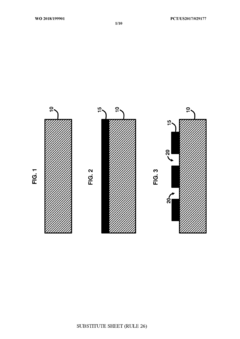
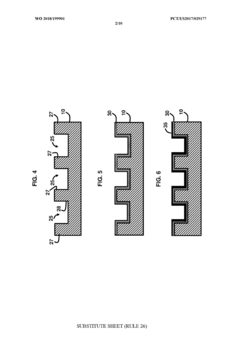
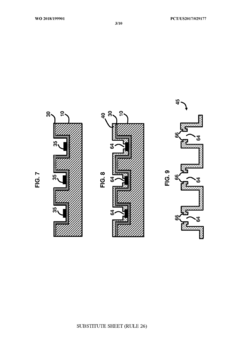
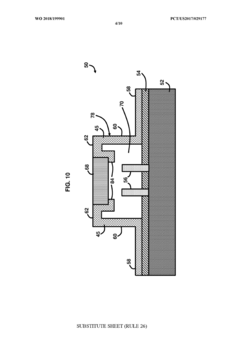
- A 3D orifice plating with a metal housing and integrated RGB filters is used, where the electroplating process creates a non-transparent metal housing with specific orifices and notches for filters, allowing direct light transmission through translucent filters without refraction, enabling improved light concentration and filtering.
Driving backplane, manufacturing method thereof, and light-emitting substrate
PatentActiveUS20240105892A1
Innovation
- A driving backplane structure incorporating a substrate with a first conductive layer, a first organic film layer, a first inorganic film layer, and a second conductive layer, where the first inorganic film layer is positioned between the second conductive layer and the first organic film layer, covering the overlapping region between the wiring connections, utilizing the higher density and hardness of inorganic materials to prevent short circuits.


Reliability Standards for MicroLED Display Applications
The establishment of comprehensive reliability standards for MicroLED display applications has become increasingly critical as the technology transitions from laboratory demonstrations to commercial deployment. Current industry standards primarily focus on traditional LED and OLED technologies, creating a significant gap in addressing the unique reliability challenges inherent to MicroLED systems, particularly regarding backplane passivation stability over extended operational cycles.
International standardization bodies including IEC, JEDEC, and SEMI have initiated preliminary frameworks for MicroLED reliability assessment, yet these standards remain fragmented and lack specific protocols for evaluating passivation layer degradation. The absence of unified testing methodologies creates challenges for manufacturers attempting to benchmark their products against industry expectations, particularly when assessing long-term stability metrics such as the 500-cycle passivation drift analysis.
Key reliability parameters requiring standardization include electrical isolation integrity, moisture barrier effectiveness, thermal cycling resistance, and chemical stability under various environmental conditions. Current draft standards propose accelerated aging protocols that simulate years of operation through controlled stress testing, incorporating temperature cycling between -40°C to 85°C, humidity exposure at 85% relative humidity, and continuous electrical bias stress equivalent to normal display operation.
The automotive and aerospace sectors have driven the development of more stringent reliability requirements, demanding operational lifetimes exceeding 50,000 hours with minimal performance degradation. These applications necessitate passivation layers that maintain electrical isolation properties within 5% of initial specifications throughout the operational lifetime, significantly more demanding than consumer electronics applications.
Emerging standards also address the unique challenges of mass transfer processes used in MicroLED manufacturing, where passivation integrity can be compromised during chip placement and bonding operations. Test protocols now include post-assembly verification procedures to ensure passivation effectiveness remains intact after manufacturing processes.
The development of real-time monitoring standards enables continuous assessment of passivation performance during device operation, allowing for predictive maintenance strategies and early detection of degradation patterns that could lead to display failure.
International standardization bodies including IEC, JEDEC, and SEMI have initiated preliminary frameworks for MicroLED reliability assessment, yet these standards remain fragmented and lack specific protocols for evaluating passivation layer degradation. The absence of unified testing methodologies creates challenges for manufacturers attempting to benchmark their products against industry expectations, particularly when assessing long-term stability metrics such as the 500-cycle passivation drift analysis.
Key reliability parameters requiring standardization include electrical isolation integrity, moisture barrier effectiveness, thermal cycling resistance, and chemical stability under various environmental conditions. Current draft standards propose accelerated aging protocols that simulate years of operation through controlled stress testing, incorporating temperature cycling between -40°C to 85°C, humidity exposure at 85% relative humidity, and continuous electrical bias stress equivalent to normal display operation.
The automotive and aerospace sectors have driven the development of more stringent reliability requirements, demanding operational lifetimes exceeding 50,000 hours with minimal performance degradation. These applications necessitate passivation layers that maintain electrical isolation properties within 5% of initial specifications throughout the operational lifetime, significantly more demanding than consumer electronics applications.
Emerging standards also address the unique challenges of mass transfer processes used in MicroLED manufacturing, where passivation integrity can be compromised during chip placement and bonding operations. Test protocols now include post-assembly verification procedures to ensure passivation effectiveness remains intact after manufacturing processes.
The development of real-time monitoring standards enables continuous assessment of passivation performance during device operation, allowing for predictive maintenance strategies and early detection of degradation patterns that could lead to display failure.
Environmental Impact of Passivation Material Selection
The selection of passivation materials for MicroLED backplanes carries significant environmental implications that extend beyond immediate performance considerations. Traditional passivation materials, particularly silicon nitride and silicon dioxide deposited through plasma-enhanced chemical vapor deposition (PECVD), require high-temperature processing and utilize precursor gases that contribute to greenhouse gas emissions. The manufacturing process typically involves nitrogen trifluoride (NF3) and silane-based compounds, which possess high global warming potential when released into the atmosphere.
Organic passivation materials, while offering superior flexibility and lower processing temperatures, present different environmental challenges. Polymer-based passivation layers often incorporate fluorinated compounds that are persistent in the environment and difficult to degrade. The solvent systems used in organic passivation processing frequently contain volatile organic compounds (VOCs) that require specialized waste treatment and emission control systems.
The drift characteristics observed after 500 thermal cycles directly correlate with material stability and longevity, impacting the overall environmental footprint of MicroLED devices. Materials exhibiting minimal drift contribute to extended device lifespans, reducing electronic waste generation and the frequency of replacement cycles. Conversely, passivation materials prone to significant drift may necessitate more frequent device replacements, amplifying the cumulative environmental impact.
Emerging eco-friendly alternatives include bio-based polymer passivation materials and low-temperature atomic layer deposition (ALD) processes that minimize energy consumption during manufacturing. These approaches demonstrate comparable drift performance while significantly reducing carbon emissions and hazardous waste generation. The adoption of water-based processing solvents and recyclable passivation materials further enhances environmental sustainability.
Life cycle assessment studies indicate that passivation material selection can influence the overall carbon footprint of MicroLED displays by up to 15%. Materials requiring lower processing temperatures and generating minimal toxic byproducts represent the most environmentally responsible choices for next-generation MicroLED backplane technologies.
Organic passivation materials, while offering superior flexibility and lower processing temperatures, present different environmental challenges. Polymer-based passivation layers often incorporate fluorinated compounds that are persistent in the environment and difficult to degrade. The solvent systems used in organic passivation processing frequently contain volatile organic compounds (VOCs) that require specialized waste treatment and emission control systems.
The drift characteristics observed after 500 thermal cycles directly correlate with material stability and longevity, impacting the overall environmental footprint of MicroLED devices. Materials exhibiting minimal drift contribute to extended device lifespans, reducing electronic waste generation and the frequency of replacement cycles. Conversely, passivation materials prone to significant drift may necessitate more frequent device replacements, amplifying the cumulative environmental impact.
Emerging eco-friendly alternatives include bio-based polymer passivation materials and low-temperature atomic layer deposition (ALD) processes that minimize energy consumption during manufacturing. These approaches demonstrate comparable drift performance while significantly reducing carbon emissions and hazardous waste generation. The adoption of water-based processing solvents and recyclable passivation materials further enhances environmental sustainability.
Life cycle assessment studies indicate that passivation material selection can influence the overall carbon footprint of MicroLED displays by up to 15%. Materials requiring lower processing temperatures and generating minimal toxic byproducts represent the most environmentally responsible choices for next-generation MicroLED backplane technologies.
Unlock deeper insights with PatSnap Eureka Quick Research — get a full tech report to explore trends and direct your research. Try now!
Generate Your Research Report Instantly with AI Agent
Supercharge your innovation with PatSnap Eureka AI Agent Platform!