

Quantify MicroLED backplane flicker using IEEE 1789 limits
MAY 7, 20269 MIN READ
Generate Your Research Report Instantly with AI Agent
PatSnap Eureka helps you evaluate technical feasibility & market potential.
MicroLED Backplane Flicker Background and IEEE 1789 Goals
MicroLED technology represents a revolutionary advancement in display systems, offering unprecedented brightness, contrast ratios, and energy efficiency compared to traditional LCD and OLED displays. However, the implementation of MicroLED backplanes introduces unique challenges related to temporal light artifacts, commonly known as flicker. This phenomenon occurs due to the discrete nature of LED switching and the pulse-width modulation (PWM) techniques employed for brightness control in MicroLED arrays.
The backplane architecture in MicroLED displays consists of millions of microscopic LEDs, each requiring individual control circuits for precise luminance management. Unlike conventional displays where backlight uniformity is maintained through diffusion layers, MicroLED systems rely on direct emission from each pixel element. This direct control mechanism, while enabling superior image quality, can introduce temporal variations in light output that manifest as perceptible flicker under certain operating conditions.
Flicker in MicroLED backplanes primarily stems from several technical factors including PWM frequency selection, duty cycle variations, and switching transients in the driving circuitry. The severity of flicker depends on the refresh rate, dimming algorithms, and the temporal characteristics of the LED response. Additionally, manufacturing variations across individual LEDs can contribute to non-uniform temporal behavior across the display surface.
IEEE 1789 standard establishes comprehensive guidelines for evaluating temporal light artifacts in LED lighting systems, providing quantitative metrics for flicker assessment. The standard defines critical parameters including flicker index, flicker percentage, and stroboscopic visibility measure (SVM) to characterize the temporal behavior of light sources. These metrics enable objective evaluation of flicker severity and its potential impact on human visual comfort and health.
The primary objective of applying IEEE 1789 limits to MicroLED backplane evaluation is to establish measurable criteria for acceptable flicker performance in display applications. This involves developing standardized testing methodologies that can accurately capture the temporal characteristics of MicroLED emissions and correlate them with the established visibility thresholds. The goal extends beyond mere compliance to encompass optimization of driving algorithms and backplane designs that minimize flicker while maintaining display performance.
Furthermore, the implementation of IEEE 1789 guidelines aims to create industry-wide standards for MicroLED flicker evaluation, enabling consistent quality assessment across different manufacturers and applications. This standardization effort seeks to establish clear performance benchmarks that can guide design decisions and ensure user safety in various lighting and display environments.
The backplane architecture in MicroLED displays consists of millions of microscopic LEDs, each requiring individual control circuits for precise luminance management. Unlike conventional displays where backlight uniformity is maintained through diffusion layers, MicroLED systems rely on direct emission from each pixel element. This direct control mechanism, while enabling superior image quality, can introduce temporal variations in light output that manifest as perceptible flicker under certain operating conditions.
Flicker in MicroLED backplanes primarily stems from several technical factors including PWM frequency selection, duty cycle variations, and switching transients in the driving circuitry. The severity of flicker depends on the refresh rate, dimming algorithms, and the temporal characteristics of the LED response. Additionally, manufacturing variations across individual LEDs can contribute to non-uniform temporal behavior across the display surface.
IEEE 1789 standard establishes comprehensive guidelines for evaluating temporal light artifacts in LED lighting systems, providing quantitative metrics for flicker assessment. The standard defines critical parameters including flicker index, flicker percentage, and stroboscopic visibility measure (SVM) to characterize the temporal behavior of light sources. These metrics enable objective evaluation of flicker severity and its potential impact on human visual comfort and health.
The primary objective of applying IEEE 1789 limits to MicroLED backplane evaluation is to establish measurable criteria for acceptable flicker performance in display applications. This involves developing standardized testing methodologies that can accurately capture the temporal characteristics of MicroLED emissions and correlate them with the established visibility thresholds. The goal extends beyond mere compliance to encompass optimization of driving algorithms and backplane designs that minimize flicker while maintaining display performance.
Furthermore, the implementation of IEEE 1789 guidelines aims to create industry-wide standards for MicroLED flicker evaluation, enabling consistent quality assessment across different manufacturers and applications. This standardization effort seeks to establish clear performance benchmarks that can guide design decisions and ensure user safety in various lighting and display environments.
Market Demand for Flicker-Free MicroLED Display Solutions
The global display industry is experiencing unprecedented demand for flicker-free MicroLED solutions as visual comfort and health concerns become paramount considerations for consumers and enterprises alike. Traditional display technologies, including OLED and LCD panels, have long struggled with temporal light artifacts that can cause eye strain, headaches, and visual discomfort during extended viewing sessions. The emergence of MicroLED technology presents a unique opportunity to address these challenges while delivering superior brightness, color accuracy, and energy efficiency.
Healthcare and medical imaging sectors represent the most critical market segments driving demand for flicker-free MicroLED displays. Surgical environments, diagnostic imaging workstations, and patient monitoring systems require displays that eliminate temporal artifacts to ensure accurate visual interpretation and reduce physician fatigue during lengthy procedures. The stringent requirements for medical-grade displays create a premium market where IEEE 1789 compliance becomes a mandatory specification rather than an optional feature.
Professional content creation industries, including film production, graphic design, and broadcast media, constitute another high-value market segment. Color-critical applications demand displays that maintain consistent luminance output without temporal variations that could interfere with accurate color grading and visual content evaluation. The growing adoption of high dynamic range content and the increasing resolution requirements in professional workflows amplify the need for flicker-free display solutions.
Consumer electronics markets are witnessing accelerated adoption of flicker-aware technologies as health consciousness rises among end users. Premium smartphone manufacturers, laptop producers, and television brands are increasingly positioning flicker-free displays as key differentiators in competitive markets. The proliferation of remote work and extended screen time has heightened consumer awareness of display-related health impacts, creating market pull for IEEE 1789 compliant solutions.
Automotive display applications present emerging opportunities as vehicle cockpits integrate multiple high-resolution screens for infotainment, navigation, and driver assistance systems. The safety-critical nature of automotive environments demands displays that minimize driver distraction and visual fatigue, making flicker quantification and mitigation essential requirements for next-generation vehicle displays.
Healthcare and medical imaging sectors represent the most critical market segments driving demand for flicker-free MicroLED displays. Surgical environments, diagnostic imaging workstations, and patient monitoring systems require displays that eliminate temporal artifacts to ensure accurate visual interpretation and reduce physician fatigue during lengthy procedures. The stringent requirements for medical-grade displays create a premium market where IEEE 1789 compliance becomes a mandatory specification rather than an optional feature.
Professional content creation industries, including film production, graphic design, and broadcast media, constitute another high-value market segment. Color-critical applications demand displays that maintain consistent luminance output without temporal variations that could interfere with accurate color grading and visual content evaluation. The growing adoption of high dynamic range content and the increasing resolution requirements in professional workflows amplify the need for flicker-free display solutions.
Consumer electronics markets are witnessing accelerated adoption of flicker-aware technologies as health consciousness rises among end users. Premium smartphone manufacturers, laptop producers, and television brands are increasingly positioning flicker-free displays as key differentiators in competitive markets. The proliferation of remote work and extended screen time has heightened consumer awareness of display-related health impacts, creating market pull for IEEE 1789 compliant solutions.
Automotive display applications present emerging opportunities as vehicle cockpits integrate multiple high-resolution screens for infotainment, navigation, and driver assistance systems. The safety-critical nature of automotive environments demands displays that minimize driver distraction and visual fatigue, making flicker quantification and mitigation essential requirements for next-generation vehicle displays.
Current MicroLED Flicker Issues and IEEE 1789 Compliance Gaps
MicroLED displays face significant flicker challenges that directly impact their compliance with IEEE 1789 standards for temporal light artifacts. Current MicroLED backplane architectures exhibit inherent flicker characteristics stemming from their pulse-width modulation (PWM) driving schemes and active matrix addressing methods. The fundamental issue lies in the discrete nature of LED switching, which creates temporal variations in luminance that can exceed acceptable thresholds defined by IEEE 1789.
The primary flicker manifestation occurs during grayscale rendering, where MicroLED arrays employ time-division multiplexing to achieve brightness levels. This approach generates periodic luminance fluctuations at frequencies ranging from 60Hz to several kilohertz, depending on the refresh rate and bit depth requirements. Many existing implementations operate within frequency ranges that fall into IEEE 1789's "low risk" and "no observable effect" categories, yet fail to meet the standard's amplitude requirements for flicker modulation.
Compliance gaps emerge particularly in mid-range brightness levels where PWM duty cycles create pronounced temporal artifacts. Current MicroLED systems often exhibit flicker percentages exceeding 10% at frequencies below 1.25kHz, violating IEEE 1789's recommended limits. The standard specifies maximum flicker percentages that decrease as frequency increases, with stricter requirements for frequencies below 90Hz where human perception sensitivity peaks.
Existing measurement methodologies for MicroLED flicker assessment lack standardization and often fail to capture the full spectrum of temporal variations. Many manufacturers rely on simplified flicker metrics that do not align with IEEE 1789's comprehensive evaluation framework, which considers both frequency content and modulation depth. This measurement inconsistency creates significant compliance verification challenges.
The backplane design complexity further complicates flicker quantification, as different pixel architectures exhibit varying temporal behaviors. Passive matrix configurations demonstrate different flicker characteristics compared to active matrix designs, with each requiring distinct evaluation approaches under IEEE 1789 guidelines. Temperature dependencies and aging effects additionally influence flicker performance, creating dynamic compliance scenarios that current assessment methods inadequately address.
Integration challenges arise when attempting to implement IEEE 1789 compliant flicker measurement systems within existing MicroLED manufacturing workflows. The standard's requirements for high-frequency sampling and precise photometric measurements demand sophisticated instrumentation that many production facilities currently lack, creating a substantial barrier to widespread compliance verification and optimization.
The primary flicker manifestation occurs during grayscale rendering, where MicroLED arrays employ time-division multiplexing to achieve brightness levels. This approach generates periodic luminance fluctuations at frequencies ranging from 60Hz to several kilohertz, depending on the refresh rate and bit depth requirements. Many existing implementations operate within frequency ranges that fall into IEEE 1789's "low risk" and "no observable effect" categories, yet fail to meet the standard's amplitude requirements for flicker modulation.
Compliance gaps emerge particularly in mid-range brightness levels where PWM duty cycles create pronounced temporal artifacts. Current MicroLED systems often exhibit flicker percentages exceeding 10% at frequencies below 1.25kHz, violating IEEE 1789's recommended limits. The standard specifies maximum flicker percentages that decrease as frequency increases, with stricter requirements for frequencies below 90Hz where human perception sensitivity peaks.
Existing measurement methodologies for MicroLED flicker assessment lack standardization and often fail to capture the full spectrum of temporal variations. Many manufacturers rely on simplified flicker metrics that do not align with IEEE 1789's comprehensive evaluation framework, which considers both frequency content and modulation depth. This measurement inconsistency creates significant compliance verification challenges.
The backplane design complexity further complicates flicker quantification, as different pixel architectures exhibit varying temporal behaviors. Passive matrix configurations demonstrate different flicker characteristics compared to active matrix designs, with each requiring distinct evaluation approaches under IEEE 1789 guidelines. Temperature dependencies and aging effects additionally influence flicker performance, creating dynamic compliance scenarios that current assessment methods inadequately address.
Integration challenges arise when attempting to implement IEEE 1789 compliant flicker measurement systems within existing MicroLED manufacturing workflows. The standard's requirements for high-frequency sampling and precise photometric measurements demand sophisticated instrumentation that many production facilities currently lack, creating a substantial barrier to widespread compliance verification and optimization.
Existing IEEE 1789 Flicker Quantification Methods
01 Backplane driving circuit optimization for flicker reduction
Advanced driving circuit designs and control methods are implemented to minimize flicker in MicroLED displays. These techniques involve optimizing the electrical characteristics of the backplane, including current regulation, voltage stabilization, and timing control mechanisms. The driving circuits are specifically designed to provide stable and uniform power delivery to individual MicroLED pixels, reducing variations that can cause visible flicker.- Driving circuit optimization for flicker reduction: Advanced driving circuits and control methods are employed to minimize flicker in MicroLED displays by optimizing current delivery and voltage regulation. These techniques involve sophisticated driver architectures that provide stable power supply and precise timing control to ensure consistent illumination across the backplane array.
- PWM control and timing synchronization: Pulse width modulation techniques and timing synchronization methods are implemented to control MicroLED brightness while preventing visible flicker. These approaches focus on optimizing refresh rates, duty cycles, and phase relationships between different LED elements to achieve smooth visual performance.
- Backplane substrate and interconnection design: Specialized backplane architectures and interconnection schemes are developed to support stable MicroLED operation with reduced electrical noise and improved signal integrity. These designs incorporate advanced materials and layout configurations that minimize parasitic effects and enhance overall display performance.
- Current uniformity and compensation techniques: Methods for achieving uniform current distribution across MicroLED arrays are implemented to prevent brightness variations and flicker artifacts. These techniques include compensation algorithms, calibration procedures, and adaptive control systems that account for device variations and aging effects.
- Display panel integration and thermal management: Comprehensive approaches to MicroLED panel integration address thermal effects and mechanical stability that can contribute to flicker issues. These solutions encompass packaging technologies, heat dissipation methods, and structural designs that maintain consistent performance under various operating conditions.
02 Pulse width modulation and timing control systems
Sophisticated timing control systems and pulse width modulation techniques are employed to manage the switching behavior of MicroLED arrays. These systems control the precise timing of pixel activation and deactivation cycles, ensuring smooth transitions and eliminating perceptible flicker. The methods include advanced algorithms for temporal dithering and synchronized switching patterns across the entire display matrix.Expand Specific Solutions03 Active matrix backplane architecture improvements
Enhanced active matrix backplane designs incorporate improved transistor configurations and circuit topologies specifically optimized for MicroLED applications. These architectures feature better charge retention capabilities, reduced leakage currents, and improved switching characteristics that contribute to flicker-free operation. The designs focus on maintaining consistent pixel brightness levels throughout the display refresh cycles.Expand Specific Solutions04 Compensation circuits and feedback mechanisms
Integrated compensation circuits and real-time feedback systems are implemented to detect and correct variations in pixel performance that could lead to flicker. These systems monitor electrical parameters and automatically adjust driving conditions to maintain uniform display quality. The compensation mechanisms account for manufacturing variations, temperature effects, and aging characteristics of individual MicroLED elements.Expand Specific Solutions05 Power management and supply stabilization techniques
Advanced power management systems and supply stabilization methods are employed to ensure consistent power delivery to MicroLED backplanes. These techniques include voltage regulation circuits, power supply filtering, and load balancing mechanisms that prevent power fluctuations from causing display flicker. The systems are designed to handle the unique power requirements and switching characteristics of MicroLED technology.Expand Specific Solutions
Key Players in MicroLED and Display Flicker Testing Industry
The MicroLED backplane flicker quantification using IEEE 1789 limits represents an emerging technical challenge in the rapidly evolving display industry. The market is in early-to-mid development stage, with significant growth potential driven by MicroLED's superior performance characteristics. Current market size remains relatively small but expanding rapidly as manufacturing costs decrease. Technology maturity varies significantly among key players: established display manufacturers like Samsung Display, BOE Technology Group, and Sony Group demonstrate advanced capabilities, while Chinese companies including TCL China Star and Everdisplay Optronics are aggressively investing in R&D. Semiconductor specialists like Himax Technologies and Semtech provide critical backplane solutions, though standardized flicker measurement protocols remain underdeveloped across the industry ecosystem.
BOE Technology Group Co., Ltd.
Technical Solution: BOE has developed comprehensive MicroLED backplane flicker quantification systems that strictly adhere to IEEE 1789 measurement standards. Their technology incorporates dedicated flicker measurement circuits within the TFT backplane architecture, utilizing high-precision current sensors and timing controllers to monitor temporal light artifacts. The system calculates flicker metrics including modulation depth and frequency analysis, ensuring compliance with IEEE 1789 low-risk thresholds. BOE's approach includes real-time feedback mechanisms that automatically adjust driving currents and PWM frequencies to maintain optimal flicker performance across varying brightness levels and ambient conditions.
Strengths: Cost-effective manufacturing processes and extensive experience in display backplane technology. Weaknesses: Relatively newer to MicroLED technology compared to established players and limited high-end market presence.
Sony Group Corp.
Technical Solution: Sony has implemented proprietary MicroLED backplane flicker quantification technology that incorporates IEEE 1789 measurement protocols directly into their display control systems. Their solution features integrated photodiode arrays within the backplane structure that continuously monitor temporal light modulation, calculating flicker percentage and frequency in real-time. The system employs advanced signal processing algorithms to analyze light output variations and automatically adjusts PWM frequencies to maintain compliance with IEEE 1789 low-risk categories, particularly focusing on frequencies above 1250Hz for general lighting applications and above 90Hz for dimmed conditions.
Strengths: Advanced signal processing capabilities and integrated measurement systems. Weaknesses: Limited scalability to larger display sizes and proprietary technology integration challenges.
Core Patents in MicroLED Flicker Reduction Technologies
Micro light-emitting diode display device and micro light-emitting diode driving circuit
PatentActiveUS10680035B1
Innovation
- A micro light-emitting diode display device with a driving transistor featuring a gate insulator thickness of less than or equal to 500 angstroms and a micro light-emitting diode with a current injection channel and an active layer portion in contact with the channel, reducing the light-emitting area and avoiding surface recombination, thereby lowering the voltage required to activate the diode.
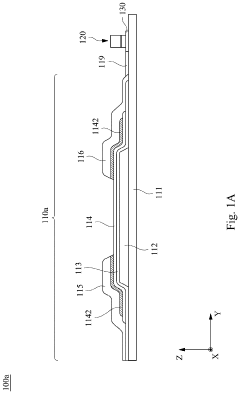
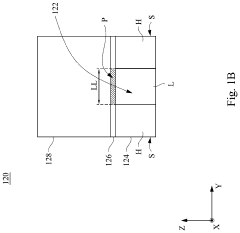
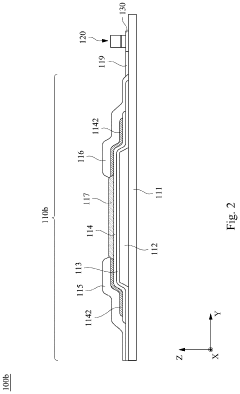
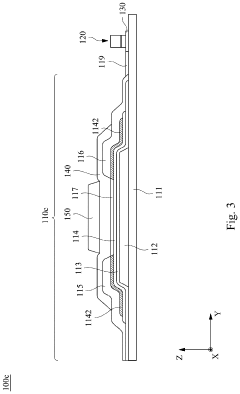
Micro LED display panel and integrated circuit backplane
PatentWO2025222489A1
Innovation
- The micro LED display panel incorporates an integrated circuit backplane with thermal conductive layers and heat dissipation structures to efficiently radiate heat away from the micro LED structures, utilizing materials with high thermal conductivity and separate heat dissipation structures outside the micro LED area.


Health and Safety Standards for Display Flicker Limits
Display flicker poses significant health and safety concerns that have prompted the development of comprehensive standards to protect users from potential adverse effects. The IEEE 1789-2015 standard represents the most widely recognized framework for evaluating flicker in LED lighting systems and displays, establishing critical thresholds that directly apply to MicroLED backplane technologies. This standard defines specific frequency ranges and modulation depths that can trigger physiological responses ranging from mild discomfort to severe photosensitive epileptic seizures.
The IEEE 1789 standard establishes two primary risk categories for flicker assessment. The "No Observable Effect" region defines conditions where flicker modulation remains below perceptible thresholds, typically occurring at frequencies above 3000 Hz or with modulation depths below specific percentage limits at lower frequencies. The "Low Risk" category encompasses moderate flicker levels that may cause discomfort in sensitive individuals but generally remain acceptable for most applications.
Photosensitive epilepsy represents the most severe health concern addressed by these standards, with specific attention to the 3-70 Hz frequency range where seizure triggers are most likely to occur. The standard mandates that flicker within the 15-25 Hz range must be strictly controlled, as this frequency band demonstrates the highest correlation with epileptic responses. MicroLED displays operating within these critical frequencies require careful modulation depth management to ensure compliance.
Beyond epileptic concerns, the standards address broader physiological impacts including eye strain, headaches, and visual fatigue. Research indicates that even sub-perceptual flicker can contribute to increased cognitive load and reduced visual performance during extended viewing periods. These findings have particular relevance for MicroLED applications in professional displays, automotive systems, and consumer electronics where prolonged exposure is common.
Regulatory frameworks across different regions have adopted variations of IEEE 1789 principles, with some jurisdictions implementing more stringent requirements for specific applications. The European Union's photobiological safety standards and FDA guidelines for medical displays incorporate similar flicker assessment methodologies, emphasizing the global consensus on these health protection measures.
Implementation of these standards requires sophisticated measurement techniques capable of detecting rapid temporal variations in luminance output. For MicroLED backplanes, this necessitates high-frequency sampling equipment and specialized analysis algorithms to accurately quantify flicker characteristics across the entire frequency spectrum defined by IEEE 1789.
The IEEE 1789 standard establishes two primary risk categories for flicker assessment. The "No Observable Effect" region defines conditions where flicker modulation remains below perceptible thresholds, typically occurring at frequencies above 3000 Hz or with modulation depths below specific percentage limits at lower frequencies. The "Low Risk" category encompasses moderate flicker levels that may cause discomfort in sensitive individuals but generally remain acceptable for most applications.
Photosensitive epilepsy represents the most severe health concern addressed by these standards, with specific attention to the 3-70 Hz frequency range where seizure triggers are most likely to occur. The standard mandates that flicker within the 15-25 Hz range must be strictly controlled, as this frequency band demonstrates the highest correlation with epileptic responses. MicroLED displays operating within these critical frequencies require careful modulation depth management to ensure compliance.
Beyond epileptic concerns, the standards address broader physiological impacts including eye strain, headaches, and visual fatigue. Research indicates that even sub-perceptual flicker can contribute to increased cognitive load and reduced visual performance during extended viewing periods. These findings have particular relevance for MicroLED applications in professional displays, automotive systems, and consumer electronics where prolonged exposure is common.
Regulatory frameworks across different regions have adopted variations of IEEE 1789 principles, with some jurisdictions implementing more stringent requirements for specific applications. The European Union's photobiological safety standards and FDA guidelines for medical displays incorporate similar flicker assessment methodologies, emphasizing the global consensus on these health protection measures.
Implementation of these standards requires sophisticated measurement techniques capable of detecting rapid temporal variations in luminance output. For MicroLED backplanes, this necessitates high-frequency sampling equipment and specialized analysis algorithms to accurately quantify flicker characteristics across the entire frequency spectrum defined by IEEE 1789.
Optical Measurement Standards for MicroLED Characterization
The quantification of MicroLED backplane flicker according to IEEE 1789 limits necessitates the establishment of comprehensive optical measurement standards specifically tailored for MicroLED characterization. These standards must address the unique photometric and temporal characteristics of MicroLED displays while ensuring compatibility with existing flicker assessment protocols.
IEEE 1789 provides critical guidance for evaluating temporal light artifacts, establishing frequency-dependent thresholds for both "No Observable Effect" and "Low Risk" categories. For MicroLED applications, measurement standards must accommodate the technology's inherent characteristics, including high peak luminance capabilities, rapid switching speeds, and potential for localized dimming variations across the display matrix.
The optical measurement framework requires precise temporal sampling protocols capable of capturing flicker frequencies ranging from DC to several kilohertz. Standard measurement geometries must account for MicroLED's directional emission patterns and potential spatial non-uniformities. Photometric accuracy becomes particularly crucial given the technology's wide color gamut and high dynamic range capabilities.
Calibration procedures for MicroLED flicker assessment demand specialized reference standards that can replicate the spectral and temporal characteristics of actual MicroLED emissions. Traditional flicker measurement equipment may require modifications to handle the unique pulse-width modulation schemes and driving frequencies commonly employed in MicroLED backplane architectures.
Measurement uncertainty analysis becomes essential when establishing traceability to IEEE 1789 compliance. The standards must define acceptable measurement tolerances, environmental conditions, and equipment specifications necessary for reliable flicker quantification. This includes considerations for ambient light rejection, measurement distance standardization, and detector response characteristics.
The integration of spatial measurement capabilities allows for comprehensive backplane assessment, enabling detection of localized flicker variations that could impact overall display performance. These standards facilitate consistent evaluation methodologies across different MicroLED implementations while maintaining alignment with established photobiological safety guidelines defined in IEEE 1789.
IEEE 1789 provides critical guidance for evaluating temporal light artifacts, establishing frequency-dependent thresholds for both "No Observable Effect" and "Low Risk" categories. For MicroLED applications, measurement standards must accommodate the technology's inherent characteristics, including high peak luminance capabilities, rapid switching speeds, and potential for localized dimming variations across the display matrix.
The optical measurement framework requires precise temporal sampling protocols capable of capturing flicker frequencies ranging from DC to several kilohertz. Standard measurement geometries must account for MicroLED's directional emission patterns and potential spatial non-uniformities. Photometric accuracy becomes particularly crucial given the technology's wide color gamut and high dynamic range capabilities.
Calibration procedures for MicroLED flicker assessment demand specialized reference standards that can replicate the spectral and temporal characteristics of actual MicroLED emissions. Traditional flicker measurement equipment may require modifications to handle the unique pulse-width modulation schemes and driving frequencies commonly employed in MicroLED backplane architectures.
Measurement uncertainty analysis becomes essential when establishing traceability to IEEE 1789 compliance. The standards must define acceptable measurement tolerances, environmental conditions, and equipment specifications necessary for reliable flicker quantification. This includes considerations for ambient light rejection, measurement distance standardization, and detector response characteristics.
The integration of spatial measurement capabilities allows for comprehensive backplane assessment, enabling detection of localized flicker variations that could impact overall display performance. These standards facilitate consistent evaluation methodologies across different MicroLED implementations while maintaining alignment with established photobiological safety guidelines defined in IEEE 1789.
Unlock deeper insights with PatSnap Eureka Quick Research — get a full tech report to explore trends and direct your research. Try now!
Generate Your Research Report Instantly with AI Agent
Supercharge your innovation with PatSnap Eureka AI Agent Platform!