Compare Soft Robotics Replication Efficiency in Mass Production
APR 14, 20269 MIN READ
Generate Your Research Report Instantly with AI Agent
Patsnap Eureka helps you evaluate technical feasibility & market potential.
Soft Robotics Manufacturing Background and Objectives
Soft robotics represents a paradigm shift from traditional rigid robotic systems, emerging from the convergence of materials science, biomimetics, and advanced manufacturing technologies. This field has evolved from laboratory curiosities in the early 2000s to commercially viable solutions addressing complex automation challenges. The foundational work began with researchers exploring bio-inspired designs, drawing inspiration from octopus tentacles, elephant trunks, and human muscle systems to create robots capable of safe human interaction and delicate object manipulation.
The manufacturing landscape for soft robotics has undergone significant transformation over the past decade. Early prototypes relied heavily on manual fabrication processes, limiting scalability and consistency. However, recent advances in additive manufacturing, silicone molding techniques, and automated assembly systems have opened new possibilities for mass production. The integration of smart materials, embedded sensors, and flexible electronics has further expanded the potential applications while simultaneously increasing manufacturing complexity.
Current market drivers for soft robotics manufacturing include the growing demand for collaborative robots in industrial settings, healthcare applications requiring gentle human interaction, and food processing systems that handle delicate products. The automotive, electronics, and pharmaceutical industries have emerged as primary adopters, seeking solutions that combine precision with adaptability. These sectors require manufacturing processes capable of producing thousands of units while maintaining consistent performance characteristics and reliability standards.
The primary objective of advancing soft robotics manufacturing efficiency centers on achieving cost-effective mass production without compromising the inherent advantages of soft robotic systems. This involves developing standardized manufacturing processes that can reliably reproduce complex geometries, integrate multiple material types, and embed functional components such as sensors and actuators. The challenge extends beyond mere replication to ensuring consistent mechanical properties, durability, and performance across large production volumes.
Manufacturing efficiency in soft robotics also encompasses the optimization of material utilization, reduction of waste streams, and minimization of post-processing requirements. Traditional manufacturing metrics such as cycle time, yield rates, and quality consistency must be redefined to accommodate the unique characteristics of soft materials and their processing requirements. The objective includes establishing quality control methodologies that can effectively assess the performance of compliant structures and embedded systems.
The ultimate goal involves creating scalable manufacturing ecosystems that can adapt to diverse soft robotics applications while maintaining economic viability. This requires developing modular production approaches that can accommodate varying sizes, functionalities, and performance specifications without requiring complete process redesigns. Success in this domain will enable widespread adoption of soft robotics across industries currently limited by production constraints and cost considerations.
The manufacturing landscape for soft robotics has undergone significant transformation over the past decade. Early prototypes relied heavily on manual fabrication processes, limiting scalability and consistency. However, recent advances in additive manufacturing, silicone molding techniques, and automated assembly systems have opened new possibilities for mass production. The integration of smart materials, embedded sensors, and flexible electronics has further expanded the potential applications while simultaneously increasing manufacturing complexity.
Current market drivers for soft robotics manufacturing include the growing demand for collaborative robots in industrial settings, healthcare applications requiring gentle human interaction, and food processing systems that handle delicate products. The automotive, electronics, and pharmaceutical industries have emerged as primary adopters, seeking solutions that combine precision with adaptability. These sectors require manufacturing processes capable of producing thousands of units while maintaining consistent performance characteristics and reliability standards.
The primary objective of advancing soft robotics manufacturing efficiency centers on achieving cost-effective mass production without compromising the inherent advantages of soft robotic systems. This involves developing standardized manufacturing processes that can reliably reproduce complex geometries, integrate multiple material types, and embed functional components such as sensors and actuators. The challenge extends beyond mere replication to ensuring consistent mechanical properties, durability, and performance across large production volumes.
Manufacturing efficiency in soft robotics also encompasses the optimization of material utilization, reduction of waste streams, and minimization of post-processing requirements. Traditional manufacturing metrics such as cycle time, yield rates, and quality consistency must be redefined to accommodate the unique characteristics of soft materials and their processing requirements. The objective includes establishing quality control methodologies that can effectively assess the performance of compliant structures and embedded systems.
The ultimate goal involves creating scalable manufacturing ecosystems that can adapt to diverse soft robotics applications while maintaining economic viability. This requires developing modular production approaches that can accommodate varying sizes, functionalities, and performance specifications without requiring complete process redesigns. Success in this domain will enable widespread adoption of soft robotics across industries currently limited by production constraints and cost considerations.
Market Demand for Mass-Produced Soft Robotic Systems
The global soft robotics market is experiencing unprecedented growth driven by increasing demand for flexible automation solutions across multiple industries. Healthcare applications represent the largest segment, where soft robotic systems are revolutionizing surgical procedures, rehabilitation devices, and prosthetics manufacturing. The biocompatible nature of soft materials and their ability to safely interact with human tissue create substantial opportunities for mass-produced medical devices that require consistent quality and regulatory compliance.
Manufacturing industries are increasingly adopting soft robotic grippers and handling systems for delicate product assembly, particularly in electronics, food processing, and pharmaceutical packaging. These applications demand high-volume production capabilities to meet cost-effectiveness requirements while maintaining the adaptive characteristics that distinguish soft robotics from traditional rigid automation systems.
The automotive sector presents emerging opportunities for mass-produced soft robotic components in vehicle assembly lines, where gentle handling of sensitive parts and improved worker safety are paramount. Consumer electronics manufacturers are exploring soft robotic solutions for handling fragile components during assembly processes, creating demand for scalable production methods that can deliver consistent performance across thousands of units.
Agricultural automation represents a rapidly expanding market segment where soft robotic systems for fruit harvesting, crop monitoring, and livestock management require mass production to achieve economic viability. The seasonal nature of agricultural operations necessitates cost-effective manufacturing approaches that can produce large quantities of reliable soft robotic systems within specific timeframes.
Defense and aerospace applications are driving demand for specialized soft robotic systems that must meet stringent performance standards while being producible at scale. These sectors require manufacturing processes that can maintain precise material properties and functional characteristics across production batches.
The logistics and warehousing industry increasingly relies on soft robotic solutions for package handling and sorting operations. The explosive growth of e-commerce has created substantial demand for mass-produced soft robotic systems capable of handling diverse package types without damage, necessitating efficient replication methods that can scale with market demands.
Research institutions and educational markets are seeking affordable, mass-produced soft robotic platforms for teaching and experimentation purposes, creating additional demand for cost-effective manufacturing solutions that maintain educational value while achieving economies of scale.
Manufacturing industries are increasingly adopting soft robotic grippers and handling systems for delicate product assembly, particularly in electronics, food processing, and pharmaceutical packaging. These applications demand high-volume production capabilities to meet cost-effectiveness requirements while maintaining the adaptive characteristics that distinguish soft robotics from traditional rigid automation systems.
The automotive sector presents emerging opportunities for mass-produced soft robotic components in vehicle assembly lines, where gentle handling of sensitive parts and improved worker safety are paramount. Consumer electronics manufacturers are exploring soft robotic solutions for handling fragile components during assembly processes, creating demand for scalable production methods that can deliver consistent performance across thousands of units.
Agricultural automation represents a rapidly expanding market segment where soft robotic systems for fruit harvesting, crop monitoring, and livestock management require mass production to achieve economic viability. The seasonal nature of agricultural operations necessitates cost-effective manufacturing approaches that can produce large quantities of reliable soft robotic systems within specific timeframes.
Defense and aerospace applications are driving demand for specialized soft robotic systems that must meet stringent performance standards while being producible at scale. These sectors require manufacturing processes that can maintain precise material properties and functional characteristics across production batches.
The logistics and warehousing industry increasingly relies on soft robotic solutions for package handling and sorting operations. The explosive growth of e-commerce has created substantial demand for mass-produced soft robotic systems capable of handling diverse package types without damage, necessitating efficient replication methods that can scale with market demands.
Research institutions and educational markets are seeking affordable, mass-produced soft robotic platforms for teaching and experimentation purposes, creating additional demand for cost-effective manufacturing solutions that maintain educational value while achieving economies of scale.
Current Replication Challenges in Soft Robotics Manufacturing
Soft robotics manufacturing faces significant replication challenges that fundamentally differ from traditional rigid robotics production. The inherent material properties of elastomers, silicones, and other soft materials create unique manufacturing complexities that impact scalability and consistency across production runs.
Material consistency represents one of the most critical challenges in soft robotics replication. Unlike rigid components with predictable mechanical properties, soft materials exhibit batch-to-batch variations in elasticity, durability, and response characteristics. These variations stem from environmental factors during curing processes, raw material quality fluctuations, and the sensitivity of polymer chains to temperature and humidity conditions during manufacturing.
Molding and fabrication precision poses another substantial obstacle. Soft robotics components often require complex geometries with intricate internal channels, chambers, and surface textures that are difficult to replicate consistently. Traditional injection molding techniques prove inadequate for many soft robotics applications, necessitating specialized processes like lost-wax casting, 3D printing with flexible materials, or multi-step assembly procedures that introduce potential points of failure and variation.
Quality control and testing standardization remains problematic due to the lack of established metrics for soft robotics performance evaluation. Unlike rigid systems where dimensional tolerances and mechanical specifications are well-defined, soft robotics requires assessment of parameters such as compliance, actuation response time, and fatigue resistance under cyclic loading. These characteristics are inherently more difficult to measure and standardize across production batches.
Assembly integration challenges emerge when combining soft components with rigid control systems, sensors, and actuators. The interface between soft and hard materials often requires specialized bonding techniques, custom connectors, and protective housings that complicate the manufacturing process and reduce overall system reliability.
Scalability limitations arise from the labor-intensive nature of current soft robotics manufacturing processes. Many production steps still require manual intervention, skilled craftsmanship, and individual component testing, making it difficult to achieve the economies of scale necessary for mass production. The transition from laboratory prototypes to industrial-scale manufacturing often reveals previously unidentified process bottlenecks and quality control issues.
Supply chain complexity further compounds replication challenges, as specialized materials and manufacturing equipment for soft robotics are often sourced from limited suppliers, creating potential disruptions and cost fluctuations that impact production consistency and economic viability in mass manufacturing scenarios.
Material consistency represents one of the most critical challenges in soft robotics replication. Unlike rigid components with predictable mechanical properties, soft materials exhibit batch-to-batch variations in elasticity, durability, and response characteristics. These variations stem from environmental factors during curing processes, raw material quality fluctuations, and the sensitivity of polymer chains to temperature and humidity conditions during manufacturing.
Molding and fabrication precision poses another substantial obstacle. Soft robotics components often require complex geometries with intricate internal channels, chambers, and surface textures that are difficult to replicate consistently. Traditional injection molding techniques prove inadequate for many soft robotics applications, necessitating specialized processes like lost-wax casting, 3D printing with flexible materials, or multi-step assembly procedures that introduce potential points of failure and variation.
Quality control and testing standardization remains problematic due to the lack of established metrics for soft robotics performance evaluation. Unlike rigid systems where dimensional tolerances and mechanical specifications are well-defined, soft robotics requires assessment of parameters such as compliance, actuation response time, and fatigue resistance under cyclic loading. These characteristics are inherently more difficult to measure and standardize across production batches.
Assembly integration challenges emerge when combining soft components with rigid control systems, sensors, and actuators. The interface between soft and hard materials often requires specialized bonding techniques, custom connectors, and protective housings that complicate the manufacturing process and reduce overall system reliability.
Scalability limitations arise from the labor-intensive nature of current soft robotics manufacturing processes. Many production steps still require manual intervention, skilled craftsmanship, and individual component testing, making it difficult to achieve the economies of scale necessary for mass production. The transition from laboratory prototypes to industrial-scale manufacturing often reveals previously unidentified process bottlenecks and quality control issues.
Supply chain complexity further compounds replication challenges, as specialized materials and manufacturing equipment for soft robotics are often sourced from limited suppliers, creating potential disruptions and cost fluctuations that impact production consistency and economic viability in mass manufacturing scenarios.
Existing Mass Production Solutions for Soft Robots
01 Advanced materials and actuator design for soft robotics
Improving replication efficiency in soft robotics through the development and use of specialized materials that enable better actuation, flexibility, and durability. These materials include elastomers, shape memory alloys, and composite structures that can be precisely manufactured and replicated. The focus is on material properties that allow for consistent performance across multiple fabricated units while maintaining the soft and compliant characteristics essential for soft robotic applications.- Advanced materials and actuator design for soft robotics: Improving replication efficiency in soft robotics through the development of novel materials with enhanced flexibility, durability, and responsiveness. This includes the use of elastomers, shape memory alloys, and composite materials that can be easily manufactured and replicated while maintaining consistent performance characteristics. Advanced actuator designs enable more efficient energy conversion and movement replication across multiple robotic units.
- Manufacturing processes and molding techniques: Development of efficient manufacturing and molding processes specifically designed for soft robotic components to enable rapid and accurate replication. These techniques focus on reducing production time, minimizing material waste, and ensuring dimensional accuracy across replicated units. Methods include injection molding, 3D printing, and casting processes optimized for soft materials.
- Control systems and programming standardization: Standardized control architectures and programming frameworks that facilitate the replication of soft robotic systems by enabling consistent behavior across multiple units. This includes modular control systems, scalable algorithms, and transferable programming interfaces that can be easily duplicated and deployed across different robotic platforms without extensive reconfiguration.
- Sensor integration and feedback mechanisms: Efficient integration of sensing technologies and feedback systems that can be reliably replicated across soft robotic units. This involves the development of flexible sensors, standardized sensor placement protocols, and consistent calibration methods that ensure uniform performance across replicated systems. The approach enables accurate proprioception and environmental interaction in multiple robotic units.
- Modular design and assembly protocols: Implementation of modular design principles and standardized assembly protocols that enhance the efficiency of replicating soft robotic systems. This includes the creation of interchangeable components, simplified connection interfaces, and documented assembly procedures that reduce complexity and time required for producing multiple identical or similar soft robotic units.
02 Manufacturing and fabrication processes for soft robotic systems
Development of scalable and repeatable manufacturing techniques specifically designed for soft robotic components. This includes molding processes, additive manufacturing methods, and assembly techniques that ensure high fidelity replication of soft robotic structures. The emphasis is on processes that can produce consistent geometric and functional properties across multiple production runs while reducing manufacturing time and costs.Expand Specific Solutions03 Control systems and sensing integration for replicable soft robots
Implementation of standardized control architectures and embedded sensing systems that can be efficiently replicated across multiple soft robotic units. This involves developing modular control frameworks, sensor integration methods, and feedback mechanisms that maintain consistent performance characteristics. The approach enables mass production of soft robots with predictable and uniform behavioral responses.Expand Specific Solutions04 Design optimization and modeling for reproducible soft robotic structures
Utilization of computational modeling, simulation tools, and design optimization techniques to create soft robotic designs that are inherently suitable for replication. This includes finite element analysis, parametric design approaches, and digital twin technologies that ensure design specifications can be accurately transferred to physical prototypes with minimal variation. The methods focus on reducing design-to-manufacturing discrepancies.Expand Specific Solutions05 Quality control and standardization methods for soft robotic production
Establishment of quality assurance protocols and standardization frameworks specifically tailored for soft robotic systems to ensure replication efficiency. This encompasses testing methodologies, performance benchmarking, and validation procedures that verify each replicated unit meets specified functional requirements. The approach includes both destructive and non-destructive testing methods to assess mechanical properties, actuation performance, and overall system reliability.Expand Specific Solutions
Key Players in Soft Robotics Manufacturing Industry
The soft robotics replication efficiency in mass production field is experiencing rapid growth as the industry transitions from research-focused development to commercial scalability. The market demonstrates significant expansion potential, driven by increasing automation demands across manufacturing, food processing, and electronics sectors. Technology maturity varies considerably among key players, with established institutions like Harvard College, MIT, and Zhejiang University leading fundamental research breakthroughs, while commercial entities such as Beijing Soft Robot Technology Co., Ltd. and ABB Ltd. focus on industrial implementation and scalable manufacturing solutions. Academic powerhouses including Harbin Institute of Technology, Huazhong University of Science & Technology, and National University of Singapore contribute advanced materials and control systems research. The competitive landscape shows a clear division between research institutions developing next-generation soft robotics technologies and industrial companies like Tata Consultancy Services optimizing production efficiency and cost-effectiveness for mass deployment applications.
President & Fellows of Harvard College
Technical Solution: Harvard has developed advanced soft lithography techniques and microfluidics-based manufacturing processes for soft robotics mass production. Their approach utilizes multi-material 3D printing combined with automated assembly systems to achieve scalable production of pneumatic soft actuators. The university has pioneered molding techniques that enable rapid prototyping and batch production of elastomeric components, significantly reducing manufacturing time from weeks to hours while maintaining consistent quality across multiple units.
Strengths: Leading research in soft materials and fabrication techniques, strong academic partnerships. Weaknesses: Limited industrial manufacturing experience, focus primarily on laboratory-scale production.
Zhejiang University
Technical Solution: Zhejiang University has developed comprehensive manufacturing frameworks for soft robotics mass production, focusing on bio-inspired design principles and advanced material processing techniques. Their research includes development of continuous manufacturing processes using extrusion-based methods and automated post-processing systems. The university has created standardized testing protocols for quality assurance and has demonstrated scalable production methods that maintain consistent performance characteristics across batch productions while reducing per-unit manufacturing costs.
Strengths: Strong research foundation in materials science, innovative manufacturing approaches, cost-effective solutions. Weaknesses: Limited commercial manufacturing experience, primarily academic-focused development without large-scale industrial validation.
Core Innovations in Soft Robotics Replication Methods
3D microstructure replication method using poisson effect
PatentWO2024253220A1
Innovation
- A 3D microstructure replication method utilizing the Poisson effect, which involves forming a soft mold using a superelastic material, applying resin, and modifying its shape through vertical pressure-induced deformation, followed by resin curing and release, to efficiently replicate microstructures with reduced process complexity and increased accuracy.


Manufacturing Soft Devices Out of Sheet Materials
PatentActiveUS20190024679A1
Innovation
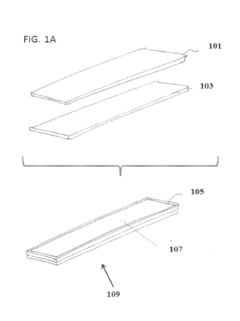
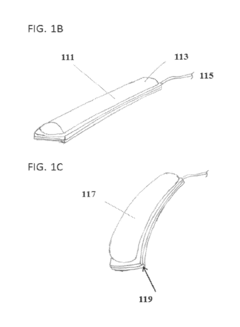
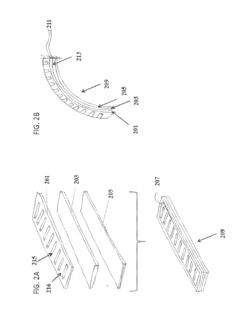
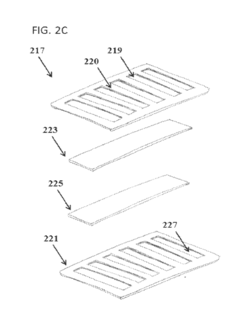
- Soft composite actuators are manufactured by bonding multiple material layers, including elastomeric, strain limiting, and radially constraining layers, to form bladders that can be actuated by pressurized fluid, allowing for efficient bending, linear extension, and twisting motions without the need for molding.
Quality Control Standards for Soft Robotics Production
Establishing comprehensive quality control standards for soft robotics production requires a multi-layered approach that addresses the unique challenges posed by flexible materials and complex manufacturing processes. Unlike traditional rigid robotics, soft robotics components exhibit variable mechanical properties that demand specialized inspection methodologies and acceptance criteria tailored to their intended applications.
Material consistency represents the foundation of quality control in soft robotics manufacturing. Elastomeric materials such as silicones, polyurethanes, and hydrogels must undergo rigorous testing for Shore hardness, tensile strength, elongation at break, and tear resistance. Batch-to-batch variations in these properties can significantly impact actuator performance and durability. Statistical process control methods should be implemented to monitor material properties within predetermined tolerance ranges, typically ±5% for critical mechanical parameters.
Dimensional accuracy standards must account for the inherent flexibility of soft robotic components. Traditional coordinate measuring machines prove inadequate for soft materials that deform under measurement forces. Non-contact measurement techniques, including laser scanning and photogrammetry, provide more suitable alternatives. Acceptable dimensional tolerances for soft robotics typically range from ±0.5mm to ±2mm depending on component size and functional requirements.
Functional performance testing constitutes a critical quality control element, encompassing actuation force, response time, and cyclic durability assessments. Pneumatic actuators should demonstrate consistent pressure-to-force relationships within 10% deviation from design specifications. Response time measurements must verify that actuation and relaxation cycles meet application requirements, typically ranging from milliseconds for high-speed applications to several seconds for precision positioning tasks.
Surface quality inspection protocols must address potential defects including air bubbles, surface roughness, and contamination that could compromise performance or biocompatibility in medical applications. Automated optical inspection systems equipped with specialized lighting and imaging algorithms can detect surface anomalies with micron-level resolution.
Documentation and traceability standards ensure complete production history tracking from raw material receipt through final assembly. Each component should carry unique identification enabling full backward traceability to material lots, processing parameters, and quality test results. This comprehensive approach supports continuous improvement initiatives and facilitates rapid response to quality issues in deployed systems.
Material consistency represents the foundation of quality control in soft robotics manufacturing. Elastomeric materials such as silicones, polyurethanes, and hydrogels must undergo rigorous testing for Shore hardness, tensile strength, elongation at break, and tear resistance. Batch-to-batch variations in these properties can significantly impact actuator performance and durability. Statistical process control methods should be implemented to monitor material properties within predetermined tolerance ranges, typically ±5% for critical mechanical parameters.
Dimensional accuracy standards must account for the inherent flexibility of soft robotic components. Traditional coordinate measuring machines prove inadequate for soft materials that deform under measurement forces. Non-contact measurement techniques, including laser scanning and photogrammetry, provide more suitable alternatives. Acceptable dimensional tolerances for soft robotics typically range from ±0.5mm to ±2mm depending on component size and functional requirements.
Functional performance testing constitutes a critical quality control element, encompassing actuation force, response time, and cyclic durability assessments. Pneumatic actuators should demonstrate consistent pressure-to-force relationships within 10% deviation from design specifications. Response time measurements must verify that actuation and relaxation cycles meet application requirements, typically ranging from milliseconds for high-speed applications to several seconds for precision positioning tasks.
Surface quality inspection protocols must address potential defects including air bubbles, surface roughness, and contamination that could compromise performance or biocompatibility in medical applications. Automated optical inspection systems equipped with specialized lighting and imaging algorithms can detect surface anomalies with micron-level resolution.
Documentation and traceability standards ensure complete production history tracking from raw material receipt through final assembly. Each component should carry unique identification enabling full backward traceability to material lots, processing parameters, and quality test results. This comprehensive approach supports continuous improvement initiatives and facilitates rapid response to quality issues in deployed systems.
Cost-Efficiency Analysis of Soft Robotics Manufacturing
The cost-efficiency analysis of soft robotics manufacturing reveals significant economic challenges that directly impact mass production scalability. Traditional manufacturing approaches for soft robots involve labor-intensive processes, particularly in material preparation and assembly stages, where specialized elastomeric materials require precise handling and curing procedures. These manual interventions substantially increase per-unit production costs compared to conventional rigid robotics manufacturing.
Material costs represent a substantial portion of the overall manufacturing expense, with specialized silicones, thermoplastic elastomers, and bio-compatible polymers commanding premium prices. The procurement of high-grade materials suitable for soft robotics applications typically costs 3-5 times more than standard industrial plastics. Additionally, material waste during production processes, especially in molding and casting operations, further escalates the cost structure.
Manufacturing equipment investment presents another critical cost factor. Specialized machinery for soft robotics production, including precision molding systems, controlled curing ovens, and automated assembly stations, requires significant capital expenditure. The return on investment timeline extends considerably due to lower production volumes compared to traditional manufacturing lines, creating financial barriers for mass production adoption.
Labor costs significantly impact the overall cost-efficiency equation. Soft robotics manufacturing demands skilled technicians capable of handling delicate materials and complex assembly procedures. The learning curve for workforce training is steep, and quality control requirements necessitate experienced personnel, resulting in higher labor costs per unit compared to automated rigid robotics production lines.
Economies of scale remain limited in current soft robotics manufacturing paradigms. Unlike traditional manufacturing where increased volume dramatically reduces per-unit costs, soft robotics production exhibits slower cost reduction curves due to process complexity and material constraints. The break-even point for mass production typically requires substantially higher volumes, making market entry challenging for many applications.
Quality assurance and testing procedures add additional cost layers to the manufacturing process. Soft robotics components require extensive performance validation, durability testing, and safety certification, particularly for medical and human-interactive applications. These quality control measures, while essential, contribute significantly to the overall production cost structure and extend manufacturing timelines.
Material costs represent a substantial portion of the overall manufacturing expense, with specialized silicones, thermoplastic elastomers, and bio-compatible polymers commanding premium prices. The procurement of high-grade materials suitable for soft robotics applications typically costs 3-5 times more than standard industrial plastics. Additionally, material waste during production processes, especially in molding and casting operations, further escalates the cost structure.
Manufacturing equipment investment presents another critical cost factor. Specialized machinery for soft robotics production, including precision molding systems, controlled curing ovens, and automated assembly stations, requires significant capital expenditure. The return on investment timeline extends considerably due to lower production volumes compared to traditional manufacturing lines, creating financial barriers for mass production adoption.
Labor costs significantly impact the overall cost-efficiency equation. Soft robotics manufacturing demands skilled technicians capable of handling delicate materials and complex assembly procedures. The learning curve for workforce training is steep, and quality control requirements necessitate experienced personnel, resulting in higher labor costs per unit compared to automated rigid robotics production lines.
Economies of scale remain limited in current soft robotics manufacturing paradigms. Unlike traditional manufacturing where increased volume dramatically reduces per-unit costs, soft robotics production exhibits slower cost reduction curves due to process complexity and material constraints. The break-even point for mass production typically requires substantially higher volumes, making market entry challenging for many applications.
Quality assurance and testing procedures add additional cost layers to the manufacturing process. Soft robotics components require extensive performance validation, durability testing, and safety certification, particularly for medical and human-interactive applications. These quality control measures, while essential, contribute significantly to the overall production cost structure and extend manufacturing timelines.
Unlock deeper insights with Patsnap Eureka Quick Research — get a full tech report to explore trends and direct your research. Try now!
Generate Your Research Report Instantly with AI Agent
Supercharge your innovation with Patsnap Eureka AI Agent Platform!