

Comparing COFs and CNTs: Electrically Conductive Properties
APR 16, 202610 MIN READ
Generate Your Research Report Instantly with AI Agent
Patsnap Eureka helps you evaluate technical feasibility & market potential.
COFs vs CNTs Conductive Properties Background and Goals
The development of electrically conductive materials has become increasingly critical in advancing next-generation electronic devices, energy storage systems, and smart materials applications. Two prominent material classes have emerged as frontrunners in this field: Covalent Organic Frameworks (COFs) and Carbon Nanotubes (CNTs). Both materials represent significant breakthroughs in nanoscale engineering, yet they offer distinctly different approaches to achieving electrical conductivity through their unique structural architectures.
COFs represent a relatively newer class of crystalline porous materials that have gained substantial attention since their first synthesis in 2005. These materials are constructed through the covalent linking of organic building blocks, creating highly ordered, porous structures with tunable properties. The evolution of COFs from insulating materials to semiconducting and eventually to metallic conductors represents a remarkable achievement in materials chemistry, driven by strategic molecular design and synthetic innovations.
Carbon nanotubes, discovered in 1991, have established themselves as benchmark materials for electrical conductivity among carbon-based nanomaterials. Their unique one-dimensional structure, derived from rolled graphene sheets, provides exceptional electronic transport properties that have made them indispensable in various high-performance applications. The maturity of CNT technology, combined with decades of research optimization, has resulted in well-established synthesis methods and comprehensive understanding of their conductive mechanisms.
The comparative analysis of these materials has become increasingly relevant as industries seek optimal solutions for specific applications. While CNTs offer proven high conductivity and mechanical strength, COFs provide unprecedented structural tunability and chemical functionality. This fundamental difference in design philosophy creates distinct advantages and limitations for each material class.
The primary objective of this technological investigation centers on establishing a comprehensive framework for evaluating the electrical conductive properties of COFs versus CNTs. This analysis aims to identify the underlying mechanisms governing conductivity in each material system, assess their performance metrics under various conditions, and determine optimal application scenarios for each technology.
Furthermore, this research seeks to bridge the knowledge gap between theoretical predictions and experimental observations in both material systems. Understanding the structure-property relationships that govern electrical transport will enable more informed material selection decisions and guide future development strategies for next-generation conductive materials in emerging technological applications.
COFs represent a relatively newer class of crystalline porous materials that have gained substantial attention since their first synthesis in 2005. These materials are constructed through the covalent linking of organic building blocks, creating highly ordered, porous structures with tunable properties. The evolution of COFs from insulating materials to semiconducting and eventually to metallic conductors represents a remarkable achievement in materials chemistry, driven by strategic molecular design and synthetic innovations.
Carbon nanotubes, discovered in 1991, have established themselves as benchmark materials for electrical conductivity among carbon-based nanomaterials. Their unique one-dimensional structure, derived from rolled graphene sheets, provides exceptional electronic transport properties that have made them indispensable in various high-performance applications. The maturity of CNT technology, combined with decades of research optimization, has resulted in well-established synthesis methods and comprehensive understanding of their conductive mechanisms.
The comparative analysis of these materials has become increasingly relevant as industries seek optimal solutions for specific applications. While CNTs offer proven high conductivity and mechanical strength, COFs provide unprecedented structural tunability and chemical functionality. This fundamental difference in design philosophy creates distinct advantages and limitations for each material class.
The primary objective of this technological investigation centers on establishing a comprehensive framework for evaluating the electrical conductive properties of COFs versus CNTs. This analysis aims to identify the underlying mechanisms governing conductivity in each material system, assess their performance metrics under various conditions, and determine optimal application scenarios for each technology.
Furthermore, this research seeks to bridge the knowledge gap between theoretical predictions and experimental observations in both material systems. Understanding the structure-property relationships that govern electrical transport will enable more informed material selection decisions and guide future development strategies for next-generation conductive materials in emerging technological applications.
Market Demand for Advanced Conductive Materials
The global market for advanced conductive materials is experiencing unprecedented growth driven by the rapid expansion of electronics, energy storage, and emerging technologies. Traditional conductive materials such as copper and aluminum are increasingly unable to meet the demanding requirements of next-generation applications, creating substantial opportunities for novel materials like Covalent Organic Frameworks (COFs) and Carbon Nanotubes (CNTs).
The electronics industry represents the largest demand segment for advanced conductive materials, particularly in flexible electronics, wearable devices, and high-frequency applications. Modern electronic devices require materials that combine excellent electrical conductivity with mechanical flexibility, thermal stability, and processability. This demand is intensified by the miniaturization trend in semiconductor manufacturing and the growing adoption of Internet of Things devices.
Energy storage and conversion technologies constitute another critical market driver. The global transition toward renewable energy and electric vehicles has created enormous demand for materials that can enhance battery performance, supercapacitor efficiency, and fuel cell functionality. Advanced conductive materials are essential for improving charge transport, reducing internal resistance, and extending device lifespan in these applications.
The aerospace and automotive sectors are increasingly seeking lightweight conductive materials that can replace traditional metals without compromising performance. Weight reduction is crucial for fuel efficiency and performance optimization, making advanced materials with superior strength-to-weight ratios highly valuable. These industries require materials that maintain conductivity under extreme conditions while offering corrosion resistance and durability.
Emerging applications in electromagnetic interference shielding, transparent conductive films, and neural interfaces are creating new market niches. The development of smart textiles, biomedical implants, and advanced sensors requires materials with unique combinations of conductivity, biocompatibility, and processability that conventional materials cannot provide.
Market growth is further accelerated by increasing research investments and government initiatives promoting advanced materials development. The push toward sustainable and environmentally friendly materials is also driving demand for alternatives to traditional conductive materials that may have environmental or supply chain limitations.
Regional demand patterns show strong growth in Asia-Pacific markets, driven by electronics manufacturing hubs, while North American and European markets focus on high-value applications in aerospace, automotive, and renewable energy sectors. The market landscape continues evolving as manufacturing costs decrease and processing technologies mature.
The electronics industry represents the largest demand segment for advanced conductive materials, particularly in flexible electronics, wearable devices, and high-frequency applications. Modern electronic devices require materials that combine excellent electrical conductivity with mechanical flexibility, thermal stability, and processability. This demand is intensified by the miniaturization trend in semiconductor manufacturing and the growing adoption of Internet of Things devices.
Energy storage and conversion technologies constitute another critical market driver. The global transition toward renewable energy and electric vehicles has created enormous demand for materials that can enhance battery performance, supercapacitor efficiency, and fuel cell functionality. Advanced conductive materials are essential for improving charge transport, reducing internal resistance, and extending device lifespan in these applications.
The aerospace and automotive sectors are increasingly seeking lightweight conductive materials that can replace traditional metals without compromising performance. Weight reduction is crucial for fuel efficiency and performance optimization, making advanced materials with superior strength-to-weight ratios highly valuable. These industries require materials that maintain conductivity under extreme conditions while offering corrosion resistance and durability.
Emerging applications in electromagnetic interference shielding, transparent conductive films, and neural interfaces are creating new market niches. The development of smart textiles, biomedical implants, and advanced sensors requires materials with unique combinations of conductivity, biocompatibility, and processability that conventional materials cannot provide.
Market growth is further accelerated by increasing research investments and government initiatives promoting advanced materials development. The push toward sustainable and environmentally friendly materials is also driving demand for alternatives to traditional conductive materials that may have environmental or supply chain limitations.
Regional demand patterns show strong growth in Asia-Pacific markets, driven by electronics manufacturing hubs, while North American and European markets focus on high-value applications in aerospace, automotive, and renewable energy sectors. The market landscape continues evolving as manufacturing costs decrease and processing technologies mature.
Current State of COFs and CNTs Electrical Conductivity
Covalent Organic Frameworks (COFs) represent a relatively nascent class of crystalline porous materials that have garnered significant attention for their tunable electrical properties. Currently, most pristine COFs exhibit insulating or semiconducting behavior due to their organic nature and limited π-conjugation pathways. However, recent advances have demonstrated that strategic molecular design can enhance conductivity through extended conjugation systems, incorporation of conductive linkers, and post-synthetic modifications.
Carbon Nanotubes (CNTs) have established themselves as benchmark materials for electrical conductivity among carbon-based nanomaterials. Single-walled CNTs can exhibit metallic or semiconducting properties depending on their chirality, with metallic variants achieving conductivities approaching that of copper. Multi-walled CNTs typically display metallic behavior due to the statistical presence of conductive pathways across multiple shells.
The current state of COF electrical conductivity spans several orders of magnitude, from insulating frameworks with conductivities below 10^-12 S/cm to highly conductive variants reaching 10^-3 S/cm. Notable achievements include tetrathiafulvalene-based COFs and those incorporating conductive polymeric chains. Doping strategies using iodine, metal ions, or guest molecules have proven effective in enhancing conductivity by introducing charge carriers or creating additional conductive pathways.
CNTs maintain superior absolute conductivity values, with pristine single-walled metallic CNTs achieving conductivities exceeding 10^4 S/cm under optimal conditions. However, practical applications often involve CNT networks or composites where inter-tube contact resistance significantly reduces overall performance. Processing challenges, including dispersion difficulties and maintaining structural integrity during device fabrication, continue to limit the realization of theoretical conductivity values.
Recent developments in COF synthesis have focused on creating two-dimensional conductive frameworks through careful selection of building blocks and reaction conditions. Strategies include incorporating redox-active units, designing extended aromatic systems, and utilizing metal coordination to enhance charge transport. While COFs currently lag behind CNTs in absolute conductivity, their synthetic tunability offers unique advantages for specific applications requiring controlled porosity combined with electrical functionality.
The integration of both materials into hybrid systems represents an emerging frontier, where COFs can serve as structured matrices for CNT organization, potentially combining the processability and designability of COFs with the exceptional conductivity of CNTs.
Carbon Nanotubes (CNTs) have established themselves as benchmark materials for electrical conductivity among carbon-based nanomaterials. Single-walled CNTs can exhibit metallic or semiconducting properties depending on their chirality, with metallic variants achieving conductivities approaching that of copper. Multi-walled CNTs typically display metallic behavior due to the statistical presence of conductive pathways across multiple shells.
The current state of COF electrical conductivity spans several orders of magnitude, from insulating frameworks with conductivities below 10^-12 S/cm to highly conductive variants reaching 10^-3 S/cm. Notable achievements include tetrathiafulvalene-based COFs and those incorporating conductive polymeric chains. Doping strategies using iodine, metal ions, or guest molecules have proven effective in enhancing conductivity by introducing charge carriers or creating additional conductive pathways.
CNTs maintain superior absolute conductivity values, with pristine single-walled metallic CNTs achieving conductivities exceeding 10^4 S/cm under optimal conditions. However, practical applications often involve CNT networks or composites where inter-tube contact resistance significantly reduces overall performance. Processing challenges, including dispersion difficulties and maintaining structural integrity during device fabrication, continue to limit the realization of theoretical conductivity values.
Recent developments in COF synthesis have focused on creating two-dimensional conductive frameworks through careful selection of building blocks and reaction conditions. Strategies include incorporating redox-active units, designing extended aromatic systems, and utilizing metal coordination to enhance charge transport. While COFs currently lag behind CNTs in absolute conductivity, their synthetic tunability offers unique advantages for specific applications requiring controlled porosity combined with electrical functionality.
The integration of both materials into hybrid systems represents an emerging frontier, where COFs can serve as structured matrices for CNT organization, potentially combining the processability and designability of COFs with the exceptional conductivity of CNTs.
Existing Conductive Enhancement Solutions for COFs and CNTs
01 COF-CNT composite materials for enhanced electrical conductivity
Covalent organic frameworks (COFs) can be combined with carbon nanotubes (CNTs) to create composite materials with improved electrical conductivity. The integration of CNTs into COF structures enhances electron transport pathways and overall conductivity. These composites leverage the ordered porous structure of COFs and the excellent electrical properties of CNTs to achieve synergistic effects in conductive applications.- COF-CNT hybrid composites for enhanced electrical conductivity: Covalent organic frameworks (COFs) can be combined with carbon nanotubes (CNTs) to form hybrid composite materials with significantly enhanced electrical conductivity. The integration of highly conductive CNTs into the COF matrix creates synergistic effects, improving electron transport pathways. These hybrid materials demonstrate superior electrical properties compared to individual components, making them suitable for applications in energy storage, sensors, and electronic devices.
- Functionalization and doping strategies for improving COF conductivity: The electrical conductivity of COFs can be enhanced through various functionalization and doping methods. Incorporating conductive functional groups, metal ions, or conjugated structures into the COF framework can significantly improve charge carrier mobility. Chemical modification and post-synthetic treatments enable the tuning of electronic properties, transforming traditionally insulating COFs into semiconducting or conductive materials suitable for electronic applications.
- CNT-based conductive networks and dispersion techniques: Carbon nanotubes can form highly conductive networks when properly dispersed in various matrices. Effective dispersion techniques, including surface modification, ultrasonication, and the use of dispersing agents, are critical for achieving uniform distribution and maximizing electrical conductivity. The formation of percolating networks at low CNT concentrations enables efficient electron transport, making these materials valuable for conductive coatings, composites, and flexible electronics.
- Conductive polymer-CNT composites for electrical applications: Conductive composites can be fabricated by incorporating CNTs into polymer matrices, resulting in materials with tunable electrical properties. The CNTs act as conductive fillers that create electron pathways throughout the polymer, dramatically increasing conductivity even at low loading levels. These composites find applications in electromagnetic shielding, antistatic materials, flexible electrodes, and wearable electronics, offering a balance between mechanical flexibility and electrical performance.
- Energy storage applications utilizing COF and CNT conductive properties: The electrical conductivity of COFs and CNTs makes them excellent candidates for energy storage devices such as supercapacitors and batteries. COFs provide high surface area and tunable porosity for ion storage, while CNTs contribute superior electrical conductivity and mechanical stability. The combination of these materials in electrode designs enables rapid charge-discharge rates, high power density, and improved cycling stability, advancing the performance of next-generation energy storage systems.
02 Functionalization and modification of CNTs for improved conductivity
Carbon nanotubes can be functionalized or modified through various chemical treatments to enhance their electrical conductive properties. Surface modifications, doping, and chemical functionalization improve the dispersion and integration of CNTs in composite materials. These treatments can also reduce contact resistance and improve charge transfer efficiency in conductive networks.Expand Specific Solutions03 COF-based conductive polymers and films
Conductive organic frameworks can be synthesized into polymer films or coatings with tailored electrical properties. These materials utilize conjugated structures and π-electron systems within COFs to facilitate charge transport. The resulting films demonstrate tunable conductivity and can be applied in electronic devices, sensors, and energy storage applications.Expand Specific Solutions04 Hybrid structures combining COFs with conductive nanomaterials
Hybrid architectures incorporating COFs with various conductive nanomaterials beyond CNTs, such as graphene or metal nanoparticles, can be developed to optimize electrical properties. These hybrid systems create multiple conductive pathways and enhance overall material performance. The combination allows for fine-tuning of electrical characteristics while maintaining structural integrity and porosity.Expand Specific Solutions05 Applications of conductive COF-CNT materials in energy and electronics
Conductive materials based on COFs and CNTs find applications in various fields including batteries, supercapacitors, sensors, and electronic devices. These materials serve as electrodes, conductive additives, or active components that require high electrical conductivity combined with structural stability. The unique properties of COF-CNT systems enable improved performance in energy storage and conversion devices.Expand Specific Solutions
Key Players in COFs and CNTs Research and Industry
The electrically conductive properties comparison between COFs and CNTs represents a rapidly evolving field within the advanced materials sector, currently in its growth phase with significant research momentum. The market demonstrates substantial potential, driven by applications in electronics, energy storage, and nanotechnology sectors. Technology maturity varies considerably across key players: established corporations like Samsung Electronics, Fujitsu, and Robert Bosch leverage industrial-scale manufacturing capabilities, while research institutions including NASA, CNRS, and various universities (Sichuan University, Xi'an Jiaotong University, Waseda University) focus on fundamental research breakthroughs. Specialized companies such as Smoltek AB and Nanostructured & Amorphous Materials advance targeted applications. The competitive landscape shows a hybrid ecosystem where academic research institutions drive innovation while industrial giants scale commercialization, indicating the technology's transition from laboratory research toward practical implementation phases.
Samsung Electronics Co., Ltd.
Technical Solution: Samsung has developed advanced CNT-based conductive materials for flexible electronics and display applications. Their technology focuses on solution-processed CNT films that achieve sheet resistance as low as 50-100 Ω/sq while maintaining high optical transparency above 90%. The company has integrated CNT transparent electrodes in OLED displays and flexible touch panels, demonstrating superior mechanical flexibility compared to traditional ITO electrodes. Samsung's CNT synthesis process utilizes chemical vapor deposition with optimized catalyst systems to produce high-purity single-walled carbon nanotubes with controlled chirality distribution.
Strengths: Excellent scalability for mass production, superior mechanical flexibility, established manufacturing infrastructure. Weaknesses: Higher production costs compared to conventional materials, limited long-term stability under harsh environmental conditions.
SMOLTEK AB
Technical Solution: SMOLTEK specializes in vertically aligned carbon nanotube (VACNT) technology for electronic applications. Their proprietary CNF-MIM (Carbon NanoFiber Metal-Insulator-Metal) capacitor technology achieves capacitance densities exceeding 100 μF/mm² while operating at frequencies up to 1 GHz. The company's CNT growth process enables precise control over nanotube diameter, length, and density, resulting in highly conductive pathways with resistivity values below 10⁻⁴ Ω·cm. SMOLTEK's technology is particularly focused on semiconductor packaging and high-frequency applications where traditional materials face limitations.
Strengths: Ultra-high capacitance density, excellent high-frequency performance, precise dimensional control. Weaknesses: Complex manufacturing process, limited to specific niche applications, high development costs.
Core Innovations in COFs and CNTs Conductivity Mechanisms
Coated carbon nanotube array electrodes
PatentInactiveUS20070134555A1
Innovation
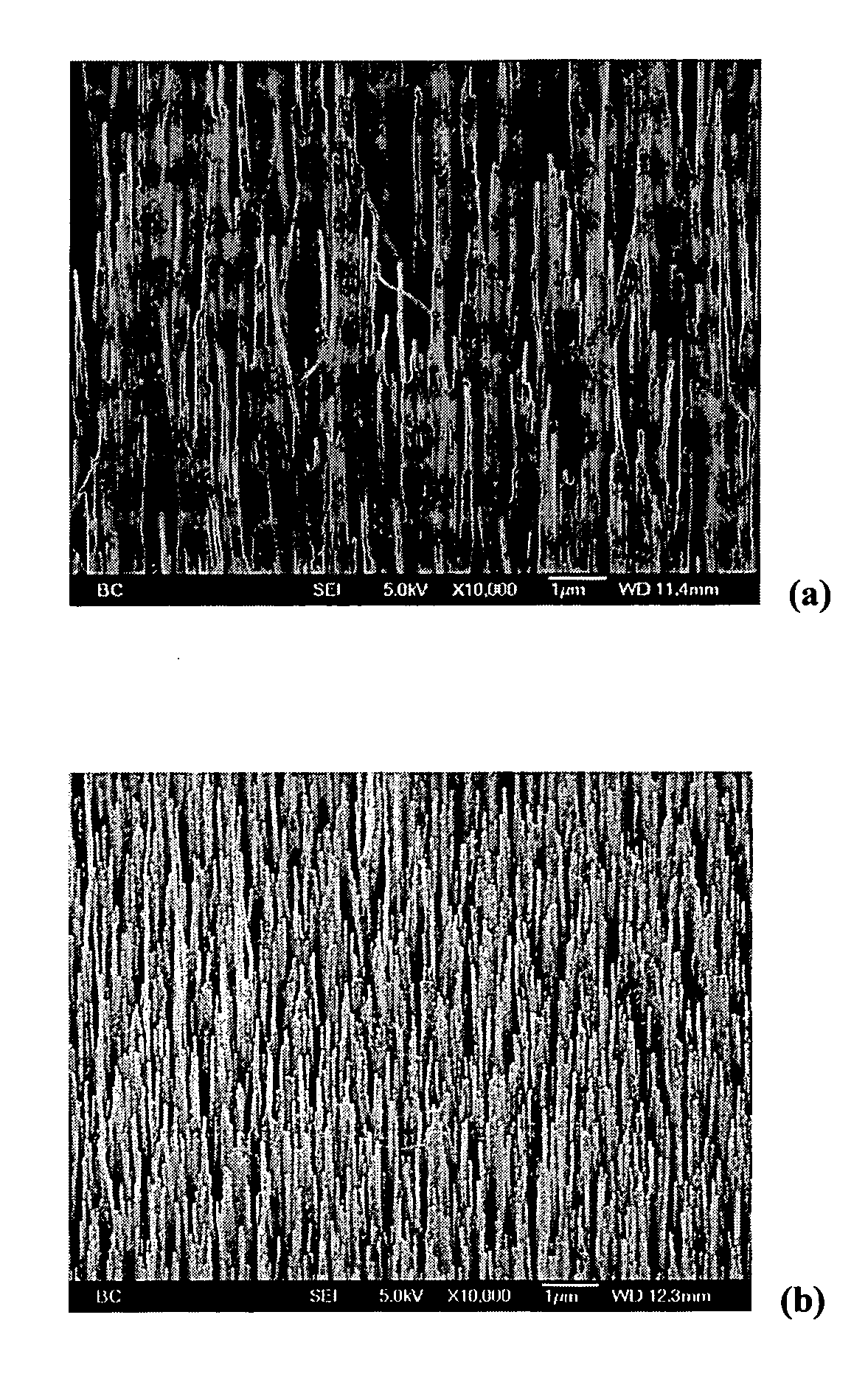
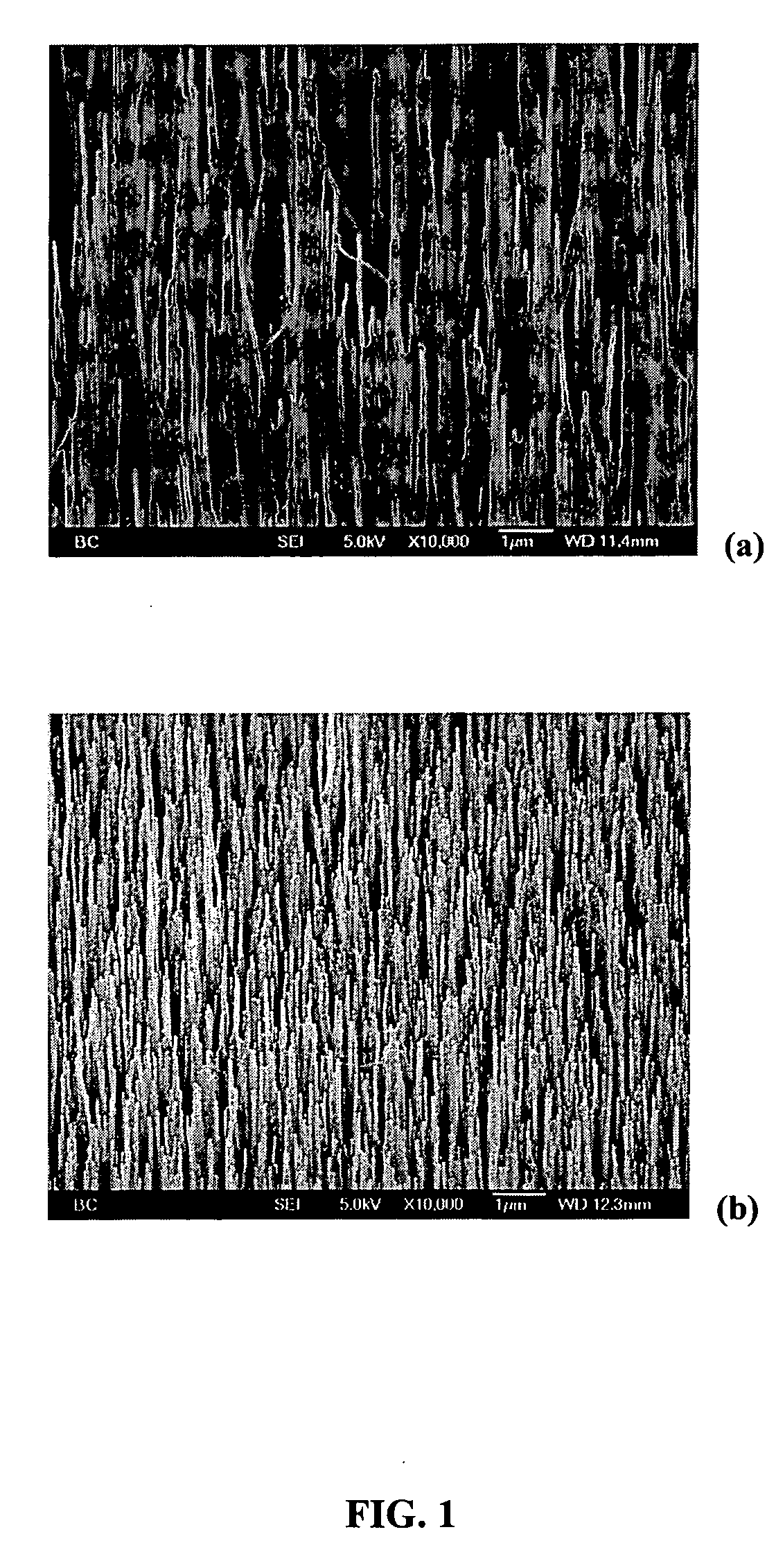
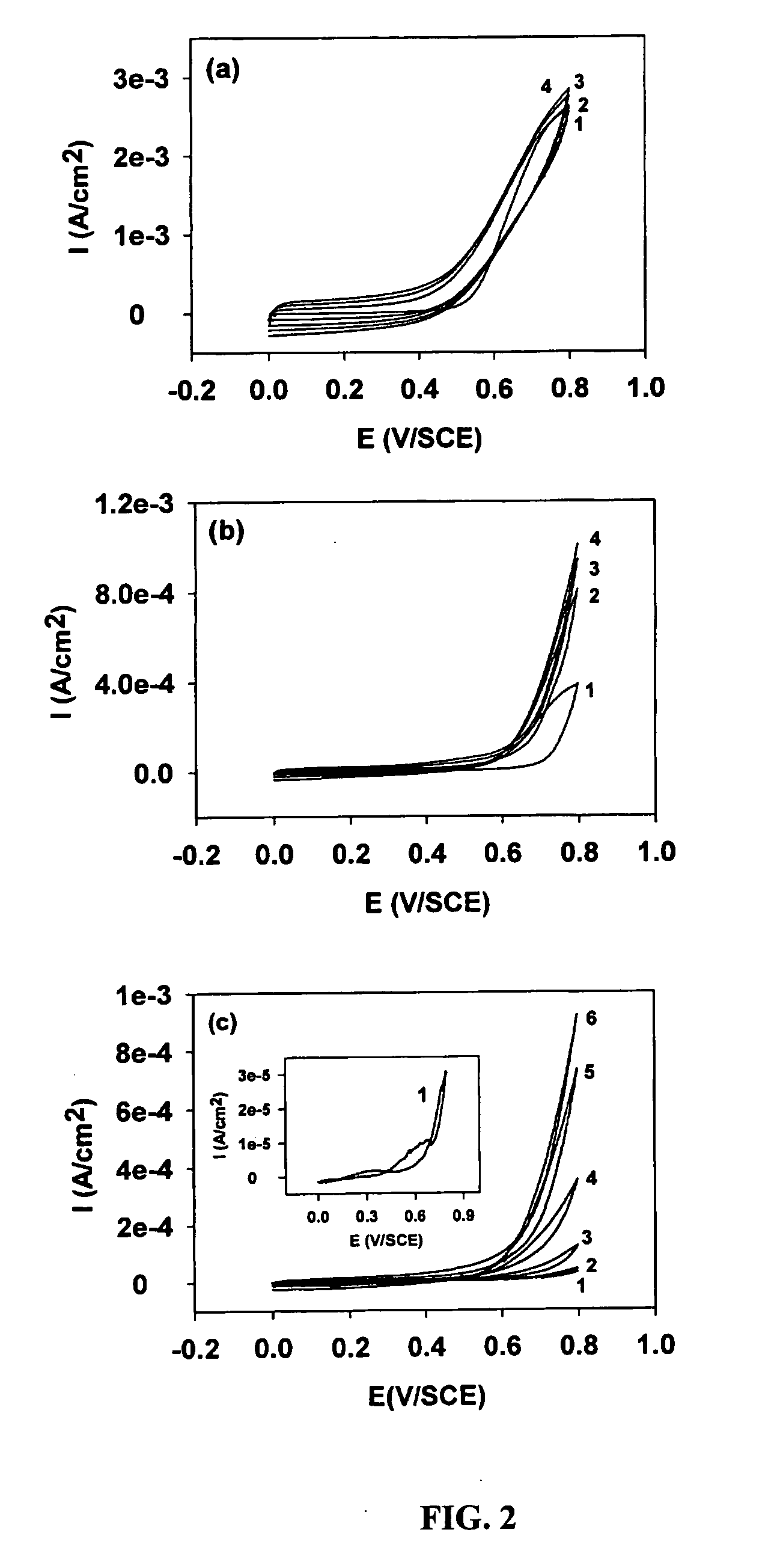
- The development of aligned CNT substrates with a uniform coating of electrically conducting polymers, such as polypyrrole, achieved through in-situ electrochemical polymerization, ensuring contiguous and adherent films with controlled thickness and porosity, enhancing electrical conductivity and charge retention.

Methodology for evaluation of electrical characteristics of carbon nanotubes
PatentInactiveUS8853856B2
Innovation
- A structure comprising carbon nanotubes grown on an electrically conductive substrate, embedded in a polymeric fill matrix with latent photoacid generators, and patterned with a photosensitive dielectric material to expose their tips for contact with an electrically conductive material, allowing for the evaluation of their electrical characteristics.


Environmental Impact of COFs and CNTs Production
The production of Covalent Organic Frameworks (COFs) and Carbon Nanotubes (CNTs) presents distinct environmental challenges that significantly impact their commercial viability and sustainability profiles. Understanding these environmental implications is crucial for evaluating the long-term feasibility of these materials in electrically conductive applications.
COF synthesis typically involves solvothermal or mechanochemical methods that require organic solvents, catalysts, and controlled atmospheric conditions. The production process generates organic waste streams containing unreacted monomers, by-products, and solvent residues. Many COF synthesis routes utilize toxic organic solvents such as dimethylformamide or dichloromethane, which require careful handling and disposal protocols. The energy consumption during synthesis is generally moderate, as reaction temperatures typically range from 80-200°C, but extended reaction times can increase overall energy requirements.
CNT production methods, including chemical vapor deposition, arc discharge, and laser ablation, present different environmental concerns. These processes often require high temperatures exceeding 800°C and consume substantial amounts of energy. Metal catalysts such as iron, cobalt, or nickel are frequently employed, creating potential heavy metal contamination issues. The purification steps necessary to remove amorphous carbon and catalyst residues involve harsh acids like nitric acid and sulfuric acid, generating hazardous waste streams that require specialized treatment.
Water consumption patterns differ significantly between the two materials. COF production generally requires less water but generates organic-contaminated wastewater that is challenging to treat using conventional methods. CNT manufacturing involves substantial water usage for cooling and purification processes, producing acidic wastewater containing metal ions and carbon particulates.
Carbon footprint analysis reveals that CNT production typically generates higher greenhouse gas emissions due to intensive energy requirements and the carbon-intensive nature of catalyst preparation. COF synthesis demonstrates a relatively lower carbon footprint, though this varies significantly depending on the specific synthetic route and precursor materials used.
Waste management strategies for both materials require specialized approaches. COF production waste streams primarily consist of organic compounds that may be recoverable through advanced separation techniques. CNT production generates mixed waste containing metals, acids, and carbon materials, necessitating complex treatment protocols to prevent environmental contamination and enable material recovery.
COF synthesis typically involves solvothermal or mechanochemical methods that require organic solvents, catalysts, and controlled atmospheric conditions. The production process generates organic waste streams containing unreacted monomers, by-products, and solvent residues. Many COF synthesis routes utilize toxic organic solvents such as dimethylformamide or dichloromethane, which require careful handling and disposal protocols. The energy consumption during synthesis is generally moderate, as reaction temperatures typically range from 80-200°C, but extended reaction times can increase overall energy requirements.
CNT production methods, including chemical vapor deposition, arc discharge, and laser ablation, present different environmental concerns. These processes often require high temperatures exceeding 800°C and consume substantial amounts of energy. Metal catalysts such as iron, cobalt, or nickel are frequently employed, creating potential heavy metal contamination issues. The purification steps necessary to remove amorphous carbon and catalyst residues involve harsh acids like nitric acid and sulfuric acid, generating hazardous waste streams that require specialized treatment.
Water consumption patterns differ significantly between the two materials. COF production generally requires less water but generates organic-contaminated wastewater that is challenging to treat using conventional methods. CNT manufacturing involves substantial water usage for cooling and purification processes, producing acidic wastewater containing metal ions and carbon particulates.
Carbon footprint analysis reveals that CNT production typically generates higher greenhouse gas emissions due to intensive energy requirements and the carbon-intensive nature of catalyst preparation. COF synthesis demonstrates a relatively lower carbon footprint, though this varies significantly depending on the specific synthetic route and precursor materials used.
Waste management strategies for both materials require specialized approaches. COF production waste streams primarily consist of organic compounds that may be recoverable through advanced separation techniques. CNT production generates mixed waste containing metals, acids, and carbon materials, necessitating complex treatment protocols to prevent environmental contamination and enable material recovery.
Safety Considerations in Conductive Material Applications
The implementation of electrically conductive materials such as Covalent Organic Frameworks (COFs) and Carbon Nanotubes (CNTs) in commercial applications necessitates comprehensive safety evaluations across multiple domains. Both materials present unique safety profiles that must be thoroughly understood before widespread deployment in electronic devices, energy storage systems, and industrial applications.
Occupational health considerations represent a primary concern when handling these conductive materials during manufacturing and processing. CNTs pose significant respiratory risks due to their fibrous nature and potential for airborne dispersion. Studies have indicated that certain CNT variants may exhibit asbestos-like behavior when inhaled, potentially leading to pulmonary inflammation and long-term respiratory complications. Workers involved in CNT synthesis, purification, and integration processes require specialized protective equipment including high-efficiency particulate air filtration systems and appropriate personal protective equipment.
COFs present different occupational safety challenges primarily related to the chemical precursors used in their synthesis rather than the final framework structure itself. Many COF synthesis routes involve organic solvents, catalysts, and reactive monomers that require careful handling protocols. The crystalline nature of COFs generally results in lower airborne particle generation compared to CNTs, but proper ventilation and containment systems remain essential during production processes.
Environmental safety assessments reveal contrasting profiles between these materials. CNTs demonstrate exceptional chemical stability and resistance to degradation, which while beneficial for device longevity, raises concerns about environmental persistence and bioaccumulation potential. Their non-biodegradable nature necessitates careful consideration of end-of-life disposal strategies and potential environmental release scenarios during manufacturing or device failure.
COFs exhibit variable environmental behavior depending on their specific chemical composition and structural design. Many COF structures demonstrate greater susceptibility to hydrolysis and chemical degradation under environmental conditions, potentially offering advantages in terms of environmental fate but requiring careful evaluation of degradation products and their associated toxicity profiles.
Electrical safety considerations become paramount when these materials are integrated into high-voltage or high-current applications. Both COFs and CNTs can exhibit variable conductivity under different environmental conditions, potentially leading to unexpected electrical behavior. Temperature-dependent conductivity changes, moisture sensitivity, and long-term stability under electrical stress require thorough characterization to prevent device failures or safety hazards.
Fire safety represents another critical consideration, particularly for energy storage applications. CNTs can exhibit complex combustion behavior, potentially releasing toxic gases under fire conditions. COFs may present different fire risks depending on their organic composition, with some frameworks potentially acting as fuel sources while others may demonstrate flame-retardant properties.
Regulatory compliance frameworks for these emerging conductive materials continue to evolve, with different jurisdictions developing specific guidelines for nanomaterial handling, environmental release limits, and workplace exposure standards. Manufacturers must navigate complex regulatory landscapes while ensuring comprehensive safety documentation and risk assessment protocols are established before commercial deployment.
Occupational health considerations represent a primary concern when handling these conductive materials during manufacturing and processing. CNTs pose significant respiratory risks due to their fibrous nature and potential for airborne dispersion. Studies have indicated that certain CNT variants may exhibit asbestos-like behavior when inhaled, potentially leading to pulmonary inflammation and long-term respiratory complications. Workers involved in CNT synthesis, purification, and integration processes require specialized protective equipment including high-efficiency particulate air filtration systems and appropriate personal protective equipment.
COFs present different occupational safety challenges primarily related to the chemical precursors used in their synthesis rather than the final framework structure itself. Many COF synthesis routes involve organic solvents, catalysts, and reactive monomers that require careful handling protocols. The crystalline nature of COFs generally results in lower airborne particle generation compared to CNTs, but proper ventilation and containment systems remain essential during production processes.
Environmental safety assessments reveal contrasting profiles between these materials. CNTs demonstrate exceptional chemical stability and resistance to degradation, which while beneficial for device longevity, raises concerns about environmental persistence and bioaccumulation potential. Their non-biodegradable nature necessitates careful consideration of end-of-life disposal strategies and potential environmental release scenarios during manufacturing or device failure.
COFs exhibit variable environmental behavior depending on their specific chemical composition and structural design. Many COF structures demonstrate greater susceptibility to hydrolysis and chemical degradation under environmental conditions, potentially offering advantages in terms of environmental fate but requiring careful evaluation of degradation products and their associated toxicity profiles.
Electrical safety considerations become paramount when these materials are integrated into high-voltage or high-current applications. Both COFs and CNTs can exhibit variable conductivity under different environmental conditions, potentially leading to unexpected electrical behavior. Temperature-dependent conductivity changes, moisture sensitivity, and long-term stability under electrical stress require thorough characterization to prevent device failures or safety hazards.
Fire safety represents another critical consideration, particularly for energy storage applications. CNTs can exhibit complex combustion behavior, potentially releasing toxic gases under fire conditions. COFs may present different fire risks depending on their organic composition, with some frameworks potentially acting as fuel sources while others may demonstrate flame-retardant properties.
Regulatory compliance frameworks for these emerging conductive materials continue to evolve, with different jurisdictions developing specific guidelines for nanomaterial handling, environmental release limits, and workplace exposure standards. Manufacturers must navigate complex regulatory landscapes while ensuring comprehensive safety documentation and risk assessment protocols are established before commercial deployment.
Unlock deeper insights with Patsnap Eureka Quick Research — get a full tech report to explore trends and direct your research. Try now!
Generate Your Research Report Instantly with AI Agent
Supercharge your innovation with Patsnap Eureka AI Agent Platform!