

Comparing Compression Molded vs Prepreg Laminates in Consumer Goods
MAY 26, 20269 MIN READ
Generate Your Research Report Instantly with AI Agent
PatSnap Eureka helps you evaluate technical feasibility & market potential.
Compression Molding vs Prepreg Technology Background and Objectives
Composite materials manufacturing has undergone significant evolution since the mid-20th century, with compression molding and prepreg lamination emerging as two dominant fabrication technologies. Compression molding, originally developed in the 1940s for thermoset plastics, has evolved to accommodate advanced fiber-reinforced composites through innovations in tooling design, heating systems, and pressure control mechanisms. This technology gained prominence in automotive and aerospace industries before expanding into consumer goods applications.
Prepreg lamination technology emerged in the 1960s as a precision manufacturing approach, initially serving aerospace applications requiring exceptional quality control and mechanical properties. The technology involves pre-impregnated fiber reinforcements with partially cured resin systems, enabling controlled fiber orientation and consistent resin distribution. Over decades, prepreg technology has advanced through improvements in resin chemistry, fiber treatments, and automated layup processes.
The consumer goods sector presents unique manufacturing challenges that differentiate it from traditional aerospace and automotive applications. Cost sensitivity, production volume requirements, aesthetic considerations, and diverse performance specifications drive the need for optimized manufacturing approaches. Both compression molding and prepreg lamination have adapted to address these consumer-focused demands through process modifications and material innovations.
Current technological objectives center on achieving optimal balance between manufacturing efficiency, product performance, and cost-effectiveness. Compression molding aims to enhance cycle time reduction, improve surface finish quality, and increase dimensional accuracy while maintaining structural integrity. Advanced heating technologies, improved mold designs, and optimized cure cycles represent key development areas.
Prepreg lamination technology focuses on expanding material compatibility, reducing processing temperatures, and developing out-of-autoclave curing methods suitable for consumer goods production. Automation integration, waste reduction, and simplified handling procedures constitute primary advancement targets.
The convergence of these technologies toward consumer applications necessitates comprehensive evaluation of their respective capabilities, limitations, and suitability for specific product categories. Understanding the fundamental technological principles, historical development trajectories, and current optimization efforts provides essential foundation for informed manufacturing decisions in consumer goods applications.
Prepreg lamination technology emerged in the 1960s as a precision manufacturing approach, initially serving aerospace applications requiring exceptional quality control and mechanical properties. The technology involves pre-impregnated fiber reinforcements with partially cured resin systems, enabling controlled fiber orientation and consistent resin distribution. Over decades, prepreg technology has advanced through improvements in resin chemistry, fiber treatments, and automated layup processes.
The consumer goods sector presents unique manufacturing challenges that differentiate it from traditional aerospace and automotive applications. Cost sensitivity, production volume requirements, aesthetic considerations, and diverse performance specifications drive the need for optimized manufacturing approaches. Both compression molding and prepreg lamination have adapted to address these consumer-focused demands through process modifications and material innovations.
Current technological objectives center on achieving optimal balance between manufacturing efficiency, product performance, and cost-effectiveness. Compression molding aims to enhance cycle time reduction, improve surface finish quality, and increase dimensional accuracy while maintaining structural integrity. Advanced heating technologies, improved mold designs, and optimized cure cycles represent key development areas.
Prepreg lamination technology focuses on expanding material compatibility, reducing processing temperatures, and developing out-of-autoclave curing methods suitable for consumer goods production. Automation integration, waste reduction, and simplified handling procedures constitute primary advancement targets.
The convergence of these technologies toward consumer applications necessitates comprehensive evaluation of their respective capabilities, limitations, and suitability for specific product categories. Understanding the fundamental technological principles, historical development trajectories, and current optimization efforts provides essential foundation for informed manufacturing decisions in consumer goods applications.
Consumer Goods Market Demand for Advanced Composite Materials
The consumer goods industry is experiencing unprecedented demand for advanced composite materials, driven by evolving consumer preferences for lightweight, durable, and aesthetically superior products. This transformation spans multiple sectors including automotive accessories, sporting goods, electronics housings, furniture, and home appliances, where traditional materials increasingly fail to meet performance expectations.
Market drivers for advanced composites in consumer applications center on weight reduction requirements without compromising structural integrity. Modern consumers demand products that offer enhanced portability while maintaining durability, particularly in portable electronics, recreational equipment, and automotive components. The superior strength-to-weight ratio of composite materials addresses these needs effectively compared to conventional metals and plastics.
Aesthetic considerations significantly influence market demand, as composites enable complex geometries and surface finishes previously unattainable with traditional manufacturing methods. The ability to integrate functional features directly into composite structures reduces assembly complexity while improving product appeal. This capability particularly resonates in premium consumer segments where design differentiation drives purchasing decisions.
Sustainability concerns increasingly shape material selection criteria across consumer goods categories. Advanced composites offer extended product lifecycles through enhanced durability and corrosion resistance, reducing replacement frequency and environmental impact. Additionally, emerging bio-based composite formulations align with growing consumer environmental consciousness and regulatory pressures for sustainable manufacturing practices.
Performance requirements in consumer applications continue escalating, demanding materials that withstand diverse environmental conditions while maintaining dimensional stability. Composites excel in applications requiring chemical resistance, thermal stability, and electrical insulation properties, making them indispensable for modern consumer electronics and appliances.
Cost considerations remain critical factors influencing adoption rates, as manufacturers balance material performance benefits against production economics. The growing availability of cost-effective composite manufacturing processes, including compression molding and prepreg lamination techniques, expands market accessibility across price-sensitive consumer segments.
Regulatory compliance requirements, particularly in automotive and electronics applications, drive demand for materials meeting stringent safety and performance standards. Advanced composites often provide superior compliance pathways compared to traditional materials, supporting market penetration in regulated consumer goods categories.
Market drivers for advanced composites in consumer applications center on weight reduction requirements without compromising structural integrity. Modern consumers demand products that offer enhanced portability while maintaining durability, particularly in portable electronics, recreational equipment, and automotive components. The superior strength-to-weight ratio of composite materials addresses these needs effectively compared to conventional metals and plastics.
Aesthetic considerations significantly influence market demand, as composites enable complex geometries and surface finishes previously unattainable with traditional manufacturing methods. The ability to integrate functional features directly into composite structures reduces assembly complexity while improving product appeal. This capability particularly resonates in premium consumer segments where design differentiation drives purchasing decisions.
Sustainability concerns increasingly shape material selection criteria across consumer goods categories. Advanced composites offer extended product lifecycles through enhanced durability and corrosion resistance, reducing replacement frequency and environmental impact. Additionally, emerging bio-based composite formulations align with growing consumer environmental consciousness and regulatory pressures for sustainable manufacturing practices.
Performance requirements in consumer applications continue escalating, demanding materials that withstand diverse environmental conditions while maintaining dimensional stability. Composites excel in applications requiring chemical resistance, thermal stability, and electrical insulation properties, making them indispensable for modern consumer electronics and appliances.
Cost considerations remain critical factors influencing adoption rates, as manufacturers balance material performance benefits against production economics. The growing availability of cost-effective composite manufacturing processes, including compression molding and prepreg lamination techniques, expands market accessibility across price-sensitive consumer segments.
Regulatory compliance requirements, particularly in automotive and electronics applications, drive demand for materials meeting stringent safety and performance standards. Advanced composites often provide superior compliance pathways compared to traditional materials, supporting market penetration in regulated consumer goods categories.
Current State and Challenges of Composite Manufacturing Methods
The composite manufacturing landscape for consumer goods currently presents a complex array of established and emerging technologies, with compression molding and prepreg lamination representing two dominant approaches. Compression molding has achieved widespread adoption due to its cost-effectiveness and ability to produce high-volume parts with consistent quality. This method utilizes thermosetting resins combined with reinforcing fibers, compressed under heat and pressure in matched metal dies. The process offers excellent dimensional control and surface finish quality, making it particularly suitable for automotive components, sporting goods, and household appliances.
Prepreg lamination technology has established itself as the premium manufacturing method for high-performance applications. This process involves pre-impregnated fiber reinforcements with partially cured resin systems, which are then laid up in molds and cured under controlled temperature and pressure conditions. The aerospace and high-end sporting goods industries have extensively adopted this technology due to its superior mechanical properties and design flexibility.
Current manufacturing capabilities face significant challenges in balancing performance requirements with economic constraints. Compression molding struggles with complex geometries and achieving consistent fiber orientation in intricate designs. The process also faces limitations in incorporating continuous fiber reinforcements, which restricts its application in high-stress components. Additionally, cycle times for thick-section parts remain problematic, affecting overall production efficiency.
Prepreg manufacturing confronts substantial material cost challenges, with prepreg materials typically costing three to five times more than compression molding compounds. Storage and handling requirements add complexity, as prepregs require refrigerated storage and have limited shelf life. The labor-intensive nature of hand lay-up processes increases production costs and introduces potential quality variations.
Quality control and process monitoring represent ongoing challenges across both technologies. Achieving consistent resin distribution, eliminating voids, and maintaining optimal cure profiles require sophisticated monitoring systems. The integration of automated inspection technologies remains incomplete, particularly for complex three-dimensional components.
Environmental and sustainability concerns increasingly influence manufacturing decisions. Both processes generate waste materials, though prepreg manufacturing typically produces higher waste percentages due to material trimming and expired shelf-life materials. Recycling capabilities for thermoset composites remain limited, creating pressure for developing more sustainable manufacturing approaches.
Supply chain complexities affect both manufacturing methods differently. Compression molding benefits from established supplier networks for bulk molding compounds, while prepreg manufacturing depends on specialized suppliers with more limited global distribution. Raw material price volatility impacts prepreg manufacturing more severely due to higher material costs and specialized resin systems.
Prepreg lamination technology has established itself as the premium manufacturing method for high-performance applications. This process involves pre-impregnated fiber reinforcements with partially cured resin systems, which are then laid up in molds and cured under controlled temperature and pressure conditions. The aerospace and high-end sporting goods industries have extensively adopted this technology due to its superior mechanical properties and design flexibility.
Current manufacturing capabilities face significant challenges in balancing performance requirements with economic constraints. Compression molding struggles with complex geometries and achieving consistent fiber orientation in intricate designs. The process also faces limitations in incorporating continuous fiber reinforcements, which restricts its application in high-stress components. Additionally, cycle times for thick-section parts remain problematic, affecting overall production efficiency.
Prepreg manufacturing confronts substantial material cost challenges, with prepreg materials typically costing three to five times more than compression molding compounds. Storage and handling requirements add complexity, as prepregs require refrigerated storage and have limited shelf life. The labor-intensive nature of hand lay-up processes increases production costs and introduces potential quality variations.
Quality control and process monitoring represent ongoing challenges across both technologies. Achieving consistent resin distribution, eliminating voids, and maintaining optimal cure profiles require sophisticated monitoring systems. The integration of automated inspection technologies remains incomplete, particularly for complex three-dimensional components.
Environmental and sustainability concerns increasingly influence manufacturing decisions. Both processes generate waste materials, though prepreg manufacturing typically produces higher waste percentages due to material trimming and expired shelf-life materials. Recycling capabilities for thermoset composites remain limited, creating pressure for developing more sustainable manufacturing approaches.
Supply chain complexities affect both manufacturing methods differently. Compression molding benefits from established supplier networks for bulk molding compounds, while prepreg manufacturing depends on specialized suppliers with more limited global distribution. Raw material price volatility impacts prepreg manufacturing more severely due to higher material costs and specialized resin systems.
Existing Manufacturing Solutions for Consumer Composite Products
01 Compression molding manufacturing processes and techniques
Manufacturing methods that utilize compression molding techniques for creating composite materials and laminates. These processes involve applying heat and pressure to form materials into desired shapes, offering advantages in terms of production efficiency and material properties. The techniques can be applied to various fiber-reinforced composites and thermoplastic materials.- Manufacturing process differences between compression molding and prepreg lamination: Compression molding involves placing material in a heated mold cavity and applying pressure to form the final shape, while prepreg lamination uses pre-impregnated fiber materials that are layered and cured. The compression molding process typically requires higher pressures and temperatures during forming, whereas prepreg lamination allows for more precise fiber orientation and resin content control through the pre-impregnation process.
- Material properties and fiber reinforcement characteristics: The two manufacturing methods result in different material properties due to variations in fiber distribution and resin flow patterns. Compression molded parts often exhibit more uniform density but may have less controlled fiber orientation, while prepreg laminates provide superior directional strength properties and consistent fiber-to-resin ratios due to the controlled pre-impregnation process.
- Quality control and dimensional accuracy considerations: Dimensional accuracy and surface finish quality differ significantly between the two processes. Compression molding typically provides excellent surface finish on both sides of the part but may have thickness variations, while prepreg lamination offers better thickness control and dimensional stability but may require additional surface treatment for cosmetic applications.
- Production efficiency and cost factors: The economic aspects of both processes vary based on production volume and part complexity. Compression molding generally offers faster cycle times and lower labor costs for high-volume production, while prepreg lamination provides better material utilization and reduced waste but requires more skilled labor and longer processing times for complex geometries.
- Application-specific performance requirements: The choice between compression molding and prepreg lamination depends on specific application requirements such as structural performance, weight constraints, and environmental resistance. Each method offers distinct advantages for different industries, with compression molding being preferred for automotive and consumer goods applications, while prepreg lamination is favored for aerospace and high-performance structural applications.
02 Prepreg laminate construction and layup methods
Techniques for constructing laminates using pre-impregnated fiber materials that are layered and cured to form composite structures. These methods involve specific fiber orientations, resin systems, and curing processes to achieve desired mechanical properties. The approach allows for precise control over fiber placement and resin content distribution.Expand Specific Solutions03 Comparative mechanical properties and performance characteristics
Analysis of strength, stiffness, and durability differences between compression molded components and prepreg laminates. The comparison includes factors such as tensile strength, flexural properties, impact resistance, and fatigue performance. Different manufacturing approaches result in varying fiber distribution patterns and void content affecting overall performance.Expand Specific Solutions04 Material composition and resin system optimization
Development of specific resin formulations and fiber reinforcement combinations suitable for different manufacturing processes. This includes thermosetting and thermoplastic matrix systems, fiber types and orientations, and additive incorporation. The optimization focuses on achieving desired processing characteristics while maintaining final product performance.Expand Specific Solutions05 Quality control and defect analysis methods
Inspection techniques and quality assessment procedures for evaluating manufactured composite parts from both processes. This includes detection of voids, delamination, fiber misalignment, and other manufacturing defects. Non-destructive testing methods and statistical process control approaches are employed to ensure consistent product quality.Expand Specific Solutions
Major Players in Composite Materials and Manufacturing Equipment
The compression molded versus prepreg laminates market in consumer goods represents a mature industry experiencing steady growth, driven by increasing demand for lightweight, high-performance materials. The market demonstrates significant scale with established aerospace leaders like Boeing, Hexcel Corp., and Toray Industries driving technological advancement alongside specialized materials companies such as Sumitomo Bakelite and Solvay Specialty Polymers. Technology maturity varies across applications, with aerospace and automotive sectors showing advanced implementation while consumer electronics applications through companies like Panasonic and Shengyi Technology continue evolving. The competitive landscape features both traditional chemical giants like DuPont and Bayer alongside innovative specialists like Vistex Composites, indicating a dynamic ecosystem where established manufacturing processes coexist with emerging compression molding technologies, suggesting the industry is transitioning from growth to optimization phase with increasing focus on cost-effectiveness and manufacturing efficiency.
Panasonic Intellectual Property Management Co. Ltd.
Technical Solution: Panasonic develops specialized compression molding and prepreg laminate technologies focused on consumer electronics applications, incorporating conductive and EMI shielding properties. Their compression molding compounds integrate carbon nanotube additives achieving electrical conductivity of 10^-2 to 10^-4 S/cm while maintaining mechanical strength above 150 MPa. The company's prepreg laminates feature ultra-thin profiles of 0.1-0.5mm thickness with excellent electromagnetic interference shielding effectiveness exceeding 40dB across 1-10GHz frequency ranges. Panasonic's manufacturing processes enable high-volume production with cycle times under 60 seconds, incorporating automated handling systems for consistent quality in smartphone housings, tablet components, and wearable device enclosures.
Strengths: Specialized EMI shielding capabilities, ultra-thin profile manufacturing, high-volume automated production systems. Weaknesses: Limited structural load-bearing applications, narrow focus on electronics markets, dependency on specialized conductive additives.
Hexcel Corp.
Technical Solution: Hexcel develops advanced compression molding technologies for high-performance composite materials, utilizing thermoplastic and thermoset resin systems optimized for consumer applications. Their compression molding process achieves fiber volume fractions of 55-65% with reduced cycle times of 2-5 minutes compared to traditional autoclave processing. The company's prepreg laminates feature out-of-autoclave curing capabilities, enabling cost-effective manufacturing while maintaining mechanical properties within 95% of autoclave-cured parts. Their HexMC molding compounds integrate chopped carbon fiber reinforcement for complex geometries in consumer electronics housings and sporting goods applications.
Strengths: Industry-leading fiber-resin interface technology, established supply chain for consumer markets. Weaknesses: Higher material costs compared to traditional manufacturing methods, limited design flexibility in thin-wall applications.
Core Technical Innovations in Compression and Prepreg Processing
Compression molding fastener
PatentInactiveUS20150176632A1
Innovation
- A cylindrical insert with a tapered leading edge and multi-faced region is used, actuated by a fixture pin to pack out surface features during molding, eliminating porosity and ensuring robust, void-free surfaces by facilitating resin flow and penetration through continuous fiber layers.


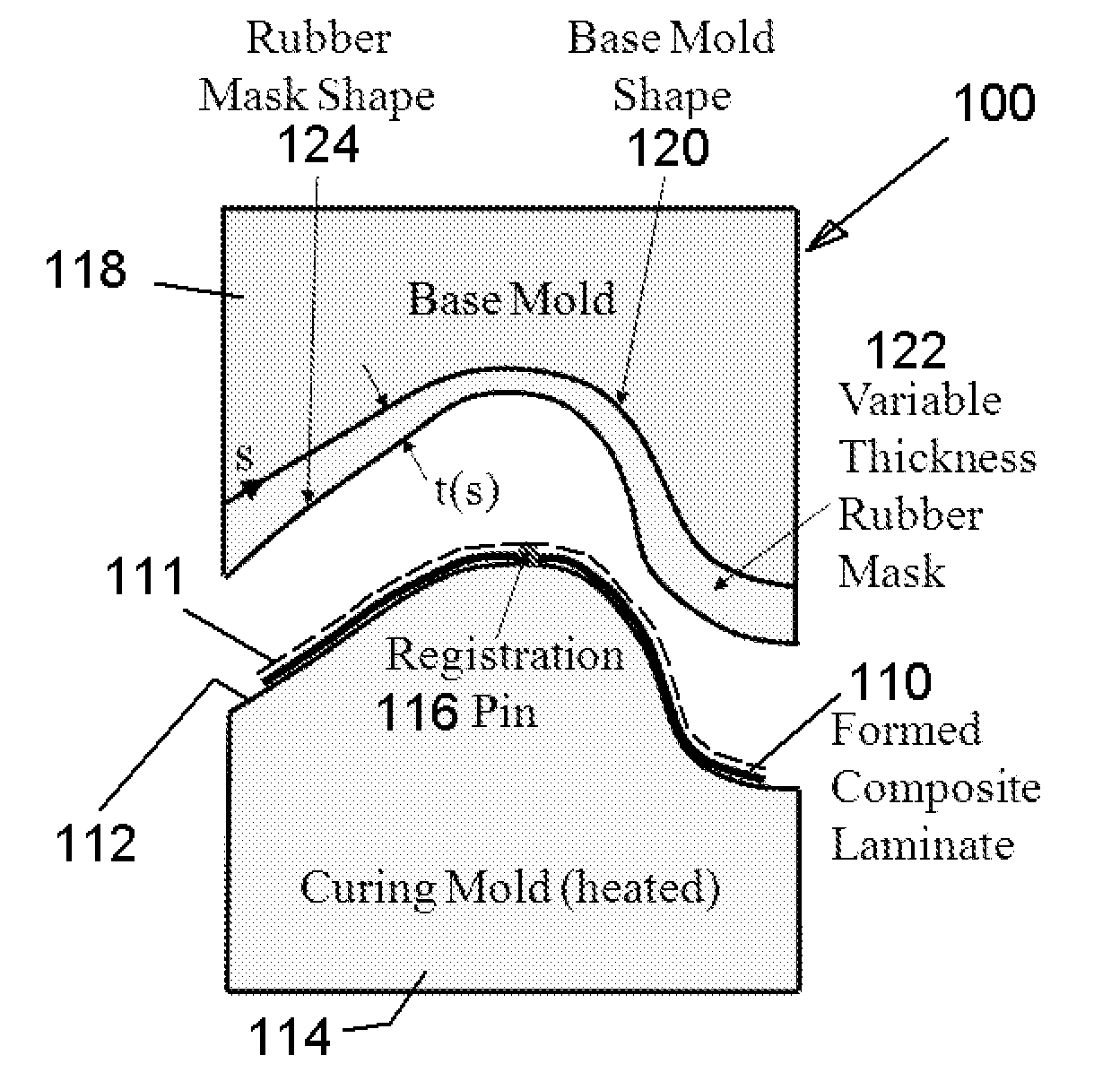
Consolidating and Curing of Thermoset Composite Parts by Pressing Between a Heated Rigid Mold and Customized Rubber-faced Mold
PatentActiveUS20100181018A1
Innovation
- A thermal pressing process using a heated rigid mold and a customized rubber-faced mold with a rubber mask to apply uniform pressure and minimize transverse stresses, allowing for the consolidation and curing of composite laminates without the need for expensive autoclaves or complex tooling, utilizing Finite Element Analysis (FEA) to optimize mold design for uniform hydrostatic pressure and rapid heat transfer.

Environmental Impact and Sustainability of Composite Manufacturing
The environmental implications of composite manufacturing processes vary significantly between compression molding and prepreg laminate production, with each method presenting distinct sustainability profiles that directly impact their viability in consumer goods applications. Manufacturing energy consumption represents a critical differentiator, as compression molding typically requires higher processing temperatures and pressures over extended cycle times, resulting in increased energy demands per unit produced. Conversely, prepreg systems often utilize lower-temperature curing processes, though the energy-intensive prepreg preparation phase must be considered in overall assessments.
Material waste generation patterns differ substantially between these manufacturing approaches. Compression molding processes frequently generate excess material through flash formation and trimming operations, though these thermoplastic-based wastes can often be reprocessed or recycled. Prepreg manufacturing typically produces more controlled material usage with minimal waste during layup operations, but thermoset-based prepreg waste presents greater disposal challenges due to limited recyclability options.
Carbon footprint analysis reveals complex trade-offs between manufacturing methods. Compression molding benefits from shorter supply chains when using locally sourced bulk molding compounds, reducing transportation-related emissions. However, the process energy intensity can offset these advantages. Prepreg systems may involve longer supply chains due to specialized material requirements, but their processing efficiency and material optimization can result in lower overall carbon emissions per finished component.
End-of-life considerations significantly influence sustainability assessments for consumer goods applications. Compression molded components using thermoplastic matrices offer superior recyclability potential, enabling circular economy approaches through mechanical recycling or chemical breakdown processes. Prepreg-based products, predominantly utilizing thermoset matrices, face greater end-of-life challenges, though emerging chemical recycling technologies and fiber recovery methods are beginning to address these limitations.
Regulatory compliance and environmental certification requirements increasingly favor manufacturing processes with demonstrated sustainability credentials. Both compression molding and prepreg laminate production must address volatile organic compound emissions, workplace safety standards, and waste management protocols, though specific requirements vary based on material systems and processing parameters employed in consumer goods manufacturing contexts.
Material waste generation patterns differ substantially between these manufacturing approaches. Compression molding processes frequently generate excess material through flash formation and trimming operations, though these thermoplastic-based wastes can often be reprocessed or recycled. Prepreg manufacturing typically produces more controlled material usage with minimal waste during layup operations, but thermoset-based prepreg waste presents greater disposal challenges due to limited recyclability options.
Carbon footprint analysis reveals complex trade-offs between manufacturing methods. Compression molding benefits from shorter supply chains when using locally sourced bulk molding compounds, reducing transportation-related emissions. However, the process energy intensity can offset these advantages. Prepreg systems may involve longer supply chains due to specialized material requirements, but their processing efficiency and material optimization can result in lower overall carbon emissions per finished component.
End-of-life considerations significantly influence sustainability assessments for consumer goods applications. Compression molded components using thermoplastic matrices offer superior recyclability potential, enabling circular economy approaches through mechanical recycling or chemical breakdown processes. Prepreg-based products, predominantly utilizing thermoset matrices, face greater end-of-life challenges, though emerging chemical recycling technologies and fiber recovery methods are beginning to address these limitations.
Regulatory compliance and environmental certification requirements increasingly favor manufacturing processes with demonstrated sustainability credentials. Both compression molding and prepreg laminate production must address volatile organic compound emissions, workplace safety standards, and waste management protocols, though specific requirements vary based on material systems and processing parameters employed in consumer goods manufacturing contexts.
Cost-Performance Trade-offs in Consumer Composite Applications
The cost-performance dynamics between compression molded and prepreg laminate composites in consumer applications present distinct economic profiles that significantly influence material selection strategies. Compression molding typically offers lower initial tooling costs and reduced material waste, making it attractive for high-volume consumer products where cost optimization is paramount. The process achieves material utilization rates exceeding 95%, compared to prepreg systems that often generate 15-25% waste during trimming and cutting operations.
Performance characteristics reveal nuanced trade-offs across different consumer application categories. Compression molded parts demonstrate excellent dimensional stability and surface finish quality, particularly beneficial for visible consumer components such as automotive interior panels and sporting goods. However, these parts typically exhibit lower fiber volume fractions, ranging from 45-55%, compared to prepreg laminates that achieve 55-65% fiber content, resulting in superior mechanical properties per unit weight.
Manufacturing scalability considerations heavily favor compression molding for consumer goods production. Cycle times for compression molded parts range from 2-8 minutes depending on part thickness, enabling high-volume production scenarios. Prepreg laminate processing requires longer cure cycles, typically 60-120 minutes in autoclave systems, though out-of-autoclave prepregs have reduced this to 15-45 minutes while maintaining acceptable performance levels.
Labor cost implications differ substantially between the two approaches. Compression molding operations can be highly automated, reducing direct labor requirements to 0.5-1.5 hours per part for complex geometries. Prepreg laminate fabrication demands skilled technicians for layup operations, typically requiring 3-8 hours of direct labor per part, though automated fiber placement technologies are beginning to address this cost driver in high-volume applications.
Material cost structures reveal compression molding advantages in commodity applications, with raw material costs typically 20-40% lower than equivalent prepreg systems. However, prepreg laminates justify their premium through enhanced performance characteristics, particularly in applications requiring superior fatigue resistance, impact tolerance, or weight optimization where the performance-to-cost ratio becomes favorable despite higher absolute material costs.
Performance characteristics reveal nuanced trade-offs across different consumer application categories. Compression molded parts demonstrate excellent dimensional stability and surface finish quality, particularly beneficial for visible consumer components such as automotive interior panels and sporting goods. However, these parts typically exhibit lower fiber volume fractions, ranging from 45-55%, compared to prepreg laminates that achieve 55-65% fiber content, resulting in superior mechanical properties per unit weight.
Manufacturing scalability considerations heavily favor compression molding for consumer goods production. Cycle times for compression molded parts range from 2-8 minutes depending on part thickness, enabling high-volume production scenarios. Prepreg laminate processing requires longer cure cycles, typically 60-120 minutes in autoclave systems, though out-of-autoclave prepregs have reduced this to 15-45 minutes while maintaining acceptable performance levels.
Labor cost implications differ substantially between the two approaches. Compression molding operations can be highly automated, reducing direct labor requirements to 0.5-1.5 hours per part for complex geometries. Prepreg laminate fabrication demands skilled technicians for layup operations, typically requiring 3-8 hours of direct labor per part, though automated fiber placement technologies are beginning to address this cost driver in high-volume applications.
Material cost structures reveal compression molding advantages in commodity applications, with raw material costs typically 20-40% lower than equivalent prepreg systems. However, prepreg laminates justify their premium through enhanced performance characteristics, particularly in applications requiring superior fatigue resistance, impact tolerance, or weight optimization where the performance-to-cost ratio becomes favorable despite higher absolute material costs.
Unlock deeper insights with PatSnap Eureka Quick Research — get a full tech report to explore trends and direct your research. Try now!
Generate Your Research Report Instantly with AI Agent
Supercharge your innovation with PatSnap Eureka AI Agent Platform!