

Comparing Reflectarray Antennas vs Phased Arrays for Satellite Use
MAY 12, 20269 MIN READ
Generate Your Research Report Instantly with AI Agent
Patsnap Eureka helps you evaluate technical feasibility & market potential.
Satellite Antenna Technology Background and Objectives
Satellite communication systems have undergone remarkable evolution since the launch of the first communication satellites in the 1960s. Early satellites relied on simple horn antennas and reflector dishes, which provided basic connectivity but lacked the flexibility and precision required for modern applications. The progression from fixed-beam antennas to mechanically steerable systems marked the first significant advancement, enabling satellites to redirect signals toward specific geographic regions.
The introduction of electronically steerable antenna arrays in the 1980s revolutionized satellite communications by eliminating mechanical components and enabling rapid beam switching. This technological leap paved the way for two dominant antenna architectures that define today's satellite systems: phased array antennas and reflectarray antennas. Both technologies emerged from the need to achieve precise beam control, high gain performance, and operational flexibility in the challenging space environment.
Phased array technology matured first, leveraging active electronic components to achieve beam steering through phase manipulation across multiple antenna elements. These systems demonstrated exceptional agility and multi-beam capabilities, making them attractive for military and commercial satellite applications requiring dynamic coverage patterns. However, the complexity and power consumption of active phased arrays created opportunities for alternative approaches.
Reflectarray antennas emerged as a hybrid solution, combining the high-gain characteristics of traditional reflector antennas with the beam-steering capabilities of phased arrays. This technology utilizes passive reflecting elements with variable phase characteristics, typically achieved through printed circuit techniques or micro-electromechanical systems (MEMS). The reflectarray approach promised reduced complexity and power consumption while maintaining competitive performance levels.
The current technological landscape presents satellite system designers with a critical decision between these two antenna architectures. Each approach offers distinct advantages and faces specific limitations that directly impact mission success, operational costs, and system performance. Understanding the fundamental differences between reflectarray and phased array technologies has become essential for optimizing satellite communication systems across diverse applications ranging from broadband internet provision to military communications and Earth observation missions.
The primary objective of this technological comparison is to establish a comprehensive framework for evaluating reflectarray antennas against phased arrays in satellite applications, enabling informed decision-making for future satellite system development and deployment strategies.
The introduction of electronically steerable antenna arrays in the 1980s revolutionized satellite communications by eliminating mechanical components and enabling rapid beam switching. This technological leap paved the way for two dominant antenna architectures that define today's satellite systems: phased array antennas and reflectarray antennas. Both technologies emerged from the need to achieve precise beam control, high gain performance, and operational flexibility in the challenging space environment.
Phased array technology matured first, leveraging active electronic components to achieve beam steering through phase manipulation across multiple antenna elements. These systems demonstrated exceptional agility and multi-beam capabilities, making them attractive for military and commercial satellite applications requiring dynamic coverage patterns. However, the complexity and power consumption of active phased arrays created opportunities for alternative approaches.
Reflectarray antennas emerged as a hybrid solution, combining the high-gain characteristics of traditional reflector antennas with the beam-steering capabilities of phased arrays. This technology utilizes passive reflecting elements with variable phase characteristics, typically achieved through printed circuit techniques or micro-electromechanical systems (MEMS). The reflectarray approach promised reduced complexity and power consumption while maintaining competitive performance levels.
The current technological landscape presents satellite system designers with a critical decision between these two antenna architectures. Each approach offers distinct advantages and faces specific limitations that directly impact mission success, operational costs, and system performance. Understanding the fundamental differences between reflectarray and phased array technologies has become essential for optimizing satellite communication systems across diverse applications ranging from broadband internet provision to military communications and Earth observation missions.
The primary objective of this technological comparison is to establish a comprehensive framework for evaluating reflectarray antennas against phased arrays in satellite applications, enabling informed decision-making for future satellite system development and deployment strategies.
Market Demand for Advanced Satellite Communication Systems
The global satellite communication market is experiencing unprecedented growth driven by increasing demand for high-speed internet connectivity, particularly in underserved regions. Traditional terrestrial infrastructure limitations have created substantial opportunities for satellite-based solutions to bridge the digital divide. Remote areas, maritime operations, and aviation sectors represent primary growth drivers requiring reliable, high-throughput communication systems.
Low Earth Orbit constellation deployments have fundamentally transformed market dynamics, creating demand for advanced antenna technologies capable of supporting dynamic beam steering and multi-satellite tracking. These constellations require sophisticated ground terminals and satellite-to-satellite communication systems that can maintain continuous connectivity while managing rapid orbital movements and frequent handovers between satellites.
Military and defense applications constitute a significant market segment demanding secure, jam-resistant communication capabilities. Modern warfare increasingly relies on satellite communications for command and control operations, intelligence gathering, and real-time battlefield coordination. These applications require antenna systems with enhanced performance characteristics including low profile designs, rapid beam switching, and electronic countermeasure resistance.
Commercial sectors including telecommunications, broadcasting, and Internet of Things applications are driving demand for cost-effective, scalable antenna solutions. The emergence of satellite internet services targeting consumer markets has created pressure for mass-producible antenna technologies that can deliver high performance at reduced costs. Manufacturing scalability and simplified installation procedures have become critical market requirements.
Emerging applications in autonomous vehicles, smart cities, and industrial automation are creating new demand patterns for satellite communication systems. These applications require antenna technologies capable of supporting low-latency communications, precise positioning services, and seamless integration with terrestrial networks. The convergence of satellite and terrestrial communication systems is driving requirements for adaptive antenna technologies.
Market growth is further accelerated by increasing data consumption patterns and the need for ubiquitous connectivity. Enterprise customers require reliable backup communication systems and primary connectivity solutions for distributed operations. The growing emphasis on disaster recovery and emergency communication capabilities has expanded market opportunities for robust satellite communication systems capable of operating under adverse conditions.
Low Earth Orbit constellation deployments have fundamentally transformed market dynamics, creating demand for advanced antenna technologies capable of supporting dynamic beam steering and multi-satellite tracking. These constellations require sophisticated ground terminals and satellite-to-satellite communication systems that can maintain continuous connectivity while managing rapid orbital movements and frequent handovers between satellites.
Military and defense applications constitute a significant market segment demanding secure, jam-resistant communication capabilities. Modern warfare increasingly relies on satellite communications for command and control operations, intelligence gathering, and real-time battlefield coordination. These applications require antenna systems with enhanced performance characteristics including low profile designs, rapid beam switching, and electronic countermeasure resistance.
Commercial sectors including telecommunications, broadcasting, and Internet of Things applications are driving demand for cost-effective, scalable antenna solutions. The emergence of satellite internet services targeting consumer markets has created pressure for mass-producible antenna technologies that can deliver high performance at reduced costs. Manufacturing scalability and simplified installation procedures have become critical market requirements.
Emerging applications in autonomous vehicles, smart cities, and industrial automation are creating new demand patterns for satellite communication systems. These applications require antenna technologies capable of supporting low-latency communications, precise positioning services, and seamless integration with terrestrial networks. The convergence of satellite and terrestrial communication systems is driving requirements for adaptive antenna technologies.
Market growth is further accelerated by increasing data consumption patterns and the need for ubiquitous connectivity. Enterprise customers require reliable backup communication systems and primary connectivity solutions for distributed operations. The growing emphasis on disaster recovery and emergency communication capabilities has expanded market opportunities for robust satellite communication systems capable of operating under adverse conditions.
Current State of Reflectarray vs Phased Array Technologies
Reflectarray antennas have emerged as a compelling alternative to traditional phased arrays in satellite applications, representing a significant evolution in antenna technology. Current reflectarray implementations utilize printed circuit board technology with variable-sized patches or phase-shifting elements arranged on a planar surface. These systems achieve beam steering through passive phase control, eliminating the need for complex feed networks that characterize phased arrays.
Modern phased array systems for satellite applications predominantly employ active electronically scanned arrays (AESA) with integrated transmit/receive modules. Leading implementations feature gallium arsenide (GaAs) and gallium nitride (GaN) semiconductor technologies, enabling high-power operation and wide bandwidth capabilities. Current phased arrays demonstrate beam steering ranges exceeding ±60 degrees with sub-millisecond switching speeds.
Contemporary reflectarray designs face significant challenges in bandwidth limitations, typically achieving 10-15% fractional bandwidth compared to phased arrays' 30-40% capability. However, recent innovations in multi-layer reflectarray architectures and novel unit cell designs have begun addressing these constraints. Advanced reflectarray systems now incorporate liquid crystal and MEMS-based reconfigurable elements, enabling dynamic beam control previously exclusive to phased arrays.
Manufacturing maturity differs substantially between technologies. Phased array production benefits from decades of refinement in semiconductor fabrication and module integration, resulting in established supply chains and quality control processes. Reflectarray manufacturing, while simpler in concept, still faces challenges in achieving precise phase control across large apertures and maintaining performance consistency across temperature variations.
Power consumption represents a critical differentiator in current implementations. Reflectarray systems operate passively, consuming power only for control electronics, while phased arrays require significant power for amplifiers and phase shifters. Modern satellite phased arrays typically consume 50-100 watts per square meter of aperture, whereas reflectarrays operate with less than 5 watts per square meter for reconfigurable designs.
Integration complexity varies significantly between approaches. Current phased array systems require sophisticated beamforming networks, thermal management systems, and distributed power architectures. Reflectarray integration focuses primarily on mechanical precision and control signal distribution, resulting in reduced system complexity and potentially higher reliability in space environments.
Performance metrics reveal complementary strengths. Phased arrays excel in multi-beam capability, rapid beam switching, and wide bandwidth operation. Current reflectarray systems demonstrate superior aperture efficiency, lower mass per unit area, and reduced thermal signatures, making them attractive for specific satellite mission profiles requiring high-gain, narrow-beam applications.
Modern phased array systems for satellite applications predominantly employ active electronically scanned arrays (AESA) with integrated transmit/receive modules. Leading implementations feature gallium arsenide (GaAs) and gallium nitride (GaN) semiconductor technologies, enabling high-power operation and wide bandwidth capabilities. Current phased arrays demonstrate beam steering ranges exceeding ±60 degrees with sub-millisecond switching speeds.
Contemporary reflectarray designs face significant challenges in bandwidth limitations, typically achieving 10-15% fractional bandwidth compared to phased arrays' 30-40% capability. However, recent innovations in multi-layer reflectarray architectures and novel unit cell designs have begun addressing these constraints. Advanced reflectarray systems now incorporate liquid crystal and MEMS-based reconfigurable elements, enabling dynamic beam control previously exclusive to phased arrays.
Manufacturing maturity differs substantially between technologies. Phased array production benefits from decades of refinement in semiconductor fabrication and module integration, resulting in established supply chains and quality control processes. Reflectarray manufacturing, while simpler in concept, still faces challenges in achieving precise phase control across large apertures and maintaining performance consistency across temperature variations.
Power consumption represents a critical differentiator in current implementations. Reflectarray systems operate passively, consuming power only for control electronics, while phased arrays require significant power for amplifiers and phase shifters. Modern satellite phased arrays typically consume 50-100 watts per square meter of aperture, whereas reflectarrays operate with less than 5 watts per square meter for reconfigurable designs.
Integration complexity varies significantly between approaches. Current phased array systems require sophisticated beamforming networks, thermal management systems, and distributed power architectures. Reflectarray integration focuses primarily on mechanical precision and control signal distribution, resulting in reduced system complexity and potentially higher reliability in space environments.
Performance metrics reveal complementary strengths. Phased arrays excel in multi-beam capability, rapid beam switching, and wide bandwidth operation. Current reflectarray systems demonstrate superior aperture efficiency, lower mass per unit area, and reduced thermal signatures, making them attractive for specific satellite mission profiles requiring high-gain, narrow-beam applications.
Existing Reflectarray and Phased Array Solutions
01 Reflectarray antenna design and configuration
Reflectarray antennas utilize an array of reflecting elements to redirect electromagnetic waves in desired directions. These antennas combine the advantages of reflector antennas and phased arrays, offering simplified feed structures and reduced complexity compared to traditional phased arrays. The reflecting elements can be designed with various geometries and materials to achieve specific radiation patterns and beam steering capabilities.- Reflectarray antenna design and configuration: Reflectarray antennas utilize an array of reflecting elements to redirect electromagnetic waves in desired directions. These antennas combine the advantages of reflector antennas and phased arrays, offering simplified feed structures and reduced complexity compared to traditional phased arrays. The reflecting elements can be designed with various geometries and materials to achieve specific radiation patterns and beam steering capabilities.
- Phased array beam steering and control systems: Phased array antennas employ multiple antenna elements with controllable phase relationships to electronically steer beams without mechanical movement. Advanced control systems manage the phase and amplitude of individual elements to achieve precise beam direction, beam shaping, and multiple beam formation. These systems enable rapid beam switching and adaptive beamforming for various communication and radar applications.
- Element design and feeding mechanisms: The individual elements in both reflectarray and phased array systems require careful design optimization for impedance matching, bandwidth, and radiation characteristics. Various feeding mechanisms including microstrip lines, waveguides, and corporate feed networks are employed to distribute signals to array elements. Element spacing, coupling effects, and mutual impedance considerations are critical for achieving desired array performance.
- Multi-band and wideband array technologies: Advanced array antenna systems are designed to operate across multiple frequency bands or wide frequency ranges to support diverse communication standards and applications. These systems incorporate frequency-selective surfaces, multi-layer structures, and broadband elements to achieve simultaneous operation at different frequencies while maintaining beam steering capabilities and radiation performance across the operational bandwidth.
- Integration and packaging solutions: Modern reflectarray and phased array systems require sophisticated integration techniques to combine antenna elements with control electronics, power management, and signal processing components. Packaging solutions address thermal management, mechanical stability, and electromagnetic compatibility while maintaining compact form factors. These integrated systems enable deployment in various platforms including satellites, aircraft, and ground-based installations.
02 Phased array beam steering and control systems
Phased array antennas employ multiple antenna elements with controllable phase relationships to electronically steer beams without mechanical movement. Advanced control systems manage the phase and amplitude of individual elements to achieve precise beam direction, null steering, and adaptive pattern formation. These systems enable rapid beam switching and multiple simultaneous beam generation for various applications.Expand Specific Solutions03 Element design and feeding networks
The design of individual antenna elements and their feeding networks is crucial for optimal performance in both reflectarray and phased array systems. Various element types including patches, dipoles, and metamaterial structures are employed to achieve desired frequency response and polarization characteristics. Feeding networks distribute signals to array elements while maintaining proper phase and amplitude relationships.Expand Specific Solutions04 Multi-band and wideband operation
Modern antenna arrays are designed to operate across multiple frequency bands or wide frequency ranges to support diverse communication requirements. Techniques include multi-layer structures, frequency selective surfaces, and adaptive element designs that maintain performance across extended bandwidths. These approaches enable single antenna systems to serve multiple applications simultaneously.Expand Specific Solutions05 Manufacturing and integration techniques
Advanced manufacturing processes and integration methods are essential for producing high-performance antenna arrays. These include printed circuit board fabrication, semiconductor integration, and novel assembly techniques that ensure precise element positioning and reliable electrical connections. Integration considerations encompass thermal management, mechanical stability, and electromagnetic compatibility with surrounding systems.Expand Specific Solutions
Key Players in Satellite Antenna Manufacturing Industry
The satellite antenna technology sector is experiencing rapid evolution as the industry transitions from traditional phased arrays to more cost-effective reflectarray solutions. The market demonstrates significant growth potential driven by increasing satellite constellation deployments and demand for high-throughput communication systems. Technology maturity varies considerably across market participants, with established aerospace giants like Boeing, Raytheon, and Thales leading in proven phased array implementations, while companies such as ViaSat and Gilat Satellite Networks advance reflectarray innovations. Research institutions including Harbin Institute of Technology and University of Southern California contribute fundamental breakthroughs, while government entities like NASA, ESA, and various defense organizations drive requirements and funding. The competitive landscape shows a clear bifurcation between mature phased array technologies deployed by traditional defense contractors and emerging reflectarray solutions being developed by specialized satellite communication companies and academic institutions.
The Boeing Co.
Technical Solution: Boeing has developed advanced phased array antenna systems for satellite communications, incorporating active electronically scanned array (AESA) technology that enables rapid beam steering and multi-beam capabilities. Their satellite antenna solutions feature digital beamforming algorithms that provide precise signal control and interference mitigation. The company's phased array systems utilize gallium arsenide (GaAs) and gallium nitride (GaN) semiconductor technologies to achieve high power efficiency and wide bandwidth operation. Boeing's antenna designs integrate with their satellite bus architectures, offering scalable solutions from small LEO constellations to large GEO platforms. Their systems demonstrate beam steering capabilities across ±60° scan angles with minimal gain degradation, supporting both commercial and military satellite applications.
Strengths: Proven track record in large-scale satellite programs, advanced digital beamforming capabilities, integration expertise. Weaknesses: Higher power consumption compared to reflectarrays, complex manufacturing processes, higher cost structure.
Raytheon Co.
Technical Solution: Raytheon specializes in electronically steered phased array antennas for satellite applications, leveraging their expertise in radar and communication systems. Their satellite phased arrays incorporate advanced T/R modules with integrated phase shifters and amplifiers, enabling independent control of each antenna element. The company's solutions feature adaptive beamforming algorithms that optimize signal-to-noise ratios and provide anti-jamming capabilities. Raytheon's phased array systems support multi-frequency operations across C, X, Ku, and Ka bands, with modular architectures that allow for scalable deployment. Their antenna systems integrate with software-defined radio platforms, enabling reconfigurable beam patterns and dynamic frequency allocation for enhanced satellite communication flexibility.
Strengths: Advanced anti-jamming capabilities, multi-band operation, modular scalable design, strong defense heritage. Weaknesses: High complexity and cost, significant power requirements, limited commercial market penetration.
Core Patents in Reflectarray and Phased Array Design
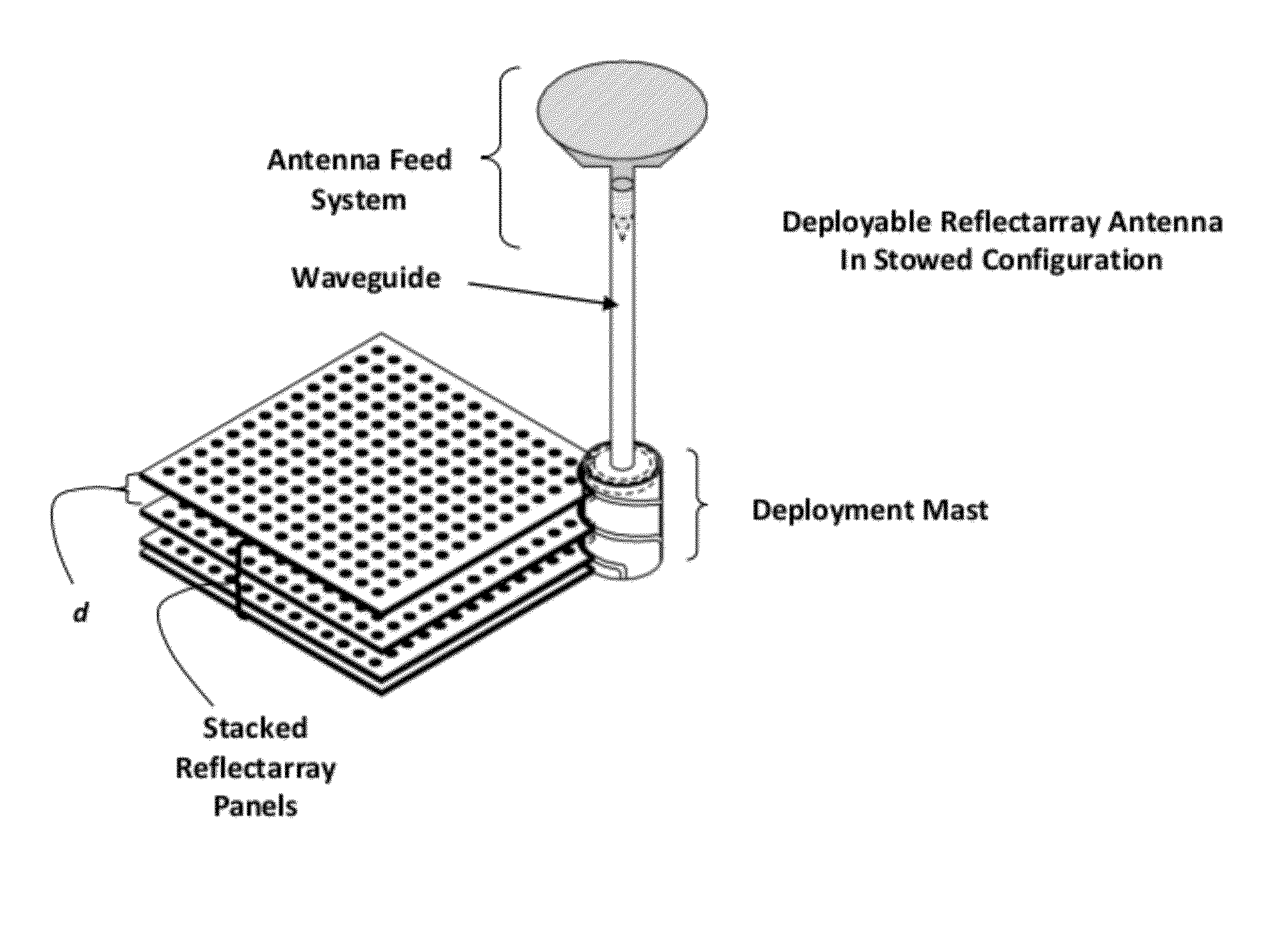
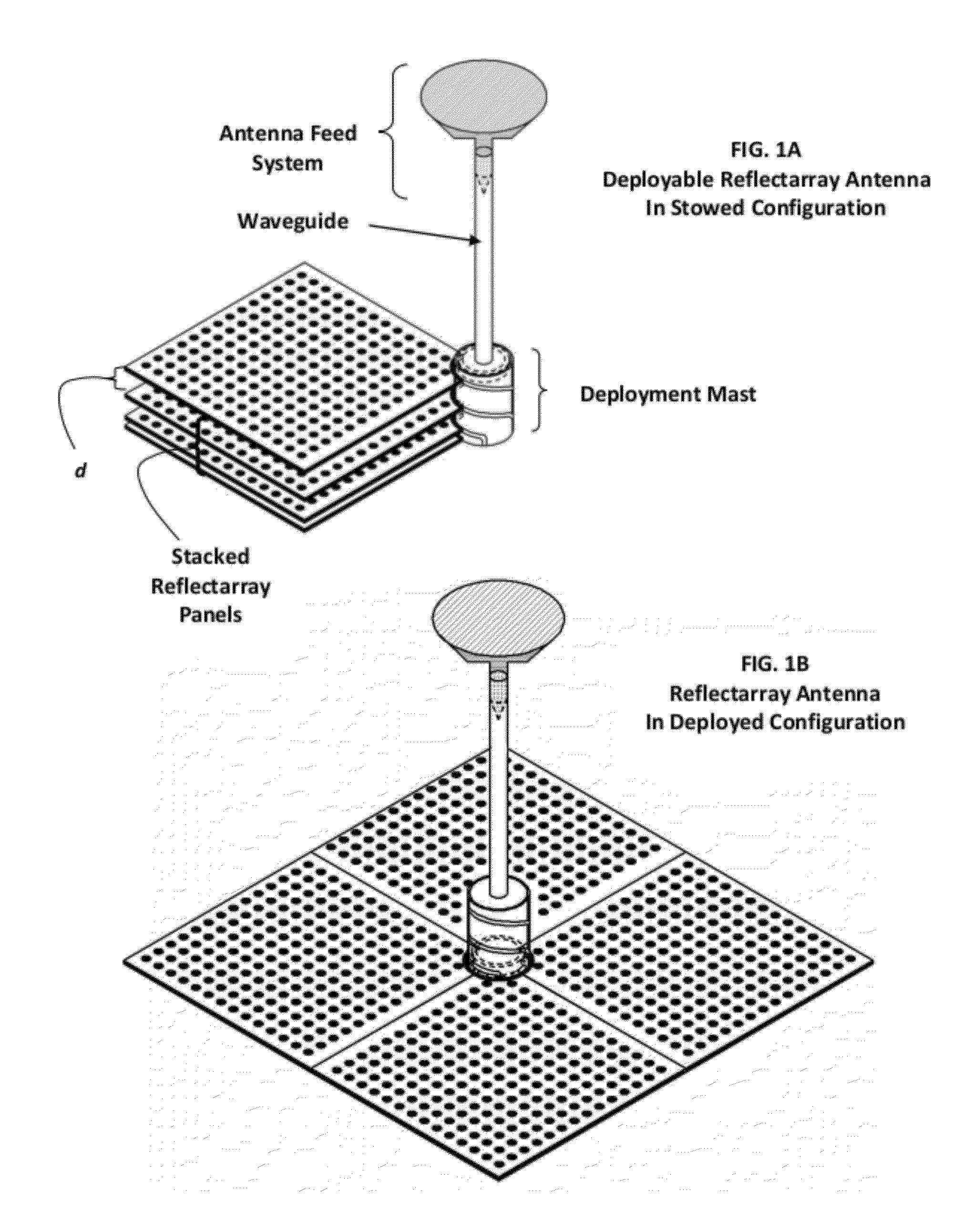
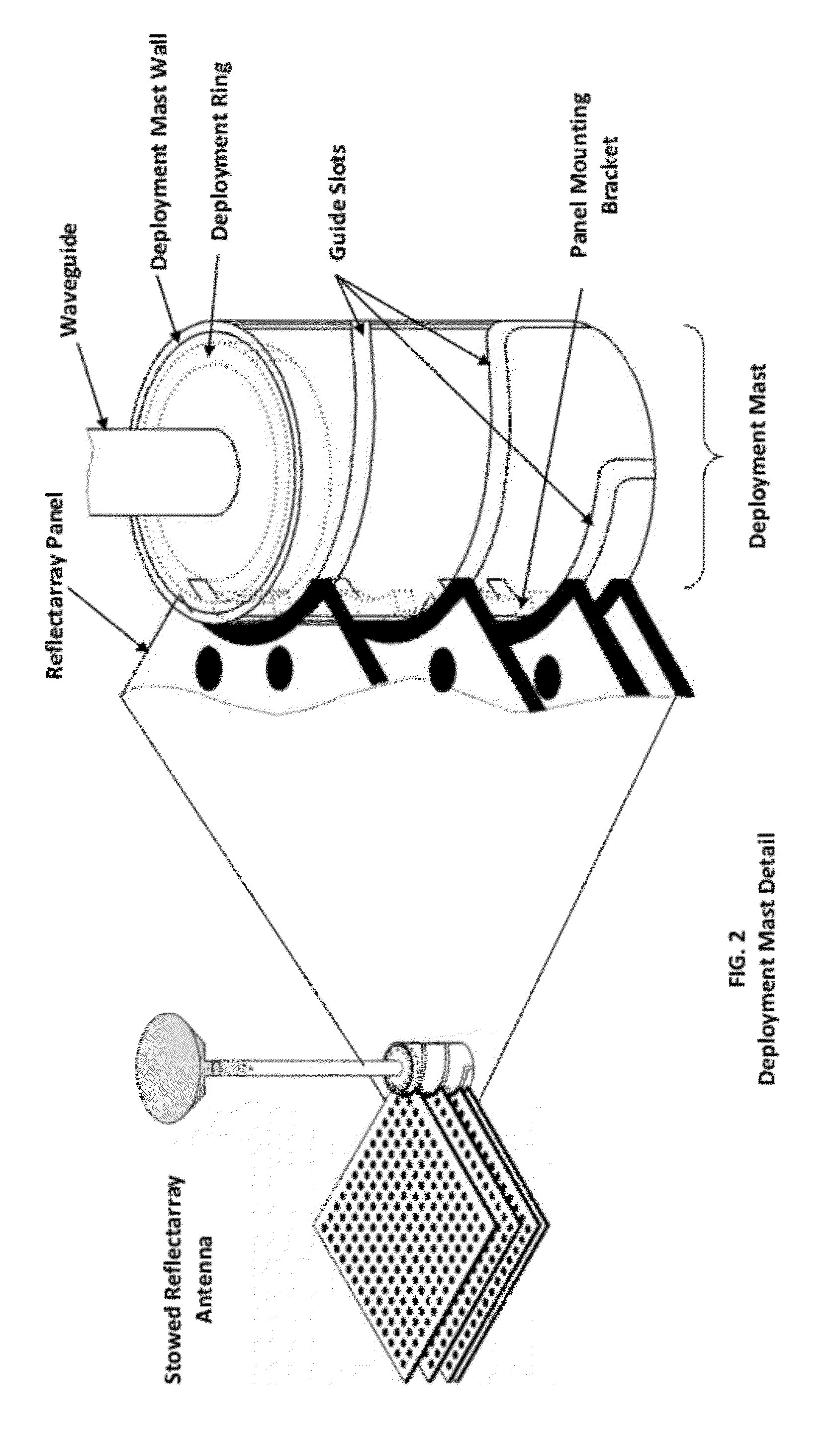
Deployable reflectarray antenna system
PatentInactiveUS8289221B1
Innovation
- A deployable reflectarray antenna system is designed with a simple deployment mechanism, where a flat reflectarray antenna is subdivided into panels that stack and deploy using a hollow cylindrical mechanism with guide slots and a deployment ring, allowing for a compact stowed configuration and a larger operational area with reduced surface area requirements.

High resolution scanning reflectarray antenna
PatentInactiveUS6081235A
Innovation
- A High Resolution Scanning Reflectarray Antenna (HRSRA) utilizing microstrip patch elements with ferroelectric films for continuous phase shifting, integrated phase shifters on the same surface as antenna elements, and a space-fed approach, allowing for full beam steering with reduced manufacturing costs and power loss.


Space Regulatory Framework for Satellite Communications
The regulatory landscape governing satellite communications presents a complex framework that directly impacts the deployment and operation of both reflectarray and phased array antenna systems. The International Telecommunication Union (ITU) serves as the primary global authority, establishing Radio Regulations that define frequency allocations, orbital slot assignments, and coordination procedures for satellite networks. These regulations create fundamental constraints that influence antenna design choices and operational parameters.
Frequency allocation regulations significantly affect antenna selection decisions for satellite applications. The ITU divides radio spectrum into specific bands for satellite services, including Fixed Satellite Service (FSS), Mobile Satellite Service (MSS), and Broadcasting Satellite Service (BSS). Each band carries distinct technical requirements regarding antenna gain patterns, sidelobe suppression levels, and interference mitigation capabilities. Phased arrays typically demonstrate superior compliance with stringent sidelobe regulations due to their precise beam control capabilities, while reflectarray antennas may require additional design considerations to meet regulatory emission masks.
Orbital coordination requirements impose critical operational constraints on satellite antenna systems. The ITU coordination process mandates specific antenna performance criteria to prevent harmful interference between satellite networks. These include minimum antenna gain requirements, maximum off-axis emission levels, and precise pointing accuracy specifications. Phased arrays offer advantages in meeting dynamic coordination requirements through electronic beam steering, enabling rapid compliance with changing operational constraints without mechanical repositioning.
National regulatory authorities implement additional layer requirements beyond ITU frameworks. The Federal Communications Commission (FCC) in the United States, the European Communications Committee (ECC), and other regional bodies establish supplementary technical standards for satellite operations within their jurisdictions. These regulations often specify enhanced antenna performance requirements, including adaptive interference mitigation capabilities and compliance with space debris mitigation guidelines.
Emerging regulatory trends focus on spectrum efficiency and interference management, particularly relevant for next-generation satellite constellations. New regulations emphasize dynamic spectrum access, cognitive radio capabilities, and real-time interference monitoring. These evolving requirements favor advanced antenna technologies capable of adaptive beamforming and interference nulling, areas where phased arrays demonstrate technological advantages over traditional reflectarray implementations.
Compliance verification procedures require comprehensive testing and documentation of antenna performance characteristics. Regulatory authorities mandate specific measurement protocols for antenna patterns, gain stability, and interference rejection capabilities. The complexity of these verification processes varies significantly between antenna technologies, with phased arrays requiring more sophisticated calibration and monitoring systems to maintain regulatory compliance throughout operational lifetime.
Frequency allocation regulations significantly affect antenna selection decisions for satellite applications. The ITU divides radio spectrum into specific bands for satellite services, including Fixed Satellite Service (FSS), Mobile Satellite Service (MSS), and Broadcasting Satellite Service (BSS). Each band carries distinct technical requirements regarding antenna gain patterns, sidelobe suppression levels, and interference mitigation capabilities. Phased arrays typically demonstrate superior compliance with stringent sidelobe regulations due to their precise beam control capabilities, while reflectarray antennas may require additional design considerations to meet regulatory emission masks.
Orbital coordination requirements impose critical operational constraints on satellite antenna systems. The ITU coordination process mandates specific antenna performance criteria to prevent harmful interference between satellite networks. These include minimum antenna gain requirements, maximum off-axis emission levels, and precise pointing accuracy specifications. Phased arrays offer advantages in meeting dynamic coordination requirements through electronic beam steering, enabling rapid compliance with changing operational constraints without mechanical repositioning.
National regulatory authorities implement additional layer requirements beyond ITU frameworks. The Federal Communications Commission (FCC) in the United States, the European Communications Committee (ECC), and other regional bodies establish supplementary technical standards for satellite operations within their jurisdictions. These regulations often specify enhanced antenna performance requirements, including adaptive interference mitigation capabilities and compliance with space debris mitigation guidelines.
Emerging regulatory trends focus on spectrum efficiency and interference management, particularly relevant for next-generation satellite constellations. New regulations emphasize dynamic spectrum access, cognitive radio capabilities, and real-time interference monitoring. These evolving requirements favor advanced antenna technologies capable of adaptive beamforming and interference nulling, areas where phased arrays demonstrate technological advantages over traditional reflectarray implementations.
Compliance verification procedures require comprehensive testing and documentation of antenna performance characteristics. Regulatory authorities mandate specific measurement protocols for antenna patterns, gain stability, and interference rejection capabilities. The complexity of these verification processes varies significantly between antenna technologies, with phased arrays requiring more sophisticated calibration and monitoring systems to maintain regulatory compliance throughout operational lifetime.
Cost-Performance Trade-offs in Satellite Antenna Selection
The selection of satellite antenna technology involves critical cost-performance considerations that directly impact mission success and economic viability. Reflectarray antennas and phased arrays represent two distinct approaches with fundamentally different cost structures and performance characteristics that must be carefully evaluated against specific mission requirements.
Initial development costs favor reflectarray antennas significantly, with manufacturing expenses typically 40-60% lower than equivalent phased array systems. This cost advantage stems from their simpler architecture, requiring fewer active components and reduced complexity in RF circuitry. Reflectarrays utilize passive elements that can be manufactured using standard PCB fabrication techniques, eliminating the need for expensive phase shifters and amplifiers required in active phased arrays.
Manufacturing scalability presents contrasting scenarios for both technologies. Reflectarray production benefits from established fabrication processes and materials, enabling cost-effective scaling for multiple units. However, phased arrays, despite higher initial costs, demonstrate superior economies of scale in high-volume production due to standardized component integration and automated assembly processes.
Performance-to-cost ratios reveal nuanced trade-offs across different operational parameters. Reflectarrays deliver excellent gain performance and beam shaping capabilities at lower costs but sacrifice beam steering agility and adaptive functionality. Phased arrays command premium pricing but provide unmatched flexibility in beam management, multi-beam operation, and real-time reconfiguration capabilities essential for advanced satellite communications.
Lifecycle cost analysis introduces additional complexity, as phased arrays typically require more sophisticated control systems and higher power consumption, increasing operational expenses. Conversely, reflectarrays offer lower maintenance requirements and reduced power demands, contributing to favorable total cost of ownership over extended mission durations.
Mission-specific requirements ultimately determine optimal cost-performance balance. Fixed-beam applications with stringent cost constraints favor reflectarray solutions, while missions demanding adaptive beamforming, interference mitigation, or multi-target tracking justify the premium investment in phased array technology. The decision framework must incorporate not only initial capital expenditure but also operational costs, mission flexibility requirements, and long-term technological evolution considerations.
Initial development costs favor reflectarray antennas significantly, with manufacturing expenses typically 40-60% lower than equivalent phased array systems. This cost advantage stems from their simpler architecture, requiring fewer active components and reduced complexity in RF circuitry. Reflectarrays utilize passive elements that can be manufactured using standard PCB fabrication techniques, eliminating the need for expensive phase shifters and amplifiers required in active phased arrays.
Manufacturing scalability presents contrasting scenarios for both technologies. Reflectarray production benefits from established fabrication processes and materials, enabling cost-effective scaling for multiple units. However, phased arrays, despite higher initial costs, demonstrate superior economies of scale in high-volume production due to standardized component integration and automated assembly processes.
Performance-to-cost ratios reveal nuanced trade-offs across different operational parameters. Reflectarrays deliver excellent gain performance and beam shaping capabilities at lower costs but sacrifice beam steering agility and adaptive functionality. Phased arrays command premium pricing but provide unmatched flexibility in beam management, multi-beam operation, and real-time reconfiguration capabilities essential for advanced satellite communications.
Lifecycle cost analysis introduces additional complexity, as phased arrays typically require more sophisticated control systems and higher power consumption, increasing operational expenses. Conversely, reflectarrays offer lower maintenance requirements and reduced power demands, contributing to favorable total cost of ownership over extended mission durations.
Mission-specific requirements ultimately determine optimal cost-performance balance. Fixed-beam applications with stringent cost constraints favor reflectarray solutions, while missions demanding adaptive beamforming, interference mitigation, or multi-target tracking justify the premium investment in phased array technology. The decision framework must incorporate not only initial capital expenditure but also operational costs, mission flexibility requirements, and long-term technological evolution considerations.
Unlock deeper insights with Patsnap Eureka Quick Research — get a full tech report to explore trends and direct your research. Try now!
Generate Your Research Report Instantly with AI Agent
Supercharge your innovation with Patsnap Eureka AI Agent Platform!