

Connecting Rod Shape Optimization for Minimizing Stress Risers
FEB 13, 20269 MIN READ
Generate Your Research Report Instantly with AI Agent
PatSnap Eureka helps you evaluate technical feasibility & market potential.
Connecting Rod Design Evolution and Stress Optimization Goals
Connecting rods have served as critical load-bearing components in reciprocating machinery since the early days of the Industrial Revolution. Initially manufactured through simple forging processes, early connecting rod designs prioritized basic functionality over stress distribution optimization. The geometric configurations were largely dictated by manufacturing constraints rather than mechanical performance considerations, resulting in components prone to premature failure at stress concentration points.
The evolution of connecting rod design accelerated significantly during the mid-20th century as internal combustion engines demanded higher power densities and operational speeds. Engineers recognized that traditional I-beam and rectangular cross-sections created substantial stress risers at fillet radii, bolt holes, and transition zones between the shank and bearing areas. These localized stress concentrations became primary failure initiation sites, limiting component durability and engine reliability.
Modern connecting rod development has shifted toward comprehensive stress optimization methodologies. Advanced computational tools including finite element analysis have enabled designers to visualize stress distribution patterns with unprecedented accuracy. This technological capability has transformed design philosophy from experience-based approaches to data-driven optimization strategies that systematically minimize peak stress values while maintaining structural integrity.
Contemporary design objectives center on achieving optimal stress homogeneity throughout the component geometry. The primary goal involves redistributing loads to eliminate sharp stress gradients that accelerate fatigue crack propagation. This requires careful attention to geometric transitions, surface curvature continuity, and cross-sectional area variations. Engineers now target specific stress concentration factor reductions, typically aiming for values below 1.5 at critical locations.
The integration of lightweight materials and manufacturing innovations has further expanded optimization possibilities. Powder metallurgy, precision forging, and additive manufacturing techniques enable complex geometries previously impossible to produce. These capabilities allow designers to implement organic shapes with smooth stress flow paths, fundamentally reimagining connecting rod architecture beyond conventional prismatic forms.
Current research emphasizes multi-objective optimization frameworks that balance stress minimization against competing requirements including weight reduction, manufacturing feasibility, and cost constraints. Advanced algorithms explore vast design spaces to identify Pareto-optimal solutions that represent the best achievable compromises. This holistic approach ensures that stress optimization efforts align with broader performance and economic objectives essential for commercial viability.
The evolution of connecting rod design accelerated significantly during the mid-20th century as internal combustion engines demanded higher power densities and operational speeds. Engineers recognized that traditional I-beam and rectangular cross-sections created substantial stress risers at fillet radii, bolt holes, and transition zones between the shank and bearing areas. These localized stress concentrations became primary failure initiation sites, limiting component durability and engine reliability.
Modern connecting rod development has shifted toward comprehensive stress optimization methodologies. Advanced computational tools including finite element analysis have enabled designers to visualize stress distribution patterns with unprecedented accuracy. This technological capability has transformed design philosophy from experience-based approaches to data-driven optimization strategies that systematically minimize peak stress values while maintaining structural integrity.
Contemporary design objectives center on achieving optimal stress homogeneity throughout the component geometry. The primary goal involves redistributing loads to eliminate sharp stress gradients that accelerate fatigue crack propagation. This requires careful attention to geometric transitions, surface curvature continuity, and cross-sectional area variations. Engineers now target specific stress concentration factor reductions, typically aiming for values below 1.5 at critical locations.
The integration of lightweight materials and manufacturing innovations has further expanded optimization possibilities. Powder metallurgy, precision forging, and additive manufacturing techniques enable complex geometries previously impossible to produce. These capabilities allow designers to implement organic shapes with smooth stress flow paths, fundamentally reimagining connecting rod architecture beyond conventional prismatic forms.
Current research emphasizes multi-objective optimization frameworks that balance stress minimization against competing requirements including weight reduction, manufacturing feasibility, and cost constraints. Advanced algorithms explore vast design spaces to identify Pareto-optimal solutions that represent the best achievable compromises. This holistic approach ensures that stress optimization efforts align with broader performance and economic objectives essential for commercial viability.
Market Demand for High-Performance Connecting Rods
The automotive and aerospace industries are experiencing unprecedented demand for high-performance connecting rods driven by stringent efficiency regulations and performance requirements. Internal combustion engines continue to dominate the automotive powertrain landscape, with manufacturers pursuing higher power densities and improved fuel economy. This pursuit necessitates connecting rods capable of withstanding extreme mechanical stresses while maintaining minimal weight, directly correlating with the critical need for optimized geometries that eliminate stress concentration points.
Racing and motorsport applications represent a particularly demanding market segment where connecting rod failure can result in catastrophic engine damage and competitive disadvantages. Professional racing teams and performance engine builders actively seek components with superior fatigue resistance and reliability under extreme operating conditions. The optimization of connecting rod shapes to minimize stress risers has become a competitive differentiator in this high-stakes environment, where marginal performance gains translate to significant advantages.
The aerospace sector presents another substantial market opportunity, particularly in general aviation and unmanned aerial vehicle propulsion systems. Weight reduction remains paramount in aircraft design, yet safety margins cannot be compromised. Connecting rods with optimized geometries that distribute loads more effectively enable lighter engine designs without sacrificing structural integrity. This dual requirement of weight minimization and stress management aligns precisely with shape optimization methodologies targeting stress riser elimination.
Heavy-duty diesel engine manufacturers face increasing pressure to extend component service life while meeting emissions standards that demand higher combustion pressures and temperatures. These operating conditions amplify stress concentrations at geometric discontinuities, making traditional connecting rod designs increasingly inadequate. The market demand for redesigned components that address these stress concentration issues through advanced shape optimization has grown substantially as engine durability expectations increase.
Emerging markets in hybrid powertrains and range-extender applications also contribute to demand growth. These systems often operate under unconventional duty cycles with frequent start-stop events, creating unique fatigue loading patterns. Connecting rods optimized to minimize stress risers demonstrate superior performance in these applications, driving adoption among manufacturers developing next-generation powertrain architectures. The convergence of regulatory pressures, performance requirements, and reliability expectations across multiple industries establishes a robust and expanding market for advanced connecting rod optimization technologies.
Racing and motorsport applications represent a particularly demanding market segment where connecting rod failure can result in catastrophic engine damage and competitive disadvantages. Professional racing teams and performance engine builders actively seek components with superior fatigue resistance and reliability under extreme operating conditions. The optimization of connecting rod shapes to minimize stress risers has become a competitive differentiator in this high-stakes environment, where marginal performance gains translate to significant advantages.
The aerospace sector presents another substantial market opportunity, particularly in general aviation and unmanned aerial vehicle propulsion systems. Weight reduction remains paramount in aircraft design, yet safety margins cannot be compromised. Connecting rods with optimized geometries that distribute loads more effectively enable lighter engine designs without sacrificing structural integrity. This dual requirement of weight minimization and stress management aligns precisely with shape optimization methodologies targeting stress riser elimination.
Heavy-duty diesel engine manufacturers face increasing pressure to extend component service life while meeting emissions standards that demand higher combustion pressures and temperatures. These operating conditions amplify stress concentrations at geometric discontinuities, making traditional connecting rod designs increasingly inadequate. The market demand for redesigned components that address these stress concentration issues through advanced shape optimization has grown substantially as engine durability expectations increase.
Emerging markets in hybrid powertrains and range-extender applications also contribute to demand growth. These systems often operate under unconventional duty cycles with frequent start-stop events, creating unique fatigue loading patterns. Connecting rods optimized to minimize stress risers demonstrate superior performance in these applications, driving adoption among manufacturers developing next-generation powertrain architectures. The convergence of regulatory pressures, performance requirements, and reliability expectations across multiple industries establishes a robust and expanding market for advanced connecting rod optimization technologies.
Current Stress Concentration Challenges in Connecting Rod Design
Connecting rods represent critical load-bearing components in reciprocating machinery, particularly in internal combustion engines where they transmit forces between pistons and crankshafts. The geometric complexity of these components, characterized by their distinctive I-beam or H-beam cross-sections and transitional regions between the small end, shank, and big end, inherently creates locations where stress concentrations accumulate. These stress risers emerge at fillet radii, cross-sectional transitions, and bolt hole peripheries, where abrupt geometric changes disrupt uniform stress distribution patterns.
The primary challenge in contemporary connecting rod design stems from the conflicting requirements of minimizing weight while maintaining structural integrity under cyclic loading conditions. Traditional manufacturing constraints have historically limited design freedom, forcing engineers to accept suboptimal stress distributions. Sharp corners and inadequate fillet radii at the junction between the rod body and bearing caps frequently generate stress concentration factors exceeding 2.5, significantly reducing fatigue life. The big end region, where bolt holes intersect with highly stressed material, presents particularly acute challenges as stress concentrations can reach critical levels during peak combustion pressures.
Material limitations further compound these geometric challenges. While high-strength steel alloys and advanced materials like titanium or powder metallurgy components offer improved strength-to-weight ratios, they cannot fully compensate for poor geometric design. Stress concentration effects become more pronounced in higher-strength materials due to reduced ductility and lower tolerance for localized plastic deformation. The transition zones between different cross-sectional areas remain vulnerable to crack initiation, especially under the millions of loading cycles experienced during typical engine operation.
Manufacturing process constraints introduce additional complications. Conventional forging operations struggle to produce optimal fillet radii and smooth geometric transitions due to die wear and material flow limitations. Machining operations for bolt holes and bearing surfaces can inadvertently introduce surface irregularities that act as additional stress concentration sites. The economic pressure to minimize production costs often prevents implementation of stress-reducing features that require complex tooling or additional manufacturing steps.
Current finite element analysis capabilities have revealed the extent of stress concentration problems in existing designs, identifying peak stress locations that were previously unknown. However, translating these analytical insights into manufacturable designs remains challenging. The industry faces the fundamental task of developing optimization methodologies that can systematically reduce stress concentration factors while respecting manufacturing constraints, material properties, and cost limitations. This challenge becomes increasingly critical as engine downsizing trends demand higher specific power outputs from smaller displacement units, intensifying the loads experienced by connecting rod assemblies.
The primary challenge in contemporary connecting rod design stems from the conflicting requirements of minimizing weight while maintaining structural integrity under cyclic loading conditions. Traditional manufacturing constraints have historically limited design freedom, forcing engineers to accept suboptimal stress distributions. Sharp corners and inadequate fillet radii at the junction between the rod body and bearing caps frequently generate stress concentration factors exceeding 2.5, significantly reducing fatigue life. The big end region, where bolt holes intersect with highly stressed material, presents particularly acute challenges as stress concentrations can reach critical levels during peak combustion pressures.
Material limitations further compound these geometric challenges. While high-strength steel alloys and advanced materials like titanium or powder metallurgy components offer improved strength-to-weight ratios, they cannot fully compensate for poor geometric design. Stress concentration effects become more pronounced in higher-strength materials due to reduced ductility and lower tolerance for localized plastic deformation. The transition zones between different cross-sectional areas remain vulnerable to crack initiation, especially under the millions of loading cycles experienced during typical engine operation.
Manufacturing process constraints introduce additional complications. Conventional forging operations struggle to produce optimal fillet radii and smooth geometric transitions due to die wear and material flow limitations. Machining operations for bolt holes and bearing surfaces can inadvertently introduce surface irregularities that act as additional stress concentration sites. The economic pressure to minimize production costs often prevents implementation of stress-reducing features that require complex tooling or additional manufacturing steps.
Current finite element analysis capabilities have revealed the extent of stress concentration problems in existing designs, identifying peak stress locations that were previously unknown. However, translating these analytical insights into manufacturable designs remains challenging. The industry faces the fundamental task of developing optimization methodologies that can systematically reduce stress concentration factors while respecting manufacturing constraints, material properties, and cost limitations. This challenge becomes increasingly critical as engine downsizing trends demand higher specific power outputs from smaller displacement units, intensifying the loads experienced by connecting rod assemblies.
Mainstream Shape Optimization Methods for Stress Reduction
01 Geometric design modifications to reduce stress concentration
Connecting rod designs incorporate specific geometric features such as optimized fillet radii, smooth transitions between sections, and carefully designed contours to minimize stress concentration points. These modifications help distribute loads more evenly across the connecting rod structure, reducing the likelihood of crack initiation at high-stress areas. The geometric optimization includes considerations for the big end, small end, and shank regions where stress risers commonly occur.- Geometric design modifications to reduce stress concentration: Connecting rod designs incorporate specific geometric features such as optimized fillet radii, smooth transitions between sections, and carefully designed contours at critical areas to minimize stress concentration. These modifications help distribute loads more evenly across the component, reducing the likelihood of crack initiation at stress riser locations. The geometric optimization focuses on eliminating sharp corners and abrupt changes in cross-section that typically act as stress risers.
- Material selection and heat treatment processes: Advanced materials and specialized heat treatment processes are employed to improve the fatigue resistance and strength of connecting rods in stress-prone areas. This includes the use of high-strength alloys, forged materials with favorable grain structures, and surface hardening treatments that enhance resistance to crack propagation. The material processing techniques aim to create microstructures that can better withstand cyclic loading at potential stress riser locations.
- Surface treatment and finishing techniques: Various surface treatment methods are applied to connecting rods to reduce the impact of stress risers, including shot peening, polishing, and coating applications. These treatments introduce beneficial compressive residual stresses at the surface, smooth out surface irregularities that could act as stress concentrators, and provide protective layers against environmental factors. The surface modifications are particularly important at high-stress regions such as the big end and small end transitions.
- Structural reinforcement at critical stress areas: Connecting rod designs incorporate structural reinforcements at locations identified as stress risers, including ribbing, localized thickness increases, and strategic material distribution. These reinforcements are engineered to strengthen areas subjected to high stress concentrations without significantly increasing overall component weight. The reinforcement strategies often involve finite element analysis to identify optimal placement and configuration of strengthening features.
- Manufacturing process control and quality assurance: Specialized manufacturing processes and quality control measures are implemented to minimize the introduction of stress risers during production. This includes precision machining techniques, controlled forging processes, and non-destructive testing methods to detect surface defects or internal flaws. The manufacturing approach emphasizes consistency in dimensional tolerances and surface finish quality, particularly at critical load-bearing interfaces and transition zones where stress concentrations are most likely to occur.
02 Material selection and heat treatment processes
Advanced materials and specialized heat treatment processes are employed to enhance the fatigue resistance and strength of connecting rods in stress-prone areas. This includes the use of high-strength alloys, forged materials, and surface hardening techniques that improve the material properties at critical stress concentration points. The material processing methods help create a microstructure that is more resistant to crack propagation and fatigue failure.Expand Specific Solutions03 Surface treatment and finishing techniques
Various surface treatment methods are applied to connecting rods to reduce stress risers and improve fatigue life. These techniques include shot peening, polishing, coating applications, and other surface modification processes that create compressive residual stresses or eliminate surface irregularities that could act as stress concentration points. The surface treatments are particularly focused on areas of geometric discontinuity and high-stress regions.Expand Specific Solutions04 Structural reinforcement at critical stress locations
Connecting rod designs incorporate structural reinforcements at locations identified as stress risers through analysis or testing. This includes the addition of ribs, gussets, or localized thickness increases in areas prone to high stress concentrations. The reinforcement strategies are designed to redistribute loads and reduce peak stresses without significantly increasing the overall weight of the component.Expand Specific Solutions05 Manufacturing process optimization to minimize defects
Advanced manufacturing techniques are employed to minimize defects and discontinuities that could serve as stress risers in connecting rods. This includes precision forging, controlled machining processes, and quality control measures to eliminate surface defects, internal voids, and other manufacturing-induced stress concentration points. The manufacturing optimization ensures consistent material properties and geometric accuracy throughout the connecting rod structure.Expand Specific Solutions
Leading Manufacturers in Connecting Rod Technology
The connecting rod shape optimization field is experiencing significant technological advancement as the automotive and aerospace industries transition toward lightweight, high-performance components. Major automotive manufacturers including Honda Motor Co., Toyota Motor Corp., Volkswagen AG, and AUDI AG are actively pursuing stress riser minimization through advanced computational design methods and material innovations. The aerospace sector, represented by Airbus Operations SAS and Airbus Operations GmbH, demonstrates mature implementation of topology optimization and finite element analysis for critical engine components. Tier-1 suppliers such as MAHLE GmbH and component specialists like Epsilon Composite SA are driving innovation through composite materials and advanced manufacturing techniques. The technology has reached a mature commercialization stage, with established players leveraging AI-driven design optimization and additive manufacturing. The market shows strong growth potential, particularly in electric vehicle applications where weight reduction directly impacts range efficiency, while Chinese manufacturers including SAIC General Motors and Zhuzhou Times New Materials Technology are rapidly expanding capabilities in this domain.
Volkswagen AG
Technical Solution: Volkswagen has implemented advanced shape optimization techniques for connecting rods utilizing parametric design optimization coupled with multi-axial fatigue analysis to eliminate stress concentration zones. Their technical approach employs genetic algorithms to explore design space efficiently, optimizing parameters such as transition radii, beam cross-sectional geometry, and bearing interface profiles. VW's methodology incorporates manufacturing simulation including forging die design optimization to ensure stress-favorable grain flow patterns align with principal stress directions. The company has developed design validation protocols that combine physical testing with virtual validation, achieving stress reduction of 20-35% at critical notch locations. Their optimization framework considers thermal loading effects and accounts for assembly-induced stresses from interference fits, ensuring comprehensive stress management throughout the component lifecycle.
Strengths: Holistic approach integrating forging process optimization with geometric design; comprehensive consideration of multi-physics loading scenarios. Weaknesses: Complex optimization framework may require specialized expertise and extended development timelines for implementation.
Toyota Motor Corp.
Technical Solution: Toyota employs a systematic approach to connecting rod optimization using response surface methodology (RSM) combined with stress analysis to minimize stress concentration factors. Their technical solution focuses on optimizing critical geometric parameters including fillet radii at the shank-to-bearing transitions, beam thickness distribution, and pin boss geometry. Toyota's methodology incorporates probabilistic design techniques to account for manufacturing variability and material property scatter, ensuring reliability under extreme operating conditions. The company utilizes multi-scale modeling approaches that consider microstructural effects on local stress distributions, particularly at surface discontinuities. Their optimization process has demonstrated stress reduction of 25-30% at critical locations while maintaining or reducing component mass, contributing to improved fuel efficiency and durability in their powertrain systems.
Strengths: Robust probabilistic design approach ensures reliability across manufacturing variations; strong focus on mass reduction alongside stress optimization. Weaknesses: Conservative design philosophy may limit aggressive optimization in some applications.
Critical Patents in Stress Riser Minimization Techniques
Forged powder metal connecting rod with stress riser crease formed in side thrust face
PatentInactiveUS5594187A
Innovation
- A forged-in stress riser crease is created on the side thrust face of a powder metal connecting rod, where the maximum stress is directed, using a V-shaped notch in the green compact that deepens during hot forging, ensuring consistent and flat fracture planes without forming additional pieces.


Engine connecting rod for high performance applications and method of manufacture
PatentInactiveUS20050145060A1
Innovation
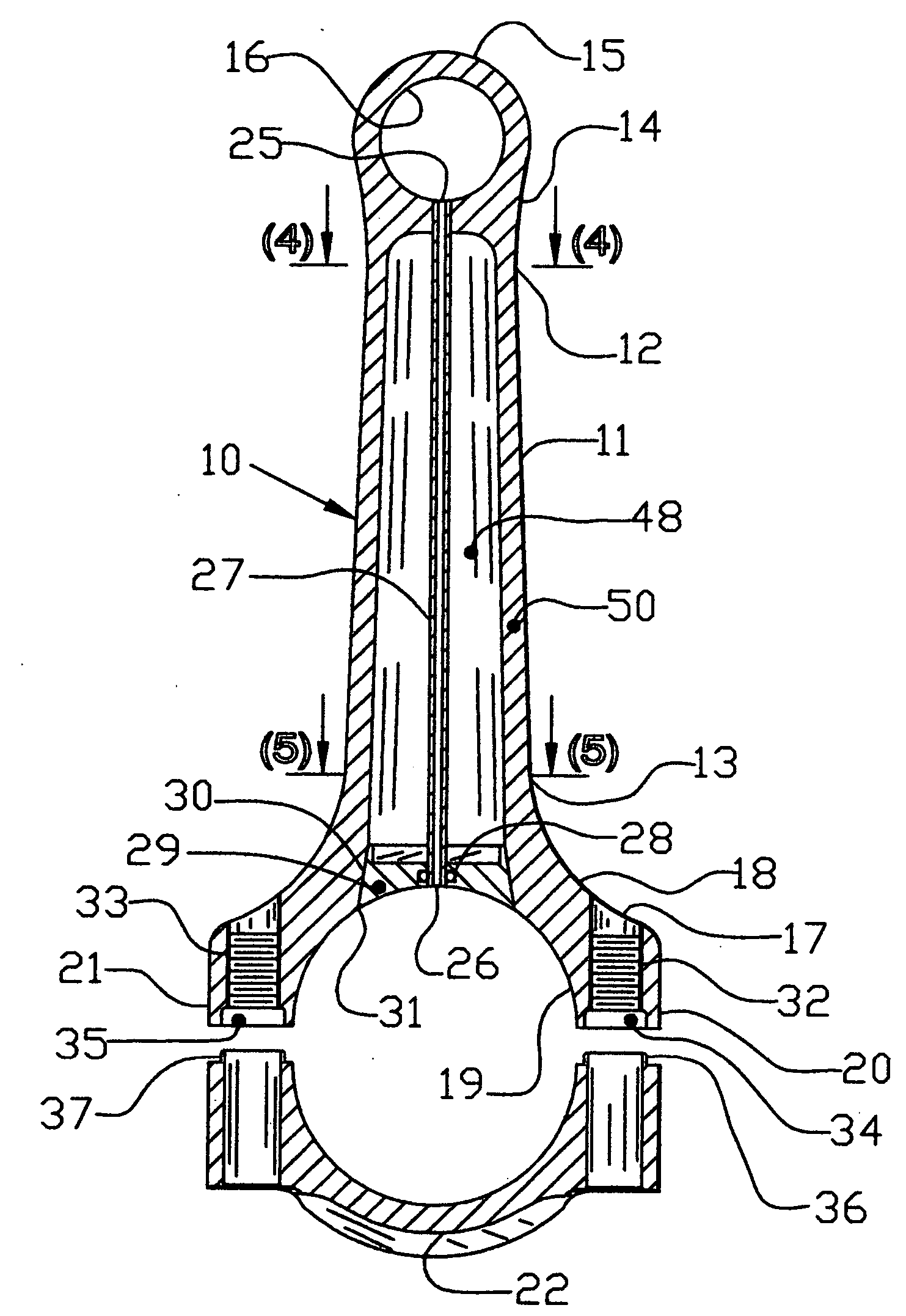
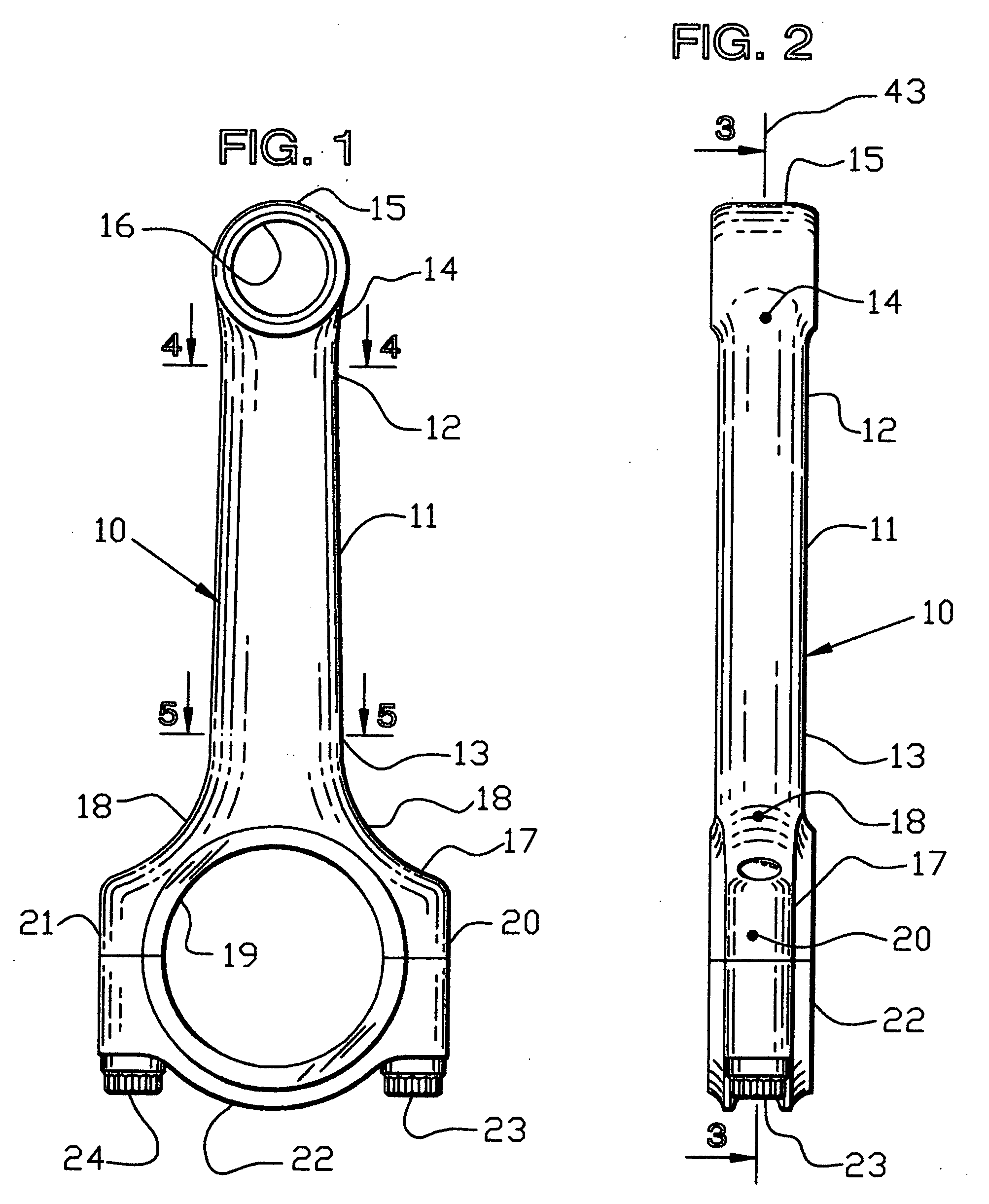
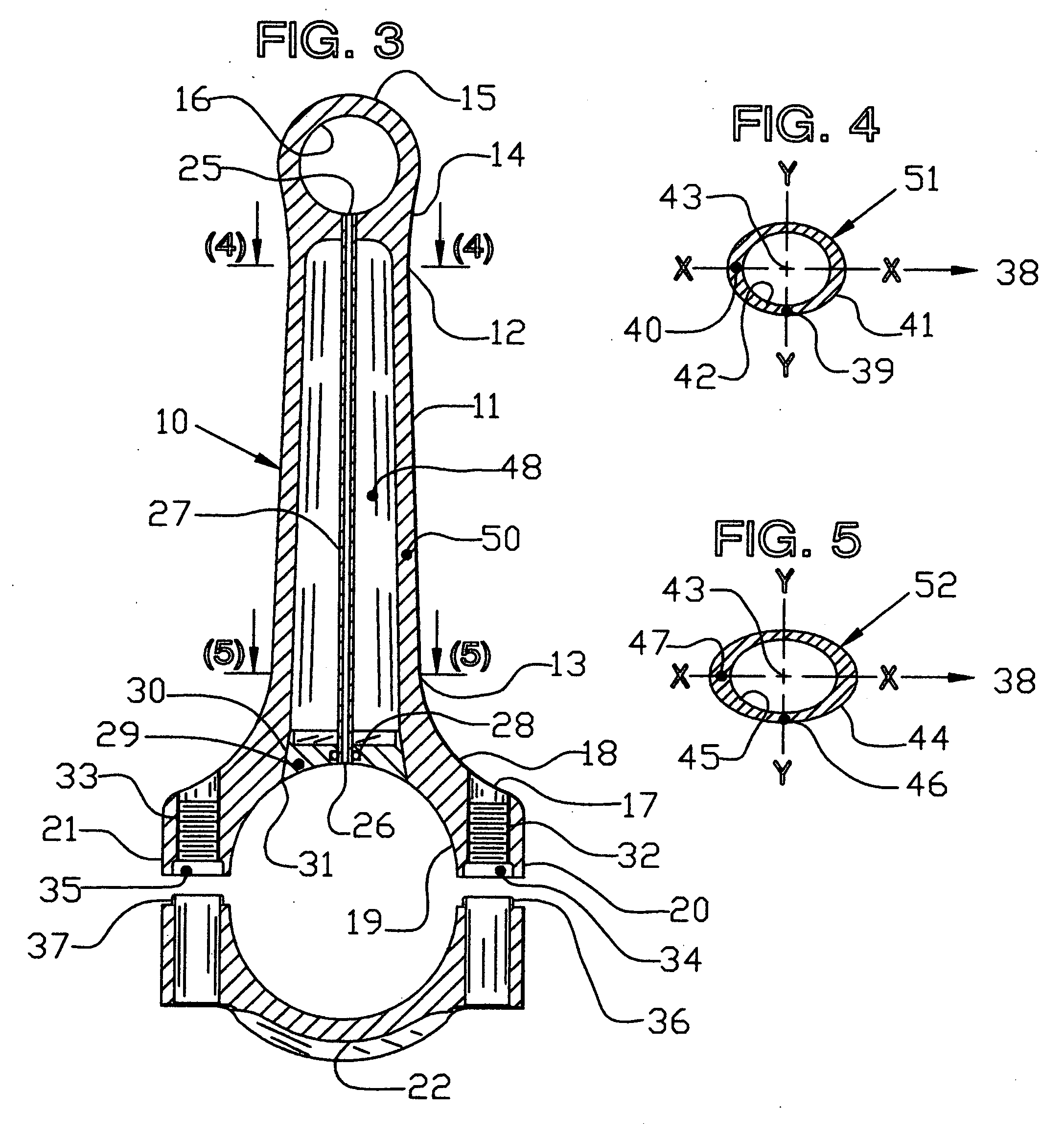
- A hollow connecting rod with a beam member featuring elliptical or oval cross-sections with smoothly blended curved regions and variable wall thickness to distribute stress evenly, reducing peak stress levels and inertia forces, and incorporating a compliant oil transfer tube and improved bearing cap alignment for enhanced performance.

Fatigue Life Standards and Testing Requirements
Fatigue life prediction and validation for connecting rods require adherence to established international standards that govern both the testing methodologies and acceptance criteria. The automotive industry primarily relies on standards such as SAE J1099 for technical reports, ISO 1143 for rotating bending fatigue tests, and ASTM E466 for force-controlled constant amplitude axial fatigue testing. These standards provide the foundational framework for evaluating component durability under cyclic loading conditions that simulate real-world operational stresses.
For connecting rod applications, the testing protocols must account for the complex multiaxial stress states encountered during engine operation. Standard test procedures typically involve constant amplitude loading at stress ratios ranging from R=-1 to R=0.1, representing the tension-compression cycles experienced during combustion and inertial loading. The minimum required fatigue life generally ranges from 10^7 to 10^8 cycles for passenger vehicle applications, while heavy-duty diesel engines may demand validation up to 10^9 cycles to ensure adequate safety margins.
Material characterization forms a critical component of fatigue life assessment, with standards specifying requirements for S-N curve generation using statistically significant sample sizes. The testing must encompass the stress range from high-cycle fatigue regime to low-cycle fatigue conditions, particularly focusing on stress concentration regions where shape optimization efforts target stress riser minimization. Surface finish requirements are explicitly defined, as surface roughness directly impacts crack initiation behavior in high-stress areas.
Accelerated testing methodologies have gained prominence in recent years, allowing manufacturers to validate design modifications more efficiently. These approaches employ elevated stress levels combined with statistical extrapolation techniques, though standards mandate correlation with full-scale endurance testing to ensure predictive accuracy. Quality assurance protocols require documentation of test conditions, including temperature, loading frequency, and environmental factors that may influence fatigue performance.
The integration of finite element analysis results with physical testing has led to the development of hybrid validation approaches. Standards now increasingly recognize computational fatigue life prediction methods when properly calibrated against experimental data, enabling more comprehensive assessment of shape optimization strategies aimed at eliminating critical stress risers in connecting rod geometries.
For connecting rod applications, the testing protocols must account for the complex multiaxial stress states encountered during engine operation. Standard test procedures typically involve constant amplitude loading at stress ratios ranging from R=-1 to R=0.1, representing the tension-compression cycles experienced during combustion and inertial loading. The minimum required fatigue life generally ranges from 10^7 to 10^8 cycles for passenger vehicle applications, while heavy-duty diesel engines may demand validation up to 10^9 cycles to ensure adequate safety margins.
Material characterization forms a critical component of fatigue life assessment, with standards specifying requirements for S-N curve generation using statistically significant sample sizes. The testing must encompass the stress range from high-cycle fatigue regime to low-cycle fatigue conditions, particularly focusing on stress concentration regions where shape optimization efforts target stress riser minimization. Surface finish requirements are explicitly defined, as surface roughness directly impacts crack initiation behavior in high-stress areas.
Accelerated testing methodologies have gained prominence in recent years, allowing manufacturers to validate design modifications more efficiently. These approaches employ elevated stress levels combined with statistical extrapolation techniques, though standards mandate correlation with full-scale endurance testing to ensure predictive accuracy. Quality assurance protocols require documentation of test conditions, including temperature, loading frequency, and environmental factors that may influence fatigue performance.
The integration of finite element analysis results with physical testing has led to the development of hybrid validation approaches. Standards now increasingly recognize computational fatigue life prediction methods when properly calibrated against experimental data, enabling more comprehensive assessment of shape optimization strategies aimed at eliminating critical stress risers in connecting rod geometries.
Material Selection Impact on Stress Distribution
Material selection plays a pivotal role in determining stress distribution patterns within connecting rods, directly influencing the formation and severity of stress risers. The mechanical properties of materials, including elastic modulus, yield strength, and fatigue resistance, fundamentally govern how loads are transmitted through the component geometry. Traditional materials such as forged steel and cast iron exhibit distinct stress concentration behaviors under identical loading conditions, with variations in their ability to redistribute localized stresses away from critical geometric transitions.
Advanced materials including titanium alloys, aluminum alloys, and composite materials demonstrate significantly different stress distribution characteristics compared to conventional options. Titanium alloys, with their high strength-to-weight ratio and superior fatigue properties, tend to produce more uniform stress fields in regions prone to concentration. However, their lower elastic modulus compared to steel can result in altered deformation patterns that may either mitigate or exacerbate stress risers depending on the specific geometry. Aluminum alloys offer reduced component mass but require careful consideration of their lower fatigue limits, which can make stress concentration zones more critical to overall component reliability.
The interaction between material properties and geometric features creates complex stress redistribution effects that cannot be predicted through geometry optimization alone. Materials with higher ductility can accommodate plastic deformation in peak stress regions, effectively blunting sharp stress gradients that would otherwise propagate as cracks. Conversely, brittle materials concentrate stresses more severely at geometric discontinuities, making fillet radii and transition zones particularly sensitive to design parameters.
Emerging material technologies, including powder metallurgy components and functionally graded materials, present opportunities for tailoring local material properties to match stress distribution requirements. These approaches enable strategic placement of high-strength material phases in stress concentration zones while utilizing lighter or more cost-effective materials in less critical regions. The selection process must balance mechanical performance requirements against manufacturing feasibility, cost constraints, and weight targets to achieve optimal stress management in connecting rod applications.
Advanced materials including titanium alloys, aluminum alloys, and composite materials demonstrate significantly different stress distribution characteristics compared to conventional options. Titanium alloys, with their high strength-to-weight ratio and superior fatigue properties, tend to produce more uniform stress fields in regions prone to concentration. However, their lower elastic modulus compared to steel can result in altered deformation patterns that may either mitigate or exacerbate stress risers depending on the specific geometry. Aluminum alloys offer reduced component mass but require careful consideration of their lower fatigue limits, which can make stress concentration zones more critical to overall component reliability.
The interaction between material properties and geometric features creates complex stress redistribution effects that cannot be predicted through geometry optimization alone. Materials with higher ductility can accommodate plastic deformation in peak stress regions, effectively blunting sharp stress gradients that would otherwise propagate as cracks. Conversely, brittle materials concentrate stresses more severely at geometric discontinuities, making fillet radii and transition zones particularly sensitive to design parameters.
Emerging material technologies, including powder metallurgy components and functionally graded materials, present opportunities for tailoring local material properties to match stress distribution requirements. These approaches enable strategic placement of high-strength material phases in stress concentration zones while utilizing lighter or more cost-effective materials in less critical regions. The selection process must balance mechanical performance requirements against manufacturing feasibility, cost constraints, and weight targets to achieve optimal stress management in connecting rod applications.
Unlock deeper insights with PatSnap Eureka Quick Research — get a full tech report to explore trends and direct your research. Try now!
Generate Your Research Report Instantly with AI Agent
Supercharge your innovation with PatSnap Eureka AI Agent Platform!