

Creating Multi-Layer Defense for Thermal Runaway Mitigation
FEB 26, 20268 MIN READ
Generate Your Research Report Instantly with AI Agent
PatSnap Eureka helps you evaluate technical feasibility & market potential.
Thermal Runaway Defense Background and Objectives
Thermal runaway represents one of the most critical safety challenges in lithium-ion battery technology, characterized by an uncontrolled chain reaction where increasing temperatures trigger further heat generation, potentially leading to fire, explosion, or toxic gas release. This phenomenon occurs when the battery's internal temperature exceeds critical thresholds, causing electrolyte decomposition, separator failure, and exothermic reactions that propagate throughout the cell and potentially to adjacent cells in battery packs.
The evolution of thermal runaway mitigation has progressed through distinct phases, beginning with basic thermal management systems in early electric vehicle applications to today's sophisticated multi-layer defense architectures. Initial approaches focused primarily on passive cooling and basic temperature monitoring, but the increasing energy density demands and safety regulations have driven the development of comprehensive protection strategies that address prevention, detection, suppression, and containment simultaneously.
Current technological trends emphasize the integration of advanced materials science, real-time monitoring systems, and predictive analytics to create robust defense mechanisms. The shift toward higher energy density batteries, particularly in electric vehicles and energy storage systems, has intensified the urgency for more effective thermal runaway mitigation solutions. Recent developments include phase-change materials for thermal management, advanced fire suppression agents, and intelligent battery management systems capable of predicting thermal events before they occur.
The primary objective of multi-layer thermal runaway defense systems is to establish redundant protection mechanisms that operate at different stages of the thermal runaway process. The first layer focuses on prevention through optimal thermal design and cell-level protection. The second layer emphasizes early detection using advanced sensing technologies and machine learning algorithms. The third layer involves active suppression through rapid cooling systems and fire suppression mechanisms. The final layer ensures containment and isolation to prevent propagation to adjacent cells or systems.
These defense systems aim to achieve specific performance targets including detection response times under 100 milliseconds, temperature reduction rates exceeding 50°C per minute during suppression events, and containment effectiveness preventing propagation beyond the affected cell or module. The ultimate goal is to transform potentially catastrophic thermal runaway events into manageable safety incidents with minimal impact on system operation and user safety.
The evolution of thermal runaway mitigation has progressed through distinct phases, beginning with basic thermal management systems in early electric vehicle applications to today's sophisticated multi-layer defense architectures. Initial approaches focused primarily on passive cooling and basic temperature monitoring, but the increasing energy density demands and safety regulations have driven the development of comprehensive protection strategies that address prevention, detection, suppression, and containment simultaneously.
Current technological trends emphasize the integration of advanced materials science, real-time monitoring systems, and predictive analytics to create robust defense mechanisms. The shift toward higher energy density batteries, particularly in electric vehicles and energy storage systems, has intensified the urgency for more effective thermal runaway mitigation solutions. Recent developments include phase-change materials for thermal management, advanced fire suppression agents, and intelligent battery management systems capable of predicting thermal events before they occur.
The primary objective of multi-layer thermal runaway defense systems is to establish redundant protection mechanisms that operate at different stages of the thermal runaway process. The first layer focuses on prevention through optimal thermal design and cell-level protection. The second layer emphasizes early detection using advanced sensing technologies and machine learning algorithms. The third layer involves active suppression through rapid cooling systems and fire suppression mechanisms. The final layer ensures containment and isolation to prevent propagation to adjacent cells or systems.
These defense systems aim to achieve specific performance targets including detection response times under 100 milliseconds, temperature reduction rates exceeding 50°C per minute during suppression events, and containment effectiveness preventing propagation beyond the affected cell or module. The ultimate goal is to transform potentially catastrophic thermal runaway events into manageable safety incidents with minimal impact on system operation and user safety.
Market Demand for Battery Safety Solutions
The global battery safety solutions market is experiencing unprecedented growth driven by the rapid expansion of electric vehicles, energy storage systems, and portable electronics. The increasing frequency of thermal runaway incidents across various applications has elevated battery safety from a secondary consideration to a primary design requirement, creating substantial demand for comprehensive multi-layer defense systems.
Electric vehicle manufacturers represent the largest segment driving demand for thermal runaway mitigation technologies. Major automotive OEMs are mandating advanced safety systems following high-profile battery fire incidents that have resulted in vehicle recalls and regulatory scrutiny. The automotive sector requires solutions that can operate effectively across extreme temperature ranges while maintaining cost efficiency for mass production applications.
Energy storage system operators constitute another critical market segment, particularly as grid-scale battery installations proliferate globally. These applications demand robust thermal management solutions capable of protecting large battery arrays where a single cell failure could cascade into catastrophic system-wide damage. The extended operational lifespan requirements of stationary storage systems create demand for highly reliable, maintenance-free safety solutions.
Consumer electronics manufacturers are increasingly seeking miniaturized thermal runaway protection systems as device power densities continue to rise. The integration of larger battery capacities into compact form factors has intensified thermal management challenges, driving demand for innovative cooling technologies and early warning detection systems.
Regulatory pressures are significantly amplifying market demand across all sectors. Government agencies worldwide are implementing stricter safety standards for battery-powered devices and vehicles, compelling manufacturers to adopt comprehensive thermal runaway mitigation strategies. These regulatory requirements are creating mandatory market demand rather than optional safety enhancements.
The market is also responding to insurance industry pressures, as carriers increasingly require documented thermal runaway protection systems before providing coverage for battery-powered assets. This trend is particularly pronounced in commercial applications where potential liability exposure is substantial.
Emerging applications in aerospace, marine, and industrial equipment are generating additional demand for specialized thermal runaway solutions tailored to unique operational environments and safety requirements.
Electric vehicle manufacturers represent the largest segment driving demand for thermal runaway mitigation technologies. Major automotive OEMs are mandating advanced safety systems following high-profile battery fire incidents that have resulted in vehicle recalls and regulatory scrutiny. The automotive sector requires solutions that can operate effectively across extreme temperature ranges while maintaining cost efficiency for mass production applications.
Energy storage system operators constitute another critical market segment, particularly as grid-scale battery installations proliferate globally. These applications demand robust thermal management solutions capable of protecting large battery arrays where a single cell failure could cascade into catastrophic system-wide damage. The extended operational lifespan requirements of stationary storage systems create demand for highly reliable, maintenance-free safety solutions.
Consumer electronics manufacturers are increasingly seeking miniaturized thermal runaway protection systems as device power densities continue to rise. The integration of larger battery capacities into compact form factors has intensified thermal management challenges, driving demand for innovative cooling technologies and early warning detection systems.
Regulatory pressures are significantly amplifying market demand across all sectors. Government agencies worldwide are implementing stricter safety standards for battery-powered devices and vehicles, compelling manufacturers to adopt comprehensive thermal runaway mitigation strategies. These regulatory requirements are creating mandatory market demand rather than optional safety enhancements.
The market is also responding to insurance industry pressures, as carriers increasingly require documented thermal runaway protection systems before providing coverage for battery-powered assets. This trend is particularly pronounced in commercial applications where potential liability exposure is substantial.
Emerging applications in aerospace, marine, and industrial equipment are generating additional demand for specialized thermal runaway solutions tailored to unique operational environments and safety requirements.
Current Thermal Runaway Challenges and Limitations
Thermal runaway represents one of the most critical safety challenges in lithium-ion battery technology, characterized by an uncontrolled chain reaction where increasing temperatures trigger further heat generation. Current detection methods primarily rely on temperature monitoring and voltage analysis, but these approaches often fail to provide sufficient early warning before the onset of catastrophic failure. The rapid escalation from initial thermal events to full runaway can occur within minutes, leaving inadequate time for effective intervention.
Existing containment strategies face significant limitations in their ability to halt thermal propagation once initiated. Traditional cooling systems, including liquid cooling and thermal interface materials, prove insufficient when confronted with the extreme heat generation rates during thermal runaway events. The exponential nature of temperature rise overwhelms conventional heat dissipation mechanisms, rendering passive cooling solutions largely ineffective during critical failure scenarios.
Current suppression technologies demonstrate notable gaps in comprehensive protection coverage. Fire suppression systems designed for lithium-ion batteries often focus on external fire control rather than addressing the internal electrochemical processes driving thermal runaway. Gas-based suppression agents may temporarily reduce external flames but cannot penetrate sealed battery cells to interrupt the underlying thermal cascade, allowing the reaction to continue internally.
Material-based solutions present additional constraints in practical implementation. Heat-resistant separators and flame-retardant electrolytes, while improving safety margins, cannot completely prevent thermal runaway under severe abuse conditions. These materials may delay the onset but ultimately succumb to extreme temperatures exceeding their thermal stability limits, particularly in high-energy density applications where thermal loads are most severe.
Integration challenges compound these technical limitations, as current safety systems operate largely independently without coordinated response mechanisms. The lack of multi-layered defense coordination results in redundancy gaps where failure of one protection layer leaves the system vulnerable. Existing approaches also struggle with false positive detection, leading to unnecessary system shutdowns that impact operational reliability and user confidence in battery safety systems.
Existing containment strategies face significant limitations in their ability to halt thermal propagation once initiated. Traditional cooling systems, including liquid cooling and thermal interface materials, prove insufficient when confronted with the extreme heat generation rates during thermal runaway events. The exponential nature of temperature rise overwhelms conventional heat dissipation mechanisms, rendering passive cooling solutions largely ineffective during critical failure scenarios.
Current suppression technologies demonstrate notable gaps in comprehensive protection coverage. Fire suppression systems designed for lithium-ion batteries often focus on external fire control rather than addressing the internal electrochemical processes driving thermal runaway. Gas-based suppression agents may temporarily reduce external flames but cannot penetrate sealed battery cells to interrupt the underlying thermal cascade, allowing the reaction to continue internally.
Material-based solutions present additional constraints in practical implementation. Heat-resistant separators and flame-retardant electrolytes, while improving safety margins, cannot completely prevent thermal runaway under severe abuse conditions. These materials may delay the onset but ultimately succumb to extreme temperatures exceeding their thermal stability limits, particularly in high-energy density applications where thermal loads are most severe.
Integration challenges compound these technical limitations, as current safety systems operate largely independently without coordinated response mechanisms. The lack of multi-layered defense coordination results in redundancy gaps where failure of one protection layer leaves the system vulnerable. Existing approaches also struggle with false positive detection, leading to unnecessary system shutdowns that impact operational reliability and user confidence in battery safety systems.
Existing Multi-Layer Thermal Protection Solutions
01 Multi-layer thermal barrier structures for battery systems
Implementation of multiple physical barrier layers between battery cells or modules to prevent thermal runaway propagation. These structures typically include heat-resistant materials, insulation layers, and thermal management components arranged in a layered configuration to contain and dissipate heat from failing cells, preventing cascade failures across the battery pack.- Multi-layer thermal barrier structures for battery systems: Implementation of multiple physical barrier layers between battery cells or modules to prevent thermal runaway propagation. These structures typically include heat-resistant materials, insulation layers, and thermal management components arranged in a layered configuration to contain and dissipate heat from failing cells before it reaches adjacent cells.
- Active cooling and heat dissipation systems: Integration of active thermal management systems including liquid cooling channels, phase change materials, and heat pipes arranged in multiple layers. These systems provide dynamic heat removal capabilities and work in conjunction with passive barriers to manage thermal events across different defense layers.
- Early detection and monitoring systems: Deployment of multi-level sensor networks and monitoring systems that detect thermal anomalies at various stages. These systems include temperature sensors, voltage monitors, and gas detection devices positioned at different layers to provide early warning and trigger protective responses before thermal runaway fully develops.
- Fire suppression and venting mechanisms: Incorporation of layered fire suppression systems including flame retardant materials, automatic extinguishing agents, and controlled venting pathways. These mechanisms are strategically placed at multiple levels to suppress flames, release pressure safely, and prevent fire propagation between battery compartments.
- Structural isolation and containment designs: Design of battery pack architectures with multiple levels of physical isolation including reinforced housings, compartmentalization, and blast-resistant enclosures. These structural elements create successive containment zones that limit the impact of thermal runaway events and protect surrounding components and systems.
02 Active cooling and heat dissipation systems
Integration of active thermal management systems including liquid cooling channels, phase change materials, and heat pipes arranged in multiple layers. These systems provide dynamic heat removal capabilities and temperature regulation to prevent thermal runaway initiation and limit heat propagation when thermal events occur.Expand Specific Solutions03 Thermal monitoring and early warning systems
Deployment of multi-level temperature sensing networks and monitoring systems that detect thermal anomalies at various stages. These systems include distributed sensors, real-time data processing, and predictive algorithms to identify potential thermal runaway conditions before they escalate, enabling preventive actions across multiple defense layers.Expand Specific Solutions04 Fire suppression and containment mechanisms
Incorporation of fire-resistant materials, flame retardant coatings, and active suppression systems in layered configurations. These mechanisms include venting systems, fire extinguishing agents, and containment structures that activate sequentially to suppress flames, contain gases, and prevent fire spread during thermal runaway events.Expand Specific Solutions05 Electrical isolation and circuit protection layers
Implementation of multiple electrical safety layers including fuses, circuit breakers, and isolation switches that disconnect failing cells or modules. These protection systems work in coordination to prevent electrical faults from contributing to thermal runaway while maintaining system functionality in unaffected areas of the battery pack.Expand Specific Solutions
Key Players in Battery Safety and Thermal Management
The thermal runaway mitigation industry is experiencing rapid growth driven by the expanding electric vehicle market and increasing safety regulations. The sector is in a dynamic development phase, with market size projected to reach billions as EV adoption accelerates globally. Technology maturity varies significantly across different defense layers. Leading battery manufacturers like Contemporary Amperex Technology (CATL), LG Energy Solution, Samsung SDI, and SK On are advancing cell-level safety features, while Tesla and GM Global Technology Operations integrate system-level protections. Material specialists including Aspen Aerogels, 3M Innovative Properties, and Rogers Corp are developing advanced thermal barriers and insulation solutions. Research institutions like CEA and Xi'an Jiaotong University contribute fundamental innovations. The competitive landscape shows established players like Sumitomo Electric Industries and emerging specialists such as KULR Technology Corp and Cadenza Innovation driving technological convergence toward comprehensive multi-layer defense systems.
Aspen Aerogels, Inc.
Technical Solution: Aspen Aerogels specializes in PyroThin thermal barrier solutions specifically designed for battery thermal runaway mitigation, featuring ultra-low thermal conductivity aerogel materials that provide exceptional insulation performance in minimal thickness. Their multi-layer defense approach includes flexible aerogel blankets that conform to battery geometries, rigid aerogel boards for structural applications, and hybrid solutions combining aerogel with fire-resistant fabrics. The materials demonstrate thermal conductivity as low as 0.014 W/mK while maintaining flexibility and durability under automotive conditions. Their solutions provide up to 30 minutes of thermal protection, allowing time for evacuation and fire suppression systems to activate while preventing thermal propagation between battery modules.
Strengths: Specialized expertise in aerogel technology, superior thermal insulation properties, lightweight solutions. Weaknesses: Limited to material supply rather than complete system integration, higher material costs compared to traditional insulation.
Contemporary Amperex Technology Co., Ltd.
Technical Solution: CATL develops Qilin battery technology featuring multi-layer thermal runaway protection through advanced cell-to-pack design with integrated cooling plates, thermal barrier materials, and intelligent thermal management algorithms. Their CTP 3.0 technology includes micro-thermal management systems with cooling efficiency improved by 4x, structural reinforcement preventing thermal propagation between cells, and advanced fire suppression materials. The system incorporates real-time thermal monitoring with predictive analytics, automatic thermal isolation mechanisms, and specialized venting systems designed to direct thermal events away from critical components while maintaining structural integrity of the battery pack.
Strengths: Leading battery manufacturer expertise, cost-effective solutions, strong R&D capabilities in thermal management. Weaknesses: Relatively newer to automotive applications compared to established players, dependency on supply chain partnerships.
Core Innovations in Thermal Runaway Prevention
Devices, systems, and methods for controlling vent gases and ejecta from thermal runaway events in energy storage systems
PatentActiveUS20240313301A1
Innovation
- A multilayer thermal barrier material comprising an insulation layer, a compressible pad, and optional thermally conductive or capacitive layers, which provides effective heat dissipation, fire resistance, and mechanical resilience to prevent thermal runaway propagation and accommodate cell expansion, while minimizing thickness and weight.
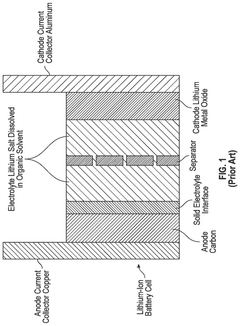
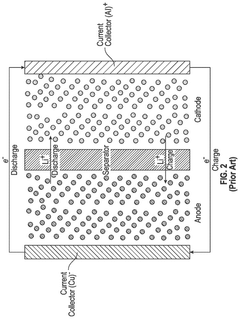
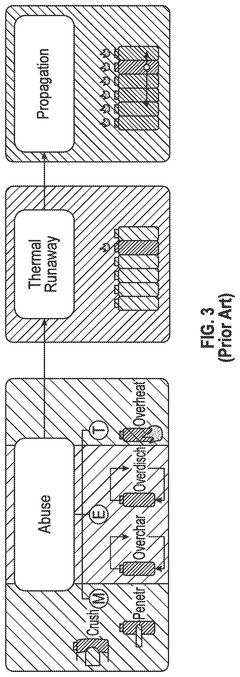
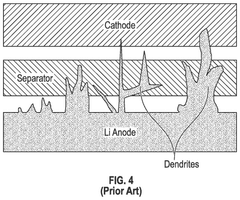
Materials, systems, and methods for mitigation of electrical energy storage thermal events
PatentPendingUS20240313300A1
Innovation
- A multilayer thermal barrier material comprising an insulation layer, a compressible pad, and optional thermally conductive or capacitive layers, designed to provide effective heat dissipation and mechanical resilience to prevent thermal propagation and accommodate cell swelling, while minimizing thickness and weight.


Safety Standards and Regulatory Framework
The regulatory landscape for thermal runaway mitigation in battery systems has evolved significantly over the past decade, driven by increasing adoption of lithium-ion batteries across automotive, energy storage, and consumer electronics sectors. International standards organizations have established comprehensive frameworks that mandate multi-layer defense approaches as fundamental safety requirements rather than optional enhancements.
The International Electrotechnical Commission (IEC) has developed IEC 62619 and IEC 62620 standards specifically addressing safety requirements for lithium-ion batteries in industrial and automotive applications. These standards explicitly require implementation of multiple independent safety barriers, including thermal monitoring systems, pressure relief mechanisms, and fire suppression capabilities. The standards mandate that failure of any single safety layer must not compromise overall system safety.
Automotive regulations have become particularly stringent following high-profile thermal runaway incidents. The United Nations Economic Commission for Europe (UNECE) Global Technical Regulation No. 20 establishes mandatory thermal propagation testing requirements for electric vehicle battery systems. This regulation requires manufacturers to demonstrate that thermal runaway in individual cells does not propagate to adjacent cells within specified timeframes, effectively mandating multi-layer thermal barriers and active cooling systems.
Regional regulatory bodies have implemented additional requirements that influence multi-layer defense strategies. The European Union's Battery Regulation 2023/1542 introduces lifecycle safety requirements that extend beyond initial design to include thermal management throughout battery operational life. Similarly, the U.S. National Highway Traffic Safety Administration has proposed Federal Motor Vehicle Safety Standard 305 amendments that would require real-time thermal monitoring and automatic disconnect systems as mandatory safety layers.
Certification processes now require comprehensive documentation of each defense layer's independence and effectiveness. Testing protocols mandate simulation of cascading failure scenarios to validate that multiple safety barriers can function simultaneously under extreme conditions. These regulatory requirements have fundamentally shaped industry approaches to thermal runaway mitigation, making multi-layer defense systems not merely best practices but legal necessities for market access and operational compliance across major global markets.
The International Electrotechnical Commission (IEC) has developed IEC 62619 and IEC 62620 standards specifically addressing safety requirements for lithium-ion batteries in industrial and automotive applications. These standards explicitly require implementation of multiple independent safety barriers, including thermal monitoring systems, pressure relief mechanisms, and fire suppression capabilities. The standards mandate that failure of any single safety layer must not compromise overall system safety.
Automotive regulations have become particularly stringent following high-profile thermal runaway incidents. The United Nations Economic Commission for Europe (UNECE) Global Technical Regulation No. 20 establishes mandatory thermal propagation testing requirements for electric vehicle battery systems. This regulation requires manufacturers to demonstrate that thermal runaway in individual cells does not propagate to adjacent cells within specified timeframes, effectively mandating multi-layer thermal barriers and active cooling systems.
Regional regulatory bodies have implemented additional requirements that influence multi-layer defense strategies. The European Union's Battery Regulation 2023/1542 introduces lifecycle safety requirements that extend beyond initial design to include thermal management throughout battery operational life. Similarly, the U.S. National Highway Traffic Safety Administration has proposed Federal Motor Vehicle Safety Standard 305 amendments that would require real-time thermal monitoring and automatic disconnect systems as mandatory safety layers.
Certification processes now require comprehensive documentation of each defense layer's independence and effectiveness. Testing protocols mandate simulation of cascading failure scenarios to validate that multiple safety barriers can function simultaneously under extreme conditions. These regulatory requirements have fundamentally shaped industry approaches to thermal runaway mitigation, making multi-layer defense systems not merely best practices but legal necessities for market access and operational compliance across major global markets.
Environmental Impact of Thermal Runaway Events
Thermal runaway events in battery systems pose significant environmental threats that extend far beyond immediate safety concerns. When lithium-ion batteries experience thermal runaway, they release toxic gases including hydrogen fluoride, carbon monoxide, and various organic compounds into the atmosphere. These emissions can contaminate air quality in surrounding areas, particularly in enclosed spaces such as parking garages, warehouses, or residential buildings where electric vehicles are stored.
The toxic gas emissions from thermal runaway events create immediate health hazards for nearby populations. Hydrogen fluoride, one of the most dangerous byproducts, can cause severe respiratory damage and chemical burns even at low concentrations. Carbon monoxide poses asphyxiation risks, while volatile organic compounds contribute to long-term air quality degradation. These emissions can persist in the environment for extended periods, requiring specialized cleanup procedures and potentially forcing temporary evacuations of affected areas.
Water contamination represents another critical environmental concern during thermal runaway incidents. Firefighting efforts often involve large quantities of water to cool burning battery systems, creating contaminated runoff containing heavy metals, electrolyte chemicals, and toxic combustion byproducts. This contaminated water can infiltrate soil systems and groundwater supplies, potentially affecting local ecosystems and drinking water sources for extended periods.
Soil contamination occurs when battery materials and toxic byproducts leach into the ground during thermal runaway events. Heavy metals such as lithium, cobalt, and nickel can accumulate in soil systems, affecting plant growth and entering the food chain through agricultural products. The persistence of these contaminants requires long-term monitoring and potential soil remediation efforts, creating lasting environmental liabilities.
The scale of environmental impact varies significantly based on the size and location of thermal runaway events. Large-scale incidents involving electric vehicle fleets or energy storage installations can affect entire communities, while smaller events may have localized but still significant environmental consequences. Climate conditions, population density, and proximity to sensitive ecosystems all influence the severity and duration of environmental impacts from these events.
The toxic gas emissions from thermal runaway events create immediate health hazards for nearby populations. Hydrogen fluoride, one of the most dangerous byproducts, can cause severe respiratory damage and chemical burns even at low concentrations. Carbon monoxide poses asphyxiation risks, while volatile organic compounds contribute to long-term air quality degradation. These emissions can persist in the environment for extended periods, requiring specialized cleanup procedures and potentially forcing temporary evacuations of affected areas.
Water contamination represents another critical environmental concern during thermal runaway incidents. Firefighting efforts often involve large quantities of water to cool burning battery systems, creating contaminated runoff containing heavy metals, electrolyte chemicals, and toxic combustion byproducts. This contaminated water can infiltrate soil systems and groundwater supplies, potentially affecting local ecosystems and drinking water sources for extended periods.
Soil contamination occurs when battery materials and toxic byproducts leach into the ground during thermal runaway events. Heavy metals such as lithium, cobalt, and nickel can accumulate in soil systems, affecting plant growth and entering the food chain through agricultural products. The persistence of these contaminants requires long-term monitoring and potential soil remediation efforts, creating lasting environmental liabilities.
The scale of environmental impact varies significantly based on the size and location of thermal runaway events. Large-scale incidents involving electric vehicle fleets or energy storage installations can affect entire communities, while smaller events may have localized but still significant environmental consequences. Climate conditions, population density, and proximity to sensitive ecosystems all influence the severity and duration of environmental impacts from these events.
Unlock deeper insights with PatSnap Eureka Quick Research — get a full tech report to explore trends and direct your research. Try now!
Generate Your Research Report Instantly with AI Agent
Supercharge your innovation with PatSnap Eureka AI Agent Platform!