

How Battery Aging Processes Affect Thermal Runaway Probability
FEB 26, 20269 MIN READ
Generate Your Research Report Instantly with AI Agent
PatSnap Eureka helps you evaluate technical feasibility & market potential.
Battery Aging and Thermal Runaway Background and Objectives
Battery technology has evolved significantly over the past several decades, transitioning from early lead-acid systems to advanced lithium-ion chemistries that now power everything from consumer electronics to electric vehicles and grid-scale energy storage systems. This evolution has been driven by increasing demands for higher energy density, longer cycle life, and improved safety characteristics. However, as battery systems age through repeated charge-discharge cycles and exposure to various environmental conditions, their internal structure and chemistry undergo fundamental changes that can significantly impact their safety profile.
Thermal runaway represents one of the most critical safety concerns in modern battery technology, particularly for lithium-ion systems. This phenomenon occurs when a battery cell experiences an uncontrolled increase in temperature, leading to a cascade of exothermic reactions that can result in fire, explosion, or toxic gas release. The probability and severity of thermal runaway events are not static characteristics but evolve dynamically as batteries age, creating complex interdependencies between degradation mechanisms and safety risks.
The relationship between battery aging and thermal runaway probability has emerged as a critical research area due to the widespread deployment of battery systems in safety-critical applications. As batteries age, multiple degradation mechanisms occur simultaneously, including solid electrolyte interphase layer growth, active material loss, electrolyte decomposition, and mechanical stress accumulation. These aging processes alter the battery's thermal stability, internal resistance, and reaction kinetics, potentially creating conditions more conducive to thermal runaway initiation and propagation.
Understanding this relationship is essential for developing predictive safety models, establishing appropriate end-of-life criteria, and designing robust battery management systems. Current safety standards and testing protocols often focus on fresh battery cells, potentially underestimating risks associated with aged systems deployed in real-world applications.
The primary objective of investigating how battery aging processes affect thermal runaway probability is to establish quantitative relationships between specific degradation mechanisms and safety risk evolution. This includes identifying critical aging thresholds where thermal runaway probability increases significantly, developing predictive models that can forecast safety risks based on aging indicators, and creating comprehensive safety assessment frameworks for aged battery systems.
Secondary objectives encompass developing enhanced battery management strategies that account for age-related safety changes, establishing improved end-of-life criteria that consider both performance and safety degradation, and informing the design of next-generation battery chemistries with improved aging-safety characteristics. These objectives collectively aim to ensure the safe and reliable operation of battery systems throughout their entire operational lifespan.
Thermal runaway represents one of the most critical safety concerns in modern battery technology, particularly for lithium-ion systems. This phenomenon occurs when a battery cell experiences an uncontrolled increase in temperature, leading to a cascade of exothermic reactions that can result in fire, explosion, or toxic gas release. The probability and severity of thermal runaway events are not static characteristics but evolve dynamically as batteries age, creating complex interdependencies between degradation mechanisms and safety risks.
The relationship between battery aging and thermal runaway probability has emerged as a critical research area due to the widespread deployment of battery systems in safety-critical applications. As batteries age, multiple degradation mechanisms occur simultaneously, including solid electrolyte interphase layer growth, active material loss, electrolyte decomposition, and mechanical stress accumulation. These aging processes alter the battery's thermal stability, internal resistance, and reaction kinetics, potentially creating conditions more conducive to thermal runaway initiation and propagation.
Understanding this relationship is essential for developing predictive safety models, establishing appropriate end-of-life criteria, and designing robust battery management systems. Current safety standards and testing protocols often focus on fresh battery cells, potentially underestimating risks associated with aged systems deployed in real-world applications.
The primary objective of investigating how battery aging processes affect thermal runaway probability is to establish quantitative relationships between specific degradation mechanisms and safety risk evolution. This includes identifying critical aging thresholds where thermal runaway probability increases significantly, developing predictive models that can forecast safety risks based on aging indicators, and creating comprehensive safety assessment frameworks for aged battery systems.
Secondary objectives encompass developing enhanced battery management strategies that account for age-related safety changes, establishing improved end-of-life criteria that consider both performance and safety degradation, and informing the design of next-generation battery chemistries with improved aging-safety characteristics. These objectives collectively aim to ensure the safe and reliable operation of battery systems throughout their entire operational lifespan.
Market Demand for Safer Battery Technologies
The global battery market is experiencing unprecedented growth driven by the rapid expansion of electric vehicles, energy storage systems, and portable electronics. This surge has intensified focus on battery safety, particularly regarding thermal runaway incidents that can lead to fires, explosions, and toxic gas emissions. The relationship between battery aging and thermal runaway probability has emerged as a critical concern for manufacturers, regulators, and end-users across multiple industries.
Electric vehicle manufacturers face mounting pressure to address safety concerns as aging batteries in deployed fleets begin exhibiting increased thermal instability. Consumer confidence remains fragile following high-profile incidents involving battery fires in electric vehicles and energy storage installations. This has created urgent demand for advanced battery management systems, improved cell chemistry, and predictive analytics capable of assessing thermal runaway risk in aging battery packs.
The energy storage sector represents another significant market driver, where large-scale installations require decades-long operational lifespans. Grid-scale battery systems must maintain safety standards throughout extended aging cycles while supporting critical infrastructure. Utility companies and energy developers increasingly prioritize battery technologies with proven aging characteristics and robust thermal management capabilities.
Regulatory frameworks worldwide are evolving to address aging-related safety risks. New standards require comprehensive testing protocols that evaluate thermal runaway probability across battery lifecycle stages. These regulations are driving demand for advanced diagnostic tools, real-time monitoring systems, and predictive maintenance solutions that can identify deteriorating cells before they pose safety risks.
The consumer electronics industry faces unique challenges as devices become more compact while battery energy density increases. Aging smartphones, laptops, and wearable devices present thermal runaway risks in close proximity to users. This has accelerated development of smart charging algorithms, thermal management solutions, and battery health monitoring technologies.
Market opportunities extend beyond traditional battery applications into emerging sectors including aerospace, medical devices, and industrial equipment. These applications demand exceptional safety reliability throughout extended operational periods, creating premium market segments for advanced battery technologies with superior aging characteristics and thermal stability.
Electric vehicle manufacturers face mounting pressure to address safety concerns as aging batteries in deployed fleets begin exhibiting increased thermal instability. Consumer confidence remains fragile following high-profile incidents involving battery fires in electric vehicles and energy storage installations. This has created urgent demand for advanced battery management systems, improved cell chemistry, and predictive analytics capable of assessing thermal runaway risk in aging battery packs.
The energy storage sector represents another significant market driver, where large-scale installations require decades-long operational lifespans. Grid-scale battery systems must maintain safety standards throughout extended aging cycles while supporting critical infrastructure. Utility companies and energy developers increasingly prioritize battery technologies with proven aging characteristics and robust thermal management capabilities.
Regulatory frameworks worldwide are evolving to address aging-related safety risks. New standards require comprehensive testing protocols that evaluate thermal runaway probability across battery lifecycle stages. These regulations are driving demand for advanced diagnostic tools, real-time monitoring systems, and predictive maintenance solutions that can identify deteriorating cells before they pose safety risks.
The consumer electronics industry faces unique challenges as devices become more compact while battery energy density increases. Aging smartphones, laptops, and wearable devices present thermal runaway risks in close proximity to users. This has accelerated development of smart charging algorithms, thermal management solutions, and battery health monitoring technologies.
Market opportunities extend beyond traditional battery applications into emerging sectors including aerospace, medical devices, and industrial equipment. These applications demand exceptional safety reliability throughout extended operational periods, creating premium market segments for advanced battery technologies with superior aging characteristics and thermal stability.
Current State of Battery Aging and Thermal Safety Research
The intersection of battery aging and thermal safety research has emerged as a critical area of investigation in recent years, driven by the widespread adoption of lithium-ion batteries across various applications. Current research efforts are primarily concentrated in three major geographical regions: North America, Europe, and East Asia, with leading institutions including MIT, Stanford University, Technical University of Munich, and several Chinese research institutes focusing on different aspects of this complex relationship.
Existing research frameworks predominantly employ multi-scale modeling approaches that combine electrochemical degradation models with thermal analysis. These studies typically investigate how capacity fade, impedance growth, and structural changes during aging cycles influence the onset conditions for thermal runaway events. Recent findings indicate that aged batteries exhibit altered thermal behavior patterns, with some studies showing increased susceptibility to thermal runaway at lower temperatures compared to fresh cells.
The primary technical challenges currently limiting comprehensive understanding include the complexity of aging mechanisms, which involve simultaneous chemical, mechanical, and thermal processes. Solid electrolyte interphase layer evolution, lithium plating, active material degradation, and separator deterioration all contribute to changing thermal characteristics, making it difficult to establish universal predictive models. Additionally, the lack of standardized aging protocols and thermal safety testing procedures across different research groups creates inconsistencies in experimental data.
Current methodological approaches face significant limitations in real-time monitoring capabilities during aging processes. Most studies rely on post-mortem analysis or periodic interruptions for characterization, which may not capture transient phenomena that influence thermal runaway probability. Furthermore, the interaction between different aging mechanisms and their cumulative effects on thermal stability remains poorly understood, particularly under realistic operating conditions that include temperature variations, partial charging cycles, and mechanical stress.
The research community has identified several critical knowledge gaps, including the role of heterogeneous aging within individual cells, the influence of aging-induced gas generation on thermal behavior, and the development of early warning indicators that can predict increased thermal runaway risk in aged battery systems. These challenges represent key areas requiring focused research attention to advance both fundamental understanding and practical safety applications.
Existing research frameworks predominantly employ multi-scale modeling approaches that combine electrochemical degradation models with thermal analysis. These studies typically investigate how capacity fade, impedance growth, and structural changes during aging cycles influence the onset conditions for thermal runaway events. Recent findings indicate that aged batteries exhibit altered thermal behavior patterns, with some studies showing increased susceptibility to thermal runaway at lower temperatures compared to fresh cells.
The primary technical challenges currently limiting comprehensive understanding include the complexity of aging mechanisms, which involve simultaneous chemical, mechanical, and thermal processes. Solid electrolyte interphase layer evolution, lithium plating, active material degradation, and separator deterioration all contribute to changing thermal characteristics, making it difficult to establish universal predictive models. Additionally, the lack of standardized aging protocols and thermal safety testing procedures across different research groups creates inconsistencies in experimental data.
Current methodological approaches face significant limitations in real-time monitoring capabilities during aging processes. Most studies rely on post-mortem analysis or periodic interruptions for characterization, which may not capture transient phenomena that influence thermal runaway probability. Furthermore, the interaction between different aging mechanisms and their cumulative effects on thermal stability remains poorly understood, particularly under realistic operating conditions that include temperature variations, partial charging cycles, and mechanical stress.
The research community has identified several critical knowledge gaps, including the role of heterogeneous aging within individual cells, the influence of aging-induced gas generation on thermal behavior, and the development of early warning indicators that can predict increased thermal runaway risk in aged battery systems. These challenges represent key areas requiring focused research attention to advance both fundamental understanding and practical safety applications.
Existing Solutions for Thermal Runaway Prevention
01 Thermal runaway prediction and early warning systems
Methods and systems for predicting battery thermal runaway events before they occur by monitoring key parameters such as temperature, voltage, and internal resistance. These systems utilize algorithms and machine learning models to analyze battery behavior patterns and provide early warnings when abnormal conditions are detected. The prediction systems enable timely intervention to prevent catastrophic failures and enhance battery safety in electric vehicles and energy storage applications.- Thermal runaway prediction and early warning systems: Advanced monitoring systems utilize various sensors and algorithms to predict thermal runaway events before they occur. These systems analyze real-time data including temperature, voltage, and internal resistance changes to identify abnormal battery behavior. Machine learning models and statistical analysis methods are employed to calculate the probability of thermal runaway occurrence, enabling early intervention and prevention measures.
- Battery thermal management and cooling systems: Effective thermal management systems are designed to maintain optimal battery operating temperatures and reduce thermal runaway risk. These systems incorporate cooling mechanisms, heat dissipation structures, and temperature control strategies to prevent excessive heat accumulation. Advanced materials and structural designs enhance heat transfer efficiency and maintain uniform temperature distribution across battery cells.
- Safety mechanisms and protective devices: Multiple safety features are integrated into battery systems to mitigate thermal runaway propagation. These include pressure relief valves, thermal barriers, flame-retardant materials, and circuit protection devices. Emergency shutdown mechanisms and isolation systems are implemented to contain thermal events and prevent cascade failures across battery modules.
- Battery state monitoring and diagnostic methods: Comprehensive diagnostic approaches assess battery health and identify conditions that increase thermal runaway probability. These methods evaluate parameters such as state of charge, state of health, internal impedance, and degradation indicators. Advanced sensing technologies and data analytics enable continuous monitoring of battery conditions to detect potential safety hazards.
- Risk assessment and probability calculation models: Mathematical models and simulation techniques are developed to quantify thermal runaway probability under various operating conditions. These models consider factors such as battery chemistry, aging effects, environmental conditions, and usage patterns. Probabilistic analysis and risk evaluation frameworks help optimize battery design and establish safety margins for different applications.
02 Thermal runaway probability assessment methods
Techniques for calculating and quantifying the probability of thermal runaway occurrence based on various risk factors and operating conditions. These methods involve statistical analysis, probabilistic modeling, and risk assessment frameworks that consider factors such as battery age, charging patterns, environmental conditions, and manufacturing defects. The assessment provides a numerical probability value that helps in decision-making for battery management and safety protocols.Expand Specific Solutions03 Real-time monitoring and detection systems
Advanced monitoring systems that continuously track battery parameters in real-time to detect early signs of thermal runaway. These systems employ multiple sensors to measure temperature distribution, gas emissions, pressure changes, and electrochemical impedance. The detection mechanisms can identify anomalies and trigger protective measures such as cooling activation, power disconnection, or emergency alerts to prevent thermal runaway propagation.Expand Specific Solutions04 Thermal runaway mitigation and suppression technologies
Technologies designed to reduce the probability and severity of thermal runaway events through various mitigation strategies. These include thermal management systems, fire suppression mechanisms, cell-level safety devices, and battery pack designs that prevent thermal propagation between cells. The technologies focus on containing thermal events, cooling overheated cells, and preventing chain reactions that could lead to complete battery failure.Expand Specific Solutions05 Data-driven analysis and machine learning approaches
Application of artificial intelligence and machine learning algorithms to analyze historical battery data and identify patterns associated with thermal runaway events. These approaches utilize big data analytics, neural networks, and deep learning models to improve prediction accuracy and understand the complex relationships between various battery parameters. The data-driven methods enable continuous improvement of safety systems through learning from past incidents and operational data.Expand Specific Solutions
Key Players in Battery Safety and Aging Research
The battery aging and thermal runaway technology sector represents a rapidly evolving market driven by the exponential growth of electric vehicles and energy storage systems. The industry is in a transitional phase from early development to maturity, with market size expanding significantly as EV adoption accelerates globally. Technology maturity varies considerably across players, with established companies like Tesla, Samsung SDI, and EVE Energy leading in commercial battery systems and safety management, while specialized firms like Aspen Aerogels focus on thermal barrier solutions. Chinese manufacturers including Microvast, Svolt Energy, and CATL-affiliated companies demonstrate advanced battery chemistry expertise, whereas research institutions like ITRI and University of Science & Technology of China contribute fundamental aging mechanism research. The competitive landscape shows a mix of automotive OEMs, dedicated battery manufacturers, and materials companies, indicating the technology's cross-industry importance and the ongoing race to solve thermal runaway challenges through improved battery management systems and advanced materials.
Tesla, Inc.
Technical Solution: Tesla has developed comprehensive battery thermal management systems that monitor cell-level temperature variations and aging parameters to predict thermal runaway risks. Their approach integrates machine learning algorithms to analyze battery degradation patterns, including capacity fade, internal resistance increase, and electrolyte decomposition that occur during aging processes. The system continuously monitors key indicators such as voltage irregularities, temperature gradients, and impedance changes that correlate with aging-induced thermal runaway probability. Tesla's battery management system incorporates predictive modeling that accounts for calendar aging, cycle aging, and their combined effects on thermal stability, enabling proactive safety interventions before critical failure points are reached.
Strengths: Advanced real-time monitoring capabilities, extensive field data from millions of vehicles, integrated AI-driven predictive analytics. Weaknesses: Proprietary system limits industry-wide adoption, high computational requirements for real-time processing.
Samsung SDI Co., Ltd.
Technical Solution: Samsung SDI has developed advanced battery safety technologies focusing on the relationship between aging processes and thermal runaway probability through their proprietary solid-state electrolyte interfaces and thermal barrier materials. Their approach involves comprehensive aging simulation models that predict how lithium plating, SEI layer growth, and active material degradation affect thermal stability over battery lifecycle. The company implements multi-layered safety systems including ceramic-coated separators, flame-retardant electrolytes, and thermal shutdown mechanisms that activate based on aging-related parameters. Samsung SDI's research demonstrates that aged batteries show increased thermal runaway probability due to reduced thermal stability margins, leading to their development of adaptive safety protocols that adjust protection thresholds based on battery age and degradation state.
Strengths: Strong materials science expertise, proven safety record in consumer electronics, comprehensive aging characterization capabilities. Weaknesses: Limited transparency in proprietary technologies, focus primarily on consumer applications rather than industrial scale systems.
Core Innovations in Battery Aging-Thermal Correlation
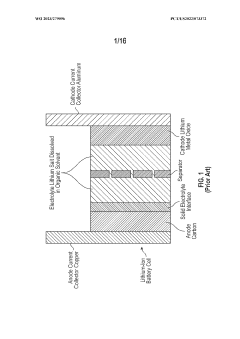
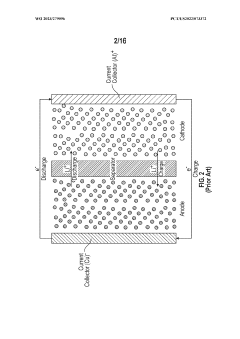
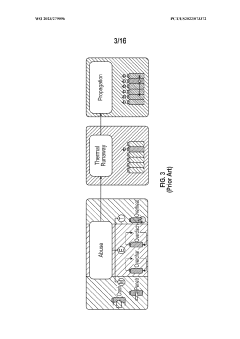
Systems and methods for mitigating thermal propagation in battery-based energy storage systems
PatentWO2023279096A2
Innovation
- A compressible thermal barrier material is introduced between battery cells, tailored to the areal energy density of individual cells, which prevents thermal propagation by absorbing mechanical energy and maintaining structural integrity during thermal events, using a multilayer material configuration with insulation and thermal conductive layers to manage heat dissipation.
Method for detecting battery thermal events via battery pack isolation resistance monitoring
PatentActiveUS8178227B1
Innovation
- A method for detecting cell failure in battery packs by monitoring variations in electrical isolation resistance, comparing it to preset values, and performing predetermined responses such as activating warnings, reducing load, increasing cooling, and activating fire containment systems when specific conditions are met.


Safety Standards and Regulations for Battery Systems
The regulatory landscape for battery systems has evolved significantly in response to growing concerns about thermal runaway incidents and their correlation with battery aging processes. International standards organizations have established comprehensive frameworks that address the intersection of battery degradation and safety performance throughout the operational lifecycle.
IEC 62133 and UL 1973 represent foundational standards that mandate thermal runaway testing protocols, requiring manufacturers to demonstrate system safety under various aging conditions. These standards have been updated to include accelerated aging tests that simulate real-world degradation scenarios, ensuring that safety mechanisms remain effective as batteries deteriorate over time. The standards specifically address how capacity fade, impedance growth, and electrolyte decomposition can compromise thermal stability.
UN 38.3 transportation regulations have incorporated aging-related safety requirements, mandating that battery systems undergo thermal abuse testing after predetermined aging cycles. This approach recognizes that fresh batteries may pass safety tests while aged batteries under identical conditions could experience thermal runaway. The regulation now requires documentation of safety performance degradation curves relative to aging parameters.
Regional regulatory bodies have implemented varying approaches to address aging-related thermal risks. The European Union's Battery Regulation emphasizes lifecycle safety assessment, requiring manufacturers to provide thermal runaway probability data across different aging stages. Similarly, China's GB standards have integrated aging simulation requirements into mandatory safety testing protocols, particularly for electric vehicle applications.
Recent regulatory developments focus on predictive safety frameworks that utilize aging indicators to assess thermal runaway probability in real-time. These emerging standards require battery management systems to incorporate aging-aware thermal monitoring algorithms, enabling proactive safety interventions before critical degradation thresholds are reached.
The regulatory trend indicates a shift toward dynamic safety standards that adapt requirements based on battery age and degradation state, rather than static one-time testing approaches. This evolution reflects growing understanding of the complex relationship between electrochemical aging mechanisms and thermal stability, driving more sophisticated regulatory frameworks for next-generation battery systems.
IEC 62133 and UL 1973 represent foundational standards that mandate thermal runaway testing protocols, requiring manufacturers to demonstrate system safety under various aging conditions. These standards have been updated to include accelerated aging tests that simulate real-world degradation scenarios, ensuring that safety mechanisms remain effective as batteries deteriorate over time. The standards specifically address how capacity fade, impedance growth, and electrolyte decomposition can compromise thermal stability.
UN 38.3 transportation regulations have incorporated aging-related safety requirements, mandating that battery systems undergo thermal abuse testing after predetermined aging cycles. This approach recognizes that fresh batteries may pass safety tests while aged batteries under identical conditions could experience thermal runaway. The regulation now requires documentation of safety performance degradation curves relative to aging parameters.
Regional regulatory bodies have implemented varying approaches to address aging-related thermal risks. The European Union's Battery Regulation emphasizes lifecycle safety assessment, requiring manufacturers to provide thermal runaway probability data across different aging stages. Similarly, China's GB standards have integrated aging simulation requirements into mandatory safety testing protocols, particularly for electric vehicle applications.
Recent regulatory developments focus on predictive safety frameworks that utilize aging indicators to assess thermal runaway probability in real-time. These emerging standards require battery management systems to incorporate aging-aware thermal monitoring algorithms, enabling proactive safety interventions before critical degradation thresholds are reached.
The regulatory trend indicates a shift toward dynamic safety standards that adapt requirements based on battery age and degradation state, rather than static one-time testing approaches. This evolution reflects growing understanding of the complex relationship between electrochemical aging mechanisms and thermal stability, driving more sophisticated regulatory frameworks for next-generation battery systems.
Environmental Impact of Battery Thermal Events
Battery thermal events, particularly thermal runaway incidents, pose significant environmental challenges that extend far beyond immediate safety concerns. These events release toxic gases, heavy metals, and corrosive substances into the atmosphere, soil, and water systems, creating complex environmental contamination scenarios that require comprehensive assessment and mitigation strategies.
The atmospheric impact of battery thermal events is particularly concerning due to the release of hydrogen fluoride, carbon monoxide, and various organic compounds. These emissions contribute to air quality degradation and can travel considerable distances from the incident site. Hydrogen fluoride, in particular, poses severe risks to both human health and vegetation, while the carbon-based emissions contribute to greenhouse gas accumulation and climate change concerns.
Soil contamination represents another critical environmental dimension of battery thermal events. Heavy metals such as lithium, cobalt, nickel, and manganese can leach into soil systems, affecting microbial communities and plant growth. The persistence of these contaminants in soil environments means that remediation efforts may be required for extended periods, potentially spanning decades depending on soil composition and environmental conditions.
Water system contamination occurs through multiple pathways during thermal events. Direct contamination can result from firefighting efforts that create contaminated runoff, while indirect contamination may occur through groundwater infiltration of leached materials. The electrolyte solutions released during thermal runaway contain organic carbonates and lithium salts that can significantly alter water chemistry and affect aquatic ecosystems.
The scale of environmental impact correlates directly with battery size, chemistry, and the effectiveness of containment measures. Large-scale energy storage systems present exponentially greater environmental risks compared to consumer electronics, requiring specialized environmental response protocols. Lithium iron phosphate batteries generally produce less toxic emissions than nickel-cobalt-aluminum chemistries, though all battery types present environmental challenges during thermal events.
Remediation strategies must address multiple contamination vectors simultaneously. Air filtration systems, soil excavation and treatment, and water system monitoring represent essential components of comprehensive environmental response plans. The development of environmentally-conscious battery designs and improved thermal management systems remains crucial for minimizing future environmental impacts from battery thermal events.
The atmospheric impact of battery thermal events is particularly concerning due to the release of hydrogen fluoride, carbon monoxide, and various organic compounds. These emissions contribute to air quality degradation and can travel considerable distances from the incident site. Hydrogen fluoride, in particular, poses severe risks to both human health and vegetation, while the carbon-based emissions contribute to greenhouse gas accumulation and climate change concerns.
Soil contamination represents another critical environmental dimension of battery thermal events. Heavy metals such as lithium, cobalt, nickel, and manganese can leach into soil systems, affecting microbial communities and plant growth. The persistence of these contaminants in soil environments means that remediation efforts may be required for extended periods, potentially spanning decades depending on soil composition and environmental conditions.
Water system contamination occurs through multiple pathways during thermal events. Direct contamination can result from firefighting efforts that create contaminated runoff, while indirect contamination may occur through groundwater infiltration of leached materials. The electrolyte solutions released during thermal runaway contain organic carbonates and lithium salts that can significantly alter water chemistry and affect aquatic ecosystems.
The scale of environmental impact correlates directly with battery size, chemistry, and the effectiveness of containment measures. Large-scale energy storage systems present exponentially greater environmental risks compared to consumer electronics, requiring specialized environmental response protocols. Lithium iron phosphate batteries generally produce less toxic emissions than nickel-cobalt-aluminum chemistries, though all battery types present environmental challenges during thermal events.
Remediation strategies must address multiple contamination vectors simultaneously. Air filtration systems, soil excavation and treatment, and water system monitoring represent essential components of comprehensive environmental response plans. The development of environmentally-conscious battery designs and improved thermal management systems remains crucial for minimizing future environmental impacts from battery thermal events.
Unlock deeper insights with PatSnap Eureka Quick Research — get a full tech report to explore trends and direct your research. Try now!
Generate Your Research Report Instantly with AI Agent
Supercharge your innovation with PatSnap Eureka AI Agent Platform!