

Develop Enhanced Properties with Nanocomposite Siloxanes
APR 28, 20269 MIN READ
Generate Your Research Report Instantly with AI Agent
PatSnap Eureka helps you evaluate technical feasibility & market potential.
Nanocomposite Siloxanes Development Background and Objectives
Siloxane-based materials have emerged as critical components in advanced material science due to their unique combination of organic and inorganic properties. The integration of nanoparticles into siloxane matrices represents a significant evolution in polymer chemistry, offering unprecedented opportunities to enhance mechanical, thermal, and functional properties. This technological advancement addresses growing industrial demands for materials that can withstand extreme conditions while maintaining flexibility and processability.
The historical development of siloxane chemistry dates back to the early 20th century, with polydimethylsiloxane (PDMS) becoming the foundation for numerous applications. However, traditional siloxanes often exhibit limitations in mechanical strength, thermal stability, and barrier properties. The incorporation of nanoscale fillers emerged in the 1990s as researchers recognized the potential to overcome these inherent weaknesses through controlled nanoparticle dispersion.
Current market drivers for enhanced nanocomposite siloxanes include the aerospace industry's need for lightweight, high-performance sealants, the electronics sector's demand for thermally conductive yet electrically insulating materials, and the automotive industry's requirements for durable gaskets and coatings. Additionally, emerging applications in biomedical devices and renewable energy systems are creating new performance benchmarks that conventional materials cannot meet.
The primary objective of developing enhanced nanocomposite siloxanes centers on achieving synergistic property improvements through strategic nanoparticle selection and dispersion optimization. Key targets include increasing tensile strength by 200-300% while maintaining elastomeric properties, enhancing thermal conductivity without compromising electrical insulation, and improving barrier properties against gases and moisture. These enhancements must be achieved while preserving the inherent advantages of siloxanes, including low-temperature flexibility, UV resistance, and biocompatibility.
Secondary objectives encompass developing scalable synthesis methods that ensure uniform nanoparticle distribution, establishing structure-property relationships for predictive material design, and creating cost-effective manufacturing processes suitable for industrial implementation. The ultimate goal is to establish a new class of high-performance materials that can replace multiple existing materials in demanding applications, thereby reducing system complexity and improving overall performance reliability.
The historical development of siloxane chemistry dates back to the early 20th century, with polydimethylsiloxane (PDMS) becoming the foundation for numerous applications. However, traditional siloxanes often exhibit limitations in mechanical strength, thermal stability, and barrier properties. The incorporation of nanoscale fillers emerged in the 1990s as researchers recognized the potential to overcome these inherent weaknesses through controlled nanoparticle dispersion.
Current market drivers for enhanced nanocomposite siloxanes include the aerospace industry's need for lightweight, high-performance sealants, the electronics sector's demand for thermally conductive yet electrically insulating materials, and the automotive industry's requirements for durable gaskets and coatings. Additionally, emerging applications in biomedical devices and renewable energy systems are creating new performance benchmarks that conventional materials cannot meet.
The primary objective of developing enhanced nanocomposite siloxanes centers on achieving synergistic property improvements through strategic nanoparticle selection and dispersion optimization. Key targets include increasing tensile strength by 200-300% while maintaining elastomeric properties, enhancing thermal conductivity without compromising electrical insulation, and improving barrier properties against gases and moisture. These enhancements must be achieved while preserving the inherent advantages of siloxanes, including low-temperature flexibility, UV resistance, and biocompatibility.
Secondary objectives encompass developing scalable synthesis methods that ensure uniform nanoparticle distribution, establishing structure-property relationships for predictive material design, and creating cost-effective manufacturing processes suitable for industrial implementation. The ultimate goal is to establish a new class of high-performance materials that can replace multiple existing materials in demanding applications, thereby reducing system complexity and improving overall performance reliability.
Market Demand for Enhanced Siloxane Materials
The global siloxane materials market is experiencing unprecedented growth driven by expanding applications across multiple high-value industries. Electronics manufacturing represents one of the most significant demand drivers, where enhanced siloxane materials serve critical functions in semiconductor packaging, thermal interface materials, and protective coatings. The miniaturization of electronic devices and the proliferation of 5G technology have intensified requirements for materials with superior thermal conductivity, electrical insulation, and mechanical stability.
Automotive industry transformation toward electric vehicles has created substantial new demand for advanced siloxane materials. These materials are essential for battery thermal management systems, power electronics cooling, and high-voltage insulation applications. The automotive sector particularly values siloxanes with enhanced thermal conductivity and flame retardancy properties, driving innovation in nanocomposite formulations.
Aerospace and defense applications constitute another high-growth segment, where extreme operating conditions demand materials with exceptional performance characteristics. Enhanced siloxane materials are increasingly specified for aircraft engine components, satellite systems, and military electronics where traditional materials fail to meet stringent reliability requirements.
The construction industry presents emerging opportunities for enhanced siloxane materials, particularly in energy-efficient building applications. Advanced sealants, coatings, and insulation materials incorporating nanocomposite siloxanes offer superior weatherability, thermal performance, and durability compared to conventional alternatives.
Healthcare and medical device manufacturing represents a specialized but rapidly growing market segment. Biocompatible siloxane materials with enhanced mechanical properties are essential for implantable devices, drug delivery systems, and medical equipment components. Regulatory requirements in this sector drive demand for materials with well-characterized performance profiles and proven safety records.
Market dynamics indicate strong preference for multifunctional materials that can replace multiple components or provide enhanced performance in existing applications. End-users increasingly seek siloxane materials that combine thermal management, electrical properties, and mechanical strength in single formulations, creating opportunities for innovative nanocomposite solutions.
Regional demand patterns show particularly strong growth in Asia-Pacific markets, driven by electronics manufacturing concentration and expanding automotive production. North American and European markets emphasize high-performance applications in aerospace, medical, and advanced manufacturing sectors, where premium pricing supports continued innovation investment.
Automotive industry transformation toward electric vehicles has created substantial new demand for advanced siloxane materials. These materials are essential for battery thermal management systems, power electronics cooling, and high-voltage insulation applications. The automotive sector particularly values siloxanes with enhanced thermal conductivity and flame retardancy properties, driving innovation in nanocomposite formulations.
Aerospace and defense applications constitute another high-growth segment, where extreme operating conditions demand materials with exceptional performance characteristics. Enhanced siloxane materials are increasingly specified for aircraft engine components, satellite systems, and military electronics where traditional materials fail to meet stringent reliability requirements.
The construction industry presents emerging opportunities for enhanced siloxane materials, particularly in energy-efficient building applications. Advanced sealants, coatings, and insulation materials incorporating nanocomposite siloxanes offer superior weatherability, thermal performance, and durability compared to conventional alternatives.
Healthcare and medical device manufacturing represents a specialized but rapidly growing market segment. Biocompatible siloxane materials with enhanced mechanical properties are essential for implantable devices, drug delivery systems, and medical equipment components. Regulatory requirements in this sector drive demand for materials with well-characterized performance profiles and proven safety records.
Market dynamics indicate strong preference for multifunctional materials that can replace multiple components or provide enhanced performance in existing applications. End-users increasingly seek siloxane materials that combine thermal management, electrical properties, and mechanical strength in single formulations, creating opportunities for innovative nanocomposite solutions.
Regional demand patterns show particularly strong growth in Asia-Pacific markets, driven by electronics manufacturing concentration and expanding automotive production. North American and European markets emphasize high-performance applications in aerospace, medical, and advanced manufacturing sectors, where premium pricing supports continued innovation investment.
Current State of Nanocomposite Siloxane Technology
Nanocomposite siloxane technology has reached a significant level of maturity, with widespread commercial applications across multiple industries. Current formulations typically incorporate various nanofillers including silica nanoparticles, carbon nanotubes, graphene oxide, and clay minerals into siloxane matrices. These hybrid materials demonstrate enhanced mechanical properties, thermal stability, and barrier performance compared to conventional siloxane polymers.
The integration of nanofillers into siloxane systems has been successfully achieved through multiple synthesis approaches. Sol-gel processing remains the dominant method, enabling precise control over nanoparticle dispersion and interfacial bonding. In-situ polymerization techniques have also gained prominence, particularly for incorporating functionalized nanofillers that form covalent bonds with the siloxane backbone. Surface modification of nanoparticles using silane coupling agents has become standard practice to improve compatibility and prevent agglomeration.
Manufacturing capabilities have evolved to support industrial-scale production of nanocomposite siloxanes. Major chemical companies have established dedicated production lines capable of processing tonnage quantities while maintaining consistent quality and dispersion characteristics. Quality control methodologies now include advanced characterization techniques such as dynamic light scattering, transmission electron microscopy, and rheological analysis to ensure optimal nanoparticle distribution.
Current applications span diverse sectors including automotive sealants, aerospace coatings, electronics encapsulants, and biomedical devices. The automotive industry particularly benefits from enhanced thermal cycling resistance and improved adhesion properties. Electronics applications leverage the superior dielectric properties and moisture barrier characteristics of these nanocomposites.
Despite technological advances, several challenges persist in the field. Achieving uniform nanoparticle dispersion at high loading levels remains problematic, often resulting in property degradation rather than enhancement. Long-term stability of nanocomposite formulations continues to be a concern, particularly regarding nanoparticle migration and agglomeration over extended periods. Cost considerations also limit widespread adoption, as specialized nanofillers and processing requirements significantly increase material expenses compared to conventional siloxane systems.
The regulatory landscape surrounding nanomaterials has created additional complexity for commercial deployment. Environmental and health safety assessments are increasingly required, particularly for applications involving direct human contact or potential environmental release. This has led to more stringent testing protocols and documentation requirements throughout the supply chain.
The integration of nanofillers into siloxane systems has been successfully achieved through multiple synthesis approaches. Sol-gel processing remains the dominant method, enabling precise control over nanoparticle dispersion and interfacial bonding. In-situ polymerization techniques have also gained prominence, particularly for incorporating functionalized nanofillers that form covalent bonds with the siloxane backbone. Surface modification of nanoparticles using silane coupling agents has become standard practice to improve compatibility and prevent agglomeration.
Manufacturing capabilities have evolved to support industrial-scale production of nanocomposite siloxanes. Major chemical companies have established dedicated production lines capable of processing tonnage quantities while maintaining consistent quality and dispersion characteristics. Quality control methodologies now include advanced characterization techniques such as dynamic light scattering, transmission electron microscopy, and rheological analysis to ensure optimal nanoparticle distribution.
Current applications span diverse sectors including automotive sealants, aerospace coatings, electronics encapsulants, and biomedical devices. The automotive industry particularly benefits from enhanced thermal cycling resistance and improved adhesion properties. Electronics applications leverage the superior dielectric properties and moisture barrier characteristics of these nanocomposites.
Despite technological advances, several challenges persist in the field. Achieving uniform nanoparticle dispersion at high loading levels remains problematic, often resulting in property degradation rather than enhancement. Long-term stability of nanocomposite formulations continues to be a concern, particularly regarding nanoparticle migration and agglomeration over extended periods. Cost considerations also limit widespread adoption, as specialized nanofillers and processing requirements significantly increase material expenses compared to conventional siloxane systems.
The regulatory landscape surrounding nanomaterials has created additional complexity for commercial deployment. Environmental and health safety assessments are increasingly required, particularly for applications involving direct human contact or potential environmental release. This has led to more stringent testing protocols and documentation requirements throughout the supply chain.
Existing Nanocomposite Siloxane Enhancement Solutions
01 Nanoparticle reinforcement in siloxane matrices
Incorporation of various nanoparticles into siloxane polymer matrices to enhance mechanical properties such as tensile strength, modulus, and durability. The nanoparticles act as reinforcing agents that improve the overall structural integrity of the siloxane composite materials through enhanced interfacial interactions and load transfer mechanisms.- Nanoparticle reinforcement in siloxane matrices: Incorporation of various nanoparticles into siloxane polymer matrices to enhance mechanical properties such as tensile strength, modulus, and durability. The nanoparticles act as reinforcing agents that improve the overall structural integrity of the siloxane composite materials through enhanced interfacial interactions and load transfer mechanisms.
- Surface modification techniques for enhanced compatibility: Methods for modifying the surface properties of nanofillers to improve their compatibility and dispersion within siloxane matrices. These techniques involve chemical functionalization and surface treatments that promote better adhesion between the nanoscale components and the polymer matrix, resulting in improved composite performance.
- Thermal and electrical property enhancement: Development of nanocomposite siloxanes with improved thermal stability, heat resistance, and electrical conductivity properties. These enhancements are achieved through the strategic incorporation of specific nanomaterials that contribute to better heat dissipation, thermal management, and electrical performance in various applications.
- Processing and fabrication methods: Advanced processing techniques and fabrication methods for producing nanocomposite siloxanes with uniform dispersion and optimal properties. These methods include specialized mixing procedures, curing processes, and manufacturing approaches that ensure consistent quality and performance of the final composite materials.
- Application-specific formulations and performance optimization: Tailored formulations of nanocomposite siloxanes designed for specific industrial applications with optimized performance characteristics. These formulations focus on achieving desired properties such as flexibility, adhesion, weather resistance, and chemical stability for targeted end-use applications in various industries.
02 Surface modification and functionalization of siloxanes
Chemical modification of siloxane surfaces through functionalization techniques to improve adhesion, compatibility, and performance characteristics. These modifications enable better integration with other materials and enhance specific properties such as hydrophobicity, thermal stability, and chemical resistance.Expand Specific Solutions03 Thermal and mechanical property enhancement
Development of nanocomposite siloxanes with improved thermal conductivity, heat resistance, and mechanical strength. These enhancements are achieved through strategic selection of nanofiller materials and optimization of processing conditions to create materials suitable for high-performance applications.Expand Specific Solutions04 Electrical and optical property modifications
Enhancement of electrical conductivity, dielectric properties, and optical characteristics of siloxane nanocomposites through incorporation of conductive or optically active nanofillers. These modifications enable applications in electronic devices, sensors, and optical components with improved performance characteristics.Expand Specific Solutions05 Processing and manufacturing optimization
Advanced processing techniques and manufacturing methods for producing nanocomposite siloxanes with controlled morphology and enhanced properties. These approaches focus on achieving uniform dispersion of nanofillers, optimizing curing conditions, and developing scalable production methods for commercial applications.Expand Specific Solutions
Key Players in Nanocomposite Siloxane Industry
The nanocomposite siloxanes industry is experiencing rapid growth driven by increasing demand for advanced materials with enhanced mechanical, thermal, and electrical properties across aerospace, automotive, and electronics sectors. The market demonstrates significant expansion potential as industries seek lightweight, high-performance materials. Technology maturity varies considerably among key players, with established leaders like Dow Silicones Corp. and Momentive Performance Materials leveraging decades of silicone expertise and comprehensive product portfolios. Specialty chemical companies including Evonik Operations GmbH and Covestro Deutschland AG contribute advanced polymer technologies, while technology giants like Samsung Electronics drive innovation in electronic applications. Academic institutions such as KAIST, Beijing Institute of Technology, and Texas A&M University provide fundamental research support. The competitive landscape shows a mature core technology base among major silicone producers, while emerging applications in nanocomposites represent growing technological frontiers with substantial development opportunities.
Momentive Performance Materials, Inc.
Technical Solution: Momentive develops nanocomposite siloxanes through proprietary functionalization of silica and alumina nanoparticles with reactive siloxane groups, enabling covalent bonding within the polymer network. Their approach involves controlled hydrolysis and condensation reactions to create hybrid organic-inorganic materials with tailored properties. The technology incorporates surface-treated nanofillers at concentrations of 5-20 wt% to achieve significant improvements in mechanical strength, thermal conductivity, and dielectric properties while maintaining processability and flexibility of the base siloxane system.
Strengths: Strong expertise in silicone chemistry and established customer relationships across multiple industries. Weaknesses: Limited portfolio compared to larger competitors and dependency on raw material suppliers.
Dow Silicones Corp.
Technical Solution: Dow Silicones develops advanced nanocomposite siloxane systems by incorporating silica nanoparticles and carbon nanotubes into silicone matrices to enhance mechanical properties, thermal stability, and electrical conductivity. Their technology focuses on surface modification of nanofillers using silane coupling agents to improve dispersion and interfacial bonding with the siloxane polymer matrix. The company utilizes sol-gel processing and in-situ polymerization techniques to achieve uniform nanoparticle distribution, resulting in composites with enhanced tensile strength, modulus, and thermal resistance for applications in electronics, automotive, and aerospace industries.
Strengths: Market leadership in silicone technology with extensive R&D capabilities and established manufacturing infrastructure. Weaknesses: High production costs and challenges in scaling nanoparticle dispersion processes.
Core Patents in Siloxane Nanocomposite Innovation
Well-defined nanosized building blocks for organic/inorganic nanocomposites
PatentInactiveEP1328529B1
Innovation
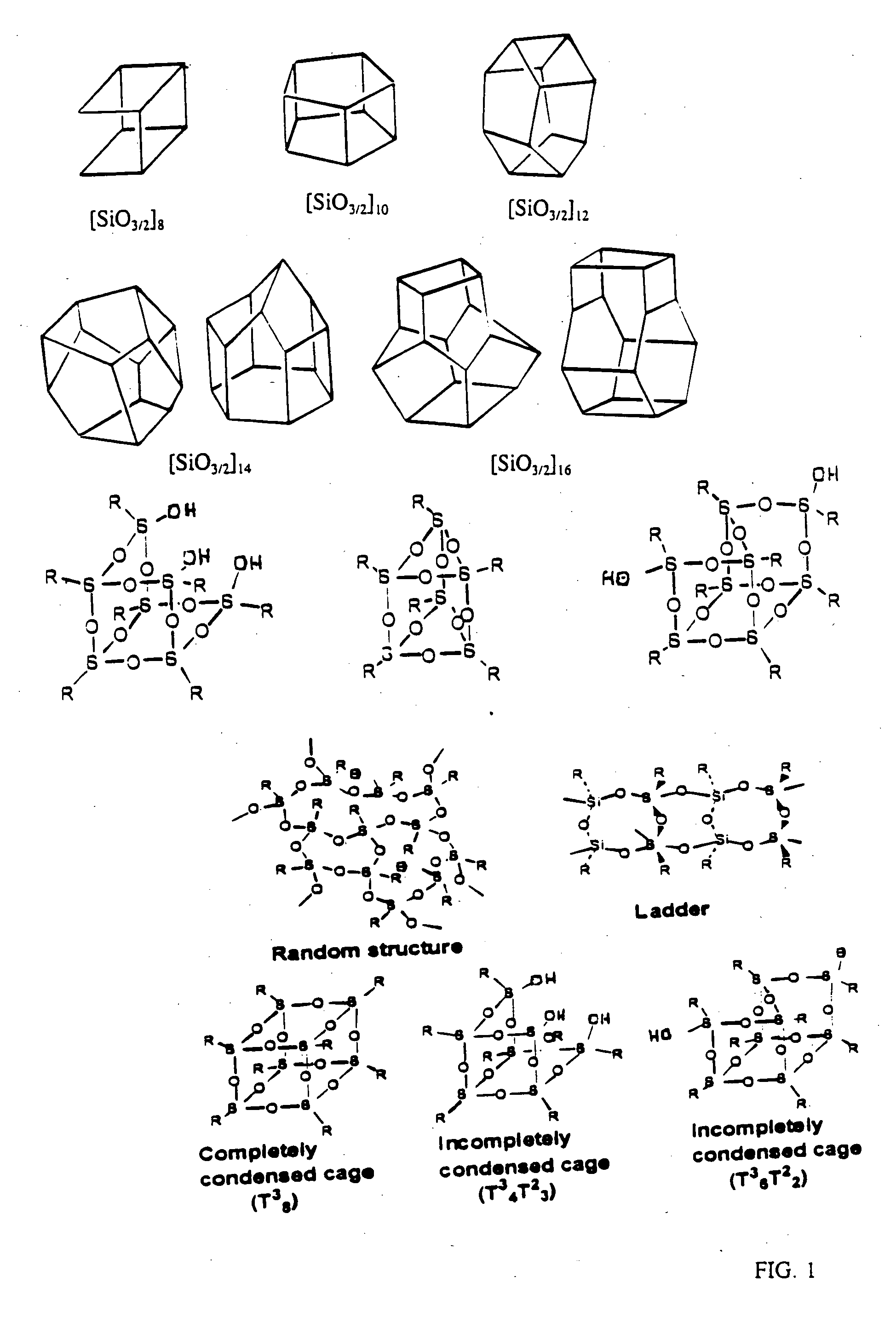
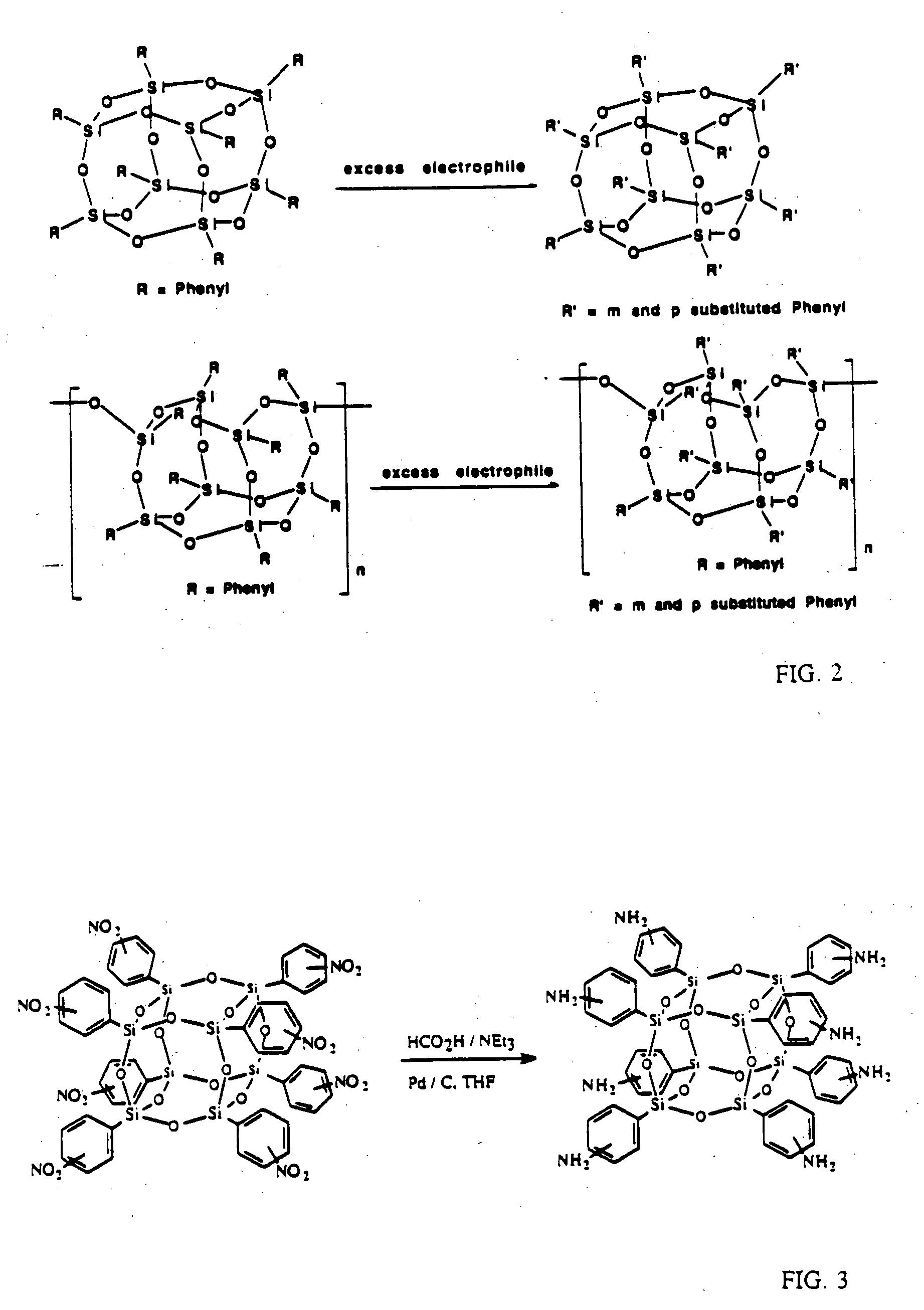
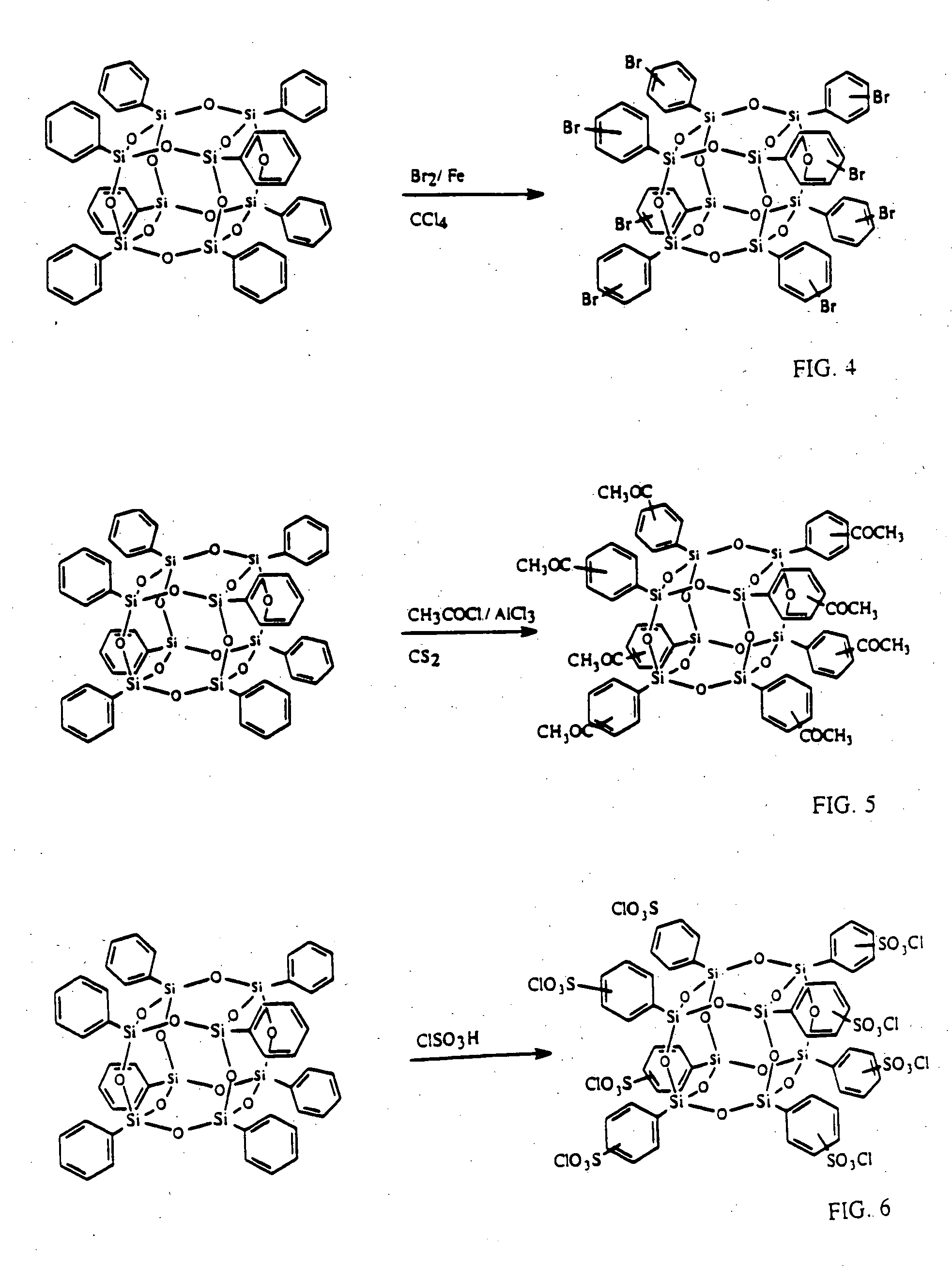
- Development of functionalized silsesquioxane nanoparticles with phenyl groups bearing reactive functional groups, allowing for controlled chemical bonding and the creation of nanocomposites with specific properties like high strength, thermal stability, and reactivity.


Well-defined nanosized building blocks for organic/inorganic nanocomposites
PatentInactiveUS20060083925A1
Innovation
- Development of functionalized phenyl silsesquioxanes with reactive groups, such as amino, maleimido, and isocyanato, that can be used to create a wide array of nanocomposites with controlled chemical bonding, utilizing inexpensive silica sources like rice hull ash and mild synthesis conditions to produce materials with enhanced properties.

Environmental Impact of Nanocomposite Siloxanes
The environmental implications of nanocomposite siloxanes represent a critical consideration in their development and widespread adoption. These materials, while offering enhanced properties for various applications, present unique environmental challenges that require comprehensive assessment throughout their lifecycle. The nanoscale components within siloxane matrices can potentially interact with environmental systems in ways that differ significantly from their bulk counterparts.
Release pathways for nanocomposite siloxanes into the environment occur through multiple channels during manufacturing, use, and disposal phases. Industrial production facilities may generate airborne nanoparticles or wastewater containing siloxane nanocomposites. During product use, weathering and degradation can lead to gradual release of nanoparticles into soil, water, and air. End-of-life disposal through landfills or incineration creates additional release scenarios that must be carefully managed.
Aquatic ecosystems face particular vulnerability to nanocomposite siloxane contamination. The hydrophobic nature of many siloxanes can lead to bioaccumulation in aquatic organisms, while nanoparticles may exhibit enhanced mobility and bioavailability compared to conventional materials. Studies indicate potential impacts on algae, fish, and invertebrates, though long-term effects remain incompletely understood. The persistence of siloxane backbones in aquatic environments raises concerns about chronic exposure effects.
Terrestrial environmental impacts encompass soil contamination and potential effects on plant and microbial communities. Nanocomposite siloxanes may alter soil chemistry and affect nutrient cycling processes. The interaction between nanoparticles and soil organic matter can influence their mobility and bioavailability, potentially affecting agricultural productivity and ecosystem health.
Atmospheric release of nanocomposite siloxanes presents additional environmental concerns. Airborne nanoparticles can travel significant distances and may contribute to air quality degradation. The potential for inhalation exposure to both humans and wildlife necessitates careful monitoring and control measures during production and application processes.
Regulatory frameworks for nanocomposite siloxanes continue to evolve as understanding of their environmental behavior improves. Current assessment approaches often rely on conventional testing methods that may not adequately capture the unique properties and behaviors of nanoscale materials. Development of specialized testing protocols and risk assessment methodologies remains an ongoing priority for regulatory agencies worldwide.
Mitigation strategies focus on implementing green chemistry principles in nanocomposite siloxane design, developing biodegradable alternatives, and establishing robust containment and treatment systems. Life cycle assessment approaches help identify environmental hotspots and guide sustainable development practices for these advanced materials.
Release pathways for nanocomposite siloxanes into the environment occur through multiple channels during manufacturing, use, and disposal phases. Industrial production facilities may generate airborne nanoparticles or wastewater containing siloxane nanocomposites. During product use, weathering and degradation can lead to gradual release of nanoparticles into soil, water, and air. End-of-life disposal through landfills or incineration creates additional release scenarios that must be carefully managed.
Aquatic ecosystems face particular vulnerability to nanocomposite siloxane contamination. The hydrophobic nature of many siloxanes can lead to bioaccumulation in aquatic organisms, while nanoparticles may exhibit enhanced mobility and bioavailability compared to conventional materials. Studies indicate potential impacts on algae, fish, and invertebrates, though long-term effects remain incompletely understood. The persistence of siloxane backbones in aquatic environments raises concerns about chronic exposure effects.
Terrestrial environmental impacts encompass soil contamination and potential effects on plant and microbial communities. Nanocomposite siloxanes may alter soil chemistry and affect nutrient cycling processes. The interaction between nanoparticles and soil organic matter can influence their mobility and bioavailability, potentially affecting agricultural productivity and ecosystem health.
Atmospheric release of nanocomposite siloxanes presents additional environmental concerns. Airborne nanoparticles can travel significant distances and may contribute to air quality degradation. The potential for inhalation exposure to both humans and wildlife necessitates careful monitoring and control measures during production and application processes.
Regulatory frameworks for nanocomposite siloxanes continue to evolve as understanding of their environmental behavior improves. Current assessment approaches often rely on conventional testing methods that may not adequately capture the unique properties and behaviors of nanoscale materials. Development of specialized testing protocols and risk assessment methodologies remains an ongoing priority for regulatory agencies worldwide.
Mitigation strategies focus on implementing green chemistry principles in nanocomposite siloxane design, developing biodegradable alternatives, and establishing robust containment and treatment systems. Life cycle assessment approaches help identify environmental hotspots and guide sustainable development practices for these advanced materials.
Safety Standards for Nanomaterial-Enhanced Siloxanes
The development of safety standards for nanomaterial-enhanced siloxanes represents a critical regulatory framework essential for the responsible commercialization of these advanced materials. Current international standards primarily derive from established frameworks such as ISO/TC 229 nanotechnologies committee guidelines and ASTM International standards, which provide foundational protocols for nanomaterial characterization and risk assessment. However, these existing frameworks require significant adaptation to address the unique properties and potential hazards associated with siloxane-based nanocomposites.
Regulatory bodies including the Environmental Protection Agency (EPA), European Chemicals Agency (ECHA), and Occupational Safety and Health Administration (OSHA) have begun establishing specific guidelines for nanomaterial handling and exposure limits. The EPA's Toxic Substances Control Act (TSCA) now requires manufacturers to report nanoscale materials separately, while ECHA's REACH regulation mandates comprehensive safety data for nanocomposite materials exceeding one ton annual production.
Key safety parameters for nanomaterial-enhanced siloxanes encompass particle size distribution analysis, surface area characterization, and agglomeration behavior assessment. Standard test methods include dynamic light scattering (DLS) for size measurement, Brunauer-Emmett-Teller (BET) analysis for surface area determination, and transmission electron microscopy (TEM) for morphological evaluation. These characterization protocols ensure consistent quality control and hazard identification across manufacturing processes.
Exposure assessment protocols focus on inhalation, dermal contact, and environmental release pathways. Workplace exposure limits typically follow the precautionary principle, with recommended exposure levels often set at 0.1-1.0 mg/m³ for respirable nanoparticles. Personal protective equipment requirements include N95 or higher-grade respirators, chemical-resistant gloves, and enclosed handling systems for powder forms.
Environmental safety standards address aquatic toxicity, soil contamination, and bioaccumulation potential. Standardized ecotoxicity testing protocols evaluate effects on algae, daphnia, and fish species, while biodegradation studies assess long-term environmental persistence. These comprehensive safety frameworks ensure that enhanced siloxane nanocomposites can be developed and deployed with minimal risk to human health and environmental systems.
Regulatory bodies including the Environmental Protection Agency (EPA), European Chemicals Agency (ECHA), and Occupational Safety and Health Administration (OSHA) have begun establishing specific guidelines for nanomaterial handling and exposure limits. The EPA's Toxic Substances Control Act (TSCA) now requires manufacturers to report nanoscale materials separately, while ECHA's REACH regulation mandates comprehensive safety data for nanocomposite materials exceeding one ton annual production.
Key safety parameters for nanomaterial-enhanced siloxanes encompass particle size distribution analysis, surface area characterization, and agglomeration behavior assessment. Standard test methods include dynamic light scattering (DLS) for size measurement, Brunauer-Emmett-Teller (BET) analysis for surface area determination, and transmission electron microscopy (TEM) for morphological evaluation. These characterization protocols ensure consistent quality control and hazard identification across manufacturing processes.
Exposure assessment protocols focus on inhalation, dermal contact, and environmental release pathways. Workplace exposure limits typically follow the precautionary principle, with recommended exposure levels often set at 0.1-1.0 mg/m³ for respirable nanoparticles. Personal protective equipment requirements include N95 or higher-grade respirators, chemical-resistant gloves, and enclosed handling systems for powder forms.
Environmental safety standards address aquatic toxicity, soil contamination, and bioaccumulation potential. Standardized ecotoxicity testing protocols evaluate effects on algae, daphnia, and fish species, while biodegradation studies assess long-term environmental persistence. These comprehensive safety frameworks ensure that enhanced siloxane nanocomposites can be developed and deployed with minimal risk to human health and environmental systems.
Unlock deeper insights with PatSnap Eureka Quick Research — get a full tech report to explore trends and direct your research. Try now!
Generate Your Research Report Instantly with AI Agent
Supercharge your innovation with PatSnap Eureka AI Agent Platform!