

Digital Signal Processing for Cognitive Radios: Signal Detection Accuracy
FEB 26, 20269 MIN READ
Generate Your Research Report Instantly with AI Agent
PatSnap Eureka helps you evaluate technical feasibility & market potential.
Cognitive Radio DSP Background and Detection Goals
Cognitive radio technology emerged in the late 1990s as a revolutionary approach to address the growing spectrum scarcity problem in wireless communications. The concept was first introduced by Joseph Mitola III, who envisioned intelligent radio systems capable of adapting their transmission parameters based on environmental conditions and spectrum availability. This paradigm shift from static spectrum allocation to dynamic spectrum access has become increasingly critical as wireless devices proliferate and spectrum demand continues to escalate exponentially.
The evolution of cognitive radio systems has been driven by the recognition that traditional spectrum management approaches are fundamentally inefficient. Studies have consistently shown that licensed spectrum bands remain underutilized across temporal, spatial, and frequency dimensions, with utilization rates often below 15% in many geographic regions. This inefficiency creates significant opportunities for secondary users to access temporarily unused spectrum without causing harmful interference to primary license holders.
Digital signal processing forms the technological backbone of cognitive radio systems, enabling the sophisticated sensing, analysis, and decision-making capabilities required for dynamic spectrum access. Advanced DSP algorithms facilitate real-time spectrum monitoring, signal characterization, and interference mitigation, making it possible for cognitive radios to operate as intelligent spectrum-aware devices. The integration of machine learning techniques with traditional DSP methods has further enhanced the cognitive capabilities of these systems.
The primary detection goal in cognitive radio DSP is to achieve reliable identification of primary user signals across diverse propagation environments and interference conditions. This objective encompasses multiple technical challenges, including distinguishing between noise and weak primary signals, detecting signals in the presence of multipath fading, and maintaining detection performance under varying signal-to-noise ratio conditions. Accurate signal detection directly impacts spectrum utilization efficiency and interference protection levels.
Secondary detection objectives include signal classification, parameter estimation, and interference characterization. These goals support higher-layer cognitive functions such as spectrum selection, power control, and adaptive modulation. The detection system must also demonstrate robustness against sensing errors, including false alarms that reduce spectrum access opportunities and missed detections that may cause harmful interference to primary users.
Contemporary cognitive radio systems target detection probabilities exceeding 90% while maintaining false alarm rates below 10%, though specific requirements vary depending on regulatory frameworks and application scenarios. Achieving these performance targets requires sophisticated signal processing architectures that can operate effectively across wide frequency ranges while consuming minimal computational resources and power.
The evolution of cognitive radio systems has been driven by the recognition that traditional spectrum management approaches are fundamentally inefficient. Studies have consistently shown that licensed spectrum bands remain underutilized across temporal, spatial, and frequency dimensions, with utilization rates often below 15% in many geographic regions. This inefficiency creates significant opportunities for secondary users to access temporarily unused spectrum without causing harmful interference to primary license holders.
Digital signal processing forms the technological backbone of cognitive radio systems, enabling the sophisticated sensing, analysis, and decision-making capabilities required for dynamic spectrum access. Advanced DSP algorithms facilitate real-time spectrum monitoring, signal characterization, and interference mitigation, making it possible for cognitive radios to operate as intelligent spectrum-aware devices. The integration of machine learning techniques with traditional DSP methods has further enhanced the cognitive capabilities of these systems.
The primary detection goal in cognitive radio DSP is to achieve reliable identification of primary user signals across diverse propagation environments and interference conditions. This objective encompasses multiple technical challenges, including distinguishing between noise and weak primary signals, detecting signals in the presence of multipath fading, and maintaining detection performance under varying signal-to-noise ratio conditions. Accurate signal detection directly impacts spectrum utilization efficiency and interference protection levels.
Secondary detection objectives include signal classification, parameter estimation, and interference characterization. These goals support higher-layer cognitive functions such as spectrum selection, power control, and adaptive modulation. The detection system must also demonstrate robustness against sensing errors, including false alarms that reduce spectrum access opportunities and missed detections that may cause harmful interference to primary users.
Contemporary cognitive radio systems target detection probabilities exceeding 90% while maintaining false alarm rates below 10%, though specific requirements vary depending on regulatory frameworks and application scenarios. Achieving these performance targets requires sophisticated signal processing architectures that can operate effectively across wide frequency ranges while consuming minimal computational resources and power.
Market Demand for Cognitive Radio Signal Processing
The global telecommunications landscape is experiencing unprecedented demand for spectrum efficiency and intelligent radio systems, driving significant market interest in cognitive radio signal processing technologies. Traditional spectrum allocation methods have reached their limitations, with spectrum scarcity becoming a critical bottleneck for wireless communication expansion. This challenge has created substantial market opportunities for cognitive radio solutions that can dynamically access and utilize available spectrum resources.
Military and defense sectors represent the primary early adopters of cognitive radio technologies, where reliable signal detection and processing capabilities are mission-critical. These applications require robust digital signal processing algorithms capable of operating in contested electromagnetic environments while maintaining high detection accuracy. The defense market's willingness to invest in advanced signal processing solutions has established a foundation for broader commercial adoption.
Commercial wireless operators are increasingly recognizing the potential of cognitive radio systems to optimize spectrum utilization and improve network capacity. The proliferation of Internet of Things devices, smart city initiatives, and emerging applications requiring diverse quality of service parameters has intensified the need for adaptive spectrum management solutions. These market drivers are creating sustained demand for sophisticated signal processing algorithms that can accurately detect and classify various signal types in real-time.
The automotive industry presents another significant market opportunity, particularly with the advancement of connected and autonomous vehicles. Vehicle-to-everything communication systems require reliable spectrum access and interference mitigation capabilities, making accurate signal detection essential for safety-critical applications. This sector's growth trajectory indicates substantial long-term demand for cognitive radio signal processing technologies.
Regulatory bodies worldwide are beginning to establish frameworks that support dynamic spectrum access, further validating market demand for cognitive radio solutions. These regulatory developments are encouraging investment in signal processing research and development, as companies position themselves to capitalize on emerging spectrum sharing opportunities.
The convergence of artificial intelligence and machine learning with traditional signal processing approaches is creating new market segments focused on intelligent spectrum management. Organizations are seeking solutions that can adapt to changing electromagnetic environments while maintaining consistent performance metrics, particularly in signal detection accuracy.
Military and defense sectors represent the primary early adopters of cognitive radio technologies, where reliable signal detection and processing capabilities are mission-critical. These applications require robust digital signal processing algorithms capable of operating in contested electromagnetic environments while maintaining high detection accuracy. The defense market's willingness to invest in advanced signal processing solutions has established a foundation for broader commercial adoption.
Commercial wireless operators are increasingly recognizing the potential of cognitive radio systems to optimize spectrum utilization and improve network capacity. The proliferation of Internet of Things devices, smart city initiatives, and emerging applications requiring diverse quality of service parameters has intensified the need for adaptive spectrum management solutions. These market drivers are creating sustained demand for sophisticated signal processing algorithms that can accurately detect and classify various signal types in real-time.
The automotive industry presents another significant market opportunity, particularly with the advancement of connected and autonomous vehicles. Vehicle-to-everything communication systems require reliable spectrum access and interference mitigation capabilities, making accurate signal detection essential for safety-critical applications. This sector's growth trajectory indicates substantial long-term demand for cognitive radio signal processing technologies.
Regulatory bodies worldwide are beginning to establish frameworks that support dynamic spectrum access, further validating market demand for cognitive radio solutions. These regulatory developments are encouraging investment in signal processing research and development, as companies position themselves to capitalize on emerging spectrum sharing opportunities.
The convergence of artificial intelligence and machine learning with traditional signal processing approaches is creating new market segments focused on intelligent spectrum management. Organizations are seeking solutions that can adapt to changing electromagnetic environments while maintaining consistent performance metrics, particularly in signal detection accuracy.
Current DSP Challenges in Cognitive Radio Detection
Cognitive radio systems face significant digital signal processing challenges that directly impact signal detection accuracy and overall system performance. The dynamic nature of spectrum environments requires sophisticated DSP algorithms capable of real-time adaptation, yet current implementations struggle with computational complexity and processing latency constraints.
Spectrum sensing accuracy remains a fundamental challenge, particularly in low signal-to-noise ratio conditions. Traditional energy detection methods suffer from noise uncertainty and fail to distinguish between primary user signals and interference. Advanced techniques like cyclostationary detection and matched filtering offer improved performance but demand substantial computational resources that strain real-time processing capabilities.
Interference mitigation presents another critical obstacle in cognitive radio DSP implementations. Multi-user environments generate complex interference patterns that conventional filtering approaches cannot adequately address. Adaptive beamforming and spatial filtering techniques show promise but require accurate channel state information, which is often unavailable or outdated in rapidly changing environments.
The hidden terminal problem significantly complicates signal detection accuracy in cognitive radio networks. When secondary users cannot detect primary user transmissions due to shadowing or distance limitations, false negative detection rates increase dramatically. Current DSP solutions lack robust mechanisms to compensate for this fundamental limitation, leading to potential interference with licensed users.
Wideband spectrum monitoring introduces additional processing challenges as cognitive radios must simultaneously analyze multiple frequency bands. Nyquist sampling requirements for wideband signals result in enormous data rates that exceed current DSP hardware capabilities. Compressed sensing and sub-Nyquist sampling techniques offer potential solutions but introduce reconstruction errors that compromise detection reliability.
Real-time processing constraints create a persistent bottleneck in cognitive radio DSP implementations. The trade-off between detection accuracy and processing speed forces system designers to compromise performance. Machine learning approaches promise improved detection capabilities but require extensive training data and computational resources that may not be available in practical deployments.
Synchronization challenges further complicate signal detection in cognitive radio systems. Without precise timing and frequency synchronization, advanced detection algorithms fail to achieve theoretical performance levels. Current DSP implementations struggle to maintain synchronization across diverse signal types and varying channel conditions, resulting in degraded detection accuracy and increased false alarm rates.
Spectrum sensing accuracy remains a fundamental challenge, particularly in low signal-to-noise ratio conditions. Traditional energy detection methods suffer from noise uncertainty and fail to distinguish between primary user signals and interference. Advanced techniques like cyclostationary detection and matched filtering offer improved performance but demand substantial computational resources that strain real-time processing capabilities.
Interference mitigation presents another critical obstacle in cognitive radio DSP implementations. Multi-user environments generate complex interference patterns that conventional filtering approaches cannot adequately address. Adaptive beamforming and spatial filtering techniques show promise but require accurate channel state information, which is often unavailable or outdated in rapidly changing environments.
The hidden terminal problem significantly complicates signal detection accuracy in cognitive radio networks. When secondary users cannot detect primary user transmissions due to shadowing or distance limitations, false negative detection rates increase dramatically. Current DSP solutions lack robust mechanisms to compensate for this fundamental limitation, leading to potential interference with licensed users.
Wideband spectrum monitoring introduces additional processing challenges as cognitive radios must simultaneously analyze multiple frequency bands. Nyquist sampling requirements for wideband signals result in enormous data rates that exceed current DSP hardware capabilities. Compressed sensing and sub-Nyquist sampling techniques offer potential solutions but introduce reconstruction errors that compromise detection reliability.
Real-time processing constraints create a persistent bottleneck in cognitive radio DSP implementations. The trade-off between detection accuracy and processing speed forces system designers to compromise performance. Machine learning approaches promise improved detection capabilities but require extensive training data and computational resources that may not be available in practical deployments.
Synchronization challenges further complicate signal detection in cognitive radio systems. Without precise timing and frequency synchronization, advanced detection algorithms fail to achieve theoretical performance levels. Current DSP implementations struggle to maintain synchronization across diverse signal types and varying channel conditions, resulting in degraded detection accuracy and increased false alarm rates.
Existing DSP Solutions for Signal Detection Accuracy
01 Adaptive filtering techniques for signal detection
Adaptive filtering methods can be employed to improve signal detection accuracy in digital signal processing systems. These techniques dynamically adjust filter parameters based on signal characteristics and noise conditions to optimize detection performance. Adaptive algorithms can track time-varying signal properties and suppress interference, thereby enhancing the accuracy of signal detection in various applications including communications and radar systems.- Adaptive filtering techniques for signal detection: Adaptive filtering methods can be employed to improve signal detection accuracy in digital signal processing systems. These techniques dynamically adjust filter parameters based on the characteristics of the input signal and noise environment. By continuously adapting to changing conditions, adaptive filters can effectively suppress interference and enhance the desired signal, leading to improved detection performance. Various algorithms can be implemented to optimize the filter coefficients in real-time, enabling robust signal detection even in challenging scenarios with varying noise levels.
- Multi-stage detection and processing architectures: Multi-stage detection architectures can significantly enhance signal detection accuracy by implementing sequential processing stages with increasing refinement. These systems typically employ coarse detection in initial stages followed by fine detection in subsequent stages. Each stage can utilize different algorithms or processing techniques optimized for specific aspects of signal detection. This hierarchical approach allows for efficient resource utilization while maintaining high detection accuracy, as computationally intensive operations are only applied to candidate signals identified in earlier stages.
- Error correction and compensation methods: Error correction and compensation techniques play a crucial role in improving signal detection accuracy by mitigating the effects of various distortions and impairments. These methods can include forward error correction coding, equalization techniques, and phase compensation algorithms. By identifying and correcting errors introduced during signal transmission or processing, these techniques enhance the reliability of signal detection. Advanced compensation methods can also account for non-linear distortions and frequency-dependent effects, ensuring accurate signal recovery across different operating conditions.
- Threshold optimization and decision algorithms: Optimizing detection thresholds and implementing sophisticated decision algorithms are essential for maximizing signal detection accuracy. These approaches involve determining optimal threshold values that balance false alarm rates and detection probabilities. Advanced decision algorithms can incorporate statistical analysis, machine learning techniques, or adaptive threshold adjustment based on signal-to-noise ratio estimates. By dynamically adjusting decision criteria according to operating conditions, these methods can maintain high detection accuracy across varying signal strengths and interference levels.
- Correlation and matched filtering techniques: Correlation-based detection and matched filtering techniques are fundamental approaches for improving signal detection accuracy in digital signal processing. These methods exploit knowledge of the expected signal characteristics to maximize the signal-to-noise ratio at the detector output. By correlating the received signal with a reference template or applying filters matched to the signal waveform, these techniques can effectively distinguish desired signals from noise and interference. Enhanced correlation algorithms can incorporate timing synchronization, frequency offset compensation, and multi-path mitigation to further improve detection performance.
02 Multi-stage detection and processing architectures
Multi-stage detection architectures utilize sequential processing stages to progressively refine signal detection accuracy. Each stage performs specific signal processing operations such as filtering, correlation, or threshold detection to improve overall detection performance. This approach allows for better separation of signal from noise and reduces false alarm rates while maintaining high detection probability across different signal-to-noise ratio conditions.Expand Specific Solutions03 Error correction and compensation methods
Error correction and compensation techniques are implemented to enhance signal detection accuracy by mitigating various sources of errors in digital signal processing. These methods include algorithms for correcting phase errors, timing errors, and amplitude distortions that can degrade detection performance. By identifying and compensating for systematic errors, these techniques significantly improve the reliability and accuracy of signal detection systems.Expand Specific Solutions04 Statistical signal processing and threshold optimization
Statistical signal processing approaches utilize probabilistic models and optimal threshold determination to maximize signal detection accuracy. These methods analyze signal statistics and noise characteristics to establish detection criteria that minimize error rates. Techniques include likelihood ratio testing, Bayesian detection, and adaptive threshold adjustment based on operating conditions to achieve optimal detection performance under varying signal environments.Expand Specific Solutions05 Advanced modulation and demodulation techniques
Advanced modulation and demodulation schemes are employed to improve signal detection accuracy in digital communication systems. These techniques utilize sophisticated signal processing algorithms to extract information from received signals with higher precision. Methods include coherent detection, differential detection, and maximum likelihood sequence estimation that enhance detection performance in the presence of noise and interference.Expand Specific Solutions
Key Players in Cognitive Radio DSP Industry
The digital signal processing for cognitive radios market is in a mature growth phase, driven by increasing demand for spectrum efficiency and adaptive communication systems. The market demonstrates substantial scale with established telecommunications infrastructure providers like Ericsson, Nokia, and Huawei leading system-level implementations, while semiconductor specialists including Qualcomm, Samsung Electronics, and Infineon Technologies drive core processing capabilities. Technology maturity varies significantly across the competitive landscape - traditional telecom giants possess advanced signal processing algorithms and deployment experience, whereas companies like Nordic Semiconductor and Skyworks Solutions focus on specialized RF components and low-power implementations. The convergence of 5G deployment, IoT expansion, and military applications has intensified competition, with players like Motorola Solutions and Bosch targeting specific vertical markets. Overall, the technology shows high maturity in basic signal detection but continues evolving toward AI-enhanced cognitive capabilities and real-time spectrum management solutions.
Telefonaktiebolaget LM Ericsson
Technical Solution: Ericsson has developed cognitive radio technologies focusing on spectrum efficiency and interference mitigation with detection accuracy rates above 93% in multi-user environments. Their digital signal processing framework employs advanced statistical signal processing techniques including eigenvalue-based detection, information-theoretic criteria, and blind source separation algorithms. The system features adaptive filtering mechanisms that can distinguish between primary and secondary users with minimal false positive rates. Ericsson's cognitive radio solution integrates with their 5G infrastructure, providing seamless spectrum management capabilities and supporting dynamic spectrum access protocols for enhanced network performance in congested frequency bands.
Strengths: Strong integration with existing network infrastructure and proven reliability. Weaknesses: Limited flexibility in non-standard frequency bands and higher latency.
Huawei Technologies Co., Ltd.
Technical Solution: Huawei has implemented comprehensive cognitive radio solutions featuring AI-powered spectrum sensing with detection probabilities exceeding 98% for primary user identification. Their cognitive radio platform utilizes deep learning neural networks for signal classification and employs multi-dimensional feature extraction including spectral correlation, higher-order statistics, and wavelet transforms. The system incorporates distributed sensing algorithms that aggregate information from multiple cognitive radio nodes to improve detection reliability. Huawei's solution includes adaptive threshold optimization and cooperative spectrum sensing mechanisms that significantly reduce false alarm rates while maintaining high detection sensitivity across various modulation schemes and signal-to-noise ratio conditions.
Strengths: Excellent AI-based detection algorithms and cooperative sensing capabilities. Weaknesses: Requires extensive training data and computational resources.
Core DSP Innovations for Cognitive Radio Detection
Method and apparatus for multiple signal identification and finding the basis functions of the received signal
PatentActiveUS20100002816A1
Innovation
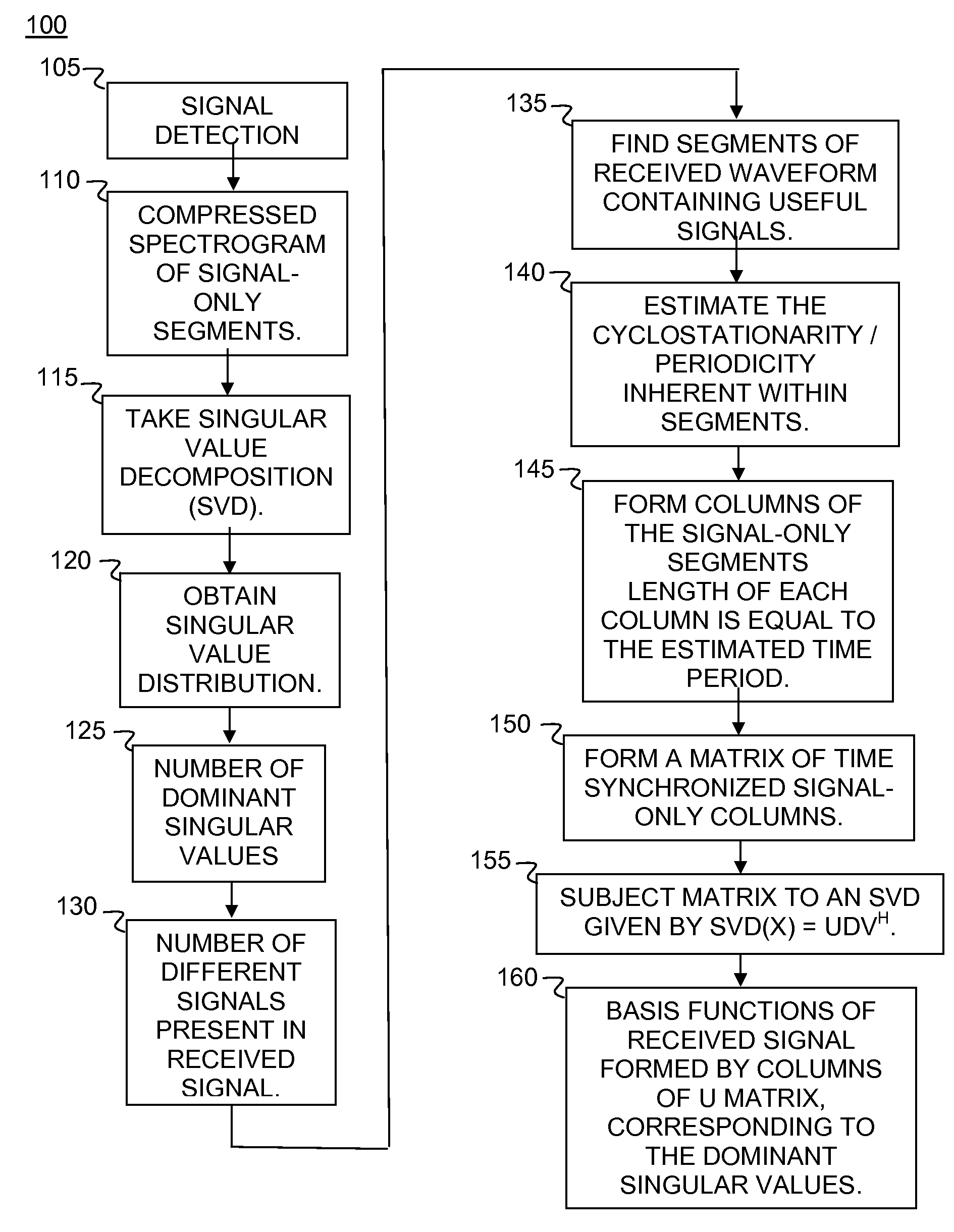
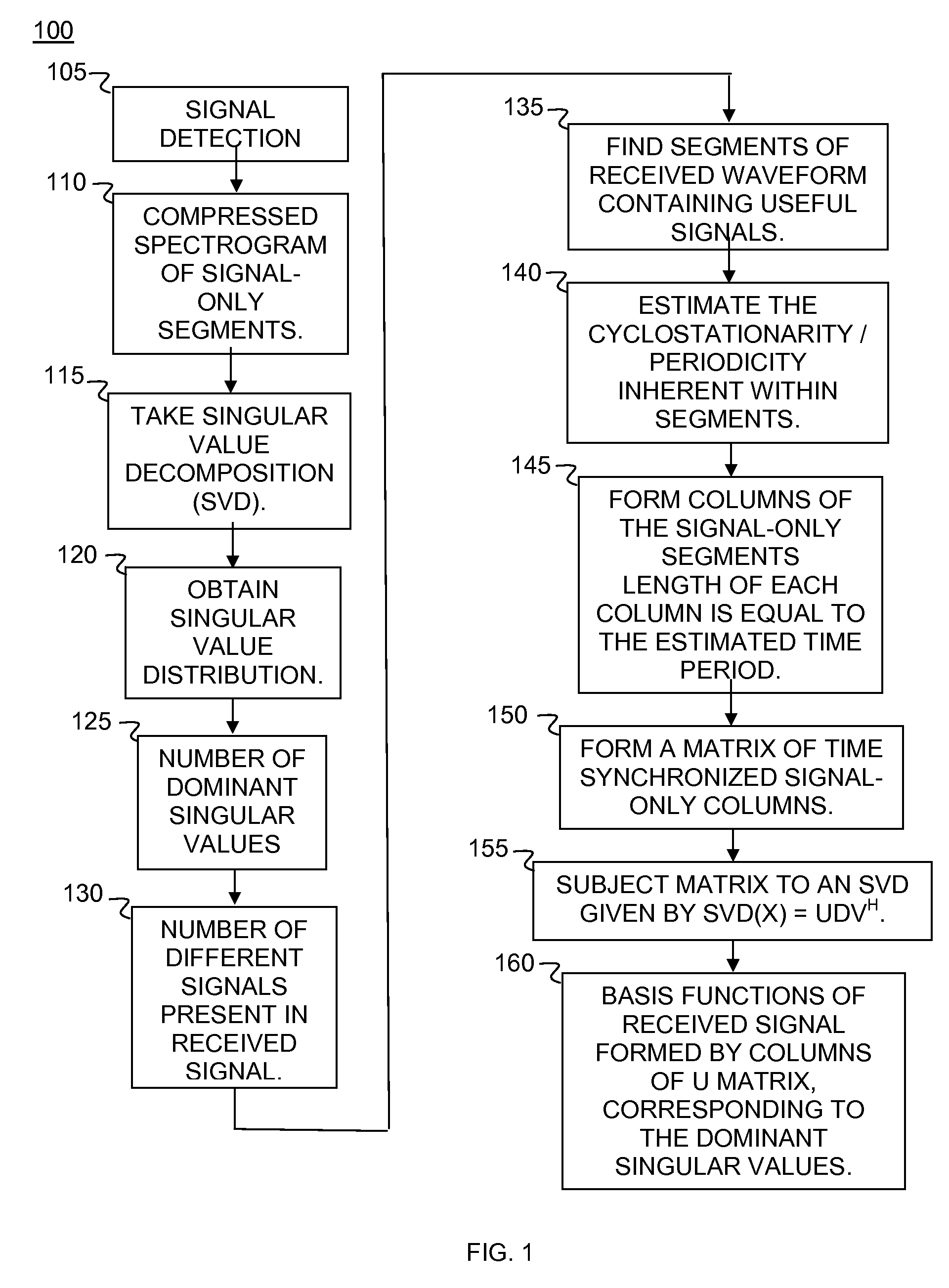
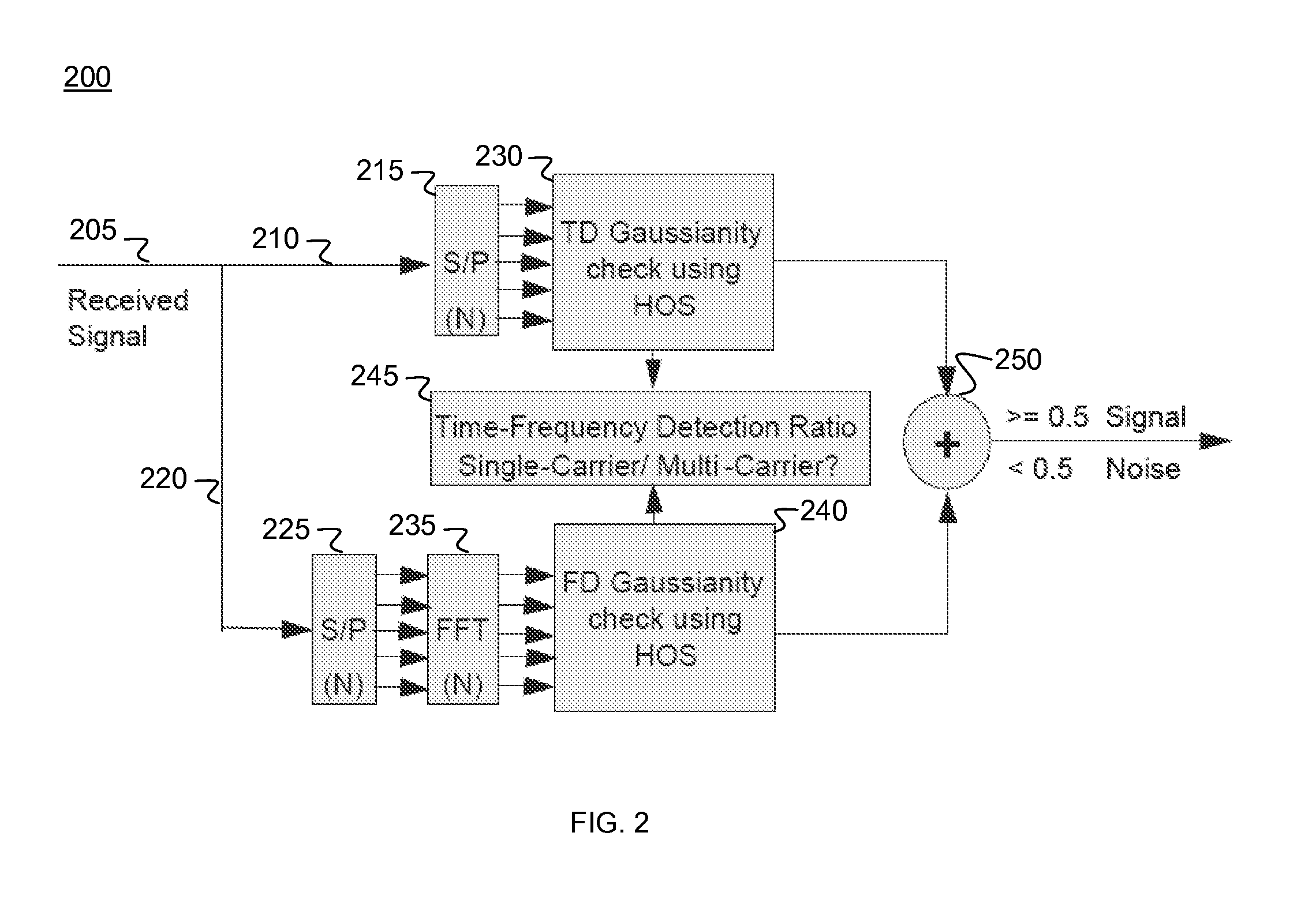
- The method employs higher-order statistics and singular value decomposition (SVD) of signal-only segments, using a compressed spectrogram to efficiently detect and classify signals, ensuring accurate alignment and estimation of basis functions by synchronizing the received signal.

Method and apparatus for detecting a presence of a signal in a communication channel
PatentInactiveUS20080086286A1
Innovation
- A processor-based apparatus and method that selects peak samples from multiple fields of a sampled signal, determines their absolute values, superimposes these values within a predetermined window, and compares the resulting peak value to a threshold to determine signal presence, utilizing a correlator to match known patterns and handle low SNR conditions with low false alarm rates and high detection probabilities.


Spectrum Regulatory Framework for Cognitive Radios
The regulatory landscape for cognitive radio systems represents a complex intersection of technological innovation and spectrum management policies. Traditional spectrum allocation frameworks, built around static frequency assignments, face significant challenges when accommodating dynamic spectrum access technologies. Regulatory bodies worldwide are grappling with the need to establish comprehensive frameworks that enable cognitive radio deployment while maintaining interference protection for incumbent users.
The Federal Communications Commission (FCC) in the United States has pioneered several regulatory initiatives for cognitive radio systems. The TV White Space regulations, established in 2008 and refined through subsequent rulings, created the first commercial framework for opportunistic spectrum access. These regulations mandate database-driven approaches for spectrum sensing and require cognitive devices to query authorized databases before transmission. Similar regulatory models have been adopted by Ofcom in the United Kingdom and other international regulatory authorities.
Spectrum sharing policies form the cornerstone of cognitive radio regulation, establishing hierarchical access rights between primary and secondary users. Primary users maintain interference protection guarantees, while secondary users operate under strict non-interference conditions. Regulatory frameworks typically define interference thresholds, geographic exclusion zones, and temporal restrictions that cognitive systems must observe. These policies directly impact signal detection requirements, as cognitive radios must demonstrate reliable primary user detection capabilities to obtain regulatory approval.
International harmonization efforts through the International Telecommunication Union (ITU) have focused on developing global standards for cognitive radio operation. The ITU-R has established working groups dedicated to cognitive radio systems, addressing cross-border interference scenarios and spectrum sharing protocols. Regional regulatory bodies, including the European Conference of Postal and Telecommunications Administrations (CEPT) and the Asia-Pacific Telecommunity (APT), have developed complementary frameworks that facilitate cognitive radio deployment across multiple jurisdictions.
Certification and compliance requirements represent critical regulatory components that directly influence cognitive radio design specifications. Regulatory authorities mandate rigorous testing procedures for spectrum sensing accuracy, interference mitigation capabilities, and database connectivity reliability. These requirements establish minimum performance thresholds for signal detection systems and create standardized testing methodologies that manufacturers must satisfy before market entry.
Emerging regulatory trends indicate movement toward more flexible, technology-neutral approaches that accommodate advanced cognitive radio capabilities. Dynamic protection criteria, real-time interference monitoring, and machine learning-based spectrum management represent evolving regulatory concepts that may reshape future cognitive radio frameworks and their associated technical requirements.
The Federal Communications Commission (FCC) in the United States has pioneered several regulatory initiatives for cognitive radio systems. The TV White Space regulations, established in 2008 and refined through subsequent rulings, created the first commercial framework for opportunistic spectrum access. These regulations mandate database-driven approaches for spectrum sensing and require cognitive devices to query authorized databases before transmission. Similar regulatory models have been adopted by Ofcom in the United Kingdom and other international regulatory authorities.
Spectrum sharing policies form the cornerstone of cognitive radio regulation, establishing hierarchical access rights between primary and secondary users. Primary users maintain interference protection guarantees, while secondary users operate under strict non-interference conditions. Regulatory frameworks typically define interference thresholds, geographic exclusion zones, and temporal restrictions that cognitive systems must observe. These policies directly impact signal detection requirements, as cognitive radios must demonstrate reliable primary user detection capabilities to obtain regulatory approval.
International harmonization efforts through the International Telecommunication Union (ITU) have focused on developing global standards for cognitive radio operation. The ITU-R has established working groups dedicated to cognitive radio systems, addressing cross-border interference scenarios and spectrum sharing protocols. Regional regulatory bodies, including the European Conference of Postal and Telecommunications Administrations (CEPT) and the Asia-Pacific Telecommunity (APT), have developed complementary frameworks that facilitate cognitive radio deployment across multiple jurisdictions.
Certification and compliance requirements represent critical regulatory components that directly influence cognitive radio design specifications. Regulatory authorities mandate rigorous testing procedures for spectrum sensing accuracy, interference mitigation capabilities, and database connectivity reliability. These requirements establish minimum performance thresholds for signal detection systems and create standardized testing methodologies that manufacturers must satisfy before market entry.
Emerging regulatory trends indicate movement toward more flexible, technology-neutral approaches that accommodate advanced cognitive radio capabilities. Dynamic protection criteria, real-time interference monitoring, and machine learning-based spectrum management represent evolving regulatory concepts that may reshape future cognitive radio frameworks and their associated technical requirements.
Security Implications in Cognitive Radio DSP Systems
Cognitive radio DSP systems face multifaceted security challenges that directly impact signal detection accuracy and overall system integrity. The dynamic spectrum access capabilities that define cognitive radios create unique attack surfaces, where malicious actors can exploit the adaptive nature of these systems to compromise detection algorithms and spectrum sensing mechanisms.
Primary spectrum sensing attacks pose significant threats to detection accuracy. Spectrum sensing data falsification attacks involve adversaries transmitting false signals to mislead cognitive radios about spectrum availability. These attacks can cause cognitive systems to incorrectly identify occupied channels as vacant or vice versa, leading to harmful interference with primary users or inefficient spectrum utilization. Byzantine attacks represent another critical concern, where compromised cognitive radio nodes provide false sensing information to cooperative sensing networks, degrading the collective detection performance.
Jamming attacks specifically target the signal detection capabilities of cognitive radio systems. Smart jamming techniques can adaptively interfere with sensing frequencies, creating blind spots in spectrum awareness. Reactive jamming poses particular challenges, as attackers monitor cognitive radio transmissions and selectively jam critical control channels or sensing periods, severely compromising detection accuracy and system coordination.
The distributed nature of cognitive radio networks introduces additional security vulnerabilities. Man-in-the-middle attacks can intercept and manipulate sensing data exchanges between cognitive nodes, leading to corrupted detection decisions. Sybil attacks, where single malicious entities create multiple fake identities, can overwhelm cooperative sensing algorithms and skew detection results toward attacker-controlled outcomes.
Machine learning-based detection algorithms, increasingly common in modern cognitive radio systems, face adversarial attacks designed to exploit algorithmic vulnerabilities. Adversarial examples can fool neural network-based spectrum classifiers, causing misidentification of signal types and occupancy states. These attacks can be particularly sophisticated, using gradient-based methods to generate imperceptible perturbations that dramatically reduce detection accuracy.
Authentication and trust management emerge as critical security requirements for maintaining detection integrity. Without robust authentication mechanisms, cognitive radio systems cannot distinguish between legitimate sensing reports and malicious data injection attempts. Establishing trust relationships among cognitive nodes becomes essential for reliable cooperative sensing and accurate spectrum detection in hostile environments.
Primary spectrum sensing attacks pose significant threats to detection accuracy. Spectrum sensing data falsification attacks involve adversaries transmitting false signals to mislead cognitive radios about spectrum availability. These attacks can cause cognitive systems to incorrectly identify occupied channels as vacant or vice versa, leading to harmful interference with primary users or inefficient spectrum utilization. Byzantine attacks represent another critical concern, where compromised cognitive radio nodes provide false sensing information to cooperative sensing networks, degrading the collective detection performance.
Jamming attacks specifically target the signal detection capabilities of cognitive radio systems. Smart jamming techniques can adaptively interfere with sensing frequencies, creating blind spots in spectrum awareness. Reactive jamming poses particular challenges, as attackers monitor cognitive radio transmissions and selectively jam critical control channels or sensing periods, severely compromising detection accuracy and system coordination.
The distributed nature of cognitive radio networks introduces additional security vulnerabilities. Man-in-the-middle attacks can intercept and manipulate sensing data exchanges between cognitive nodes, leading to corrupted detection decisions. Sybil attacks, where single malicious entities create multiple fake identities, can overwhelm cooperative sensing algorithms and skew detection results toward attacker-controlled outcomes.
Machine learning-based detection algorithms, increasingly common in modern cognitive radio systems, face adversarial attacks designed to exploit algorithmic vulnerabilities. Adversarial examples can fool neural network-based spectrum classifiers, causing misidentification of signal types and occupancy states. These attacks can be particularly sophisticated, using gradient-based methods to generate imperceptible perturbations that dramatically reduce detection accuracy.
Authentication and trust management emerge as critical security requirements for maintaining detection integrity. Without robust authentication mechanisms, cognitive radio systems cannot distinguish between legitimate sensing reports and malicious data injection attempts. Establishing trust relationships among cognitive nodes becomes essential for reliable cooperative sensing and accurate spectrum detection in hostile environments.
Unlock deeper insights with PatSnap Eureka Quick Research — get a full tech report to explore trends and direct your research. Try now!
Generate Your Research Report Instantly with AI Agent
Supercharge your innovation with PatSnap Eureka AI Agent Platform!