
Enhance Photovoltaic Module Performance by Reducing Oxidation
FEB 26, 20269 MIN READ
Generate Your Research Report Instantly with AI Agent
Patsnap Eureka helps you evaluate technical feasibility & market potential.
PV Module Oxidation Challenges and Performance Goals
Photovoltaic module oxidation represents one of the most significant long-term degradation mechanisms affecting solar panel performance and reliability. This phenomenon primarily occurs when oxygen and moisture penetrate the module encapsulation system, leading to corrosion of metallic components, particularly the silver-based grid lines and interconnects that are critical for current collection and transmission.
The oxidation process typically manifests through several pathways, including electrochemical corrosion at the cell-encapsulant interface, degradation of anti-reflective coatings, and formation of oxide layers on conductive elements. These degradation mechanisms result in increased series resistance, reduced light transmission, and ultimately decreased power output over the module's operational lifetime.
Current industry data indicates that oxidation-related degradation can cause annual power losses ranging from 0.5% to 0.8% in standard crystalline silicon modules, with accelerated degradation rates observed in harsh environmental conditions such as high humidity, temperature cycling, and coastal environments with elevated salt content.
The primary performance goals for addressing oxidation challenges encompass multiple technical objectives. First, extending module operational lifetime beyond the current 25-year warranty period to 30-35 years while maintaining power output above 80% of initial capacity. Second, reducing annual degradation rates to below 0.4% through improved oxidation resistance of critical components.
Enhanced encapsulation barrier properties represent another crucial goal, targeting water vapor transmission rates below 0.1 g/m²/day and oxygen permeability reduction of at least 50% compared to conventional EVA-based systems. Additionally, developing oxidation-resistant metallization systems that maintain conductivity and adhesion properties throughout extended operational periods.
Temperature stability improvements constitute a fundamental objective, as oxidation rates typically double for every 10°C increase in operating temperature. Advanced thermal management solutions and materials with superior high-temperature oxidation resistance are essential for achieving these performance targets in diverse climatic conditions.
The oxidation process typically manifests through several pathways, including electrochemical corrosion at the cell-encapsulant interface, degradation of anti-reflective coatings, and formation of oxide layers on conductive elements. These degradation mechanisms result in increased series resistance, reduced light transmission, and ultimately decreased power output over the module's operational lifetime.
Current industry data indicates that oxidation-related degradation can cause annual power losses ranging from 0.5% to 0.8% in standard crystalline silicon modules, with accelerated degradation rates observed in harsh environmental conditions such as high humidity, temperature cycling, and coastal environments with elevated salt content.
The primary performance goals for addressing oxidation challenges encompass multiple technical objectives. First, extending module operational lifetime beyond the current 25-year warranty period to 30-35 years while maintaining power output above 80% of initial capacity. Second, reducing annual degradation rates to below 0.4% through improved oxidation resistance of critical components.
Enhanced encapsulation barrier properties represent another crucial goal, targeting water vapor transmission rates below 0.1 g/m²/day and oxygen permeability reduction of at least 50% compared to conventional EVA-based systems. Additionally, developing oxidation-resistant metallization systems that maintain conductivity and adhesion properties throughout extended operational periods.
Temperature stability improvements constitute a fundamental objective, as oxidation rates typically double for every 10°C increase in operating temperature. Advanced thermal management solutions and materials with superior high-temperature oxidation resistance are essential for achieving these performance targets in diverse climatic conditions.
Market Demand for High-Performance Solar Modules
The global solar photovoltaic market has experienced unprecedented growth driven by increasing environmental consciousness, declining installation costs, and supportive government policies worldwide. This expansion has intensified demand for high-performance solar modules that can deliver superior energy conversion efficiency, extended operational lifespans, and enhanced reliability under diverse environmental conditions.
Performance degradation remains a critical concern for solar module manufacturers and end-users alike. Traditional photovoltaic modules typically experience annual efficiency losses that significantly impact long-term energy generation capacity and return on investment. This degradation directly correlates with reduced power output, necessitating larger installations to meet energy requirements and increasing the levelized cost of electricity.
Oxidation-related performance deterioration has emerged as a primary factor limiting module longevity and efficiency retention. Oxygen infiltration through encapsulant materials and backsheet layers leads to corrosion of metallic components, particularly silver contacts and interconnects, resulting in increased series resistance and power losses. Additionally, oxidative stress affects semiconductor materials and anti-reflective coatings, further compromising module performance over time.
Market segments demanding enhanced performance characteristics include utility-scale solar installations, commercial rooftop systems, and residential applications in harsh environmental conditions. Utility developers increasingly prioritize modules with minimal degradation rates to maximize project economics over typical power purchase agreement terms spanning two to three decades. Commercial and industrial customers similarly seek high-performance solutions to optimize limited rooftop space and achieve faster payback periods.
Geographic markets with extreme climatic conditions, including high-temperature regions, coastal areas with salt exposure, and locations experiencing significant temperature cycling, demonstrate particularly strong demand for oxidation-resistant modules. These environments accelerate traditional degradation mechanisms, making performance enhancement technologies economically attractive despite potential premium pricing.
The competitive landscape increasingly favors manufacturers capable of delivering differentiated performance characteristics. Market leaders are investing substantially in advanced materials research, improved encapsulation technologies, and innovative cell architectures to address oxidation challenges while maintaining cost competitiveness in an increasingly commoditized industry.
Performance degradation remains a critical concern for solar module manufacturers and end-users alike. Traditional photovoltaic modules typically experience annual efficiency losses that significantly impact long-term energy generation capacity and return on investment. This degradation directly correlates with reduced power output, necessitating larger installations to meet energy requirements and increasing the levelized cost of electricity.
Oxidation-related performance deterioration has emerged as a primary factor limiting module longevity and efficiency retention. Oxygen infiltration through encapsulant materials and backsheet layers leads to corrosion of metallic components, particularly silver contacts and interconnects, resulting in increased series resistance and power losses. Additionally, oxidative stress affects semiconductor materials and anti-reflective coatings, further compromising module performance over time.
Market segments demanding enhanced performance characteristics include utility-scale solar installations, commercial rooftop systems, and residential applications in harsh environmental conditions. Utility developers increasingly prioritize modules with minimal degradation rates to maximize project economics over typical power purchase agreement terms spanning two to three decades. Commercial and industrial customers similarly seek high-performance solutions to optimize limited rooftop space and achieve faster payback periods.
Geographic markets with extreme climatic conditions, including high-temperature regions, coastal areas with salt exposure, and locations experiencing significant temperature cycling, demonstrate particularly strong demand for oxidation-resistant modules. These environments accelerate traditional degradation mechanisms, making performance enhancement technologies economically attractive despite potential premium pricing.
The competitive landscape increasingly favors manufacturers capable of delivering differentiated performance characteristics. Market leaders are investing substantially in advanced materials research, improved encapsulation technologies, and innovative cell architectures to address oxidation challenges while maintaining cost competitiveness in an increasingly commoditized industry.
Current Oxidation Issues and Technical Barriers in PV
Photovoltaic modules face significant oxidation challenges that substantially impact their long-term performance and reliability. The primary oxidation issues occur at multiple levels within the module structure, creating complex degradation pathways that reduce energy conversion efficiency and shorten operational lifespan.
Metallization grid oxidation represents one of the most critical technical barriers in PV systems. Silver-based front contacts are particularly susceptible to electrochemical corrosion when exposed to moisture and oxygen infiltration. This oxidation process increases series resistance, leading to power output degradation of 0.5-0.8% annually in affected modules. The formation of silver oxide compounds creates high-resistance pathways that impede current collection efficiency.
Encapsulant material degradation poses another significant challenge, particularly with ethylene vinyl acetate (EVA) encapsulants. UV exposure catalyzes acetic acid formation through hydrolysis reactions, creating an acidic environment that accelerates corrosion of metallic components. This process generates discoloration and reduces optical transmission, while simultaneously promoting further oxidative reactions throughout the module structure.
Backsheet oxidation emerges as a critical failure mechanism, especially in fluoropolymer-based materials. Thermal cycling and UV radiation induce polymer chain scission, creating micro-cracks that allow moisture ingress. These pathways facilitate oxygen penetration to sensitive internal components, establishing conditions for widespread oxidative degradation.
Solder bond deterioration represents a particularly challenging technical barrier, as traditional tin-lead and lead-free solders exhibit varying oxidation susceptibilities under field conditions. Intermetallic compound formation at solder interfaces creates brittle zones prone to mechanical failure, while oxidation products increase electrical resistance and thermal stress concentrations.
Cell-level oxidation manifests through silicon nitride anti-reflective coating degradation and potential-induced degradation mechanisms. These processes create localized hot spots and current leakage pathways that compromise overall module performance. The interconnected nature of these oxidation mechanisms creates cascading failure modes that are difficult to predict and mitigate through conventional approaches.
Current technical barriers include limited understanding of oxidation kinetics under real-world operating conditions, inadequate accelerated testing protocols that fail to replicate field degradation patterns, and insufficient material characterization techniques for early-stage oxidation detection. These challenges necessitate comprehensive research into advanced protective strategies and novel material formulations.
Metallization grid oxidation represents one of the most critical technical barriers in PV systems. Silver-based front contacts are particularly susceptible to electrochemical corrosion when exposed to moisture and oxygen infiltration. This oxidation process increases series resistance, leading to power output degradation of 0.5-0.8% annually in affected modules. The formation of silver oxide compounds creates high-resistance pathways that impede current collection efficiency.
Encapsulant material degradation poses another significant challenge, particularly with ethylene vinyl acetate (EVA) encapsulants. UV exposure catalyzes acetic acid formation through hydrolysis reactions, creating an acidic environment that accelerates corrosion of metallic components. This process generates discoloration and reduces optical transmission, while simultaneously promoting further oxidative reactions throughout the module structure.
Backsheet oxidation emerges as a critical failure mechanism, especially in fluoropolymer-based materials. Thermal cycling and UV radiation induce polymer chain scission, creating micro-cracks that allow moisture ingress. These pathways facilitate oxygen penetration to sensitive internal components, establishing conditions for widespread oxidative degradation.
Solder bond deterioration represents a particularly challenging technical barrier, as traditional tin-lead and lead-free solders exhibit varying oxidation susceptibilities under field conditions. Intermetallic compound formation at solder interfaces creates brittle zones prone to mechanical failure, while oxidation products increase electrical resistance and thermal stress concentrations.
Cell-level oxidation manifests through silicon nitride anti-reflective coating degradation and potential-induced degradation mechanisms. These processes create localized hot spots and current leakage pathways that compromise overall module performance. The interconnected nature of these oxidation mechanisms creates cascading failure modes that are difficult to predict and mitigate through conventional approaches.
Current technical barriers include limited understanding of oxidation kinetics under real-world operating conditions, inadequate accelerated testing protocols that fail to replicate field degradation patterns, and insufficient material characterization techniques for early-stage oxidation detection. These challenges necessitate comprehensive research into advanced protective strategies and novel material formulations.
Existing Anti-Oxidation Solutions for Solar Modules
01 Module structure and encapsulation materials
Photovoltaic module performance can be enhanced through optimized encapsulation materials and structural designs. Advanced encapsulants provide better protection against environmental factors such as moisture, UV radiation, and temperature fluctuations. Improved sealing techniques and barrier layers help maintain long-term module efficiency by preventing degradation of solar cells. The selection of appropriate backsheet materials and glass compositions also contributes to overall module durability and power output stability.- Module structure and encapsulation materials: Photovoltaic module performance can be enhanced through optimized encapsulation materials and structural designs. Advanced encapsulants provide better protection against environmental factors such as moisture, UV radiation, and temperature fluctuations. The selection of appropriate backsheet materials, glass types, and sealing methods significantly impacts the long-term durability and efficiency of solar modules. Improved encapsulation techniques help maintain optical transparency while providing mechanical strength and electrical insulation.
- Cell interconnection and electrical configuration: The electrical performance of photovoltaic modules depends heavily on cell interconnection methods and circuit configurations. Advanced interconnection technologies reduce resistive losses and improve current collection efficiency. Optimized cell spacing, busbar designs, and ribbon configurations contribute to enhanced power output. Novel interconnection approaches also improve mechanical reliability and reduce the risk of cell cracking during thermal cycling and mechanical stress.
- Anti-reflective and light management technologies: Enhancing light absorption and reducing reflection losses are critical for improving module efficiency. Anti-reflective coatings, textured surfaces, and light-trapping structures increase the amount of incident light converted to electricity. Advanced optical designs minimize reflection at various angles of incidence and across different wavelengths. These technologies are particularly effective in improving performance under low-light conditions and at high incident angles.
- Thermal management and heat dissipation: Temperature control is essential for maintaining optimal photovoltaic module performance, as elevated temperatures reduce conversion efficiency. Thermal management solutions include heat-dissipating materials, ventilation designs, and cooling systems. Proper thermal design prevents hot spots, reduces degradation rates, and extends module lifetime. Advanced materials with high thermal conductivity and low thermal expansion coefficients help maintain stable operating temperatures.
- Performance monitoring and degradation prevention: Long-term performance stability requires effective monitoring systems and degradation prevention strategies. Advanced diagnostic techniques detect potential issues such as potential-induced degradation, light-induced degradation, and mechanical failures. Protective measures including bypass diodes, optimized grounding schemes, and barrier layers help prevent common degradation mechanisms. Real-time monitoring systems enable predictive maintenance and optimize energy yield over the module lifetime.
02 Cell interconnection and electrical configuration
The electrical performance of photovoltaic modules depends significantly on cell interconnection methods and circuit configurations. Advanced interconnection technologies reduce resistive losses and improve current collection efficiency. Optimized cell spacing and arrangement patterns enhance light capture while minimizing shading losses. Novel busbar designs and ribbon configurations contribute to better electrical conductivity and mechanical reliability under thermal cycling conditions.Expand Specific Solutions03 Anti-reflective and light management technologies
Module performance can be improved through advanced light management techniques that maximize photon absorption. Anti-reflective coatings and surface texturing reduce reflection losses and increase the amount of light reaching the active cell layers. Light-trapping structures and optical enhancement layers help capture a broader spectrum of solar radiation. These technologies are particularly effective in improving performance under low-light conditions and at different angles of incidence.Expand Specific Solutions04 Thermal management and heat dissipation
Effective thermal management is crucial for maintaining optimal photovoltaic module performance, as elevated temperatures can significantly reduce conversion efficiency. Advanced cooling mechanisms and heat dissipation structures help maintain lower operating temperatures. Thermal interface materials and heat-spreading layers facilitate efficient heat transfer away from solar cells. Proper thermal design also extends module lifetime by reducing thermal stress and preventing hotspot formation.Expand Specific Solutions05 Performance monitoring and degradation prevention
Long-term module performance relies on effective monitoring systems and degradation prevention strategies. Advanced diagnostic techniques enable early detection of performance issues such as potential-induced degradation, cell cracking, and delamination. Protective measures against environmental stressors help maintain stable power output over the module lifetime. Integration of sensors and smart monitoring capabilities allows for real-time performance assessment and predictive maintenance.Expand Specific Solutions
Key Players in PV Module and Anti-Corrosion Technology
The photovoltaic module oxidation reduction technology represents a mature market segment within the rapidly expanding global solar industry, which has reached multi-billion dollar valuations driven by renewable energy transitions. The competitive landscape features established manufacturers like JinkoSolar, Trina Solar, and CSI Solar dominating through scale and cost optimization, while emerging players such as Aiko Solar and specialized research entities like CEA and CNRS drive innovation in anti-oxidation solutions. Technology maturity varies significantly across players, with traditional manufacturers focusing on incremental improvements to existing silicon-based modules, while research institutions and newer entrants like Dracula Technologies explore advanced materials and organic photovoltaics. The market demonstrates consolidation among major Chinese manufacturers alongside growing specialization in niche oxidation-resistant technologies, indicating both mature manufacturing capabilities and ongoing innovation opportunities in performance enhancement solutions.
Zhejiang Jinko Solar Co. Ltd.
Technical Solution: JinkoSolar has developed advanced anti-oxidation technologies for photovoltaic modules, including enhanced encapsulant materials and improved backsheet designs. Their Tiger Neo series incorporates specialized EVA encapsulants with anti-oxidation additives that significantly reduce polymer degradation under UV exposure and thermal cycling. The company has implemented multi-layer barrier films in their backsheet construction, utilizing materials like PVDF and TPU that provide superior moisture and oxygen barrier properties. Additionally, JinkoSolar employs advanced edge sealing techniques using butyl rubber and silicone-based sealants to prevent moisture ingress, which is a primary cause of oxidation in solar cells. Their manufacturing process includes strict quality control measures for material selection and lamination parameters to minimize initial oxidation potential.
Strengths: Leading market position with extensive R&D capabilities, proven track record in module durability, cost-effective manufacturing processes. Weaknesses: High competition in pricing, dependency on raw material supply chains, limited differentiation in mature technologies.
Trina Solar Co., Ltd.
Technical Solution: Trina Solar has developed comprehensive anti-oxidation solutions focusing on advanced encapsulant chemistry and cell-level protection technologies. Their Vertex series modules feature proprietary POE (Polyolefin Elastomer) encapsulants that demonstrate superior resistance to UV-induced degradation compared to traditional EVA materials. The company has invested heavily in developing anti-reflective coatings with integrated anti-oxidation properties, utilizing silicon nitride and aluminum oxide layers that not only enhance light transmission but also provide protective barriers against environmental oxidants. Trina Solar's approach includes optimized cell metallization using silver pastes with enhanced corrosion resistance and improved adhesion properties. Their modules incorporate advanced junction box designs with enhanced sealing capabilities and corrosion-resistant materials to prevent oxidation at electrical connection points.
Strengths: Strong technological innovation capabilities, comprehensive product portfolio, established global manufacturing network. Weaknesses: Intense price competition, regulatory compliance challenges in different markets, technology transition costs.
Core Innovations in PV Module Oxidation Prevention
Photovoltaic module with improved corrosion resistance and method for producing the same
PatentInactiveEP2280420A2
Innovation
- Incorporating a corrosion inhibitor, preferably a gas phase inhibitor such as benzotriazole or tolyltriazole, into the photovoltaic module, either via the embedding material or directly on the solar cells, which adsorbs onto metallic surfaces, providing protection against corrosive substances and covering small cracks that form during operation.


Solar cell and manufacturing method therefor
PatentPendingEP4503140A1
Innovation
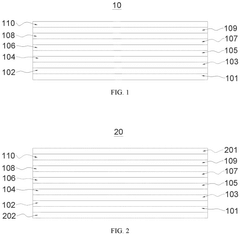
- A manufacturing method for solar cells that involves forming dense silicon oxide layers on the front and back sides of a semi-finished silicon wafer using an atomic layer deposition process, effectively blocking alkali metal ions and enhancing PID resistance while maintaining reflection reduction effects.

Environmental Impact Assessment of PV Module Materials
The environmental impact assessment of photovoltaic module materials represents a critical evaluation framework for understanding the ecological implications of solar technology deployment, particularly in the context of oxidation-resistant materials and manufacturing processes. This assessment encompasses the entire lifecycle of PV modules, from raw material extraction through manufacturing, operation, and end-of-life disposal or recycling.
Silicon-based photovoltaic modules, which dominate the current market, present varying environmental profiles depending on their anti-oxidation treatments and protective materials. The production of high-purity silicon requires significant energy input, typically ranging from 50-200 kWh per kilogram, contributing substantially to the carbon footprint of solar panels. However, enhanced oxidation resistance through advanced encapsulation materials and protective coatings can extend module lifespans from 25 to 35+ years, significantly improving the energy payback ratio and reducing long-term environmental impact per unit of energy generated.
Anti-reflective coatings and oxidation-resistant materials, while improving performance and durability, introduce additional environmental considerations. Titanium dioxide-based coatings, commonly used for their excellent anti-oxidation properties, require energy-intensive production processes but offer superior longevity. Alternative materials such as silicon nitride and aluminum oxide present different environmental trade-offs, with silicon nitride requiring less energy for deposition but potentially involving more complex waste management protocols.
The manufacturing phase environmental impact varies significantly based on the oxidation prevention strategies employed. Plasma-enhanced chemical vapor deposition (PECVD) processes used for applying protective layers consume considerable electricity but enable precise control over material properties, ultimately reducing material waste. Conversely, solution-based coating methods may use fewer energy resources during application but can involve organic solvents requiring careful handling and disposal.
Encapsulation materials play a crucial role in both performance enhancement and environmental impact. Ethylene vinyl acetate (EVA) and polyolefin elastomer (POE) encapsulants provide excellent oxidation protection but present different end-of-life scenarios. POE materials demonstrate superior recyclability compared to traditional EVA, supporting circular economy principles while maintaining comparable anti-oxidation performance.
End-of-life considerations become increasingly important as first-generation solar installations approach retirement. Modules with enhanced oxidation resistance may retain higher material value during recycling processes, as protective coatings and treatments can preserve the integrity of valuable materials like silver contacts and high-grade silicon. This preservation potential reduces the environmental burden associated with primary material extraction for new modules.
Water usage during manufacturing represents another significant environmental factor, particularly for cleaning processes essential to preventing oxidation-inducing contaminants. Advanced manufacturing facilities implementing closed-loop water systems and ultra-pure water recycling can reduce water consumption by up to 90% while maintaining the cleanliness standards necessary for oxidation-resistant module production.
Silicon-based photovoltaic modules, which dominate the current market, present varying environmental profiles depending on their anti-oxidation treatments and protective materials. The production of high-purity silicon requires significant energy input, typically ranging from 50-200 kWh per kilogram, contributing substantially to the carbon footprint of solar panels. However, enhanced oxidation resistance through advanced encapsulation materials and protective coatings can extend module lifespans from 25 to 35+ years, significantly improving the energy payback ratio and reducing long-term environmental impact per unit of energy generated.
Anti-reflective coatings and oxidation-resistant materials, while improving performance and durability, introduce additional environmental considerations. Titanium dioxide-based coatings, commonly used for their excellent anti-oxidation properties, require energy-intensive production processes but offer superior longevity. Alternative materials such as silicon nitride and aluminum oxide present different environmental trade-offs, with silicon nitride requiring less energy for deposition but potentially involving more complex waste management protocols.
The manufacturing phase environmental impact varies significantly based on the oxidation prevention strategies employed. Plasma-enhanced chemical vapor deposition (PECVD) processes used for applying protective layers consume considerable electricity but enable precise control over material properties, ultimately reducing material waste. Conversely, solution-based coating methods may use fewer energy resources during application but can involve organic solvents requiring careful handling and disposal.
Encapsulation materials play a crucial role in both performance enhancement and environmental impact. Ethylene vinyl acetate (EVA) and polyolefin elastomer (POE) encapsulants provide excellent oxidation protection but present different end-of-life scenarios. POE materials demonstrate superior recyclability compared to traditional EVA, supporting circular economy principles while maintaining comparable anti-oxidation performance.
End-of-life considerations become increasingly important as first-generation solar installations approach retirement. Modules with enhanced oxidation resistance may retain higher material value during recycling processes, as protective coatings and treatments can preserve the integrity of valuable materials like silver contacts and high-grade silicon. This preservation potential reduces the environmental burden associated with primary material extraction for new modules.
Water usage during manufacturing represents another significant environmental factor, particularly for cleaning processes essential to preventing oxidation-inducing contaminants. Advanced manufacturing facilities implementing closed-loop water systems and ultra-pure water recycling can reduce water consumption by up to 90% while maintaining the cleanliness standards necessary for oxidation-resistant module production.
Cost-Benefit Analysis of Advanced Anti-Oxidation Methods
The economic evaluation of advanced anti-oxidation methods for photovoltaic modules reveals significant variations in cost-effectiveness across different technological approaches. Traditional encapsulant materials typically cost $0.15-0.25 per watt-peak, while advanced anti-oxidation solutions range from $0.08-0.45 per watt-peak depending on the technology complexity and manufacturing scale.
Barrier film technologies demonstrate the most favorable cost-benefit ratio in the short term. These solutions add approximately $0.08-0.12 per watt-peak to module costs but can extend module lifespan by 5-8 years, translating to a 15-20% improvement in lifetime energy yield. The payback period for barrier film implementation typically ranges from 2.5-3.5 years, making it highly attractive for commercial deployment.
Advanced polymer encapsulants incorporating UV stabilizers and antioxidant additives present moderate cost implications at $0.18-0.28 per watt-peak. However, these materials offer superior long-term performance benefits, reducing power degradation rates from 0.7% annually to 0.4% annually. The cumulative benefit over a 25-year operational period can justify the initial investment through improved energy output and reduced maintenance requirements.
Nano-coating technologies represent the premium segment with costs ranging $0.35-0.45 per watt-peak. Despite higher upfront investments, these solutions provide exceptional oxidation resistance and can extend module warranties to 30-35 years. The total cost of ownership analysis indicates break-even points at 8-10 years, with substantial long-term benefits for utility-scale installations.
Manufacturing scale significantly impacts cost structures. Volume production of advanced anti-oxidation materials can reduce unit costs by 25-40% compared to small-batch manufacturing. Companies investing in dedicated production lines for anti-oxidation technologies report cost reductions of $0.05-0.08 per watt-peak when achieving annual volumes exceeding 1 GW.
Regional market dynamics influence cost-benefit calculations substantially. In high-irradiance environments with elevated oxidation risks, premium anti-oxidation solutions demonstrate accelerated payback periods of 6-8 years compared to 10-12 years in moderate climates. This geographic variation necessitates tailored economic models for different deployment scenarios.
The integration complexity of various anti-oxidation methods affects overall implementation costs. Surface treatments and coating applications require minimal process modifications, adding $0.02-0.05 per watt-peak in manufacturing costs. Conversely, advanced encapsulant systems may require equipment upgrades and process optimization, contributing additional $0.08-0.15 per watt-peak in transition costs.
Barrier film technologies demonstrate the most favorable cost-benefit ratio in the short term. These solutions add approximately $0.08-0.12 per watt-peak to module costs but can extend module lifespan by 5-8 years, translating to a 15-20% improvement in lifetime energy yield. The payback period for barrier film implementation typically ranges from 2.5-3.5 years, making it highly attractive for commercial deployment.
Advanced polymer encapsulants incorporating UV stabilizers and antioxidant additives present moderate cost implications at $0.18-0.28 per watt-peak. However, these materials offer superior long-term performance benefits, reducing power degradation rates from 0.7% annually to 0.4% annually. The cumulative benefit over a 25-year operational period can justify the initial investment through improved energy output and reduced maintenance requirements.
Nano-coating technologies represent the premium segment with costs ranging $0.35-0.45 per watt-peak. Despite higher upfront investments, these solutions provide exceptional oxidation resistance and can extend module warranties to 30-35 years. The total cost of ownership analysis indicates break-even points at 8-10 years, with substantial long-term benefits for utility-scale installations.
Manufacturing scale significantly impacts cost structures. Volume production of advanced anti-oxidation materials can reduce unit costs by 25-40% compared to small-batch manufacturing. Companies investing in dedicated production lines for anti-oxidation technologies report cost reductions of $0.05-0.08 per watt-peak when achieving annual volumes exceeding 1 GW.
Regional market dynamics influence cost-benefit calculations substantially. In high-irradiance environments with elevated oxidation risks, premium anti-oxidation solutions demonstrate accelerated payback periods of 6-8 years compared to 10-12 years in moderate climates. This geographic variation necessitates tailored economic models for different deployment scenarios.
The integration complexity of various anti-oxidation methods affects overall implementation costs. Surface treatments and coating applications require minimal process modifications, adding $0.02-0.05 per watt-peak in manufacturing costs. Conversely, advanced encapsulant systems may require equipment upgrades and process optimization, contributing additional $0.08-0.15 per watt-peak in transition costs.
Unlock deeper insights with Patsnap Eureka Quick Research — get a full tech report to explore trends and direct your research. Try now!
Generate Your Research Report Instantly with AI Agent
Supercharge your innovation with Patsnap Eureka AI Agent Platform!