
Oxidation Impact on Polymer Adhesion
FEB 26, 20268 MIN READ
Generate Your Research Report Instantly with AI Agent
Patsnap Eureka helps you evaluate technical feasibility & market potential.
Polymer Oxidation Background and Adhesion Goals
Polymer oxidation represents one of the most significant degradation mechanisms affecting material performance across diverse industrial applications. This chemical process occurs when polymer chains react with oxygen molecules, typically accelerated by environmental factors such as heat, ultraviolet radiation, mechanical stress, and the presence of catalytic impurities. The oxidation process fundamentally alters the molecular structure of polymers through chain scission, cross-linking, and the formation of polar functional groups including carbonyls, hydroperoxides, and carboxylic acids.
The historical understanding of polymer oxidation has evolved significantly since the early 20th century when synthetic polymers first emerged commercially. Initial observations focused primarily on visible degradation symptoms such as discoloration, brittleness, and surface cracking. However, advanced analytical techniques developed over subsequent decades revealed the complex chemical mechanisms underlying these macroscopic changes, establishing oxidation as a critical factor in polymer longevity and performance.
Adhesion performance in polymer systems depends fundamentally on interfacial interactions between the polymer matrix and substrate materials. These interactions encompass van der Waals forces, hydrogen bonding, chemical bonding, and mechanical interlocking mechanisms. When oxidation occurs, the resulting chemical modifications can dramatically alter these interfacial properties, often leading to adhesion failure in critical applications ranging from aerospace composites to automotive coatings and biomedical devices.
The relationship between oxidation and adhesion failure manifests through multiple pathways. Surface oxidation can create weak boundary layers that compromise interfacial strength, while bulk oxidation may alter the mechanical properties of the polymer matrix, affecting stress transfer mechanisms. Additionally, oxidation-induced dimensional changes can generate internal stresses that propagate interfacial cracks and accelerate delamination processes.
Contemporary research objectives focus on developing comprehensive predictive models that correlate oxidation kinetics with adhesion degradation rates. These models aim to enable proactive material selection and design optimization for applications requiring long-term adhesive performance under oxidative environments. Furthermore, understanding oxidation-adhesion relationships facilitates the development of advanced stabilization strategies and surface modification techniques to enhance durability and reliability in demanding service conditions.
The historical understanding of polymer oxidation has evolved significantly since the early 20th century when synthetic polymers first emerged commercially. Initial observations focused primarily on visible degradation symptoms such as discoloration, brittleness, and surface cracking. However, advanced analytical techniques developed over subsequent decades revealed the complex chemical mechanisms underlying these macroscopic changes, establishing oxidation as a critical factor in polymer longevity and performance.
Adhesion performance in polymer systems depends fundamentally on interfacial interactions between the polymer matrix and substrate materials. These interactions encompass van der Waals forces, hydrogen bonding, chemical bonding, and mechanical interlocking mechanisms. When oxidation occurs, the resulting chemical modifications can dramatically alter these interfacial properties, often leading to adhesion failure in critical applications ranging from aerospace composites to automotive coatings and biomedical devices.
The relationship between oxidation and adhesion failure manifests through multiple pathways. Surface oxidation can create weak boundary layers that compromise interfacial strength, while bulk oxidation may alter the mechanical properties of the polymer matrix, affecting stress transfer mechanisms. Additionally, oxidation-induced dimensional changes can generate internal stresses that propagate interfacial cracks and accelerate delamination processes.
Contemporary research objectives focus on developing comprehensive predictive models that correlate oxidation kinetics with adhesion degradation rates. These models aim to enable proactive material selection and design optimization for applications requiring long-term adhesive performance under oxidative environments. Furthermore, understanding oxidation-adhesion relationships facilitates the development of advanced stabilization strategies and surface modification techniques to enhance durability and reliability in demanding service conditions.
Market Demand for Oxidation-Resistant Polymer Adhesives
The global market for oxidation-resistant polymer adhesives is experiencing robust growth driven by increasing demands across multiple industrial sectors. Aerospace and automotive industries represent the largest market segments, where adhesive systems must withstand extreme thermal cycling, UV exposure, and oxidative environments while maintaining structural integrity over extended service periods.
Electronics manufacturing constitutes another significant demand driver, particularly in semiconductor packaging and flexible electronics applications. The miniaturization trend in electronic devices requires adhesives that can resist oxidative degradation at elevated operating temperatures while preserving electrical insulation properties and dimensional stability.
Marine and offshore applications generate substantial demand for oxidation-resistant formulations due to harsh saltwater environments combined with UV radiation exposure. These applications require adhesives that maintain bond strength despite continuous oxidative stress from both chemical and photochemical sources.
The renewable energy sector, particularly solar panel manufacturing and wind turbine assembly, has emerged as a rapidly expanding market segment. Solar panel encapsulants and structural adhesives must resist photo-oxidative degradation over decades of outdoor exposure while maintaining optical clarity and mechanical performance.
Medical device manufacturing represents a specialized but growing market niche, where biocompatible oxidation-resistant adhesives are essential for implantable devices and long-term medical applications. Regulatory requirements drive demand for adhesives with proven oxidative stability under physiological conditions.
Construction and infrastructure markets increasingly specify oxidation-resistant adhesives for curtain wall systems, structural glazing, and weatherproofing applications. Building codes and sustainability standards emphasize long-term performance, creating demand for adhesives that resist environmental oxidation throughout building lifecycles.
Industrial maintenance and repair operations require adhesives capable of bonding oxidized substrates while resisting further oxidative attack. This segment values formulations that can restore structural integrity in chemically aggressive industrial environments.
Market growth is further accelerated by regulatory pressures for longer product lifecycles and reduced maintenance requirements across industries, making oxidation resistance a critical performance criterion rather than merely a desirable feature.
Electronics manufacturing constitutes another significant demand driver, particularly in semiconductor packaging and flexible electronics applications. The miniaturization trend in electronic devices requires adhesives that can resist oxidative degradation at elevated operating temperatures while preserving electrical insulation properties and dimensional stability.
Marine and offshore applications generate substantial demand for oxidation-resistant formulations due to harsh saltwater environments combined with UV radiation exposure. These applications require adhesives that maintain bond strength despite continuous oxidative stress from both chemical and photochemical sources.
The renewable energy sector, particularly solar panel manufacturing and wind turbine assembly, has emerged as a rapidly expanding market segment. Solar panel encapsulants and structural adhesives must resist photo-oxidative degradation over decades of outdoor exposure while maintaining optical clarity and mechanical performance.
Medical device manufacturing represents a specialized but growing market niche, where biocompatible oxidation-resistant adhesives are essential for implantable devices and long-term medical applications. Regulatory requirements drive demand for adhesives with proven oxidative stability under physiological conditions.
Construction and infrastructure markets increasingly specify oxidation-resistant adhesives for curtain wall systems, structural glazing, and weatherproofing applications. Building codes and sustainability standards emphasize long-term performance, creating demand for adhesives that resist environmental oxidation throughout building lifecycles.
Industrial maintenance and repair operations require adhesives capable of bonding oxidized substrates while resisting further oxidative attack. This segment values formulations that can restore structural integrity in chemically aggressive industrial environments.
Market growth is further accelerated by regulatory pressures for longer product lifecycles and reduced maintenance requirements across industries, making oxidation resistance a critical performance criterion rather than merely a desirable feature.
Current Oxidation Challenges in Polymer Adhesion Systems
Polymer adhesion systems face significant oxidation-related challenges that fundamentally compromise their structural integrity and performance reliability. The primary challenge stems from the susceptibility of polymer chains to oxidative degradation, which occurs through free radical mechanisms initiated by environmental factors such as oxygen exposure, UV radiation, and elevated temperatures. This degradation process leads to chain scission, cross-linking, and the formation of polar functional groups that alter the polymer's surface chemistry and mechanical properties.
Interface degradation represents another critical challenge in polymer adhesion systems. Oxidation at the polymer-substrate interface creates weak boundary layers that significantly reduce adhesive strength. The formation of oxide layers on metal substrates and the simultaneous degradation of polymer chains near the interface create a complex failure mechanism that is difficult to predict and control. This phenomenon is particularly problematic in aerospace and automotive applications where long-term reliability is essential.
Environmental stress factors compound oxidation challenges by accelerating degradation processes. Thermal cycling, humidity variations, and chemical exposure create synergistic effects that amplify oxidative damage. The challenge lies in developing predictive models that accurately account for these multi-factor interactions, as traditional accelerated aging tests often fail to replicate real-world degradation patterns.
Material compatibility issues arise when attempting to incorporate antioxidants and stabilizers into polymer adhesion systems. Many effective antioxidants can migrate to surfaces, potentially interfering with adhesion mechanisms or creating compatibility problems with substrates. Balancing oxidation resistance with adhesive performance requires careful selection of stabilizer systems that do not compromise the primary bonding function.
Detection and monitoring of oxidation-induced degradation present ongoing challenges for quality control and maintenance protocols. Current analytical methods often require destructive testing or may not detect early-stage oxidation that could lead to premature failure. The development of non-destructive evaluation techniques capable of identifying oxidation-related degradation in operational environments remains a significant technical hurdle.
Scale-up challenges emerge when translating laboratory-developed oxidation-resistant formulations to industrial production. Processing conditions, mixing protocols, and storage requirements can significantly impact the effectiveness of antioxidant systems, creating variability in performance that complicates quality assurance and regulatory compliance efforts.
Interface degradation represents another critical challenge in polymer adhesion systems. Oxidation at the polymer-substrate interface creates weak boundary layers that significantly reduce adhesive strength. The formation of oxide layers on metal substrates and the simultaneous degradation of polymer chains near the interface create a complex failure mechanism that is difficult to predict and control. This phenomenon is particularly problematic in aerospace and automotive applications where long-term reliability is essential.
Environmental stress factors compound oxidation challenges by accelerating degradation processes. Thermal cycling, humidity variations, and chemical exposure create synergistic effects that amplify oxidative damage. The challenge lies in developing predictive models that accurately account for these multi-factor interactions, as traditional accelerated aging tests often fail to replicate real-world degradation patterns.
Material compatibility issues arise when attempting to incorporate antioxidants and stabilizers into polymer adhesion systems. Many effective antioxidants can migrate to surfaces, potentially interfering with adhesion mechanisms or creating compatibility problems with substrates. Balancing oxidation resistance with adhesive performance requires careful selection of stabilizer systems that do not compromise the primary bonding function.
Detection and monitoring of oxidation-induced degradation present ongoing challenges for quality control and maintenance protocols. Current analytical methods often require destructive testing or may not detect early-stage oxidation that could lead to premature failure. The development of non-destructive evaluation techniques capable of identifying oxidation-related degradation in operational environments remains a significant technical hurdle.
Scale-up challenges emerge when translating laboratory-developed oxidation-resistant formulations to industrial production. Processing conditions, mixing protocols, and storage requirements can significantly impact the effectiveness of antioxidant systems, creating variability in performance that complicates quality assurance and regulatory compliance efforts.
Existing Solutions for Oxidation-Resistant Polymer Bonding
01 Surface treatment methods for enhancing polymer adhesion
Various surface treatment techniques can be employed to improve the adhesion properties of polymers. These methods include plasma treatment, corona discharge, chemical etching, and surface oxidation processes. Such treatments modify the surface energy and create functional groups that promote better bonding between polymer substrates and adhesives or coatings. The treatments can increase surface roughness and polarity, leading to enhanced mechanical interlocking and chemical bonding.- Surface treatment methods for enhancing polymer adhesion: Various surface treatment techniques can be employed to improve the adhesion properties of polymers. These methods include plasma treatment, corona discharge, chemical etching, and surface oxidation processes. Such treatments modify the surface energy and create functional groups that promote better bonding between polymer substrates and adhesives or coatings. The treatments can increase surface roughness and introduce polar groups that enhance wettability and mechanical interlocking.
- Adhesion promoters and coupling agents for polymer bonding: Adhesion promoters and coupling agents serve as intermediary layers to improve the bond strength between polymers and other materials. These compounds typically contain functional groups that can react with both the polymer surface and the adherend material. Silane coupling agents, titanates, and zirconates are commonly used to enhance adhesion in polymer composites and coatings. The use of such agents can significantly improve the durability and performance of bonded assemblies.
- Polymer blend compositions with improved adhesive properties: Formulating polymer blends with specific compositions can enhance adhesion characteristics. By combining different polymers or incorporating additives such as compatibilizers, tackifiers, and plasticizers, the adhesive performance can be optimized. These blends can be tailored to achieve desired properties such as flexibility, tack, peel strength, and shear resistance. The selection of appropriate polymer combinations and additives is crucial for achieving superior adhesion in various applications.
- Mechanical and chemical modification of polymer surfaces: Mechanical methods such as abrasion, sandblasting, or laser texturing can create surface roughness that improves mechanical interlocking for better adhesion. Chemical modification techniques involve grafting functional groups onto polymer surfaces through reactions such as oxidation, halogenation, or polymer grafting. These modifications alter the surface chemistry to enhance compatibility with adhesives and coatings, resulting in stronger and more durable bonds.
- Adhesive formulations specifically designed for polymer substrates: Specialized adhesive formulations have been developed to address the challenges of bonding to low-surface-energy polymers. These formulations may include reactive adhesives, pressure-sensitive adhesives, or hot-melt adhesives with tailored rheological and chemical properties. The adhesives are designed to wet the polymer surface effectively and form strong interfacial bonds through chemical reactions or physical interactions. Selection of appropriate adhesive chemistry is essential for achieving optimal adhesion performance on different polymer types.
02 Adhesion promoters and coupling agents for polymer systems
Specific chemical compounds can be incorporated as adhesion promoters or coupling agents to improve the bonding between polymers and various substrates. These agents typically contain functional groups that can react with both the polymer matrix and the substrate surface, creating a chemical bridge. Common examples include silane coupling agents, titanate compounds, and maleic anhydride grafted polymers. These additives are particularly effective in composite materials and multi-layer structures.Expand Specific Solutions03 Polymer blend compositions for improved adhesion
The formulation of polymer blends with specific compatibilizers and additives can significantly enhance adhesion properties. By combining different polymer types with appropriate interfacial agents, the compatibility between phases can be improved, resulting in better adhesion to various substrates. These compositions may include block copolymers, reactive compatibilizers, or functionalized polymers that create strong interfacial bonds.Expand Specific Solutions04 Adhesive layer structures and multi-layer polymer systems
Multi-layer polymer structures with specially designed adhesive interlayers can provide superior bonding performance. These systems often incorporate tie layers or primer coatings that are chemically compatible with both adjacent layers. The adhesive layers may contain modified polymers, tackifiers, or crosslinking agents that enhance the overall adhesion strength. Such structures are commonly used in packaging films, laminates, and protective coatings.Expand Specific Solutions05 Crosslinking and curing methods for adhesion enhancement
Various crosslinking and curing techniques can be applied to improve polymer adhesion through the formation of three-dimensional network structures. These methods include thermal curing, UV radiation, electron beam irradiation, and moisture curing processes. The crosslinking reactions create stronger interfacial bonds and improve the mechanical properties of the adhesive joint. Catalysts, initiators, and crosslinking agents are often used to control the curing process and optimize adhesion performance.Expand Specific Solutions
Key Players in Polymer Adhesive and Anti-Oxidant Industry
The oxidation impact on polymer adhesion field represents a mature but evolving market segment within the broader adhesives and materials science industry. The competitive landscape is characterized by established chemical giants including BASF Corp., LG Chem Ltd., Mitsui Chemicals Inc., and Nitto Denko Corp., alongside specialized adhesive manufacturers like LINTEC Corp. and tesa SE. Technology maturity varies significantly across applications, with automotive sector solutions from companies like Robert Bosch GmbH and DENSO TEN Ltd. showing advanced development, while emerging applications in electronics and renewable energy remain in growth phases. The market demonstrates substantial scale given the involvement of major petrochemical players such as Idemitsu Kosan Co. Ltd. and diversified technology companies like Infineon Technologies AG, indicating strong commercial viability and continued innovation potential in oxidation-resistant polymer adhesion technologies.
LINTEC Corp.
Technical Solution: LINTEC specializes in pressure-sensitive adhesive technologies with advanced oxidation resistance formulations. Their approach involves developing acrylic-based adhesive systems that maintain bonding strength even after prolonged exposure to oxidative environments. The company has pioneered surface treatment methods that create protective barriers against oxygen penetration while preserving adhesive functionality. Their research includes studying the relationship between polymer backbone structure and oxidative stability, leading to the development of specialized monomers that inherently resist oxidation. LINTEC's solutions particularly focus on maintaining adhesion performance in automotive and electronic applications where long-term reliability is critical.
Strengths: Specialized expertise in pressure-sensitive adhesives and surface treatments. Weaknesses: Limited to specific adhesive types and application methods.
Nitto Denko Corp.
Technical Solution: Nitto Denko has developed multi-layered adhesive tape systems that incorporate oxidation-resistant polymers and barrier layers to prevent degradation-induced adhesion loss. Their technology includes the use of specialized primer layers that enhance adhesion while providing oxidative protection to the underlying substrate. The company's research focuses on understanding how oxidation affects interfacial chemistry and developing compensating mechanisms through chemical coupling agents and surface modifications. Their solutions include thermally stable adhesive formulations that maintain performance even when exposed to elevated temperatures and oxygen, particularly important for automotive and industrial applications requiring long-term durability.
Strengths: Advanced multi-layer technology and strong industrial application focus. Weaknesses: Complex manufacturing processes and higher material costs.
Core Innovations in Oxidation-Stable Adhesion Mechanisms
Surface Treatment For Polymeric Part Adhesion
PatentInactiveUS20130149472A1
Innovation
- The method involves using an air plasma device to increase the oxygen composition on the surface of an adhesive layer, creating a higher oxygen content that enhances bonding between polymeric parts and substrates, potentially eliminating the need for coupling agents by increasing the number of surface functional groups for chemical bonding.


Coatings and methods for improved adhesion to plastic
PatentInactiveUS20090258154A1
Innovation
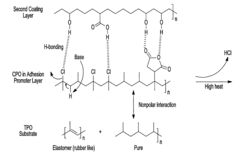
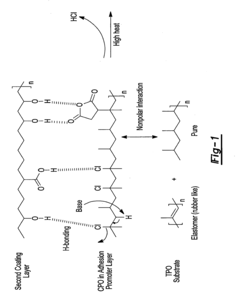
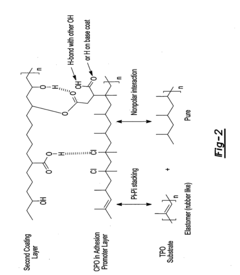
- The use of an adhesion promoter coating with a compound having a saturated carbon-carbon bond, which is dehydrogenated with a base to form an unsaturated carbon-carbon bond, and the application of a second coating layer that includes a base, such as an amine compound, to enhance adhesion through chemical interactions like covalent bonding and pi bonding.
Environmental Regulations for Polymer Oxidation Control
The regulatory landscape governing polymer oxidation control has evolved significantly in response to growing environmental concerns and health risks associated with oxidative degradation products. International frameworks such as REACH (Registration, Evaluation, Authorization and Restriction of Chemicals) in Europe and TSCA (Toxic Substances Control Act) in the United States establish comprehensive requirements for chemical substance management, including oxidation byproducts from polymer materials.
Environmental protection agencies worldwide have implemented stringent emission standards targeting volatile organic compounds and particulate matter released during polymer oxidation processes. The European Union's Industrial Emissions Directive sets specific limits on oxidation-related emissions from manufacturing facilities, while similar regulations in Asia-Pacific regions focus on air quality protection through controlled polymer processing conditions.
Product safety regulations increasingly address the impact of oxidative degradation on material performance and consumer safety. The FDA's food contact substance regulations specifically govern polymer materials susceptible to oxidation in food packaging applications, requiring extensive migration testing and stability assessments. Similarly, medical device regulations mandate comprehensive oxidation resistance testing for implantable polymer components.
Waste management regulations have introduced extended producer responsibility frameworks that hold manufacturers accountable for the entire lifecycle of polymer products, including oxidative degradation pathways. These regulations incentivize the development of oxidation-resistant formulations and proper disposal methods for degraded materials.
Emerging regulatory trends focus on microplastic pollution prevention, recognizing that oxidative degradation accelerates polymer fragmentation in environmental conditions. New legislation in several jurisdictions requires manufacturers to demonstrate oxidation resistance under simulated environmental exposure conditions.
Compliance frameworks increasingly emphasize predictive modeling and accelerated testing protocols to assess long-term oxidation behavior. Regulatory bodies are developing standardized test methods that correlate laboratory oxidation studies with real-world environmental exposure scenarios, enabling more accurate risk assessments and regulatory decision-making processes.
Environmental protection agencies worldwide have implemented stringent emission standards targeting volatile organic compounds and particulate matter released during polymer oxidation processes. The European Union's Industrial Emissions Directive sets specific limits on oxidation-related emissions from manufacturing facilities, while similar regulations in Asia-Pacific regions focus on air quality protection through controlled polymer processing conditions.
Product safety regulations increasingly address the impact of oxidative degradation on material performance and consumer safety. The FDA's food contact substance regulations specifically govern polymer materials susceptible to oxidation in food packaging applications, requiring extensive migration testing and stability assessments. Similarly, medical device regulations mandate comprehensive oxidation resistance testing for implantable polymer components.
Waste management regulations have introduced extended producer responsibility frameworks that hold manufacturers accountable for the entire lifecycle of polymer products, including oxidative degradation pathways. These regulations incentivize the development of oxidation-resistant formulations and proper disposal methods for degraded materials.
Emerging regulatory trends focus on microplastic pollution prevention, recognizing that oxidative degradation accelerates polymer fragmentation in environmental conditions. New legislation in several jurisdictions requires manufacturers to demonstrate oxidation resistance under simulated environmental exposure conditions.
Compliance frameworks increasingly emphasize predictive modeling and accelerated testing protocols to assess long-term oxidation behavior. Regulatory bodies are developing standardized test methods that correlate laboratory oxidation studies with real-world environmental exposure scenarios, enabling more accurate risk assessments and regulatory decision-making processes.
Sustainability Considerations in Oxidation-Resistant Polymers
The development of oxidation-resistant polymers presents significant opportunities to advance sustainability goals across multiple dimensions of the materials lifecycle. Traditional polymer degradation due to oxidative processes results in substantial material waste, frequent replacement cycles, and increased environmental burden through disposal and manufacturing of replacement components. By enhancing oxidation resistance, these advanced polymer systems can dramatically extend service life, reducing the frequency of material replacement and minimizing waste generation.
Life cycle assessment studies demonstrate that oxidation-resistant polymers can reduce overall environmental impact by 30-50% compared to conventional materials when considering extended service intervals. The enhanced durability translates directly into reduced raw material consumption over the product lifetime, as components maintain their structural integrity and adhesive properties for significantly longer periods. This extended functionality is particularly valuable in applications where polymer failure leads to cascading system replacements.
The circular economy principles align well with oxidation-resistant polymer development, as these materials maintain their performance characteristics longer, enabling more effective recycling and reprocessing cycles. Advanced stabilization systems, including bio-based antioxidants and renewable stabilizer compounds, are increasingly being integrated into polymer formulations without compromising oxidation resistance. These bio-derived additives offer comparable or superior performance while reducing dependence on petroleum-based stabilization systems.
Energy efficiency considerations reveal additional sustainability benefits, as oxidation-resistant polymers often eliminate the need for protective coatings, secondary treatments, or frequent maintenance procedures that consume energy and resources. The reduced processing requirements and extended maintenance intervals contribute to lower overall energy consumption throughout the material lifecycle.
Emerging research focuses on developing oxidation-resistant polymers from renewable feedstocks, combining sustainability at both the raw material and performance levels. These innovations include plant-based polymer backbones with inherent oxidation resistance and recyclable stabilizer systems that can be recovered and reused in subsequent manufacturing cycles, creating closed-loop material systems that minimize environmental impact while maintaining superior adhesion performance under oxidative conditions.
Life cycle assessment studies demonstrate that oxidation-resistant polymers can reduce overall environmental impact by 30-50% compared to conventional materials when considering extended service intervals. The enhanced durability translates directly into reduced raw material consumption over the product lifetime, as components maintain their structural integrity and adhesive properties for significantly longer periods. This extended functionality is particularly valuable in applications where polymer failure leads to cascading system replacements.
The circular economy principles align well with oxidation-resistant polymer development, as these materials maintain their performance characteristics longer, enabling more effective recycling and reprocessing cycles. Advanced stabilization systems, including bio-based antioxidants and renewable stabilizer compounds, are increasingly being integrated into polymer formulations without compromising oxidation resistance. These bio-derived additives offer comparable or superior performance while reducing dependence on petroleum-based stabilization systems.
Energy efficiency considerations reveal additional sustainability benefits, as oxidation-resistant polymers often eliminate the need for protective coatings, secondary treatments, or frequent maintenance procedures that consume energy and resources. The reduced processing requirements and extended maintenance intervals contribute to lower overall energy consumption throughout the material lifecycle.
Emerging research focuses on developing oxidation-resistant polymers from renewable feedstocks, combining sustainability at both the raw material and performance levels. These innovations include plant-based polymer backbones with inherent oxidation resistance and recyclable stabilizer systems that can be recovered and reused in subsequent manufacturing cycles, creating closed-loop material systems that minimize environmental impact while maintaining superior adhesion performance under oxidative conditions.
Unlock deeper insights with Patsnap Eureka Quick Research — get a full tech report to explore trends and direct your research. Try now!
Generate Your Research Report Instantly with AI Agent
Supercharge your innovation with Patsnap Eureka AI Agent Platform!