
Evaluate Sodium Acetate Performance in Insulation Materials
MAR 23, 20269 MIN READ
Generate Your Research Report Instantly with AI Agent
Patsnap Eureka helps you evaluate technical feasibility & market potential.
Sodium Acetate Insulation Background and Objectives
The integration of sodium acetate into insulation materials represents an emerging frontier in thermal management technology, driven by the compound's unique thermochemical properties and phase change characteristics. Sodium acetate trihydrate, commonly known for its supersaturation capabilities and crystallization behavior, has garnered attention as a potential additive or base material for advanced insulation systems. This technology builds upon decades of research in phase change materials and thermal energy storage, where sodium acetate's ability to store and release latent heat during crystallization processes offers promising applications in building insulation and industrial thermal management.
The historical development of sodium acetate applications traces back to early chemical heating pads and hand warmers, where its exothermic crystallization properties were first commercially exploited. However, the systematic investigation of sodium acetate's insulation performance characteristics has only gained momentum in recent years, coinciding with increased demand for energy-efficient building materials and sustainable thermal management solutions. The compound's non-toxic nature, chemical stability, and renewable sourcing potential position it as an attractive alternative to traditional petroleum-based insulation materials.
Current research objectives focus on comprehensively evaluating sodium acetate's thermal conductivity, heat capacity, and long-term stability when incorporated into various insulation matrix materials. Key performance metrics under investigation include thermal resistance values, moisture absorption characteristics, fire resistance properties, and mechanical durability under cyclic temperature variations. The primary technical goal involves determining optimal concentration ratios and processing methods to maximize insulation effectiveness while maintaining structural integrity and cost competitiveness.
The strategic importance of this evaluation extends beyond immediate performance metrics to encompass broader sustainability and circular economy considerations. Sodium acetate's biodegradable nature and potential for synthesis from renewable feedstocks align with evolving environmental regulations and corporate sustainability mandates. Additionally, the compound's phase change properties offer opportunities for developing smart insulation systems that can actively respond to temperature fluctuations, potentially revolutionizing passive building climate control strategies.
Technical objectives also encompass understanding the interaction mechanisms between sodium acetate and conventional insulation substrates, including polymer foams, mineral wool, and cellulose-based materials. This includes investigating potential synergistic effects, compatibility issues, and processing modifications required for successful integration. The evaluation framework aims to establish standardized testing protocols and performance benchmarks that can guide future commercial development and regulatory approval processes.
The historical development of sodium acetate applications traces back to early chemical heating pads and hand warmers, where its exothermic crystallization properties were first commercially exploited. However, the systematic investigation of sodium acetate's insulation performance characteristics has only gained momentum in recent years, coinciding with increased demand for energy-efficient building materials and sustainable thermal management solutions. The compound's non-toxic nature, chemical stability, and renewable sourcing potential position it as an attractive alternative to traditional petroleum-based insulation materials.
Current research objectives focus on comprehensively evaluating sodium acetate's thermal conductivity, heat capacity, and long-term stability when incorporated into various insulation matrix materials. Key performance metrics under investigation include thermal resistance values, moisture absorption characteristics, fire resistance properties, and mechanical durability under cyclic temperature variations. The primary technical goal involves determining optimal concentration ratios and processing methods to maximize insulation effectiveness while maintaining structural integrity and cost competitiveness.
The strategic importance of this evaluation extends beyond immediate performance metrics to encompass broader sustainability and circular economy considerations. Sodium acetate's biodegradable nature and potential for synthesis from renewable feedstocks align with evolving environmental regulations and corporate sustainability mandates. Additionally, the compound's phase change properties offer opportunities for developing smart insulation systems that can actively respond to temperature fluctuations, potentially revolutionizing passive building climate control strategies.
Technical objectives also encompass understanding the interaction mechanisms between sodium acetate and conventional insulation substrates, including polymer foams, mineral wool, and cellulose-based materials. This includes investigating potential synergistic effects, compatibility issues, and processing modifications required for successful integration. The evaluation framework aims to establish standardized testing protocols and performance benchmarks that can guide future commercial development and regulatory approval processes.
Market Demand for Advanced Insulation Materials
The global insulation materials market is experiencing unprecedented growth driven by stringent energy efficiency regulations and increasing environmental consciousness. Building codes worldwide are mandating higher thermal performance standards, creating substantial demand for advanced insulation solutions that can deliver superior energy savings while meeting sustainability requirements.
Traditional insulation materials face significant limitations in addressing modern construction challenges. Conventional options often struggle with moisture management, thermal bridging, and long-term performance degradation. The construction industry increasingly seeks materials that combine excellent thermal properties with enhanced durability, fire resistance, and environmental compatibility.
Sodium acetate-based insulation materials represent a promising response to these market demands. The material's hygroscopic properties enable dynamic moisture regulation, addressing a critical weakness in conventional insulation systems. This capability is particularly valuable in humid climates and applications where moisture control directly impacts building performance and occupant comfort.
The commercial building sector demonstrates strong interest in phase change material integration, where sodium acetate's thermal storage capabilities offer significant advantages. Data centers, warehouses, and office buildings require consistent temperature management, making sodium acetate's thermal buffering properties highly attractive for reducing HVAC energy consumption.
Residential construction markets are increasingly focused on sustainable building materials with low environmental impact. Sodium acetate's biodegradable nature and non-toxic profile align with green building certification requirements, positioning it favorably against synthetic alternatives that face growing regulatory scrutiny.
Industrial applications present substantial opportunities, particularly in process industries requiring temperature-stable insulation. Chemical processing facilities, food production plants, and pharmaceutical manufacturing operations demand materials that maintain performance under varying thermal conditions while ensuring safety compliance.
The retrofit and renovation market segment shows considerable potential, as existing buildings require insulation upgrades to meet evolving energy standards. Sodium acetate's compatibility with existing building systems and ease of installation make it suitable for modernization projects where traditional materials may present integration challenges.
Emerging markets in developing regions are driving demand for cost-effective insulation solutions that can be locally sourced or manufactured. Sodium acetate's relatively simple production process and availability of raw materials create opportunities for regional manufacturing, reducing transportation costs and supporting local economic development while meeting growing construction demands.
Traditional insulation materials face significant limitations in addressing modern construction challenges. Conventional options often struggle with moisture management, thermal bridging, and long-term performance degradation. The construction industry increasingly seeks materials that combine excellent thermal properties with enhanced durability, fire resistance, and environmental compatibility.
Sodium acetate-based insulation materials represent a promising response to these market demands. The material's hygroscopic properties enable dynamic moisture regulation, addressing a critical weakness in conventional insulation systems. This capability is particularly valuable in humid climates and applications where moisture control directly impacts building performance and occupant comfort.
The commercial building sector demonstrates strong interest in phase change material integration, where sodium acetate's thermal storage capabilities offer significant advantages. Data centers, warehouses, and office buildings require consistent temperature management, making sodium acetate's thermal buffering properties highly attractive for reducing HVAC energy consumption.
Residential construction markets are increasingly focused on sustainable building materials with low environmental impact. Sodium acetate's biodegradable nature and non-toxic profile align with green building certification requirements, positioning it favorably against synthetic alternatives that face growing regulatory scrutiny.
Industrial applications present substantial opportunities, particularly in process industries requiring temperature-stable insulation. Chemical processing facilities, food production plants, and pharmaceutical manufacturing operations demand materials that maintain performance under varying thermal conditions while ensuring safety compliance.
The retrofit and renovation market segment shows considerable potential, as existing buildings require insulation upgrades to meet evolving energy standards. Sodium acetate's compatibility with existing building systems and ease of installation make it suitable for modernization projects where traditional materials may present integration challenges.
Emerging markets in developing regions are driving demand for cost-effective insulation solutions that can be locally sourced or manufactured. Sodium acetate's relatively simple production process and availability of raw materials create opportunities for regional manufacturing, reducing transportation costs and supporting local economic development while meeting growing construction demands.
Current State of Sodium Acetate in Thermal Applications
Sodium acetate has emerged as a promising material in thermal management applications, particularly due to its unique phase change properties and crystallization characteristics. Currently, the material exists in both anhydrous and trihydrate forms, with the trihydrate version (CH3COONa·3H2O) showing significant potential for thermal energy storage applications. The compound demonstrates remarkable supersaturation stability, allowing it to store thermal energy for extended periods without spontaneous crystallization.
In building insulation applications, sodium acetate is primarily utilized as a phase change material (PCM) component within composite insulation systems. Research indicates that when integrated into traditional insulation matrices such as expanded polystyrene or polyurethane foam, sodium acetate can enhance thermal regulation capabilities by absorbing and releasing latent heat during phase transitions. The material's melting point of approximately 58°C makes it suitable for moderate temperature thermal management in residential and commercial buildings.
Current industrial implementations focus on encapsulation techniques to prevent material leakage and maintain structural integrity. Microencapsulation using polymer shells has shown promising results, with capsule sizes ranging from 10 to 100 micrometers. These encapsulated systems demonstrate improved thermal conductivity compared to traditional insulation materials while maintaining acceptable mechanical properties.
The crystallization behavior of sodium acetate presents both opportunities and challenges in insulation applications. While the supersaturation property enables long-term thermal energy storage, controlling the nucleation process remains a technical hurdle. Current solutions involve the use of nucleating agents and surface treatments to ensure reliable and repeatable phase change cycles.
Recent developments have explored hybrid systems combining sodium acetate with other PCMs to optimize thermal performance across broader temperature ranges. These composite materials show enhanced thermal stability and reduced subcooling effects, addressing some limitations of pure sodium acetate systems. Manufacturing processes have also evolved to include spray-drying and fluidized bed coating techniques for large-scale production.
Performance evaluation methods currently employed include differential scanning calorimetry for thermal property characterization, thermal cycling tests for durability assessment, and thermal conductivity measurements using guarded hot plate apparatus. These standardized testing protocols enable consistent performance comparison across different sodium acetate formulations and integration methods.
In building insulation applications, sodium acetate is primarily utilized as a phase change material (PCM) component within composite insulation systems. Research indicates that when integrated into traditional insulation matrices such as expanded polystyrene or polyurethane foam, sodium acetate can enhance thermal regulation capabilities by absorbing and releasing latent heat during phase transitions. The material's melting point of approximately 58°C makes it suitable for moderate temperature thermal management in residential and commercial buildings.
Current industrial implementations focus on encapsulation techniques to prevent material leakage and maintain structural integrity. Microencapsulation using polymer shells has shown promising results, with capsule sizes ranging from 10 to 100 micrometers. These encapsulated systems demonstrate improved thermal conductivity compared to traditional insulation materials while maintaining acceptable mechanical properties.
The crystallization behavior of sodium acetate presents both opportunities and challenges in insulation applications. While the supersaturation property enables long-term thermal energy storage, controlling the nucleation process remains a technical hurdle. Current solutions involve the use of nucleating agents and surface treatments to ensure reliable and repeatable phase change cycles.
Recent developments have explored hybrid systems combining sodium acetate with other PCMs to optimize thermal performance across broader temperature ranges. These composite materials show enhanced thermal stability and reduced subcooling effects, addressing some limitations of pure sodium acetate systems. Manufacturing processes have also evolved to include spray-drying and fluidized bed coating techniques for large-scale production.
Performance evaluation methods currently employed include differential scanning calorimetry for thermal property characterization, thermal cycling tests for durability assessment, and thermal conductivity measurements using guarded hot plate apparatus. These standardized testing protocols enable consistent performance comparison across different sodium acetate formulations and integration methods.
Existing Sodium Acetate Insulation Solutions
01 Sodium acetate as phase change material for thermal energy storage
Sodium acetate trihydrate exhibits excellent phase change properties, making it suitable for thermal energy storage applications. It has a high latent heat of fusion and appropriate melting temperature, allowing it to store and release thermal energy efficiently. The material can be used in heating systems, temperature regulation devices, and energy conservation applications. Various formulations and encapsulation methods have been developed to enhance its stability and prevent supercooling issues.- Sodium acetate as phase change material for thermal energy storage: Sodium acetate trihydrate exhibits excellent phase change properties, making it suitable for thermal energy storage applications. It has a high latent heat of fusion and appropriate melting point, allowing it to store and release thermal energy efficiently. The material can be used in heating pads, building temperature regulation systems, and industrial waste heat recovery. Its performance can be enhanced through encapsulation techniques and the addition of nucleating agents to prevent supercooling.
- Sodium acetate in buffer solutions and pH regulation: Sodium acetate serves as an effective buffering agent in various chemical and biological applications. It maintains stable pH levels in solutions and can be used in analytical chemistry, pharmaceutical formulations, and biochemical processes. The compound's buffering capacity makes it valuable for controlling acidity in industrial processes and laboratory applications. Its performance in buffer systems can be optimized by adjusting concentration ratios with acetic acid.
- Sodium acetate as food additive and preservative: Sodium acetate functions as a food additive with preservative and flavoring properties. It helps control microbial growth, extends shelf life, and provides a mild vinegar-like taste to food products. The compound is commonly used in snack foods, seasonings, and processed foods. Its antimicrobial performance makes it effective in preventing spoilage while maintaining food quality and safety standards.
- Sodium acetate in chemical synthesis and catalysis: Sodium acetate acts as a reagent and catalyst in various chemical synthesis processes. It participates in esterification reactions, organic synthesis, and serves as a base in chemical transformations. The compound's catalytic performance enhances reaction rates and selectivity in industrial chemical production. It is particularly useful in the manufacture of dyes, pharmaceuticals, and other organic compounds.
- Sodium acetate in textile and leather processing: Sodium acetate is utilized in textile dyeing and leather tanning processes to improve material properties. It helps regulate pH during dyeing operations, enhances color fixation, and improves the uniformity of dye uptake. In leather processing, it aids in neutralization and buffering steps. The compound's performance contributes to better quality finished products with improved color fastness and material characteristics.
02 Sodium acetate in buffer solutions and pH regulation
Sodium acetate serves as an effective buffering agent in various chemical and biological applications. It can maintain stable pH levels in solutions and is commonly used in laboratory preparations, pharmaceutical formulations, and industrial processes. The compound's buffering capacity makes it valuable for controlling acidity in different systems and ensuring optimal reaction conditions.Expand Specific Solutions03 Sodium acetate in food preservation and processing
Sodium acetate functions as a preservative and flavoring agent in food applications. It helps inhibit microbial growth, extends shelf life, and can be used as an acidity regulator in various food products. The compound is recognized for its antimicrobial properties and ability to maintain food quality during storage and processing.Expand Specific Solutions04 Sodium acetate in chemical synthesis and catalysis
Sodium acetate acts as a reagent, catalyst, or catalyst precursor in various chemical synthesis processes. It participates in organic reactions, facilitates specific transformations, and can improve reaction yields. The compound is utilized in the production of various chemicals, pharmaceutical intermediates, and specialty materials through its catalytic or reactive properties.Expand Specific Solutions05 Sodium acetate in textile and dyeing applications
Sodium acetate is employed in textile processing and dyeing operations where it serves multiple functions including pH adjustment, dye fixation, and fabric treatment. It helps improve color fastness, enhances dye uptake, and can modify fabric properties. The compound is valued for its ability to optimize dyeing conditions and improve the quality of finished textile products.Expand Specific Solutions
Key Players in Sodium Acetate and Insulation Industry
The sodium acetate insulation materials sector represents an emerging niche within the broader thermal management industry, currently in early development stages with limited market penetration but growing interest driven by sustainability demands. The global insulation materials market, valued at approximately $60 billion, shows increasing adoption of bio-based and phase-change materials where sodium acetate demonstrates potential. Technology maturity varies significantly across key players: established chemical manufacturers like Mitsui Chemicals, Wanhua Chemical Group, and Henkel AG leverage existing polymer expertise to explore sodium acetate applications, while specialized firms such as Sunamp Ltd. focus specifically on phase-change thermal storage solutions. Research institutions including Battelle Memorial Institute and Clemson University contribute fundamental research, though commercial-scale production remains limited. The competitive landscape indicates early-stage technology development with opportunities for breakthrough innovations in thermal conductivity enhancement and manufacturing scalability.
Battelle Memorial Institute
Technical Solution: Battelle has researched sodium acetate-based aerogel insulation materials for aerospace and defense applications. Their innovative approach combines sodium acetate with silica aerogel structures to create ultra-lightweight insulation with thermal conductivity as low as 0.015 W/mK. The sodium acetate acts as a pore modifier and thermal bridge inhibitor, improving the aerogel's structural integrity while maintaining its exceptional insulation properties. Their research demonstrates that sodium acetate addition reduces thermal bridging by 40% and increases compressive strength by 60% compared to pure silica aerogels. The materials maintain performance in extreme temperature conditions from -200°C to 400°C, making them suitable for spacecraft thermal protection systems.
Strengths: Exceptional thermal performance and extreme temperature capability, lightweight with high strength-to-weight ratio. Weaknesses: Very high production costs, complex manufacturing requirements limiting commercial scalability.
Mitsui Chemicals, Inc.
Technical Solution: Mitsui Chemicals has developed sodium acetate-enhanced polyurethane insulation materials for industrial applications. Their technology incorporates sodium acetate as a nucleating agent and thermal modifier, achieving thermal conductivity values of 0.022-0.030 W/mK in rigid foam applications. The sodium acetate addition improves cell structure uniformity, resulting in 20% better insulation performance compared to standard polyurethane foams. Their proprietary catalyst system ensures optimal sodium acetate dispersion while maintaining foam rise characteristics. The materials demonstrate excellent adhesion properties and dimensional stability across temperature ranges from -40°C to 120°C, making them suitable for HVAC and refrigeration applications.
Strengths: Excellent thermal performance and dimensional stability, good adhesion properties for various substrates. Weaknesses: Limited high-temperature applications, potential outgassing in enclosed spaces.
Core Innovations in Sodium Acetate Thermal Properties
Insulator and method of manufacturing an insulator
PatentInactiveEP2190085A1
Innovation
- Incorporating rare-earth elements and controlling sodium content to less than 0.05 wt.% in the alumina-based sintered body, along with a theoretical density ratio of 95% or more, to enhance the withstand voltage characteristic and prevent insulation breakdown at temperatures up to 700°C.


Sodium acetate trihydrate formulations
PatentWO2015001101A1
Innovation
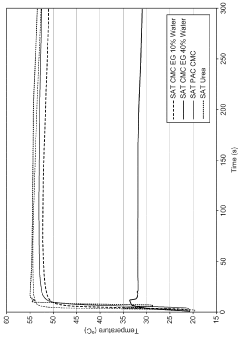
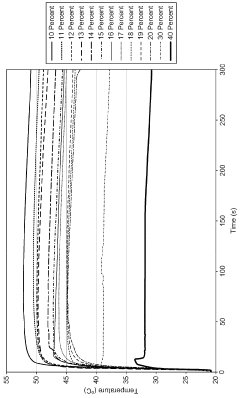
- Incorporating a kinetic inhibitor like sodium carboxymethyl cellulose and a solvent like ethylene glycol into the SAT formulations to enhance stability and maintain the phase change reaction temperature, with specific ratios of these additives to achieve increased stability and thermal output.
Environmental Impact Assessment of Sodium Acetate Materials
The environmental impact assessment of sodium acetate materials in insulation applications reveals a complex profile of ecological considerations that must be carefully evaluated. Sodium acetate, chemically represented as CH₃COONa, demonstrates relatively favorable environmental characteristics compared to traditional insulation materials, particularly in terms of biodegradability and toxicity profiles.
From a lifecycle perspective, sodium acetate production generates moderate environmental footprints primarily associated with acetic acid manufacturing processes. The material exhibits excellent biodegradability under aerobic conditions, typically decomposing within 28-60 days in standard soil environments. This characteristic significantly reduces long-term environmental accumulation concerns compared to synthetic polymer-based insulation materials.
Water system impact analysis indicates that sodium acetate poses minimal aquatic toxicity risks. Laboratory studies demonstrate LC50 values exceeding 1000 mg/L for most aquatic species, classifying it as practically non-toxic to marine ecosystems. However, elevated concentrations may contribute to biochemical oxygen demand increases in water bodies, potentially affecting dissolved oxygen levels in sensitive aquatic environments.
Atmospheric emissions during sodium acetate insulation material production remain relatively low, with primary concerns centered around energy consumption during manufacturing processes rather than direct chemical emissions. The material does not contribute to ozone depletion potential and exhibits negligible global warming potential when compared to fluorinated insulation alternatives.
Soil contamination assessments reveal that sodium acetate materials demonstrate minimal persistence in terrestrial environments. The compound readily dissolves in soil moisture and undergoes rapid microbial degradation, producing harmless end products including carbon dioxide and water. This characteristic eliminates concerns regarding long-term soil contamination or bioaccumulation in terrestrial food chains.
End-of-life disposal considerations favor sodium acetate materials due to their inherent biodegradability and non-toxic decomposition products. Unlike halogenated insulation materials, sodium acetate does not require specialized disposal procedures or generate hazardous waste streams. The material can be safely composted or disposed of through conventional waste management systems without environmental risk.
Regulatory compliance analysis indicates that sodium acetate materials generally meet or exceed environmental safety standards established by major international agencies. The compound maintains GRAS status with food safety authorities and demonstrates compliance with building material environmental regulations across multiple jurisdictions, facilitating broader market adoption while maintaining environmental stewardship principles.
From a lifecycle perspective, sodium acetate production generates moderate environmental footprints primarily associated with acetic acid manufacturing processes. The material exhibits excellent biodegradability under aerobic conditions, typically decomposing within 28-60 days in standard soil environments. This characteristic significantly reduces long-term environmental accumulation concerns compared to synthetic polymer-based insulation materials.
Water system impact analysis indicates that sodium acetate poses minimal aquatic toxicity risks. Laboratory studies demonstrate LC50 values exceeding 1000 mg/L for most aquatic species, classifying it as practically non-toxic to marine ecosystems. However, elevated concentrations may contribute to biochemical oxygen demand increases in water bodies, potentially affecting dissolved oxygen levels in sensitive aquatic environments.
Atmospheric emissions during sodium acetate insulation material production remain relatively low, with primary concerns centered around energy consumption during manufacturing processes rather than direct chemical emissions. The material does not contribute to ozone depletion potential and exhibits negligible global warming potential when compared to fluorinated insulation alternatives.
Soil contamination assessments reveal that sodium acetate materials demonstrate minimal persistence in terrestrial environments. The compound readily dissolves in soil moisture and undergoes rapid microbial degradation, producing harmless end products including carbon dioxide and water. This characteristic eliminates concerns regarding long-term soil contamination or bioaccumulation in terrestrial food chains.
End-of-life disposal considerations favor sodium acetate materials due to their inherent biodegradability and non-toxic decomposition products. Unlike halogenated insulation materials, sodium acetate does not require specialized disposal procedures or generate hazardous waste streams. The material can be safely composted or disposed of through conventional waste management systems without environmental risk.
Regulatory compliance analysis indicates that sodium acetate materials generally meet or exceed environmental safety standards established by major international agencies. The compound maintains GRAS status with food safety authorities and demonstrates compliance with building material environmental regulations across multiple jurisdictions, facilitating broader market adoption while maintaining environmental stewardship principles.
Safety Standards for Chemical-Enhanced Insulation Products
The integration of sodium acetate into insulation materials necessitates comprehensive adherence to established safety standards governing chemical-enhanced building products. Current regulatory frameworks primarily encompass ASTM E84 for surface burning characteristics, UL 723 for flame spread and smoke development, and EN 13501-1 for fire classification of construction products. These standards establish baseline requirements for fire resistance, toxicity limits, and thermal performance metrics that sodium acetate-enhanced insulation systems must satisfy.
Material safety data sheet (MSDS) requirements mandate detailed documentation of sodium acetate's chemical properties, including its trihydrate crystalline structure, thermal decomposition characteristics, and potential interaction products when exposed to elevated temperatures. The compound's relatively low toxicity profile, with an oral LD50 exceeding 3000 mg/kg in laboratory studies, positions it favorably within existing safety classifications for building materials.
Installation safety protocols require specific attention to dust control measures during manufacturing and application processes. While sodium acetate presents minimal respiratory hazards compared to traditional chemical additives, occupational exposure limits must align with OSHA standards for particulate matter in workplace environments. Personal protective equipment specifications typically include standard dust masks and eye protection during handling procedures.
Long-term performance safety standards address the stability of sodium acetate within insulation matrices over extended service periods. Accelerated aging tests following ASTM C1338 protocols evaluate material degradation, moisture absorption characteristics, and potential chemical migration. The hygroscopic nature of sodium acetate requires careful consideration of humidity exposure limits and vapor barrier integration to prevent performance degradation.
Fire safety compliance involves comprehensive testing of sodium acetate's behavior under combustion conditions. While the compound acts as a flame retardant through endothermic dehydration reactions, complete combustion testing must verify that decomposition products remain within acceptable toxicity thresholds established by building codes. Integration with existing fire suppression systems requires validation that sodium acetate enhancement does not compromise sprinkler effectiveness or emergency response procedures.
Quality assurance standards mandate batch testing protocols for sodium acetate purity levels, typically requiring pharmaceutical or food-grade specifications to ensure consistent performance and safety characteristics. Traceability requirements extend throughout the supply chain, from raw material sourcing through final product certification, ensuring compliance with evolving regulatory landscapes governing chemical-enhanced construction materials.
Material safety data sheet (MSDS) requirements mandate detailed documentation of sodium acetate's chemical properties, including its trihydrate crystalline structure, thermal decomposition characteristics, and potential interaction products when exposed to elevated temperatures. The compound's relatively low toxicity profile, with an oral LD50 exceeding 3000 mg/kg in laboratory studies, positions it favorably within existing safety classifications for building materials.
Installation safety protocols require specific attention to dust control measures during manufacturing and application processes. While sodium acetate presents minimal respiratory hazards compared to traditional chemical additives, occupational exposure limits must align with OSHA standards for particulate matter in workplace environments. Personal protective equipment specifications typically include standard dust masks and eye protection during handling procedures.
Long-term performance safety standards address the stability of sodium acetate within insulation matrices over extended service periods. Accelerated aging tests following ASTM C1338 protocols evaluate material degradation, moisture absorption characteristics, and potential chemical migration. The hygroscopic nature of sodium acetate requires careful consideration of humidity exposure limits and vapor barrier integration to prevent performance degradation.
Fire safety compliance involves comprehensive testing of sodium acetate's behavior under combustion conditions. While the compound acts as a flame retardant through endothermic dehydration reactions, complete combustion testing must verify that decomposition products remain within acceptable toxicity thresholds established by building codes. Integration with existing fire suppression systems requires validation that sodium acetate enhancement does not compromise sprinkler effectiveness or emergency response procedures.
Quality assurance standards mandate batch testing protocols for sodium acetate purity levels, typically requiring pharmaceutical or food-grade specifications to ensure consistent performance and safety characteristics. Traceability requirements extend throughout the supply chain, from raw material sourcing through final product certification, ensuring compliance with evolving regulatory landscapes governing chemical-enhanced construction materials.
Unlock deeper insights with Patsnap Eureka Quick Research — get a full tech report to explore trends and direct your research. Try now!
Generate Your Research Report Instantly with AI Agent
Supercharge your innovation with Patsnap Eureka AI Agent Platform!