

Evaluating Iron-Anodes for Improved Battery Performance
APR 27, 20269 MIN READ
Generate Your Research Report Instantly with AI Agent
PatSnap Eureka helps you evaluate technical feasibility & market potential.
Iron-Anode Battery Technology Background and Objectives
Iron-anode battery technology represents a paradigm shift in energy storage systems, leveraging iron's abundant availability and unique electrochemical properties to address critical limitations of conventional battery technologies. This technology emerged from the growing demand for sustainable, cost-effective energy storage solutions that can support large-scale applications including grid storage, electric vehicles, and renewable energy integration.
The historical development of iron-based electrochemical systems dates back to the early 20th century with iron-air batteries, but recent advances in materials science and electrochemistry have renewed interest in iron anodes. Modern iron-anode batteries have evolved through several generations, progressing from simple iron-air configurations to sophisticated iron-flow batteries and iron-ion systems that demonstrate significantly improved performance metrics.
Current technological evolution focuses on overcoming traditional challenges associated with iron oxidation, including capacity fade, voltage instability, and cycle life limitations. Advanced surface modification techniques, electrolyte optimization, and novel cell architectures have emerged as key enablers for practical iron-anode implementation. These developments have positioned iron-anode technology as a viable alternative to lithium-based systems for specific applications.
The primary objective of iron-anode battery development centers on achieving superior energy density while maintaining cost advantages inherent to iron-based materials. Target specifications include achieving energy densities exceeding 200 Wh/kg, cycle life beyond 5,000 cycles, and manufacturing costs below $100/kWh. These metrics would establish iron-anode batteries as competitive alternatives for stationary storage applications.
Secondary objectives encompass environmental sustainability and supply chain security. Iron's abundance eliminates resource scarcity concerns associated with lithium, cobalt, and other critical materials. The technology aims to deliver fully recyclable battery systems with minimal environmental impact throughout their lifecycle.
Performance optimization objectives include developing stable iron-anode interfaces that resist corrosion and dendrite formation, engineering electrolyte systems that support reversible iron electrochemistry, and creating cell designs that maximize volumetric efficiency. These technical goals collectively support the broader vision of establishing iron-anode batteries as mainstream energy storage solutions for grid-scale and transportation applications.
The historical development of iron-based electrochemical systems dates back to the early 20th century with iron-air batteries, but recent advances in materials science and electrochemistry have renewed interest in iron anodes. Modern iron-anode batteries have evolved through several generations, progressing from simple iron-air configurations to sophisticated iron-flow batteries and iron-ion systems that demonstrate significantly improved performance metrics.
Current technological evolution focuses on overcoming traditional challenges associated with iron oxidation, including capacity fade, voltage instability, and cycle life limitations. Advanced surface modification techniques, electrolyte optimization, and novel cell architectures have emerged as key enablers for practical iron-anode implementation. These developments have positioned iron-anode technology as a viable alternative to lithium-based systems for specific applications.
The primary objective of iron-anode battery development centers on achieving superior energy density while maintaining cost advantages inherent to iron-based materials. Target specifications include achieving energy densities exceeding 200 Wh/kg, cycle life beyond 5,000 cycles, and manufacturing costs below $100/kWh. These metrics would establish iron-anode batteries as competitive alternatives for stationary storage applications.
Secondary objectives encompass environmental sustainability and supply chain security. Iron's abundance eliminates resource scarcity concerns associated with lithium, cobalt, and other critical materials. The technology aims to deliver fully recyclable battery systems with minimal environmental impact throughout their lifecycle.
Performance optimization objectives include developing stable iron-anode interfaces that resist corrosion and dendrite formation, engineering electrolyte systems that support reversible iron electrochemistry, and creating cell designs that maximize volumetric efficiency. These technical goals collectively support the broader vision of establishing iron-anode batteries as mainstream energy storage solutions for grid-scale and transportation applications.
Market Demand for Iron-Based Battery Solutions
The global energy storage market is experiencing unprecedented growth driven by the urgent need for sustainable energy solutions and grid stabilization technologies. Iron-based battery solutions are emerging as a compelling alternative to traditional lithium-ion systems, particularly in applications where cost-effectiveness and safety take precedence over energy density. The market demand for these solutions is primarily fueled by large-scale energy storage projects, renewable energy integration requirements, and the growing emphasis on supply chain security.
Utility-scale energy storage represents the most significant market opportunity for iron-based battery technologies. Grid operators worldwide are seeking cost-effective solutions for load balancing, frequency regulation, and renewable energy integration. Iron-based systems offer compelling advantages in these applications due to their inherent safety characteristics, long cycle life, and reduced fire risk compared to lithium-ion alternatives. The extended duration storage market, particularly for applications requiring 4-12 hour discharge cycles, presents substantial growth potential.
Industrial and commercial sectors are increasingly recognizing the value proposition of iron-based battery solutions for backup power and peak shaving applications. Manufacturing facilities, data centers, and commercial buildings require reliable energy storage systems that can operate safely in various environmental conditions. The non-toxic nature of iron-based chemistries eliminates many regulatory and safety concerns associated with other battery technologies, making them attractive for installations in populated areas.
The residential energy storage market, while traditionally dominated by lithium-ion systems, is beginning to show interest in iron-based alternatives. Homeowners are becoming more conscious of safety considerations and total cost of ownership. Iron-based systems offer potential advantages in terms of longevity and reduced maintenance requirements, though market penetration remains limited by energy density constraints.
Emerging markets in developing countries present significant opportunities for iron-based battery deployment. These regions often prioritize cost-effectiveness and reliability over cutting-edge performance metrics. The abundance of iron as a raw material and simplified manufacturing processes could enable local production capabilities, reducing dependence on complex global supply chains.
The market trajectory for iron-based battery solutions is closely tied to technological advancements in anode performance and overall system efficiency. As research progresses in improving iron anode characteristics, market acceptance is expected to accelerate across multiple application segments, positioning these technologies as viable alternatives in the evolving energy storage landscape.
Utility-scale energy storage represents the most significant market opportunity for iron-based battery technologies. Grid operators worldwide are seeking cost-effective solutions for load balancing, frequency regulation, and renewable energy integration. Iron-based systems offer compelling advantages in these applications due to their inherent safety characteristics, long cycle life, and reduced fire risk compared to lithium-ion alternatives. The extended duration storage market, particularly for applications requiring 4-12 hour discharge cycles, presents substantial growth potential.
Industrial and commercial sectors are increasingly recognizing the value proposition of iron-based battery solutions for backup power and peak shaving applications. Manufacturing facilities, data centers, and commercial buildings require reliable energy storage systems that can operate safely in various environmental conditions. The non-toxic nature of iron-based chemistries eliminates many regulatory and safety concerns associated with other battery technologies, making them attractive for installations in populated areas.
The residential energy storage market, while traditionally dominated by lithium-ion systems, is beginning to show interest in iron-based alternatives. Homeowners are becoming more conscious of safety considerations and total cost of ownership. Iron-based systems offer potential advantages in terms of longevity and reduced maintenance requirements, though market penetration remains limited by energy density constraints.
Emerging markets in developing countries present significant opportunities for iron-based battery deployment. These regions often prioritize cost-effectiveness and reliability over cutting-edge performance metrics. The abundance of iron as a raw material and simplified manufacturing processes could enable local production capabilities, reducing dependence on complex global supply chains.
The market trajectory for iron-based battery solutions is closely tied to technological advancements in anode performance and overall system efficiency. As research progresses in improving iron anode characteristics, market acceptance is expected to accelerate across multiple application segments, positioning these technologies as viable alternatives in the evolving energy storage landscape.
Current State and Challenges of Iron-Anode Technologies
Iron-anode technologies have emerged as a promising alternative to conventional lithium-ion battery systems, driven by iron's abundance, low cost, and inherent safety characteristics. Current research focuses primarily on iron-air, iron-sulfur, and aqueous iron-ion battery configurations, each demonstrating unique electrochemical properties and performance metrics.
The global development landscape shows concentrated research activities in North America, Europe, and Asia-Pacific regions. Leading research institutions in the United States, including MIT and Stanford University, have made significant contributions to iron-anode fundamental science. European initiatives, particularly in Germany and the Netherlands, emphasize grid-scale energy storage applications. Meanwhile, Asian countries like China and Japan are advancing manufacturing scalability and cost optimization strategies.
Contemporary iron-anode systems face several critical technical challenges that limit their commercial viability. The primary obstacle involves capacity degradation during charge-discharge cycles, attributed to iron dissolution and subsequent electrode morphology changes. Parasitic reactions, particularly hydrogen evolution in aqueous electrolytes, significantly reduce coulombic efficiency and compromise long-term performance stability.
Electrolyte compatibility represents another substantial challenge, as traditional organic electrolytes demonstrate poor stability with iron anodes. Aqueous systems, while offering improved safety profiles, suffer from limited voltage windows and accelerated corrosion rates. The formation of passive oxide layers on iron surfaces creates additional resistance barriers, reducing overall energy density and power output capabilities.
Manufacturing scalability poses significant industrial challenges, particularly regarding electrode preparation and quality control. Current production methods struggle to achieve consistent iron particle distribution and optimal porosity levels required for commercial applications. The lack of standardized testing protocols further complicates performance evaluation and comparison across different research groups.
Temperature sensitivity remains a critical operational constraint, as iron-anode performance varies significantly across different thermal conditions. Low-temperature environments reduce ionic conductivity and increase internal resistance, while elevated temperatures accelerate degradation mechanisms and safety risks.
Despite these challenges, recent technological advances show promising solutions. Novel electrolyte formulations incorporating ionic liquids and solid-state configurations demonstrate improved stability and extended cycle life. Advanced iron nanostructuring techniques, including surface modification and composite electrode designs, address capacity retention issues while maintaining cost advantages over conventional battery technologies.
The global development landscape shows concentrated research activities in North America, Europe, and Asia-Pacific regions. Leading research institutions in the United States, including MIT and Stanford University, have made significant contributions to iron-anode fundamental science. European initiatives, particularly in Germany and the Netherlands, emphasize grid-scale energy storage applications. Meanwhile, Asian countries like China and Japan are advancing manufacturing scalability and cost optimization strategies.
Contemporary iron-anode systems face several critical technical challenges that limit their commercial viability. The primary obstacle involves capacity degradation during charge-discharge cycles, attributed to iron dissolution and subsequent electrode morphology changes. Parasitic reactions, particularly hydrogen evolution in aqueous electrolytes, significantly reduce coulombic efficiency and compromise long-term performance stability.
Electrolyte compatibility represents another substantial challenge, as traditional organic electrolytes demonstrate poor stability with iron anodes. Aqueous systems, while offering improved safety profiles, suffer from limited voltage windows and accelerated corrosion rates. The formation of passive oxide layers on iron surfaces creates additional resistance barriers, reducing overall energy density and power output capabilities.
Manufacturing scalability poses significant industrial challenges, particularly regarding electrode preparation and quality control. Current production methods struggle to achieve consistent iron particle distribution and optimal porosity levels required for commercial applications. The lack of standardized testing protocols further complicates performance evaluation and comparison across different research groups.
Temperature sensitivity remains a critical operational constraint, as iron-anode performance varies significantly across different thermal conditions. Low-temperature environments reduce ionic conductivity and increase internal resistance, while elevated temperatures accelerate degradation mechanisms and safety risks.
Despite these challenges, recent technological advances show promising solutions. Novel electrolyte formulations incorporating ionic liquids and solid-state configurations demonstrate improved stability and extended cycle life. Advanced iron nanostructuring techniques, including surface modification and composite electrode designs, address capacity retention issues while maintaining cost advantages over conventional battery technologies.
Existing Iron-Anode Performance Enhancement Solutions
01 Iron anode material composition and structure optimization
Optimization of iron anode materials involves modifying the composition and microstructure to enhance electrochemical performance. This includes developing iron-based alloys, nanostructured materials, and composite anodes that improve conductivity, reduce corrosion, and increase energy density. Various dopants and additives can be incorporated to enhance the structural stability and electrochemical properties of iron anodes.- Iron anode material composition and structure optimization: Optimization of iron anode materials involves modifying the composition and microstructure to enhance electrochemical performance. This includes developing iron-based alloys, composite materials, and nanostructured iron anodes that provide improved conductivity, stability, and energy density. Various dopants and additives can be incorporated to enhance the structural integrity and electrochemical properties of iron anodes.
- Surface treatment and coating technologies for iron anodes: Surface modification techniques are employed to improve the performance and durability of iron anodes. These treatments include protective coatings, surface functionalization, and barrier layers that prevent corrosion and enhance charge transfer kinetics. Advanced coating materials and deposition methods are utilized to create uniform and stable surface layers that maintain anode performance over extended cycling.
- Electrolyte compatibility and interface engineering: The interaction between iron anodes and electrolyte systems is critical for battery performance. This involves developing compatible electrolyte formulations, optimizing electrolyte additives, and engineering the electrode-electrolyte interface to minimize side reactions and improve ion transport. Interface stabilization techniques help maintain consistent performance and prevent degradation mechanisms.
- Manufacturing processes and fabrication methods: Advanced manufacturing techniques for iron anodes focus on scalable production methods that ensure consistent quality and performance. This includes powder metallurgy processes, electrode preparation techniques, and assembly methods that optimize the physical and electrochemical properties of iron anodes. Process parameters are carefully controlled to achieve desired porosity, particle size distribution, and electrode architecture.
- Performance testing and characterization methods: Comprehensive evaluation of iron anode performance requires specialized testing protocols and characterization techniques. This includes electrochemical testing methods, cycle life assessment, capacity retention analysis, and degradation mechanism studies. Advanced analytical techniques are employed to understand the fundamental behavior of iron anodes under various operating conditions and to optimize their performance parameters.
02 Surface treatment and coating technologies for iron anodes
Surface modification techniques are employed to improve iron anode performance by applying protective coatings, surface treatments, or functional layers. These treatments help prevent corrosion, reduce side reactions, and enhance charge transfer kinetics. The surface engineering approaches can significantly extend the lifespan and improve the efficiency of iron-based battery systems.Expand Specific Solutions03 Electrolyte formulation and compatibility with iron anodes
The development of suitable electrolyte systems that are compatible with iron anodes is crucial for optimal battery performance. This involves formulating electrolytes with appropriate pH levels, ionic conductivity, and chemical stability to minimize iron dissolution and maximize electrochemical efficiency. Advanced electrolyte additives and stabilizers are used to enhance the interaction between iron anodes and the electrolyte medium.Expand Specific Solutions04 Battery design and configuration optimization
Optimization of battery cell design and configuration specifically for iron anode systems involves engineering the electrode architecture, separator selection, and overall cell construction. This includes developing appropriate current collectors, optimizing electrode spacing, and designing battery configurations that maximize the utilization of iron anode materials while maintaining structural integrity and safety.Expand Specific Solutions05 Performance enhancement through manufacturing processes
Advanced manufacturing techniques and processing methods are employed to improve iron anode battery performance. This includes specialized fabrication processes, heat treatment methods, and quality control measures that ensure consistent performance and reliability. The manufacturing approaches focus on achieving optimal particle size distribution, porosity control, and electrode uniformity to maximize battery efficiency and cycle life.Expand Specific Solutions
Key Players in Iron-Anode Battery Industry
The iron-anode battery technology sector is experiencing rapid evolution as the industry transitions from early research phases to commercial viability, driven by the need for sustainable, cost-effective energy storage solutions. The market demonstrates significant growth potential, particularly in grid-scale applications, with established players like Sony Group Corp., Samsung Electronics, and LG Energy Solution leveraging their manufacturing expertise alongside emerging specialists such as Form Energy and 24M Technologies who are pioneering iron-based chemistries. Technology maturity varies considerably across the competitive landscape, where traditional lithium-ion manufacturers like Murata Manufacturing and Svolt Energy are adapting existing production capabilities, while innovative companies including Nexeon Ltd. and Sicona Battery Technologies are developing novel anode materials and manufacturing processes, creating a dynamic ecosystem spanning from fundamental research at institutions like Cornell University and Bar-Ilan University to commercial deployment by automotive partners such as Zhejiang Geely Holding Group.
Form Energy, Inc.
Technical Solution: Form Energy has developed revolutionary iron-air battery technology that utilizes iron anodes as the primary energy storage mechanism. Their system operates through the reversible rusting and de-rusting of iron, where iron anodes are oxidized during discharge and reduced during charging. The company's multi-day energy storage solution can deliver electricity for up to 100 hours at system costs competitive with legacy power plants. Their iron-air batteries use abundant, safe, and recyclable materials, with iron serving as the core anode material that enables ultra-low-cost energy storage for grid-scale applications.
Strengths: Ultra-low cost materials, 100-hour duration capability, uses abundant iron resources, environmentally safe. Weaknesses: Lower energy density compared to lithium-ion, slower response times, primarily suited for stationary applications.
Samsung Electronics Co., Ltd.
Technical Solution: Samsung has been researching iron-based anode materials as alternatives to conventional lithium-ion battery anodes. Their approach focuses on iron oxide nanostructures and iron-silicon composite anodes that can provide higher theoretical capacity than graphite anodes. The company has developed iron-based anode materials with enhanced cycling stability through advanced nanoengineering techniques, including iron oxide nanowires and iron-carbon composite structures. These materials aim to improve energy density while maintaining cost-effectiveness, particularly for large-scale energy storage applications and next-generation battery systems.
Strengths: Advanced nanoengineering capabilities, strong R&D infrastructure, integration with existing battery manufacturing. Weaknesses: Still in research phase, challenges with volume expansion, lower conductivity than conventional anodes.
Core Patents in Iron-Anode Battery Technologies
Nickel-iron battery with a chemically pre-formed (CPF) iron negative electrode
PatentInactiveUS20180366721A1
Innovation
- A nickel-iron battery with a chemically pre-formed iron negative electrode, treated with oxidants like water, hydrogen peroxide, or ozone to achieve an optimized oxidation state, reducing the need for formation cycles and improving electrolyte access and utilization.


Novel iron anode for stationary storage
PatentWO2016193963A1
Innovation
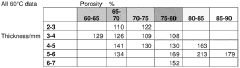
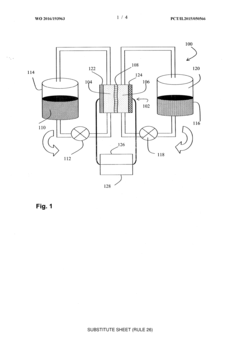
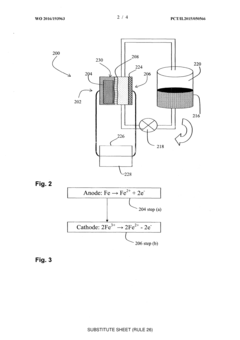
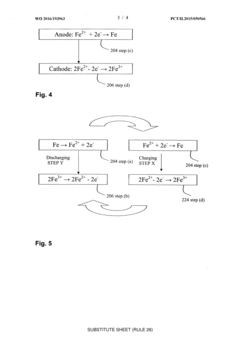
- Using coarser grain size micro-particles of iron sintered into thicker electrodes with high porosity (at least 70%) instead of nano-particles, allowing for increased specific capacity and stability, and employing methods like mixing with pore formers and sintering on metal meshes to fabricate these anodes.
Environmental Impact Assessment of Iron-Anode Batteries
Iron-anode batteries present significant environmental advantages compared to conventional lithium-ion and lead-acid battery technologies. The primary environmental benefit stems from iron's abundance as the fourth most common element in Earth's crust, eliminating concerns about resource scarcity and reducing mining pressure on rare earth elements. Unlike lithium extraction, which requires extensive water consumption and can contaminate local water sources, iron mining has established sustainable practices with lower environmental footprint per unit extracted.
The manufacturing phase of iron-anode batteries demonstrates reduced carbon emissions compared to traditional battery production. Iron processing requires less energy-intensive purification methods than lithium or cobalt, resulting in approximately 30-40% lower greenhouse gas emissions during material preparation. Additionally, iron-based electrodes can be produced using existing steel industry infrastructure, leveraging established recycling networks and reducing the need for specialized manufacturing facilities.
End-of-life management represents a crucial environmental advantage for iron-anode batteries. Iron components are fully recyclable through conventional steel recycling processes, achieving recovery rates exceeding 95%. This contrasts sharply with lithium-ion batteries, where complex separation processes are required to recover valuable materials, often resulting in lower recycling efficiency and higher processing costs.
Toxicity assessments reveal minimal environmental risks associated with iron-anode batteries. Iron compounds used in battery applications are generally non-toxic and do not pose significant threats to soil or water systems if accidentally released. This characteristic eliminates the need for specialized hazardous waste handling procedures required for batteries containing heavy metals or toxic electrolytes.
Life cycle analysis studies indicate that iron-anode batteries achieve carbon neutrality approximately 60% faster than lithium-ion alternatives, primarily due to lower manufacturing emissions and simplified recycling processes. The reduced transportation requirements for iron materials, given their global availability, further contribute to lower overall environmental impact throughout the battery lifecycle.
However, current iron-anode technologies face challenges in energy density optimization, which may require larger battery systems to achieve equivalent performance, potentially offsetting some environmental benefits through increased material usage and transportation requirements.
The manufacturing phase of iron-anode batteries demonstrates reduced carbon emissions compared to traditional battery production. Iron processing requires less energy-intensive purification methods than lithium or cobalt, resulting in approximately 30-40% lower greenhouse gas emissions during material preparation. Additionally, iron-based electrodes can be produced using existing steel industry infrastructure, leveraging established recycling networks and reducing the need for specialized manufacturing facilities.
End-of-life management represents a crucial environmental advantage for iron-anode batteries. Iron components are fully recyclable through conventional steel recycling processes, achieving recovery rates exceeding 95%. This contrasts sharply with lithium-ion batteries, where complex separation processes are required to recover valuable materials, often resulting in lower recycling efficiency and higher processing costs.
Toxicity assessments reveal minimal environmental risks associated with iron-anode batteries. Iron compounds used in battery applications are generally non-toxic and do not pose significant threats to soil or water systems if accidentally released. This characteristic eliminates the need for specialized hazardous waste handling procedures required for batteries containing heavy metals or toxic electrolytes.
Life cycle analysis studies indicate that iron-anode batteries achieve carbon neutrality approximately 60% faster than lithium-ion alternatives, primarily due to lower manufacturing emissions and simplified recycling processes. The reduced transportation requirements for iron materials, given their global availability, further contribute to lower overall environmental impact throughout the battery lifecycle.
However, current iron-anode technologies face challenges in energy density optimization, which may require larger battery systems to achieve equivalent performance, potentially offsetting some environmental benefits through increased material usage and transportation requirements.
Safety Standards and Testing Protocols for Iron-Anode Systems
The development of comprehensive safety standards for iron-anode battery systems requires establishing rigorous protocols that address the unique characteristics and potential risks associated with iron-based electrochemistry. Current safety frameworks primarily focus on lithium-ion technologies, necessitating adaptation and expansion to accommodate iron-anode specific failure modes, thermal behaviors, and chemical interactions.
Thermal safety testing protocols must evaluate iron-anode systems under various temperature conditions, including thermal runaway scenarios, overheating during charging cycles, and performance degradation at extreme temperatures. Standard test procedures should incorporate nail penetration tests, crush tests, and overcharge protection evaluations specifically calibrated for iron-anode chemistry. These protocols need to account for the different thermal signatures and gas evolution patterns compared to conventional battery technologies.
Electrochemical safety assessments require specialized testing methodologies to evaluate iron corrosion rates, electrolyte compatibility, and long-term stability under various operating conditions. Testing protocols should include accelerated aging tests, deep discharge recovery evaluations, and electrolyte leakage assessments. Particular attention must be paid to hydrogen gas generation during charging processes and the implementation of appropriate ventilation and monitoring systems.
Mechanical integrity testing standards should address the structural stability of iron-anode systems under physical stress, vibration, and impact conditions. These protocols must evaluate housing materials, seal integrity, and internal component durability specific to iron-anode configurations. Testing procedures should simulate real-world application scenarios including automotive crash conditions, industrial equipment vibrations, and stationary storage system mechanical stresses.
Regulatory compliance frameworks need to establish clear certification pathways for iron-anode battery systems, incorporating existing safety standards while addressing technology-specific requirements. International harmonization of testing protocols will be essential for global market adoption, requiring collaboration between standards organizations, manufacturers, and regulatory bodies to ensure consistent safety evaluation methodologies across different jurisdictions and applications.
Thermal safety testing protocols must evaluate iron-anode systems under various temperature conditions, including thermal runaway scenarios, overheating during charging cycles, and performance degradation at extreme temperatures. Standard test procedures should incorporate nail penetration tests, crush tests, and overcharge protection evaluations specifically calibrated for iron-anode chemistry. These protocols need to account for the different thermal signatures and gas evolution patterns compared to conventional battery technologies.
Electrochemical safety assessments require specialized testing methodologies to evaluate iron corrosion rates, electrolyte compatibility, and long-term stability under various operating conditions. Testing protocols should include accelerated aging tests, deep discharge recovery evaluations, and electrolyte leakage assessments. Particular attention must be paid to hydrogen gas generation during charging processes and the implementation of appropriate ventilation and monitoring systems.
Mechanical integrity testing standards should address the structural stability of iron-anode systems under physical stress, vibration, and impact conditions. These protocols must evaluate housing materials, seal integrity, and internal component durability specific to iron-anode configurations. Testing procedures should simulate real-world application scenarios including automotive crash conditions, industrial equipment vibrations, and stationary storage system mechanical stresses.
Regulatory compliance frameworks need to establish clear certification pathways for iron-anode battery systems, incorporating existing safety standards while addressing technology-specific requirements. International harmonization of testing protocols will be essential for global market adoption, requiring collaboration between standards organizations, manufacturers, and regulatory bodies to ensure consistent safety evaluation methodologies across different jurisdictions and applications.
Unlock deeper insights with PatSnap Eureka Quick Research — get a full tech report to explore trends and direct your research. Try now!
Generate Your Research Report Instantly with AI Agent
Supercharge your innovation with PatSnap Eureka AI Agent Platform!