

Ferromagnetic Resonance Vs Spin Valve: Efficiency Discussions
MAR 7, 20269 MIN READ
Generate Your Research Report Instantly with AI Agent
PatSnap Eureka helps you evaluate technical feasibility & market potential.
Ferromagnetic Resonance vs Spin Valve Technology Background
Ferromagnetic resonance (FMR) and spin valve technologies represent two fundamental approaches in spintronics, each emerging from distinct theoretical foundations and experimental discoveries. FMR technology traces its origins to the 1940s when Charles Kittel first described the resonant absorption of electromagnetic radiation by ferromagnetic materials. This phenomenon occurs when the precession frequency of magnetic moments matches the applied microwave frequency, enabling precise control and manipulation of magnetic states.
The development of FMR technology has been driven by the need for high-frequency magnetic devices and advanced characterization techniques. Early applications focused on understanding magnetic anisotropy and damping mechanisms in ferromagnetic materials. Over decades, FMR evolved from a purely analytical tool into a platform for developing microwave devices, magnetic sensors, and spin-wave electronics.
Spin valve technology emerged later, building upon the discovery of giant magnetoresistance (GMR) in the late 1980s by Albert Fert and Peter Grünberg. This breakthrough revealed that electrical resistance in layered magnetic structures could be dramatically altered by changing the relative orientation of magnetic layers. The spin valve configuration, consisting of a free magnetic layer and a pinned reference layer separated by a non-magnetic spacer, became the cornerstone of modern magnetic storage and sensing technologies.
The evolution of spin valve technology has been primarily market-driven, with applications in hard disk drives, magnetic random-access memory (MRAM), and magnetic field sensors. The technology objectives have consistently focused on maximizing magnetoresistance ratios, reducing switching fields, and improving thermal stability for commercial applications.
Both technologies have converged in recent years as researchers explore hybrid approaches combining FMR dynamics with spin valve architectures. This convergence aims to achieve enhanced efficiency in spin manipulation, faster switching speeds, and improved signal-to-noise ratios. The integration of these technologies represents a significant step toward next-generation spintronic devices that can exploit both resonant magnetic dynamics and resistance-based readout mechanisms.
Current technological objectives center on optimizing energy efficiency, reducing operational power consumption, and achieving faster response times while maintaining device reliability and scalability for industrial applications.
The development of FMR technology has been driven by the need for high-frequency magnetic devices and advanced characterization techniques. Early applications focused on understanding magnetic anisotropy and damping mechanisms in ferromagnetic materials. Over decades, FMR evolved from a purely analytical tool into a platform for developing microwave devices, magnetic sensors, and spin-wave electronics.
Spin valve technology emerged later, building upon the discovery of giant magnetoresistance (GMR) in the late 1980s by Albert Fert and Peter Grünberg. This breakthrough revealed that electrical resistance in layered magnetic structures could be dramatically altered by changing the relative orientation of magnetic layers. The spin valve configuration, consisting of a free magnetic layer and a pinned reference layer separated by a non-magnetic spacer, became the cornerstone of modern magnetic storage and sensing technologies.
The evolution of spin valve technology has been primarily market-driven, with applications in hard disk drives, magnetic random-access memory (MRAM), and magnetic field sensors. The technology objectives have consistently focused on maximizing magnetoresistance ratios, reducing switching fields, and improving thermal stability for commercial applications.
Both technologies have converged in recent years as researchers explore hybrid approaches combining FMR dynamics with spin valve architectures. This convergence aims to achieve enhanced efficiency in spin manipulation, faster switching speeds, and improved signal-to-noise ratios. The integration of these technologies represents a significant step toward next-generation spintronic devices that can exploit both resonant magnetic dynamics and resistance-based readout mechanisms.
Current technological objectives center on optimizing energy efficiency, reducing operational power consumption, and achieving faster response times while maintaining device reliability and scalability for industrial applications.
Market Demand for High-Efficiency Spintronic Devices
The global spintronic devices market is experiencing unprecedented growth driven by the increasing demand for energy-efficient computing solutions and advanced data storage technologies. Traditional semiconductor devices face fundamental limitations in power consumption and processing speed, creating substantial market opportunities for spintronic alternatives that leverage both electron charge and spin properties.
Data centers and cloud computing infrastructure represent the largest market segment demanding high-efficiency spintronic devices. These facilities consume enormous amounts of energy, with magnetic storage and processing components accounting for significant portions of operational costs. The efficiency comparison between ferromagnetic resonance-based devices and spin valve technologies directly impacts procurement decisions in this sector, as even marginal efficiency improvements translate to substantial cost savings at scale.
The automotive industry presents another rapidly expanding market for spintronic applications, particularly in electric vehicles and autonomous driving systems. Advanced driver assistance systems require high-performance magnetic sensors and memory devices that can operate reliably under extreme conditions while maintaining low power consumption. The efficiency characteristics of different spintronic approaches influence their suitability for automotive applications, where battery life and thermal management are critical considerations.
Consumer electronics manufacturers increasingly prioritize energy efficiency to extend battery life and reduce heat generation in mobile devices. Smartphones, tablets, and wearable devices require magnetic sensors, memory components, and processing units that deliver superior performance per watt. The market demand specifically favors spintronic solutions that demonstrate clear efficiency advantages over conventional alternatives.
Industrial automation and Internet of Things applications create additional demand for efficient spintronic devices. Manufacturing facilities require robust magnetic sensors and memory systems that can operate continuously with minimal power consumption. The efficiency debate between ferromagnetic resonance and spin valve technologies becomes particularly relevant in these applications where long-term reliability and energy costs directly impact operational profitability.
Emerging quantum computing and neuromorphic computing markets represent future growth opportunities for advanced spintronic devices. These applications demand unprecedented efficiency levels and novel operating principles that push the boundaries of current technology capabilities.
Data centers and cloud computing infrastructure represent the largest market segment demanding high-efficiency spintronic devices. These facilities consume enormous amounts of energy, with magnetic storage and processing components accounting for significant portions of operational costs. The efficiency comparison between ferromagnetic resonance-based devices and spin valve technologies directly impacts procurement decisions in this sector, as even marginal efficiency improvements translate to substantial cost savings at scale.
The automotive industry presents another rapidly expanding market for spintronic applications, particularly in electric vehicles and autonomous driving systems. Advanced driver assistance systems require high-performance magnetic sensors and memory devices that can operate reliably under extreme conditions while maintaining low power consumption. The efficiency characteristics of different spintronic approaches influence their suitability for automotive applications, where battery life and thermal management are critical considerations.
Consumer electronics manufacturers increasingly prioritize energy efficiency to extend battery life and reduce heat generation in mobile devices. Smartphones, tablets, and wearable devices require magnetic sensors, memory components, and processing units that deliver superior performance per watt. The market demand specifically favors spintronic solutions that demonstrate clear efficiency advantages over conventional alternatives.
Industrial automation and Internet of Things applications create additional demand for efficient spintronic devices. Manufacturing facilities require robust magnetic sensors and memory systems that can operate continuously with minimal power consumption. The efficiency debate between ferromagnetic resonance and spin valve technologies becomes particularly relevant in these applications where long-term reliability and energy costs directly impact operational profitability.
Emerging quantum computing and neuromorphic computing markets represent future growth opportunities for advanced spintronic devices. These applications demand unprecedented efficiency levels and novel operating principles that push the boundaries of current technology capabilities.
Current FMR and Spin Valve Efficiency Limitations
Ferromagnetic resonance (FMR) technology faces significant efficiency constraints primarily stemming from damping mechanisms and energy dissipation processes. The Gilbert damping parameter, typically ranging from 0.001 to 0.1 in metallic ferromagnets, represents a fundamental limitation where magnetic energy converts to heat through spin-orbit coupling and magnon-phonon interactions. This intrinsic damping becomes particularly problematic at high frequencies, where FMR applications demand operational ranges exceeding 10 GHz, leading to substantial power consumption and reduced signal-to-noise ratios.
Inhomogeneous broadening presents another critical efficiency bottleneck in FMR systems. Variations in magnetic anisotropy, surface roughness, and crystalline defects create distributed resonance conditions across the ferromagnetic material. These variations typically contribute 10-100 Oe to the linewidth, significantly broader than the intrinsic Gilbert damping contribution, resulting in reduced spectral resolution and increased power requirements for maintaining coherent magnetic precession.
Spin valve structures encounter distinct efficiency challenges centered on spin injection and detection mechanisms. The spin polarization efficiency at ferromagnet-normal metal interfaces rarely exceeds 50% due to conductivity mismatch and interface scattering effects. This limitation directly impacts the magnetoresistance ratio, typically constraining giant magnetoresistance (GMR) effects to 10-20% in conventional spin valves, substantially below theoretical predictions.
Interface quality degradation represents a persistent challenge in spin valve efficiency. Interdiffusion between magnetic and non-magnetic layers, particularly at elevated temperatures, reduces spin coherence length and increases spin-flip scattering rates. Orange peel coupling and pinholes in the spacer layer create magnetic coupling between ferromagnetic layers, compromising the independent switching behavior essential for optimal spin valve operation.
Current density limitations further constrain spin valve performance, particularly in spin-transfer torque applications. Critical current densities typically range from 10^6 to 10^8 A/cm², creating substantial Joule heating that degrades device reliability and limits operational speed. The trade-off between switching speed and power consumption remains a fundamental constraint, with faster switching requiring exponentially higher current densities.
Thermal stability issues affect both FMR and spin valve systems, though through different mechanisms. FMR devices suffer from temperature-dependent magnetic anisotropy changes that shift resonance frequencies and broaden linewidths. Spin valves experience thermal activation of magnetic domains and reduced coercivity differences between hard and soft magnetic layers, leading to decreased operational margins and potential data retention failures in memory applications.
Inhomogeneous broadening presents another critical efficiency bottleneck in FMR systems. Variations in magnetic anisotropy, surface roughness, and crystalline defects create distributed resonance conditions across the ferromagnetic material. These variations typically contribute 10-100 Oe to the linewidth, significantly broader than the intrinsic Gilbert damping contribution, resulting in reduced spectral resolution and increased power requirements for maintaining coherent magnetic precession.
Spin valve structures encounter distinct efficiency challenges centered on spin injection and detection mechanisms. The spin polarization efficiency at ferromagnet-normal metal interfaces rarely exceeds 50% due to conductivity mismatch and interface scattering effects. This limitation directly impacts the magnetoresistance ratio, typically constraining giant magnetoresistance (GMR) effects to 10-20% in conventional spin valves, substantially below theoretical predictions.
Interface quality degradation represents a persistent challenge in spin valve efficiency. Interdiffusion between magnetic and non-magnetic layers, particularly at elevated temperatures, reduces spin coherence length and increases spin-flip scattering rates. Orange peel coupling and pinholes in the spacer layer create magnetic coupling between ferromagnetic layers, compromising the independent switching behavior essential for optimal spin valve operation.
Current density limitations further constrain spin valve performance, particularly in spin-transfer torque applications. Critical current densities typically range from 10^6 to 10^8 A/cm², creating substantial Joule heating that degrades device reliability and limits operational speed. The trade-off between switching speed and power consumption remains a fundamental constraint, with faster switching requiring exponentially higher current densities.
Thermal stability issues affect both FMR and spin valve systems, though through different mechanisms. FMR devices suffer from temperature-dependent magnetic anisotropy changes that shift resonance frequencies and broaden linewidths. Spin valves experience thermal activation of magnetic domains and reduced coercivity differences between hard and soft magnetic layers, leading to decreased operational margins and potential data retention failures in memory applications.
Existing FMR and Spin Valve Efficiency Solutions
01 Optimization of ferromagnetic layer thickness for enhanced spin valve performance
The thickness of ferromagnetic layers in spin valve structures significantly affects ferromagnetic resonance characteristics and magnetoresistance efficiency. By carefully controlling the thickness of free and pinned ferromagnetic layers, the spin valve can achieve optimal magnetic switching properties and reduced ferromagnetic resonance linewidth. Thinner ferromagnetic layers typically exhibit higher resonance frequencies and improved spin-dependent scattering, leading to enhanced magnetoresistive ratios and better device performance in magnetic sensing and memory applications.- Optimization of ferromagnetic layer thickness for FMR performance: The thickness of ferromagnetic layers in spin valve structures significantly affects ferromagnetic resonance characteristics and overall device efficiency. Optimizing the thickness of free and pinned magnetic layers can reduce damping, improve resonance frequency response, and enhance magnetoresistance ratios. Proper thickness control enables better spin transfer efficiency and reduces energy losses during magnetic switching operations.
- Material composition and doping for enhanced spin valve performance: The selection and doping of ferromagnetic materials directly impacts spin valve efficiency and ferromagnetic resonance properties. Specific alloy compositions and the introduction of dopants can modify magnetic anisotropy, reduce coercivity, and improve spin polarization. Advanced material engineering enables better control over resonance linewidth and increases the magnetoresistance effect, leading to more efficient spin-dependent transport.
- Antiferromagnetic pinning layer optimization: The antiferromagnetic layer plays a crucial role in stabilizing the reference layer magnetization and defining the operating characteristics of spin valves. Optimization of the pinning layer material, thickness, and interface quality affects the exchange bias field strength, thermal stability, and ferromagnetic resonance behavior. Proper engineering of this layer reduces unwanted magnetic fluctuations and improves device reliability across temperature ranges.
- Spacer layer engineering for spin-dependent scattering: The non-magnetic spacer layer between ferromagnetic layers is critical for controlling spin-dependent scattering and magnetoresistance magnitude. The spacer material selection, thickness optimization, and interface quality directly influence spin valve efficiency by affecting spin coherence length and scattering mechanisms. Advanced spacer layer designs can enhance giant magnetoresistance effects while maintaining favorable ferromagnetic resonance characteristics.
- Multilayer stack architecture for improved FMR and efficiency: Complex multilayer architectures incorporating multiple ferromagnetic and non-magnetic layers can be designed to optimize both ferromagnetic resonance properties and spin valve efficiency. Synthetic antiferromagnetic structures, dual spin valves, and engineered buffer layers provide enhanced control over magnetic coupling, resonance modes, and spin transport. These advanced structures enable higher sensitivity, better thermal stability, and improved signal-to-noise ratios in magnetic sensing applications.
02 Use of antiferromagnetic pinning layers to control magnetic anisotropy
Antiferromagnetic materials are employed as pinning layers in spin valve structures to fix the magnetization direction of one ferromagnetic layer. This pinning effect reduces unwanted magnetic fluctuations and narrows the ferromagnetic resonance linewidth, thereby improving spin valve efficiency. The exchange coupling between antiferromagnetic and ferromagnetic layers creates a stable reference magnetization that enhances the signal-to-noise ratio and enables more reliable magnetic field detection with reduced sensitivity to external disturbances.Expand Specific Solutions03 Incorporation of non-magnetic spacer layers for spin-dependent transport
Non-magnetic spacer layers, typically composed of conductive materials, are inserted between ferromagnetic layers to facilitate spin-dependent electron transport. The thickness and material composition of these spacer layers critically influence the ferromagnetic resonance behavior and the magnitude of magnetoresistance effects. Proper selection of spacer layer materials and dimensions can minimize spin-flip scattering, enhance spin coherence length, and maximize the spin valve efficiency by promoting constructive interference of spin-polarized electrons.Expand Specific Solutions04 Material composition engineering for reduced damping and improved resonance
The selection and engineering of ferromagnetic materials with specific compositions can significantly reduce magnetic damping and improve ferromagnetic resonance characteristics. Alloys incorporating elements that modify the electronic band structure and spin-orbit coupling can achieve lower Gilbert damping parameters, resulting in sharper resonance peaks and higher quality factors. This approach enhances spin valve efficiency by reducing energy dissipation during magnetization dynamics and enabling faster switching speeds with lower power consumption in spintronic devices.Expand Specific Solutions05 Structural design for minimizing interlayer coupling and optimizing resonance modes
The overall structural design of spin valve devices, including layer sequencing, interface quality, and geometric configuration, plays a crucial role in controlling ferromagnetic resonance modes and interlayer magnetic coupling. By minimizing unintended magnetic coupling between layers and optimizing the resonance mode spectrum, the spin valve can achieve higher sensitivity and efficiency. Advanced fabrication techniques that ensure smooth interfaces and precise layer control help suppress parasitic resonance modes and enhance the desired magnetoresistive response for improved device performance.Expand Specific Solutions
Key Players in Spintronics and Magnetic Device Industry
The ferromagnetic resonance versus spin valve efficiency discussion represents a mature technological field within the advanced magnetic sensing and data storage industry, currently valued at approximately $15-20 billion globally. The industry has reached a consolidation phase, with established players like Toshiba Corp., Western Digital Technologies, Samsung Electronics, and TDK Corp. dominating commercial applications through decades of R&D investment. Technology maturity varies significantly across applications - while companies like Headway Technologies and Allegro MicroSystems have achieved high manufacturing readiness in magnetic recording heads and sensor systems, emerging applications in quantum computing and neuromorphic devices remain in early development stages. Research institutions including Fudan University, Beihang University, and Centre National de la Recherche Scientifique continue advancing fundamental understanding, while industrial giants like IBM, Infineon Technologies, and Honeywell International Technologies drive practical implementations, indicating a healthy ecosystem balancing innovation with commercial viability across multiple technological readiness levels.
Toshiba Corp.
Technical Solution: Toshiba has developed advanced spin valve technologies for magnetic storage applications, focusing on optimizing the giant magnetoresistance (GMR) effect. Their approach involves engineering multilayer structures with precise control of ferromagnetic and non-magnetic layer thicknesses to maximize spin-dependent scattering. The company has implemented sophisticated materials engineering techniques to enhance the spin polarization efficiency while minimizing thermal noise effects. Their spin valve designs incorporate antiferromagnetic pinning layers to stabilize the reference layer magnetization, achieving improved signal-to-noise ratios in read head applications. Toshiba's research emphasizes the balance between sensitivity and thermal stability, particularly for high-density storage devices where miniaturization challenges become critical.
Strengths: Strong expertise in multilayer thin film deposition and materials engineering for magnetic storage applications. Weaknesses: Limited focus on emerging spintronic applications beyond traditional storage devices.
Western Digital Technologies, Inc.
Technical Solution: Western Digital has developed comprehensive spin valve solutions for hard disk drive read heads, emphasizing the optimization of magnetoresistive effects for high-density storage applications. Their technology focuses on advanced tunnel magnetoresistance (TMR) structures that utilize ferromagnetic resonance principles to enhance read sensitivity. The company has implemented sophisticated barrier engineering techniques in magnetic tunnel junctions, achieving high TMR ratios while maintaining thermal stability. Their approach includes the development of perpendicular magnetic anisotropy materials to support ultra-high density recording. Western Digital's spin valve architectures incorporate advanced antiferromagnetic coupling mechanisms and optimized free layer designs to minimize noise and maximize signal clarity in challenging operating environments.
Strengths: Industry-leading expertise in magnetic storage applications with proven commercial success and high-volume manufacturing capabilities. Weaknesses: Technology primarily focused on storage applications with limited diversification into other spintronic markets.
Core Patents in High-Efficiency Magnetic Switching
Magnetoresistance effect element having a nonmagnetic intermediate layer having a two-dimensional fluctuation of resistance
PatentInactiveUS7130164B2
Innovation
- A magnetoresistance effect element with a magnetically pinned layer, a magnetically free layer, and a nonmagnetic intermediate layer having regions of varying oxygen concentrations, where the sense current preferentially flows through low-resistance regions, is used in a CPP-type structure to enhance resistance change and sensitivity.


Method and apparatus for providing a magnetic read sensor having a thin pinning layer and improved magnetoreistive coefficient
PatentInactiveUS7872837B2
Innovation
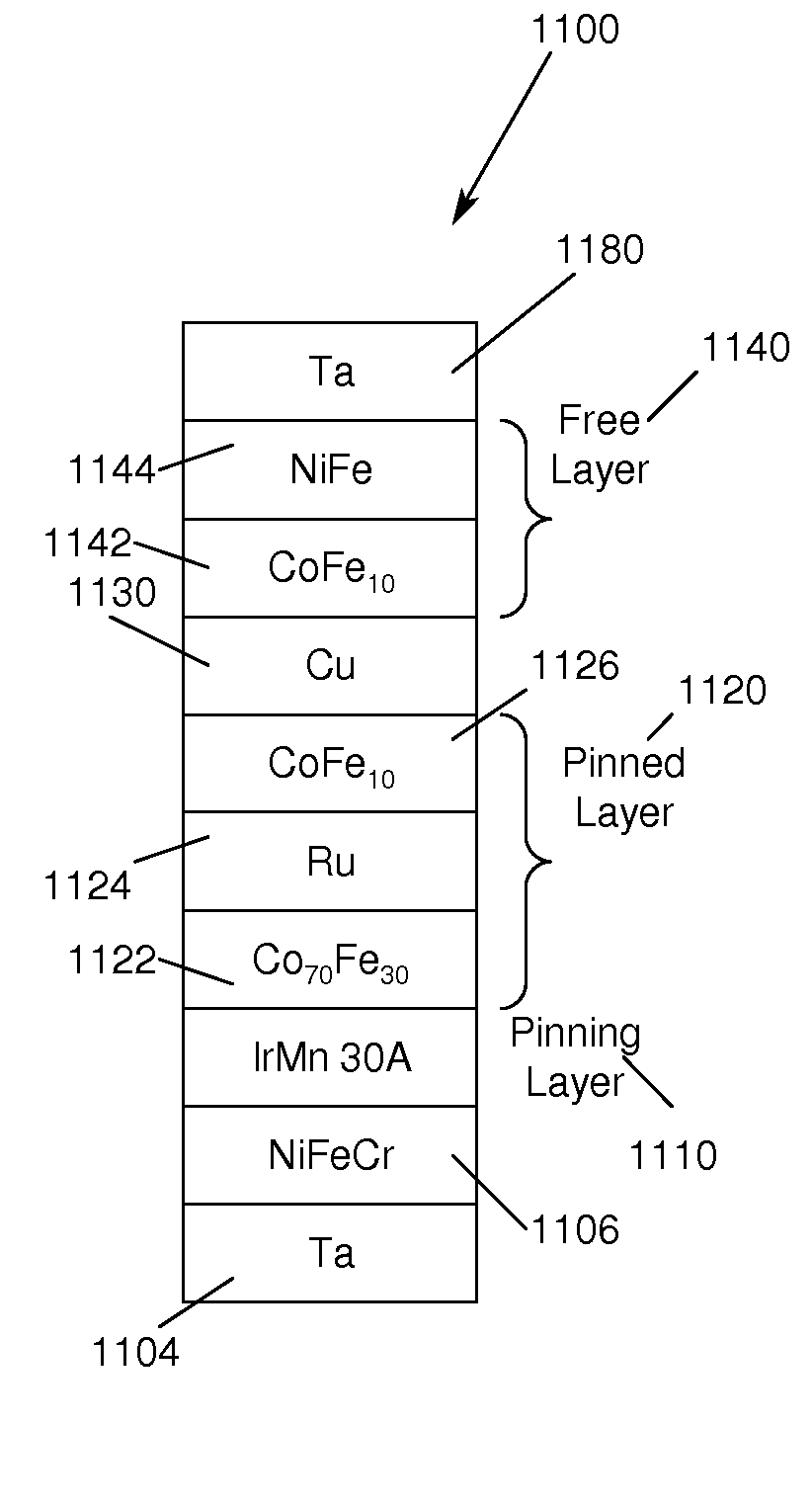
- A magnetic read sensor with a thin IrMn alloy pinning layer adjacent a composite pinned layer, where the iron percentage in the pinned layer is between 20-40% to maximize pinning, and the thickness of at least two pinned layers is equal for enhanced exchange coupling.

Material Science Advances in Magnetic Heterostructures
The development of magnetic heterostructures has undergone remarkable transformation over the past two decades, driven by the fundamental understanding of spin-dependent transport phenomena and the quest for enhanced device performance. These multilayered systems, comprising alternating magnetic and non-magnetic layers, have emerged as cornerstone materials for spintronic applications, offering unprecedented control over magnetic properties through interfacial engineering and structural design.
Recent breakthroughs in epitaxial growth techniques have enabled the fabrication of atomically precise magnetic heterostructures with tailored magnetic anisotropy and exchange coupling. Advanced molecular beam epitaxy and sputtering methods now allow for sub-nanometer thickness control, facilitating the creation of synthetic antiferromagnets and perpendicular magnetic anisotropy systems that were previously unattainable. These fabrication advances have directly impacted both ferromagnetic resonance characteristics and spin valve performance metrics.
The integration of novel materials such as topological insulators, two-dimensional van der Waals magnets, and heavy metal layers with strong spin-orbit coupling has revolutionized heterostructure design paradigms. Bismuth selenide and tungsten-based underlayers have demonstrated remarkable improvements in spin Hall efficiency, while graphene and hexagonal boron nitride interlayers provide unique spin filtering capabilities that enhance overall device functionality.
Interface engineering has emerged as a critical factor in optimizing magnetic heterostructures for specific applications. The development of buffer layers, seed layers, and capping structures has enabled precise control over magnetic dead layers, interfacial roughness, and oxidation resistance. These advances directly influence the quality factor in ferromagnetic resonance measurements and the magnetoresistance ratios achievable in spin valve configurations.
Contemporary research focuses on hybrid heterostructures that combine multiple functional materials to achieve synergistic effects. Multiferroic heterostructures incorporating ferroelectric layers enable voltage-controlled magnetic switching, while proximity-induced magnetism in initially non-magnetic materials opens new avenues for device architectures. These material science innovations continue to push the boundaries of what is achievable in magnetic heterostructure performance and functionality.
Recent breakthroughs in epitaxial growth techniques have enabled the fabrication of atomically precise magnetic heterostructures with tailored magnetic anisotropy and exchange coupling. Advanced molecular beam epitaxy and sputtering methods now allow for sub-nanometer thickness control, facilitating the creation of synthetic antiferromagnets and perpendicular magnetic anisotropy systems that were previously unattainable. These fabrication advances have directly impacted both ferromagnetic resonance characteristics and spin valve performance metrics.
The integration of novel materials such as topological insulators, two-dimensional van der Waals magnets, and heavy metal layers with strong spin-orbit coupling has revolutionized heterostructure design paradigms. Bismuth selenide and tungsten-based underlayers have demonstrated remarkable improvements in spin Hall efficiency, while graphene and hexagonal boron nitride interlayers provide unique spin filtering capabilities that enhance overall device functionality.
Interface engineering has emerged as a critical factor in optimizing magnetic heterostructures for specific applications. The development of buffer layers, seed layers, and capping structures has enabled precise control over magnetic dead layers, interfacial roughness, and oxidation resistance. These advances directly influence the quality factor in ferromagnetic resonance measurements and the magnetoresistance ratios achievable in spin valve configurations.
Contemporary research focuses on hybrid heterostructures that combine multiple functional materials to achieve synergistic effects. Multiferroic heterostructures incorporating ferroelectric layers enable voltage-controlled magnetic switching, while proximity-induced magnetism in initially non-magnetic materials opens new avenues for device architectures. These material science innovations continue to push the boundaries of what is achievable in magnetic heterostructure performance and functionality.
Energy Consumption Standards for Spintronic Applications
The establishment of comprehensive energy consumption standards for spintronic applications has become increasingly critical as the technology transitions from laboratory demonstrations to commercial implementations. Current industry benchmarks primarily focus on traditional semiconductor metrics, which inadequately address the unique operational characteristics of spintronic devices such as ferromagnetic resonance systems and spin valve configurations.
Existing energy efficiency standards for spintronic devices typically measure power consumption per bit operation, with leading specifications targeting sub-femtojoule switching energies. The IEEE 1838 standard provides preliminary guidelines for spin-based memory devices, establishing baseline measurements for static and dynamic power consumption. However, these standards lack specificity regarding the comparative efficiency metrics between different spintronic architectures, particularly when evaluating ferromagnetic resonance versus spin valve implementations.
International standardization bodies including IEC TC 113 and JEDEC JC-45 are actively developing comprehensive frameworks that address spintronic-specific parameters. These emerging standards incorporate metrics such as spin injection efficiency, magnetization switching thresholds, and thermal stability factors. The proposed standards differentiate between voltage-controlled and current-controlled spintronic devices, recognizing their distinct energy profiles and operational requirements.
Regional variations in energy consumption standards reflect different technological priorities and regulatory environments. European standards emphasize lifecycle energy assessment, incorporating manufacturing and operational phases, while Asian markets focus on peak performance efficiency metrics. North American standards prioritize scalability benchmarks, addressing energy consumption patterns across different device densities and integration levels.
The standardization process faces significant challenges due to the diverse nature of spintronic applications, ranging from high-speed cache memories to ultra-low-power IoT sensors. Proposed universal metrics include normalized energy per switching event, standby power density, and retention energy requirements. These standards must accommodate the inherent trade-offs between switching speed, energy efficiency, and data retention characteristics that define spintronic device performance across various operational scenarios.
Existing energy efficiency standards for spintronic devices typically measure power consumption per bit operation, with leading specifications targeting sub-femtojoule switching energies. The IEEE 1838 standard provides preliminary guidelines for spin-based memory devices, establishing baseline measurements for static and dynamic power consumption. However, these standards lack specificity regarding the comparative efficiency metrics between different spintronic architectures, particularly when evaluating ferromagnetic resonance versus spin valve implementations.
International standardization bodies including IEC TC 113 and JEDEC JC-45 are actively developing comprehensive frameworks that address spintronic-specific parameters. These emerging standards incorporate metrics such as spin injection efficiency, magnetization switching thresholds, and thermal stability factors. The proposed standards differentiate between voltage-controlled and current-controlled spintronic devices, recognizing their distinct energy profiles and operational requirements.
Regional variations in energy consumption standards reflect different technological priorities and regulatory environments. European standards emphasize lifecycle energy assessment, incorporating manufacturing and operational phases, while Asian markets focus on peak performance efficiency metrics. North American standards prioritize scalability benchmarks, addressing energy consumption patterns across different device densities and integration levels.
The standardization process faces significant challenges due to the diverse nature of spintronic applications, ranging from high-speed cache memories to ultra-low-power IoT sensors. Proposed universal metrics include normalized energy per switching event, standby power density, and retention energy requirements. These standards must accommodate the inherent trade-offs between switching speed, energy efficiency, and data retention characteristics that define spintronic device performance across various operational scenarios.
Unlock deeper insights with PatSnap Eureka Quick Research — get a full tech report to explore trends and direct your research. Try now!
Generate Your Research Report Instantly with AI Agent
Supercharge your innovation with PatSnap Eureka AI Agent Platform!