
High-Performance Elastomers in Soft Pneumatic Actuators
OCT 8, 20259 MIN READ
Generate Your Research Report Instantly with AI Agent
Patsnap Eureka helps you evaluate technical feasibility & market potential.
Elastomer Technology Evolution and Objectives
Elastomers have undergone significant evolution in the field of soft pneumatic actuators (SPAs) since their initial application in the 1950s. The journey began with natural rubber, which offered basic elasticity but lacked durability and precision control. The 1970s witnessed the emergence of silicone-based elastomers, marking a pivotal advancement that enhanced material performance and reliability in pneumatic systems.
The 1990s brought polyurethane elastomers into prominence, offering improved mechanical properties and chemical resistance. This period also saw the first serious academic exploration of elastomers specifically designed for soft robotics applications, though commercial development remained limited. By the early 2000s, researchers began developing composite elastomers with embedded functional materials, enabling multi-property systems that could respond to various stimuli beyond mere pneumatic pressure.
The past decade has witnessed an acceleration in elastomer innovation specifically tailored for SPAs. Developments include self-healing elastomers capable of recovering from punctures or tears, electrically conductive elastomers that enable sensing capabilities within the actuator itself, and gradient elastomers with varying stiffness profiles that allow for complex motion patterns when pneumatically actuated.
Current technological objectives in high-performance elastomers for SPAs focus on several key areas. First is the enhancement of mechanical properties, particularly the achievement of higher elongation capabilities while maintaining return force, thus enabling greater actuation range and power. Second is the improvement of response time, seeking elastomers that can rapidly deform and recover with minimal hysteresis, essential for applications requiring precise dynamic control.
Another critical objective is increasing operational longevity through enhanced fatigue resistance, as SPAs typically undergo thousands of inflation-deflation cycles. Researchers are also pursuing greater environmental adaptability, developing elastomers that maintain consistent performance across wide temperature ranges and harsh chemical environments. This is particularly important for SPAs deployed in medical, underwater, or industrial settings.
The integration of multifunctionality represents perhaps the most ambitious objective, with efforts to develop elastomers that simultaneously serve as actuators, sensors, and structural elements. This includes the incorporation of self-sensing capabilities through piezoresistive properties and the development of variable-stiffness elastomers that can adapt their mechanical properties in real-time, potentially revolutionizing the versatility and capability of soft pneumatic systems.
The 1990s brought polyurethane elastomers into prominence, offering improved mechanical properties and chemical resistance. This period also saw the first serious academic exploration of elastomers specifically designed for soft robotics applications, though commercial development remained limited. By the early 2000s, researchers began developing composite elastomers with embedded functional materials, enabling multi-property systems that could respond to various stimuli beyond mere pneumatic pressure.
The past decade has witnessed an acceleration in elastomer innovation specifically tailored for SPAs. Developments include self-healing elastomers capable of recovering from punctures or tears, electrically conductive elastomers that enable sensing capabilities within the actuator itself, and gradient elastomers with varying stiffness profiles that allow for complex motion patterns when pneumatically actuated.
Current technological objectives in high-performance elastomers for SPAs focus on several key areas. First is the enhancement of mechanical properties, particularly the achievement of higher elongation capabilities while maintaining return force, thus enabling greater actuation range and power. Second is the improvement of response time, seeking elastomers that can rapidly deform and recover with minimal hysteresis, essential for applications requiring precise dynamic control.
Another critical objective is increasing operational longevity through enhanced fatigue resistance, as SPAs typically undergo thousands of inflation-deflation cycles. Researchers are also pursuing greater environmental adaptability, developing elastomers that maintain consistent performance across wide temperature ranges and harsh chemical environments. This is particularly important for SPAs deployed in medical, underwater, or industrial settings.
The integration of multifunctionality represents perhaps the most ambitious objective, with efforts to develop elastomers that simultaneously serve as actuators, sensors, and structural elements. This includes the incorporation of self-sensing capabilities through piezoresistive properties and the development of variable-stiffness elastomers that can adapt their mechanical properties in real-time, potentially revolutionizing the versatility and capability of soft pneumatic systems.
Market Demand Analysis for Soft Pneumatic Actuators
The global market for soft pneumatic actuators is experiencing significant growth, driven by increasing demand across multiple sectors including healthcare, robotics, and industrial automation. The market size for soft robotics, which encompasses soft pneumatic actuators, was valued at approximately 645 million USD in 2020 and is projected to reach 2.1 billion USD by 2026, representing a compound annual growth rate (CAGR) of 21.5%.
Healthcare applications represent the largest market segment for soft pneumatic actuators, accounting for nearly 35% of the total market share. Within this sector, rehabilitation devices, assistive wearables, and minimally invasive surgical tools are driving adoption. The aging population in developed countries has created substantial demand for rehabilitation robots and exoskeletons that utilize soft pneumatic actuators for their inherent safety and compliance when interacting with humans.
The industrial robotics sector is rapidly adopting soft pneumatic actuator technology, particularly for collaborative robots (cobots) that work alongside human operators. This segment is growing at 25% annually, outpacing the overall market growth rate. The inherent safety features of elastomer-based pneumatic actuators make them ideal for human-robot interaction scenarios in manufacturing environments.
Consumer electronics and wearable technology represent emerging application areas with significant growth potential. The market for haptic feedback devices utilizing soft pneumatic actuators is expected to grow by 30% annually through 2025, driven by virtual reality and augmented reality applications that require realistic tactile feedback.
Geographically, North America currently leads the market with approximately 40% share, followed by Europe (30%) and Asia-Pacific (25%). However, the Asia-Pacific region is experiencing the fastest growth rate at 24% annually, primarily due to rapid industrialization in China, Japan, and South Korea, and increasing healthcare expenditure across the region.
A key market trend is the growing demand for customized soft pneumatic actuators with application-specific performance characteristics. End-users are increasingly seeking actuators with tailored force output, response time, and durability profiles, creating opportunities for specialized material solutions and manufacturing processes.
Despite positive growth indicators, market penetration faces challenges including high material costs, manufacturing complexity, and durability concerns. The average cost of high-performance elastomers suitable for pneumatic actuators remains 3-5 times higher than conventional materials, creating a significant barrier to widespread adoption in price-sensitive applications.
Healthcare applications represent the largest market segment for soft pneumatic actuators, accounting for nearly 35% of the total market share. Within this sector, rehabilitation devices, assistive wearables, and minimally invasive surgical tools are driving adoption. The aging population in developed countries has created substantial demand for rehabilitation robots and exoskeletons that utilize soft pneumatic actuators for their inherent safety and compliance when interacting with humans.
The industrial robotics sector is rapidly adopting soft pneumatic actuator technology, particularly for collaborative robots (cobots) that work alongside human operators. This segment is growing at 25% annually, outpacing the overall market growth rate. The inherent safety features of elastomer-based pneumatic actuators make them ideal for human-robot interaction scenarios in manufacturing environments.
Consumer electronics and wearable technology represent emerging application areas with significant growth potential. The market for haptic feedback devices utilizing soft pneumatic actuators is expected to grow by 30% annually through 2025, driven by virtual reality and augmented reality applications that require realistic tactile feedback.
Geographically, North America currently leads the market with approximately 40% share, followed by Europe (30%) and Asia-Pacific (25%). However, the Asia-Pacific region is experiencing the fastest growth rate at 24% annually, primarily due to rapid industrialization in China, Japan, and South Korea, and increasing healthcare expenditure across the region.
A key market trend is the growing demand for customized soft pneumatic actuators with application-specific performance characteristics. End-users are increasingly seeking actuators with tailored force output, response time, and durability profiles, creating opportunities for specialized material solutions and manufacturing processes.
Despite positive growth indicators, market penetration faces challenges including high material costs, manufacturing complexity, and durability concerns. The average cost of high-performance elastomers suitable for pneumatic actuators remains 3-5 times higher than conventional materials, creating a significant barrier to widespread adoption in price-sensitive applications.
Current Elastomer Challenges in Pneumatic Applications
Current elastomer materials used in soft pneumatic actuators face significant limitations that hinder their widespread adoption and performance optimization. Traditional elastomers such as silicone rubbers (PDMS, Ecoflex) and polyurethanes exhibit insufficient mechanical properties for demanding applications. These materials typically demonstrate a trade-off between elasticity and strength, where highly elastic materials lack durability while stronger materials sacrifice flexibility.
Material fatigue represents a critical challenge, as repeated inflation-deflation cycles lead to microstructural damage and eventual failure. Most commercially available elastomers show significant performance degradation after several thousand actuation cycles, limiting their viability in applications requiring long-term reliability. This fatigue behavior is particularly problematic in medical devices and industrial automation where consistent performance is essential.
Environmental sensitivity further complicates elastomer selection, as many materials degrade when exposed to UV radiation, ozone, chemicals, or extreme temperatures. Silicone-based elastomers, while offering good biocompatibility, often show poor resistance to hydrocarbon solvents. Polyurethanes provide better chemical resistance but may degrade under prolonged UV exposure. This environmental vulnerability restricts deployment in outdoor or harsh industrial environments.
Manufacturing inconsistencies present additional challenges, as elastomer properties can vary significantly between production batches. This variability complicates quality control and performance prediction, especially for applications requiring precise and repeatable actuation characteristics. The lack of standardized testing protocols specifically designed for soft pneumatic applications further exacerbates this issue.
Permeability issues also plague current elastomer technologies. Gas leakage through elastomer walls reduces actuation efficiency and necessitates continuous pressure maintenance. While some elastomers offer better gas barrier properties, they typically compromise on flexibility or manufacturing ease. This permeability challenge becomes particularly acute in miniaturized systems where wall thickness is limited.
The biocompatibility of elastomers remains problematic for medical and wearable applications. Many high-performance elastomers contain additives or processing aids that may leach out during use, potentially causing adverse biological reactions. Finding materials that balance mechanical performance with biological safety continues to challenge researchers and manufacturers.
Cost considerations further limit adoption, as specialized high-performance elastomers often come with prohibitive price tags. This economic barrier particularly affects scaling production from laboratory prototypes to commercial products, forcing compromises in material selection that may undermine performance or durability.
Material fatigue represents a critical challenge, as repeated inflation-deflation cycles lead to microstructural damage and eventual failure. Most commercially available elastomers show significant performance degradation after several thousand actuation cycles, limiting their viability in applications requiring long-term reliability. This fatigue behavior is particularly problematic in medical devices and industrial automation where consistent performance is essential.
Environmental sensitivity further complicates elastomer selection, as many materials degrade when exposed to UV radiation, ozone, chemicals, or extreme temperatures. Silicone-based elastomers, while offering good biocompatibility, often show poor resistance to hydrocarbon solvents. Polyurethanes provide better chemical resistance but may degrade under prolonged UV exposure. This environmental vulnerability restricts deployment in outdoor or harsh industrial environments.
Manufacturing inconsistencies present additional challenges, as elastomer properties can vary significantly between production batches. This variability complicates quality control and performance prediction, especially for applications requiring precise and repeatable actuation characteristics. The lack of standardized testing protocols specifically designed for soft pneumatic applications further exacerbates this issue.
Permeability issues also plague current elastomer technologies. Gas leakage through elastomer walls reduces actuation efficiency and necessitates continuous pressure maintenance. While some elastomers offer better gas barrier properties, they typically compromise on flexibility or manufacturing ease. This permeability challenge becomes particularly acute in miniaturized systems where wall thickness is limited.
The biocompatibility of elastomers remains problematic for medical and wearable applications. Many high-performance elastomers contain additives or processing aids that may leach out during use, potentially causing adverse biological reactions. Finding materials that balance mechanical performance with biological safety continues to challenge researchers and manufacturers.
Cost considerations further limit adoption, as specialized high-performance elastomers often come with prohibitive price tags. This economic barrier particularly affects scaling production from laboratory prototypes to commercial products, forcing compromises in material selection that may undermine performance or durability.
Current Elastomer Solutions for Soft Actuators
01 Silicone-based high-performance elastomers
Silicone elastomers offer exceptional thermal stability, weatherability, and flexibility across a wide temperature range. These materials are formulated with siloxane backbones and various functional groups to enhance properties such as tear strength and chemical resistance. Advanced silicone elastomers incorporate reinforcing fillers and cross-linking agents to achieve superior mechanical properties while maintaining their characteristic elasticity and durability in extreme environments.- Silicone-based high-performance elastomers: Silicone elastomers offer exceptional thermal stability, weatherability, and flexibility across a wide temperature range. These materials are modified with various additives to enhance specific properties such as tear strength, compression set resistance, and electrical insulation. Advanced formulations incorporate silica fillers, platinum catalysts, and specialized cross-linking agents to achieve superior performance in demanding applications like automotive components, medical devices, and electronics.
- Fluoroelastomers for extreme conditions: Fluoroelastomers represent a class of high-performance materials designed to withstand extreme chemical exposure, high temperatures, and harsh operating environments. These specialized elastomers feature carbon-fluorine bonds that provide exceptional resistance to oils, fuels, acids, and solvents. Their unique molecular structure enables them to maintain elasticity and sealing properties even when exposed to temperatures exceeding 200°C, making them ideal for aerospace, automotive, and chemical processing applications.
- Thermoplastic elastomers (TPEs) with enhanced properties: Thermoplastic elastomers combine the processing advantages of thermoplastics with the functional properties of conventional vulcanized rubber. These materials can be repeatedly melted and processed using standard thermoplastic equipment while providing rubber-like elasticity. Advanced TPE formulations incorporate specialized block copolymers, compatibilizers, and reinforcing agents to achieve improved mechanical properties, chemical resistance, and durability while maintaining recyclability and ease of processing.
- Bio-based and sustainable elastomers: Environmentally friendly elastomers derived from renewable resources represent an emerging category of high-performance materials. These formulations utilize bio-based monomers, natural oils, and sustainable reinforcing agents to create elastomers with reduced environmental impact. Advanced processing techniques and cross-linking methods enable these materials to achieve performance characteristics comparable to petroleum-based counterparts while offering improved biodegradability and reduced carbon footprint.
- Nanocomposite elastomers with enhanced mechanical properties: Incorporating nanoscale fillers into elastomer matrices creates high-performance materials with significantly improved mechanical and functional properties. These nanocomposites utilize materials such as carbon nanotubes, graphene, nanoclays, and metal oxide nanoparticles to enhance tensile strength, tear resistance, and abrasion resistance while maintaining elasticity. The nanoscale dispersion of these fillers creates unique interfacial interactions with the elastomer matrix, resulting in synergistic property improvements that cannot be achieved with conventional fillers.
02 Thermoplastic elastomers (TPEs) with enhanced properties
Thermoplastic elastomers combine the processing advantages of thermoplastics with the functional properties of vulcanized rubber. These materials can be repeatedly melted and reformed while maintaining elastomeric characteristics. Advanced TPE formulations incorporate block copolymers, specialty additives, and nanomaterials to achieve improved mechanical strength, chemical resistance, and durability. Recent innovations focus on enhancing service temperature ranges and reducing permanent deformation under load.Expand Specific Solutions03 Fluoroelastomers for extreme conditions
Fluoroelastomers represent a class of high-performance elastomeric materials designed specifically for extreme operating conditions. These materials offer exceptional resistance to high temperatures, aggressive chemicals, and petroleum-based fluids. Advanced fluoroelastomer formulations incorporate specialized curing systems and stabilizers to enhance long-term performance in aerospace, automotive, and industrial applications where conventional elastomers would rapidly degrade.Expand Specific Solutions04 Bio-based and sustainable elastomers
Environmentally sustainable elastomers derived from renewable resources represent an emerging category of high-performance materials. These elastomers incorporate bio-based monomers, natural oils, or modified natural polymers to reduce dependence on petroleum-based feedstocks. Recent innovations focus on achieving comparable or superior mechanical properties to conventional elastomers while reducing environmental impact through biodegradability or recyclability features.Expand Specific Solutions05 Nanocomposite elastomers with enhanced mechanical properties
Nanocomposite elastomers incorporate nanoscale fillers to dramatically enhance mechanical and functional properties. These advanced materials utilize nanoparticles, nanotubes, or nanoplatelets to create reinforcing networks within the elastomer matrix. The resulting materials exhibit significantly improved tensile strength, tear resistance, and abrasion resistance while maintaining essential elasticity. Recent developments focus on achieving better dispersion of nanomaterials and tailoring interfacial interactions to optimize performance for specific applications.Expand Specific Solutions
Key Industry Players and Competitive Landscape
The soft pneumatic actuator market is in a growth phase, characterized by increasing adoption across robotics, healthcare, and wearable technologies. The market size is expanding rapidly, driven by demand for flexible, lightweight automation solutions. Technologically, high-performance elastomers for these actuators are advancing through significant research contributions from academic institutions like Harvard, MIT, and Zhejiang University, alongside industrial players such as Huawei and SRI International. While academic institutions lead fundamental research in material properties and design optimization, companies like Minebea Mitsumi and Lubrizol Advanced Materials are advancing commercial applications. The technology is approaching maturity in specific applications but continues to evolve with innovations in material science, particularly in durability, response time, and energy efficiency.
President & Fellows of Harvard College
Technical Solution: Harvard's Wyss Institute has pioneered soft pneumatic actuators through their groundbreaking work on soft robotics. Their technical approach focuses on developing high-performance elastomeric materials with programmable mechanical properties that can be pneumatically actuated. They've created a platform technology using silicone-based elastomers with embedded pneumatic networks (PneuNets) that inflate like balloons when pressurized with air. Their innovation includes multi-material 3D printing techniques to fabricate complex soft actuators with integrated sensing capabilities. Harvard researchers have developed composite materials combining elastomers with fibrous reinforcements to control deformation patterns and increase force output while maintaining compliance. Their recent advancements include self-healing elastomers that can recover from damage and maintain functionality after punctures or tears, significantly improving durability and operational lifetime of soft pneumatic systems.
Strengths: Pioneer in the field with extensive intellectual property portfolio; integration of sensing capabilities with actuation; multi-material fabrication expertise. Weaknesses: Some of their advanced elastomer formulations require complex manufacturing processes that may limit scalability; higher production costs compared to conventional elastomers; potential challenges in achieving consistent mechanical properties across large production batches.
Massachusetts Institute of Technology
Technical Solution: MIT's approach to high-performance elastomers for soft pneumatic actuators centers on their proprietary hydraulically amplified self-healing electrostatic (HASEL) actuators. These combine the benefits of fluidic and electrostatic actuation, using specialized elastomer dielectrics with high permittivity and mechanical resilience. Their technical solution incorporates liquid-metal embedded elastomers that maintain conductivity during extreme deformation, enabling seamless sensing and actuation integration. MIT has developed a family of silicone-based elastomers with tailored viscoelastic properties that minimize hysteresis during cyclic pneumatic actuation, significantly improving response time and positional accuracy. Their materials engineering approach includes the incorporation of nanofillers (carbon nanotubes, graphene) into elastomer matrices to enhance mechanical properties while maintaining flexibility. Recent innovations include temperature-responsive elastomers that can adjust stiffness based on environmental conditions, providing adaptive performance in variable operating environments.
Strengths: Superior material science expertise; excellent integration of electronic and fluidic systems; advanced manufacturing capabilities for complex geometries. Weaknesses: Higher cost of specialized elastomer formulations; some solutions require sophisticated control systems that increase complexity; potential durability concerns with liquid-metal embedded systems under long-term cyclic loading.
Critical Patents in High-Performance Elastomer Technology
Apparatus, system, and method for providing fabric-elastomer composites as pneumatic actuators
PatentActiveUS20150070904A1
Innovation
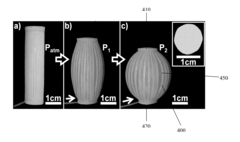
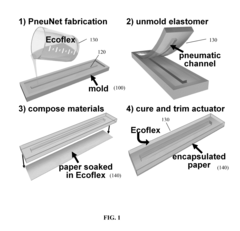
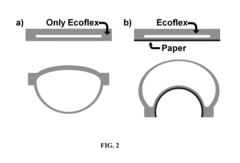
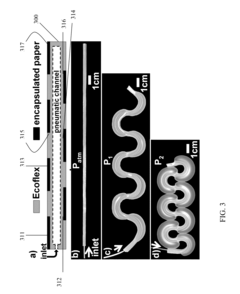
- The development of soft robotics using composite actuators made from elastomers and embedded flexible sheets, such as paper, which introduce controlled anisotropy to enable a range of motions including extension, contraction, twisting, and bending through pneumatic actuation, allowing for flexible control and practical design.
Bistable elastomeric actuator
PatentActiveUS12129876B2
Innovation
- A bistable elastomeric actuator design featuring pairs of frustums with different base angles and a soft folding hinge, integrated with silicone and polyethylene terephthalate (PET) components, allowing for fast actuation and mechanical compliance through a novel fabrication method.


Material Sustainability and Environmental Impact
The sustainability profile of elastomers used in soft pneumatic actuators represents a critical consideration in their development and deployment. Traditional elastomers, particularly those derived from petroleum sources, pose significant environmental challenges throughout their lifecycle. The production processes for silicone-based elastomers, commonly used in soft actuators, typically involve energy-intensive manufacturing and the use of potentially harmful chemical additives, resulting in substantial carbon footprints.
Recent research has focused on developing bio-based elastomers as sustainable alternatives. These materials, derived from renewable resources such as plant oils, cellulose, and other biomass sources, offer reduced environmental impact while maintaining the mechanical properties required for pneumatic actuation. For instance, natural rubber and modified starch-based elastomers have shown promising results in experimental soft actuator applications, demonstrating comparable performance to their synthetic counterparts.
End-of-life considerations present another significant environmental challenge. Conventional elastomers can persist in the environment for hundreds of years, contributing to microplastic pollution. Emerging biodegradable elastomers address this concern by incorporating chemically modified structures that facilitate breakdown under specific environmental conditions without compromising performance during operational life.
Life cycle assessment (LCA) studies of elastomers in soft pneumatic systems reveal that material selection significantly influences overall environmental impact. These assessments consider factors including raw material extraction, processing energy requirements, operational efficiency, and disposal pathways. Recent LCA data indicates that optimizing material formulation can reduce environmental impact by 30-45% compared to standard formulations, particularly when considering extended service life scenarios.
Recyclability presents both challenges and opportunities. While thermosetting elastomers traditionally used in pneumatic actuators are difficult to recycle due to their cross-linked molecular structure, innovative approaches such as dynamic covalent chemistry enable the development of recyclable elastomers with reversible cross-linking. These materials can be reprocessed multiple times without significant degradation of mechanical properties, creating potential for closed-loop material systems.
Water consumption and toxicity concerns also merit attention in elastomer production. Manufacturing processes for high-performance elastomers often require substantial water resources and may generate effluents containing residual catalysts, unreacted monomers, and processing aids. Advanced green chemistry approaches are addressing these issues through water-efficient synthesis routes and the elimination of harmful substances, particularly those classified as substances of very high concern (SVHC) under regulatory frameworks like REACH.
Recent research has focused on developing bio-based elastomers as sustainable alternatives. These materials, derived from renewable resources such as plant oils, cellulose, and other biomass sources, offer reduced environmental impact while maintaining the mechanical properties required for pneumatic actuation. For instance, natural rubber and modified starch-based elastomers have shown promising results in experimental soft actuator applications, demonstrating comparable performance to their synthetic counterparts.
End-of-life considerations present another significant environmental challenge. Conventional elastomers can persist in the environment for hundreds of years, contributing to microplastic pollution. Emerging biodegradable elastomers address this concern by incorporating chemically modified structures that facilitate breakdown under specific environmental conditions without compromising performance during operational life.
Life cycle assessment (LCA) studies of elastomers in soft pneumatic systems reveal that material selection significantly influences overall environmental impact. These assessments consider factors including raw material extraction, processing energy requirements, operational efficiency, and disposal pathways. Recent LCA data indicates that optimizing material formulation can reduce environmental impact by 30-45% compared to standard formulations, particularly when considering extended service life scenarios.
Recyclability presents both challenges and opportunities. While thermosetting elastomers traditionally used in pneumatic actuators are difficult to recycle due to their cross-linked molecular structure, innovative approaches such as dynamic covalent chemistry enable the development of recyclable elastomers with reversible cross-linking. These materials can be reprocessed multiple times without significant degradation of mechanical properties, creating potential for closed-loop material systems.
Water consumption and toxicity concerns also merit attention in elastomer production. Manufacturing processes for high-performance elastomers often require substantial water resources and may generate effluents containing residual catalysts, unreacted monomers, and processing aids. Advanced green chemistry approaches are addressing these issues through water-efficient synthesis routes and the elimination of harmful substances, particularly those classified as substances of very high concern (SVHC) under regulatory frameworks like REACH.
Manufacturing Scalability and Cost Analysis
The manufacturing scalability of high-performance elastomers for soft pneumatic actuators presents significant challenges and opportunities for industrial implementation. Current production methods primarily rely on labor-intensive processes such as molding, casting, and manual assembly, which limit throughput and increase unit costs. Small-batch production remains the norm, with typical manufacturing volumes ranging from dozens to hundreds of units per production run, substantially increasing per-unit costs compared to potential mass-production scenarios.
Cost analysis reveals that material expenses constitute approximately 30-40% of total production costs for high-performance elastomers in soft pneumatic applications. Silicone-based elastomers, while offering excellent performance characteristics, command premium prices ranging from $50-200 per kilogram depending on specific formulations and performance requirements. This represents a significant cost driver, particularly for applications requiring specialized properties such as extreme temperature resistance or biocompatibility.
Processing equipment for elastomer manufacturing requires substantial capital investment, with industrial-grade mixing, molding, and curing equipment typically costing between $50,000-500,000 depending on automation level and throughput capacity. This high initial investment creates significant barriers to entry for smaller manufacturers and startups exploring this technology space.
Recent advancements in manufacturing technologies show promising directions for improved scalability. Automated dispensing systems have demonstrated potential to reduce labor costs by 40-60% while improving consistency in elastomer mixing and application. Additionally, continuous flow production methods are emerging as alternatives to batch processing, potentially increasing throughput by 3-5 times while maintaining quality parameters.
3D printing technologies specifically adapted for elastomeric materials represent another significant advancement toward scalable manufacturing. While still evolving, these systems offer reduced tooling costs and enable complex geometries that would be challenging with traditional molding techniques. Current limitations include slower production speeds and higher material costs compared to conventional methods, though these gaps are narrowing with technological improvements.
Economic viability analysis indicates that current manufacturing approaches become cost-effective at production volumes exceeding 10,000 units annually for most soft pneumatic actuator applications. Below this threshold, custom manufacturing approaches typically result in per-unit costs 2-3 times higher than theoretical mass-production scenarios, limiting commercial adoption in price-sensitive markets.
Cost analysis reveals that material expenses constitute approximately 30-40% of total production costs for high-performance elastomers in soft pneumatic applications. Silicone-based elastomers, while offering excellent performance characteristics, command premium prices ranging from $50-200 per kilogram depending on specific formulations and performance requirements. This represents a significant cost driver, particularly for applications requiring specialized properties such as extreme temperature resistance or biocompatibility.
Processing equipment for elastomer manufacturing requires substantial capital investment, with industrial-grade mixing, molding, and curing equipment typically costing between $50,000-500,000 depending on automation level and throughput capacity. This high initial investment creates significant barriers to entry for smaller manufacturers and startups exploring this technology space.
Recent advancements in manufacturing technologies show promising directions for improved scalability. Automated dispensing systems have demonstrated potential to reduce labor costs by 40-60% while improving consistency in elastomer mixing and application. Additionally, continuous flow production methods are emerging as alternatives to batch processing, potentially increasing throughput by 3-5 times while maintaining quality parameters.
3D printing technologies specifically adapted for elastomeric materials represent another significant advancement toward scalable manufacturing. While still evolving, these systems offer reduced tooling costs and enable complex geometries that would be challenging with traditional molding techniques. Current limitations include slower production speeds and higher material costs compared to conventional methods, though these gaps are narrowing with technological improvements.
Economic viability analysis indicates that current manufacturing approaches become cost-effective at production volumes exceeding 10,000 units annually for most soft pneumatic actuator applications. Below this threshold, custom manufacturing approaches typically result in per-unit costs 2-3 times higher than theoretical mass-production scenarios, limiting commercial adoption in price-sensitive markets.
Unlock deeper insights with Patsnap Eureka Quick Research — get a full tech report to explore trends and direct your research. Try now!
Generate Your Research Report Instantly with AI Agent
Supercharge your innovation with Patsnap Eureka AI Agent Platform!