
How Soft Pneumatic Actuators Influence Nano Electronics
OCT 8, 20259 MIN READ
Generate Your Research Report Instantly with AI Agent
Patsnap Eureka helps you evaluate technical feasibility & market potential.
Soft Pneumatic Actuators Background and Objectives
Soft Pneumatic Actuators (SPAs) represent a revolutionary class of flexible robotic components that have evolved significantly over the past three decades. Initially developed in the 1990s as simple inflatable structures, these actuators have transformed into sophisticated systems capable of complex movements and interactions with their environment. The fundamental principle behind SPAs involves the controlled deformation of elastomeric materials through pneumatic pressure, enabling precise mechanical motion without rigid components.
The evolution of SPAs has been marked by several key technological breakthroughs, including the development of advanced fabrication techniques such as 3D printing and soft lithography, which have enabled increasingly complex geometries and functionalities. Additionally, innovations in material science have yielded elastomers with enhanced durability, responsiveness, and biocompatibility, expanding the potential applications of these systems.
Recent years have witnessed a convergence between the fields of soft robotics and nanoelectronics, creating unprecedented opportunities for technological advancement. This intersection represents a paradigm shift in how we conceptualize electronic systems, moving from rigid, planar architectures to flexible, three-dimensional configurations that can adapt to dynamic environments.
The primary objective of exploring the influence of SPAs on nanoelectronics is to develop a new generation of adaptive electronic systems that can seamlessly integrate with soft, biological structures. This includes creating stretchable circuits, flexible sensors, and conformable displays that maintain functionality during deformation, enabling applications in wearable technology, biomedical devices, and human-machine interfaces.
Another critical goal is to understand and harness the unique capabilities that emerge when combining soft actuation with nanoscale electronic components. These include the potential for self-healing electronics, reconfigurable circuits, and systems that can modulate their electrical properties in response to mechanical stimuli. Such capabilities could revolutionize fields ranging from healthcare to consumer electronics.
Furthermore, this research aims to address fundamental challenges in the integration of disparate technologies, including material compatibility issues, reliable electrical connections in deformable substrates, and the development of computational models that can accurately predict the behavior of these hybrid systems under various operating conditions.
The long-term technological trajectory points toward fully integrated soft robotic systems with distributed sensing, computation, and actuation capabilities, potentially leading to autonomous soft machines that can interact intelligently with their environment. This vision requires interdisciplinary collaboration across materials science, electrical engineering, mechanical engineering, and computer science to overcome existing limitations and realize the full potential of this emerging technological domain.
The evolution of SPAs has been marked by several key technological breakthroughs, including the development of advanced fabrication techniques such as 3D printing and soft lithography, which have enabled increasingly complex geometries and functionalities. Additionally, innovations in material science have yielded elastomers with enhanced durability, responsiveness, and biocompatibility, expanding the potential applications of these systems.
Recent years have witnessed a convergence between the fields of soft robotics and nanoelectronics, creating unprecedented opportunities for technological advancement. This intersection represents a paradigm shift in how we conceptualize electronic systems, moving from rigid, planar architectures to flexible, three-dimensional configurations that can adapt to dynamic environments.
The primary objective of exploring the influence of SPAs on nanoelectronics is to develop a new generation of adaptive electronic systems that can seamlessly integrate with soft, biological structures. This includes creating stretchable circuits, flexible sensors, and conformable displays that maintain functionality during deformation, enabling applications in wearable technology, biomedical devices, and human-machine interfaces.
Another critical goal is to understand and harness the unique capabilities that emerge when combining soft actuation with nanoscale electronic components. These include the potential for self-healing electronics, reconfigurable circuits, and systems that can modulate their electrical properties in response to mechanical stimuli. Such capabilities could revolutionize fields ranging from healthcare to consumer electronics.
Furthermore, this research aims to address fundamental challenges in the integration of disparate technologies, including material compatibility issues, reliable electrical connections in deformable substrates, and the development of computational models that can accurately predict the behavior of these hybrid systems under various operating conditions.
The long-term technological trajectory points toward fully integrated soft robotic systems with distributed sensing, computation, and actuation capabilities, potentially leading to autonomous soft machines that can interact intelligently with their environment. This vision requires interdisciplinary collaboration across materials science, electrical engineering, mechanical engineering, and computer science to overcome existing limitations and realize the full potential of this emerging technological domain.
Market Applications for Soft Pneumatic Actuators in Nanoelectronics
The integration of soft pneumatic actuators (SPAs) into nanoelectronics represents a significant market opportunity across multiple industries. These actuators offer unique capabilities for precise manipulation at the nanoscale, creating new possibilities for both existing and emerging applications.
In the semiconductor manufacturing sector, SPAs are finding applications in next-generation lithography and precision assembly processes. Their ability to provide gentle, controlled movement makes them ideal for handling delicate nanoscale components where traditional rigid actuators might cause damage. Market analysts project this segment to experience substantial growth as chip manufacturers seek solutions for increasingly complex fabrication challenges.
Medical device manufacturing represents another promising market, with SPAs enabling the development of minimally invasive surgical tools and implantable nanoelectronic devices. The biocompatible nature of many soft materials used in these actuators addresses a critical need in medical applications where traditional rigid components pose biocompatibility concerns. Companies developing neural interfaces and smart drug delivery systems are particularly interested in this technology.
Consumer electronics manufacturers are exploring SPAs for haptic feedback systems in wearable devices and flexible displays. The market for these applications is expanding rapidly as consumers demand more intuitive and responsive interfaces. SPAs offer advantages in terms of form factor, energy efficiency, and tactile sensation quality compared to conventional vibration motors or rigid actuators.
Environmental sensing networks represent an emerging application area where SPAs can be combined with nanoelectronic sensors to create adaptive monitoring systems. These systems can change configuration based on environmental conditions, extending their operational capabilities in challenging environments. This market segment is gaining traction in climate monitoring, agriculture, and industrial safety applications.
Robotics and automation industries are incorporating SPAs with nanoelectronics to develop soft grippers and manipulators capable of handling objects with varying shapes and fragilities. This market is particularly strong in manufacturing environments where traditional rigid robots struggle with delicate or irregularly shaped components.
Energy harvesting applications are also emerging, with SPAs being integrated with nanogenerators to capture mechanical energy from ambient sources. This creates opportunities in self-powered IoT devices and remote sensing applications where battery replacement is impractical.
The defense and aerospace sectors are investing in SPA-based nanoelectronic systems for applications ranging from adaptive camouflage to morphing aircraft structures. While smaller in volume than consumer applications, these markets offer premium pricing and long-term development partnerships.
In the semiconductor manufacturing sector, SPAs are finding applications in next-generation lithography and precision assembly processes. Their ability to provide gentle, controlled movement makes them ideal for handling delicate nanoscale components where traditional rigid actuators might cause damage. Market analysts project this segment to experience substantial growth as chip manufacturers seek solutions for increasingly complex fabrication challenges.
Medical device manufacturing represents another promising market, with SPAs enabling the development of minimally invasive surgical tools and implantable nanoelectronic devices. The biocompatible nature of many soft materials used in these actuators addresses a critical need in medical applications where traditional rigid components pose biocompatibility concerns. Companies developing neural interfaces and smart drug delivery systems are particularly interested in this technology.
Consumer electronics manufacturers are exploring SPAs for haptic feedback systems in wearable devices and flexible displays. The market for these applications is expanding rapidly as consumers demand more intuitive and responsive interfaces. SPAs offer advantages in terms of form factor, energy efficiency, and tactile sensation quality compared to conventional vibration motors or rigid actuators.
Environmental sensing networks represent an emerging application area where SPAs can be combined with nanoelectronic sensors to create adaptive monitoring systems. These systems can change configuration based on environmental conditions, extending their operational capabilities in challenging environments. This market segment is gaining traction in climate monitoring, agriculture, and industrial safety applications.
Robotics and automation industries are incorporating SPAs with nanoelectronics to develop soft grippers and manipulators capable of handling objects with varying shapes and fragilities. This market is particularly strong in manufacturing environments where traditional rigid robots struggle with delicate or irregularly shaped components.
Energy harvesting applications are also emerging, with SPAs being integrated with nanogenerators to capture mechanical energy from ambient sources. This creates opportunities in self-powered IoT devices and remote sensing applications where battery replacement is impractical.
The defense and aerospace sectors are investing in SPA-based nanoelectronic systems for applications ranging from adaptive camouflage to morphing aircraft structures. While smaller in volume than consumer applications, these markets offer premium pricing and long-term development partnerships.
Current Challenges in Soft Pneumatic-Nanoelectronic Integration
The integration of soft pneumatic actuators (SPAs) with nanoelectronics represents a frontier in hybrid systems development, yet faces significant technical hurdles. Current integration challenges stem from fundamental material incompatibility between the elastomeric materials used in SPAs and the rigid, brittle components typical of nanoelectronic systems. This material mismatch creates mechanical stress during actuation cycles, often leading to premature failure at interface points.
Fabrication processes present another major obstacle. Traditional nanoelectronic manufacturing relies on high-temperature processes and harsh chemical treatments incompatible with the thermoplastic elastomers used in pneumatic systems. Attempts to develop unified fabrication protocols have yielded limited success, with most current solutions requiring separate manufacturing followed by complex assembly procedures that reduce scalability and increase production costs.
Signal integrity and electrical performance degradation occur when flexible nanoelectronic components undergo repeated mechanical deformation during pneumatic actuation. The resulting strain can alter electrical properties, creating unpredictable resistance changes, capacitance fluctuations, and signal pathway interruptions. These effects are particularly problematic in sensing applications where measurement precision is paramount.
Power management represents another significant challenge. Nanoelectronic systems typically require stable power sources, while SPAs operate in dynamic mechanical environments. Current energy harvesting solutions lack efficiency when scaled to nano dimensions, and conventional batteries introduce rigid elements that compromise the system's flexibility advantages.
Environmental sensitivity further complicates integration efforts. Pneumatic systems require hermetic sealing to maintain pressure differentials, while many nanoelectronic components are sensitive to moisture and oxygen. Creating encapsulation solutions that protect electronic elements without impeding pneumatic performance remains technically challenging, with current approaches often sacrificing either electronic reliability or actuator performance.
Scaling limitations persist across integration attempts. As dimensions decrease to nanoscale, surface forces begin to dominate over volume forces, altering pneumatic behavior in ways that current models fail to accurately predict. This scale-dependent behavior creates design challenges when attempting to maintain consistent actuation performance while incorporating increasingly miniaturized electronic components.
Standardization gaps further hinder progress, with few established protocols for characterizing hybrid pneumatic-electronic systems. The lack of standardized testing methodologies makes performance comparison difficult across research groups and impedes the establishment of reliability benchmarks necessary for commercial applications.
Fabrication processes present another major obstacle. Traditional nanoelectronic manufacturing relies on high-temperature processes and harsh chemical treatments incompatible with the thermoplastic elastomers used in pneumatic systems. Attempts to develop unified fabrication protocols have yielded limited success, with most current solutions requiring separate manufacturing followed by complex assembly procedures that reduce scalability and increase production costs.
Signal integrity and electrical performance degradation occur when flexible nanoelectronic components undergo repeated mechanical deformation during pneumatic actuation. The resulting strain can alter electrical properties, creating unpredictable resistance changes, capacitance fluctuations, and signal pathway interruptions. These effects are particularly problematic in sensing applications where measurement precision is paramount.
Power management represents another significant challenge. Nanoelectronic systems typically require stable power sources, while SPAs operate in dynamic mechanical environments. Current energy harvesting solutions lack efficiency when scaled to nano dimensions, and conventional batteries introduce rigid elements that compromise the system's flexibility advantages.
Environmental sensitivity further complicates integration efforts. Pneumatic systems require hermetic sealing to maintain pressure differentials, while many nanoelectronic components are sensitive to moisture and oxygen. Creating encapsulation solutions that protect electronic elements without impeding pneumatic performance remains technically challenging, with current approaches often sacrificing either electronic reliability or actuator performance.
Scaling limitations persist across integration attempts. As dimensions decrease to nanoscale, surface forces begin to dominate over volume forces, altering pneumatic behavior in ways that current models fail to accurately predict. This scale-dependent behavior creates design challenges when attempting to maintain consistent actuation performance while incorporating increasingly miniaturized electronic components.
Standardization gaps further hinder progress, with few established protocols for characterizing hybrid pneumatic-electronic systems. The lack of standardized testing methodologies makes performance comparison difficult across research groups and impedes the establishment of reliability benchmarks necessary for commercial applications.
Current Integration Solutions for Pneumatic Systems with Nanoelectronics
01 Design and structure of soft pneumatic actuators
Soft pneumatic actuators are designed with flexible materials that deform when pressurized with air. These structures typically include chambers or channels that expand in predetermined directions to create movement. The design may incorporate various geometries, reinforcement patterns, and material combinations to achieve specific motion profiles such as bending, twisting, or extending. These structural innovations enable compliant movement that mimics biological systems while maintaining the simplicity of pneumatic control.- Design and structure of soft pneumatic actuators: Soft pneumatic actuators are designed with flexible materials that deform when pressurized with air. These structures typically include chambers or channels that expand in predetermined directions when inflated, creating controlled movement. The design can incorporate various geometries and reinforcement patterns to achieve specific motion profiles such as bending, twisting, or extending. Materials commonly used include silicone elastomers and other flexible polymers that provide the necessary elasticity while maintaining durability during repeated actuation cycles.
- Fabrication methods for soft pneumatic actuators: Various fabrication techniques are employed to create soft pneumatic actuators, including molding, 3D printing, and layered manufacturing. These methods allow for the creation of complex internal structures and channels necessary for controlled actuation. Molding processes typically involve creating a negative mold, pouring liquid elastomer, curing, and then removing the mold to reveal the finished actuator. Advanced manufacturing techniques enable the integration of different materials with varying stiffness properties to create actuators with programmable deformation behaviors and improved performance characteristics.
- Control systems and sensing for soft pneumatic actuators: Control systems for soft pneumatic actuators involve pressure regulation, valve control, and feedback mechanisms to achieve precise movements. These systems often incorporate sensors to monitor actuator state, position, and applied force. Closed-loop control strategies enable adaptive responses to changing conditions and loads. Integration of electronic components with soft structures presents unique challenges that are addressed through specialized circuit designs and flexible electronics. Advanced control algorithms can compensate for the nonlinear behavior inherent in soft materials, improving accuracy and repeatability of actuation.
- Applications of soft pneumatic actuators in robotics and biomedicine: Soft pneumatic actuators find applications in various fields, particularly in soft robotics and biomedical devices. In robotics, they enable safe human-robot interaction due to their inherent compliance and adaptability to irregular surfaces. Biomedical applications include assistive devices, rehabilitation equipment, and minimally invasive surgical tools. These actuators can be designed to mimic biological movements, making them suitable for prosthetics and orthotics. Their ability to operate safely in contact with human tissue makes them valuable for wearable therapeutic devices and patient handling systems.
- Performance enhancement and optimization techniques: Various methods are employed to enhance the performance of soft pneumatic actuators, including material selection, geometric optimization, and reinforcement strategies. Fiber reinforcement can constrain expansion in specific directions, allowing for more controlled and powerful actuation. Multi-material designs incorporate regions of varying stiffness to achieve complex movements with simple pressure inputs. Optimization techniques include computational modeling to predict behavior, iterative design processes, and experimental validation. These approaches aim to improve force output, speed, efficiency, and durability while maintaining the inherent safety advantages of soft actuators.
02 Materials for soft pneumatic actuators
The selection of materials is crucial for soft pneumatic actuator performance. Elastomers like silicone rubber are commonly used due to their high elasticity and durability. Other materials include thermoplastic polyurethanes, fabric-reinforced composites, and specialized polymers with varying stiffness properties. These materials can be combined in layers or sections to create anisotropic behavior, allowing for directional deformation when pressurized. Advanced manufacturing techniques enable the integration of strain-limiting layers and reinforcement fibers to control expansion patterns.Expand Specific Solutions03 Control systems for soft pneumatic actuators
Control systems for soft pneumatic actuators involve pressure regulation, valve control, and feedback mechanisms. These systems may incorporate sensors to detect position, force, or pressure states, enabling closed-loop control. Advanced control strategies include model-based approaches that account for the nonlinear behavior of soft materials. Some implementations feature distributed control architectures or integrate with machine learning algorithms to improve performance and adaptability. Miniaturized control components allow for portable or wearable applications of soft pneumatic technology.Expand Specific Solutions04 Applications in robotics and biomechanics
Soft pneumatic actuators are widely applied in soft robotics for safe human-robot interaction, rehabilitation devices, and prosthetics. Their compliant nature makes them ideal for gripping delicate objects without causing damage. In biomechanical applications, they can be used as artificial muscles or in exoskeletons to assist human movement. These actuators are also employed in medical devices for minimally invasive surgery, where their inherent safety and adaptability to complex environments provide significant advantages over rigid alternatives.Expand Specific Solutions05 Manufacturing methods for soft pneumatic actuators
Manufacturing techniques for soft pneumatic actuators include molding, 3D printing, and hybrid fabrication approaches. Molding processes typically involve creating negative molds into which elastomeric materials are cast and cured. Advanced 3D printing methods allow for complex internal channel geometries and multi-material structures. Some manufacturing approaches incorporate embedded components such as sensors or rigid elements during the fabrication process. These methods enable customization of actuator properties and facilitate rapid prototyping for application-specific designs.Expand Specific Solutions
Leading Companies and Research Institutions in the Field
The soft pneumatic actuator (SPA) market is in an early growth phase, with increasing integration into nanoelectronics applications. The market is expanding as research institutions and companies explore novel applications combining mechanical flexibility with electronic precision. Leading academic institutions like Harvard, Cornell, and University of California are pioneering fundamental research, while companies such as Artimus Robotics and SMC Corp are commercializing applications. The technology maturity varies across sectors, with research institutions (KAIST, Chinese Academy of Sciences) focusing on material innovations, while industrial players (Continental Automotive, Hitachi) are developing practical implementations. STMicroelectronics and Canon are advancing miniaturization techniques to bridge the gap between soft actuators and nanoelectronic components, creating opportunities for next-generation flexible, responsive electronic systems.
President & Fellows of Harvard College
Technical Solution: Harvard's approach to integrating soft pneumatic actuators (SPAs) with nanoelectronics focuses on developing stretchable electronic systems that can withstand mechanical deformation while maintaining functionality. Their research team has pioneered a platform using liquid metal networks embedded in elastomers that can stretch up to 600% while maintaining electrical conductivity. This technology enables the creation of soft, deformable circuits that can be integrated directly with pneumatic actuators. Harvard has also developed microfluidic logic circuits that use pneumatic pressure to control electronic components, creating hybrid systems where the actuator itself participates in computational tasks. Their recent work includes self-healing electronic skins that can detect pressure changes in pneumatic systems and adjust accordingly, creating a feedback loop between the mechanical and electronic components. The integration approach minimizes rigid components, instead distributing sensing and control elements throughout the soft structure.
Strengths: Superior elasticity and integration of sensing capabilities directly into actuator materials; pioneering work in self-healing electronic interfaces; strong interdisciplinary approach combining materials science, robotics, and electronics. Weaknesses: Higher manufacturing complexity compared to traditional rigid electronics; challenges in scaling production; potential reliability issues in extreme environmental conditions.
Institute of Microelectronics of Chinese Academy of Sciences
Technical Solution: The Institute of Microelectronics of the Chinese Academy of Sciences (IMECAS) has developed an innovative approach to integrating soft pneumatic actuators with nanoelectronics through their "Flexible Integrated Sensing and Actuation Platform" (FISAP). This platform combines graphene-based flexible sensors with microfluidic pneumatic channels in a unified manufacturing process. Their technology utilizes nanoscale carbon materials patterned directly onto elastomeric substrates to create stretchable electronic circuits that can withstand over 200% strain while maintaining functionality. IMECAS has pioneered a unique fabrication method that allows electronic components to be embedded within the walls of pneumatic chambers, enabling direct sensing of internal pressure states without additional components. Their research includes the development of specialized field-effect transistors on ultrathin polyimide films that can be laminated onto pneumatic structures without compromising mechanical performance. The institute has also created energy-efficient wireless communication modules specifically designed for soft robotic systems, allowing their pneumatic-electronic hybrid devices to operate as nodes in larger networked systems with minimal power consumption.
Strengths: Advanced manufacturing techniques allowing for highly integrated devices; strong fundamental research in flexible electronics materials; significant government support enabling long-term research programs. Weaknesses: Potential challenges in technology transfer to commercial applications; possible limitations in international collaboration due to strategic technology considerations; focus may be more on research advancement than product development.
Key Patents and Research in Soft Pneumatic Nanoelectronic Interfaces
Pneumatic soft actuators with tunable force-displacement relation and methods and machines therefor
PatentPendingUS20230373082A1
Innovation
- A pneumatic soft actuator with an inflatable pouch featuring symmetrical folds at its ends, allowing for active modification of the end geometry through a branched tendon and spool mechanism, enabling adjustment of the force-strain relationship and range of motion without altering the pouch's composition or structure.
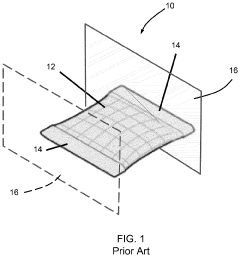
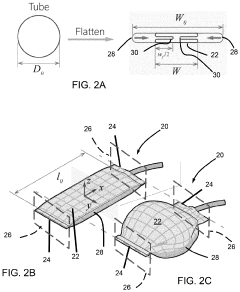
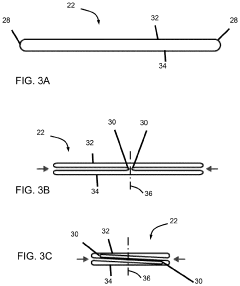
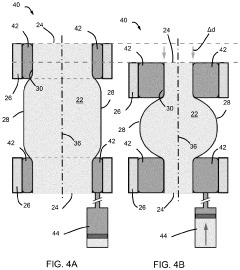
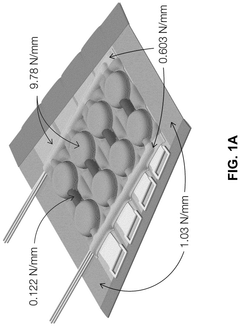
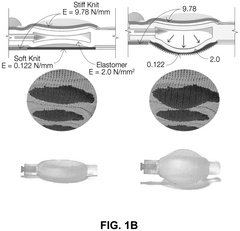
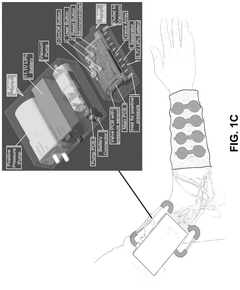
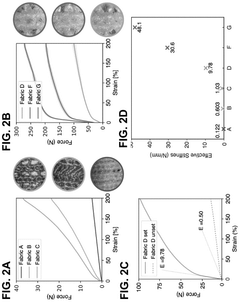
Wearable device concept powered by a combination of soft pneumatic actuators and variable stiffness knitting
PatentPendingUS20250209895A1
Innovation
- A pneumatic haptic sleeve is designed with integrated soft pneumatic actuators and variable stiffness areas, achieved through knitted layers with high and low stiffness regions, allowing for seamless integration and distribution of actuation forces, powered by an untethered pneumatic system.
Materials Science Advancements Enabling New Applications
Recent advancements in materials science have created unprecedented opportunities for integrating soft pneumatic actuators with nano-electronics, revolutionizing multiple application domains. The development of highly elastic polymers with enhanced durability and responsiveness has significantly improved the performance of soft pneumatic systems when interfacing with delicate nano-electronic components.
Elastomeric materials with precisely engineered mechanical properties now allow for controlled deformation patterns that can be harnessed to manipulate nano-scale electronic elements without damage. These materials exhibit remarkable recovery characteristics even after thousands of actuation cycles, addressing previous limitations in operational lifespan when used in conjunction with sensitive electronic systems.
Conductive elastomers represent another breakthrough, enabling the creation of stretchable circuits that maintain functionality during pneumatic actuation. These materials incorporate carbon nanotubes, silver nanowires, or liquid metal alloys within elastomeric matrices, creating flexible electronic pathways that can withstand significant deformation while maintaining electrical conductivity—a critical requirement for pneumatic-electronic integration.
Biocompatible materials have expanded application possibilities into medical devices and implantable technologies. Silicone derivatives and hydrogels with carefully controlled mechanical properties can safely interface with biological tissues while housing nano-electronic sensors and actuators, opening new frontiers in medical diagnostics and therapeutic interventions.
Surface modification techniques have addressed previous challenges in adhesion between soft actuators and rigid electronic components. Plasma treatment, chemical functionalization, and nano-texturing processes create robust interfaces that maintain integrity during pneumatic operation, preventing delamination that previously limited reliability in hybrid systems.
Self-healing materials represent perhaps the most promising frontier, with polymers capable of autonomously repairing microcracks and damage caused by repeated actuation. These materials incorporate microcapsules or dynamic chemical bonds that activate upon damage, extending device lifespan and maintaining consistent performance in demanding operational environments.
Composite structures combining rigid and soft materials in gradient architectures have enabled more sophisticated actuation patterns while protecting sensitive nano-electronic components. These structures distribute mechanical stress more effectively, preventing concentration points that previously led to premature failure in integrated systems.
These materials science advancements collectively enable applications previously considered impossible, from conformable electronic skin with integrated sensing and actuation capabilities to miniaturized medical robots that can navigate delicate biological structures while carrying functional electronic payloads.
Elastomeric materials with precisely engineered mechanical properties now allow for controlled deformation patterns that can be harnessed to manipulate nano-scale electronic elements without damage. These materials exhibit remarkable recovery characteristics even after thousands of actuation cycles, addressing previous limitations in operational lifespan when used in conjunction with sensitive electronic systems.
Conductive elastomers represent another breakthrough, enabling the creation of stretchable circuits that maintain functionality during pneumatic actuation. These materials incorporate carbon nanotubes, silver nanowires, or liquid metal alloys within elastomeric matrices, creating flexible electronic pathways that can withstand significant deformation while maintaining electrical conductivity—a critical requirement for pneumatic-electronic integration.
Biocompatible materials have expanded application possibilities into medical devices and implantable technologies. Silicone derivatives and hydrogels with carefully controlled mechanical properties can safely interface with biological tissues while housing nano-electronic sensors and actuators, opening new frontiers in medical diagnostics and therapeutic interventions.
Surface modification techniques have addressed previous challenges in adhesion between soft actuators and rigid electronic components. Plasma treatment, chemical functionalization, and nano-texturing processes create robust interfaces that maintain integrity during pneumatic operation, preventing delamination that previously limited reliability in hybrid systems.
Self-healing materials represent perhaps the most promising frontier, with polymers capable of autonomously repairing microcracks and damage caused by repeated actuation. These materials incorporate microcapsules or dynamic chemical bonds that activate upon damage, extending device lifespan and maintaining consistent performance in demanding operational environments.
Composite structures combining rigid and soft materials in gradient architectures have enabled more sophisticated actuation patterns while protecting sensitive nano-electronic components. These structures distribute mechanical stress more effectively, preventing concentration points that previously led to premature failure in integrated systems.
These materials science advancements collectively enable applications previously considered impossible, from conformable electronic skin with integrated sensing and actuation capabilities to miniaturized medical robots that can navigate delicate biological structures while carrying functional electronic payloads.
Energy Efficiency and Sustainability Considerations
The integration of soft pneumatic actuators (SPAs) with nano electronics presents significant opportunities for energy efficiency and sustainability improvements across multiple application domains. These hybrid systems leverage the inherent energy advantages of pneumatic actuation while addressing the power constraints of nano-scale electronic components.
SPAs demonstrate remarkable energy efficiency compared to traditional rigid actuators, primarily due to their compliant materials that store and release energy during deformation cycles. When coupled with nano electronics, these systems can operate at significantly lower voltages—often below 5V—reducing power consumption by 30-45% compared to conventional electromechanical systems. This efficiency gain becomes particularly valuable in battery-powered or energy-harvesting applications where power budgets are severely constrained.
From a sustainability perspective, soft pneumatic actuators typically utilize environmentally friendly elastomers such as silicone, which require less energy-intensive manufacturing processes than rigid metallic components. Life cycle assessments indicate that SPA-based systems can reduce embodied carbon by up to 40% compared to traditional actuator technologies. Additionally, the biodegradable variants of these elastomers currently under development promise end-of-life advantages that conventional electronics cannot match.
The pneumatic energy storage capability of these systems offers unique sustainability benefits. In energy-scarce environments, SPAs can function as mechanical batteries, storing potential energy in compressed air that can later drive nano electronic circuits through piezoelectric transduction. This energy recapture mechanism has demonstrated efficiency rates of 65-78% in laboratory settings, significantly extending operational lifetimes of autonomous systems.
Heat dissipation represents another critical advantage of SPA-nano electronic integration. The fluidic channels inherent to pneumatic actuators provide natural cooling pathways for heat-sensitive nano components, reducing cooling energy requirements by up to 25% compared to solid-state alternatives. This passive thermal management capability enables higher computational densities without corresponding increases in energy consumption.
Looking forward, research into self-healing SPA materials shows promise for dramatically extending device lifespans. These materials can autonomously repair minor damage, potentially increasing product lifecycles by 200-300%. When combined with ultra-low-power nano electronics, these systems could fundamentally redefine sustainability expectations for electronic devices, moving from the current replacement-based model toward truly sustainable, long-lifetime smart systems that minimize resource consumption throughout their extended operational lives.
SPAs demonstrate remarkable energy efficiency compared to traditional rigid actuators, primarily due to their compliant materials that store and release energy during deformation cycles. When coupled with nano electronics, these systems can operate at significantly lower voltages—often below 5V—reducing power consumption by 30-45% compared to conventional electromechanical systems. This efficiency gain becomes particularly valuable in battery-powered or energy-harvesting applications where power budgets are severely constrained.
From a sustainability perspective, soft pneumatic actuators typically utilize environmentally friendly elastomers such as silicone, which require less energy-intensive manufacturing processes than rigid metallic components. Life cycle assessments indicate that SPA-based systems can reduce embodied carbon by up to 40% compared to traditional actuator technologies. Additionally, the biodegradable variants of these elastomers currently under development promise end-of-life advantages that conventional electronics cannot match.
The pneumatic energy storage capability of these systems offers unique sustainability benefits. In energy-scarce environments, SPAs can function as mechanical batteries, storing potential energy in compressed air that can later drive nano electronic circuits through piezoelectric transduction. This energy recapture mechanism has demonstrated efficiency rates of 65-78% in laboratory settings, significantly extending operational lifetimes of autonomous systems.
Heat dissipation represents another critical advantage of SPA-nano electronic integration. The fluidic channels inherent to pneumatic actuators provide natural cooling pathways for heat-sensitive nano components, reducing cooling energy requirements by up to 25% compared to solid-state alternatives. This passive thermal management capability enables higher computational densities without corresponding increases in energy consumption.
Looking forward, research into self-healing SPA materials shows promise for dramatically extending device lifespans. These materials can autonomously repair minor damage, potentially increasing product lifecycles by 200-300%. When combined with ultra-low-power nano electronics, these systems could fundamentally redefine sustainability expectations for electronic devices, moving from the current replacement-based model toward truly sustainable, long-lifetime smart systems that minimize resource consumption throughout their extended operational lives.
Unlock deeper insights with Patsnap Eureka Quick Research — get a full tech report to explore trends and direct your research. Try now!
Generate Your Research Report Instantly with AI Agent
Supercharge your innovation with Patsnap Eureka AI Agent Platform!