

How Elemental Sulfur Influences Electric Efficiency
MAR 31, 20269 MIN READ
Generate Your Research Report Instantly with AI Agent
Patsnap Eureka helps you evaluate technical feasibility & market potential.
Sulfur Battery Technology Background and Efficiency Goals
Sulfur-based battery technology represents a paradigm shift in energy storage systems, emerging from decades of research into alternative electrochemical couples that could surpass the limitations of conventional lithium-ion batteries. The fundamental appeal of sulfur lies in its exceptional theoretical capacity of 1,675 mAh/g, which is nearly five times higher than traditional cathode materials like lithium cobalt oxide. This remarkable energy density potential, combined with sulfur's natural abundance and low cost, has positioned sulfur batteries as a critical technology for next-generation energy storage applications.
The historical development of sulfur battery technology traces back to the 1960s when researchers first explored lithium-sulfur electrochemical systems. However, significant technical challenges, particularly the polysulfide shuttle effect and poor electrical conductivity of sulfur, hindered practical implementation for decades. The resurgence of interest in the 2000s coincided with advances in nanotechnology and materials science, enabling novel approaches to address these fundamental limitations.
Contemporary sulfur battery research encompasses multiple technological pathways, including lithium-sulfur, sodium-sulfur, and emerging solid-state sulfur systems. Each approach presents unique advantages and challenges in terms of operating conditions, safety requirements, and performance characteristics. The diversity of sulfur battery architectures reflects the complexity of optimizing elemental sulfur's electrochemical behavior while maintaining practical device requirements.
The primary efficiency goals driving current sulfur battery development focus on achieving stable cycling performance with minimal capacity fade over extended operational periods. Target specifications typically include maintaining 80% capacity retention after 500-1000 charge-discharge cycles, while achieving energy densities exceeding 400 Wh/kg at the cell level. Additionally, improving coulombic efficiency to above 99.5% remains crucial for commercial viability.
Temperature stability represents another critical efficiency objective, as sulfur batteries must operate reliably across wide temperature ranges without significant performance degradation. This requirement is particularly important for automotive and grid storage applications where environmental conditions vary substantially. Furthermore, achieving fast charging capabilities while maintaining safety standards continues to challenge researchers, as rapid ion transport must be balanced against thermal management and structural integrity considerations.
The historical development of sulfur battery technology traces back to the 1960s when researchers first explored lithium-sulfur electrochemical systems. However, significant technical challenges, particularly the polysulfide shuttle effect and poor electrical conductivity of sulfur, hindered practical implementation for decades. The resurgence of interest in the 2000s coincided with advances in nanotechnology and materials science, enabling novel approaches to address these fundamental limitations.
Contemporary sulfur battery research encompasses multiple technological pathways, including lithium-sulfur, sodium-sulfur, and emerging solid-state sulfur systems. Each approach presents unique advantages and challenges in terms of operating conditions, safety requirements, and performance characteristics. The diversity of sulfur battery architectures reflects the complexity of optimizing elemental sulfur's electrochemical behavior while maintaining practical device requirements.
The primary efficiency goals driving current sulfur battery development focus on achieving stable cycling performance with minimal capacity fade over extended operational periods. Target specifications typically include maintaining 80% capacity retention after 500-1000 charge-discharge cycles, while achieving energy densities exceeding 400 Wh/kg at the cell level. Additionally, improving coulombic efficiency to above 99.5% remains crucial for commercial viability.
Temperature stability represents another critical efficiency objective, as sulfur batteries must operate reliably across wide temperature ranges without significant performance degradation. This requirement is particularly important for automotive and grid storage applications where environmental conditions vary substantially. Furthermore, achieving fast charging capabilities while maintaining safety standards continues to challenge researchers, as rapid ion transport must be balanced against thermal management and structural integrity considerations.
Market Demand for High-Efficiency Sulfur-Based Energy Storage
The global energy storage market is experiencing unprecedented growth driven by the urgent need for grid stabilization, renewable energy integration, and sustainable power solutions. Traditional lithium-ion battery technologies face significant challenges including resource scarcity, high costs, and environmental concerns, creating substantial market opportunities for alternative energy storage technologies. Sulfur-based energy storage systems have emerged as a promising solution due to sulfur's abundance, low cost, and high theoretical energy density.
The renewable energy sector represents the largest demand driver for high-efficiency sulfur-based energy storage solutions. Wind and solar power installations require robust energy storage systems to manage intermittency and ensure grid stability. Sulfur-based batteries offer compelling advantages in this application due to their potential for large-scale deployment at competitive costs. The technology's ability to store energy for extended periods makes it particularly attractive for utility-scale renewable energy projects.
Electric vehicle manufacturers and automotive suppliers constitute another significant market segment seeking sulfur-based energy storage solutions. The automotive industry's transition toward electrification demands batteries with higher energy density, longer cycle life, and reduced material costs. Sulfur-based battery technologies, particularly lithium-sulfur systems, offer theoretical energy densities significantly higher than conventional lithium-ion batteries, addressing range anxiety concerns while potentially reducing vehicle costs.
Grid-scale energy storage applications represent a rapidly expanding market opportunity for sulfur-based technologies. Utilities require cost-effective, long-duration energy storage systems to support grid modernization initiatives and accommodate increasing renewable energy penetration. Sulfur-based systems can provide the necessary scale and economic viability for these applications, particularly in regions with abundant sulfur resources.
Industrial and commercial energy users are increasingly seeking energy storage solutions to reduce peak demand charges, improve power quality, and enhance energy security. Sulfur-based energy storage systems offer potential advantages in terms of operational costs and maintenance requirements compared to existing technologies. The technology's scalability makes it suitable for diverse industrial applications ranging from manufacturing facilities to data centers.
Emerging markets in developing countries present substantial growth opportunities for sulfur-based energy storage technologies. These regions often lack established electrical infrastructure and face challenges with grid reliability. Cost-effective sulfur-based energy storage systems could enable distributed energy solutions and support rural electrification initiatives, particularly when combined with renewable energy generation.
The market demand is further amplified by increasing regulatory support for clean energy technologies and carbon reduction initiatives. Government policies promoting energy storage deployment and renewable energy adoption create favorable market conditions for innovative sulfur-based solutions that can demonstrate superior performance and cost-effectiveness.
The renewable energy sector represents the largest demand driver for high-efficiency sulfur-based energy storage solutions. Wind and solar power installations require robust energy storage systems to manage intermittency and ensure grid stability. Sulfur-based batteries offer compelling advantages in this application due to their potential for large-scale deployment at competitive costs. The technology's ability to store energy for extended periods makes it particularly attractive for utility-scale renewable energy projects.
Electric vehicle manufacturers and automotive suppliers constitute another significant market segment seeking sulfur-based energy storage solutions. The automotive industry's transition toward electrification demands batteries with higher energy density, longer cycle life, and reduced material costs. Sulfur-based battery technologies, particularly lithium-sulfur systems, offer theoretical energy densities significantly higher than conventional lithium-ion batteries, addressing range anxiety concerns while potentially reducing vehicle costs.
Grid-scale energy storage applications represent a rapidly expanding market opportunity for sulfur-based technologies. Utilities require cost-effective, long-duration energy storage systems to support grid modernization initiatives and accommodate increasing renewable energy penetration. Sulfur-based systems can provide the necessary scale and economic viability for these applications, particularly in regions with abundant sulfur resources.
Industrial and commercial energy users are increasingly seeking energy storage solutions to reduce peak demand charges, improve power quality, and enhance energy security. Sulfur-based energy storage systems offer potential advantages in terms of operational costs and maintenance requirements compared to existing technologies. The technology's scalability makes it suitable for diverse industrial applications ranging from manufacturing facilities to data centers.
Emerging markets in developing countries present substantial growth opportunities for sulfur-based energy storage technologies. These regions often lack established electrical infrastructure and face challenges with grid reliability. Cost-effective sulfur-based energy storage systems could enable distributed energy solutions and support rural electrification initiatives, particularly when combined with renewable energy generation.
The market demand is further amplified by increasing regulatory support for clean energy technologies and carbon reduction initiatives. Government policies promoting energy storage deployment and renewable energy adoption create favorable market conditions for innovative sulfur-based solutions that can demonstrate superior performance and cost-effectiveness.
Current State and Challenges of Elemental Sulfur in Batteries
Elemental sulfur has emerged as a promising cathode material for next-generation battery systems, particularly in lithium-sulfur batteries, due to its high theoretical specific capacity of 1675 mAh/g and energy density of 2600 Wh/kg. However, the current state of sulfur-based battery technology faces significant technical barriers that limit its commercial viability and electric efficiency performance.
The primary challenge stems from sulfur's inherent insulating properties, with electrical conductivity as low as 5×10^-30 S/cm at room temperature. This poor conductivity severely restricts electron transport within the cathode, leading to incomplete sulfur utilization and reduced overall battery efficiency. Current implementations typically achieve only 60-70% of sulfur's theoretical capacity under practical operating conditions.
Polysulfide dissolution represents another critical obstacle affecting electric efficiency. During discharge cycles, intermediate lithium polysulfides (Li2Sx, 4≤x≤8) dissolve into the electrolyte, causing active material loss and creating the notorious "shuttle effect." This phenomenon results in capacity fade rates of 0.5-2% per cycle and significantly impacts long-term efficiency stability.
The volumetric expansion issue further compounds efficiency challenges. Sulfur undergoes approximately 80% volume change during lithiation, causing mechanical stress, electrode degradation, and loss of electrical contact between active materials and current collectors. This expansion-contraction cycle disrupts the electrode's structural integrity and reduces charge transfer efficiency over time.
Current mitigation strategies include sulfur-carbon composites, conductive polymer coatings, and advanced electrolyte formulations. While these approaches have improved performance metrics, achieving consistent electric efficiency above 85% remains elusive. The heterogeneous nature of sulfur conversion reactions and non-uniform current distribution across electrode surfaces continue to limit overall system efficiency.
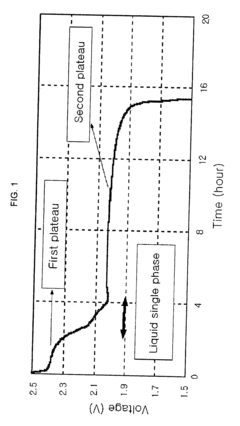
Temperature sensitivity also affects sulfur's electrochemical behavior, with efficiency dropping significantly below 0°C due to reduced ionic conductivity and sluggish reaction kinetics. Additionally, the multi-step conversion mechanism from S8 to Li2S involves complex intermediate phases, creating efficiency bottlenecks at different voltage plateaus and limiting the technology's practical energy output compared to theoretical predictions.
The primary challenge stems from sulfur's inherent insulating properties, with electrical conductivity as low as 5×10^-30 S/cm at room temperature. This poor conductivity severely restricts electron transport within the cathode, leading to incomplete sulfur utilization and reduced overall battery efficiency. Current implementations typically achieve only 60-70% of sulfur's theoretical capacity under practical operating conditions.
Polysulfide dissolution represents another critical obstacle affecting electric efficiency. During discharge cycles, intermediate lithium polysulfides (Li2Sx, 4≤x≤8) dissolve into the electrolyte, causing active material loss and creating the notorious "shuttle effect." This phenomenon results in capacity fade rates of 0.5-2% per cycle and significantly impacts long-term efficiency stability.
The volumetric expansion issue further compounds efficiency challenges. Sulfur undergoes approximately 80% volume change during lithiation, causing mechanical stress, electrode degradation, and loss of electrical contact between active materials and current collectors. This expansion-contraction cycle disrupts the electrode's structural integrity and reduces charge transfer efficiency over time.
Current mitigation strategies include sulfur-carbon composites, conductive polymer coatings, and advanced electrolyte formulations. While these approaches have improved performance metrics, achieving consistent electric efficiency above 85% remains elusive. The heterogeneous nature of sulfur conversion reactions and non-uniform current distribution across electrode surfaces continue to limit overall system efficiency.
Temperature sensitivity also affects sulfur's electrochemical behavior, with efficiency dropping significantly below 0°C due to reduced ionic conductivity and sluggish reaction kinetics. Additionally, the multi-step conversion mechanism from S8 to Li2S involves complex intermediate phases, creating efficiency bottlenecks at different voltage plateaus and limiting the technology's practical energy output compared to theoretical predictions.
Existing Solutions for Enhancing Sulfur Electric Efficiency
01 Electrochemical conversion of sulfur in battery systems
Technologies focused on improving the electrical efficiency of elemental sulfur through electrochemical conversion processes in battery applications, particularly lithium-sulfur batteries. These methods enhance the utilization of sulfur as an active cathode material by optimizing electron transfer mechanisms and reducing polarization losses during charge-discharge cycles.- Electrochemical conversion processes for elemental sulfur: Technologies focused on electrochemical methods for converting elemental sulfur or sulfur-containing compounds through electrical processes. These methods involve the use of electrochemical cells and reactors to achieve efficient conversion with improved electrical efficiency. The processes may include oxidation or reduction reactions of sulfur species in various electrolyte systems to optimize energy consumption and product yield.
- Sulfur-based battery and energy storage systems: Development of energy storage devices utilizing elemental sulfur as an active material in batteries, particularly lithium-sulfur and sodium-sulfur battery systems. These technologies aim to enhance electrical efficiency through improved electrode designs, electrolyte formulations, and charge-discharge mechanisms. The focus is on maximizing energy density while maintaining high coulombic efficiency and cycle stability.
- Catalytic processes for sulfur conversion with enhanced efficiency: Catalytic systems and methods designed to improve the electrical and energy efficiency of sulfur conversion processes. These include the use of specific catalysts and reactor configurations to facilitate sulfur reactions at lower energy inputs. The technologies encompass both homogeneous and heterogeneous catalytic systems that optimize reaction kinetics and reduce electrical power requirements.
- Sulfur recovery and purification with electrical methods: Electrical and electrochemical techniques for recovering and purifying elemental sulfur from various sources including industrial waste streams and natural gas processing. These methods employ electrical energy to enhance separation efficiency, improve product purity, and reduce overall process energy consumption. The technologies may involve electrostatic separation, electrochemical precipitation, or electrically-assisted filtration processes.
- Sulfur combustion and oxidation systems with efficiency optimization: Systems and processes for the controlled combustion or oxidation of elemental sulfur with emphasis on electrical efficiency and energy recovery. These technologies include furnace designs, burner configurations, and process control methods that maximize thermal-to-electrical conversion efficiency. The approaches may incorporate waste heat recovery systems and optimized air-fuel ratios to improve overall system efficiency.
02 Sulfur recovery processes with enhanced energy efficiency
Industrial processes for recovering elemental sulfur from gas streams with improved electrical and thermal efficiency. These technologies optimize the conversion of hydrogen sulfide and other sulfur compounds into elemental sulfur while minimizing energy consumption through advanced reactor designs and catalytic systems.Expand Specific Solutions03 Conductive additives and composites for sulfur electrodes
Development of conductive materials and composite structures that improve the electrical conductivity of sulfur-based electrodes. These innovations address the inherently poor electrical conductivity of elemental sulfur by incorporating carbon materials, conductive polymers, or metal compounds to enhance electron transport and overall electrochemical performance.Expand Specific Solutions04 Electrolytic sulfur production methods
Electrochemical methods for producing elemental sulfur through electrolysis processes with optimized current efficiency and energy consumption. These techniques involve the electrochemical oxidation or reduction of sulfur-containing compounds in aqueous or molten salt systems to generate high-purity elemental sulfur.Expand Specific Solutions05 Sulfur utilization in energy storage with efficiency optimization
Advanced energy storage systems utilizing elemental sulfur with focus on maximizing coulombic efficiency and cycle life. These technologies incorporate novel cell architectures, electrolyte formulations, and electrode designs to improve the reversibility of sulfur redox reactions and minimize capacity fade during repeated cycling.Expand Specific Solutions
Key Players in Sulfur Battery and Energy Storage Industry
The elemental sulfur's influence on electric efficiency represents a rapidly evolving technological landscape primarily driven by next-generation battery development, particularly lithium-sulfur systems. The industry is in an early-to-mid development stage with significant growth potential, as sulfur-based batteries promise up to five times higher energy density than conventional lithium-ion technologies. Market leaders like Samsung SDI, LG Energy Solution, and Panasonic are advancing commercial applications, while specialized companies such as Sion Power are pioneering breakthrough Licerion® technology achieving 500 Wh/kg energy density. Research institutions including Rice University and Jilin University are contributing fundamental breakthroughs in sulfur chemistry optimization. Technology maturity varies significantly across applications, with established players like Bosch and Siemens integrating sulfur-enhanced systems into industrial solutions, while emerging companies focus on overcoming technical challenges like sulfur dissolution and cycle stability for widespread commercial deployment.
Samsung SDI Co., Ltd.
Technical Solution: Samsung SDI has developed advanced lithium-sulfur battery technology that addresses the polysulfide shuttle effect through innovative cathode design and electrolyte optimization. Their approach involves using carbon-sulfur composite cathodes with enhanced conductivity and implementing specialized separators to minimize sulfur dissolution. The company has achieved significant improvements in cycle life and energy density by controlling elemental sulfur distribution within the electrode matrix, resulting in enhanced electric efficiency through reduced internal resistance and improved charge transfer kinetics.
Strengths: Strong R&D capabilities and manufacturing scale, proven track record in battery technology. Weaknesses: High production costs and challenges in commercial scalability of sulfur-based systems.
Robert Bosch GmbH
Technical Solution: Robert Bosch has investigated sulfur-based materials for automotive battery applications, particularly focusing on how elemental sulfur can enhance electric efficiency in energy storage systems. Their research encompasses sulfur-doped electrode materials and hybrid battery chemistries that leverage sulfur's high theoretical capacity. The company has developed advanced battery management systems that optimize the electrochemical utilization of sulfur compounds, leading to improved overall system efficiency through better thermal management and charge control algorithms specifically designed for sulfur-enhanced battery technologies.
Strengths: Strong automotive industry expertise and advanced battery management systems. Weaknesses: Limited focus on pure sulfur battery technologies and primarily automotive-centric applications.
Core Innovations in Sulfur Electrode Design and Chemistry
Positive active material of a lithium-sulfur battery and method of fabricating same
PatentInactiveUS20040058246A1
Innovation
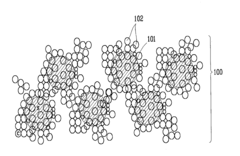
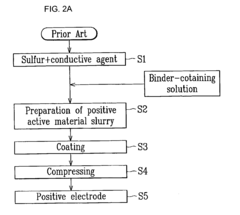
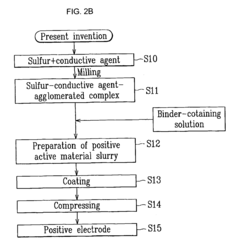
- A sulfur-conductive agent-agglomerated complex is created by attaching conductive agent particles onto sulfur particles with an average size of less than 7 μm, preventing aggregation and enhancing the reactive surface area, achieved through a milling process without adding solvents, and using a binder to maintain the conductive network structure.
Polymer-sulfur composite materials for electrodes in li-s energy storage devices
PatentWO2013066448A2
Innovation
- A sulfurized polymer composite is developed with cross-linked chains that chemically confine sulfur and polysulfides, enhancing conductivity and stability, and incorporating conductive carbon materials like graphene to improve electrode performance.


Environmental Impact Assessment of Sulfur Battery Systems
The environmental implications of sulfur battery systems present a complex landscape of both opportunities and challenges that must be carefully evaluated across their entire lifecycle. Unlike conventional lithium-ion batteries that rely on scarce and environmentally problematic materials, sulfur-based energy storage systems offer a fundamentally different environmental profile due to sulfur's abundance and relatively benign nature as a raw material.
Manufacturing phase environmental considerations reveal significant advantages for sulfur battery systems. The production process generates substantially lower carbon emissions compared to traditional battery technologies, primarily due to the elimination of energy-intensive lithium extraction and cobalt mining operations. Sulfur, being a byproduct of petroleum refining and natural gas processing, requires minimal additional extraction activities, thereby reducing the overall environmental footprint of battery production.
Operational environmental benefits emerge through enhanced energy efficiency characteristics that directly correlate with reduced environmental impact. Higher energy density and improved charge-discharge efficiency in sulfur systems translate to decreased energy consumption during operation, resulting in lower indirect emissions from power generation. The absence of toxic heavy metals in sulfur cathodes eliminates the risk of hazardous material leakage during normal operation, addressing a critical environmental concern associated with conventional battery chemistries.
End-of-life environmental management presents unique advantages for sulfur battery systems. The recyclability of sulfur components is significantly superior to that of lithium-ion batteries, with sulfur being recoverable through relatively simple chemical processes that do not require high-temperature treatment or complex separation techniques. This enhanced recyclability reduces the burden on waste management systems and minimizes the environmental impact of battery disposal.
However, certain environmental challenges require careful consideration. The production of lithium polysulfide intermediates during battery operation can potentially lead to sulfur compound emissions if not properly contained. Additionally, the manufacturing of specialized electrolytes and separator materials for sulfur batteries may introduce environmental considerations that differ from those of conventional systems.
Lifecycle assessment studies indicate that sulfur battery systems demonstrate superior environmental performance across most impact categories, including global warming potential, acidification potential, and resource depletion. The overall environmental benefit becomes more pronounced when considering the extended operational lifespan and improved efficiency characteristics that reduce the frequency of battery replacement and associated manufacturing impacts.
Manufacturing phase environmental considerations reveal significant advantages for sulfur battery systems. The production process generates substantially lower carbon emissions compared to traditional battery technologies, primarily due to the elimination of energy-intensive lithium extraction and cobalt mining operations. Sulfur, being a byproduct of petroleum refining and natural gas processing, requires minimal additional extraction activities, thereby reducing the overall environmental footprint of battery production.
Operational environmental benefits emerge through enhanced energy efficiency characteristics that directly correlate with reduced environmental impact. Higher energy density and improved charge-discharge efficiency in sulfur systems translate to decreased energy consumption during operation, resulting in lower indirect emissions from power generation. The absence of toxic heavy metals in sulfur cathodes eliminates the risk of hazardous material leakage during normal operation, addressing a critical environmental concern associated with conventional battery chemistries.
End-of-life environmental management presents unique advantages for sulfur battery systems. The recyclability of sulfur components is significantly superior to that of lithium-ion batteries, with sulfur being recoverable through relatively simple chemical processes that do not require high-temperature treatment or complex separation techniques. This enhanced recyclability reduces the burden on waste management systems and minimizes the environmental impact of battery disposal.
However, certain environmental challenges require careful consideration. The production of lithium polysulfide intermediates during battery operation can potentially lead to sulfur compound emissions if not properly contained. Additionally, the manufacturing of specialized electrolytes and separator materials for sulfur batteries may introduce environmental considerations that differ from those of conventional systems.
Lifecycle assessment studies indicate that sulfur battery systems demonstrate superior environmental performance across most impact categories, including global warming potential, acidification potential, and resource depletion. The overall environmental benefit becomes more pronounced when considering the extended operational lifespan and improved efficiency characteristics that reduce the frequency of battery replacement and associated manufacturing impacts.
Safety Standards and Protocols for Sulfur-Based Devices
The development of comprehensive safety standards for sulfur-based electrical devices has become increasingly critical as these technologies gain prominence in energy storage and power management applications. Current regulatory frameworks primarily draw from established battery safety protocols, adapting them to address the unique characteristics of elemental sulfur's electrochemical behavior and potential hazards.
International safety standards organizations, including IEC and UL, have begun establishing specific guidelines for sulfur-containing energy devices. These standards address fundamental safety concerns such as thermal runaway prevention, gas emission control, and structural integrity under various operating conditions. The protocols emphasize the importance of monitoring sulfur's phase transitions and their impact on device performance and safety margins.
Temperature management protocols represent a cornerstone of sulfur device safety standards. Given sulfur's multiple allotropic forms and phase transition temperatures, safety protocols mandate strict thermal monitoring systems with redundant temperature sensors and automated shutdown mechanisms. These systems must account for sulfur's expansion characteristics during heating cycles and potential pressure buildup in sealed systems.
Ventilation and containment protocols specifically address the risk of hydrogen sulfide generation, which can occur under certain electrochemical conditions. Safety standards require active ventilation systems in installations exceeding specified capacity thresholds, along with gas detection systems capable of identifying sulfur compounds at concentrations well below hazardous levels. Emergency response procedures must include specific protocols for sulfur compound exposure.
Material compatibility standards have been established to prevent corrosion and degradation issues common in sulfur-based systems. These protocols specify approved materials for housing, connectors, and internal components, with particular attention to sulfur's corrosive potential in the presence of moisture. Regular inspection schedules and material degradation monitoring are mandated for commercial installations.
Testing and certification procedures for sulfur-based devices incorporate specialized protocols including accelerated aging tests under sulfur-specific stress conditions, thermal cycling tests that account for sulfur's unique phase behavior, and long-term stability assessments. These procedures ensure devices maintain safety performance throughout their operational lifecycle while accounting for sulfur's influence on electrical efficiency and system reliability.
International safety standards organizations, including IEC and UL, have begun establishing specific guidelines for sulfur-containing energy devices. These standards address fundamental safety concerns such as thermal runaway prevention, gas emission control, and structural integrity under various operating conditions. The protocols emphasize the importance of monitoring sulfur's phase transitions and their impact on device performance and safety margins.
Temperature management protocols represent a cornerstone of sulfur device safety standards. Given sulfur's multiple allotropic forms and phase transition temperatures, safety protocols mandate strict thermal monitoring systems with redundant temperature sensors and automated shutdown mechanisms. These systems must account for sulfur's expansion characteristics during heating cycles and potential pressure buildup in sealed systems.
Ventilation and containment protocols specifically address the risk of hydrogen sulfide generation, which can occur under certain electrochemical conditions. Safety standards require active ventilation systems in installations exceeding specified capacity thresholds, along with gas detection systems capable of identifying sulfur compounds at concentrations well below hazardous levels. Emergency response procedures must include specific protocols for sulfur compound exposure.
Material compatibility standards have been established to prevent corrosion and degradation issues common in sulfur-based systems. These protocols specify approved materials for housing, connectors, and internal components, with particular attention to sulfur's corrosive potential in the presence of moisture. Regular inspection schedules and material degradation monitoring are mandated for commercial installations.
Testing and certification procedures for sulfur-based devices incorporate specialized protocols including accelerated aging tests under sulfur-specific stress conditions, thermal cycling tests that account for sulfur's unique phase behavior, and long-term stability assessments. These procedures ensure devices maintain safety performance throughout their operational lifecycle while accounting for sulfur's influence on electrical efficiency and system reliability.
Unlock deeper insights with Patsnap Eureka Quick Research — get a full tech report to explore trends and direct your research. Try now!
Generate Your Research Report Instantly with AI Agent
Supercharge your innovation with Patsnap Eureka AI Agent Platform!