How Optimize Sulfur Usage in High-Capacity Devices
MAR 31, 20269 MIN READ
Generate Your Research Report Instantly with AI Agent
PatSnap Eureka helps you evaluate technical feasibility & market potential.
Sulfur Battery Technology Background and Optimization Goals
Sulfur-based battery technology has emerged as one of the most promising next-generation energy storage solutions, driven by sulfur's exceptional theoretical capacity of 1,675 mAh/g and abundant natural availability. The lithium-sulfur (Li-S) battery system represents a paradigm shift from conventional lithium-ion technologies, offering theoretical energy densities exceeding 2,600 Wh/kg, which is nearly five times higher than current commercial lithium-ion batteries.
The evolution of sulfur battery technology began in the 1960s with early research into sulfur cathodes, but significant breakthroughs only emerged in the past two decades as material science and nanotechnology advanced. The technology has progressed through several developmental phases, from basic sulfur-carbon composites to sophisticated nanostructured architectures and advanced electrolyte systems.
Current high-capacity device applications demand energy storage solutions that can deliver both exceptional energy density and reliable performance across extended operational cycles. The integration of sulfur-based systems into these applications faces unique challenges related to sulfur utilization efficiency, which directly impacts the practical energy density and economic viability of the technology.
The primary optimization goals center on maximizing active sulfur utilization while maintaining structural integrity throughout charge-discharge cycles. Effective sulfur utilization in high-capacity devices requires addressing the polysulfide shuttle effect, which causes active material loss and capacity degradation. Advanced cathode architectures, including hierarchical porous structures and conductive frameworks, aim to confine sulfur species and enhance electron transport pathways.
Electrolyte optimization represents another critical objective, focusing on developing formulations that suppress polysulfide dissolution while maintaining high ionic conductivity. Solid-state and gel polymer electrolytes are being explored as alternatives to conventional liquid electrolytes to improve sulfur retention and cycling stability.
The ultimate technological targets include achieving over 80% sulfur utilization in practical devices, extending cycle life beyond 1,000 cycles with minimal capacity fade, and maintaining performance stability across wide temperature ranges. These goals require coordinated advances in materials engineering, cell design, and manufacturing processes to unlock sulfur's full potential in next-generation high-capacity energy storage applications.
The evolution of sulfur battery technology began in the 1960s with early research into sulfur cathodes, but significant breakthroughs only emerged in the past two decades as material science and nanotechnology advanced. The technology has progressed through several developmental phases, from basic sulfur-carbon composites to sophisticated nanostructured architectures and advanced electrolyte systems.
Current high-capacity device applications demand energy storage solutions that can deliver both exceptional energy density and reliable performance across extended operational cycles. The integration of sulfur-based systems into these applications faces unique challenges related to sulfur utilization efficiency, which directly impacts the practical energy density and economic viability of the technology.
The primary optimization goals center on maximizing active sulfur utilization while maintaining structural integrity throughout charge-discharge cycles. Effective sulfur utilization in high-capacity devices requires addressing the polysulfide shuttle effect, which causes active material loss and capacity degradation. Advanced cathode architectures, including hierarchical porous structures and conductive frameworks, aim to confine sulfur species and enhance electron transport pathways.
Electrolyte optimization represents another critical objective, focusing on developing formulations that suppress polysulfide dissolution while maintaining high ionic conductivity. Solid-state and gel polymer electrolytes are being explored as alternatives to conventional liquid electrolytes to improve sulfur retention and cycling stability.
The ultimate technological targets include achieving over 80% sulfur utilization in practical devices, extending cycle life beyond 1,000 cycles with minimal capacity fade, and maintaining performance stability across wide temperature ranges. These goals require coordinated advances in materials engineering, cell design, and manufacturing processes to unlock sulfur's full potential in next-generation high-capacity energy storage applications.
Market Demand for High-Capacity Sulfur-Based Energy Storage
The global energy storage market is experiencing unprecedented growth driven by the urgent need for renewable energy integration and grid stabilization solutions. Sulfur-based energy storage systems, particularly lithium-sulfur batteries, have emerged as a promising technology to address the limitations of conventional lithium-ion batteries in high-capacity applications. The theoretical energy density of lithium-sulfur batteries reaches 2600 Wh/kg, significantly exceeding current commercial battery technologies, making them highly attractive for applications requiring substantial energy storage capacity.
Electric vehicle manufacturers represent a primary market segment driving demand for high-capacity sulfur-based energy storage. The automotive industry's transition toward electrification has created substantial pressure to develop batteries with extended range capabilities while maintaining cost-effectiveness. Sulfur's abundance and low cost compared to traditional cathode materials like cobalt and nickel present compelling economic advantages for large-scale deployment in electric vehicles.
Grid-scale energy storage applications constitute another significant market driver for sulfur-based technologies. Utility companies and renewable energy developers require cost-effective, high-capacity storage solutions to manage intermittent renewable energy sources and provide grid stability services. The scalability potential of sulfur-based systems aligns well with the massive storage capacities needed for grid applications, where weight constraints are less critical than in mobile applications.
Aerospace and defense sectors demonstrate growing interest in high-capacity sulfur-based energy storage due to weight-sensitive applications requiring long-duration power supply. Unmanned aerial vehicles, satellites, and portable military equipment benefit from the high energy density potential of optimized sulfur-based systems, despite current technical challenges.
Consumer electronics markets, particularly for high-end devices and emerging applications like augmented reality and electric aircraft, are beginning to explore sulfur-based energy storage as performance requirements exceed current battery capabilities. The demand for longer-lasting, lighter batteries in these applications creates market opportunities for advanced sulfur utilization technologies.
Regional market dynamics show strong development momentum in Asia-Pacific, North America, and Europe, with government policies supporting advanced battery research and manufacturing capabilities. Investment in sulfur-based energy storage research has intensified as industries recognize the potential for breakthrough performance improvements through optimized sulfur utilization in high-capacity devices.
Electric vehicle manufacturers represent a primary market segment driving demand for high-capacity sulfur-based energy storage. The automotive industry's transition toward electrification has created substantial pressure to develop batteries with extended range capabilities while maintaining cost-effectiveness. Sulfur's abundance and low cost compared to traditional cathode materials like cobalt and nickel present compelling economic advantages for large-scale deployment in electric vehicles.
Grid-scale energy storage applications constitute another significant market driver for sulfur-based technologies. Utility companies and renewable energy developers require cost-effective, high-capacity storage solutions to manage intermittent renewable energy sources and provide grid stability services. The scalability potential of sulfur-based systems aligns well with the massive storage capacities needed for grid applications, where weight constraints are less critical than in mobile applications.
Aerospace and defense sectors demonstrate growing interest in high-capacity sulfur-based energy storage due to weight-sensitive applications requiring long-duration power supply. Unmanned aerial vehicles, satellites, and portable military equipment benefit from the high energy density potential of optimized sulfur-based systems, despite current technical challenges.
Consumer electronics markets, particularly for high-end devices and emerging applications like augmented reality and electric aircraft, are beginning to explore sulfur-based energy storage as performance requirements exceed current battery capabilities. The demand for longer-lasting, lighter batteries in these applications creates market opportunities for advanced sulfur utilization technologies.
Regional market dynamics show strong development momentum in Asia-Pacific, North America, and Europe, with government policies supporting advanced battery research and manufacturing capabilities. Investment in sulfur-based energy storage research has intensified as industries recognize the potential for breakthrough performance improvements through optimized sulfur utilization in high-capacity devices.
Current Sulfur Utilization Challenges in Battery Systems
Sulfur utilization in high-capacity battery systems faces significant technical barriers that limit commercial viability and performance optimization. The primary challenge stems from sulfur's inherent insulating properties, with electrical conductivity approximately 10^-30 S/cm at room temperature, creating substantial resistance to electron transport within the electrode matrix. This fundamental limitation necessitates complex conductive additive networks that often compromise energy density.
The polysulfide shuttle effect represents the most critical operational challenge in lithium-sulfur battery systems. During discharge cycles, intermediate lithium polysulfides (Li2Sx, where 4≤x≤8) dissolve into the electrolyte and migrate between electrodes, causing active material loss and self-discharge phenomena. This parasitic reaction reduces coulombic efficiency to typically 85-95% and severely impacts cycle life, with capacity retention often dropping below 80% after 200 cycles.
Volume expansion during lithium-sulfur reactions presents another significant constraint. The conversion from sulfur to Li2S involves approximately 80% volumetric change, generating mechanical stress that degrades electrode integrity and separator stability. This expansion-contraction cycling leads to particle pulverization, loss of electrical contact, and progressive capacity fade over extended operation periods.
Electrolyte compatibility issues further complicate sulfur utilization optimization. Conventional carbonate-based electrolytes demonstrate poor compatibility with sulfur chemistry, while ether-based alternatives, though more suitable, exhibit limited electrochemical stability windows and higher volatility. The selection of appropriate electrolyte systems requires careful balance between polysulfide solubility suppression and ionic conductivity maintenance.
Temperature sensitivity significantly affects sulfur utilization efficiency in practical applications. Low-temperature operation below 0°C dramatically reduces sulfur conversion kinetics, while elevated temperatures above 60°C accelerate polysulfide dissolution and electrolyte decomposition. This narrow operational temperature window constrains deployment in diverse environmental conditions and limits system design flexibility.
Manufacturing scalability presents additional challenges for high-capacity sulfur-based devices. Current laboratory-scale preparation methods, including melt-diffusion and chemical precipitation techniques, face difficulties in maintaining uniform sulfur distribution and consistent electrochemical performance when scaled to industrial production volumes. Quality control and reproducibility remain significant hurdles for commercial implementation.
The polysulfide shuttle effect represents the most critical operational challenge in lithium-sulfur battery systems. During discharge cycles, intermediate lithium polysulfides (Li2Sx, where 4≤x≤8) dissolve into the electrolyte and migrate between electrodes, causing active material loss and self-discharge phenomena. This parasitic reaction reduces coulombic efficiency to typically 85-95% and severely impacts cycle life, with capacity retention often dropping below 80% after 200 cycles.
Volume expansion during lithium-sulfur reactions presents another significant constraint. The conversion from sulfur to Li2S involves approximately 80% volumetric change, generating mechanical stress that degrades electrode integrity and separator stability. This expansion-contraction cycling leads to particle pulverization, loss of electrical contact, and progressive capacity fade over extended operation periods.
Electrolyte compatibility issues further complicate sulfur utilization optimization. Conventional carbonate-based electrolytes demonstrate poor compatibility with sulfur chemistry, while ether-based alternatives, though more suitable, exhibit limited electrochemical stability windows and higher volatility. The selection of appropriate electrolyte systems requires careful balance between polysulfide solubility suppression and ionic conductivity maintenance.
Temperature sensitivity significantly affects sulfur utilization efficiency in practical applications. Low-temperature operation below 0°C dramatically reduces sulfur conversion kinetics, while elevated temperatures above 60°C accelerate polysulfide dissolution and electrolyte decomposition. This narrow operational temperature window constrains deployment in diverse environmental conditions and limits system design flexibility.
Manufacturing scalability presents additional challenges for high-capacity sulfur-based devices. Current laboratory-scale preparation methods, including melt-diffusion and chemical precipitation techniques, face difficulties in maintaining uniform sulfur distribution and consistent electrochemical performance when scaled to industrial production volumes. Quality control and reproducibility remain significant hurdles for commercial implementation.
Existing Solutions for Sulfur Utilization Enhancement
01 Sulfur application methods and dosage optimization in agriculture
Optimization of sulfur usage involves controlling application rates, timing, and methods to maximize crop yield and soil health. Techniques include precision application systems, controlled-release formulations, and soil testing to determine optimal sulfur levels. These methods help reduce waste while ensuring adequate sulfur availability for plant nutrition and growth.- Sulfur application methods and dosage optimization in agriculture: Optimization of sulfur usage involves controlling application rates, timing, and methods to maximize crop yield and soil health. Techniques include precision application systems, controlled-release formulations, and integration with other nutrients to enhance sulfur efficiency while minimizing waste and environmental impact.
- Sulfur recovery and recycling processes: Methods for optimizing sulfur usage through recovery from industrial processes, including petroleum refining, natural gas processing, and chemical manufacturing. These processes involve capturing sulfur compounds from waste streams and converting them into reusable forms, thereby reducing raw material consumption and improving overall process efficiency.
- Sulfur-based formulations for enhanced performance: Development of optimized sulfur-containing compositions with improved properties for various applications. This includes modified sulfur formulations with enhanced stability, reactivity, or dispersion characteristics achieved through particle size control, surface treatment, or combination with synergistic additives to maximize effectiveness while reducing required quantities.
- Catalytic processes for sulfur utilization efficiency: Optimization of sulfur usage through catalytic systems that improve conversion efficiency and selectivity in chemical reactions. These technologies enable lower sulfur consumption, reduced byproduct formation, and enhanced product yields through the use of specialized catalysts and optimized reaction conditions.
- Monitoring and control systems for sulfur management: Implementation of advanced monitoring, sensing, and control technologies to optimize sulfur usage in real-time. These systems utilize sensors, analytical methods, and automated control algorithms to precisely manage sulfur levels, detect inefficiencies, and adjust processes dynamically to minimize waste and maximize utilization across various industrial applications.
02 Sulfur recovery and recycling in industrial processes
Industrial sulfur optimization focuses on recovering and recycling sulfur from waste streams and byproducts. Technologies include sulfur recovery units, Claus processes, and tail gas treatment systems that capture sulfur compounds from refinery operations and chemical manufacturing. These approaches minimize environmental impact while improving resource efficiency and reducing raw material costs.Expand Specific Solutions03 Sulfur-based fertilizer formulations and compositions
Development of enhanced sulfur fertilizer formulations that improve nutrient delivery and uptake efficiency. These include sulfur-coated products, elemental sulfur blends, and sulfate-based compounds designed for specific soil conditions and crop requirements. The formulations aim to provide sustained sulfur release and minimize losses through leaching or volatilization.Expand Specific Solutions04 Sulfur utilization in petroleum refining and fuel processing
Optimization strategies for sulfur management in petroleum operations, including desulfurization processes, sulfur content reduction in fuels, and conversion of sulfur byproducts into valuable materials. These technologies help meet environmental regulations while improving process efficiency and product quality in refining operations.Expand Specific Solutions05 Sulfur monitoring and measurement systems
Advanced monitoring technologies and analytical methods for tracking sulfur content, distribution, and utilization efficiency in various applications. These systems include sensors, spectroscopic techniques, and data analytics platforms that enable real-time optimization of sulfur usage, ensuring compliance with specifications and reducing excess consumption.Expand Specific Solutions
Key Players in Sulfur Battery and Energy Storage Industry
The sulfur optimization in high-capacity devices market represents an emerging technological frontier currently in its early development stage, with significant growth potential driven by increasing industrial efficiency demands and environmental regulations. The market size remains relatively modest but is expanding rapidly as industries seek sustainable sulfur management solutions. Technology maturity varies considerably across different applications, with established players like Siemens AG, Bayer AG, and Toyota Motor Corp. leveraging their extensive R&D capabilities to develop advanced sulfur optimization technologies. Academic institutions including Beijing Institute of Technology, Indian Institute of Technology Kanpur, and University of Waterloo are contributing fundamental research breakthroughs. Specialized companies such as Topsoe A/S and Chemetics Inc. are pioneering innovative catalytic processes, while energy sector leaders like Phillips 66 and Shell are implementing large-scale sulfur recovery systems. The competitive landscape shows a convergence of traditional industrial giants, emerging technology companies like Peregrine Hydrogen, and research institutions, indicating a dynamic ecosystem with substantial innovation potential and diverse technological approaches to sulfur utilization optimization.
LG Energy Solution Ltd.
Technical Solution: LG Energy Solution has developed advanced lithium-sulfur battery technology that optimizes sulfur utilization through innovative cathode design and electrolyte formulations. Their approach includes using carbon-sulfur composite materials and specialized separators to enhance sulfur retention and prevent polysulfide dissolution. The company has implemented multi-layered cathode structures that maximize sulfur loading while maintaining electrical conductivity. Their proprietary electrolyte additives help stabilize sulfur compounds during charge-discharge cycles, significantly improving capacity retention in high-energy density applications.
Strengths: Leading battery manufacturer with extensive R&D capabilities and proven mass production experience. Weaknesses: High manufacturing costs and complex production processes limit widespread adoption.
Metso Outotec Finland Oy
Technical Solution: Metso Outotec specializes in sulfur recovery and optimization technologies for industrial applications, particularly in metallurgical processes. Their solutions include advanced sulfur capture systems that maximize sulfur utilization efficiency in smelting operations and chemical processing plants. The company has developed proprietary catalytic processes that convert sulfur compounds into valuable byproducts while minimizing waste. Their integrated approach combines process optimization software with specialized equipment to achieve optimal sulfur recovery rates exceeding 99% in high-capacity industrial facilities.
Strengths: Extensive industrial experience and proven track record in large-scale sulfur processing applications. Weaknesses: Limited focus on emerging battery technologies and primarily serves traditional industrial markets.
Core Innovations in Sulfur Electrode Design and Chemistry
Systems and methods of preparing lithium sulfur electrode using sacrificial template
PatentActiveUS10319989B2
Innovation
- The method involves preparing Li-S electrodes using a sacrificial template that prevents sulfur coarsening by mixing sulfur with a lithium salt and conductive carbon, heating above the sulfur's melting point but below the template's, and dissolving the template in the electrolyte to create a high concentration of triple-phase junctions, enhancing electrochemical activity and capacity.
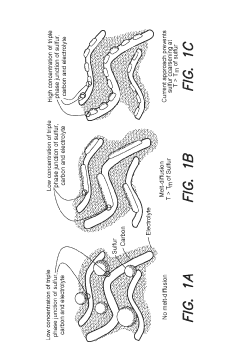
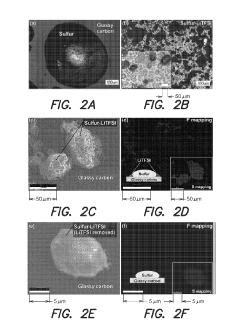
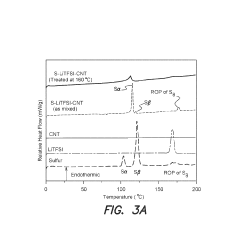
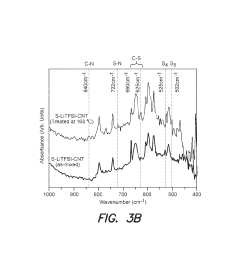
Composition for a desulfurizer with a high sulfur capacity and the process of making the same
PatentActiveUS20080047395A1
Innovation
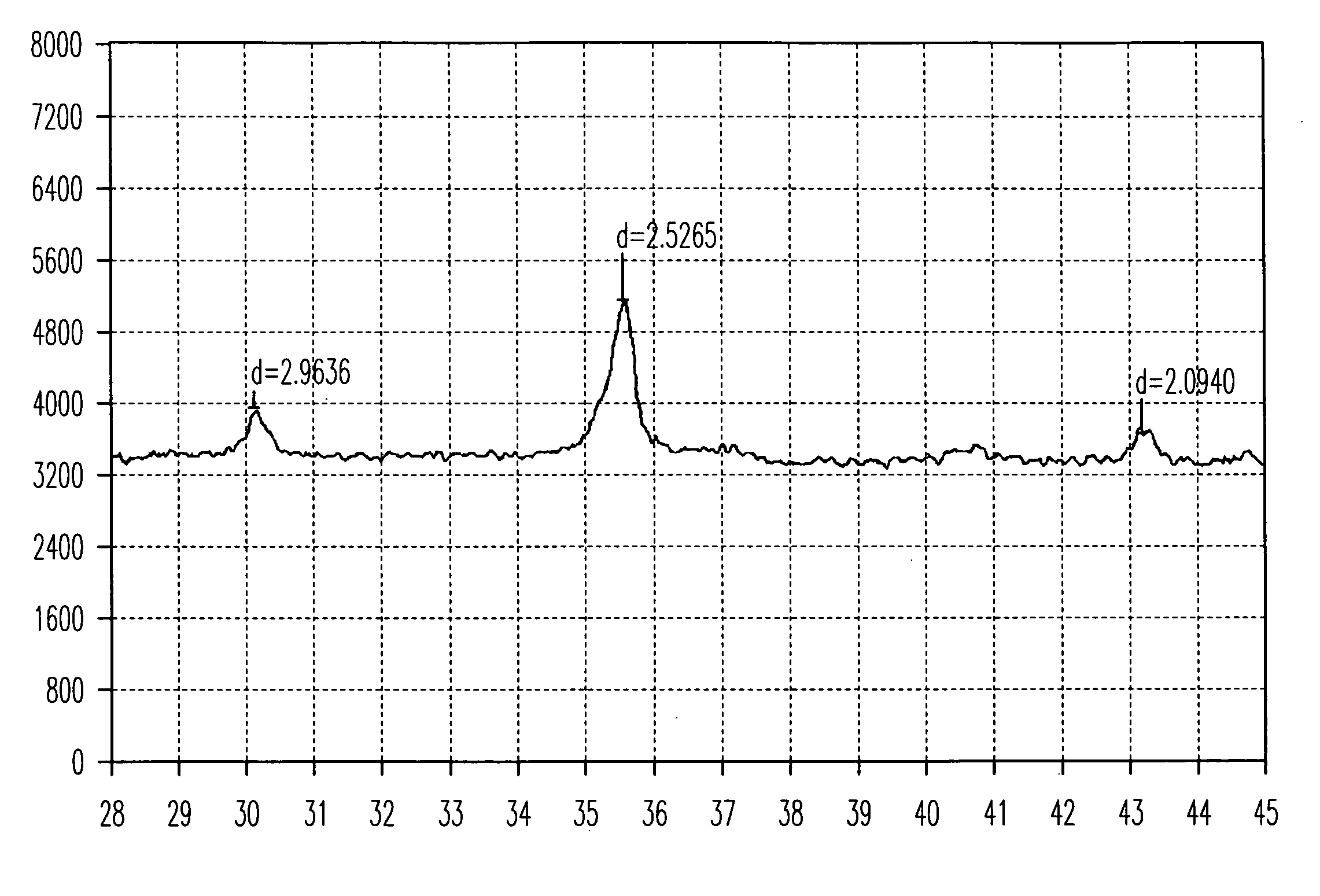
- A composition comprising ferroferric oxide in the cubic crystalline phase, amorphous ferric oxide, and amorphous ferric oxide monohydrate, with specific weight percentages, and a preparation process involving mixing a solid ferrous compound with a solid hydroxide at a controlled molar ratio, kneading, drying, and natural or baking steps to achieve a high sulfur capacity desulfurizer.
Environmental Impact and Sustainability of Sulfur Batteries
The environmental implications of sulfur battery technology present both significant opportunities and challenges for sustainable energy storage solutions. Sulfur, as an abundant industrial byproduct, offers inherent environmental advantages over traditional lithium-ion battery materials. The utilization of sulfur in high-capacity devices directly addresses resource scarcity concerns while reducing dependency on rare earth elements and conflict minerals commonly associated with conventional battery technologies.
Life cycle assessment studies indicate that sulfur batteries demonstrate substantially lower carbon footprints during material extraction and processing phases. The abundance of sulfur as a waste product from petroleum refining and natural gas processing creates a circular economy opportunity, transforming industrial waste into valuable energy storage components. This approach significantly reduces mining-related environmental degradation and associated ecosystem disruption.
However, optimizing sulfur usage in high-capacity applications introduces specific sustainability challenges. The polysulfide dissolution phenomenon, while being a technical hurdle, also raises concerns about potential environmental contamination during battery manufacturing and end-of-life disposal. Advanced containment strategies and electrolyte formulations are essential to prevent sulfur compound leaching into environmental systems.
Recycling infrastructure for sulfur batteries requires specialized development to maintain sustainability benefits throughout the product lifecycle. Unlike lithium-ion systems, sulfur battery recycling can potentially achieve higher material recovery rates due to sulfur's chemical stability and abundance. The development of closed-loop recycling processes could establish sulfur batteries as truly sustainable energy storage solutions.
The scalability of sulfur battery production for high-capacity applications must consider regional sulfur availability and transportation emissions. Strategic placement of manufacturing facilities near sulfur sources, particularly petroleum refineries, can minimize transportation-related environmental impacts while supporting local industrial ecosystems.
Regulatory frameworks are evolving to address sulfur battery environmental standards, particularly concerning manufacturing emissions and workplace safety protocols. Compliance with emerging environmental regulations will be crucial for widespread adoption of optimized sulfur battery technologies in high-capacity device applications.
Life cycle assessment studies indicate that sulfur batteries demonstrate substantially lower carbon footprints during material extraction and processing phases. The abundance of sulfur as a waste product from petroleum refining and natural gas processing creates a circular economy opportunity, transforming industrial waste into valuable energy storage components. This approach significantly reduces mining-related environmental degradation and associated ecosystem disruption.
However, optimizing sulfur usage in high-capacity applications introduces specific sustainability challenges. The polysulfide dissolution phenomenon, while being a technical hurdle, also raises concerns about potential environmental contamination during battery manufacturing and end-of-life disposal. Advanced containment strategies and electrolyte formulations are essential to prevent sulfur compound leaching into environmental systems.
Recycling infrastructure for sulfur batteries requires specialized development to maintain sustainability benefits throughout the product lifecycle. Unlike lithium-ion systems, sulfur battery recycling can potentially achieve higher material recovery rates due to sulfur's chemical stability and abundance. The development of closed-loop recycling processes could establish sulfur batteries as truly sustainable energy storage solutions.
The scalability of sulfur battery production for high-capacity applications must consider regional sulfur availability and transportation emissions. Strategic placement of manufacturing facilities near sulfur sources, particularly petroleum refineries, can minimize transportation-related environmental impacts while supporting local industrial ecosystems.
Regulatory frameworks are evolving to address sulfur battery environmental standards, particularly concerning manufacturing emissions and workplace safety protocols. Compliance with emerging environmental regulations will be crucial for widespread adoption of optimized sulfur battery technologies in high-capacity device applications.
Manufacturing Scalability and Cost Optimization Strategies
Manufacturing scalability for sulfur optimization in high-capacity devices presents unique challenges that require systematic approaches to achieve cost-effective production. The transition from laboratory-scale synthesis to industrial-scale manufacturing demands careful consideration of process parameters, equipment selection, and quality control mechanisms. Current manufacturing bottlenecks primarily stem from the complex nature of sulfur chemistry and the need to maintain precise stoichiometric ratios across large production volumes.
Process standardization emerges as a critical factor in achieving manufacturing scalability. Automated mixing systems and continuous flow reactors offer significant advantages over traditional batch processing methods, enabling consistent sulfur distribution and reducing material waste. These systems can maintain optimal temperature and pressure conditions while minimizing human intervention, thereby reducing production costs and improving reproducibility. The implementation of real-time monitoring systems allows for immediate adjustments to process parameters, ensuring consistent product quality across production runs.
Raw material sourcing strategies play a pivotal role in cost optimization. Establishing long-term partnerships with sulfur suppliers can secure favorable pricing structures and ensure consistent material quality. The development of alternative sulfur sources, including recycled sulfur from industrial waste streams, presents opportunities for significant cost reduction while supporting sustainability objectives. Strategic inventory management systems help balance carrying costs with supply chain reliability, particularly important given sulfur price volatility in global markets.
Equipment optimization focuses on maximizing throughput while minimizing energy consumption and maintenance requirements. Modular manufacturing systems allow for flexible capacity scaling based on market demand, reducing capital investment risks. The integration of predictive maintenance technologies helps prevent costly equipment failures and extends operational lifespans. Energy recovery systems, particularly those capturing heat from sulfur processing operations, can substantially reduce operational costs and improve overall process efficiency.
Quality assurance frameworks must scale proportionally with production volumes while maintaining cost effectiveness. Statistical process control methods enable efficient monitoring of critical quality parameters without requiring extensive manual testing. Automated sampling and analysis systems reduce labor costs while providing more comprehensive quality data. The implementation of lean manufacturing principles helps identify and eliminate waste streams, further optimizing both costs and resource utilization throughout the production process.
Process standardization emerges as a critical factor in achieving manufacturing scalability. Automated mixing systems and continuous flow reactors offer significant advantages over traditional batch processing methods, enabling consistent sulfur distribution and reducing material waste. These systems can maintain optimal temperature and pressure conditions while minimizing human intervention, thereby reducing production costs and improving reproducibility. The implementation of real-time monitoring systems allows for immediate adjustments to process parameters, ensuring consistent product quality across production runs.
Raw material sourcing strategies play a pivotal role in cost optimization. Establishing long-term partnerships with sulfur suppliers can secure favorable pricing structures and ensure consistent material quality. The development of alternative sulfur sources, including recycled sulfur from industrial waste streams, presents opportunities for significant cost reduction while supporting sustainability objectives. Strategic inventory management systems help balance carrying costs with supply chain reliability, particularly important given sulfur price volatility in global markets.
Equipment optimization focuses on maximizing throughput while minimizing energy consumption and maintenance requirements. Modular manufacturing systems allow for flexible capacity scaling based on market demand, reducing capital investment risks. The integration of predictive maintenance technologies helps prevent costly equipment failures and extends operational lifespans. Energy recovery systems, particularly those capturing heat from sulfur processing operations, can substantially reduce operational costs and improve overall process efficiency.
Quality assurance frameworks must scale proportionally with production volumes while maintaining cost effectiveness. Statistical process control methods enable efficient monitoring of critical quality parameters without requiring extensive manual testing. Automated sampling and analysis systems reduce labor costs while providing more comprehensive quality data. The implementation of lean manufacturing principles helps identify and eliminate waste streams, further optimizing both costs and resource utilization throughout the production process.
Unlock deeper insights with PatSnap Eureka Quick Research — get a full tech report to explore trends and direct your research. Try now!
Generate Your Research Report Instantly with AI Agent
Supercharge your innovation with PatSnap Eureka AI Agent Platform!