

How Reflectarray Antennas Improve Low-Earth-Orbit Satellite Operations
MAY 12, 20269 MIN READ
Generate Your Research Report Instantly with AI Agent
PatSnap Eureka helps you evaluate technical feasibility & market potential.
Reflectarray Antenna Technology Background and LEO Satellite Goals
Reflectarray antenna technology emerged in the 1960s as a hybrid solution combining the advantages of parabolic reflectors and phased arrays. This innovative antenna design utilizes a planar array of reflecting elements, each capable of introducing specific phase shifts to incident electromagnetic waves. Unlike traditional parabolic antennas that rely on curved surfaces for beam focusing, reflectarray antennas achieve beam steering and shaping through electronically controlled phase manipulation across individual array elements.
The fundamental principle involves illuminating a flat or slightly curved surface containing numerous reflecting elements with a feed antenna. Each element, typically consisting of microstrip patches, dipoles, or other resonant structures, reflects the incident wave with a predetermined phase shift. By carefully controlling these phase relationships across the array aperture, the antenna can form highly directional beams, perform beam steering, and even generate multiple simultaneous beams without mechanical movement.
The evolution of reflectarray technology has been driven by advances in microwave circuit design, computational electromagnetics, and manufacturing techniques. Early implementations faced limitations in bandwidth and beam steering range, but modern designs incorporate sophisticated element geometries, multi-layer structures, and active components to overcome these constraints. The integration of microelectromechanical systems and liquid crystal technologies has further enhanced the reconfigurability and performance characteristics of contemporary reflectarray antennas.
For Low Earth Orbit satellite operations, reflectarray antennas address several critical technological objectives. The primary goal involves achieving high-gain, steerable antenna performance while maintaining compact form factors and reduced system complexity compared to traditional mechanically steered dishes. LEO satellites require rapid beam tracking capabilities to maintain communication links with ground stations and other satellites as orbital dynamics create constantly changing geometric relationships.
Power efficiency represents another crucial objective, as LEO satellites operate under strict power budgets. Reflectarray antennas offer superior power-to-weight ratios and can eliminate the need for complex rotary joints and mechanical steering mechanisms that consume significant power and introduce potential failure points. Additionally, the planar nature of reflectarray designs facilitates integration with satellite structures and enables conformal installations that minimize aerodynamic drag during orbital insertion phases.
The technology aims to enable advanced communication architectures including satellite-to-satellite links, dynamic coverage area adjustment, and interference mitigation through precise beam control, ultimately supporting the growing demands of LEO constellation networks for global connectivity services.
The fundamental principle involves illuminating a flat or slightly curved surface containing numerous reflecting elements with a feed antenna. Each element, typically consisting of microstrip patches, dipoles, or other resonant structures, reflects the incident wave with a predetermined phase shift. By carefully controlling these phase relationships across the array aperture, the antenna can form highly directional beams, perform beam steering, and even generate multiple simultaneous beams without mechanical movement.
The evolution of reflectarray technology has been driven by advances in microwave circuit design, computational electromagnetics, and manufacturing techniques. Early implementations faced limitations in bandwidth and beam steering range, but modern designs incorporate sophisticated element geometries, multi-layer structures, and active components to overcome these constraints. The integration of microelectromechanical systems and liquid crystal technologies has further enhanced the reconfigurability and performance characteristics of contemporary reflectarray antennas.
For Low Earth Orbit satellite operations, reflectarray antennas address several critical technological objectives. The primary goal involves achieving high-gain, steerable antenna performance while maintaining compact form factors and reduced system complexity compared to traditional mechanically steered dishes. LEO satellites require rapid beam tracking capabilities to maintain communication links with ground stations and other satellites as orbital dynamics create constantly changing geometric relationships.
Power efficiency represents another crucial objective, as LEO satellites operate under strict power budgets. Reflectarray antennas offer superior power-to-weight ratios and can eliminate the need for complex rotary joints and mechanical steering mechanisms that consume significant power and introduce potential failure points. Additionally, the planar nature of reflectarray designs facilitates integration with satellite structures and enables conformal installations that minimize aerodynamic drag during orbital insertion phases.
The technology aims to enable advanced communication architectures including satellite-to-satellite links, dynamic coverage area adjustment, and interference mitigation through precise beam control, ultimately supporting the growing demands of LEO constellation networks for global connectivity services.
Market Demand Analysis for Advanced LEO Satellite Communication
The global LEO satellite communication market is experiencing unprecedented growth driven by increasing demand for high-speed, low-latency connectivity across diverse applications. Traditional geostationary satellites face limitations in providing real-time communication services due to their high orbital altitude, creating substantial market opportunities for LEO constellation operators. The proliferation of Internet of Things devices, autonomous vehicles, and remote sensing applications has intensified the need for reliable satellite communication infrastructure that can deliver consistent performance regardless of geographical location.
Commercial sectors represent the largest demand segment, with telecommunications companies seeking to extend broadband coverage to underserved regions where terrestrial infrastructure deployment remains economically unfeasible. Maritime and aviation industries require continuous connectivity for operational efficiency and safety compliance, driving sustained demand for LEO satellite services. The defense and government sectors prioritize secure, resilient communication channels that can operate independently of terrestrial networks, particularly for mission-critical applications and emergency response scenarios.
Emerging applications in precision agriculture, environmental monitoring, and smart city initiatives are creating new market segments that require cost-effective satellite communication solutions. The growing adoption of edge computing and distributed network architectures necessitates satellite systems capable of supporting dynamic bandwidth allocation and adaptive beamforming capabilities. Financial services and energy sectors increasingly rely on satellite connectivity for remote asset monitoring and real-time data transmission from offshore installations.
The market demonstrates strong regional variations, with North America and Europe leading in terms of technology adoption and infrastructure investment. Asia-Pacific regions show rapid growth potential due to expanding industrial activities and increasing digitalization initiatives. Developing markets in Africa and Latin America present significant opportunities for satellite communication providers, as these regions often lack comprehensive terrestrial communication infrastructure.
Market analysts project continued expansion driven by decreasing launch costs, miniaturization of satellite components, and advances in antenna technologies that enable more efficient spectrum utilization. The competitive landscape is evolving rapidly, with traditional satellite operators facing competition from technology companies and new space ventures that leverage innovative constellation architectures and ground segment technologies.
Commercial sectors represent the largest demand segment, with telecommunications companies seeking to extend broadband coverage to underserved regions where terrestrial infrastructure deployment remains economically unfeasible. Maritime and aviation industries require continuous connectivity for operational efficiency and safety compliance, driving sustained demand for LEO satellite services. The defense and government sectors prioritize secure, resilient communication channels that can operate independently of terrestrial networks, particularly for mission-critical applications and emergency response scenarios.
Emerging applications in precision agriculture, environmental monitoring, and smart city initiatives are creating new market segments that require cost-effective satellite communication solutions. The growing adoption of edge computing and distributed network architectures necessitates satellite systems capable of supporting dynamic bandwidth allocation and adaptive beamforming capabilities. Financial services and energy sectors increasingly rely on satellite connectivity for remote asset monitoring and real-time data transmission from offshore installations.
The market demonstrates strong regional variations, with North America and Europe leading in terms of technology adoption and infrastructure investment. Asia-Pacific regions show rapid growth potential due to expanding industrial activities and increasing digitalization initiatives. Developing markets in Africa and Latin America present significant opportunities for satellite communication providers, as these regions often lack comprehensive terrestrial communication infrastructure.
Market analysts project continued expansion driven by decreasing launch costs, miniaturization of satellite components, and advances in antenna technologies that enable more efficient spectrum utilization. The competitive landscape is evolving rapidly, with traditional satellite operators facing competition from technology companies and new space ventures that leverage innovative constellation architectures and ground segment technologies.
Current State and Challenges of Reflectarray Antennas in LEO
Reflectarray antennas have emerged as a promising technology for low-Earth-orbit satellite applications, combining the advantages of both reflector and phased array antennas. Currently, these antennas demonstrate significant potential in providing high-gain, electronically steerable beam capabilities while maintaining relatively simple feeding structures compared to traditional phased arrays. The technology has reached a maturity level where several space agencies and commercial satellite operators are actively integrating reflectarray solutions into their LEO constellation designs.
The current state of reflectarray technology in LEO applications shows considerable progress in frequency reconfigurability and beam steering capabilities. Modern implementations utilize various element designs including microstrip patches, dipoles, and metamaterial-inspired structures that can operate across multiple frequency bands. Recent developments have achieved bandwidth improvements exceeding 20% while maintaining acceptable cross-polarization levels below -20 dB across the operational frequency range.
However, significant technical challenges persist in the LEO environment. Space radiation exposure poses a critical concern for the electronic components used in active reflectarray elements, particularly affecting the reliability of varactor diodes and PIN switches commonly employed for phase control. The harsh thermal cycling conditions in LEO orbits, ranging from -150°C to +120°C, create substantial material stress that can degrade the performance of substrate materials and metallization layers over extended mission durations.
Power consumption remains another substantial challenge, especially for large-scale reflectarray implementations requiring thousands of controllable elements. Current active reflectarray designs typically consume 10-50 mW per element for phase control, which becomes prohibitive for arrays exceeding 10,000 elements when considering the limited power budgets of LEO satellites.
Manufacturing complexity and cost considerations also present significant barriers to widespread adoption. The precise fabrication tolerances required for millimeter-wave and higher frequency applications, combined with the need for space-qualified components, result in substantially higher production costs compared to conventional antenna solutions. Additionally, the integration of control electronics and DC bias networks adds complexity to the overall system architecture.
Beam pointing accuracy represents another technical hurdle, as LEO satellites require rapid beam repositioning to maintain communication links with ground stations and other satellites. Current reflectarray implementations struggle to achieve the sub-degree pointing accuracy required for high-data-rate communications while maintaining acceptable sidelobe levels below -25 dB.
Despite these challenges, ongoing research efforts focus on developing radiation-hardened control circuits, improved substrate materials with enhanced thermal stability, and novel element designs that reduce power consumption while maintaining performance specifications.
The current state of reflectarray technology in LEO applications shows considerable progress in frequency reconfigurability and beam steering capabilities. Modern implementations utilize various element designs including microstrip patches, dipoles, and metamaterial-inspired structures that can operate across multiple frequency bands. Recent developments have achieved bandwidth improvements exceeding 20% while maintaining acceptable cross-polarization levels below -20 dB across the operational frequency range.
However, significant technical challenges persist in the LEO environment. Space radiation exposure poses a critical concern for the electronic components used in active reflectarray elements, particularly affecting the reliability of varactor diodes and PIN switches commonly employed for phase control. The harsh thermal cycling conditions in LEO orbits, ranging from -150°C to +120°C, create substantial material stress that can degrade the performance of substrate materials and metallization layers over extended mission durations.
Power consumption remains another substantial challenge, especially for large-scale reflectarray implementations requiring thousands of controllable elements. Current active reflectarray designs typically consume 10-50 mW per element for phase control, which becomes prohibitive for arrays exceeding 10,000 elements when considering the limited power budgets of LEO satellites.
Manufacturing complexity and cost considerations also present significant barriers to widespread adoption. The precise fabrication tolerances required for millimeter-wave and higher frequency applications, combined with the need for space-qualified components, result in substantially higher production costs compared to conventional antenna solutions. Additionally, the integration of control electronics and DC bias networks adds complexity to the overall system architecture.
Beam pointing accuracy represents another technical hurdle, as LEO satellites require rapid beam repositioning to maintain communication links with ground stations and other satellites. Current reflectarray implementations struggle to achieve the sub-degree pointing accuracy required for high-data-rate communications while maintaining acceptable sidelobe levels below -25 dB.
Despite these challenges, ongoing research efforts focus on developing radiation-hardened control circuits, improved substrate materials with enhanced thermal stability, and novel element designs that reduce power consumption while maintaining performance specifications.
Current Reflectarray Solutions for LEO Satellite Operations
01 Reflectarray antenna design and configuration
Reflectarray antennas utilize arrays of reflecting elements to redirect electromagnetic waves. The design involves optimizing the arrangement and characteristics of individual reflecting elements to achieve desired radiation patterns and beam steering capabilities. Various element geometries and configurations are employed to control phase and amplitude responses across the array surface.- Reflectarray antenna design and configuration methods: Various design methodologies and configuration approaches for reflectarray antennas to optimize their performance characteristics. These methods involve specific geometric arrangements, element positioning, and structural configurations that enhance the antenna's operational capabilities and efficiency in different applications.
- Phase control and beam steering mechanisms: Techniques for controlling the phase response of reflectarray elements to achieve desired beam steering and directional characteristics. These mechanisms enable dynamic control of the antenna's radiation pattern and allow for adaptive beam formation in various operational scenarios.
- Element structure and unit cell optimization: Development of specialized element structures and unit cell designs that form the building blocks of reflectarray antennas. These optimized structures improve the antenna's frequency response, bandwidth characteristics, and overall electromagnetic performance through advanced geometric and material considerations.
- Multi-band and wideband operation techniques: Methods for enabling reflectarray antennas to operate across multiple frequency bands or achieve wideband performance. These techniques involve sophisticated design approaches that maintain consistent performance characteristics across different frequency ranges while minimizing interference and maximizing operational flexibility.
- Manufacturing and fabrication processes: Specialized manufacturing techniques and fabrication processes for producing reflectarray antennas with precise specifications and reliable performance. These processes ensure consistent quality, dimensional accuracy, and proper electromagnetic characteristics while enabling cost-effective production methods.
02 Beam steering and phase control mechanisms
Advanced beam steering techniques enable dynamic control of reflectarray antenna radiation patterns. Phase control mechanisms allow for electronic beam scanning without mechanical movement, utilizing variable phase shifters or tunable elements. These systems provide precise control over beam direction and can support multiple simultaneous beams for enhanced functionality.Expand Specific Solutions03 Frequency reconfigurable and wideband operations
Modern reflectarray antennas incorporate frequency agile capabilities to operate across multiple frequency bands or provide tunable frequency response. Wideband designs enable operation over extended frequency ranges while maintaining acceptable performance characteristics. These implementations often utilize active elements or metamaterial structures to achieve the desired frequency behavior.Expand Specific Solutions04 Active and smart reflectarray systems
Active reflectarray systems integrate amplification and signal processing capabilities directly into the reflecting elements. Smart antenna technologies enable adaptive beamforming and interference mitigation through real-time adjustment of element characteristics. These systems can dynamically optimize performance based on changing environmental conditions or communication requirements.Expand Specific Solutions05 Manufacturing and implementation techniques
Various fabrication methods and implementation approaches are employed to realize reflectarray antennas in practical applications. Manufacturing techniques focus on achieving precise element placement and maintaining consistent performance across the array. Implementation considerations include substrate selection, feeding mechanisms, and integration with existing communication systems.Expand Specific Solutions
Major Players in Reflectarray and LEO Satellite Industry
The reflectarray antenna technology for low-Earth-orbit satellite operations represents a rapidly evolving competitive landscape characterized by significant market growth and diverse technological maturity levels across key players. The industry is transitioning from early development to commercial deployment phases, driven by the expanding LEO satellite constellation market valued in billions. Major aerospace contractors like Lockheed Martin, Thales SA, and Thales Alenia Space Italia demonstrate advanced technological capabilities, while telecommunications giants such as Huawei Technologies and NTT Inc. leverage their infrastructure expertise. Research institutions including Johns Hopkins University and specialized companies like Metawave Corp. contribute innovative beamsteering solutions. Chinese entities like Space Star Technology and The 54th Research Institute of China Electronics Technology Group Corporation showcase growing regional capabilities, while emerging players like Hefei Ruosen Intelligent Technology focus on ultra-low profile antenna solutions, indicating a competitive environment with varying technological readiness levels.
Huawei Technologies Co., Ltd.
Technical Solution: Huawei has developed reflectarray antenna solutions for LEO satellite communications, emphasizing cost-effective manufacturing and rapid deployment capabilities. Their technology focuses on electronically reconfigurable reflectarray surfaces using varactor diodes and PIN switches to enable real-time beam steering and pattern optimization. The company's approach integrates artificial intelligence algorithms for predictive beam steering, anticipating satellite movement and optimizing communication links before handovers occur. Their reflectarray designs support 5G NTN (Non-Terrestrial Network) standards, enabling seamless integration between satellite and terrestrial networks. Huawei's solutions emphasize mass production techniques and standardized components to reduce per-unit costs for large LEO constellations.
Strengths: Cost-effective mass production capabilities, 5G integration expertise, AI-driven optimization algorithms. Weaknesses: Regulatory restrictions in some markets, limited space heritage compared to traditional aerospace companies.
Thales Alenia Space Italia SpA
Technical Solution: Thales Alenia Space has developed advanced reflectarray antenna systems specifically designed for LEO satellite constellations, featuring electronically steerable beam capabilities and multi-band operation. Their reflectarray technology incorporates phase-shifting elements that enable dynamic beam steering without mechanical movement, significantly reducing satellite weight and power consumption. The company's solutions support Ka-band and Ku-band frequencies with beam steering capabilities up to ±45 degrees, enabling continuous Earth coverage as satellites traverse their orbits. Their reflectarray antennas demonstrate improved gain stability and reduced pointing losses compared to traditional phased arrays, making them particularly suitable for high-throughput LEO satellite applications.
Strengths: Extensive space heritage, proven reliability in harsh space environments, integrated satellite system expertise. Weaknesses: Higher development costs, longer design cycles compared to commercial alternatives.
Core Patent Analysis in Reflectarray Antenna Innovation
Deployable reflectarray antenna system
PatentInactiveUS8289221B1
Innovation
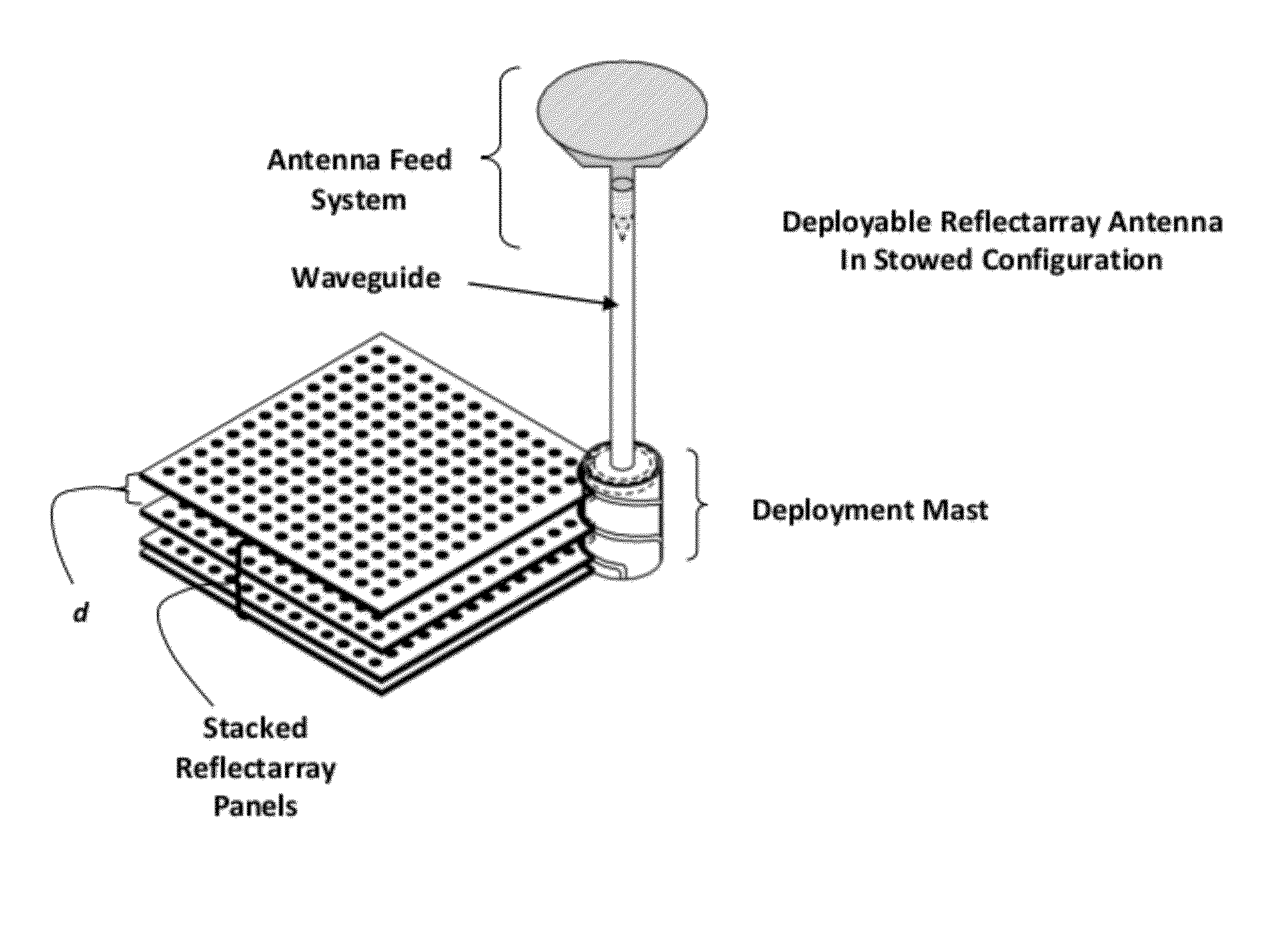
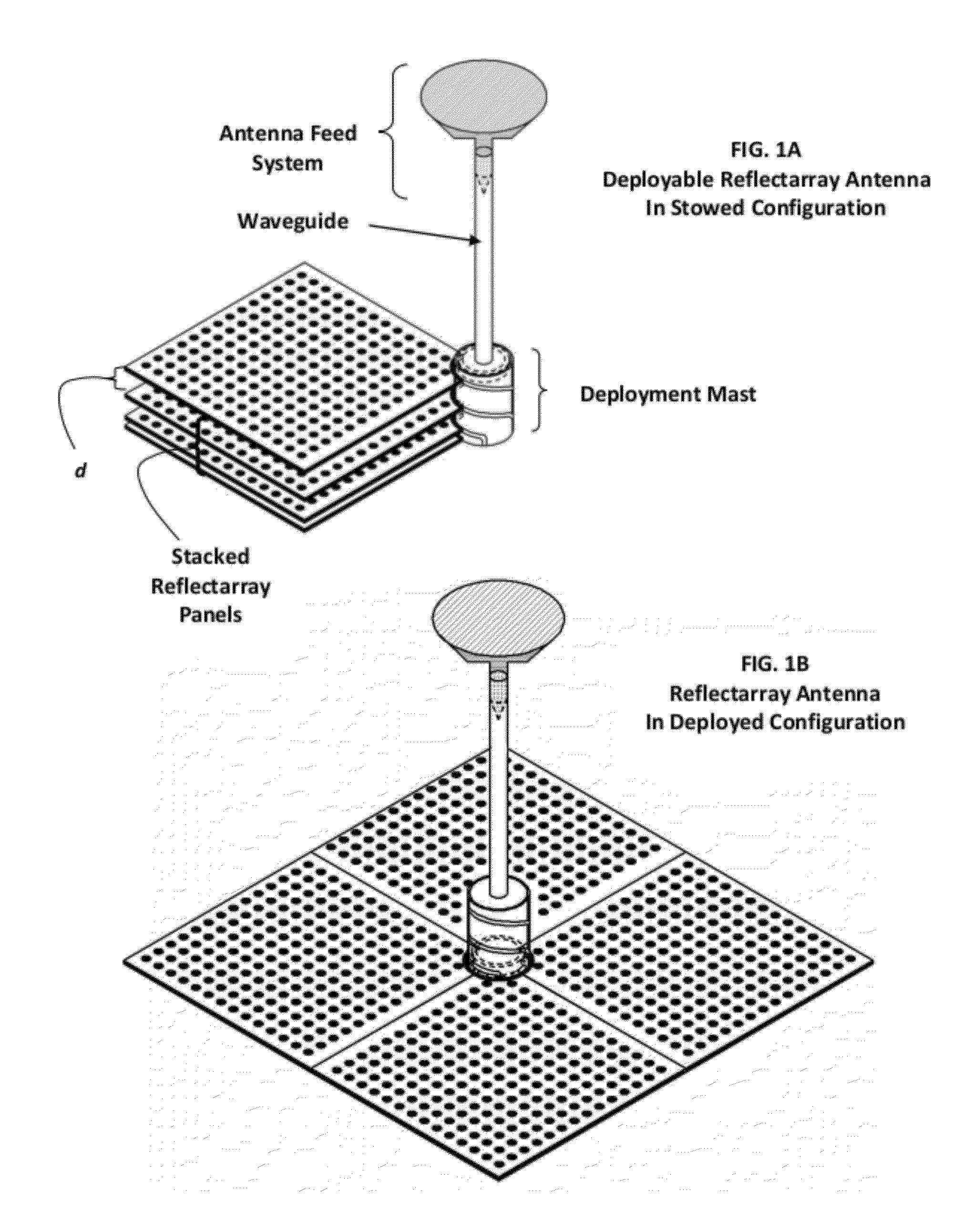
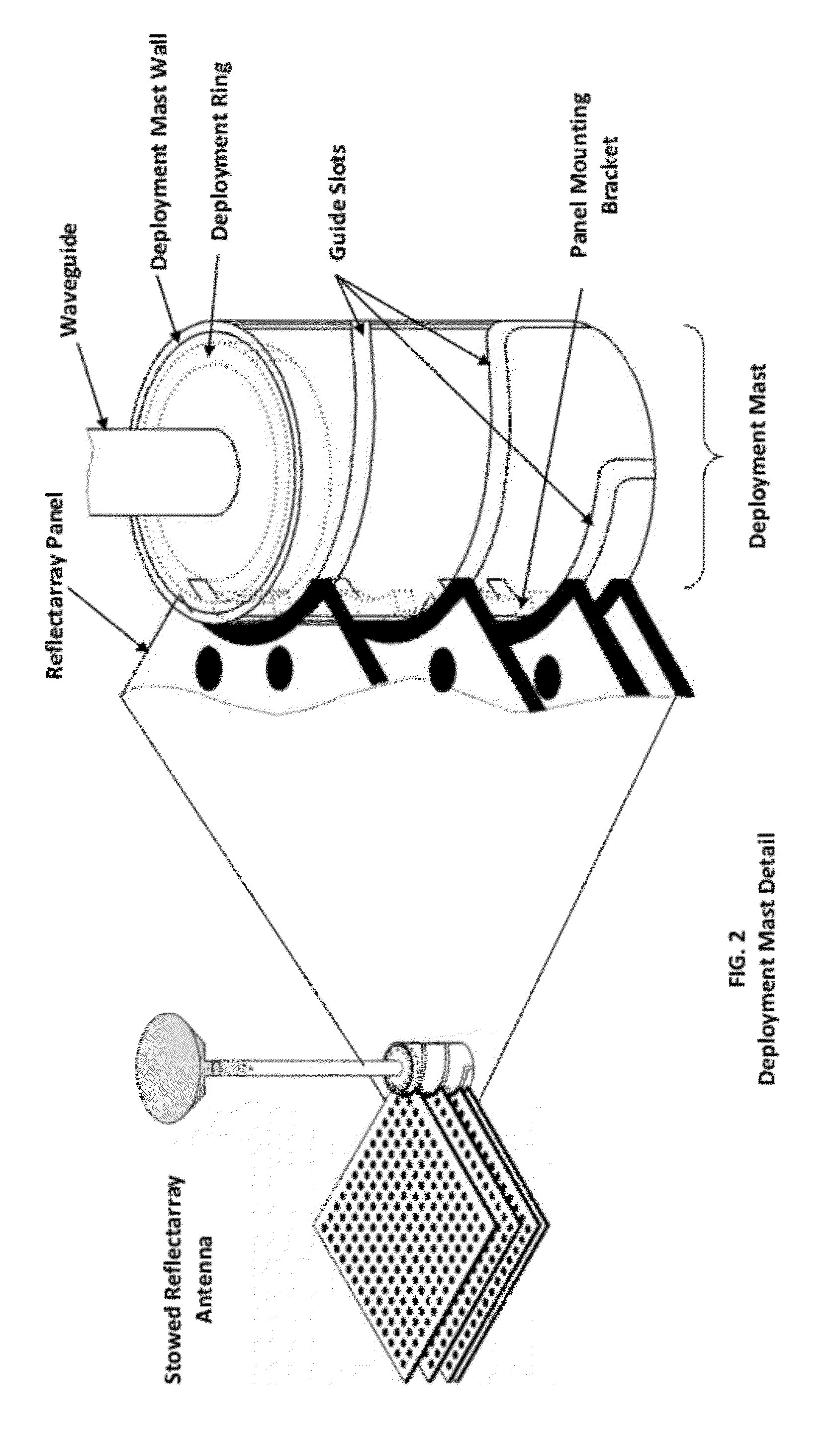
- A deployable reflectarray antenna system is designed with a simple deployment mechanism, where a flat reflectarray antenna is subdivided into panels that stack and deploy using a hollow cylindrical mechanism with guide slots and a deployment ring, allowing for a compact stowed configuration and a larger operational area with reduced surface area requirements.

Patent
Innovation
- Dynamic beam steering capability through electronically controlled phase shifters enables real-time tracking of ground stations without mechanical rotation, significantly reducing satellite power consumption and mechanical complexity.
- Lightweight reflectarray design using printed circuit board technology reduces satellite payload mass by 40-60% compared to traditional parabolic antennas while maintaining equivalent gain performance.
- Integrated multi-beam capability allows simultaneous communication with multiple ground terminals, enabling enhanced data throughput and network connectivity for LEO constellation operations.
Space Regulatory Framework for LEO Satellite Deployment
The deployment of LEO satellite constellations equipped with reflectarray antennas operates within a complex regulatory framework that has evolved to address the unique challenges posed by large-scale satellite operations. The International Telecommunication Union (ITU) serves as the primary global regulatory body, establishing frequency coordination procedures and orbital slot allocations that directly impact reflectarray antenna design specifications and operational parameters.
National space agencies and telecommunications authorities implement ITU guidelines through domestic licensing frameworks. The Federal Communications Commission (FCC) in the United States has streamlined licensing procedures for LEO constellations, while the European Space Agency (ESA) coordinates with national authorities across member states. These regulatory bodies establish technical standards for antenna performance, including gain patterns, sidelobe suppression levels, and interference mitigation capabilities that reflectarray antennas must satisfy.
Frequency spectrum allocation represents a critical regulatory consideration for reflectarray-equipped satellites. The ITU Radio Regulations define specific frequency bands for satellite services, with Ka-band and Ku-band allocations being particularly relevant for LEO operations. Regulatory frameworks mandate coordination procedures between satellite operators to prevent harmful interference, requiring precise antenna beam shaping and steering capabilities that reflectarray technology can provide.
Space debris mitigation guidelines established by the Inter-Agency Space Debris Coordination Committee (IADC) and incorporated into national regulations influence satellite design requirements. These guidelines mandate end-of-life disposal procedures and collision avoidance capabilities that affect antenna system design, including the need for rapid beam reconfiguration and satellite maneuverability that reflectarray antennas can support through their electronic steering capabilities.
International coordination mechanisms facilitate cross-border satellite operations through bilateral and multilateral agreements. The Outer Space Treaty of 1967 provides the foundational legal framework, while more recent agreements address specific technical and operational aspects of LEO constellation deployment. These regulatory structures continue evolving to accommodate the growing complexity of satellite operations and the advanced capabilities offered by reflectarray antenna technology.
National space agencies and telecommunications authorities implement ITU guidelines through domestic licensing frameworks. The Federal Communications Commission (FCC) in the United States has streamlined licensing procedures for LEO constellations, while the European Space Agency (ESA) coordinates with national authorities across member states. These regulatory bodies establish technical standards for antenna performance, including gain patterns, sidelobe suppression levels, and interference mitigation capabilities that reflectarray antennas must satisfy.
Frequency spectrum allocation represents a critical regulatory consideration for reflectarray-equipped satellites. The ITU Radio Regulations define specific frequency bands for satellite services, with Ka-band and Ku-band allocations being particularly relevant for LEO operations. Regulatory frameworks mandate coordination procedures between satellite operators to prevent harmful interference, requiring precise antenna beam shaping and steering capabilities that reflectarray technology can provide.
Space debris mitigation guidelines established by the Inter-Agency Space Debris Coordination Committee (IADC) and incorporated into national regulations influence satellite design requirements. These guidelines mandate end-of-life disposal procedures and collision avoidance capabilities that affect antenna system design, including the need for rapid beam reconfiguration and satellite maneuverability that reflectarray antennas can support through their electronic steering capabilities.
International coordination mechanisms facilitate cross-border satellite operations through bilateral and multilateral agreements. The Outer Space Treaty of 1967 provides the foundational legal framework, while more recent agreements address specific technical and operational aspects of LEO constellation deployment. These regulatory structures continue evolving to accommodate the growing complexity of satellite operations and the advanced capabilities offered by reflectarray antenna technology.
Orbital Debris Mitigation in Reflectarray Design
The proliferation of orbital debris poses significant challenges to Low-Earth-Orbit satellite operations, necessitating innovative design approaches that minimize space junk generation while maintaining operational effectiveness. Reflectarray antennas present unique opportunities for debris mitigation through their inherent structural characteristics and operational flexibility.
Traditional parabolic dish antennas require complex mechanical pointing systems with multiple moving parts, creating potential failure points that could generate debris fragments. Reflectarray antennas eliminate this vulnerability through electronic beam steering capabilities, reducing mechanical complexity and associated debris risks. The solid-state nature of reflectarray elements significantly decreases the probability of component fragmentation during orbital operations.
Material selection plays a crucial role in debris mitigation strategies for reflectarray designs. Advanced composite substrates with enhanced durability characteristics resist micrometeorite impacts and thermal cycling stress, reducing the likelihood of material degradation and fragment generation. Low-outgassing materials prevent contamination of surrounding space environment while maintaining structural integrity throughout extended mission durations.
Modular reflectarray architectures enable controlled deorbiting strategies at end-of-life scenarios. Individual array elements can be designed with predetermined failure modes that facilitate complete disintegration during atmospheric reentry, preventing the creation of persistent orbital debris. This approach contrasts sharply with traditional antenna systems that may leave substantial metallic components in orbit.
The compact profile of reflectarray antennas reduces collision cross-sections compared to conventional dish antennas, decreasing the probability of debris-generating impacts with existing space objects. Flat or low-profile configurations present smaller targets for orbital debris encounters while maintaining equivalent communication performance capabilities.
Integrated debris shielding represents another mitigation approach specific to reflectarray implementations. Protective layers can be incorporated directly into the antenna structure without compromising electromagnetic performance, providing dual functionality that traditional antennas cannot achieve efficiently. This integration reduces overall satellite mass while enhancing debris protection capabilities.
Future reflectarray designs increasingly incorporate biodegradable or rapidly degrading materials for non-critical structural components, ensuring complete disposal during atmospheric reentry phases. These innovations align with international space sustainability guidelines while advancing satellite communication capabilities for Low-Earth-Orbit operations.
Traditional parabolic dish antennas require complex mechanical pointing systems with multiple moving parts, creating potential failure points that could generate debris fragments. Reflectarray antennas eliminate this vulnerability through electronic beam steering capabilities, reducing mechanical complexity and associated debris risks. The solid-state nature of reflectarray elements significantly decreases the probability of component fragmentation during orbital operations.
Material selection plays a crucial role in debris mitigation strategies for reflectarray designs. Advanced composite substrates with enhanced durability characteristics resist micrometeorite impacts and thermal cycling stress, reducing the likelihood of material degradation and fragment generation. Low-outgassing materials prevent contamination of surrounding space environment while maintaining structural integrity throughout extended mission durations.
Modular reflectarray architectures enable controlled deorbiting strategies at end-of-life scenarios. Individual array elements can be designed with predetermined failure modes that facilitate complete disintegration during atmospheric reentry, preventing the creation of persistent orbital debris. This approach contrasts sharply with traditional antenna systems that may leave substantial metallic components in orbit.
The compact profile of reflectarray antennas reduces collision cross-sections compared to conventional dish antennas, decreasing the probability of debris-generating impacts with existing space objects. Flat or low-profile configurations present smaller targets for orbital debris encounters while maintaining equivalent communication performance capabilities.
Integrated debris shielding represents another mitigation approach specific to reflectarray implementations. Protective layers can be incorporated directly into the antenna structure without compromising electromagnetic performance, providing dual functionality that traditional antennas cannot achieve efficiently. This integration reduces overall satellite mass while enhancing debris protection capabilities.
Future reflectarray designs increasingly incorporate biodegradable or rapidly degrading materials for non-critical structural components, ensuring complete disposal during atmospheric reentry phases. These innovations align with international space sustainability guidelines while advancing satellite communication capabilities for Low-Earth-Orbit operations.
Unlock deeper insights with PatSnap Eureka Quick Research — get a full tech report to explore trends and direct your research. Try now!
Generate Your Research Report Instantly with AI Agent
Supercharge your innovation with PatSnap Eureka AI Agent Platform!