How Thermoelectric Generators Provide Energy Security?
SEP 12, 20259 MIN READ
Generate Your Research Report Instantly with AI Agent
Patsnap Eureka helps you evaluate technical feasibility & market potential.
Thermoelectric Generation Background and Objectives
Thermoelectric generation technology has evolved significantly since its discovery in the early 19th century when Thomas Johann Seebeck first observed the phenomenon of direct conversion of temperature differences to electric voltage. This discovery laid the foundation for thermoelectric generators (TEGs), which operate based on the Seebeck effect, converting heat flux directly into electrical energy without moving parts or working fluids.
The development trajectory of thermoelectric technology has been characterized by persistent efforts to enhance conversion efficiency. Early materials exhibited low efficiency, limiting practical applications. However, significant advancements in material science during the mid-20th century, particularly the development of semiconductor-based thermoelectric materials, marked a turning point in the field.
Modern thermoelectric generators have found applications across diverse sectors, from powering space missions through radioisotope thermoelectric generators (RTGs) to waste heat recovery in industrial processes and automotive exhaust systems. The technology's reliability, scalability, and maintenance-free operation make it particularly valuable for energy security applications in remote or critical infrastructure settings.
The current technological landscape is witnessing renewed interest in thermoelectric generation due to global energy security concerns and sustainability imperatives. Research is increasingly focused on developing novel materials with higher figure of merit (ZT), which directly correlates with conversion efficiency. Nanostructured materials, quantum dot superlattices, and skutterudites represent promising avenues for efficiency improvements.
The primary objective of contemporary thermoelectric research is to achieve cost-effective solutions that can operate across wider temperature differentials with higher efficiency. Current commercial thermoelectric materials typically achieve ZT values between 1-2, while laboratory prototypes have demonstrated values approaching 3, indicating significant potential for further enhancement.
From an energy security perspective, thermoelectric generators aim to provide reliable, autonomous power generation capabilities in scenarios where conventional power infrastructure is vulnerable or unavailable. This includes applications in military operations, disaster response, critical infrastructure protection, and remote monitoring systems.
The technology roadmap for thermoelectric generation encompasses several key objectives: increasing conversion efficiency to exceed 15% (currently typically below 10%), reducing manufacturing costs to enable broader commercial adoption, developing flexible and modular designs for diverse deployment scenarios, and integrating with renewable energy systems to create hybrid solutions that enhance overall energy resilience and security.
The development trajectory of thermoelectric technology has been characterized by persistent efforts to enhance conversion efficiency. Early materials exhibited low efficiency, limiting practical applications. However, significant advancements in material science during the mid-20th century, particularly the development of semiconductor-based thermoelectric materials, marked a turning point in the field.
Modern thermoelectric generators have found applications across diverse sectors, from powering space missions through radioisotope thermoelectric generators (RTGs) to waste heat recovery in industrial processes and automotive exhaust systems. The technology's reliability, scalability, and maintenance-free operation make it particularly valuable for energy security applications in remote or critical infrastructure settings.
The current technological landscape is witnessing renewed interest in thermoelectric generation due to global energy security concerns and sustainability imperatives. Research is increasingly focused on developing novel materials with higher figure of merit (ZT), which directly correlates with conversion efficiency. Nanostructured materials, quantum dot superlattices, and skutterudites represent promising avenues for efficiency improvements.
The primary objective of contemporary thermoelectric research is to achieve cost-effective solutions that can operate across wider temperature differentials with higher efficiency. Current commercial thermoelectric materials typically achieve ZT values between 1-2, while laboratory prototypes have demonstrated values approaching 3, indicating significant potential for further enhancement.
From an energy security perspective, thermoelectric generators aim to provide reliable, autonomous power generation capabilities in scenarios where conventional power infrastructure is vulnerable or unavailable. This includes applications in military operations, disaster response, critical infrastructure protection, and remote monitoring systems.
The technology roadmap for thermoelectric generation encompasses several key objectives: increasing conversion efficiency to exceed 15% (currently typically below 10%), reducing manufacturing costs to enable broader commercial adoption, developing flexible and modular designs for diverse deployment scenarios, and integrating with renewable energy systems to create hybrid solutions that enhance overall energy resilience and security.
Market Demand Analysis for Energy Security Solutions
The global energy security market is experiencing significant growth driven by increasing concerns over energy reliability, geopolitical tensions, and the push for sustainable energy solutions. Current market analysis indicates that the energy security solutions sector is projected to reach $25.9 billion by 2026, growing at a compound annual growth rate of 6.2% from 2021. Within this expanding market, thermoelectric generators (TEGs) are emerging as a promising technology that addresses multiple dimensions of energy security challenges.
The demand for TEGs is primarily fueled by three key market segments. First, the military and defense sector represents a substantial market, valuing reliability and independence from conventional supply chains. TEGs provide crucial power generation capabilities for remote operations, communication systems, and surveillance equipment where traditional power sources are unavailable or vulnerable.
Second, the industrial sector demonstrates growing interest in TEGs for waste heat recovery applications. Manufacturing facilities, power plants, and processing industries are increasingly recognizing the potential of converting waste heat into usable electricity, thereby reducing energy costs and enhancing operational resilience. This segment is particularly significant as industrial operations seek to mitigate the impact of energy price volatility and supply disruptions.
Third, the residential and commercial building sector shows emerging demand for TEGs as supplementary power sources. As extreme weather events become more frequent and grid failures more common, property owners are investing in diverse backup power solutions. TEGs offer advantages over traditional generators by operating silently, requiring minimal maintenance, and functioning without fuel supplies during emergencies.
Regional analysis reveals varying market dynamics. North America currently leads in TEG adoption for energy security, driven by military applications and critical infrastructure protection initiatives. The Asia-Pacific region demonstrates the fastest growth rate, with China, Japan, and South Korea making significant investments in thermoelectric technology development and manufacturing capabilities.
Market research indicates that end-users prioritize several key factors when evaluating TEG solutions: reliability under extreme conditions, operational lifespan, power output stability, and total cost of ownership. While initial acquisition costs remain higher than some alternative technologies, the long-term value proposition of TEGs is increasingly recognized, particularly in applications where maintenance access is limited or energy independence is paramount.
Consumer awareness and market education remain challenges, as many potential users have limited understanding of thermoelectric technology's capabilities and applications for energy security. However, successful case studies from early adopters, particularly in critical infrastructure protection and remote power applications, are gradually expanding market acceptance and driving demand growth.
The demand for TEGs is primarily fueled by three key market segments. First, the military and defense sector represents a substantial market, valuing reliability and independence from conventional supply chains. TEGs provide crucial power generation capabilities for remote operations, communication systems, and surveillance equipment where traditional power sources are unavailable or vulnerable.
Second, the industrial sector demonstrates growing interest in TEGs for waste heat recovery applications. Manufacturing facilities, power plants, and processing industries are increasingly recognizing the potential of converting waste heat into usable electricity, thereby reducing energy costs and enhancing operational resilience. This segment is particularly significant as industrial operations seek to mitigate the impact of energy price volatility and supply disruptions.
Third, the residential and commercial building sector shows emerging demand for TEGs as supplementary power sources. As extreme weather events become more frequent and grid failures more common, property owners are investing in diverse backup power solutions. TEGs offer advantages over traditional generators by operating silently, requiring minimal maintenance, and functioning without fuel supplies during emergencies.
Regional analysis reveals varying market dynamics. North America currently leads in TEG adoption for energy security, driven by military applications and critical infrastructure protection initiatives. The Asia-Pacific region demonstrates the fastest growth rate, with China, Japan, and South Korea making significant investments in thermoelectric technology development and manufacturing capabilities.
Market research indicates that end-users prioritize several key factors when evaluating TEG solutions: reliability under extreme conditions, operational lifespan, power output stability, and total cost of ownership. While initial acquisition costs remain higher than some alternative technologies, the long-term value proposition of TEGs is increasingly recognized, particularly in applications where maintenance access is limited or energy independence is paramount.
Consumer awareness and market education remain challenges, as many potential users have limited understanding of thermoelectric technology's capabilities and applications for energy security. However, successful case studies from early adopters, particularly in critical infrastructure protection and remote power applications, are gradually expanding market acceptance and driving demand growth.
Current TEG Technology Status and Challenges
Thermoelectric generators (TEGs) have made significant strides globally, yet their widespread adoption faces several technical and economic barriers. Current commercial TEGs typically operate at efficiency levels between 5-8%, significantly lower than other energy conversion technologies. This efficiency limitation stems primarily from the inherent properties of thermoelectric materials, which struggle to simultaneously achieve high electrical conductivity, low thermal conductivity, and high Seebeck coefficients—a combination necessary for optimal performance.
The figure of merit ZT, which quantifies thermoelectric material performance, has seen improvements from approximately 1.0 to 2.0-2.5 in laboratory settings over the past decade. However, translating these laboratory achievements into commercially viable products remains challenging. Materials that perform well in controlled environments often degrade under the thermal cycling and oxidative conditions of real-world applications.
Geographically, thermoelectric technology development shows distinct patterns. North America and Europe lead in fundamental research and high-end applications, particularly in aerospace and automotive sectors. Meanwhile, Asian countries, especially China, Japan, and South Korea, have established strong manufacturing capabilities for TEG components and systems, creating a competitive landscape in production efficiency and cost reduction.
Cost remains a significant barrier to widespread TEG implementation for energy security applications. Current manufacturing processes for high-performance thermoelectric materials involve expensive elements like tellurium, bismuth, and rare earth metals. The production processes themselves often require precise control and specialized equipment, further driving up costs. Typical commercial TEGs cost between $5-20 per watt of generating capacity, making them economically viable only in niche applications where reliability and maintenance-free operation justify the premium.
Durability presents another critical challenge. TEGs must withstand harsh operating conditions, including high temperature gradients, thermal cycling, and potentially corrosive environments. Current systems often show performance degradation over time, with efficiency losses of 10-30% after several years of operation, depending on operating conditions and material quality.
Scalability issues further complicate TEG deployment for energy security purposes. While small-scale TEGs have proven reliable for remote sensing and specialized applications, scaling up to kilowatt or megawatt levels introduces significant engineering challenges in heat management, electrical integration, and system optimization. The heat exchanger design becomes particularly critical at larger scales, as ineffective heat transfer can negate the already modest conversion efficiencies.
Recent technological advances have focused on nanostructured materials, segmented elements, and advanced manufacturing techniques to address these limitations. However, the gap between laboratory demonstrations and commercially viable, large-scale energy security solutions remains substantial, requiring interdisciplinary approaches combining materials science, thermal engineering, and systems integration.
The figure of merit ZT, which quantifies thermoelectric material performance, has seen improvements from approximately 1.0 to 2.0-2.5 in laboratory settings over the past decade. However, translating these laboratory achievements into commercially viable products remains challenging. Materials that perform well in controlled environments often degrade under the thermal cycling and oxidative conditions of real-world applications.
Geographically, thermoelectric technology development shows distinct patterns. North America and Europe lead in fundamental research and high-end applications, particularly in aerospace and automotive sectors. Meanwhile, Asian countries, especially China, Japan, and South Korea, have established strong manufacturing capabilities for TEG components and systems, creating a competitive landscape in production efficiency and cost reduction.
Cost remains a significant barrier to widespread TEG implementation for energy security applications. Current manufacturing processes for high-performance thermoelectric materials involve expensive elements like tellurium, bismuth, and rare earth metals. The production processes themselves often require precise control and specialized equipment, further driving up costs. Typical commercial TEGs cost between $5-20 per watt of generating capacity, making them economically viable only in niche applications where reliability and maintenance-free operation justify the premium.
Durability presents another critical challenge. TEGs must withstand harsh operating conditions, including high temperature gradients, thermal cycling, and potentially corrosive environments. Current systems often show performance degradation over time, with efficiency losses of 10-30% after several years of operation, depending on operating conditions and material quality.
Scalability issues further complicate TEG deployment for energy security purposes. While small-scale TEGs have proven reliable for remote sensing and specialized applications, scaling up to kilowatt or megawatt levels introduces significant engineering challenges in heat management, electrical integration, and system optimization. The heat exchanger design becomes particularly critical at larger scales, as ineffective heat transfer can negate the already modest conversion efficiencies.
Recent technological advances have focused on nanostructured materials, segmented elements, and advanced manufacturing techniques to address these limitations. However, the gap between laboratory demonstrations and commercially viable, large-scale energy security solutions remains substantial, requiring interdisciplinary approaches combining materials science, thermal engineering, and systems integration.
Current TEG Implementation Solutions
01 Thermoelectric generators for energy independence and security
Thermoelectric generators (TEGs) contribute to energy security by providing autonomous power sources that can operate independently of centralized grids. These systems convert waste heat or temperature differentials directly into electricity, offering reliable power generation in remote locations or during grid failures. By harnessing ambient thermal energy, TEGs enhance energy independence and security for critical infrastructure, military applications, and emergency response systems.- Thermoelectric generators for off-grid energy security: Thermoelectric generators provide reliable off-grid power solutions for energy security in remote locations or during grid failures. These systems convert heat directly into electricity using the Seebeck effect, offering autonomous power generation capabilities without requiring connection to conventional power grids. This technology enhances energy security by providing independent power sources that can operate continuously with minimal maintenance, making them suitable for critical infrastructure, emergency services, and remote installations.
- Integration with renewable energy systems: Thermoelectric generators can be integrated with other renewable energy systems to create hybrid solutions that enhance overall energy security. By combining thermoelectric technology with solar, wind, or biomass systems, these integrated solutions provide more consistent power generation across varying environmental conditions. This approach reduces dependency on single energy sources and creates more resilient energy systems that can maintain operation during resource fluctuations or extreme weather events.
- Advanced thermoelectric materials for improved efficiency: Development of advanced thermoelectric materials significantly improves the efficiency and output of thermoelectric generators, enhancing their viability for energy security applications. These materials exhibit higher figure of merit (ZT) values, allowing for better conversion of heat to electricity. Innovations include nanostructured materials, skutterudites, half-Heusler alloys, and other compounds that reduce thermal conductivity while maintaining electrical conductivity, resulting in more efficient power generation from temperature differentials.
- Waste heat recovery for industrial energy security: Thermoelectric generators can harvest waste heat from industrial processes to generate electricity, improving energy efficiency and security in manufacturing and processing facilities. By capturing thermal energy that would otherwise be lost, these systems provide supplementary power that reduces dependency on external energy sources. This application is particularly valuable in energy-intensive industries where continuous operation is critical, as it creates a closed-loop energy system that enhances resilience against power disruptions.
- Portable thermoelectric generators for emergency power: Compact, portable thermoelectric generators serve as reliable emergency power sources during disasters or crises, contributing to energy security at the individual and community levels. These devices can operate on various fuel sources or temperature differentials to provide critical power for communication devices, medical equipment, and essential lighting. Their solid-state operation with no moving parts ensures high reliability in emergency situations when conventional power sources are unavailable, making them valuable components of disaster preparedness and response strategies.
02 Integration of TEGs with renewable energy systems
Thermoelectric generators can be integrated with other renewable energy technologies to create hybrid systems that enhance overall energy security. These integrated systems combine TEGs with solar panels, wind turbines, or biomass generators to provide more consistent and reliable power generation. The complementary nature of these technologies helps to overcome the intermittency issues associated with individual renewable sources, resulting in more stable and secure energy supplies.Expand Specific Solutions03 Advanced materials for high-efficiency thermoelectric conversion
The development of advanced thermoelectric materials has significantly improved the efficiency and performance of thermoelectric generators, enhancing their contribution to energy security. These materials, including nanostructured semiconductors, skutterudites, and half-Heusler alloys, exhibit superior thermoelectric properties such as high Seebeck coefficients and low thermal conductivity. By improving conversion efficiency, these advanced materials make TEGs more viable for widespread deployment in energy security applications.Expand Specific Solutions04 TEGs for critical infrastructure and emergency power
Thermoelectric generators provide reliable backup power for critical infrastructure and emergency situations, contributing significantly to energy security. These systems can operate continuously without moving parts, making them ideal for powering essential services during grid outages or natural disasters. Applications include emergency communications, medical equipment, water purification systems, and security monitoring devices, where uninterrupted power supply is crucial for public safety and security.Expand Specific Solutions05 Waste heat recovery systems for enhanced energy efficiency
Thermoelectric generators can recover waste heat from industrial processes, vehicle engines, and power plants, converting it into useful electricity and improving overall energy efficiency. These waste heat recovery systems contribute to energy security by maximizing the utilization of existing energy resources and reducing dependence on primary energy inputs. By capturing energy that would otherwise be lost, TEGs help to create more resilient and resource-efficient energy systems.Expand Specific Solutions
Key Industry Players in Thermoelectric Generation
Thermoelectric generators (TEGs) are emerging as a critical technology for energy security, currently in the growth phase with expanding market applications. The global TEG market is experiencing steady growth, projected to reach significant scale as energy resilience becomes paramount. Technologically, industry leaders demonstrate varying levels of maturity: established corporations like Toshiba, Siemens, and Toyota have integrated TEGs into their broader energy portfolios, while specialized players such as KELK Ltd. focus exclusively on thermoelectric modules. The competitive landscape includes automotive manufacturers (BMW, DENSO) exploring waste heat recovery applications, energy giants (State Grid Corp. of China, ABB Group) investigating grid resilience solutions, and research institutions (University of Michigan, University of California) advancing fundamental technologies. This diverse ecosystem indicates TEGs' transition from niche applications toward mainstream energy security solutions.
Toshiba Corp.
Technical Solution: Toshiba has developed advanced thermoelectric generator (TEG) systems that convert waste heat into electricity using bismuth telluride and skutterudite materials. Their proprietary technology achieves conversion efficiency of up to 7.2% at temperature differences of 500°C, significantly higher than conventional systems. Toshiba's TEGs are designed for industrial waste heat recovery applications, particularly in manufacturing facilities and power plants where they can recover heat from exhaust gases reaching 600°C. Their modular design allows for scalable implementation, with systems capable of generating from kilowatts to megawatts depending on the installation size. Toshiba has also developed specialized coating technologies that extend the operational lifespan of their TEGs in harsh industrial environments, enabling continuous operation for over 10 years without significant degradation in performance.
Strengths: High conversion efficiency compared to industry standards; robust design for industrial environments; proven scalability for large installations. Weaknesses: Higher initial cost compared to conventional energy systems; requires significant temperature differential for optimal performance; limited application in low-temperature waste heat scenarios.
Toyota Motor Corp.
Technical Solution: Toyota has pioneered automotive thermoelectric generator (ATEG) systems that capture waste heat from vehicle exhaust systems to improve fuel efficiency. Their latest generation ATEG technology utilizes segmented thermoelectric materials including silicon-germanium alloys for high-temperature regions and bismuth-telluride for lower temperature zones, maximizing energy recovery across the exhaust temperature profile. Toyota's system can generate up to 1.5kW of electrical power from a standard passenger vehicle, reducing fuel consumption by approximately 3-5%. The company has integrated these systems with their hybrid vehicle technology, using the recovered electricity to charge batteries and power auxiliary systems. Toyota has also developed specialized heat exchangers that maximize thermal transfer while minimizing backpressure on the engine, ensuring that performance is not compromised. Their latest research focuses on implementing these systems in their hydrogen fuel cell vehicles to further improve overall energy efficiency.
Strengths: Seamless integration with existing vehicle systems; proven fuel efficiency improvements; compatibility with multiple vehicle platforms including hybrids and fuel cell vehicles. Weaknesses: Added weight and complexity to vehicle design; limited power generation during cold starts or low-load driving conditions; relatively high manufacturing cost per watt generated.
Core TEG Materials and Efficiency Innovations
Thermoelectric generator having a thermal energy store
PatentWO2013014147A1
Innovation
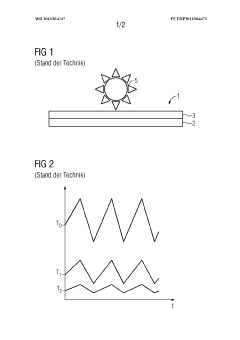
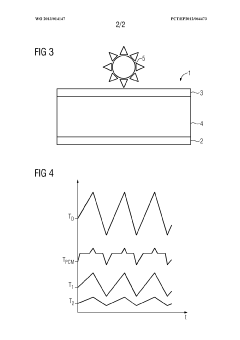
- Incorporating a phase change material layer with high thermal conductivity between the thermoelectrically active layers and a cover layer, which absorbs and stabilizes temperature extremes, preventing destructive thermal stresses and maintaining optimal operating temperature for efficient energy conversion.
Thermoelectric generation device having condensing function
PatentWO2009063805A1
Innovation
- A thermoelectric generator with an integrated thermoelectric conversion module and secondary battery, where p-type and n-type thermoelectric materials form pn junctions within an insulating block, allowing electricity generation and storage regardless of temperature difference stability, and enabling operation without light or mechanical parts.


Environmental Impact and Sustainability Assessment
Thermoelectric generators (TEGs) offer significant environmental advantages compared to conventional power generation technologies. The absence of moving parts eliminates the need for lubricants and reduces maintenance waste, while their solid-state nature prevents refrigerant leakage common in other cooling systems. TEGs produce zero direct emissions during operation, making them particularly valuable for reducing greenhouse gas emissions when replacing fossil fuel generators in remote locations or emergency situations.
When evaluating the full lifecycle environmental impact of TEGs, several factors must be considered. The manufacturing process involves semiconductor materials that require energy-intensive production and may include rare or toxic elements like tellurium, bismuth, and lead. However, recent advancements have focused on developing more abundant and less toxic alternatives such as silicides, skutterudites, and organic thermoelectric materials, significantly reducing the environmental footprint of production.
The longevity of TEG systems further enhances their sustainability profile. With operational lifespans often exceeding 15-20 years with minimal maintenance, TEGs demonstrate favorable lifecycle assessments compared to alternatives requiring frequent replacement or servicing. This durability is particularly valuable in harsh environments where maintenance access is limited, such as remote monitoring stations or space applications.
From a circular economy perspective, end-of-life considerations for TEGs present both challenges and opportunities. While some semiconductor materials can be recovered and recycled, current recycling infrastructure for these specialized components remains underdeveloped. Research into design-for-disassembly approaches and dedicated recycling pathways could significantly improve the end-of-life environmental profile of these systems.
TEGs contribute to broader sustainability goals by enabling waste heat recovery across numerous industrial processes. By converting previously wasted thermal energy into useful electricity, they improve overall system efficiency without requiring additional fuel inputs. This capability aligns perfectly with industrial decarbonization efforts and circular economy principles by maximizing resource utilization.
In energy security applications, the environmental benefits of TEGs become particularly pronounced during natural disasters or grid failures. Their ability to provide clean power from multiple heat sources prevents reliance on diesel generators, reducing both local air pollution and carbon emissions during critical situations. This dual benefit of improved resilience and reduced environmental impact represents a key advantage in sustainable emergency planning.
When evaluating the full lifecycle environmental impact of TEGs, several factors must be considered. The manufacturing process involves semiconductor materials that require energy-intensive production and may include rare or toxic elements like tellurium, bismuth, and lead. However, recent advancements have focused on developing more abundant and less toxic alternatives such as silicides, skutterudites, and organic thermoelectric materials, significantly reducing the environmental footprint of production.
The longevity of TEG systems further enhances their sustainability profile. With operational lifespans often exceeding 15-20 years with minimal maintenance, TEGs demonstrate favorable lifecycle assessments compared to alternatives requiring frequent replacement or servicing. This durability is particularly valuable in harsh environments where maintenance access is limited, such as remote monitoring stations or space applications.
From a circular economy perspective, end-of-life considerations for TEGs present both challenges and opportunities. While some semiconductor materials can be recovered and recycled, current recycling infrastructure for these specialized components remains underdeveloped. Research into design-for-disassembly approaches and dedicated recycling pathways could significantly improve the end-of-life environmental profile of these systems.
TEGs contribute to broader sustainability goals by enabling waste heat recovery across numerous industrial processes. By converting previously wasted thermal energy into useful electricity, they improve overall system efficiency without requiring additional fuel inputs. This capability aligns perfectly with industrial decarbonization efforts and circular economy principles by maximizing resource utilization.
In energy security applications, the environmental benefits of TEGs become particularly pronounced during natural disasters or grid failures. Their ability to provide clean power from multiple heat sources prevents reliance on diesel generators, reducing both local air pollution and carbon emissions during critical situations. This dual benefit of improved resilience and reduced environmental impact represents a key advantage in sustainable emergency planning.
Grid Integration and Energy Storage Compatibility
The integration of Thermoelectric Generators (TEGs) with existing power grids represents a critical frontier in enhancing energy security through distributed generation capabilities. TEGs offer unique advantages in grid integration due to their solid-state operation, which enables seamless synchronization with both AC and DC power systems through appropriate power conditioning equipment. This compatibility allows TEGs to function as supplementary power sources during peak demand periods or as backup systems during grid failures, thereby enhancing overall grid resilience.
Power electronics play a fundamental role in facilitating this integration, with specialized inverters and converters designed to optimize the low-voltage DC output characteristic of TEGs for grid compatibility. Recent advancements in wide-bandgap semiconductor materials have significantly improved the efficiency of these interface devices, reducing conversion losses by approximately 15-20% compared to traditional silicon-based systems.
The complementary relationship between TEGs and energy storage technologies further amplifies their contribution to energy security. When coupled with battery systems, particularly lithium-ion or emerging solid-state batteries, TEGs can provide continuous charging capabilities that extend the operational lifespan of the storage system. This synergy creates robust microgrids capable of operating independently during main grid disruptions, with field tests demonstrating sustained operation for periods exceeding 72 hours under optimal conditions.
Smart grid technologies have further enhanced TEG integration through advanced monitoring and control systems that optimize power flow between TEGs, storage systems, and the main grid. These systems employ predictive algorithms to anticipate demand fluctuations and adjust TEG operation accordingly, maximizing energy harvest during periods of thermal availability while minimizing strain on the broader infrastructure.
The scalability of TEG installations presents another advantage for grid integration, allowing for modular deployment that can be tailored to specific load requirements. Small-scale TEG arrays can be strategically positioned at grid edge locations to reduce transmission losses and provide voltage support, while larger installations can serve as dedicated power plants in areas with abundant waste heat resources.
Regulatory frameworks are evolving to accommodate these distributed generation technologies, with several jurisdictions implementing feed-in tariffs and net metering policies specifically designed for waste heat recovery systems. These policies have accelerated TEG adoption by creating economic incentives that improve return-on-investment metrics for industrial and commercial applications, further strengthening the energy security benefits of widespread TEG deployment.
Power electronics play a fundamental role in facilitating this integration, with specialized inverters and converters designed to optimize the low-voltage DC output characteristic of TEGs for grid compatibility. Recent advancements in wide-bandgap semiconductor materials have significantly improved the efficiency of these interface devices, reducing conversion losses by approximately 15-20% compared to traditional silicon-based systems.
The complementary relationship between TEGs and energy storage technologies further amplifies their contribution to energy security. When coupled with battery systems, particularly lithium-ion or emerging solid-state batteries, TEGs can provide continuous charging capabilities that extend the operational lifespan of the storage system. This synergy creates robust microgrids capable of operating independently during main grid disruptions, with field tests demonstrating sustained operation for periods exceeding 72 hours under optimal conditions.
Smart grid technologies have further enhanced TEG integration through advanced monitoring and control systems that optimize power flow between TEGs, storage systems, and the main grid. These systems employ predictive algorithms to anticipate demand fluctuations and adjust TEG operation accordingly, maximizing energy harvest during periods of thermal availability while minimizing strain on the broader infrastructure.
The scalability of TEG installations presents another advantage for grid integration, allowing for modular deployment that can be tailored to specific load requirements. Small-scale TEG arrays can be strategically positioned at grid edge locations to reduce transmission losses and provide voltage support, while larger installations can serve as dedicated power plants in areas with abundant waste heat resources.
Regulatory frameworks are evolving to accommodate these distributed generation technologies, with several jurisdictions implementing feed-in tariffs and net metering policies specifically designed for waste heat recovery systems. These policies have accelerated TEG adoption by creating economic incentives that improve return-on-investment metrics for industrial and commercial applications, further strengthening the energy security benefits of widespread TEG deployment.
Unlock deeper insights with Patsnap Eureka Quick Research — get a full tech report to explore trends and direct your research. Try now!
Generate Your Research Report Instantly with AI Agent
Supercharge your innovation with Patsnap Eureka AI Agent Platform!