How to Align Front Suspension for Maximum Stability
MAR 31, 20269 MIN READ
Generate Your Research Report Instantly with AI Agent
PatSnap Eureka helps you evaluate technical feasibility & market potential.
Front Suspension Alignment Technology Background and Objectives
Front suspension alignment technology has evolved significantly since the early days of automotive engineering, transforming from basic mechanical adjustments to sophisticated computer-controlled systems. The fundamental principles of suspension geometry were established in the 1930s and 1940s, with engineers recognizing that precise wheel positioning directly impacts vehicle stability, tire wear, and handling characteristics. Early alignment procedures relied on simple mechanical gauges and manual adjustments, requiring extensive expertise and time-consuming processes.
The development of modern alignment technology accelerated during the 1970s and 1980s with the introduction of electronic measurement systems. These systems enabled more precise detection of angular deviations in camber, caster, and toe settings, while reducing human error in measurement and adjustment procedures. The integration of computer-assisted alignment equipment in the 1990s marked a revolutionary shift, allowing technicians to achieve unprecedented accuracy in suspension geometry optimization.
Contemporary front suspension alignment technology encompasses multiple interconnected parameters that collectively determine vehicle stability performance. Primary alignment angles include camber, which affects tire contact patch distribution and cornering stability; caster, which influences steering returnability and straight-line tracking; and toe settings, which impact tire wear patterns and directional control. Secondary parameters such as steering axis inclination, included angle, and thrust angle contribute to overall suspension geometry optimization.
The primary objective of advanced front suspension alignment is to achieve maximum vehicle stability across diverse operating conditions while maintaining optimal tire performance and component longevity. This involves establishing precise geometric relationships between suspension components that ensure consistent tire contact with road surfaces, minimize unwanted steering inputs, and provide predictable vehicle response characteristics during acceleration, braking, and cornering maneuvers.
Modern alignment technology aims to address the increasing complexity of contemporary vehicle designs, including independent suspension systems, electronic stability control integration, and advanced driver assistance systems. The objective extends beyond traditional static alignment to encompass dynamic behavior optimization, ensuring that suspension geometry remains effective under varying load conditions, speed ranges, and environmental factors that influence vehicle stability performance.
The development of modern alignment technology accelerated during the 1970s and 1980s with the introduction of electronic measurement systems. These systems enabled more precise detection of angular deviations in camber, caster, and toe settings, while reducing human error in measurement and adjustment procedures. The integration of computer-assisted alignment equipment in the 1990s marked a revolutionary shift, allowing technicians to achieve unprecedented accuracy in suspension geometry optimization.
Contemporary front suspension alignment technology encompasses multiple interconnected parameters that collectively determine vehicle stability performance. Primary alignment angles include camber, which affects tire contact patch distribution and cornering stability; caster, which influences steering returnability and straight-line tracking; and toe settings, which impact tire wear patterns and directional control. Secondary parameters such as steering axis inclination, included angle, and thrust angle contribute to overall suspension geometry optimization.
The primary objective of advanced front suspension alignment is to achieve maximum vehicle stability across diverse operating conditions while maintaining optimal tire performance and component longevity. This involves establishing precise geometric relationships between suspension components that ensure consistent tire contact with road surfaces, minimize unwanted steering inputs, and provide predictable vehicle response characteristics during acceleration, braking, and cornering maneuvers.
Modern alignment technology aims to address the increasing complexity of contemporary vehicle designs, including independent suspension systems, electronic stability control integration, and advanced driver assistance systems. The objective extends beyond traditional static alignment to encompass dynamic behavior optimization, ensuring that suspension geometry remains effective under varying load conditions, speed ranges, and environmental factors that influence vehicle stability performance.
Market Demand Analysis for Vehicle Stability Enhancement Systems
The global automotive industry is experiencing unprecedented demand for enhanced vehicle stability systems, driven by increasingly stringent safety regulations and consumer expectations for superior driving performance. Modern vehicles require sophisticated suspension alignment technologies to meet evolving safety standards, particularly as vehicle speeds and performance capabilities continue to advance. The integration of electronic stability control systems and advanced driver assistance features has created new requirements for precision suspension tuning.
Consumer awareness regarding vehicle safety has reached new heights, with stability-related features becoming primary purchasing considerations rather than optional add-ons. Market research indicates that buyers across all vehicle segments now prioritize stability enhancement systems, viewing them as essential safety equipment. This shift in consumer behavior has prompted manufacturers to invest heavily in advanced suspension technologies and alignment systems.
The commercial vehicle sector presents particularly strong demand for stability enhancement solutions, as fleet operators seek to reduce accident rates and insurance costs while improving driver confidence. Heavy-duty trucks and commercial transport vehicles require specialized front suspension alignment systems capable of maintaining stability under varying load conditions and diverse operating environments.
Regulatory frameworks worldwide are mandating increasingly sophisticated stability requirements for new vehicle models. European Union safety standards, North American safety regulations, and emerging market requirements are converging toward more stringent stability performance criteria. These regulatory pressures are accelerating adoption of advanced suspension alignment technologies across global automotive markets.
Emerging markets represent significant growth opportunities for vehicle stability enhancement systems, as rising disposable incomes and infrastructure development drive demand for safer, more reliable vehicles. Countries with rapidly expanding automotive industries are implementing safety standards that require advanced suspension technologies, creating substantial market potential for stability-focused solutions.
The aftermarket segment demonstrates robust demand for suspension alignment services and upgrade systems, as vehicle owners seek to improve handling characteristics and extend vehicle lifespan. Professional service providers are investing in advanced alignment equipment to meet growing customer expectations for precision suspension tuning and stability optimization.
Technological convergence between traditional mechanical systems and electronic control technologies is expanding market opportunities for integrated stability solutions. The demand for systems that combine precise mechanical alignment with real-time electronic adjustments continues to grow across passenger and commercial vehicle segments.
Consumer awareness regarding vehicle safety has reached new heights, with stability-related features becoming primary purchasing considerations rather than optional add-ons. Market research indicates that buyers across all vehicle segments now prioritize stability enhancement systems, viewing them as essential safety equipment. This shift in consumer behavior has prompted manufacturers to invest heavily in advanced suspension technologies and alignment systems.
The commercial vehicle sector presents particularly strong demand for stability enhancement solutions, as fleet operators seek to reduce accident rates and insurance costs while improving driver confidence. Heavy-duty trucks and commercial transport vehicles require specialized front suspension alignment systems capable of maintaining stability under varying load conditions and diverse operating environments.
Regulatory frameworks worldwide are mandating increasingly sophisticated stability requirements for new vehicle models. European Union safety standards, North American safety regulations, and emerging market requirements are converging toward more stringent stability performance criteria. These regulatory pressures are accelerating adoption of advanced suspension alignment technologies across global automotive markets.
Emerging markets represent significant growth opportunities for vehicle stability enhancement systems, as rising disposable incomes and infrastructure development drive demand for safer, more reliable vehicles. Countries with rapidly expanding automotive industries are implementing safety standards that require advanced suspension technologies, creating substantial market potential for stability-focused solutions.
The aftermarket segment demonstrates robust demand for suspension alignment services and upgrade systems, as vehicle owners seek to improve handling characteristics and extend vehicle lifespan. Professional service providers are investing in advanced alignment equipment to meet growing customer expectations for precision suspension tuning and stability optimization.
Technological convergence between traditional mechanical systems and electronic control technologies is expanding market opportunities for integrated stability solutions. The demand for systems that combine precise mechanical alignment with real-time electronic adjustments continues to grow across passenger and commercial vehicle segments.
Current State and Challenges in Suspension Alignment Technology
The current landscape of front suspension alignment technology presents a complex interplay of traditional methodologies and emerging digital solutions. Contemporary alignment systems predominantly rely on laser-based measurement tools and computerized wheel alignment equipment that can achieve precision within 0.1-degree tolerances. These systems measure critical parameters including camber, caster, toe angles, and thrust angles to optimize vehicle stability and handling characteristics.
Modern alignment facilities utilize advanced 3D imaging technology and wireless sensor networks to capture real-time suspension geometry data. Leading manufacturers such as Hunter Engineering, Snap-on, and Hofmann have developed sophisticated alignment platforms that integrate machine learning algorithms to compensate for measurement variations and environmental factors. These systems can process alignment data within minutes, significantly reducing service time compared to traditional manual methods.
Despite technological advances, several fundamental challenges persist in achieving optimal suspension alignment for maximum stability. Measurement accuracy remains compromised by factors including tire pressure variations, vehicle loading conditions, and suspension component wear. Environmental variables such as shop floor levelness, temperature fluctuations, and equipment calibration drift can introduce systematic errors that affect alignment precision.
The integration of electronic stability control systems and advanced driver assistance features has elevated the complexity of suspension alignment requirements. Modern vehicles demand more stringent alignment tolerances to ensure proper interaction between mechanical suspension components and electronic control systems. This evolution has created a gap between traditional alignment practices and the precision requirements of contemporary vehicle architectures.
Manufacturing tolerances in suspension components present another significant challenge. Variations in control arm geometry, strut mounting points, and subframe positioning can create alignment scenarios that fall outside standard adjustment ranges. These manufacturing inconsistencies require adaptive alignment strategies that current standardized procedures often cannot accommodate effectively.
The emergence of electric and hybrid vehicles introduces additional complexity through altered weight distribution patterns and unique suspension designs. Battery pack placement affects vehicle center of gravity and suspension loading characteristics, requiring modified alignment approaches that existing equipment and procedures may not fully address. This technological shift demands new alignment methodologies specifically tailored to electrified vehicle platforms.
Modern alignment facilities utilize advanced 3D imaging technology and wireless sensor networks to capture real-time suspension geometry data. Leading manufacturers such as Hunter Engineering, Snap-on, and Hofmann have developed sophisticated alignment platforms that integrate machine learning algorithms to compensate for measurement variations and environmental factors. These systems can process alignment data within minutes, significantly reducing service time compared to traditional manual methods.
Despite technological advances, several fundamental challenges persist in achieving optimal suspension alignment for maximum stability. Measurement accuracy remains compromised by factors including tire pressure variations, vehicle loading conditions, and suspension component wear. Environmental variables such as shop floor levelness, temperature fluctuations, and equipment calibration drift can introduce systematic errors that affect alignment precision.
The integration of electronic stability control systems and advanced driver assistance features has elevated the complexity of suspension alignment requirements. Modern vehicles demand more stringent alignment tolerances to ensure proper interaction between mechanical suspension components and electronic control systems. This evolution has created a gap between traditional alignment practices and the precision requirements of contemporary vehicle architectures.
Manufacturing tolerances in suspension components present another significant challenge. Variations in control arm geometry, strut mounting points, and subframe positioning can create alignment scenarios that fall outside standard adjustment ranges. These manufacturing inconsistencies require adaptive alignment strategies that current standardized procedures often cannot accommodate effectively.
The emergence of electric and hybrid vehicles introduces additional complexity through altered weight distribution patterns and unique suspension designs. Battery pack placement affects vehicle center of gravity and suspension loading characteristics, requiring modified alignment approaches that existing equipment and procedures may not fully address. This technological shift demands new alignment methodologies specifically tailored to electrified vehicle platforms.
Current Technical Solutions for Optimal Front Suspension Alignment
01 Stabilizer bar and anti-roll mechanisms
Front suspension stability can be enhanced through the implementation of stabilizer bars and anti-roll mechanisms that reduce body roll during cornering and improve vehicle handling. These systems connect the left and right suspension components to distribute forces more evenly across the front axle. The stabilizer bar works by resisting the twisting motion that occurs when one wheel moves differently from the other, thereby maintaining better contact between tires and road surface. Advanced designs incorporate adjustable stiffness settings to optimize performance under various driving conditions.- Stabilizer bar and anti-roll mechanisms: Front suspension stability can be enhanced through the implementation of stabilizer bars and anti-roll mechanisms that reduce body roll during cornering and improve vehicle handling. These systems connect the left and right suspension components to distribute forces more evenly across the front axle. The stabilizer bar works by resisting the twisting motion that occurs when one wheel moves differently from the other, thereby maintaining better contact between tires and road surface.
- Geometry optimization and kingpin design: The geometric configuration of front suspension components, including kingpin inclination angle, caster angle, and camber settings, plays a crucial role in maintaining stability. Proper geometry ensures optimal tire contact patch, reduces steering effort, and improves directional stability during acceleration and braking. Advanced designs incorporate adjustable parameters to accommodate different loading conditions and driving scenarios.
- Damping and shock absorption systems: Enhanced damping mechanisms and shock absorber technologies contribute significantly to front suspension stability by controlling oscillations and vibrations. These systems manage the compression and rebound movements of the suspension, preventing excessive bouncing and maintaining consistent tire contact with the road. Advanced damping solutions can adapt to varying road conditions and vehicle speeds to optimize stability performance.
- Structural reinforcement and mounting systems: The structural integrity of front suspension mounting points and reinforcement of connection areas are essential for maintaining stability under various load conditions. Robust mounting systems reduce flex and deformation during dynamic maneuvers, ensuring consistent suspension geometry. These designs often incorporate high-strength materials and optimized stress distribution to enhance durability and performance.
- Active control and electronic stability systems: Modern front suspension stability solutions incorporate active control systems and electronic components that continuously monitor and adjust suspension parameters in real-time. These systems utilize sensors and actuators to respond to driving conditions, vehicle dynamics, and driver inputs. Integration with electronic stability control allows for coordinated adjustments that enhance overall vehicle stability and safety.
02 Geometry optimization and kingpin inclination
Suspension geometry plays a critical role in front suspension stability through proper configuration of kingpin inclination angle, caster angle, and camber settings. Optimized geometry ensures that steering forces are properly balanced and that the suspension maintains appropriate wheel alignment throughout its travel range. This approach focuses on the spatial relationship between suspension pivot points and wheel centers to achieve self-centering steering characteristics and minimize tire scrub. Proper geometry design also contributes to predictable handling behavior and reduced steering effort.Expand Specific Solutions03 Damping and shock absorber systems
Advanced damping systems are essential for controlling suspension movement and maintaining front suspension stability by managing the rate of compression and rebound. These systems utilize hydraulic or gas-charged shock absorbers with carefully calibrated valving to control oscillations and prevent excessive body motion. Modern implementations may include variable damping rates that adapt to road conditions and driving dynamics. Proper damping ensures that the suspension can respond quickly to road irregularities while maintaining tire contact and preventing resonance.Expand Specific Solutions04 Bushing and mounting compliance control
The use of specially designed bushings and mounting systems with controlled compliance characteristics helps isolate vibrations while maintaining precise suspension geometry for improved stability. These components provide a balance between flexibility for comfort and rigidity for handling precision. Strategic placement and material selection of bushings can influence suspension kinematics and reduce unwanted movement under load. Compliance control also helps manage noise, vibration, and harshness while preserving steering response and directional stability.Expand Specific Solutions05 Multi-link and independent suspension configurations
Independent front suspension designs utilizing multi-link configurations provide enhanced stability by allowing each wheel to react independently to road conditions while maintaining optimal geometry. These systems employ multiple control arms and links arranged to precisely control wheel motion in all directions. The independent nature of these suspensions prevents disturbances from one wheel from directly affecting the other, resulting in improved ride quality and handling. Advanced multi-link designs can be tuned to provide specific handling characteristics while maintaining stability across a wide range of operating conditions.Expand Specific Solutions
Major Players in Automotive Suspension and Alignment Industry
The front suspension alignment technology market represents a mature automotive sector experiencing steady evolution driven by advanced vehicle dynamics requirements and autonomous driving integration. The industry operates within a multi-billion dollar global automotive market, with established players like Honda Motor Co., Toyota Motor Corp., and Ford Global Technologies LLC leading traditional alignment methodologies, while companies such as BYD Co., SAIC Motor Corp., and Beijing Electric Vehicle Co. are advancing electric vehicle-specific suspension technologies. Technology maturity varies significantly, with conventional mechanical alignment systems being well-established, while adaptive and electronically-controlled suspension alignment represents emerging frontiers. Tier-1 suppliers like Robert Bosch GmbH and NSK Ltd. provide sophisticated sensor and actuator technologies, while research institutions including Jiangsu University and Hefei University of Technology contribute fundamental research. The competitive landscape shows convergence between traditional automotive manufacturers and new energy vehicle companies, indicating technology transition toward intelligent, adaptive suspension systems that optimize stability through real-time adjustments rather than static alignment parameters.
Honda Motor Co., Ltd.
Technical Solution: Honda implements a sophisticated double-wishbone front suspension design in their performance vehicles, featuring precise alignment specifications with optimized kingpin inclination angles and scrub radius calculations. Their suspension alignment methodology focuses on achieving neutral steering characteristics through careful tuning of suspension geometry parameters. Honda's approach includes the use of compliance bushings and advanced materials to maintain alignment stability under dynamic loading conditions. The company's VTEC technology integration extends to suspension systems, providing variable damping characteristics that adapt to driving conditions while maintaining optimal wheel alignment for maximum stability and handling precision.
Strengths: Innovative engineering solutions, excellent handling characteristics, strong focus on driver engagement and stability. Weaknesses: Limited to specific vehicle segments, may prioritize performance over comfort in some applications.
Toyota Motor Corp.
Technical Solution: Toyota employs advanced MacPherson strut front suspension systems with optimized geometry parameters including precise caster angle (typically 2-4 degrees), camber angle (-0.5 to -1.5 degrees), and toe settings (0.1-0.3 degrees toe-in) for maximum stability. Their suspension alignment technology incorporates adaptive damping control systems and electronic stability management that continuously monitors wheel alignment parameters through integrated sensors. The company utilizes computer-aided suspension geometry optimization and real-time alignment adjustment capabilities in their premium vehicles like Lexus models, ensuring optimal contact patch distribution and enhanced directional stability during various driving conditions.
Strengths: Industry-leading reliability and precision in suspension systems, extensive R&D capabilities, proven track record in stability optimization. Weaknesses: Higher manufacturing costs, complex systems may require specialized maintenance expertise.
Core Technologies in Precision Suspension Geometry Control
Front suspension device
PatentActiveIN2939CHE2014A
Innovation
- A front suspension device with arm support points at two longitudinal locations on the vehicle body, where the rear support point is ahead of the axle, and the swing axis is angled upward, reducing toe-out changes and allowing a wider operational range for the axle, while minimizing component count and weight.


Suspension and insulator of the same
PatentInactiveUS7370869B2
Innovation
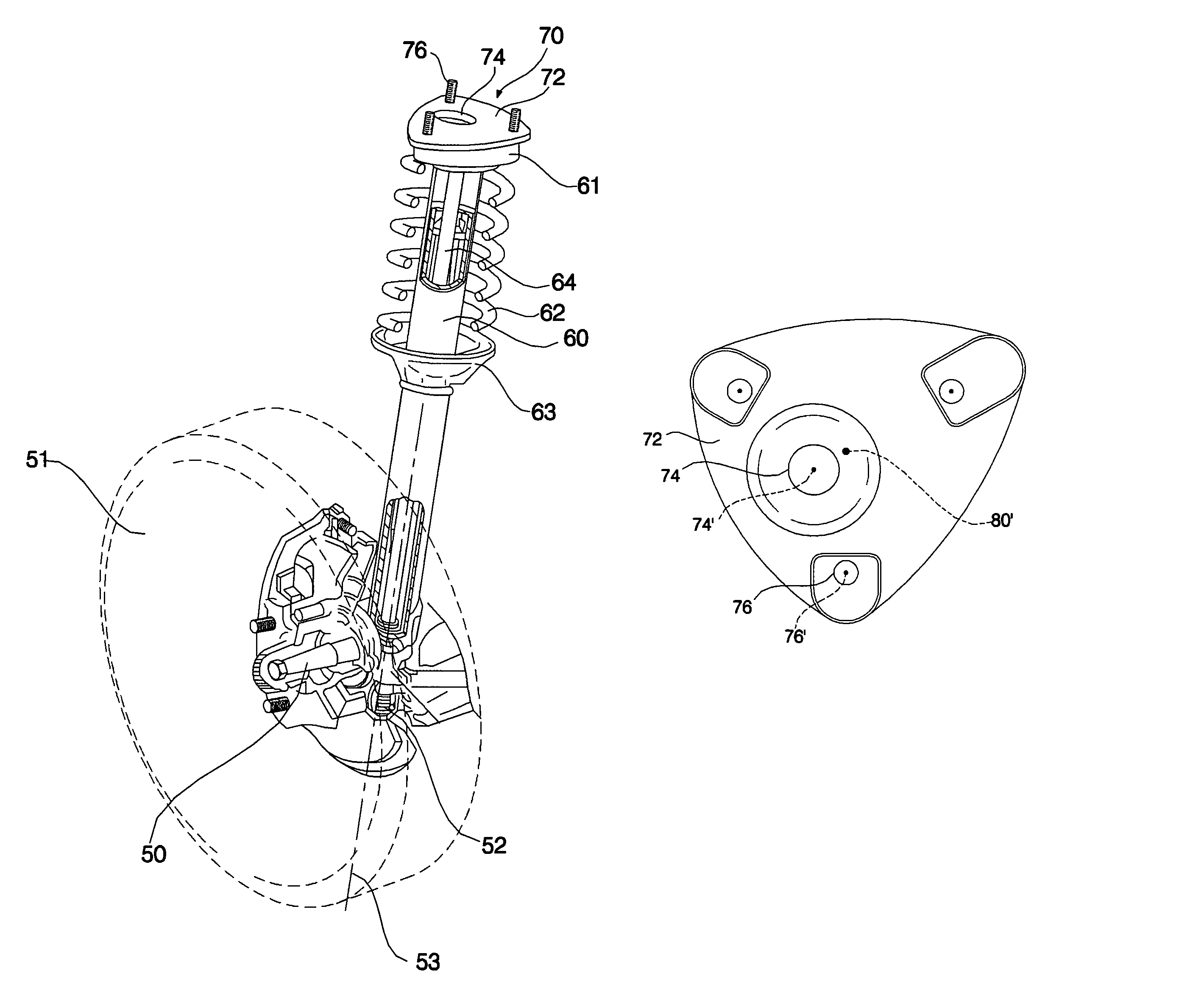
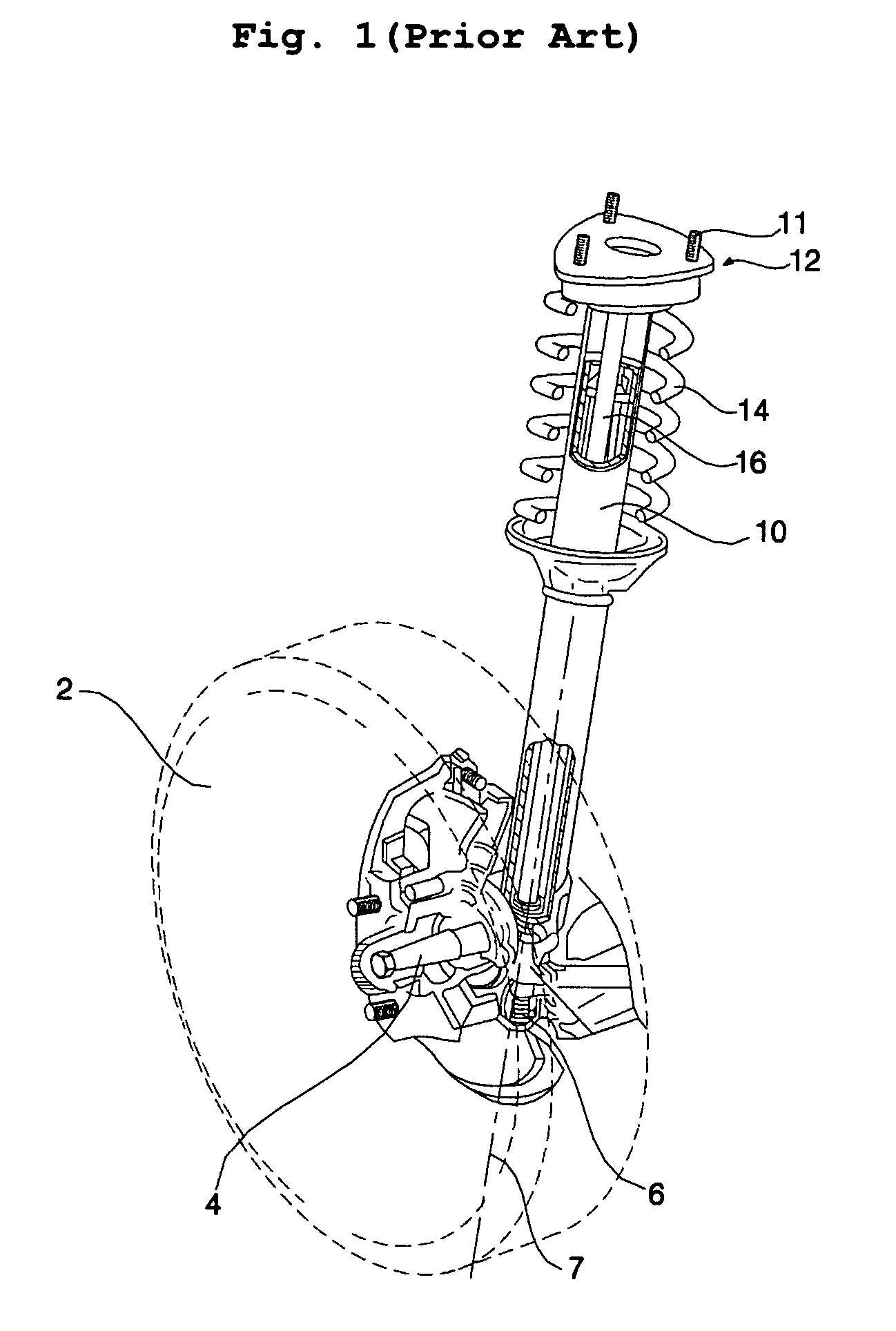
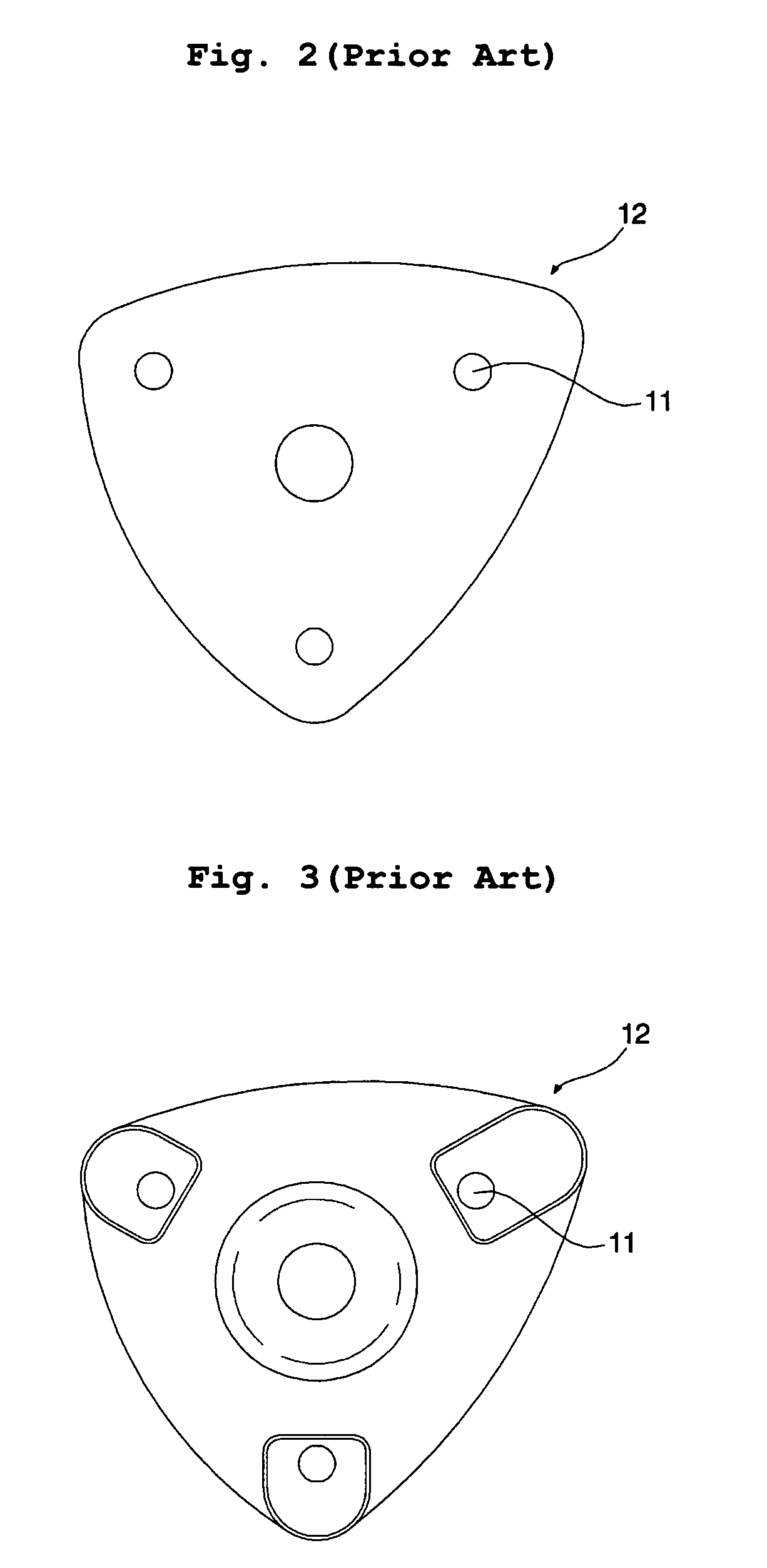
- A suspension system with an insulator that allows adjustment of the caster angle by rotating a strut point eccentric to the center of a circle formed by car body points, enabling the strut to tilt forward or backward, thereby changing the caster angle without modifying the suspension structure, using a strut point positioned inside the circle and connected by uniformly spaced car body points.

Safety Standards and Regulations for Vehicle Suspension Systems
Vehicle suspension systems operate under stringent safety frameworks established by multiple regulatory bodies worldwide. The Federal Motor Vehicle Safety Standards (FMVSS) in the United States, particularly FMVSS 105 and 126, define critical requirements for suspension component performance and durability. These standards mandate specific testing protocols for suspension alignment tolerances, ensuring that front suspension systems maintain stability parameters within acceptable ranges during various operating conditions.
The European Union's ECE regulations, specifically ECE R13 and R79, establish comprehensive guidelines for suspension system safety and electronic stability control integration. These regulations require suspension alignment systems to maintain precise geometric relationships between components, with particular emphasis on caster, camber, and toe specifications that directly impact vehicle stability. Compliance testing must demonstrate consistent performance across temperature variations and load conditions.
ISO 26262 functional safety standards have become increasingly relevant for modern suspension systems incorporating electronic alignment assistance. This standard requires rigorous hazard analysis and risk assessment for any electronic components involved in suspension alignment processes. Safety integrity levels must be established for alignment sensors and automated adjustment mechanisms to prevent systematic failures that could compromise vehicle stability.
Regional variations in safety requirements present additional complexity for global manufacturers. Japanese JIS standards emphasize different testing methodologies for suspension durability, while Chinese GB standards incorporate specific requirements for electric vehicle suspension systems. These variations necessitate comprehensive compliance strategies that address multiple regulatory frameworks simultaneously.
Recent regulatory developments focus on advanced driver assistance systems integration with suspension alignment. New standards require suspension systems to maintain stability performance even when electronic stability control systems are active, creating more stringent alignment precision requirements. Additionally, emerging regulations address the safety implications of adaptive suspension systems that can alter alignment characteristics in real-time.
Certification processes typically involve extensive testing protocols including dynamic stability assessments, component fatigue analysis, and environmental durability validation. Manufacturers must demonstrate that suspension alignment procedures and equipment meet these safety standards through documented testing and quality assurance programs, ensuring consistent vehicle stability performance throughout the product lifecycle.
The European Union's ECE regulations, specifically ECE R13 and R79, establish comprehensive guidelines for suspension system safety and electronic stability control integration. These regulations require suspension alignment systems to maintain precise geometric relationships between components, with particular emphasis on caster, camber, and toe specifications that directly impact vehicle stability. Compliance testing must demonstrate consistent performance across temperature variations and load conditions.
ISO 26262 functional safety standards have become increasingly relevant for modern suspension systems incorporating electronic alignment assistance. This standard requires rigorous hazard analysis and risk assessment for any electronic components involved in suspension alignment processes. Safety integrity levels must be established for alignment sensors and automated adjustment mechanisms to prevent systematic failures that could compromise vehicle stability.
Regional variations in safety requirements present additional complexity for global manufacturers. Japanese JIS standards emphasize different testing methodologies for suspension durability, while Chinese GB standards incorporate specific requirements for electric vehicle suspension systems. These variations necessitate comprehensive compliance strategies that address multiple regulatory frameworks simultaneously.
Recent regulatory developments focus on advanced driver assistance systems integration with suspension alignment. New standards require suspension systems to maintain stability performance even when electronic stability control systems are active, creating more stringent alignment precision requirements. Additionally, emerging regulations address the safety implications of adaptive suspension systems that can alter alignment characteristics in real-time.
Certification processes typically involve extensive testing protocols including dynamic stability assessments, component fatigue analysis, and environmental durability validation. Manufacturers must demonstrate that suspension alignment procedures and equipment meet these safety standards through documented testing and quality assurance programs, ensuring consistent vehicle stability performance throughout the product lifecycle.
Real-time Alignment Monitoring and Adjustment Technologies
Real-time alignment monitoring and adjustment technologies represent a paradigm shift in automotive suspension management, moving beyond traditional static alignment procedures to dynamic, continuous optimization systems. These advanced technologies integrate sophisticated sensor networks, artificial intelligence algorithms, and automated adjustment mechanisms to maintain optimal front suspension alignment parameters during vehicle operation.
The foundation of real-time monitoring systems relies on multi-axis accelerometers, gyroscopic sensors, and strain gauges strategically positioned throughout the suspension assembly. These sensors continuously capture data on wheel positioning, camber angles, caster measurements, and toe settings while the vehicle is in motion. Advanced magnetostrictive position sensors and optical encoders provide precise measurements with accuracy levels reaching 0.01-degree resolution, enabling detection of minute alignment deviations that could compromise stability.
Machine learning algorithms process the continuous sensor data streams, comparing real-time measurements against optimal alignment parameters for current driving conditions. These systems account for variables such as vehicle speed, road surface conditions, load distribution, and cornering forces to determine ideal alignment settings dynamically. The algorithms can predict alignment drift patterns and proactively adjust parameters before stability degradation occurs.
Automated adjustment mechanisms employ electronically controlled actuators integrated into suspension components. Piezoelectric actuators and servo-controlled adjustment systems can modify camber, caster, and toe angles within milliseconds of receiving correction commands. Some advanced systems utilize magnetorheological dampers and electronically controlled air springs to achieve real-time geometry adjustments while maintaining ride comfort.
Current implementations include BMW's Dynamic Stability Control integration with active suspension systems and Audi's predictive active suspension technology. These systems demonstrate the practical viability of real-time alignment adjustment, though widespread adoption remains limited by cost considerations and system complexity.
The technology's evolution toward fully autonomous alignment management promises significant improvements in vehicle stability, tire wear reduction, and overall safety performance through continuous optimization of suspension geometry parameters.
The foundation of real-time monitoring systems relies on multi-axis accelerometers, gyroscopic sensors, and strain gauges strategically positioned throughout the suspension assembly. These sensors continuously capture data on wheel positioning, camber angles, caster measurements, and toe settings while the vehicle is in motion. Advanced magnetostrictive position sensors and optical encoders provide precise measurements with accuracy levels reaching 0.01-degree resolution, enabling detection of minute alignment deviations that could compromise stability.
Machine learning algorithms process the continuous sensor data streams, comparing real-time measurements against optimal alignment parameters for current driving conditions. These systems account for variables such as vehicle speed, road surface conditions, load distribution, and cornering forces to determine ideal alignment settings dynamically. The algorithms can predict alignment drift patterns and proactively adjust parameters before stability degradation occurs.
Automated adjustment mechanisms employ electronically controlled actuators integrated into suspension components. Piezoelectric actuators and servo-controlled adjustment systems can modify camber, caster, and toe angles within milliseconds of receiving correction commands. Some advanced systems utilize magnetorheological dampers and electronically controlled air springs to achieve real-time geometry adjustments while maintaining ride comfort.
Current implementations include BMW's Dynamic Stability Control integration with active suspension systems and Audi's predictive active suspension technology. These systems demonstrate the practical viability of real-time alignment adjustment, though widespread adoption remains limited by cost considerations and system complexity.
The technology's evolution toward fully autonomous alignment management promises significant improvements in vehicle stability, tire wear reduction, and overall safety performance through continuous optimization of suspension geometry parameters.
Unlock deeper insights with PatSnap Eureka Quick Research — get a full tech report to explore trends and direct your research. Try now!
Generate Your Research Report Instantly with AI Agent
Supercharge your innovation with PatSnap Eureka AI Agent Platform!