How to Differentiate Enol from Keto Using FTIR
MAR 6, 20268 MIN READ
Generate Your Research Report Instantly with AI Agent
PatSnap Eureka helps you evaluate technical feasibility & market potential.
FTIR Tautomerism Analysis Background and Objectives
Tautomerism represents one of the most fundamental phenomena in organic chemistry, involving the rapid interconversion between structural isomers that differ in the position of a proton and a double bond. The keto-enol tautomerism, characterized by the equilibrium between carbonyl compounds and their corresponding enol forms, plays a crucial role in numerous chemical and biological processes. This dynamic equilibrium significantly influences molecular reactivity, stability, and biological activity across diverse chemical systems.
The historical development of tautomerism analysis has evolved from classical wet chemistry methods to sophisticated spectroscopic techniques. Early detection methods relied primarily on chemical derivatization and indirect analytical approaches, which often provided limited structural information and required substantial sample quantities. The advent of infrared spectroscopy revolutionized this field by enabling direct, non-destructive analysis of tautomeric forms in their native states.
Fourier Transform Infrared (FTIR) spectroscopy has emerged as a premier analytical technique for tautomerism studies due to its exceptional sensitivity to molecular vibrations and hydrogen bonding patterns. The technique's ability to detect subtle changes in bond characteristics, particularly C=O stretching frequencies and O-H vibrations, makes it uniquely suited for distinguishing between keto and enol tautomers. Modern FTIR instruments offer enhanced resolution, improved signal-to-noise ratios, and advanced data processing capabilities that enable precise identification of tautomeric species.
The primary objective of developing robust FTIR-based differentiation methods centers on establishing reliable spectroscopic markers that can unambiguously identify keto versus enol forms. This involves comprehensive characterization of diagnostic vibrational frequencies, including carbonyl stretching modes, hydroxyl group vibrations, and C-C double bond characteristics. Advanced spectral analysis techniques, including peak deconvolution and multivariate analysis, are being integrated to enhance discrimination capabilities.
Contemporary research aims to expand the applicability of FTIR tautomerism analysis across diverse molecular systems, from simple β-dicarbonyl compounds to complex pharmaceutical intermediates and natural products. The development of standardized analytical protocols, coupled with machine learning approaches for spectral interpretation, represents a significant advancement toward automated tautomer identification and quantification in both research and industrial applications.
The historical development of tautomerism analysis has evolved from classical wet chemistry methods to sophisticated spectroscopic techniques. Early detection methods relied primarily on chemical derivatization and indirect analytical approaches, which often provided limited structural information and required substantial sample quantities. The advent of infrared spectroscopy revolutionized this field by enabling direct, non-destructive analysis of tautomeric forms in their native states.
Fourier Transform Infrared (FTIR) spectroscopy has emerged as a premier analytical technique for tautomerism studies due to its exceptional sensitivity to molecular vibrations and hydrogen bonding patterns. The technique's ability to detect subtle changes in bond characteristics, particularly C=O stretching frequencies and O-H vibrations, makes it uniquely suited for distinguishing between keto and enol tautomers. Modern FTIR instruments offer enhanced resolution, improved signal-to-noise ratios, and advanced data processing capabilities that enable precise identification of tautomeric species.
The primary objective of developing robust FTIR-based differentiation methods centers on establishing reliable spectroscopic markers that can unambiguously identify keto versus enol forms. This involves comprehensive characterization of diagnostic vibrational frequencies, including carbonyl stretching modes, hydroxyl group vibrations, and C-C double bond characteristics. Advanced spectral analysis techniques, including peak deconvolution and multivariate analysis, are being integrated to enhance discrimination capabilities.
Contemporary research aims to expand the applicability of FTIR tautomerism analysis across diverse molecular systems, from simple β-dicarbonyl compounds to complex pharmaceutical intermediates and natural products. The development of standardized analytical protocols, coupled with machine learning approaches for spectral interpretation, represents a significant advancement toward automated tautomer identification and quantification in both research and industrial applications.
Market Demand for Enol-Keto Differentiation Solutions
The pharmaceutical industry represents the largest market segment for enol-keto differentiation solutions, driven by the critical need for tautomeric analysis in drug development and quality control. Pharmaceutical companies require precise identification of enol and keto forms to understand drug stability, bioavailability, and therapeutic efficacy. The increasing complexity of modern drug molecules and stringent regulatory requirements from agencies like FDA and EMA have intensified the demand for reliable analytical methods.
Chemical manufacturing sectors demonstrate substantial demand for these analytical solutions, particularly in fine chemicals and specialty materials production. Companies involved in catalyst development, polymer synthesis, and advanced materials manufacturing rely on accurate tautomeric identification to optimize reaction conditions and ensure product consistency. The growing emphasis on process analytical technology has further amplified the need for real-time monitoring capabilities.
Academic and research institutions constitute a significant market segment, with universities and government laboratories requiring sophisticated analytical tools for fundamental research in organic chemistry, biochemistry, and materials science. The expansion of research programs focusing on molecular dynamics and structural chemistry has created sustained demand for advanced spectroscopic techniques.
The food and beverage industry presents an emerging market opportunity, where enol-keto differentiation plays a crucial role in flavor compound analysis, food additive characterization, and quality assurance processes. Natural product companies and flavor manufacturers increasingly seek precise analytical methods to understand the chemical behavior of their products.
Environmental monitoring agencies and consulting firms represent a growing market segment, particularly for analyzing organic pollutants and their transformation products in soil and water systems. The increasing focus on environmental remediation and contamination assessment has created new applications for tautomeric analysis.
Market growth drivers include the expansion of pharmaceutical R&D activities, increasing regulatory scrutiny of chemical products, and the growing adoption of process analytical technology across industries. The trend toward green chemistry and sustainable manufacturing processes has also heightened the need for precise molecular characterization tools.
Regional demand patterns show strong growth in Asia-Pacific markets, driven by expanding pharmaceutical manufacturing and chemical production capabilities. North American and European markets remain mature but continue to demand advanced analytical solutions for high-value applications.
Chemical manufacturing sectors demonstrate substantial demand for these analytical solutions, particularly in fine chemicals and specialty materials production. Companies involved in catalyst development, polymer synthesis, and advanced materials manufacturing rely on accurate tautomeric identification to optimize reaction conditions and ensure product consistency. The growing emphasis on process analytical technology has further amplified the need for real-time monitoring capabilities.
Academic and research institutions constitute a significant market segment, with universities and government laboratories requiring sophisticated analytical tools for fundamental research in organic chemistry, biochemistry, and materials science. The expansion of research programs focusing on molecular dynamics and structural chemistry has created sustained demand for advanced spectroscopic techniques.
The food and beverage industry presents an emerging market opportunity, where enol-keto differentiation plays a crucial role in flavor compound analysis, food additive characterization, and quality assurance processes. Natural product companies and flavor manufacturers increasingly seek precise analytical methods to understand the chemical behavior of their products.
Environmental monitoring agencies and consulting firms represent a growing market segment, particularly for analyzing organic pollutants and their transformation products in soil and water systems. The increasing focus on environmental remediation and contamination assessment has created new applications for tautomeric analysis.
Market growth drivers include the expansion of pharmaceutical R&D activities, increasing regulatory scrutiny of chemical products, and the growing adoption of process analytical technology across industries. The trend toward green chemistry and sustainable manufacturing processes has also heightened the need for precise molecular characterization tools.
Regional demand patterns show strong growth in Asia-Pacific markets, driven by expanding pharmaceutical manufacturing and chemical production capabilities. North American and European markets remain mature but continue to demand advanced analytical solutions for high-value applications.
Current FTIR Limitations in Tautomer Identification
Despite significant advances in FTIR spectroscopy, several fundamental limitations persist when attempting to differentiate enol and keto tautomers. The primary challenge stems from the overlapping spectral regions where characteristic peaks of both tautomeric forms appear, particularly in the carbonyl and hydroxyl stretching regions between 1600-1800 cm⁻¹ and 2500-3500 cm⁻¹ respectively.
Spectral resolution represents a critical bottleneck in current FTIR instrumentation. Standard benchtop FTIR spectrometers typically operate at resolutions of 0.5-4 cm⁻¹, which proves insufficient for resolving closely spaced vibrational bands that distinguish subtle tautomeric differences. This limitation becomes particularly pronounced when analyzing compounds where enol and keto forms exhibit similar molecular environments or when dealing with rapid tautomeric equilibria.
Temperature-dependent spectral variations pose another significant constraint. Tautomeric equilibria are highly sensitive to temperature fluctuations, causing peak intensities and positions to shift unpredictably during measurement. Current FTIR systems often lack adequate temperature control mechanisms, leading to inconsistent results and compromised reproducibility in tautomer identification studies.
Sample preparation artifacts frequently compromise analytical accuracy. Traditional FTIR sample preparation methods, including KBr pellet formation and solution-based measurements, can inadvertently shift tautomeric equilibria through mechanical stress, solvent interactions, or moisture exposure. These preparation-induced changes mask the true tautomeric distribution present in the original sample.
Matrix interference effects significantly complicate spectral interpretation in complex samples. When analyzing tautomeric compounds within biological matrices or industrial formulations, overlapping absorption bands from co-existing molecules obscure the diagnostic peaks necessary for reliable enol-keto differentiation. Current background subtraction algorithms often prove inadequate for eliminating these interference patterns.
Detection sensitivity limitations restrict analysis to relatively high concentration samples. Many tautomeric systems exist in dynamic equilibrium with one form present in trace quantities. Conventional FTIR detectors lack sufficient sensitivity to reliably detect and quantify minor tautomeric species, particularly when their characteristic peaks fall within noisy spectral regions or overlap with stronger absorption bands from the predominant tautomer.
Spectral resolution represents a critical bottleneck in current FTIR instrumentation. Standard benchtop FTIR spectrometers typically operate at resolutions of 0.5-4 cm⁻¹, which proves insufficient for resolving closely spaced vibrational bands that distinguish subtle tautomeric differences. This limitation becomes particularly pronounced when analyzing compounds where enol and keto forms exhibit similar molecular environments or when dealing with rapid tautomeric equilibria.
Temperature-dependent spectral variations pose another significant constraint. Tautomeric equilibria are highly sensitive to temperature fluctuations, causing peak intensities and positions to shift unpredictably during measurement. Current FTIR systems often lack adequate temperature control mechanisms, leading to inconsistent results and compromised reproducibility in tautomer identification studies.
Sample preparation artifacts frequently compromise analytical accuracy. Traditional FTIR sample preparation methods, including KBr pellet formation and solution-based measurements, can inadvertently shift tautomeric equilibria through mechanical stress, solvent interactions, or moisture exposure. These preparation-induced changes mask the true tautomeric distribution present in the original sample.
Matrix interference effects significantly complicate spectral interpretation in complex samples. When analyzing tautomeric compounds within biological matrices or industrial formulations, overlapping absorption bands from co-existing molecules obscure the diagnostic peaks necessary for reliable enol-keto differentiation. Current background subtraction algorithms often prove inadequate for eliminating these interference patterns.
Detection sensitivity limitations restrict analysis to relatively high concentration samples. Many tautomeric systems exist in dynamic equilibrium with one form present in trace quantities. Conventional FTIR detectors lack sufficient sensitivity to reliably detect and quantify minor tautomeric species, particularly when their characteristic peaks fall within noisy spectral regions or overlap with stronger absorption bands from the predominant tautomer.
Existing FTIR Methods for Keto-Enol Discrimination
01 FTIR spectroscopy for material identification and characterization
Fourier Transform Infrared (FTIR) spectroscopy is utilized as a primary analytical technique for identifying and characterizing various materials based on their unique infrared absorption patterns. This method enables differentiation between different chemical compositions, molecular structures, and functional groups present in samples. The technique provides rapid, non-destructive analysis suitable for quality control and material verification applications.- FTIR spectroscopy for material identification and characterization: Fourier Transform Infrared (FTIR) spectroscopy is utilized as a primary analytical technique for identifying and characterizing various materials based on their unique infrared absorption patterns. This method enables differentiation between different chemical compositions, molecular structures, and functional groups present in samples. The technique provides rapid, non-destructive analysis suitable for quality control and material verification applications.
- FTIR differentiation of biological samples and tissues: FTIR spectroscopy is employed for differentiating biological materials including cells, tissues, and biological fluids. The technique can distinguish between normal and abnormal tissue samples, identify cellular components, and detect biochemical changes. This application is particularly valuable in medical diagnostics and pathological analysis where precise differentiation of biological specimens is required.
- FTIR analysis for polymer and plastic differentiation: The application of FTIR spectroscopy for identifying and differentiating various polymers, plastics, and synthetic materials based on their characteristic spectral fingerprints. This technique enables sorting, classification, and quality assessment of polymer materials in manufacturing and recycling processes. The method can distinguish between different polymer types, grades, and compositions with high accuracy.
- FTIR differentiation in pharmaceutical and chemical analysis: FTIR spectroscopy is utilized for differentiating pharmaceutical compounds, active ingredients, and chemical substances. The technique enables identification of drug formulations, detection of counterfeit medications, and verification of chemical purity. This application supports quality control in pharmaceutical manufacturing and chemical processing industries by providing rapid and accurate differentiation of similar compounds.
- FTIR imaging and mapping for spatial differentiation: Advanced FTIR imaging techniques that provide spatial differentiation and chemical mapping of heterogeneous samples. This approach combines spectroscopic analysis with imaging capabilities to visualize the distribution of different components within a sample. The method enables differentiation of materials at microscopic levels and provides detailed information about compositional variations across sample surfaces.
02 FTIR differentiation of biological samples and tissues
FTIR spectroscopy is employed for differentiating biological materials including cells, tissues, and biological fluids. The technique can distinguish between normal and abnormal tissue states, identify cellular components, and detect biochemical changes. This application is particularly valuable in medical diagnostics, pathology, and biomedical research where precise differentiation of biological specimens is required.Expand Specific Solutions03 FTIR analysis for pharmaceutical and chemical compound differentiation
FTIR technology is applied to differentiate pharmaceutical formulations, active ingredients, and chemical compounds. The method enables identification of polymorphs, detection of impurities, verification of chemical purity, and authentication of drug substances. This approach supports pharmaceutical quality assurance, counterfeit detection, and regulatory compliance requirements.Expand Specific Solutions04 FTIR differentiation in polymer and material science applications
FTIR spectroscopy serves as a critical tool for differentiating polymers, plastics, and composite materials. The technique identifies polymer types, detects additives, assesses degradation, and characterizes surface modifications. Applications include material sorting, recycling processes, quality control in manufacturing, and failure analysis of polymer-based products.Expand Specific Solutions05 Advanced FTIR imaging and mapping for spatial differentiation
FTIR imaging and mapping techniques provide spatial differentiation capabilities by generating chemical maps of heterogeneous samples. This advanced approach combines spectroscopic analysis with microscopy to visualize chemical distribution across sample surfaces. The technology enables differentiation of components in complex mixtures, multilayer structures, and spatially varying compositions with high resolution.Expand Specific Solutions
Key Players in FTIR and Analytical Instrumentation
The competitive landscape for FTIR-based enol-keto differentiation represents a mature analytical chemistry field in its growth phase, driven by expanding applications across pharmaceutical, petrochemical, and materials science sectors. The market demonstrates significant scale with established players spanning major oil companies like ExxonMobil Technology & Engineering Co., Saudi Arabian Oil Co., and China Petroleum & Chemical Corp., alongside pharmaceutical giants such as Pfizer Inc. and research institutions including Sloan-Kettering Institute for Cancer Research. Technology maturity is evidenced by specialized instrument manufacturers like Horiba Ltd. and QuantaRed Technologies GmbH developing advanced FTIR systems, while academic institutions such as Peking University, Xi'an Jiaotong University, and École Polytechnique Fédérale de Lausanne contribute fundamental research. The convergence of industrial demand, established analytical protocols, and continuous technological refinement positions this field as a stable, innovation-driven market with strong growth potential across multiple application domains.
ExxonMobil Technology & Engineering Co.
Technical Solution: ExxonMobil utilizes FTIR spectroscopy for analyzing keto-enol equilibria in petroleum-derived compounds and fuel additives. Their technology focuses on identifying tautomeric forms in complex hydrocarbon mixtures using multivariate analysis techniques. The company has developed specialized sampling methods for volatile organic compounds and employs ATR-FTIR (Attenuated Total Reflectance) for direct analysis of liquid samples. Their approach includes database comparison methods and pattern recognition algorithms to differentiate between keto and enol forms in industrial chemical processes and quality control applications.
Strengths: Expertise in complex mixture analysis, robust industrial-scale implementation. Weaknesses: Primarily focused on petroleum applications, limited sensitivity for trace-level tautomer detection.
Pfizer Inc.
Technical Solution: Pfizer employs FTIR spectroscopy in pharmaceutical research for tautomer identification in drug compounds. Their approach combines traditional FTIR with chemometric analysis and machine learning algorithms to distinguish between keto and enol forms in pharmaceutical intermediates. The company has developed proprietary software that analyzes multiple spectral regions simultaneously, including carbonyl stretching frequencies and hydroxyl group vibrations. Their methodology incorporates solvent effects analysis and temperature-dependent measurements to provide comprehensive tautomeric equilibrium characterization for drug development processes.
Strengths: Extensive pharmaceutical application experience, advanced data analysis software integration. Weaknesses: Limited to pharmaceutical compounds, methodology may not be directly applicable to other chemical systems.
Core FTIR Innovations for Tautomer Detection
Infra-red spectroscopy system
PatentWO2018178669A2
Innovation
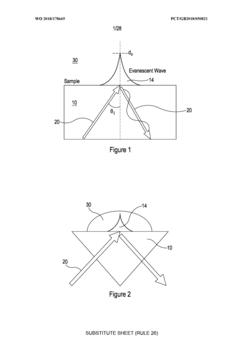
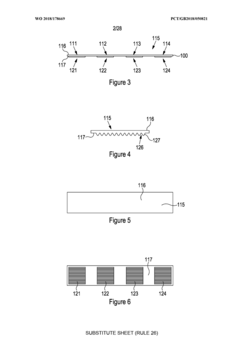
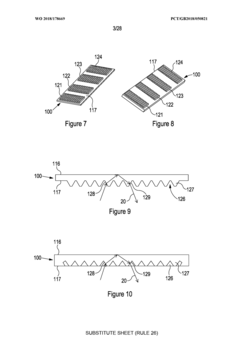
- A sample slide with multiple sample-receiving portions and integrated beam-receiving portions acting as internal reflection elements, allowing for multiple measurements without removing and replacing the slide, and the use of a disposable silicon slide to reduce costs and eliminate cleaning and drying requirements.

Analytical apparatus
PatentInactiveUS20230417713A1
Innovation
- An integrated analytical apparatus comprising a chromatographic module, mass spectrometry module, and infrared spectroscopy module, where the chromatographic module is connected in parallel to both MS and IR modules, allowing simultaneous analysis and splitting of the chromatographic flow for optimized sensitivity and speed, with a processing unit for data comparison against spectral libraries.


Analytical Method Validation Standards and Regulations
The differentiation of enol and keto tautomers using FTIR spectroscopy requires adherence to established analytical method validation standards to ensure reliable and reproducible results. International guidelines such as ICH Q2(R1), USP General Chapter <1225>, and ISO/IEC 17025 provide comprehensive frameworks for validating analytical methods in pharmaceutical and chemical analysis applications.
Method validation for FTIR-based tautomer identification must demonstrate specificity, which is particularly critical given the subtle spectral differences between enol and keto forms. The method should clearly distinguish between the characteristic O-H stretching vibrations of enol forms (typically 3200-3600 cm⁻¹) and C=O stretching of keto forms (around 1700-1750 cm⁻¹) without interference from other molecular vibrations or environmental factors.
Precision validation encompasses both repeatability and intermediate precision assessments. Repeatability studies should involve multiple measurements of the same sample under identical conditions, while intermediate precision evaluates method performance across different days, analysts, and instruments. For FTIR applications, this includes validation of spectral preprocessing techniques, baseline correction methods, and peak integration parameters.
Accuracy validation presents unique challenges for tautomeric equilibrium studies, as certified reference materials for specific enol-keto ratios are often unavailable. Alternative approaches include synthetic mixture preparation with known compositions or cross-validation with complementary analytical techniques such as NMR spectroscopy or UV-Vis spectrophotometry.
Linearity and range validation must account for the dynamic equilibrium nature of tautomeric systems. The method should demonstrate linear response across the expected concentration range while considering temperature-dependent equilibrium shifts and solvent effects that may influence tautomeric ratios.
Robustness testing should evaluate method performance under varied experimental conditions including temperature fluctuations, humidity changes, sample preparation variations, and instrumental parameters. This is particularly important for FTIR methods as environmental conditions can significantly affect both spectral quality and tautomeric equilibrium positions.
Regulatory compliance requires comprehensive documentation of validation protocols, acceptance criteria, and statistical analysis methods. The validation report must demonstrate that the FTIR method meets predetermined performance criteria and is suitable for its intended analytical purpose in tautomer differentiation studies.
Method validation for FTIR-based tautomer identification must demonstrate specificity, which is particularly critical given the subtle spectral differences between enol and keto forms. The method should clearly distinguish between the characteristic O-H stretching vibrations of enol forms (typically 3200-3600 cm⁻¹) and C=O stretching of keto forms (around 1700-1750 cm⁻¹) without interference from other molecular vibrations or environmental factors.
Precision validation encompasses both repeatability and intermediate precision assessments. Repeatability studies should involve multiple measurements of the same sample under identical conditions, while intermediate precision evaluates method performance across different days, analysts, and instruments. For FTIR applications, this includes validation of spectral preprocessing techniques, baseline correction methods, and peak integration parameters.
Accuracy validation presents unique challenges for tautomeric equilibrium studies, as certified reference materials for specific enol-keto ratios are often unavailable. Alternative approaches include synthetic mixture preparation with known compositions or cross-validation with complementary analytical techniques such as NMR spectroscopy or UV-Vis spectrophotometry.
Linearity and range validation must account for the dynamic equilibrium nature of tautomeric systems. The method should demonstrate linear response across the expected concentration range while considering temperature-dependent equilibrium shifts and solvent effects that may influence tautomeric ratios.
Robustness testing should evaluate method performance under varied experimental conditions including temperature fluctuations, humidity changes, sample preparation variations, and instrumental parameters. This is particularly important for FTIR methods as environmental conditions can significantly affect both spectral quality and tautomeric equilibrium positions.
Regulatory compliance requires comprehensive documentation of validation protocols, acceptance criteria, and statistical analysis methods. The validation report must demonstrate that the FTIR method meets predetermined performance criteria and is suitable for its intended analytical purpose in tautomer differentiation studies.
Sample Preparation and Environmental Considerations
Sample preparation represents a critical determinant in achieving reliable differentiation between enol and keto tautomers through FTIR spectroscopy. The choice of sample preparation method directly influences the tautomeric equilibrium and spectral quality. Solid-state preparations using KBr pellets or ATR techniques are preferred for compounds that exist predominantly in one tautomeric form in the crystalline state. However, care must be taken during grinding and pellet formation to avoid mechanical stress that could induce tautomeric shifts or sample degradation.
Solution-phase measurements require careful solvent selection, as different solvents can dramatically alter the enol-keto equilibrium through hydrogen bonding interactions and polarity effects. Non-polar solvents like CCl4 or cyclohexane typically favor enol forms through intramolecular hydrogen bonding, while polar protic solvents may stabilize keto forms. The concentration of analyte solutions must be optimized to avoid intermolecular interactions that could complicate spectral interpretation while maintaining sufficient signal intensity.
Environmental control during measurement is paramount for obtaining reproducible results. Temperature variations can significantly shift tautomeric equilibria, with higher temperatures generally favoring the keto form due to entropic considerations. Maintaining consistent temperature conditions, typically at room temperature (20-25°C), ensures reproducible measurements. Some applications may require temperature-controlled sample compartments or variable-temperature FTIR capabilities to study temperature-dependent tautomeric behavior.
Moisture control presents another critical consideration, as water can participate in hydrogen bonding networks that stabilize specific tautomeric forms. Dry nitrogen purging of the sample compartment and use of desiccants help eliminate atmospheric moisture interference. For hygroscopic samples, preparation and measurement under inert atmosphere conditions may be necessary.
Sample stability during measurement must be evaluated, particularly for photosensitive compounds or those prone to oxidation. Extended exposure to IR radiation can induce sample heating and potential tautomeric shifts. Rapid scanning techniques and sample rotation can minimize these effects while maintaining spectral quality for accurate tautomer identification.
Solution-phase measurements require careful solvent selection, as different solvents can dramatically alter the enol-keto equilibrium through hydrogen bonding interactions and polarity effects. Non-polar solvents like CCl4 or cyclohexane typically favor enol forms through intramolecular hydrogen bonding, while polar protic solvents may stabilize keto forms. The concentration of analyte solutions must be optimized to avoid intermolecular interactions that could complicate spectral interpretation while maintaining sufficient signal intensity.
Environmental control during measurement is paramount for obtaining reproducible results. Temperature variations can significantly shift tautomeric equilibria, with higher temperatures generally favoring the keto form due to entropic considerations. Maintaining consistent temperature conditions, typically at room temperature (20-25°C), ensures reproducible measurements. Some applications may require temperature-controlled sample compartments or variable-temperature FTIR capabilities to study temperature-dependent tautomeric behavior.
Moisture control presents another critical consideration, as water can participate in hydrogen bonding networks that stabilize specific tautomeric forms. Dry nitrogen purging of the sample compartment and use of desiccants help eliminate atmospheric moisture interference. For hygroscopic samples, preparation and measurement under inert atmosphere conditions may be necessary.
Sample stability during measurement must be evaluated, particularly for photosensitive compounds or those prone to oxidation. Extended exposure to IR radiation can induce sample heating and potential tautomeric shifts. Rapid scanning techniques and sample rotation can minimize these effects while maintaining spectral quality for accurate tautomer identification.
Unlock deeper insights with PatSnap Eureka Quick Research — get a full tech report to explore trends and direct your research. Try now!
Generate Your Research Report Instantly with AI Agent
Supercharge your innovation with PatSnap Eureka AI Agent Platform!