How to Efficiently Integrate Analog Signals with Digital Controllers
MAR 31, 20269 MIN READ
Generate Your Research Report Instantly with AI Agent
PatSnap Eureka helps you evaluate technical feasibility & market potential.
Analog-Digital Integration Background and Objectives
The integration of analog signals with digital controllers represents a fundamental challenge in modern electronic systems, bridging the gap between the continuous physical world and discrete digital processing domains. This technological convergence has become increasingly critical as industries demand higher precision, faster response times, and more sophisticated control capabilities across diverse applications ranging from industrial automation to consumer electronics.
Historically, analog and digital systems operated in separate domains, with analog circuits handling signal conditioning and digital systems managing computational tasks. The evolution began in the 1970s with the introduction of analog-to-digital converters and digital signal processors, marking the first systematic attempts to merge these technologies. The progression accelerated through the 1980s and 1990s as semiconductor manufacturing advanced, enabling more sophisticated mixed-signal integrated circuits.
The current technological landscape presents both unprecedented opportunities and complex challenges. Modern applications require seamless integration where analog sensors interface directly with digital controllers, demanding minimal latency, high accuracy, and robust noise immunity. This integration spans multiple domains including automotive systems, medical devices, telecommunications infrastructure, and industrial process control, each presenting unique requirements for signal fidelity and processing speed.
Contemporary trends indicate a shift toward system-on-chip solutions that incorporate both analog front-ends and digital processing cores on single substrates. This evolution is driven by demands for miniaturization, power efficiency, and cost reduction while maintaining or improving performance metrics. The emergence of Internet of Things applications has further intensified the need for efficient analog-digital integration, as billions of sensors require seamless connectivity to digital networks.
The primary objective of advancing analog-digital integration technology centers on achieving optimal signal conversion efficiency while minimizing power consumption and system complexity. Key targets include reducing conversion latency to sub-microsecond levels, improving signal-to-noise ratios beyond current 16-bit standards, and developing adaptive algorithms that can dynamically optimize conversion parameters based on signal characteristics.
Future technological goals encompass the development of intelligent integration systems capable of self-calibration and real-time optimization. These systems aim to automatically adjust gain, filtering, and sampling parameters to maintain optimal performance across varying environmental conditions and signal types, ultimately enabling more robust and versatile electronic systems across all application domains.
Historically, analog and digital systems operated in separate domains, with analog circuits handling signal conditioning and digital systems managing computational tasks. The evolution began in the 1970s with the introduction of analog-to-digital converters and digital signal processors, marking the first systematic attempts to merge these technologies. The progression accelerated through the 1980s and 1990s as semiconductor manufacturing advanced, enabling more sophisticated mixed-signal integrated circuits.
The current technological landscape presents both unprecedented opportunities and complex challenges. Modern applications require seamless integration where analog sensors interface directly with digital controllers, demanding minimal latency, high accuracy, and robust noise immunity. This integration spans multiple domains including automotive systems, medical devices, telecommunications infrastructure, and industrial process control, each presenting unique requirements for signal fidelity and processing speed.
Contemporary trends indicate a shift toward system-on-chip solutions that incorporate both analog front-ends and digital processing cores on single substrates. This evolution is driven by demands for miniaturization, power efficiency, and cost reduction while maintaining or improving performance metrics. The emergence of Internet of Things applications has further intensified the need for efficient analog-digital integration, as billions of sensors require seamless connectivity to digital networks.
The primary objective of advancing analog-digital integration technology centers on achieving optimal signal conversion efficiency while minimizing power consumption and system complexity. Key targets include reducing conversion latency to sub-microsecond levels, improving signal-to-noise ratios beyond current 16-bit standards, and developing adaptive algorithms that can dynamically optimize conversion parameters based on signal characteristics.
Future technological goals encompass the development of intelligent integration systems capable of self-calibration and real-time optimization. These systems aim to automatically adjust gain, filtering, and sampling parameters to maintain optimal performance across varying environmental conditions and signal types, ultimately enabling more robust and versatile electronic systems across all application domains.
Market Demand for Hybrid Signal Processing Solutions
The global market for hybrid signal processing solutions is experiencing unprecedented growth driven by the proliferation of Internet of Things devices, autonomous systems, and smart infrastructure. Industries ranging from automotive to industrial automation require sophisticated systems that can seamlessly bridge the gap between analog sensor inputs and digital control mechanisms. This convergence has created substantial demand for integrated solutions that can handle real-world analog signals while leveraging the computational power and flexibility of digital controllers.
Automotive sector represents one of the most significant demand drivers, particularly with the advancement of electric vehicles and autonomous driving technologies. Modern vehicles incorporate hundreds of sensors measuring temperature, pressure, position, and environmental conditions, all requiring efficient analog-to-digital conversion and processing. The transition toward software-defined vehicles has intensified the need for robust hybrid signal processing architectures that can handle safety-critical applications while maintaining real-time performance requirements.
Industrial automation and Industry 4.0 initiatives have generated substantial market pull for hybrid signal processing solutions. Manufacturing facilities increasingly rely on predictive maintenance systems, quality control mechanisms, and process optimization tools that depend on accurate analog signal acquisition and digital processing. The integration of machine learning algorithms with traditional control systems has created new requirements for high-speed, low-latency signal processing capabilities.
Healthcare and medical device markets present another significant growth area, where patient monitoring systems, diagnostic equipment, and therapeutic devices require precise analog signal conditioning coupled with sophisticated digital analysis. Regulatory requirements for medical devices have driven demand for highly reliable and validated hybrid signal processing solutions that can ensure patient safety while enabling advanced functionality.
The telecommunications infrastructure sector continues to expand its requirements for hybrid signal processing, particularly with 5G network deployments and edge computing implementations. Base stations, network equipment, and communication devices require efficient analog front-end processing combined with digital signal processing capabilities to handle increasing bandwidth and performance demands.
Emerging applications in renewable energy systems, smart grid technologies, and energy storage solutions have created new market segments for hybrid signal processing. These applications require precise monitoring and control of analog parameters such as voltage, current, and power quality, combined with digital communication and control algorithms for grid integration and optimization.
Market demand is increasingly focused on solutions that offer higher integration levels, reduced power consumption, and enhanced performance while maintaining cost-effectiveness. This has driven innovation toward system-on-chip architectures and advanced packaging technologies that can deliver complete hybrid signal processing solutions in compact form factors suitable for space-constrained applications.
Automotive sector represents one of the most significant demand drivers, particularly with the advancement of electric vehicles and autonomous driving technologies. Modern vehicles incorporate hundreds of sensors measuring temperature, pressure, position, and environmental conditions, all requiring efficient analog-to-digital conversion and processing. The transition toward software-defined vehicles has intensified the need for robust hybrid signal processing architectures that can handle safety-critical applications while maintaining real-time performance requirements.
Industrial automation and Industry 4.0 initiatives have generated substantial market pull for hybrid signal processing solutions. Manufacturing facilities increasingly rely on predictive maintenance systems, quality control mechanisms, and process optimization tools that depend on accurate analog signal acquisition and digital processing. The integration of machine learning algorithms with traditional control systems has created new requirements for high-speed, low-latency signal processing capabilities.
Healthcare and medical device markets present another significant growth area, where patient monitoring systems, diagnostic equipment, and therapeutic devices require precise analog signal conditioning coupled with sophisticated digital analysis. Regulatory requirements for medical devices have driven demand for highly reliable and validated hybrid signal processing solutions that can ensure patient safety while enabling advanced functionality.
The telecommunications infrastructure sector continues to expand its requirements for hybrid signal processing, particularly with 5G network deployments and edge computing implementations. Base stations, network equipment, and communication devices require efficient analog front-end processing combined with digital signal processing capabilities to handle increasing bandwidth and performance demands.
Emerging applications in renewable energy systems, smart grid technologies, and energy storage solutions have created new market segments for hybrid signal processing. These applications require precise monitoring and control of analog parameters such as voltage, current, and power quality, combined with digital communication and control algorithms for grid integration and optimization.
Market demand is increasingly focused on solutions that offer higher integration levels, reduced power consumption, and enhanced performance while maintaining cost-effectiveness. This has driven innovation toward system-on-chip architectures and advanced packaging technologies that can deliver complete hybrid signal processing solutions in compact form factors suitable for space-constrained applications.
Current ADC/DAC Integration Challenges and Limitations
The integration of analog-to-digital converters (ADCs) and digital-to-analog converters (DACs) with digital controllers faces significant technical barriers that limit system performance and efficiency. Resolution limitations represent a fundamental constraint, as most commercial ADCs operate within 12-16 bit ranges for high-speed applications, while precision applications requiring 24-bit resolution suffer from substantially reduced sampling rates. This trade-off between resolution and speed creates bottlenecks in applications demanding both high precision and rapid response times.
Sampling rate constraints pose another critical challenge, particularly in real-time control systems. High-resolution ADCs typically operate at sampling frequencies well below the Nyquist requirements for many control applications, leading to aliasing effects and signal distortion. The inherent latency introduced by successive approximation and sigma-delta conversion architectures further compounds timing issues in closed-loop control systems where microsecond-level response times are essential.
Power consumption emerges as a significant limitation in battery-powered and embedded applications. High-performance ADCs and DACs can consume substantial power, particularly when operating at maximum sampling rates and resolution. The power-performance trade-off becomes especially pronounced in multi-channel systems where multiple converters operate simultaneously, creating thermal management challenges and reducing overall system efficiency.
Signal integrity issues present complex technical hurdles in mixed-signal environments. Crosstalk between analog and digital sections, ground bounce effects, and electromagnetic interference significantly degrade conversion accuracy. The physical separation requirements between analog and digital domains often result in increased board complexity and component count, driving up system costs and design complexity.
Interface compatibility represents an ongoing challenge as digital controllers increasingly adopt advanced communication protocols while many analog sensors and actuators remain tied to traditional voltage and current signal standards. The mismatch between legacy analog interfaces and modern digital communication requirements necessitates complex bridging solutions that introduce additional latency and potential failure points.
Calibration and linearity maintenance across temperature and aging variations require sophisticated compensation algorithms that consume processing resources and complicate system design. Non-linearity errors, offset drift, and gain variations directly impact control system stability and accuracy, particularly in precision applications where sub-percent accuracy is required over extended operational periods.
Sampling rate constraints pose another critical challenge, particularly in real-time control systems. High-resolution ADCs typically operate at sampling frequencies well below the Nyquist requirements for many control applications, leading to aliasing effects and signal distortion. The inherent latency introduced by successive approximation and sigma-delta conversion architectures further compounds timing issues in closed-loop control systems where microsecond-level response times are essential.
Power consumption emerges as a significant limitation in battery-powered and embedded applications. High-performance ADCs and DACs can consume substantial power, particularly when operating at maximum sampling rates and resolution. The power-performance trade-off becomes especially pronounced in multi-channel systems where multiple converters operate simultaneously, creating thermal management challenges and reducing overall system efficiency.
Signal integrity issues present complex technical hurdles in mixed-signal environments. Crosstalk between analog and digital sections, ground bounce effects, and electromagnetic interference significantly degrade conversion accuracy. The physical separation requirements between analog and digital domains often result in increased board complexity and component count, driving up system costs and design complexity.
Interface compatibility represents an ongoing challenge as digital controllers increasingly adopt advanced communication protocols while many analog sensors and actuators remain tied to traditional voltage and current signal standards. The mismatch between legacy analog interfaces and modern digital communication requirements necessitates complex bridging solutions that introduce additional latency and potential failure points.
Calibration and linearity maintenance across temperature and aging variations require sophisticated compensation algorithms that consume processing resources and complicate system design. Non-linearity errors, offset drift, and gain variations directly impact control system stability and accuracy, particularly in precision applications where sub-percent accuracy is required over extended operational periods.
Existing ADC Integration and Interface Solutions
01 Hybrid analog-digital circuit architecture for improved integration
Integration of analog and digital circuits on a single chip through hybrid architectures that optimize the interface between analog and digital domains. This approach utilizes specialized circuit designs that minimize signal degradation during conversion while maximizing chip density and reducing power consumption. The architecture typically includes dedicated interface circuits and optimized layout strategies to reduce noise coupling between analog and digital sections.- Mixed-signal circuit architecture for improved integration: Integration of analog and digital circuits on a single chip using mixed-signal architecture improves overall system efficiency. This approach utilizes specialized circuit designs that allow analog and digital components to coexist while minimizing interference and optimizing signal conversion. The architecture includes techniques for isolating analog and digital sections, reducing noise coupling, and implementing efficient data converters that bridge the two domains.
- High-speed analog-to-digital conversion techniques: Advanced analog-to-digital converter designs enhance integration efficiency through improved conversion speed and accuracy. These techniques employ parallel processing, pipeline architectures, and optimized sampling methods to achieve faster conversion rates while maintaining signal integrity. The implementations focus on reducing conversion latency and power consumption, which are critical factors in integrated systems requiring real-time signal processing.
- Power management and optimization in integrated systems: Efficient power management strategies are employed to optimize the performance of integrated analog-digital systems. These approaches include dynamic power scaling, voltage regulation techniques, and power domain isolation to reduce overall power consumption. The methods address the different power requirements of analog and digital circuits, implementing smart power distribution and control mechanisms that adapt to varying operational conditions.
- Signal processing and noise reduction methods: Specialized signal processing techniques are implemented to enhance integration efficiency by minimizing noise and interference between analog and digital domains. These methods include filtering algorithms, error correction schemes, and calibration techniques that compensate for non-idealities in the conversion process. The approaches focus on maintaining signal quality throughout the analog-digital interface while optimizing processing speed and resource utilization.
- Integrated circuit layout and substrate isolation techniques: Physical design methodologies for integrated circuits incorporate advanced layout strategies and substrate isolation techniques to improve analog-digital integration efficiency. These techniques include guard ring structures, separate ground planes, and optimized component placement to minimize crosstalk and electromagnetic interference. The design approaches ensure proper isolation between sensitive analog circuits and noisy digital switching circuits while maximizing chip area utilization and performance.
02 Advanced analog-to-digital converter designs for enhanced efficiency
Implementation of high-performance converter circuits that improve the efficiency of analog-digital integration through novel conversion techniques. These designs focus on reducing conversion time, improving resolution, and minimizing power consumption through innovative circuit topologies and signal processing methods. The converters employ techniques such as pipelining, successive approximation, and delta-sigma modulation to achieve optimal performance.Expand Specific Solutions03 Signal processing techniques for seamless analog-digital integration
Methods for processing signals at the analog-digital interface to improve integration efficiency through filtering, buffering, and conditioning techniques. These approaches ensure signal integrity during conversion and minimize distortion and noise. The techniques include adaptive filtering, automatic gain control, and impedance matching to optimize signal transfer between domains.Expand Specific Solutions04 Power management strategies for integrated analog-digital systems
Power optimization techniques specifically designed for mixed-signal integrated circuits that balance the different power requirements of analog and digital sections. These strategies include dynamic voltage scaling, power domain isolation, and intelligent clock gating to reduce overall power consumption while maintaining performance. The methods address the challenge of managing different voltage levels and current requirements in a unified system.Expand Specific Solutions05 Layout and packaging solutions for analog-digital co-integration
Physical design methodologies and packaging technologies that facilitate efficient integration of analog and digital components on the same substrate. These solutions address issues such as substrate noise coupling, thermal management, and electromagnetic interference through careful floor planning, shielding techniques, and advanced packaging structures. The approaches enable higher integration density while maintaining signal integrity and reliability.Expand Specific Solutions
Key Players in Mixed-Signal IC and Controller Industry
The analog-to-digital signal integration market represents a mature yet rapidly evolving sector driven by increasing automation and IoT demands. The industry has reached technological maturity with established players like Texas Instruments, Analog Devices, and Infineon Technologies leading in specialized converter technologies and mixed-signal processing solutions. Market leaders such as Siemens AG and Microchip Technology demonstrate advanced integration capabilities, while semiconductor giants like Taiwan Semiconductor Manufacturing and NXP Semiconductors provide foundational manufacturing expertise. The competitive landscape spans from automotive applications (Mobileye, automotive-focused divisions) to industrial automation (Hitachi, Rohde & Schwarz) and aerospace/defense sectors (Lockheed Martin, Raytheon). Emerging players like Scalinx SASU are introducing innovative programmable conversion technologies, indicating continued technological advancement. The market shows strong growth potential across automotive, industrial IoT, and telecommunications sectors, with established companies maintaining competitive advantages through comprehensive product portfolios and specialized application expertise.
Siemens AG
Technical Solution: Siemens develops industrial automation solutions with SIMATIC controllers that integrate analog I/O modules with digital processing units. Their ET 200 distributed I/O systems feature high-resolution analog input modules with 16-bit resolution and galvanic isolation for industrial sensor interfacing. The SIMATIC S7 PLC family includes integrated analog signal processing with configurable input ranges and digital filtering capabilities. Siemens' TIA Portal engineering software provides comprehensive tools for configuring analog signal acquisition, scaling, and integration with digital control algorithms for complex industrial automation applications.
Strengths: Comprehensive industrial automation ecosystem, excellent system integration capabilities. Weaknesses: Higher system cost, primarily focused on large-scale industrial applications rather than embedded solutions.
Microchip Technology, Inc.
Technical Solution: Microchip provides PIC and AVR microcontrollers with integrated analog peripherals including 10-bit to 12-bit ADCs, DACs, and analog comparators. Their dsPIC digital signal controllers combine DSP functionality with analog signal conditioning for real-time control applications. The company's SAM series ARM-based MCUs feature advanced analog front-ends with differential inputs and programmable gain stages. Microchip's solutions include dedicated analog-to-digital converter ICs that interface directly with their microcontroller families, providing seamless hardware and software integration for embedded control systems.
Strengths: Strong microcontroller ecosystem, good price-performance ratio for mid-range applications. Weaknesses: Limited high-end analog performance, fewer advanced signal processing features.
Core Innovations in High-Speed Signal Conversion
Integrating analog-digital converter
PatentInactiveEP0675604A1
Innovation
- The design of an integrating analog-to-digital converter that uses a series connection of an analog integrator, A/D converter, and synchronous sampling, with a D/A converter in feedback, allowing for freely selectable integration time and high accuracy, while using a simple three-point or five-point controller to manage quantization levels and pulse width modulation for efficient signal transmission.


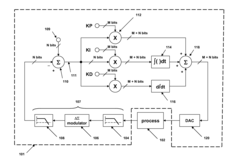
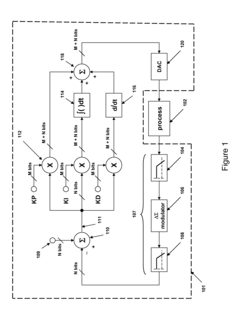
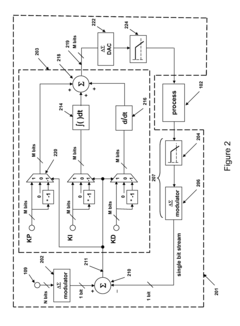
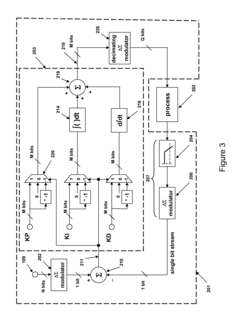
Oversampling PID Controller for Integration with a Delta-Sigma Analog-to-Digital Converter
PatentActiveUS20090237282A1
Innovation
- A digital controller structure employing a delta-sigma modulator to produce one-bit signals for measured and set-point values, using subtraction to calculate control signals, eliminating the need for multi-bit multiplications by utilizing a control block with multiplexers to select partial sums based on control error signals.
EMC Compliance Standards for Mixed-Signal Systems
EMC compliance standards for mixed-signal systems represent a critical regulatory framework that governs the electromagnetic compatibility requirements for devices integrating both analog and digital signal processing components. These standards ensure that mixed-signal systems can operate effectively in their intended electromagnetic environment without causing or experiencing harmful interference.
The primary international standards governing mixed-signal EMC compliance include IEC 61000 series, CISPR standards, and regional regulations such as FCC Part 15 in North America and EN 55032 in Europe. These frameworks establish emission limits for conducted and radiated electromagnetic interference, while also defining immunity requirements against external electromagnetic disturbances that could compromise system functionality.
Mixed-signal systems face unique EMC challenges due to the inherent interaction between analog and digital domains. Digital switching activities generate broadband noise that can interfere with sensitive analog circuits, while analog signal paths may act as antennas for external interference. Compliance standards specifically address these interactions through stringent requirements for harmonic emissions, spurious signals, and susceptibility thresholds.
Testing methodologies for mixed-signal EMC compliance involve specialized procedures that account for both operational modes. Standards mandate testing under various system states, including active signal processing, standby modes, and transient conditions. Measurement techniques must consider the dynamic nature of mixed-signal operations, requiring sophisticated test setups that can capture intermittent emissions and assess immunity during critical analog-to-digital conversion processes.
Recent updates to EMC standards have incorporated provisions for modern mixed-signal architectures, including requirements for software-defined radio systems, IoT devices, and high-speed data converters. These evolving standards address emerging challenges such as wideband interference, cognitive radio compatibility, and the increasing density of mixed-signal integration in compact form factors.
Compliance verification requires comprehensive documentation demonstrating adherence to applicable standards, including detailed test reports, design validation procedures, and risk assessment documentation. Manufacturers must establish robust quality management systems that ensure consistent EMC performance throughout product lifecycles while maintaining traceability to relevant standard requirements.
The primary international standards governing mixed-signal EMC compliance include IEC 61000 series, CISPR standards, and regional regulations such as FCC Part 15 in North America and EN 55032 in Europe. These frameworks establish emission limits for conducted and radiated electromagnetic interference, while also defining immunity requirements against external electromagnetic disturbances that could compromise system functionality.
Mixed-signal systems face unique EMC challenges due to the inherent interaction between analog and digital domains. Digital switching activities generate broadband noise that can interfere with sensitive analog circuits, while analog signal paths may act as antennas for external interference. Compliance standards specifically address these interactions through stringent requirements for harmonic emissions, spurious signals, and susceptibility thresholds.
Testing methodologies for mixed-signal EMC compliance involve specialized procedures that account for both operational modes. Standards mandate testing under various system states, including active signal processing, standby modes, and transient conditions. Measurement techniques must consider the dynamic nature of mixed-signal operations, requiring sophisticated test setups that can capture intermittent emissions and assess immunity during critical analog-to-digital conversion processes.
Recent updates to EMC standards have incorporated provisions for modern mixed-signal architectures, including requirements for software-defined radio systems, IoT devices, and high-speed data converters. These evolving standards address emerging challenges such as wideband interference, cognitive radio compatibility, and the increasing density of mixed-signal integration in compact form factors.
Compliance verification requires comprehensive documentation demonstrating adherence to applicable standards, including detailed test reports, design validation procedures, and risk assessment documentation. Manufacturers must establish robust quality management systems that ensure consistent EMC performance throughout product lifecycles while maintaining traceability to relevant standard requirements.
Power Efficiency Optimization in Hybrid Controllers
Power efficiency optimization represents a critical design consideration in hybrid controllers that integrate analog and digital signal processing capabilities. The fundamental challenge lies in managing the inherently different power consumption characteristics of analog and digital components while maintaining optimal system performance. Analog circuits typically exhibit continuous power draw with voltage-dependent consumption patterns, whereas digital controllers demonstrate discrete switching behaviors that create dynamic power profiles.
The primary approach to power optimization involves implementing adaptive power management strategies that dynamically adjust operating parameters based on real-time system demands. This includes selective activation of analog front-end circuits, where unused signal conditioning paths are powered down during idle periods. Advanced hybrid controllers employ intelligent duty cycling mechanisms that coordinate between analog sampling phases and digital processing intervals to minimize overall energy consumption.
Clock domain optimization plays a pivotal role in reducing power dissipation across the analog-digital interface. By implementing asynchronous clock generation schemes and variable frequency scaling, hybrid controllers can significantly reduce switching losses during signal conversion processes. The strategic placement of power islands allows independent voltage scaling for different functional blocks, enabling fine-grained control over power distribution based on computational requirements.
Voltage regulation techniques specifically designed for hybrid architectures incorporate multi-rail power delivery systems that provide optimized supply voltages for both analog and digital domains. These systems utilize adaptive voltage scaling algorithms that monitor signal integrity requirements and adjust supply levels accordingly, ensuring minimal power consumption while maintaining acceptable noise margins.
Advanced power gating strategies enable selective shutdown of unused analog signal paths and digital processing units during low-activity periods. This approach requires sophisticated wake-up mechanisms that can rapidly restore full functionality when signal processing demands increase, minimizing latency penalties associated with power state transitions.
The integration of energy harvesting capabilities and power-aware scheduling algorithms further enhances overall system efficiency. These techniques leverage predictive analytics to anticipate processing loads and pre-emptively adjust power allocation strategies, resulting in substantial improvements in battery life and thermal management for portable hybrid controller applications.
The primary approach to power optimization involves implementing adaptive power management strategies that dynamically adjust operating parameters based on real-time system demands. This includes selective activation of analog front-end circuits, where unused signal conditioning paths are powered down during idle periods. Advanced hybrid controllers employ intelligent duty cycling mechanisms that coordinate between analog sampling phases and digital processing intervals to minimize overall energy consumption.
Clock domain optimization plays a pivotal role in reducing power dissipation across the analog-digital interface. By implementing asynchronous clock generation schemes and variable frequency scaling, hybrid controllers can significantly reduce switching losses during signal conversion processes. The strategic placement of power islands allows independent voltage scaling for different functional blocks, enabling fine-grained control over power distribution based on computational requirements.
Voltage regulation techniques specifically designed for hybrid architectures incorporate multi-rail power delivery systems that provide optimized supply voltages for both analog and digital domains. These systems utilize adaptive voltage scaling algorithms that monitor signal integrity requirements and adjust supply levels accordingly, ensuring minimal power consumption while maintaining acceptable noise margins.
Advanced power gating strategies enable selective shutdown of unused analog signal paths and digital processing units during low-activity periods. This approach requires sophisticated wake-up mechanisms that can rapidly restore full functionality when signal processing demands increase, minimizing latency penalties associated with power state transitions.
The integration of energy harvesting capabilities and power-aware scheduling algorithms further enhances overall system efficiency. These techniques leverage predictive analytics to anticipate processing loads and pre-emptively adjust power allocation strategies, resulting in substantial improvements in battery life and thermal management for portable hybrid controller applications.
Unlock deeper insights with PatSnap Eureka Quick Research — get a full tech report to explore trends and direct your research. Try now!
Generate Your Research Report Instantly with AI Agent
Supercharge your innovation with PatSnap Eureka AI Agent Platform!