

How to Formulate Bridge Rectifier Frameworks for Evolution
MAR 24, 20269 MIN READ
Generate Your Research Report Instantly with AI Agent
Patsnap Eureka helps you evaluate technical feasibility & market potential.
Bridge Rectifier Evolution Background and Technical Goals
Bridge rectifier circuits have undergone significant evolution since their inception in the early 20th century, transforming from simple diode-based configurations to sophisticated power conversion systems integral to modern electronics. The fundamental bridge rectifier topology, consisting of four diodes arranged in a diamond configuration, was first conceptualized to address the limitations of center-tap rectifiers and has since become the cornerstone of AC-to-DC conversion applications across diverse industries.
The historical development trajectory reveals three distinct evolutionary phases. The initial phase focused on basic functionality using vacuum tube diodes, followed by the semiconductor revolution that introduced silicon and germanium diodes with improved efficiency and reliability. The contemporary phase emphasizes advanced materials, intelligent control systems, and integration with power management frameworks that support renewable energy systems, electric vehicles, and high-frequency switching applications.
Current technological objectives center on addressing critical performance limitations inherent in traditional bridge rectifier designs. Primary goals include minimizing conduction losses through advanced semiconductor materials such as silicon carbide and gallium nitride, which offer superior switching characteristics and thermal performance compared to conventional silicon-based devices. These materials enable operation at higher frequencies and temperatures while maintaining efficiency levels exceeding 95%.
Another fundamental objective involves developing adaptive rectification frameworks that can dynamically optimize performance based on load conditions and input variations. This includes implementing synchronous rectification techniques that replace passive diodes with actively controlled switches, thereby reducing forward voltage drops and associated power losses. Such approaches are particularly crucial for low-voltage, high-current applications where traditional diode drops represent significant efficiency penalties.
The integration of digital control systems represents a pivotal evolutionary direction, enabling real-time monitoring and adjustment of rectifier parameters. These intelligent frameworks incorporate predictive algorithms that anticipate load changes and adjust switching patterns accordingly, optimizing both efficiency and electromagnetic compatibility. Additionally, the development of modular rectifier architectures allows for scalable power processing capabilities while maintaining standardized interfaces and control protocols.
Future-oriented objectives emphasize the convergence of bridge rectifier technology with emerging power electronics paradigms, including wireless power transfer systems and grid-tied renewable energy converters. These applications demand rectifier frameworks capable of bidirectional power flow, advanced filtering capabilities, and seamless integration with energy storage systems, establishing new benchmarks for versatility and performance in power conversion applications.
The historical development trajectory reveals three distinct evolutionary phases. The initial phase focused on basic functionality using vacuum tube diodes, followed by the semiconductor revolution that introduced silicon and germanium diodes with improved efficiency and reliability. The contemporary phase emphasizes advanced materials, intelligent control systems, and integration with power management frameworks that support renewable energy systems, electric vehicles, and high-frequency switching applications.
Current technological objectives center on addressing critical performance limitations inherent in traditional bridge rectifier designs. Primary goals include minimizing conduction losses through advanced semiconductor materials such as silicon carbide and gallium nitride, which offer superior switching characteristics and thermal performance compared to conventional silicon-based devices. These materials enable operation at higher frequencies and temperatures while maintaining efficiency levels exceeding 95%.
Another fundamental objective involves developing adaptive rectification frameworks that can dynamically optimize performance based on load conditions and input variations. This includes implementing synchronous rectification techniques that replace passive diodes with actively controlled switches, thereby reducing forward voltage drops and associated power losses. Such approaches are particularly crucial for low-voltage, high-current applications where traditional diode drops represent significant efficiency penalties.
The integration of digital control systems represents a pivotal evolutionary direction, enabling real-time monitoring and adjustment of rectifier parameters. These intelligent frameworks incorporate predictive algorithms that anticipate load changes and adjust switching patterns accordingly, optimizing both efficiency and electromagnetic compatibility. Additionally, the development of modular rectifier architectures allows for scalable power processing capabilities while maintaining standardized interfaces and control protocols.
Future-oriented objectives emphasize the convergence of bridge rectifier technology with emerging power electronics paradigms, including wireless power transfer systems and grid-tied renewable energy converters. These applications demand rectifier frameworks capable of bidirectional power flow, advanced filtering capabilities, and seamless integration with energy storage systems, establishing new benchmarks for versatility and performance in power conversion applications.
Market Demand for Advanced Bridge Rectifier Solutions
The global power electronics market continues to experience robust growth driven by increasing demand for energy-efficient solutions across multiple sectors. Bridge rectifier circuits, as fundamental components in AC-to-DC conversion systems, represent a critical segment within this expanding market landscape. The proliferation of electronic devices, renewable energy systems, and electric vehicle infrastructure has created substantial demand for more sophisticated rectification solutions that can handle higher power densities while maintaining superior efficiency standards.
Industrial automation and manufacturing sectors constitute primary demand drivers for advanced bridge rectifier frameworks. Modern industrial equipment requires precise power conversion capabilities to support variable frequency drives, motor control systems, and automated production lines. These applications demand rectifier solutions that can operate reliably under harsh environmental conditions while delivering consistent performance across wide temperature ranges and varying load conditions.
The renewable energy sector presents significant growth opportunities for evolved bridge rectifier technologies. Solar photovoltaic systems, wind power installations, and energy storage systems require sophisticated power conversion interfaces that can efficiently manage bidirectional power flow and grid synchronization. Advanced rectifier frameworks must accommodate the intermittent nature of renewable sources while maintaining grid stability and power quality standards.
Electric vehicle charging infrastructure represents an emerging high-growth market segment demanding innovative rectifier solutions. Fast-charging stations require high-power rectification systems capable of converting grid AC power to precise DC voltages for battery charging applications. These systems must demonstrate exceptional efficiency, compact form factors, and robust thermal management capabilities to meet the stringent requirements of automotive applications.
Consumer electronics and telecommunications infrastructure continue to drive demand for miniaturized yet powerful rectifier solutions. The proliferation of 5G networks, data centers, and edge computing facilities requires power conversion systems that can deliver high power densities while occupying minimal physical space. Advanced bridge rectifier frameworks must address these space constraints while maintaining electromagnetic compatibility and thermal performance standards.
The market increasingly favors rectifier solutions that incorporate intelligent control capabilities, real-time monitoring features, and adaptive performance optimization. End users seek systems that can provide diagnostic information, predictive maintenance capabilities, and seamless integration with digital control platforms to enhance overall system reliability and operational efficiency.
Industrial automation and manufacturing sectors constitute primary demand drivers for advanced bridge rectifier frameworks. Modern industrial equipment requires precise power conversion capabilities to support variable frequency drives, motor control systems, and automated production lines. These applications demand rectifier solutions that can operate reliably under harsh environmental conditions while delivering consistent performance across wide temperature ranges and varying load conditions.
The renewable energy sector presents significant growth opportunities for evolved bridge rectifier technologies. Solar photovoltaic systems, wind power installations, and energy storage systems require sophisticated power conversion interfaces that can efficiently manage bidirectional power flow and grid synchronization. Advanced rectifier frameworks must accommodate the intermittent nature of renewable sources while maintaining grid stability and power quality standards.
Electric vehicle charging infrastructure represents an emerging high-growth market segment demanding innovative rectifier solutions. Fast-charging stations require high-power rectification systems capable of converting grid AC power to precise DC voltages for battery charging applications. These systems must demonstrate exceptional efficiency, compact form factors, and robust thermal management capabilities to meet the stringent requirements of automotive applications.
Consumer electronics and telecommunications infrastructure continue to drive demand for miniaturized yet powerful rectifier solutions. The proliferation of 5G networks, data centers, and edge computing facilities requires power conversion systems that can deliver high power densities while occupying minimal physical space. Advanced bridge rectifier frameworks must address these space constraints while maintaining electromagnetic compatibility and thermal performance standards.
The market increasingly favors rectifier solutions that incorporate intelligent control capabilities, real-time monitoring features, and adaptive performance optimization. End users seek systems that can provide diagnostic information, predictive maintenance capabilities, and seamless integration with digital control platforms to enhance overall system reliability and operational efficiency.
Current State and Challenges in Bridge Rectifier Design
Bridge rectifier technology has reached a mature state in conventional applications, yet faces significant challenges as power electronics systems demand higher efficiency, greater power density, and enhanced reliability. Current bridge rectifier designs predominantly utilize silicon-based diodes and MOSFETs, which have approached their theoretical performance limits. The widespread adoption of these conventional solutions has created a technological plateau where incremental improvements yield diminishing returns.
The emergence of wide bandgap semiconductors, particularly silicon carbide (SiC) and gallium nitride (GaN), represents a paradigmatic shift in bridge rectifier capabilities. However, integration of these materials introduces complex design challenges including thermal management, gate drive optimization, and parasitic minimization. Current implementations often fail to fully exploit the superior switching characteristics of these advanced semiconductors due to legacy circuit topologies and control methodologies.
Power density requirements in modern applications, especially in electric vehicles, renewable energy systems, and data centers, have exposed fundamental limitations in traditional bridge rectifier architectures. Conventional designs struggle with heat dissipation, electromagnetic interference, and size constraints. The increasing demand for bidirectional power flow capability further complicates design requirements, as traditional unidirectional rectifiers cannot accommodate modern grid-interactive applications.
Control system integration presents another significant challenge in contemporary bridge rectifier design. Legacy analog control schemes lack the sophistication required for advanced power factor correction, harmonic mitigation, and dynamic load response. Digital control implementation, while offering superior performance potential, introduces complexity in real-time processing, sensor integration, and fault detection mechanisms.
Manufacturing scalability and cost optimization remain critical constraints limiting widespread adoption of advanced bridge rectifier technologies. High-performance solutions often require specialized components, precise manufacturing tolerances, and extensive testing protocols that significantly increase production costs. This economic barrier prevents many innovative designs from achieving commercial viability despite superior technical performance.
Reliability and longevity concerns persist as major challenges, particularly in harsh operating environments. Current bridge rectifier designs often exhibit degraded performance under extreme temperatures, voltage transients, and mechanical stress. The lack of standardized reliability testing protocols for emerging technologies further complicates design validation and market acceptance.
The emergence of wide bandgap semiconductors, particularly silicon carbide (SiC) and gallium nitride (GaN), represents a paradigmatic shift in bridge rectifier capabilities. However, integration of these materials introduces complex design challenges including thermal management, gate drive optimization, and parasitic minimization. Current implementations often fail to fully exploit the superior switching characteristics of these advanced semiconductors due to legacy circuit topologies and control methodologies.
Power density requirements in modern applications, especially in electric vehicles, renewable energy systems, and data centers, have exposed fundamental limitations in traditional bridge rectifier architectures. Conventional designs struggle with heat dissipation, electromagnetic interference, and size constraints. The increasing demand for bidirectional power flow capability further complicates design requirements, as traditional unidirectional rectifiers cannot accommodate modern grid-interactive applications.
Control system integration presents another significant challenge in contemporary bridge rectifier design. Legacy analog control schemes lack the sophistication required for advanced power factor correction, harmonic mitigation, and dynamic load response. Digital control implementation, while offering superior performance potential, introduces complexity in real-time processing, sensor integration, and fault detection mechanisms.
Manufacturing scalability and cost optimization remain critical constraints limiting widespread adoption of advanced bridge rectifier technologies. High-performance solutions often require specialized components, precise manufacturing tolerances, and extensive testing protocols that significantly increase production costs. This economic barrier prevents many innovative designs from achieving commercial viability despite superior technical performance.
Reliability and longevity concerns persist as major challenges, particularly in harsh operating environments. Current bridge rectifier designs often exhibit degraded performance under extreme temperatures, voltage transients, and mechanical stress. The lack of standardized reliability testing protocols for emerging technologies further complicates design validation and market acceptance.
Current Bridge Rectifier Framework Solutions
01 Basic bridge rectifier circuit configurations
Bridge rectifier circuits utilize four diodes arranged in a bridge configuration to convert alternating current (AC) to direct current (DC). The basic topology includes four rectifying elements connected to form a bridge network, where the AC input is applied across one diagonal and the DC output is taken from the other diagonal. This fundamental configuration provides full-wave rectification with improved efficiency compared to half-wave rectifiers.- Basic bridge rectifier circuit configurations: Bridge rectifier circuits utilize four diodes arranged in a bridge configuration to convert alternating current (AC) to direct current (DC). The basic topology includes four rectifying elements connected to form a diamond or bridge shape, where AC input is applied to one diagonal and DC output is obtained from the other diagonal. This fundamental configuration provides full-wave rectification with improved efficiency compared to half-wave rectifiers.
- Integrated bridge rectifier modules and packaging: Bridge rectifiers can be manufactured as integrated modules where multiple diodes are packaged together in a single component. These integrated designs improve reliability, reduce assembly complexity, and minimize space requirements. The packaging techniques include encapsulation methods, heat sink integration, and terminal arrangements optimized for various mounting configurations and thermal management requirements.
- High-voltage and high-power bridge rectifier applications: Specialized bridge rectifier designs are developed for high-voltage and high-power applications, incorporating enhanced diode structures, improved thermal dissipation mechanisms, and voltage balancing techniques. These designs address challenges such as reverse recovery time, forward voltage drop, and thermal management in demanding power conversion scenarios including industrial power supplies and electric vehicle charging systems.
- Active and synchronous bridge rectification: Advanced bridge rectifier circuits employ active switching elements such as MOSFETs or IGBTs instead of passive diodes to achieve synchronous rectification. This approach significantly reduces conduction losses and improves overall efficiency, particularly in low-voltage high-current applications. Control circuits are integrated to properly time the switching of active elements, ensuring correct rectification operation while minimizing switching losses.
- Bridge rectifier protection and control circuits: Protection mechanisms and control circuits are incorporated into bridge rectifier systems to enhance reliability and performance. These include overvoltage protection, overcurrent limiting, thermal shutdown, soft-start circuits, and filtering components. Advanced designs integrate monitoring and feedback systems that enable adaptive control, fault detection, and communication capabilities for smart power management applications.
02 Integrated bridge rectifier designs
Integrated bridge rectifiers combine multiple rectifying elements into a single package or semiconductor device. These designs improve compactness, thermal management, and manufacturing efficiency by integrating the bridge configuration onto a single substrate or within a unified housing. The integration approach reduces component count and simplifies circuit assembly while maintaining or improving electrical performance characteristics.Expand Specific Solutions03 Bridge rectifier with voltage regulation and control
Advanced bridge rectifier systems incorporate voltage regulation and control mechanisms to provide stable DC output despite variations in input voltage or load conditions. These systems may include feedback circuits, active control elements, and monitoring capabilities to maintain desired output characteristics. The control features enable adaptive operation and protection against overvoltage or overcurrent conditions.Expand Specific Solutions04 High-efficiency and low-loss bridge rectifier implementations
Modern bridge rectifier designs focus on minimizing power losses and improving conversion efficiency through the use of advanced semiconductor materials, optimized circuit topologies, and innovative cooling solutions. These implementations may employ synchronous rectification, low forward-voltage-drop diodes, or other techniques to reduce conduction losses and improve overall system efficiency, particularly important for high-power applications.Expand Specific Solutions05 Bridge rectifier applications in power supply systems
Bridge rectifiers serve as essential components in various power supply systems, including AC-DC converters, battery charging circuits, and industrial power equipment. Specific implementations address requirements such as electromagnetic compatibility, surge protection, and multi-phase rectification. These applications demonstrate the versatility of bridge rectifier technology across different voltage levels, power ratings, and operational environments.Expand Specific Solutions
Major Players in Bridge Rectifier and Power Electronics
The bridge rectifier framework evolution field represents an emerging technological domain in the early development stage, primarily driven by academic research institutions and state-owned enterprises in China. The market remains nascent with limited commercial applications, indicating significant growth potential as power electronics and energy infrastructure modernization accelerate. Technology maturity varies considerably across participants, with leading universities like Zhejiang University, Southeast University, and Huazhong University of Science & Technology demonstrating advanced research capabilities, while industry players including China Southern Power Grid Research Institute, Global Energy Interconnection Research Institute, and China Railway Group provide practical implementation expertise. The competitive landscape shows strong collaboration between academic institutions and infrastructure companies, suggesting a research-to-application pipeline that could accelerate technological advancement and market adoption in the coming years.
Zhejiang University
Technical Solution: Developed advanced bridge rectifier frameworks utilizing wide bandgap semiconductors like SiC and GaN for enhanced power conversion efficiency. Their approach integrates adaptive control algorithms with real-time monitoring systems to optimize rectification performance under varying load conditions. The framework incorporates machine learning-based predictive maintenance capabilities and features modular design architecture that allows for scalable implementation across different power ratings. Research focuses on minimizing switching losses through innovative gate drive circuits and implementing advanced thermal management solutions.
Strengths: Leading research in wide bandgap semiconductors and adaptive control systems. Weaknesses: Limited industrial-scale implementation experience compared to commercial entities.
North China Electric Power University
Technical Solution: Specializes in high-voltage bridge rectifier frameworks for power grid applications, incorporating fault-tolerant design principles and redundancy mechanisms. Their evolutionary approach emphasizes reliability enhancement through multi-level converter topologies and advanced protection schemes. The framework features intelligent switching strategies that adapt to grid conditions and load variations, utilizing digital signal processing for real-time optimization. Research includes development of hybrid rectifier systems combining traditional silicon devices with emerging wide bandgap technologies for improved efficiency and reduced harmonic distortion.
Strengths: Extensive expertise in power grid applications and high-voltage systems. Weaknesses: Focus primarily on grid-scale applications may limit versatility in smaller power systems.
Core Technologies in Bridge Rectifier Innovation
Synchronous bridge rectifier using planar switching elements
PatentPendingUS20250080007A1
Innovation
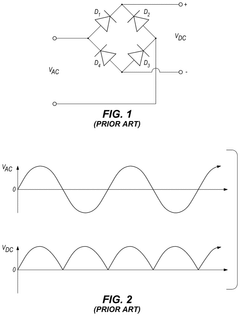
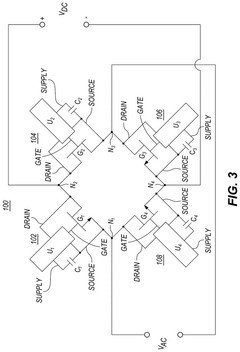
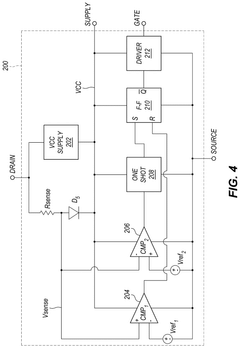
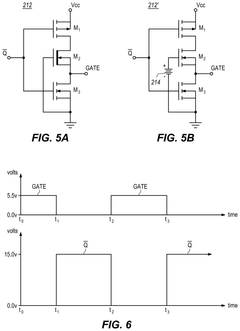
- A synchronous bridge rectifier utilizing planar switching elements, such as gallium nitride (GaN) transistors, with integrated controller circuits that sense voltage and generate drive signals to control the switching elements for efficient rectification.
Power efficient bridge rectifier implemented with switches
PatentActiveUS11258372B2
Innovation
- The use of switching circuits in combination with driving circuits replaces traditional diodes, reducing power dissipation and enhancing the reliability and stability of the bridge rectifier by leveraging low impedance switching circuits and corresponding driving circuits.


Energy Efficiency Standards and Regulatory Requirements
The evolution of bridge rectifier frameworks must align with increasingly stringent energy efficiency standards established by regulatory bodies worldwide. The IEEE 802.3bt standard mandates minimum efficiency requirements of 85% for power over Ethernet applications, while the Energy Star program requires rectifier systems to achieve efficiency levels exceeding 90% under typical operating conditions. These benchmarks directly influence the design parameters for evolutionary bridge rectifier architectures.
International regulatory frameworks such as the IEC 62040 series establish comprehensive guidelines for uninterruptible power systems incorporating bridge rectifiers. The European Union's Ecodesign Directive 2009/125/EC imposes strict energy consumption limits, requiring manufacturers to demonstrate measurable improvements in power conversion efficiency. Similarly, the California Energy Commission's Title 20 regulations set forth mandatory efficiency standards that bridge rectifier frameworks must satisfy to gain market access.
Compliance with electromagnetic compatibility standards presents additional constraints for evolutionary designs. The FCC Part 15 regulations and EN 55022 standards limit electromagnetic interference emissions, necessitating careful consideration of switching frequencies and filtering mechanisms in advanced bridge rectifier topologies. These requirements often conflict with efficiency optimization goals, creating design trade-offs that must be addressed through innovative circuit architectures.
Emerging regulatory trends focus on dynamic efficiency requirements across varying load conditions. The 80 PLUS certification program evaluates power supply efficiency at 20%, 50%, and 100% load levels, pushing bridge rectifier designs toward adaptive control mechanisms. Future regulatory frameworks are expected to incorporate real-time efficiency monitoring and reporting capabilities, driving the need for intelligent rectifier systems with embedded sensing and communication features.
Regional variations in regulatory requirements create additional complexity for global bridge rectifier framework development. The Japanese Top Runner program emphasizes continuous improvement in energy efficiency, while Chinese GB standards focus on power factor correction and harmonic distortion limits. These diverse regulatory landscapes necessitate flexible design approaches that can accommodate multiple compliance requirements simultaneously while maintaining cost-effectiveness and performance optimization.
International regulatory frameworks such as the IEC 62040 series establish comprehensive guidelines for uninterruptible power systems incorporating bridge rectifiers. The European Union's Ecodesign Directive 2009/125/EC imposes strict energy consumption limits, requiring manufacturers to demonstrate measurable improvements in power conversion efficiency. Similarly, the California Energy Commission's Title 20 regulations set forth mandatory efficiency standards that bridge rectifier frameworks must satisfy to gain market access.
Compliance with electromagnetic compatibility standards presents additional constraints for evolutionary designs. The FCC Part 15 regulations and EN 55022 standards limit electromagnetic interference emissions, necessitating careful consideration of switching frequencies and filtering mechanisms in advanced bridge rectifier topologies. These requirements often conflict with efficiency optimization goals, creating design trade-offs that must be addressed through innovative circuit architectures.
Emerging regulatory trends focus on dynamic efficiency requirements across varying load conditions. The 80 PLUS certification program evaluates power supply efficiency at 20%, 50%, and 100% load levels, pushing bridge rectifier designs toward adaptive control mechanisms. Future regulatory frameworks are expected to incorporate real-time efficiency monitoring and reporting capabilities, driving the need for intelligent rectifier systems with embedded sensing and communication features.
Regional variations in regulatory requirements create additional complexity for global bridge rectifier framework development. The Japanese Top Runner program emphasizes continuous improvement in energy efficiency, while Chinese GB standards focus on power factor correction and harmonic distortion limits. These diverse regulatory landscapes necessitate flexible design approaches that can accommodate multiple compliance requirements simultaneously while maintaining cost-effectiveness and performance optimization.
Sustainability Impact of Bridge Rectifier Technologies
The sustainability impact of bridge rectifier technologies represents a critical consideration in modern power electronics development, encompassing environmental, economic, and social dimensions that influence long-term technological adoption and regulatory compliance. As global emphasis on carbon neutrality and circular economy principles intensifies, the environmental footprint of rectification systems has become a primary evaluation criterion for technology selection and implementation strategies.
Energy efficiency stands as the most significant sustainability factor, where advanced bridge rectifier frameworks demonstrate substantial improvements in power conversion efficiency compared to traditional linear regulators. Modern silicon carbide and gallium nitride-based rectifiers achieve efficiency ratings exceeding 95%, translating to reduced energy consumption and lower operational carbon emissions across diverse applications from data centers to electric vehicle charging infrastructure.
Material sustainability considerations encompass the entire lifecycle of bridge rectifier components, from raw material extraction through manufacturing processes to end-of-life disposal and recycling. The transition toward wide-bandgap semiconductors, while offering superior performance characteristics, introduces challenges related to rare earth element sourcing and specialized manufacturing requirements that demand careful environmental impact assessment.
Thermal management improvements inherent in evolved bridge rectifier frameworks contribute significantly to sustainability outcomes through reduced cooling requirements and extended component lifespans. Enhanced thermal efficiency translates to decreased auxiliary power consumption for cooling systems and reduced electronic waste generation due to improved reliability and longevity of rectification systems.
The economic sustainability dimension encompasses total cost of ownership considerations, including initial investment, operational expenses, and maintenance requirements. Advanced bridge rectifier technologies demonstrate favorable long-term economic profiles through reduced energy costs, minimized cooling infrastructure requirements, and extended replacement cycles that collectively support sustainable business operations.
Regulatory compliance with emerging environmental standards, including RoHS directives and energy efficiency mandates, drives the development of sustainable bridge rectifier frameworks that align with global sustainability objectives while maintaining competitive performance characteristics essential for widespread market adoption.
Energy efficiency stands as the most significant sustainability factor, where advanced bridge rectifier frameworks demonstrate substantial improvements in power conversion efficiency compared to traditional linear regulators. Modern silicon carbide and gallium nitride-based rectifiers achieve efficiency ratings exceeding 95%, translating to reduced energy consumption and lower operational carbon emissions across diverse applications from data centers to electric vehicle charging infrastructure.
Material sustainability considerations encompass the entire lifecycle of bridge rectifier components, from raw material extraction through manufacturing processes to end-of-life disposal and recycling. The transition toward wide-bandgap semiconductors, while offering superior performance characteristics, introduces challenges related to rare earth element sourcing and specialized manufacturing requirements that demand careful environmental impact assessment.
Thermal management improvements inherent in evolved bridge rectifier frameworks contribute significantly to sustainability outcomes through reduced cooling requirements and extended component lifespans. Enhanced thermal efficiency translates to decreased auxiliary power consumption for cooling systems and reduced electronic waste generation due to improved reliability and longevity of rectification systems.
The economic sustainability dimension encompasses total cost of ownership considerations, including initial investment, operational expenses, and maintenance requirements. Advanced bridge rectifier technologies demonstrate favorable long-term economic profiles through reduced energy costs, minimized cooling infrastructure requirements, and extended replacement cycles that collectively support sustainable business operations.
Regulatory compliance with emerging environmental standards, including RoHS directives and energy efficiency mandates, drives the development of sustainable bridge rectifier frameworks that align with global sustainability objectives while maintaining competitive performance characteristics essential for widespread market adoption.
Unlock deeper insights with Patsnap Eureka Quick Research — get a full tech report to explore trends and direct your research. Try now!
Generate Your Research Report Instantly with AI Agent
Supercharge your innovation with Patsnap Eureka AI Agent Platform!